ABU DHABI, U.A.E : Sheikh Zayed Book Award names 2026 winners and outlines plans for 20th anniversary

Authors, scholars and institutions from Arab world and beyond honoured as Abu Dhabi prize celebrates two decades of cultural influence.

The 2026 winners of the Sheikh Zayed Book Award were announced on Friday, marking two decades of one of the Arab world’s most influential literary prizes.

Established in 2006 and held under the patronage of President Sheikh Mohamed, the award has grown into a fixture on the region’s cultural calendar, drawing submissions from across the world and supporting the global reach of Arabic literature.

This year’s winners reflect that international scope, with recipients from countries including Egypt, Morocco, Germany and the UAE.

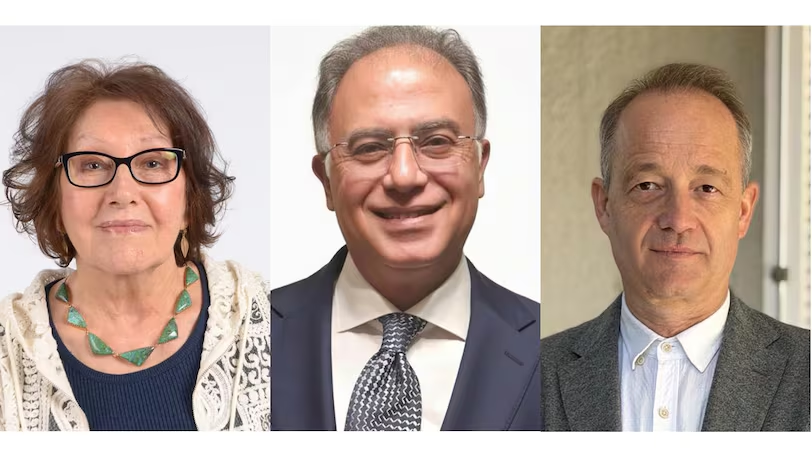
Egyptian writer Ashraf Elashmawy took the Literature prize for his novel Births in the Zoo, a work that explores shifts in Egyptian society through closely observed, character-driven storytelling. Moroccan researcher Mustapha Rajouane won in the Young Author category for a study examining how rhetoric shapes narrative in the modern Arabic novel.

In Translation, Iraqi-American scholar Nawal Nasrallah has been recognised for her English edition of a 13th-century Arabic culinary text, bringing a complex historical manuscript to a wider readership. Jordanian academic Zuhair Tawfiq received the Literary and Art Criticism award for his study of how Arab and western cultures have historically imagined one another.

German writer and translator Stefan Weidner won in the Arab Culture in Other Languages category for a major anthology of pre-Islamic Arabic poetry, while the Emirates Literature Foundation was honoured for its role in developing the UAE’s literary scene and supporting readers and writers.

The Encyclopaedias and Lexicons category went to Egyptian academic Mohamed Elkhosht for his six-volume Encyclopaedia of World Religions, and veteran Egyptian singer Nagat Al Saghira was named Cultural Personality of the Year, recognising a career that has helped shape modern Arabic song and language.

More than 4,000 submissions were received from 74 countries, underlining the award’s growing international profile. Since its launch, it has attracted more than 33,000 entries and honoured 136 winners, including writers, translators and cultural institutions.

Mohamed Khalifa Al Mubarak , chairman of the Department of Culture and Tourism – Abu Dhabi, said the award continues to build on the UAE’s long-standing investment in culture and knowledge, while Ali bin Tamim, secretary general of the award, described it as a platform that has helped shape contemporary Arabic literary and research landscapes.

A programme of events is planned throughout the year to mark the award’s 20th anniversary. Winners will be honoured at a ceremony in Abu Dhabi, with Al Saghira receiving Dh1 million for being Cultural Personality of the Year, and other category winners awarded Dh750,000 each.

source/content: nationalnews.com (headline edited)

____________

From left, Nawal Nasrallah, Ashraf Elashmawy and Stefan Weidner are among the winners of the 20th edition. Photo: Sheikh Zayed Book Award

_____________________________________________

EGYPT / IRAQ / JORDAN / MOROCCO / U.A.E

IRAQI women mourn Sajida Obaid, a singer who gave them a taste of freedom

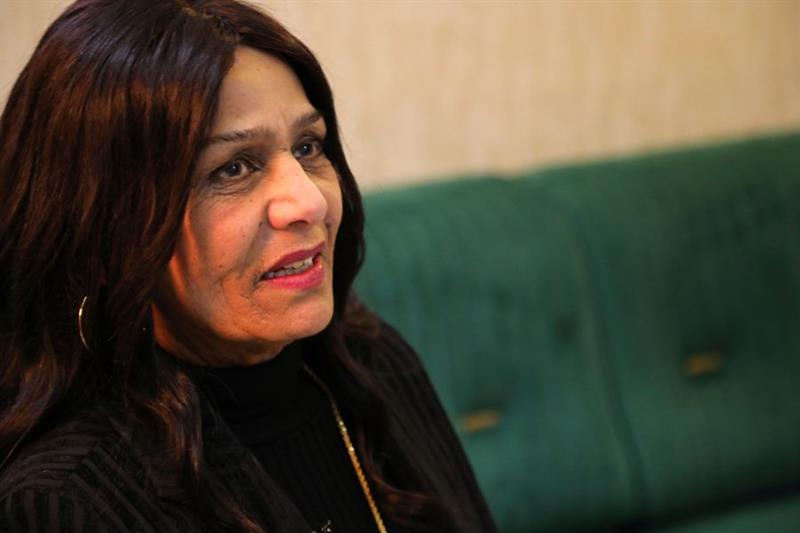
Seven days after the legendary Iraqi singer Sajida Obaid died, women sat wrapped in black veils and abayas, their faces wet at her family home in the northern city of Irbil. Some were family members and others were fans who had loved her for decades.

Bitter black coffee, the drink of Iraqi mourning, passed quietly from hand to hand. The music drifting in from outside filled the spaces between sobs.

Outside, men sat under a canvas tent in the street. A traditional band beat the daf as some of the men wiped their eyes. In Iraq, the seventh day marks a return, a final gathering before grief begins to thin into memory.

Obaid died on April 4 at the age of 68 after a battle with lung cancer. The news was overshadowed by the Iran war that had spilled over into neighboring Iraq. But for her fans, her death felt personal — the loss of a woman whose voice had given them, for a few hours at a time, something close to freedom.

A space for women to let loose

In Iraq, a woman moving through public life carries weight with her; eyes watching what she wears, how she moves, whether she is stepping too far outside the lines. So Obaid decided to hold parties only for women. Every staff member including the DJ, the waiters, the security, and the organizers was a woman. No phones were allowed to prevent photography. To protect the women in the room, their freedom stayed inside those walls.

Women who would never dream of dancing in front of male audience came. They dressed how they wanted and danced the way they had forgotten they could.

Virgin Jaji, 68, was one of them. While the Arab world traditionally begins its mornings with the dreamy songs of the Lebanese singer Fayrouz, Jaji said she has listened to Obaid every morning for years, in the car, at home, even at the gym. “Even my parrot only dances to Sajida Obaid’s music.

“In her women’s parties we danced like we had no cares in the world,” Jaji said, her eyes red from crying. “We felt free. Truly free.”

Mina Mohammed, 40, said, “The first time I heard about a women-only party by Sajida, I borrowed money from friends just to be in that hall. Her voice will always take me back to the best moments of my life.”

A quick rise to stardom

Obaid was born in Baghdad in 1957, the daughter of a Roma family. In Iraq, Roma people are known as “Kawliya,” a community long tied to music and performance, but also one that has lived for generations at the edge of society. Sajida began singing at 12, performing at parties to help her family pay the bills.

By her teenage years she was already a known name. Her voice was warm and commanding, rooted in the dance rhythms of the Kawliya and in the older, more tender Iraqi style known as mawal. By the 1980s, it had reached the most powerful and most dangerous men in Iraq.

Saddam Hussein’s security guards would pull her away mid-performance from other people’s weddings and bring her to sing. She performed at the weddings of Saddam’s children and at birthday parties for his sons and daughters. It was the complicated price of being a national star in an era of dictatorship. She traveled the world, performed at international festivals and sometimes played as many as seven shows a week.

Shrinking space for Iraqi women

But the women-only parties were always special to her, said her brother and manager, Aayed Awda.

“Those parties were something the women themselves asked for, including women from the most conservative families, because they wanted a place where they could dress freely, move freely, be themselves,” he said. “Sajida believed deeply in helping women and giving them that space.”

Obaid’s songs sometimes pushed social boundaries, like “Inkasarat al-Sheesha” (“the shisha broke”), about a woman who has lost her virginity and must now face her family. “What will I tell my mother?” the lyrics ask. In Iraq, that is not a light question. Obaid sang it with a full voice, without apology.

Many Iraqi women feel that the gains they had made in rights over the years are receding. Last year, Iraqi Parliament passed amendments to the country’s personal status law that opponents say would in effect legalize child marriage and erode women’s rights in matters like divorce and inheritance.

“Iraq feels like it’s moving backward, and the space for women’s freedom is shrinking,” said Mohammed, the fan who borrowed money to attend Obaid’s parties. She hopes that the carefree moments they brought can “be carried forward, even in small ways, like women-only DJ nights with her music.”

A quiet end

In her final months, the woman who had sung on stages across five continents lived quietly in Irbil, in the home of her elder brother’s family. She had no children. She had married twice and divorced twice. She rarely went out. She spent her days close to the people she loved and played with the children in the house.

“She was gentle and warm, and she never once caused harm to anyone,” said her niece Sahar Sabti, 38, who shared the home with her. “She took care of everyone around her.”

About four months before Obaid died, doctors found lung cancer, Sabti said. She still insisted on flying to Canada for a concert. But when she came home to receive her first chemo session, her body gave up.

She was hospitalized in Irbil, where she remained for more than two weeks before being sent home on oxygen. Her family took her to the hospital once more, and this time she didn’t come home.

Her brother recalled the 40 years they worked together, and their sibling bickering about the shade of her makeup, the cut and color of her dress, the theme of the next party.

“We disagreed on everything,” Awda said, his voice breaking. “And I miss every single one of those arguments.”

On the seventh day of mourning, as the drum outside finally fell silent and the women inside dried their faces, they spoke about Obaid the way people speak about someone who has stepped out of the room for a moment.

“For me and my friends, dancing and Sajida are the same word,” said Leila Botrus, 55. “She brought people together everywhere she went through joy, through music.”

Outside in the tent, the band played its last song of the evening. The coffee in the cups grew cold, but the women stayed a little longer together.

In that room, filled with women sitting close together, it felt as though Sajida had left behind exactly what she always gave them; a space of their own.

source/content: english.ahram.org.eg (headline edited)

_____________

photo AP

________

IRAQ

IRAQ : As he takes office as UNHCR chief, Iraq’s Barham Salih tells of refugee experience

A former Iraqi president, Barham Salih, 65, at the start of the year became the first former head of state to run the UNHCR.

Barham Salih has known torture and the wrenching loss of exile. Four decades after his own ordeal, he has taken the helm of the UN refugee agency as it grapples with a funding shortfall and ever-rising needs.

A former Iraqi president, Salih, 65, at the start of the year became the first former head of state to run the United Nations High Commission for Refugees (UNHCR).

“It is a profound moral and legal responsibility,” Salih said during his first trip in the new role, to Kakuma refugee camp in Kenya.

“I know the pain of losing a home, losing your friends,” he said.

The Kakuma refugee camp, which Salih visited on Sunday, is east Africa’s second largest, hosting roughly 300,000 people from South Sudan, Somalia, Uganda and Burundi. It has been in place since 1992.

The world “should not allow this to continue”, Salih said, praising a new initiative by Kenya to turn its camps into economic hubs.

“We should not only protect refugees … but also enable them to have more durable solutions,” he said, while adding, “The better way is to have peace established in their own countries … nowhere is nicer than home.”

The son of a judge and a women’s rights activist, Salih was born in 1960 in Sulaymaniyah, a stronghold of the Patriotic Union of Kurdistan (PUK), which sought self-determination for Iraq’s Kurds.

He went into exile in Iran in 1974, spending a year at a school for refugees. As a teenager in 1979, back in Iraq and already a member of the PUK, he was arrested twice by former President Saddam Hussein’s regime.

“I was released after 43 days after having suffered torture, electric shocks, beating,” he said.

Upon release, he still managed to rank among Iraq’s top three high school students, according to a former colleague, before fleeing with his family to Britain where he earned a degree in computer engineering and a doctorate.

Salih has “real experience of exile … He brings a personal perspective of displacement, which is very important,” Filippo Grandi, his predecessor at UNHCR, said last month.

Salih went on to a successful career in Iraqi Kurdistan and Iraq’s federal government after Saddam Hussein’s overthrow in 2003, holding the largely ceremonial role of president from 2018 to 2022.

Refugee numbers have doubled to 117 million in the past decade, the UNHCR said in June, but funding has dropped sharply, especially since Donald Trump returned to the White House.

UN Secretary-General Antonio Guterres recently praised Salih’s experience as a “crisis negotiator and architect of national reforms” at a time when the agency faces “very serious challenges”.

“We have had very serious budget cuts last year. A lot of staff have been reduced,” Salih said.

“But we have to understand, we have to adapt,” he said, calling for “more efficiency and accountability” while also insisting the international community meets its “legal and moral obligations to help”.

source/content: thearabweekly.com (headline edited)

_____________

A file picture shows then-Iraqi President Barham Salih at the Rome Mediterranean summit MED 2018 in Rome, Italy November 22, 2018.

__________

IRAQ

IRAQ-KURDISTAN : First Gene/Seed Bank in Kurdistan Region to Preserve Iraq’s Agricultural Heritage

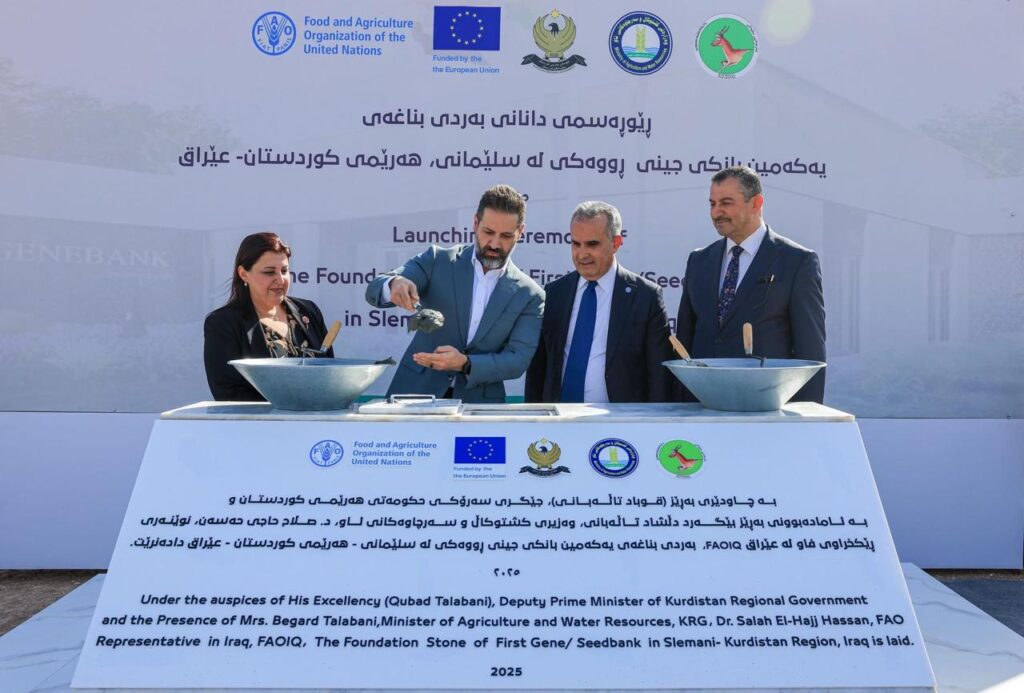
Under the auspices of H.E. Mr. Qubad Talabani, Deputy Prime Minister of the Kurdistan Regional Government, Iraq marked a major step toward safeguarding its agricultural heritage and enhancing its food security with the laying of the foundation stone for the first-ever Gene/Seed Bank in the Region.

The facility, located in Hawari Shar Park in Sulaymaniyah, is funded by the European Union (EU) and implemented by the Food and Agriculture Organization of the United Nations (FAO), in collaboration with the Federal and Regional Governments as part of the  “Restoration and Strengthening the Resilience of Agri-Food Systems in Iraq” project. The facility will enable the preservation of plant genetic diversity, enhance food security, and build resilience against climate change.

The event was inaugurated by H.E. Deputy Prime Minister of the Kurdistan Regional Government, Mr. Qubad Talabani; H.E. Minister of Agriculture and Water Resources, Ms. Begard Talabani; the Governor of Sulaymaniyah, Dr. Haval Abubakir; the Mayor of Sulaymaniyah, Ms. Leyla Omar Ali; the FAO Representative in Iraq, Mr. Salah El Hajj Hassan; along with a number of senior representatives from  academic and agricultural institutions.

H.E. Mr Qubad Talabani, Deputy Prime Minister, emphasised the importance of this initiative, saying: ‘The gene bank is an investment for the future; it protects our past and secures our future.’

The Gene/Seed bank is a strategic facility for conserving Iraq’s rich plant genetic diversity, which includes over 3,500 plant species originating from the ancient civilizations that once flourished in Iraq—the cradle of civilization. These species hold scientific, historical, and human value across the region and globally. The facility will enable the conservation of rare plant genetic resources, including wild varieties of grains, vegetables, and indigenous crops. It will also strengthen Iraq’s capacity to conserve seeds and make use of valuable genetic traits—such as drought tolerance—from wild species to support the development of more climate-resilient crops.

In her remarks, H.E. Minister Begard Talabani stated: “This initiative represents a strategic milestone in the journey of developing the agricultural sector by protecting plant diversity and supporting scientific research. It will enable farmers to benefit from our historical plant heritage and will allow us to preserve our agricultural legacy for future generations.”

FAO Representative in Iraq, Mr. Salah El Hajj Hassan, expressed his sincere appreciation to FAO’s national partners in the federal government and the Kurdistan Regional Government for their close collaboration and support. He also acknowledged and thanked the European Union for funding this initiative under the scope of the  “Restoration and Strengthening the Resilience of Agri-Food Systems in Iraq,” project,  which also reflects the follow-up to the recommendations resulting from  the FAO Director-General visit to Iraq and his meetings with senior officials. He added that this facility represents a center for scientific innovation in research and resilience-building. It enables the preservation of Iraq’s historical, environmental and agricultural heritage, ensures that future generations can benefit from it, and stands as a testament to FAO’s commitment to transforming Iraq’s agricultural legacy into a powerful tool for sustainable development.”

The gene bank will house modern storage vaults, laboratories, research and training facilities, and seed data documentation and conservation areas. Future expansion is anticipated to include a field gene bank, a tissue culture laboratory, and a cryobank.

The initiative directly contributes to the Sustainable Development Goals (SDGs), particularly SDG 2: Zero Hunger and SDG 13: Climate Action, by investing in biodiversity conservation and climate-resilient agriculture.

source/content: fao.org – FAO of the UN (headline edited)

______________

______________________

IRAQ / KURDISTAN

IRAQ / DUBAI, U.A.E : Aisha Nizar Nazim crowned champion of the ’09th Arab Reading Challenge’ in Iraq

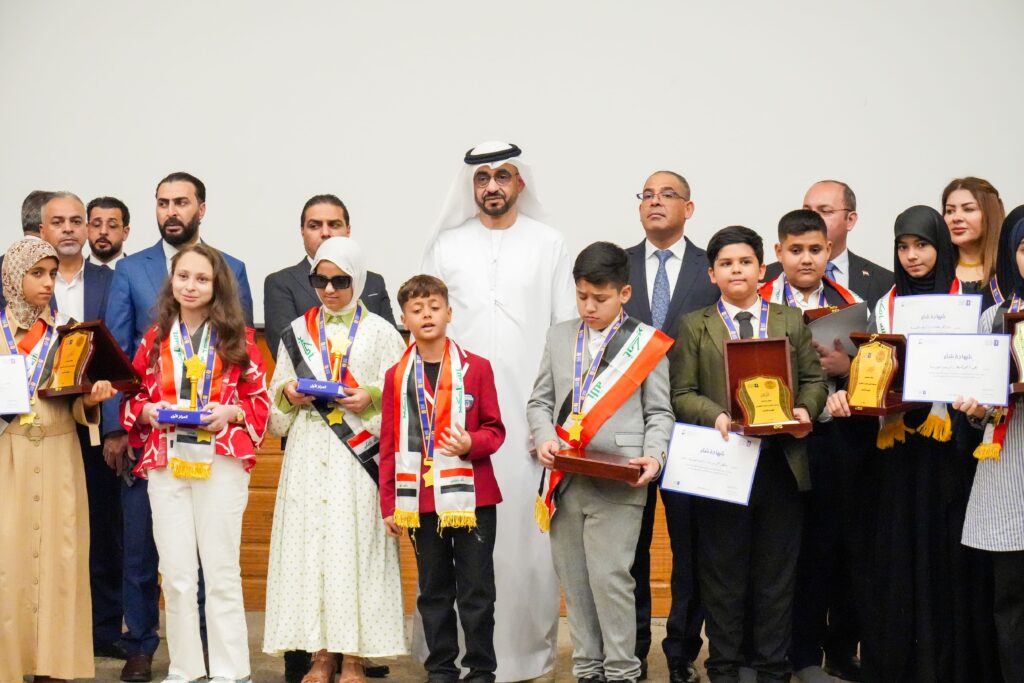
 Student Aisha Nizar Nazim won the title of champion of the ninth edition of the Arab Reading Challenge in Iraq, after qualifiers in which 1,339,270 students from 38,100 schools participated, under the supervision of 16,310 supervisors, who contributed to the success of the ninth edition of the largest reading event of its kind in the Arabic language in the world, organized by the Mohammed bin Rashid Al Maktoum Global Initiatives Foundation since its launch in 2015.

Student Aisha Nizar Nazim, a seventh-grade student at Zaha Hadid School for Excellence in Nineveh, was announced as the winner during the closing ceremony of the ninth edition of the Arab Reading Challenge, which was held in the Iraqi capital, Baghdad, in the presence of His Excellency Dr. Ibrahim Namis Al-Jabouri, Minister of Education; Dr. Adnan Al-Sarraj, Advisor to the Prime Minister for Education Affairs; Mohammed Dayea Al-Azzawi, Undersecretary of the Ministry of Education for Administrative Affairs and Chairman of the Higher Committee; and Mr. Mohammed Saleh Al-Taniji, Acting Charge d’Affaires.

At the UAE Embassy in Baghdad, Dr. Fawzan Al Khalidi, Director of Programs and Initiatives at the Mohammed bin Rashid Al Maktoum Global Initiatives Foundation, participated, along with a number of officials and educators in charge of the Arab Reading Challenge initiative, and a large crowd of parents of the participating students.


The closing ceremony also witnessed the announcement of Maria Hassan Ajeel, a fifth-grade student at Al Fara’a Girls School in the Salah al-Din district, as the winner of first place in the People of Determination category, out of 450 students who participated in the qualifiers

The list of the top ten finalists from which the judging committees selected student Aisha Nizar Nazim as the champion of the ninth Arab Reading Challenge at the level of the Republic of Iraq, included: Muntadhar Ahmed Mardan from the fifth grade at Al-Insaf School in the Karbala region, Akram Khalil Abdullah from the tenth grade at Al-Dhakirin Intermediate School (Kirkuk), Fatima Muhammad Abdul-Amir from the eleventh grade at Shams Al-Hurriyah Preparatory School (Najaf), Yusr Hamza Farhan from the eleventh grade at Al-Nabaa Al-Azim Secondary School (Qadisiyah), Rawan Muntadhar Mansour from the tenth grade at Haifa Intermediate School for Girls (Babylon), Hadi Hassan Hadi from the eleventh grade at Al-Nahrawan School for Boys (Rusafa 3), Aya Ziad Subhi from the eleventh grade at Al-Rafidain School (Kirkuk), Hussein Ali Ahmed from the tenth grade at Al-Dhakirin School (Kirkuk), and Haider Ali Abdul-Aziz from the seventh grade at Al-Muhwebin School (Najaf).

The ninth edition of the Arab Reading Challenge initiative achieved a record participation of 32 million and 231 thousand students from 50 countries representing 132,112 schools, under the supervision of 161,004 supervisors.
His Excellency Professor Ibrahim Namis Al-Jabouri, Minister of Education of the Republic of Iraq, praised the vital role played by the Mohammed bin Rashid Al Maktoum Global Initiatives Foundation in empowering new Arab generations to acquire the knowledge, sciences, and skills necessary to build the future. He pointed to the successive successes achieved by the Arab Reading Challenge initiative in this context, and its tangible impact in spreading the culture of reading and developing the potential of Arab students.

He said: “We are proud of this new participation in the Arab Reading Challenge initiative. 133,920 students, through their interaction with this knowledge competition and their outstanding performance, have proven the development of the educational and cultural landscape in Iraq and the effectiveness of the plans put in place by the Ministry of Education to advance students’ levels and enhance the status of the Arabic language, in line with our rich cultural heritage and the creativity of the people of Iraq in various fields, thus strengthening our confidence in a brighter tomorrow for our country and the Arab nation.

 Dr. Ibrahim Al-Jubouri extended his congratulations to student Aisha Nizar Nazim, all the winners, participating students and their families, as well as to the schools and educational staff across Iraq. He extended his thanks to the Mohammed bin  Rashid Al Maktoum Global Initiatives Foundation and everyone who contributed to the success of the ninth round’s qualifiers.

Dr. Fawzan Al Khalidi affirmed that the Arab Reading Challenge initiative continues to fulfill its mission of spreading the culture of knowledge, providing the means for rising Arab generations to enhance their capabilities, hone their talents, and strengthen their connection to the Arabic language, thus providing them with the visions and tools necessary to revive Arab civilization and contribute effectively to the development of Arab societies.

The Director of Programs and Initiatives at the Mohammed bin Rashid Al Maktoum Global Initiatives Foundation praised the wide Iraqi participation in the qualifying rounds of the ninth edition of the Arab Reading Challenge, saying: “We greatly appreciate the participation of more than 1.3 million students in the ninth edition, which reflects the great efforts made by the Ministry of Education in the sisterly Republic of Iraq, and those concerned with cultural affairs and Iraqi society to motivate students to read. These efforts represented a significant contribution to the achievement of the ninth edition, in which more than 32.2 million students from 50 countries around the world participated.”


On behalf of the Mohammed bin Rashid Al Maktoum Global Initiatives Foundation and the Arab Reading Challenge, Dr. Fawzan Al Khalidi congratulated the ninth edition’s champions in Iraq and all the participants. He also thanked the Iraqi Ministry of Education and everyone who helped the students advance to the ninth edition’s qualifying rounds.

The Arab Reading Challenge, launched in the 2015-2016 academic year under the directives of His Highness Sheikh Mohammed bin Rashid Al Maktoum, Vice President and Prime Minister of the UAE and Ruler of Dubai, aims to foster a  comprehensive reading and knowledge movement, instill a culture of reading in Arabic as a language capable of keeping pace with all forms of literature, science, and knowledge, and encourage young generations to use Arabic in their daily interactions. It also aims to develop mechanisms for understanding and self-expression in fluent Arabic, and foster creative thinking skills.

The challenge seeks to enhance the importance of cognitive reading in building self-learning skills and fostering a value system for young people by exposing them to the values, customs, and beliefs of other cultures. This instills the principles of tolerance, coexistence, and acceptance of others, and encourages dialogue and cultural and human openness.

source/content: wam.ae (headline edited)

_____________

__________________________________________________

IRAQ / DUBAI, UNITED ARAB EMIRATES (U.A.E)

IRAQ : Sayyed Nehma Al-Fahham: Carving legacy in Iraq’s ancient Kufa alleys

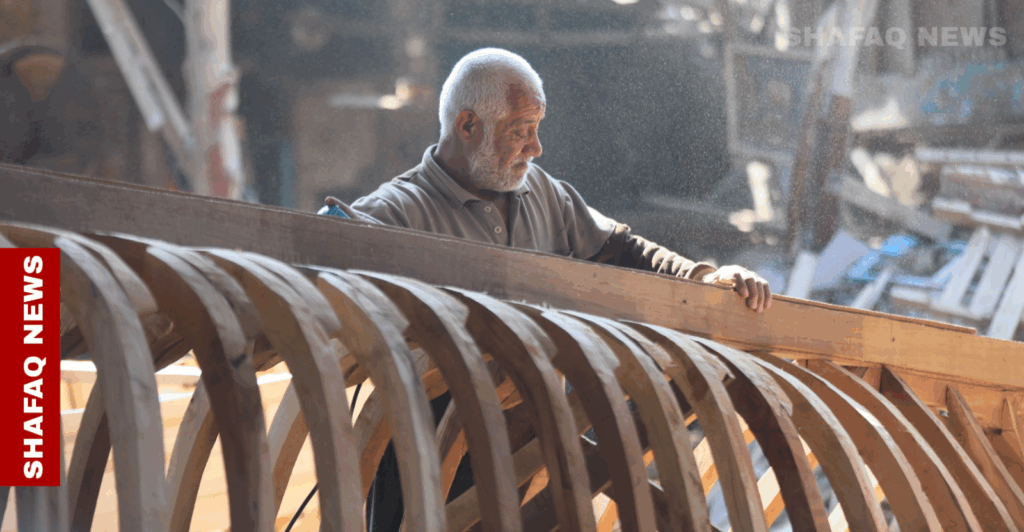
In the heart of ancient Kufa, where Iraqi tradition clings to the air like the scent of sawdust, one man stands against the tide of time.

Sayyed Nehma Hassan al-Fahham, better known as Abu Karrar, has turned a fading heritage into a living legacy, handcrafting wooden boats just as his father and grandfather did before him.

At over sixty, Abu Karrar moves with the ease of a man half his age, weaving between planks and tools in his modest workshop, tucked within the old city’s narrow, echoing streets.

Here, with calloused hands and steady resolve, he breathes life into vessels that glide through Iraq’s rivers and marshes—from the southern waters of Basra to the far edges of Tharthar.

Boats Born of Tradition

“We build for fishermen—and sometimes for fun,” he says with a quiet smile, gesturing toward a half-finished bellem tayara (fast boat), a large craft that takes over a month of meticulous work.

Each boat tells a different story: the Kad, Rika, Kad Abu al-Gharafa, and Kad Karufi serve different needs, while the smaller Jalaka, perfect for shallow waters, can be built in just a week. Prices stretch from 500,000 ($379.85) to 7 million dinars ($5,317.96), with specialized sea-going boats like the Maheela fetching up to 25 million ($18,992.73).

Blending Old Soul with New Strength

Abu Karrar’s tools may look old-fashioned, but his methods are a careful blend of past and present. He still uses traditional woods—jam, sidr, touth, and imported jawy—but the tar once used to seal hulls has given way to fiberglass, boosting durability and streamlining the process.

“We adapt where we need to,” he said, “but the spirit of the craft stays the same.”

Kufa’s Boats, Iraq’s Waters

What starts in Kufa doesn’t stay there. His boats travel—shipped to Basra, Maysan, Al-Nasiriyah, Al-Diwaniyah, Al-Kut, and beyond.

“We source wood locally or import it, depending on the order,” he explained. “Six-arm length, seven-arm, whatever the customer wants—we make it.”

Despite the pressures of modernization and faster transport, Abu Karrar and his brothers keep the flame of this ancient trade burning. Their boats aren’t just vessels—they’re floating memories, carved in wood, and launched into Iraq’s living waters.

source/content: shafaq.com (headline edited)

___________

__________

IRAQ

IRAQ : Actress Awatef Naeem Receives Award at Eazees International Women’s Theatre Festival

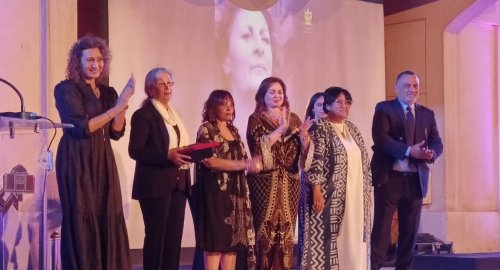
The activities of the International Eazees International Women’s Theatre Festival have kicked off in the Egyptian capital, Cairo, with Arab and international participation.
 
‘The festival organizers announced the honoring of the esteemed Iraqi artist Awatef Naeem, within its second edition, which is being held from May 16 to 22 in Cairo, as reported by the Iraqi News Agency-INA.
 
“Actress Awatif Naim is one of the most prominent stars in the Arab world,” festival chairwoman Abeer Lotfi told the Iraqi News Agency (INA), noting that “Naim’s talent did not limit her to a specific role, but unleashed her to fly in the sky of art through acting, writing, directing and scientific research, which reflects the ability of women and their ability to prove themselves in difficult fields that require great effort.”
 
She pointed out that “the artist is scheduled to be honored for the play “I am my face”, which was written and directed by her, and co-starring artists and artists (Shatha Salem, Samar Mohammed, Shaima Jaafar and Ali Al-Sudani),” explaining that “the events of the play revolve around three women who embody the suffering that women endure in family, social and political life, to reach their essence and their true face.”
 
It’s to be mentioned, Awatif Naim, an Iraqi actress, director and academic researcher, was born in 1949. She obtained a doctorate in theater directing, and began her artistic career by writing and directing many programs and series for Iraqi radio and television, in parallel with her work in the field of criticism and academic research in theater, and she is a founding member of the Theater Critics Association in Iraq.


She was awarded the French Order of Arts and Letters in 2022 by the French Ministry of Culture. She founded the Children’s Theater Department at the Department of Cinema and Theater in 1996 and held its first festival in 2002.

source/content: ina.iq (headline edited)

_____________

________

IRAQ

SAUDI ARABIA: Winners of 09th Iqra competition from Iraq, Morocco and Saudi were crowned in Dhahran

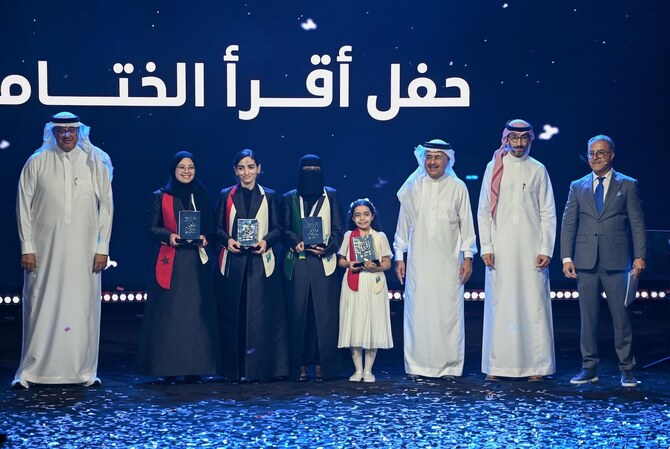
Boasting an attendance of 16,000 people, including Nobel laureates in literature, the King Abdulaziz Center for World Culture concluded its ninth annual Iqra competition on Saturday.

Amin Nasser, Saudi Aramco’s president and CEO, and other senior officials attended the two-day event in Dhahran.

Nobel literature laureates Abdulrazak Gurnah and Olga Tokarczuk were also present and offered insights during speaking sessions.

Visitors experienced a series of activities, culminating in the announcement of the competition’s winners.

Moroccan Meryem Bououd was awarded Reader of the Year, while 10-year-old Moroccan Fatima Kettani won the Promising Reader prize.

Iraqi Hira Karkhi secured the Text of the Year prize, while the Reading School award went to Tarbiyat Al-Ajial of the Private International School, Hafr Al-Batin, Saudi Arabia.

Saudi Safia Al-Ghubari claimed the People’s Reader award, while teacher Najla Ghazi Al-Suhaimi took home the Reading Ambassador prize.

Noura Al-Zamil, Ithra’s program director, spoke of the competition’s significant milestones since its inception in 2013.

Over nine editions Iqra has attracted more than 225,000 applicants and offered 48,000 hours of educational programming.

It has also engaged more than 600 speakers from 30 countries, bringing three Nobel Prize-winning authors to its stage.

Al-Zamil stressed Ithra’s continued efforts to innovate, introducing new elements like the Iqra Travels, Iqra Marathon, and Kitabiya Exhibit, to foster a reading culture among Arab youngsters.

The closing event featured cultural sessions, including a talk by Tokarczuk, who discussed literature as a tool for bridging languages and cultures.

Discussing the future, Tokarczuk expressed both optimism and caution, adding: “I embrace modern tools like ChatGPT but remain concerned about their potential misuse.”

Gurnah, reflecting on his roots, said: “Zanzibar will always be my true homeland, despite my long absence.”

source/content: arabnews.com (headline edited)

_____________

Boasting an attendance of 16,000 people, the King Abdulaziz Center for World Culture concluded its ninth annual Iqra competition on Saturday. (Supplied)

_____________________________________

IRAQ / MOROCCO / SAUDI ARABIA

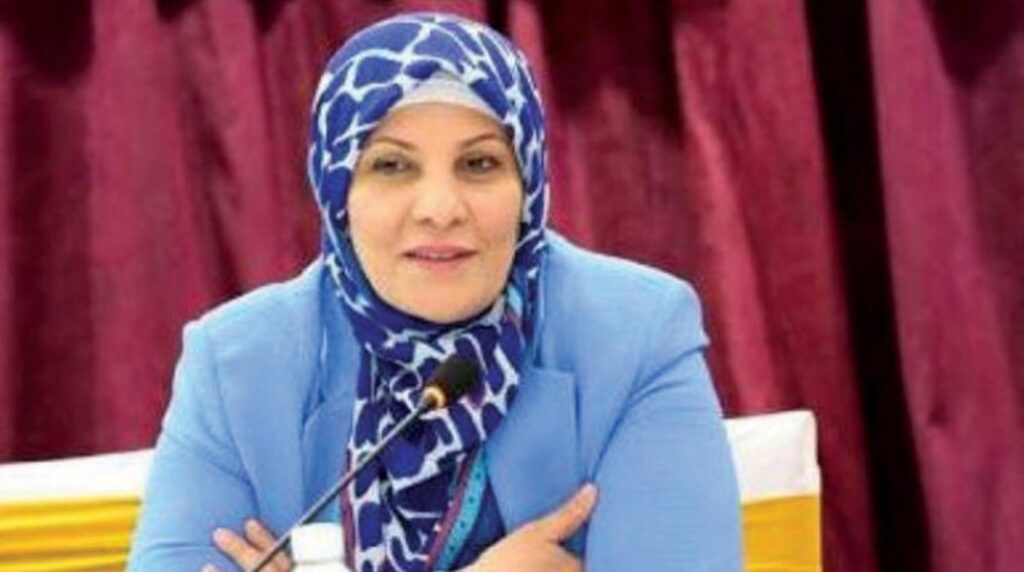
IRAQ: Dr. Azhar Hussein Saleh, First Iraqi Woman to receive the ‘Arab Woman of Excellence Award’. Only Woman in Arab Region to Head a Syndicate of Engineers.

Dr. Azhar Hussein Saleh, Undersecretary of the Ministry of Planning and the head of Syndicate of Iraqi Engineers, received the Arab Woman of Excellence Award in the field of public service.

In an interview she gave to the Iraqi News Agency, Dr. Saleh said that she received this award, the first Iraqi woman to do so, as the only woman in the Arab region to head a syndicate of engineers, in addition to her other accomplishments. She added that she did not receive the award in person in light of the current circumstances. A ceremony that would allow her to officially receive it from Arab League will be held in Tunis early next year as part of Arab Women Week.

She goes on to say: “This major award is considered among the most prestigious honoring Arab women.” She then emphasizes that she will continue to move along the same path and work to keep pace with technological development, in order to help her country grow and prosper.

Dr. Saleh then explained that this award honors the distinguished role Iraqi women play in the development and construction of Iraq despite the difficult circumstances.

Dr. Saleh holds a Ph.D. in engineering and has held many high-ranking administrative positions; before being an Undersecretary, she had been the General Director of the General Government Contracts Department and Director General of Sector Planning Department at the Ministry of Planning. She also represents Iraq in the World Federation of Engineering Organizations, and has many academic and social achievements to her name.

source/content: english.aawsat.com (headline edited)

_____________

Dr. Azhar Hussein Saleh

_________

IRAQ

IRAQI AMERICAN – Miss Arab USA 2024 Zenovia Jafar talks pageant experience and aspirations

Iraqi American Zenovia Jafar was over the moon for “having made it” as she was crowned winner of the Miss Arab USA 2024 pageant in Arizona on Sunday.

“My experience with Miss Arab USA is one of the best experiences of my life. When I walked in, I had no idea what was going to happen, if I was even going to win. But most importantly, when I walked in, I will honestly say that winning was the only thing on my mind. I didn’t think about anything else,” Jafar told Arab News in an interview.

“But once I actually got there, I realized the friendships and the connections I’ve made with the people here is priceless and it is far more important than winning … I genuinely wanted to connect with every single person that I met, and I think that’s what helped me win Miss Arab USA. Because I focused more on genuine connection and doing what I need to do. And I was committed to just being myself,” she added.

When asked about her goals going forward, the Michigan resident said: “I’m going to be using my platform to raise awareness on issues regarding people who are … from underdeveloped communities, people who are in need. I’m going to be raising more money for charities. I’m here to serve Miss Arab USA and use my voice to amplify the voices of people who are not heard all over the world.”

Jafar’s family moved to the US — having escaped the war in Iraq and spent two years in Syria after — in the late 90s, when she was a toddler.

“When I moved here, I remember one thing that my mother told us is that we should never forget our roots and where we come from. My mother was committed to teaching us how to read and write and speak Arabic. And that is something that I am so grateful to my mother for because I can read Arabic, I can write Arabic, I can speak Arabic, I can understand many Arabic dialects. And I never let go of who I was and where my family came from. And I think that’s something that is so important when you grow up away from home, is to stay connected to who you are. Because at the end of the day, all you have is your roots,” she said.

When asked if she had any advice for young Arab American women, Jafar said: “I will say that as an Arab woman, it is very, very important to push your limits and always do things outside of your comfort zone because you will never grow as a person if you are stuck in your comfort zone. Always push yourself to be better.”

source/content: arabnews.com (headline edited)

________________

Iraqi American Zenovia Jafar (centre) was over the moon for “having made it” as she was crowned winner of the Miss Arab USA 2024 pageant in Arizona on Sunday. (Supplied)

_____________________

AMERICAN / IRAQI