Arabs & Arabian Records Aggregator. Chronicler. Milestones of the 25 Countries of the Arabic Speaking World (official / co-official). AGCC. MENA. Global. Ist's to Top 10's. Records. Read & Enjoy./ www.arabianrecords.org
Somalia’s football story this week has extended beyond the headlines surrounding World Cup refereeing to a landmark moment for the country’s women’s game.
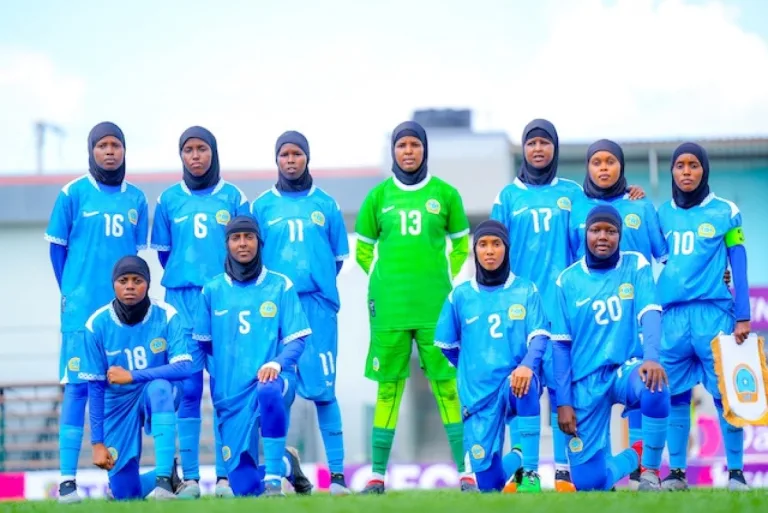
While attention has focused on Somali referee Omar Artan and reports that he was unable to travel to the United States to officiate at a FIFA tournament — a missed opportunity that would have marked a first World Cup finals involvement for Somalia — the country’s women’s Under-17 team has quietly made history of its own.
Competing at the CECAFA Women’s U-17 Championship in Dar es Salaam, Tanzania, Somalia fielded its first-ever women’s team in an international football competition.
Although the side exited at the group stage, their final match delivered a series of milestones that marked a significant moment for football development in the country.
Somalia recorded the biggest victory in the nation’s football history with an 8–2 win over Sudan and celebrated the first international hat-trick scored by a Somali player in a debut tournament appearance.
Sundus Mohamed scored twice, including Somalia’s first-ever goal in women’s international tournament football, while Najmo Mohamed claimed a hat-trick. Captain Halimo Isse, Maryan Osoble and Hibo Salad also found the net.
Shortly after the match, Somali Football Federation president Ali Abdi Mohamed called the squad to congratulate the players and coaching staff.
“You did well and I was sure you can,” he told the team, while praising captain Halimo Isse for her leadership throughout the tournament.
Reflecting on the wider significance of the team’s debut, Mohamed described the performance as an encouraging sign for the future of women’s football in Somalia.
“Somalia is a developing nation recovering from decades of civil war and we are very new to the women’s football environment, but we are improving,” he said.
“If our first international appearance was such a positive experience, I am sure we are developing and we will do much better in the months and years to come.”
Mohamed also acknowledged support from international football bodies.
“I would like to thank FIFA and CAF for their constant financial assistance, education and guidance. Without them we could not have achieved such progress,” he said.
He added that the federation plans to continue investing in the women’s game.
“We have spent significant time, money and energy on women’s football and I am fully committed to increasing our investment. Our women and girls are doing an excellent job and I am very proud of them.”
Somalia’s participation in the tournament has extended beyond the playing squad. Two Somali female match officials — referee Fadumo Mohamed Nor and assistant referee Iqara Ali Ahmed — remain in Tanzania after continuing to receive appointments during the competition.
The Task of the Translator Research Lab, developed and facilitated by artist and editor Sarasija Subramanian, runs until Aug. 30
Brings participants together for collective reading, watching and listening sessions, alongside exercises exploring language, accessibility, subjectivity and the idea of the original
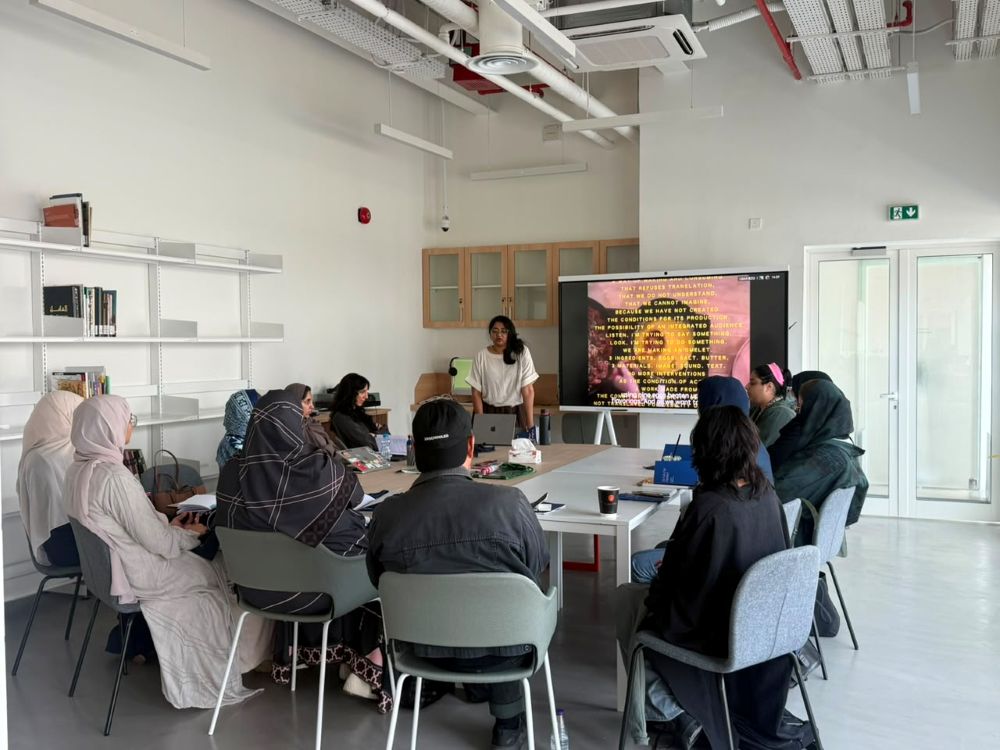
A research lab at Jameel Library is inviting people to take a broader view of translation — as a way of moving between languages, images, sounds, experiences and different forms of knowledge.
The Task of the Translator Research Lab, developed and facilitated by artist and editor Sarasija Subramanian, runs until Aug. 30. It brings participants together for collective reading, watching and listening sessions, alongside exercises exploring language, accessibility, subjectivity and the idea of the “original.”
“The starting point for us was the idea of translation as something much bigger than moving from one language to another,” said Khaled Al-Qahtani, library and research coordinator at Jameel Library.
“We are constantly translating between languages, but also between images and words, between what we see and what someone else might experience, between different ways of knowing and understanding.”
The week-long program explores what happens when an image is described for someone who cannot see it, when sound is translated into words, or when an experience is communicated through another form.
Al-Qahtani said: “We wanted the lab to create a space where we could slow down and actually examine those processes. What happens when you describe an image for someone who cannot see it? What happens when you translate sound into words, or an experience into another form? What is gained, what is lost, and what kinds of new meanings can emerge?”
For Subramanian, the project comes from her interest in “expanded translation,” a concept that considers movement between mediums as translation.
“The lab comes from my own interest as an artist and editor in the field of expanded translation, where translation is not only about moving from one language to another, but also thinking of information and ideas moving from one medium to another,” she said.
Subramanian works with drawing and tracing as forms of translating images, while her publishing house, Reliable Copy, works with artists to translate their ideas and research into books.
“The primary drive of the lab is to be able to consider these kinds of shifts between mediums as translation, and consequently to question translation’s need to be faithful to the ‘original’, and to rethink the mandate that we must be objective and impersonal during the process,” she said.
The lab also examines accessibility through tools including alt-text, audio descriptions and closed captions.
Subramanian said such tools were often viewed as additional accommodations for visually impaired audiences but could also encourage people with sight to look more closely.
“When we write alt-text for a painting, or audio-descriptions for a film, we see the image or the video through a very different point of view, which reveals to us details and nuances that we would otherwise overlook,” she said.
She compared translating an image to translating a text from English into Arabic, where every word, punctuation mark and piece of context must be considered.
“It is the same with an image, or a video,” she said, adding: “As such, the lab as a whole is to look at material we encounter on a daily basis closely, and rethink the ways in which we communicate and share.”
Subramanian said this approach also challenges the idea of a single, fixed interpretation, allowing different perspectives to become part of the process: “The question then, or the task, is to be able to use these subjectivities as a tool and an aid, instead of seeing them as inherently wrong.”
For Al-Qahtani, Jameel Library was a natural setting for the project because libraries already bring together different languages, histories and forms of knowledge.
“Libraries are already spaces of translation in a way,” he said.
The project, he added, sought to make the library more than a place for presenting research, turning it into a space where research could unfold collectively through experimentation, conversation and making.
Accessibility also requires cultural institutions to question assumptions about how audiences are expected to look, listen, read or participate.
“We often design cultural experiences around an assumed audience and an assumed way of looking, listening, reading or participating,” Al-Qahtani said. “Accessibility asks us to question those assumptions.
“For me, accessibility is not something that should come at the end of a process, as an additional service or adjustment. It can actually change the way we think about the work from the beginning.”
Guest lecturer Sara H. Hammami, a librarian, book artist and poet, sees translation as closely connected to culture and human connection.
She said translation could create movement toward understanding, curiosity and respect, but that this required openness from everyone in a multilingual environment.
“In any multilingual space this requires a curiosity regardless of the language one is starting in/moving towards it must be reciprocated by everybody for the kind of fluidity and warmth that can be brought forward from a space of translation,” she said.
Her work across libraries and translation has also shaped her view of accessibility. Cultural institutions, she said, have a responsibility to make audiences feel welcome: “The more people are given the opportunity and chance to attend and participate in these conversations and spaces, the stronger and more imaginative we become as a cultural landscape,” Hammami said.
In Saudi Arabia, she sees language equity as an important starting point.
“I feel language equity in a multilingual space is one of the first and most accessible ways to start building accessibility for our public,” she said. “I wonder what it might do for us and our language if we were to enter more cultural landscapes and find materials not only in Arabic, English, or French, but also in Tagalog, Urdu, or Bengali. I imagine a future in which everyone feels invited to these spaces and moments.”
Artist Park McArthur also approaches translation through questions of access, language and power.
“Translation and access could be shared phenomenon known by different names,” McArthur said, adding that stories and ideas move between languages through translation, whether through curiosity or other forces: “The power dynamics of language and access make something like force hard to pin down, actually. Power is an element of language and access.”
McArthur said language also extends beyond the linguistic.
“Artistic traditions and experimentation teach me that language is linguistic, while it is also a way of doing things, a means of gathering, a ritual, a performance,” she said.
She wants audiences to reconsider the traditional relationship between an original work and its translation. She also argued that the original also depends on translation for its circulation and continued use.
“We are perhaps more accustomed to approaching the act of translation as ‘dependent upon’ an originary text. An originary text is dependent upon versioning and translation for its circulation, its use, for its ongoing care,” she said.
Her own contribution to the program illustrates that relationship. An artistic experiment describing a day at the beach as a space for gathering was translated from English into Arabic by Al-Qahtani.
“Khaled’s translation, which I have no linguistic access to, extends this gathering, this day at the beach, which I dream of,” McArthur said.
While the lab is designed for participants who responded to the open call, its wider public programming opens the conversation to a broader audience.
source/content: arabnews.com (headline edited)
______________
A research lab at Jameel Library is inviting people to take a broader view of translation — as a way of moving between languages, images, sounds, experiences and different forms of knowledge. (Supplied)
In a country where youth creativity increasingly thrives in the digital marketplace, a growing number of Iraqis are turning their gaze far back — to the dawn of civilization itself. Amid handmade crafts, digital art, and jewelry design, many are drawing inspiration from the symbols and stories of Sumer, the world’s first known civilization, which emerged more than 5,000 years ago in the fertile plains of southern Mesopotamia — the land that is today Iraq.
For these young Iraqis, the fascination extends beyond aesthetics. It reflects a concerted effort to reconnect with a heritage that laid humanity’s earliest foundations of urban life, law, and writing.
From Uruk and Ur to Eridu and Lagash, the influence of the Sumerian past still resonates across Iraq’s soil and memory. Now, those echoes are finding new expression — not in clay tablets, but in metal, leather, and digital design.
Future Wears History
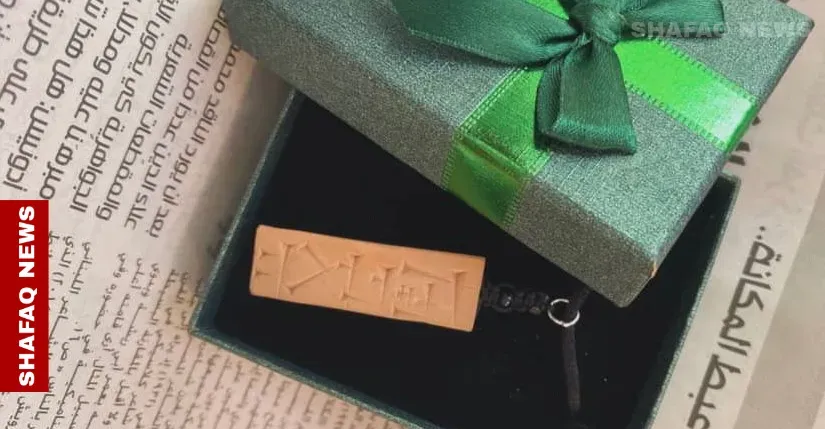
Among those spearheading this revival is Mustafa al-Rudaini, an artist and archaeologist from Baghdad who blends ancient language with contemporary craftsmanship. He converts cuneiform inscriptions — the wedge-shaped characters of Sumerian — into bracelets, pendants, and artworks that merge history with modern design.
“The idea came to me while studying archaeology,” Rudaini explained to Shafaq News. “I realized how disconnected many Iraqis have become from their own ancient identity. Through art, I wanted to rebuild that connection.” His designs are meticulously researched, each symbol reflecting historical and linguistic accuracy.
Al-Rudaini’s work offers a window into the rebirth of a language once thought lost forever. The Sumerian language, spoken by the inhabitants of southern Mesopotamia around 3100 BCE, was the world’s first written tongue — etched into wet clay with reed styluses.
Although it disappeared as a spoken language by 2000 BCE, scholars preserved it through Akkadian translations, and in the 19th century, it was deciphered from cuneiform tablets unearthed in Iraq. Today, Sumerian attracts archaeologists, philologists, and increasingly, Iraqis seeking a renewed link to their ancient roots.
Al-Rudaini’s revival aligns with this growing curiosity. Online, Iraqis share posts about learning Sumerian symbols, while universities report rising interest in Mesopotamian studies. “There’s a sense of cultural reawakening,” al-Rudaini observed. “We’re rediscovering who we are — not just as Iraqis, but as heirs of civilization itself.”
His handcrafted pieces, featuring inscriptions such as “freedom,” “love,” “life,” and “strength” in cuneiform, resonate deeply with Iraq’s youth.
“Every piece carries a message,” he noted, emphasizing that it’s not merely jewelry — it is identity in tangible form.
Heritage Sells
Al-Rudaini’s creations quickly attracted attention on social media, drawing buyers from Iraq and abroad. “Orders came from students, archaeologists, and even tourists,” he mentioned. “People want to feel connected to something that embodies pride — a history that began here.”
Beyond individual artistry, the revival reflects a broader cultural movement — an embrace of Iraq’s layered heritage beneath modern complexities. The Sumerian aesthetic has permeated décor, tattoo art, and fashion. “Sumerian symbols are not just historical artifacts,” al-Rudaini highlighted. “They have become a form of expression — a way of saying: We remember.”
Dr. Munahel al-Saleh, a sociologist at the University of Baghdad, interprets this fascination as both emotional and psychological. “After decades of conflict and fragmentation, Iraqis are reclaiming continuity,” she observed, noting that by reaching back to Sumerian roots, they find stability and meaning that transcend modern divisions.
She further emphasized that Sumerian imagery — once confined to museum walls — has become an accessible language of pride. “These cultural revivals are not nostalgia. They are acts of resilience. The youth are using art and language to signal: We existed long before destruction, and we will exist long after it,” she added.
Oldest Word Rings
This rediscovery extends beyond scholars and artists. Across Iraq, young people increasingly explore cuneiform symbols and integrate them into daily life.
Tiba Hassan, a university student from Najaf, wears a necklace engraved with the Sumerian sign for “hope.” “It reminds me that my ancestors once wrote this same word in clay thousands of years ago,” she reflected. “It’s a bridge between me and them.”
Similarly, Raad Mahmoud, a craftsman from al-Nasiriyah — near the site of ancient Ur — described how visitors to his shop frequently request Sumerian-themed souvenirs. “They view it as a mark of authenticity,” he remarked, emphasizing that it is distinctly Iraqi, not imported or imitated.
For Dalia Qasim, a graphic designer in Mosul, cuneiform patterns have become an integral part of her digital creations, from posters to logos. By weaving these ancient symbols into modern design, she creates a bridge between past and present, allowing Iraq’s earliest expressions of language to resonate within contemporary visuals.
These individual accounts point to a larger truth: the revival of Sumerian symbols mirrors the revival of memory. The world’s oldest written language — once buried beneath millennia of dust — now speaks again through the hands of Iraq’s new generation.
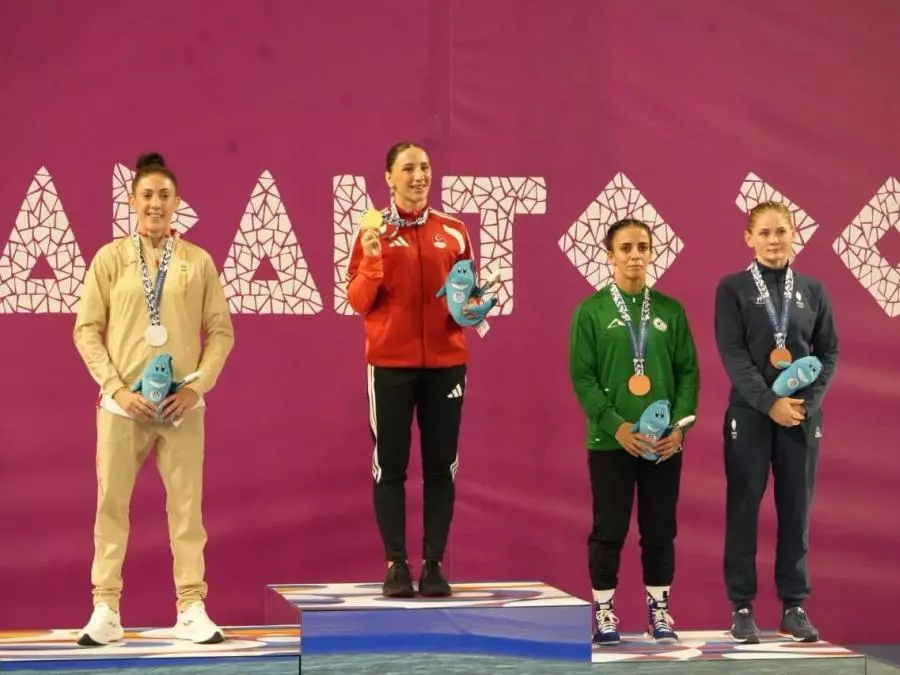
Algeria boosted its medal tally on Tuesday with three additional bronze medals at the ongoing Mediterranean Games in Taranto, Italy.
In freestyle wrestling, Chaïma Chebila claimed the bronze medal in the Under 53 kg category after a dominant 6-1 victory over Morocco’s Zineb Ech-Chabki.
Earlier on Tuesday, another Algerian wrestler, Ibtissem Doudou, secured the bronze medal in the Under 50 kg category by overcoming Egypt’s Malak Ahmed Hassan Mohamed with a tight 3-2 score.
These two bronze medals raise the Algerian wrestling team’s overall tally to seven medals (one gold, one silver, and five bronzes).
Meanwhile, Nour El Houda Maïdi earned a bronze medal in the “Raffa” (Boules) competition. Maïdi successfully edged past San Marino’s Stella Paoletti with a narrow 7-6 victory.
Boxing: A Trio Advances to the Semi-Finals
In boxing, three Algerian fighters punched their tickets to the semi-finals, officially guaranteeing at least three more bronze medals for the national delegation. The advancing boxers are:
Mustapha Abdou (80 kg), who defeated Tunisia’s Youssef Rafrafi via unanimous decision (5-0).
Ismaïl Bekhsis (66 kg), who secured a flawless 5-0 victory over his Turkish opponent, Kanli.
Amine Zanaz (55 kg), who edged past Morocco’s Ismail Bin Siyar with a 3-2 split decision.
These three boxers join their compatriot, Djoher Bennan (65 kg), who had booked her spot in the women’s semi-finals earlier in the tournament.
Following the fifth day of the 20th Mediterranean Games which are set to run until Thursday, September 3, Algeria’s overall medal count has climbed to ten, comprising one gold, one silver, and eight bronzes.
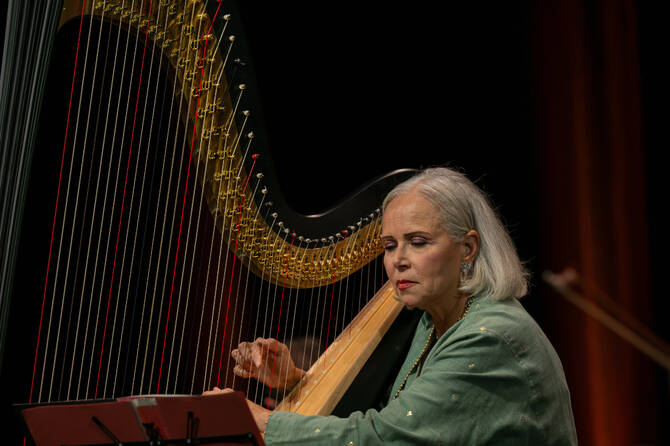
Egyptian harpist Manal Mohei Eldin captivated audiences at the King Abdulaziz Center for World Culture, or Ithra, with three nights of performances blending classical harp techniques with traditional Arabic rhythms and melodies. The final show will be on Friday.
Known as one of the most prominent musicians in the Arab world, she is celebrated for calibrating the harp strings to speak “fluent Arabic” by incorporating traditional Oriental rhythms and melodies with classic techniques.
Arab News spoke exclusively to Mohei Eldin on Thursday night.
“As an Egyptian harpist, it is such an honor to receive this important invitation to showcase my work and my art in the Kingdom of Saudi Arabia,” she said.
“It is not my first time here (at Ithra) — I’ve had the pleasure of working with the great Omar Khairat two years ago, but it is my absolute honor to say that this is my debut as a soloist playing my Arabic, oriental rhythms with my ensemble in the Kingdom.”
Indeed, while she was on stage previously at Ithra in 2024 as a key orchestra member supporting the legendary Egyptian composer and pianist, Khairat, this is her first show as a soloist, with her ensemble.
The Oriental Strokes Ensemble, who joined her on stage, consists of Shady Abdel Salam on violin I, Hossam Ezzat on violin II, Emad Morsy on the viola, Alaa Abdallah on cello. Also, Karim Wassef on bass guitar, Beshoy Rezkalla on accordion, Mahmoud Kamal on nay, Hesham Kamal on percussion, and Doha El-Guerzawi on percussion.
“It pleases me greatly that our first presence in the Kingdom is at Ithra specifically, where we are performing three nights,” Mohei Eldin added.
“The audience at Ithra is very involved and passionate. To be honest, I expected the majority of the seats to be occupied by Egyptians, but to my surprise, most turned out to be Saudis.”
On Thursday night, in between songs, someone from the audience shouted out a request for the musicians to play “Nassam Alayna El Hawa” by Lebanese songstress Nouhad Wadie Haddad, better known by her stage name, Fairouz.
“I don’t know him (the person who shouted out the request), but I played it even though it was not in the original program. It is clear to me that he knew my work and knew I had played that before. It makes me very happy that the Saudi audience loves music and they really know music,” she added.
The program consisted of such crowd favorites as “Zourouni Kol Sana Marra,” composed by Sayed Darwish; “Asmahan Medley,” composed by Farid Al-Atrash, Mohammed El-Qasabgi and Medhat Assem; and “Aziza Dance,” composed by Mohamed Abdul Wahab.
Images of the classic Egyptian stars who inspired the sounds were shown on the large screen as a backdrop.
A professor at the Cairo Conservatoire, Mohei Eldin began her musical journey in her native Egypt and has since performed on some of the world’s greatest stages.
She became a pioneer when she enrolled at 10 years old to pursue learning the harp at the Cairo Conservatoire, where she graduated with honors in 1987.
Upon receiving the coveted German Academic Exchange Service scholarship, she continued her journey with the instrument in Germany with Prof. Buss Lorberth at the Hochschule fur Musik und Darstellende Kunst in Frankfurt and training with Giselle Herbert at the Hoch Conservatory Musik Hochschule in Wurzburg.
Since then, she became the first Egyptian solo harpist at the Cairo Symphony Orchestra, and she famously performed at the opening of the Egyptian Pavilion at the Louvre Museum in Paris and the Ancient Treasures Exhibition at the National Museum of Women in the Arts in Washington, D.C.
“The vast majority of Arabs love to sing along to words, and the fact that they came to listen to only musical instruments, and on an instrument (the harp) that isn’t very familiar to many in the region, honestly made me very, very happy,” she concluded.
source/content: arabnews.com (headline edited)
_______________
Known as one of the most prominent musicians in the Arab world, Manal Mohei Eldin is celebrated for calibrating the harp strings to speak “fluent Arabic” by incorporating traditional Oriental rhythms and melodies with classic techniques. (Supplied)
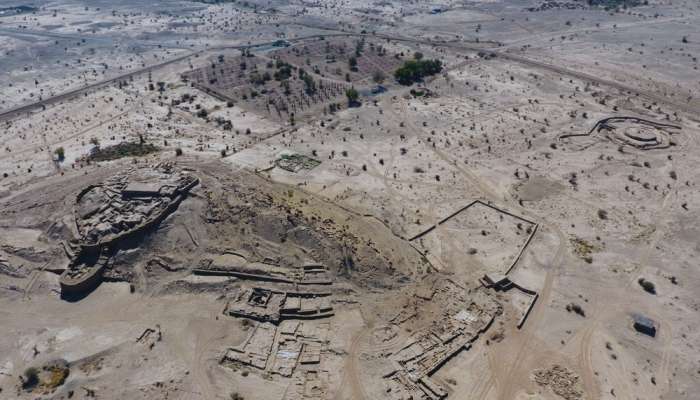
The archaeological oasis of Bisya and Salut, nestled between the banks of Wadi Saifam and Wadi Bahla in A’Dakhiliyah Governorate, constitutes an extraordinary cultural treasure, with archaeological evidence spanning from the Bronze Age through the Iron Age and into the Islamic era, representing an organized human settlement of profound historical importance.
Ibtisam Abdullah Al Maamari, Director of the World Heritage Department at the Ministry of Heritage and Tourism, told Oman News Agency that the Bisya and Salut site in the Wilayat of Bahla embodies criteria of outstanding universal value, representing a unique and exceptional global artistic masterpiece. The site eloquently expresses human creativity, reflects a significant exchange of human values, bears witness to enduring cultural traditions, and occupies a landscape of remarkable natural beauty encompassing environments rich in biodiversity.
She further elaborated that the Ministry of Heritage and Tourism, in partnership with relevant stakeholders, is actively working to enhance the representation of Oman’s historical sites on the UNESCO World Heritage List. The nation is currently in the advanced stages of preparing the nomination file for the Bisya and Salut site, to be submitted under the title “Salut: An Iron Age Settlement.” The designated expert tasked with preparing the dossier will concurrently develop a comprehensive site management plan to accompany the nomination submission. The endeavour is expected to require approximately two years of concerted effort and strategic planning until its culmination.
Ahmed bin Mohammed Al Tamimi, Director of the Bisya and Salut Archaeological Site Department, affirmed the exceptional richness of the site, first documented in 1973. Archaeological missions have been conducting excavations since the early 1980s, with a succession of international teams contributing to its exploration. Presently, the Italian mission from the University of Milan is engaged in excavating the archaeological tombs at Bisya, seeking to unravel the mysteries enshrouding these ancient burial structures. Concurrently, a mission from the Sorbonne University in France is conducting excavations at the archaeological sites of “Fal” and “Al-Dhabi.” Both missions are diligently working to determine the chronology of the sites under investigation, complete previous excavation efforts, and develop a comprehensive vision and deeper understanding of these archaeological expanses, whose habitation traces back to the late fourth millennium BC.
Al Tamimi highlighted the ongoing endeavours of the Ministry of Heritage and Tourism, channelled through the Bisya and Salut Visitor Center, to introduce and promote this historical site. Since its inauguration in February 2023 until the close of December 2025, the site has welcomed over 16,400 visitors, encompassing citizens, residents, and international tourists.
Promotional initiatives include an annual programme of events executed in collaboration with the local community, with dedicated outdoor spaces allocated for hosting diverse activities. These include programs organized by Omani Women’s Association branches, sports teams affiliated with Bahla Club, civil society institutions, and community libraries. Among the events realized are poetry evenings, productive family exhibitions, children’s activities, and art exhibitions, fostering community engagement and cultural enrichment.
He further elaborated that the Visitor Center at the Bisya and Salut archaeological complex features comprehensive exhibition panels delineating the history of archaeological investigation in the region, diverse patterns of human settlement, typological classifications of ancient tombs, and the commercial networks that connected this civilization with neighboring polities. The center annually welcomes a cohort of scholars and researchers who independently visit the site to pursue scientific inquiry across multiple disciplines, thereby advancing the Ministry’s ongoing mandate of archaeological survey and documentation.
He added that the center incorporates a dedicated repository for archaeological artifacts, tasked with receiving and preserving objects from the moment of their discovery during excavation campaigns. These artifacts subsequently undergo systematic registration, archival documentation, and secure storage. Selected items proceed to conservation and restoration laboratories at either the Ministry of Heritage and Tourism headquarters or the on-site Visitor Center facilities, while others are designated for museum exhibition. Numerous significant finds from the Bisya and Salut excavations have been displayed at the National Museum and the Oman Across Ages Museum, underscoring the site’s national archaeological importance.
He affirmed that the site constitutes an exceptionally rich archaeological landscape, encompassing thousands of Bronze Age funerary monuments, the imposing Salut Fortress with its adjacent urban settlement, third-millennium BCE towers, extensive cemeteries spanning both Bronze and Iron Ages, and a remarkable corpus of rock art. The archaeological hinterland extends to the nearby villages of Al-Dhabi, Fal, and Al-Ma’mur, revealing a densely occupied cultural landscape. The settlement of Salut itself represents a particularly significant urban center, attesting to intensive occupation and human agency during the first millennium BCE. The fortress, serving as an administrative nucleus, confirms the existence of sophisticated governance structures and an economic foundation built upon agriculture and the aflaj irrigation systems.
Regarding ongoing research initiatives, he stated: “The Bisya and Salut Archaeological Site Department, operating through the Visitor Center, coordinates various research activities. We engage external researchers through collaborative projects as circumstances warrant. During the current year, 2026, we inaugurated a comprehensive project to inventory and document the rock art corpus distributed throughout the Bisya and Salut region, enlisting local community guides possessing intimate knowledge of the drawings’ locations across mountainous terrain, valleys, and rocky outcrops. Upon completion of this documentation phase, we will undertake analytical studies to establish chronological frameworks for these artistic expressions.”
Addressing site development initiatives launched with the February 2023 opening of the Visitor Center, he noted: “Visitor pathways have been upgraded and paved to provide access to principal archaeological features, including Salut Fortress, the Bronze and Iron Age necropolises, the ancient urban core of Salut, and the third-millennium tower. During the current year, we will enhance visitor stopping points with interpretive panels presenting scientific information in accessible formats. Since the second half of 2025, we have conducted comprehensive rehabilitation, maintenance, and restoration operations at multiple locations, continuing through February 2026 at Salut Fortress, along the visitor circuit, and within the urban precinct adjacent to the fortress. A local Omani enterprise is finalizing the design and production of multimedia installations for the Visitor Center’s display systems, scheduled for completion this month, February 2026. These technological enhancements will facilitate information dissemination and showcase previously unexhibited archaeological discoveries through interactive screens. Furthermore, a field classroom has been established within the palm grove situated within the site’s protected perimeter, designated for programs integrating theoretical instruction with practical field applications. Since the center’s inauguration through the conclusion of 2025, we have conducted 79 educational programs and cultural events, serving 6,230 participants spanning all age demographics.”
He further detailed the programs and events scheduled for implementation during 2026, including the UNESCO Associated Schools Forum, the second edition of the Salut Photography Forum, in addition to numerous community-engaged activities, training workshops, and artistic initiatives designed to promote the archaeological site, introduce the Visitor Center and its surrounding antiquities, facilitate the exchange of expertise, and explore diverse experiential methodologies.
It is noteworthy that archaeological discoveries unearthed at the Bisya and Salut site collectively attest to the profound civilizational interconnections between Oman and the ancient world. Among the most significant finds are seals bearing stylistic influences from the Indus Valley Civilization, serpent figurines, various anthropomorphic and zoomorphic terracotta artifacts reflecting Indus Valley cultural traditions, and an assemblage of ceramic vessels. Particularly remarkable discoveries from the 2024/2025 excavation season include a collection of charred dates and date stones unearthed at the Al-Dhabi site, meticulously dated to the third millennium BCE, providing invaluable evidence of ancient agricultural practices and trade networks.
“Islam” and “feminism” are two words most people in Western society wouldn’t usually associate with one another. But recent developments in the historically conservative Persian Gulf region, and in Kuwait in particular, suggest that may be changing.
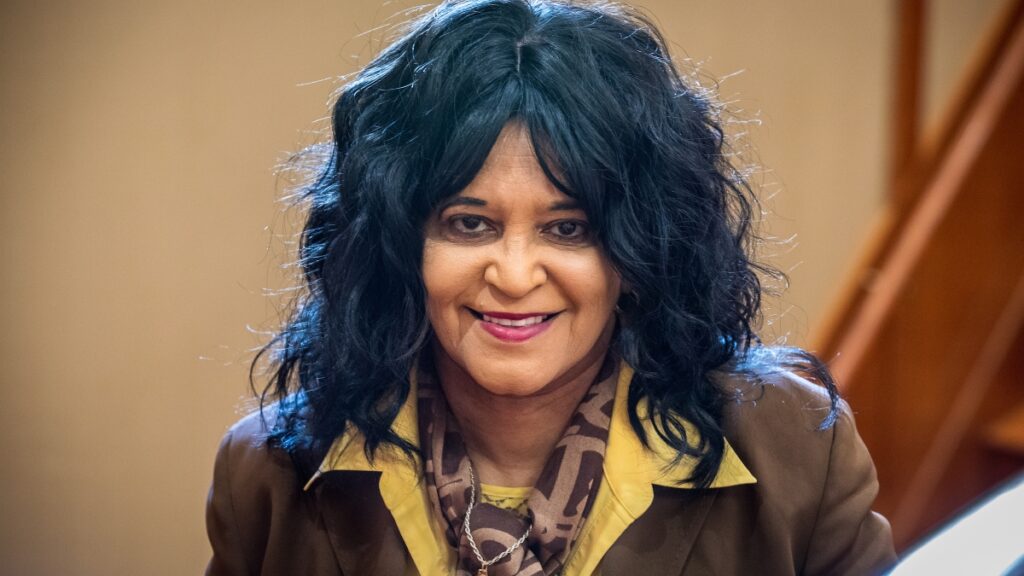
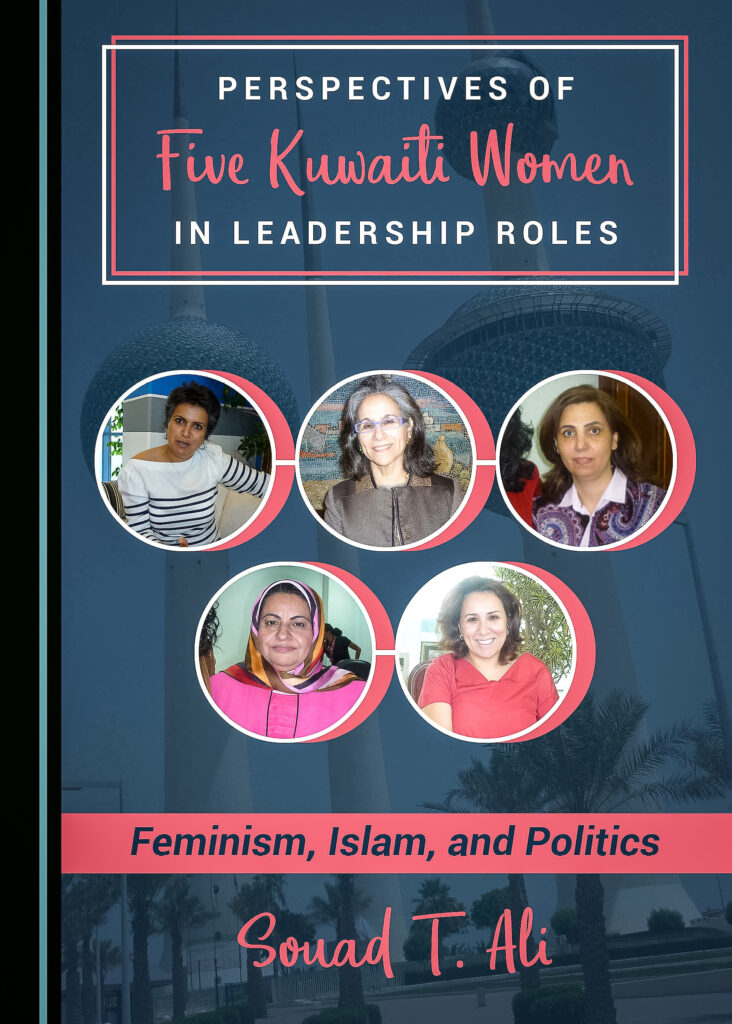
In 2005, Kuwait, a country that is more than 90% Muslim, passed laws granting women both the right to vote and the right to run in elections. In her new book, “Perspectives of Five Kuwaiti Women in Leadership Roles: Feminism, Islam and Politics” ASU Professor and Founding Chair of the Council for Arabic and Islamic Studies Souad T. Ali reveals how these and other advancements have affected them on an individual and societal level.
A native of Sudan who became a naturalized U.S. citizen after the 1989 Sudanese coup d’état replaced her original home country’s newly elected democratic government with a totalitarian regime, Ali was inspired to write “Perspectives” during her 2009–2010 Faculty Fulbright Fellowship at the American University of Kuwait.
“I admire the fact that Kuwaiti women are very outspoken,” Ali said. “They’re very interested in improving their society and they don’t fear speaking out against what they see as oppressive aspects of their society.”
Based on ethnographic research and in-depth interviews with five women, Ali’s new book discusses these women’s work in diverse leadership roles. They include Rola Dashti, a leading Kuwaiti economist, politician and human rights activist who was among the first four women elected to the Kuwaiti parliament; Sheikha Hussah Sabah al-Salem al-Sabah, a patron of Islamic art and museums; Sara Akbar, an oil industry engineer leader and co-founder of Kuwait Energy; Sheikha Dana Nasser Sabah Al-Ahmed Al-Sabah, founder of the American University of Kuwait and an established businesswoman; and Safa al-Hashem, a powerful Kuwaiti politician and entrepreneur who is currently the only elected female member of the Kuwaiti parliament.
Ali, who serves as head of Middle Eastern and classics studies, and coordinator of Arabic studies, turned down an offer from Princeton in order to build ASU’s Arabic studies program from the ground up. Since joining ASU in 2004, she has established three concentrations, including a certificate in Arabic studies, the Arabic studies minor and most recently the Arabic studies bachelor’s degree concentration.
She also is the author of more than 25 articles and three books, including “Perspectives,” and she has participated in more than 100 scholarly presentations and academic conferences in her fields of Middle Eastern studies and Islamic studies. Her forthcoming book, an edited volume with colleague Emily Silverman will explore subjugated voices in religion.
Ali has been active nationally and internationally representing ASU as president of the American Academy of Religion/Western Region branch; as president of the Sudan Studies Association of North America; as a Fulbright Scholar in Kuwait and the Persian Gulf; and as a State Department’s speaker and specialist in Senegal on issues including Islam and democracy, Sufism and religious freedom.
ASU Now sat down with Ali to talk about her new book and how Islam and feminism aren’t as disparate as you might have thought.
Question: How does the feminist movement in Kuwait compare to other countries in the Persian Gulf region?
Answer: From my perspective, the issue of women’s rights is just one issue. But there are many brands of feminism, given the fact that women come from different cultures and have different backgrounds and different histories. Kuwaiti women have a marginal freedom within their government, which is a parliament. There isn’t any other parliamentary government anywhere else in the Gulf region. I discuss feminism in Islam in much detail in the last chapter of my book, highlighting the fact that it emphasizes the inclusion of Muslim women in the religious sphere, with no conflict with their call for their political rights or their active participation in public life. There have been several Muslim women elected as prime ministers in their countries, for example.
Q: What are some of the issues you discussed with the women in your book?
A: The book discusses multiple issues addressed by these women in their leadership roles. These include women’s rights, the issue of reform, political change, equality, gender segregation, veiling, etc., and how these women view feminism and their similar or different perspectives therein. This of course includes the issue of interpretation in Islam that affects how people view issues such as veiling and whether or not it is required by the religion, the need to respect difference in interpretation as much as it does not infringe on others’ perspectives and freedom of expression, and most importantly, respecting women’s agency.
Q: What accounts for the lack of understanding of Muslim women’s rights?
A: I would say the majority, or at least 50% of Muslim women, don’t know their rights, if they don’t read the Qur’an directly. Many of them depend on the male interpretation. And the Qur’an, for the past 14 centuries, has been interpreted by men projecting male perspectives to the exclusion of women’s voices. Only recently has it begun to be interpreted by women. I have been teaching a very popular class at ASU since 2007 titled Qur’an Text and Women. Among the texts we read are “ Qur’an and Woman: Rereading the Sacred Text froma Woman’s Perspective,” by Amina Wadud; “Believing Women; in Islam: Un-reading Patriarchal Interpretations of theQur’an,” by Asma Barlas; and “Woman’s Identity and the Qur’an : A New Reading” by Nimat Hafez Barazangi, among others. These women are among the first Muslim American women to interpret the Qur’an. There were some earlier female interpretations of the Qur’an in the region. However, those were seen by many as appeasing to the male interpretation.
Q: Are there aspects of feminism in Islam?
A: Yes, except they didn’t call it feminism at that time. My research on “a focus on the egalitarian message of the Qur’an” can help answer this question. I discuss the issue of feminism in Islam in detail in the last chapter. Further, feminism is not a monolithic concept and can differ based on women’s history, background and culture, as I and several other scholars — including Barbara Christian — argued. Based on historical records, several aspects of Islam, in their correct interpretation, speak to women’s rights, despite other controversial aspects. In her book, “Women and Gender in Islam: Historical Roots of a Modern Debate,” Dr. Leila Ahmed, a professor at the Harvard Divinity School, argues that the prophet Muhammad’s wife Aisha contributed 2,210 Hadith narratives. The Hadith is the second source of Islamic law, next to the Qur’an. She maintains that women in seventh century Arabia were sought out by the prophet’s companions and included their testimonies into the Hadith. At the society level, the prophet’s marriage story with his first wife Khadija, who was 15 years his senior and a very wealthy merchant, could be interpreted and seen through the prism of those egalitarian aspects. At first, she employed him because she perceived him to be an honest person, then she proposed to marry him. This was in the seventh century, and at that point, the pre-Islamic society was very misogynistic. They remained married within a monogamous situation for 25 years until her death. She was also the first person to embrace religion of Islam.
Q: Why is this something everyone around the world should care about?
A: The fact that there are so many misconceptions about women and women’s rights in Islam. The book gives readers the opportunity to see facts that have been distorted. For example, Muslims in general, but especially Muslim women, are perceived to be oppressed by their religion, which is a fallacy. They are oppressed by their society, by tradition, by governments and politics. Several of these oppressive measures are in fact criticized in the Qur’an itself, such as female infanticide — used as basis for the so-called “honor-killing” in some countries. Polygamy, that had existed before the advent of religion and had existed in all monotheistic religions, including Islam that inherited it, is very much discouraged in the Qur’an with clear verses within the context of a fair interpretation. Although there are other controversial aspects of Islam that we continue addressing as scholars, Muslim feminists draw attention to the importance of emphasizing those egalitarian aspects of Islam that have largely been neglected by male interpretations that endured for centuries, unfortunately. I cordially invite the audience to read the entire book to help them learn more of these aspects on women in Islam, and Kuwaiti women, the focus of the book.
Islamic Ministry begins distribution of 1.9 million editions across the Kingdom’s air, land, sea ports.
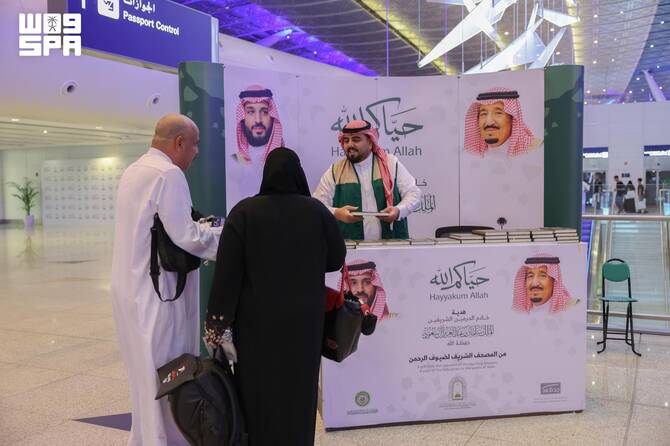
The Ministry of Islamic Affairs has begun distributing King Salman’s gift of the Holy Qur’an and its translated editions to departing pilgrims and seasonal field workers.
Distribution started in the departure halls of King Abdulaziz International Airport in Jeddah, ensuring international pilgrims receive their copies before boarding return flights.
The campaign includes 1.9 million copies produced by the King Fahd Complex for Printing the Holy Qur’an in Madinah, the Saudi Press Agency reported on Saturday.
Available in more than 80 languages, the translated editions enable returning pilgrims to study the Qur’an in their native languages.
The ministry said that distribution will continue around the clock at all air, land and sea ports in the coming days, the SPA added.
Minister of Islamic Affairs Sheikh Abdullatif Al-Alsheikh said the gift reflects the leadership’s commitment to spreading the message of the Holy Qur’an worldwide.
He added that the ministry has mobilized all logistical and human resources to ensure smooth, efficient and accessible distribution for departing pilgrims.
The Passports Department at Jeddah airport has processed departure procedures for the first outbound flights of pilgrims returning home after completing Hajj.
The General Directorate of Passports confirmed its highest level of operational readiness at the Kingdom’s land, air and sea ports to manage post-Hajj departures, urging international pilgrims to adhere to their scheduled travel times.
According to official statistics, 1,707,301 pilgrims performed Hajj this year, up 2.04 percent from 2025. Of the total, 1,546,655 arrived from outside the Kingdom, including 1,485,729 who traveled by air, while 160,646 were citizens or residents of Saudi Arabia.
source/content: arabnews.com (headline edited)
______________
Distribution started in the departure halls of King Abdulaziz International Airport in Jeddah (SPA)
The Doha Historical Dictionary of the Arabic Language is one of the largest projects for the Arab Center for Research and Policy Studies.
Cornell University in the United States and the University of British Columbia in Canada have included the Doha Historical Dictionary of the Arabic Language in their digital library collections.
Cornell University in the United States and the University of British Columbia in Canada are ranked among the world’s leading institutions.
In a statement by the Arab Center for Research and Policy Studies on Tuesday, Mohammed Al-Obaidi, Executive Director of the Doha Historical Dictionary of the Arabic Language, said that this provides researchers worldwide with unique historical material on the Arabic language for the first time.
“Making the dictionary available openly is a translation of the identity of the project, as it is a national project, and one of its most important priorities is to provide researchers wherever they are with the unique historical dictionary material that is available for the first time in the history of this ancient language,” said Al-Obaidi.
In the details, the American Cornell University included the Doha Dictionary in its electronic library, within a hierarchical classification that includes the following titles: Near Eastern Studies, Arabic Literature, Dictionaries, and Dictionaries of Synonyms and Acronyms.
The university also assigned a special subtitle to the dictionary, Arabic Ontology, with a description that provides a tool for comparative research across dictionaries and, in its final form, aims to document the semantic transformation of each word in its blog.
The Doha Historical Dictionary of the Arabic Language is one of the largest projects of the Arab Center for Research and Policy Studies.
It was officially launched on 25 May 2013, and development continued for more than 12 years.
It was completed on 22 December 2025, with more than 500 researchers from across the Arab world contributing to its development. The project is also open to the public for comments, corrections and proposals.
For its part, the University of British Columbia in Canada has added the Doha Historical Dictionary to its library with a different hierarchical classification: Research Guide – Literature, Humanities and Social Sciences – Middle East Studies – Free and Open Sources – Dictionaries.
The description of the dictionary on the University Library reads: “The Doha Historical Dictionary of the Arabic Language is an ongoing project of the Arab Center for Research and Policy Studies located in Doha, Qatar. The first and second phases of the project covered the history of the Arabic language from the earliest written document to the fifth century AH…”
Al-Obaidi welcomed this step, expecting that more universities in the Arab world and beyond will follow suit.
“For more than a decade, we have been keen to adjust the scientific material of the dictionary according to the highest possible academic standards, and then we have made it available through a free electronic portal to be a help for researchers in all fields of humanities and social sciences,” said Al-Obaidi.
Al-Obeidi called on Arab universities and academic institutions to make the dictionary available to students and researchers.
He also invited Arab researchers, “wherever they are, to conduct studies that deal with the dictionary or employ its material.”
This is the month in which Palestinians commemorate the Nakba, a catastrophe often described in historical accounts as having displaced some 750,000 people.
It is true that Israel expelled this number of Palestinians from the territories it occupied unlawfully during the 1948 War. Yet the victims of Israel’s seizure of lands that had not been allocated to it under the UN Partition Plan — territories it appropriated by force during the conflict — are many times that number. Official statistics indicate that nearly 5.9 million Palestinian refugees are registered with the United Nations Relief and Works Agency (UNRWA), in addition to countless Palestinians who settled in other Arab or foreign countries and became part of their host societies, so they are no longer officially classified as refugees.
All of these people are victims of the Nakba that befell the Palestinian people as a result of the establishment of a Jewish state on Palestinian land. This reality makes the Nakba far more than a passing historical episode. It represents a profound transformation that redrew the map of the Middle East and altered the destiny of an entire people.
When we look at the images commonly associated with the Nakba, they usually depict masses of Palestinians leaving their homes and carrying their belongings on their backs, as though the tragedy unfolded in a single day. But this is misleading. Photographs capture only the instance in which they are taken, whereas the Nakba was never a single moment or an isolated event in Palestinian history. It was a prolonged process that began during the British Mandate in Palestine and continued long after its end.
Throughout this process, more than 500 Palestinian towns and villages were destroyed. The Deir Yassin massacre, for example, took place even before the outbreak of the 1948 War, claiming the lives of more than 110 men, women and children. When we speak of the Nakba, therefore, we are speaking of the systematic dismantling of an entire society that had once been stable and deeply rooted in its land, a deliberate project aimed at erasing a people’s geographic and civilisational identity.
That project, moreover, has never truly ceased. What happened in Gaza, and what is now unfolding in the West Bank, reflects the continuation of the same logic: emptying the land of its inhabitants through expulsion, displacement or killing; transforming the identity of the place; and erasing its cultural character. This confirms that the Nakba was not confined to the war of 1948. It is an ongoing process that began before the war and continues to this day.
* A version of this article appears in print in the 28 May, 2026 edition of Al-Ahram Weekly