TUNISIA : Hero of Tunisia’s 2011 revolution Lina Ben Mhenni dies at 36

Nobel Peace Prize nominee was an internationally recognised human rights activist who documented abuses under Ben Ali.

Tributes are pouring in after prominent Tunisian human rights activist and blogger Lina Ben Mhenni, one of the heroes of the 2011 revolution, died in the early hours of Monday from a chronic illness.

The 36-year-old was an English teacher at the University of Tunis. Her father and fellow activist, Sadok Ben Mhenni, was a political prisoner under Habib Bourguiba and one of the founders of the Tunisian branch of rights group Amnesty International.

Her final blog post was published on Sunday morning, in which she took aim at a spat-turned-fracas between MPs in parliament, asking Tunisians to remember their political past and learn from it.

A cyber-dissident, Ben Mhenni became well known for her  “A Tunisian Girl” blog and using her real name at great personal risk, documenting human rights abuses under Zine El Abidine Ben Ali. In response, Ben Ali’s government banned her blog in 2007.

But in the 2011 uprising that toppled the longtime autocrat, Ben Mhenni began blogging once again, becoming a vital source of information through her documentation in English, French and Arabic of the violent crackdown on protesters by police, particularly in Sidi Bouzid, Regueb and Kasserine. 

Her blog soon gained international recognition. In 2011, she was nominated for a Nobel Peace Prize and received the Best Blog Award at the Deutsche Welle Global Media Forum in Germany’s Bonn.

“I had to ensure that the voices of these people and their families be heard so that they hadn’t died in vain,” she said speaking at the time.

In 2013, following the assassinations of leftist politicians Chokri Belaid and Mohamed Brahmi, she was informed by authorities of being “number 1 on a kill list” drawn up by hardline groups.

Despite her ailing health and being in need of a kidney transplant, in recent years Ben Mhenni participated in many panels and cultural events, most recently at the Arab Women Literature Festival, and she campaigned for Tunisia’s youth and a reading initiative  in Tunisian prisons.

Tunisia’s culture ministry expressed “great sorrow” at Ben Mhenni’s death. 

source/content: middleeasteye.net (headline edited)

_____________
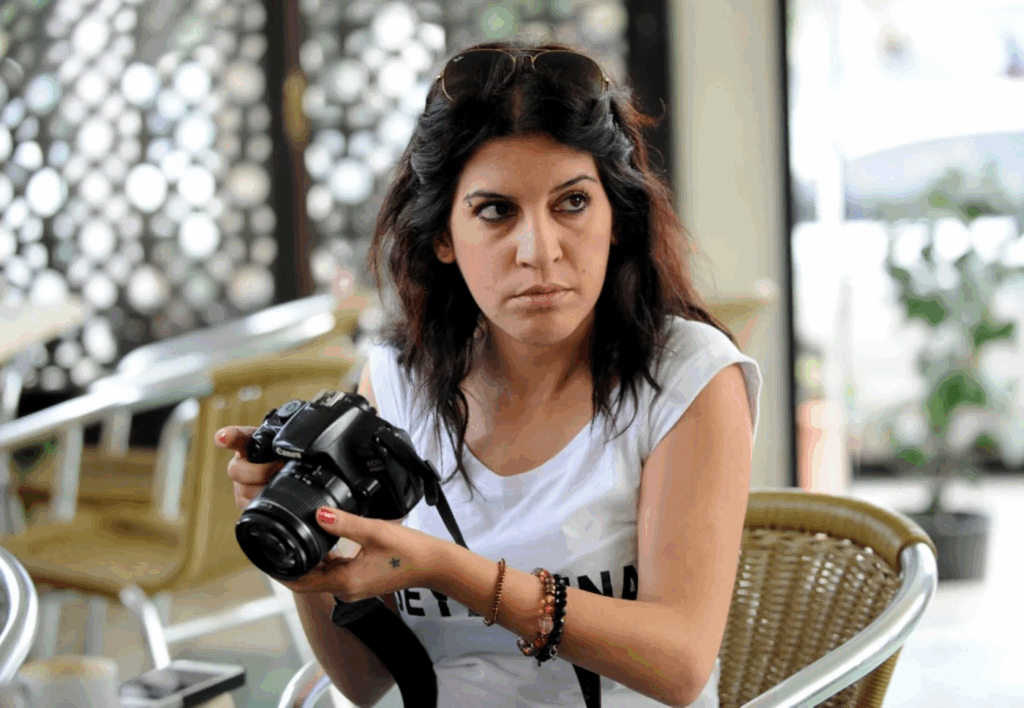
Activist and blogger Lina Ben Mhenni documented police violence during the 2011 revolution (AFP)

___________

TUNISIA

US QATARI Sophia Al-Maria wins 2025 Frieze Artist Award 

US Qatari artist and writer Sophia Al-Maria has been announced as the recipient of the 2025 Frieze Artist Award, one of the art world’s most highly anticipated annual commissions. 

The award is part of Frieze London, a leading international art fair that will return to Regent’s Park from Oct. 15-19, bringing together more than 280 galleries from 45 countries.

Presented in partnership with Forma, the award supports early- to mid-career artists in debuting new works. This year, Al-Maria will perform “Wall Based Work (a Trompe LOL),” a live stand-up comedy show held daily inside the fair tent.

The work marks Al-Maria’s first attempt at stand-up, in which she will blend sharp humor with her long-standing interest in mythology, empire and pop culture.

“In partnership with Forma, we are proud to continue supporting artist-centered programming,” said Eva Langret, director of Frieze EMEA. “Al-Maria’s debut stand-up promises a collective experience exploring vulnerability, creativity, shared anxieties and LOLs.”

Meanwhile, Chris Rawcliffe, artistic director at Forma, said: “By wielding humor as a tool for survival, Al-Maria not only provokes reflection but actively reshapes the cultural conversation … Al-Maria is more than an artist and critic, she is a catalyst for change, and an indispensable voice in both the art world and the wider social landscape.” 

Al-Maria’s proposal was selected by a jury of leading industry professionals, including curator and museum consultant Lydia Yee and the artistic director of exhibitions at Ikon Gallery, Melanie Pocock, artistic director of exhibitions at Ikon Gallery, as well as Langret and Rawcliffe.

Based in London, Al-Maria works across drawing, collage, sculpture, film and writing. Her practice is unified by a focus on storytelling and mythmaking, often reimagining histories and envisioning speculative futures. Her work has been shown at major institutions and biennales, including the Gwangju Biennale, the New Museum and Whitney Museum in New York, the Venice Biennale, and Tate Britain.

source/content: arabnews.com (headline edited)

_____________

_________________

U. S. A / QATAR

SYRIA unveils new national emblem as part of sweeping identity overhaul

Unveiled during a ceremony in Damascus on Thursday

New emblem reimagines iconic Syrian golden eagle with symbolic elements representing country’s history, geography and post-conflict aspirations

The Syrian Arab Republic has launched a new national visual identity featuring a redesigned golden eagle emblem, in what officials described as a break from the legacy of authoritarianism and a step toward a state defined by service, unity and popular legitimacy.

Unveiled during a ceremony in Damascus on Thursday, the new emblem reimagines the iconic Syrian golden eagle with symbolic elements representing the country’s history, geography and post-conflict aspirations, the Syrian Arab News Agency reported.

The redesign forms the centerpiece of a wider national branding effort aimed at redefining Syria’s image at home and abroad.

The eagle has long held significance in Syrian history, appearing in early Islamic military symbolism, notably in the 7th-century Battle of Thaniyat Al-Uqab, and later as part of the 1945 emblem of Syria.

The new design retains this historic continuity but shifts its meaning, and the combative shield clutched by previous iterations of the eagle has been removed.

Instead, the emblem now features the eagle topped by three stars representing the people symbolically placed above the state.

The redesigned wings are outstretched, balanced rather than aggressive, with seven feathers each to represent Syria’s 14 governorates.

The tail carries five feathers symbolizing the country’s major geographical regions: north, south, east, west, and central Syria — a nod to national unity and inclusivity, SANA reported.

Officials described the design as a “visual political covenant,” aimed at linking the unity of land with the unity of national decision-making.

“The people, whose ambitions embrace the stars of the sky, are now guarded by a state that protects and enables them,” said a statement accompanying the launch. “In return, their survival and participation ensure the renaissance of the state.”

The emblem is designed to signal historical continuity with the original post-independence design of 1945, while also representing the vision of a modern Syrian state born from the will of its people, SANA said.

Officials said the elevation of the stars above the eagle was intended to reflect the empowerment and liberation of the people, and the transition from a combative state to a more civic-minded one.

The symbolism also reinforces Syria’s territorial integrity, with all regions and governorates represented equally. The design, they said, reflects a new national pact, one that defines the relationship between the state and its citizens based on mutual responsibility and shared aspirations.

The new emblem is also intended as a symbolic end to Syria’s past as a security-driven state, replacing a legacy of repression with one of reconstruction and citizen empowerment.

President Ahmad Al-Sharaa, who has positioned his administration as one of reform and renewal, described the change as emblematic of “a government emanating from the people and serving them.”

The visual identity was developed entirely by Syrian artists and designers, including visual artist Khaled Al-Asali, in a deliberate effort to ground the new identity in local heritage and creativity.

Officials said that the process was intended not only as a rebranding exercise but as a reflection of Syria’s cultural and civilizational legacy — and its future potential.

Foreign Minister Asaad Al-Shaibani, speaking at the event, framed the launch as part of a broader transformation in Syrian governance and diplomacy.

“In every encounter, we carried a new face of Syria,” he said. “Our efforts brought Syria back to the international stage — not as a delayed hope, but as a present reality.”

He said the country was now rejecting the “deteriorated reality” inherited from decades of authoritarian rule, and described the new emblem as a symbol of Syria’s emergence as a state that “guards” and empowers its people, rather than controlling them.

Al-Shaibani concluded his remarks by calling the moment “a cultural death” for the former regime’s narrative.

“What we need today is a national spirit that reclaims the scattered pieces of our Syrian identity, that is the starting point for building the future.”

source/content: arabnews.com (headline edited)

____________

The Syrian Arab Republic has launched a new national visual identity featuring a redesigned golden eagle emblem, in what officials described as a break from the legacy of authoritarianism and a step toward a state defined by service, unity and popular legitimacy. (SANA)

_________

SYRIA