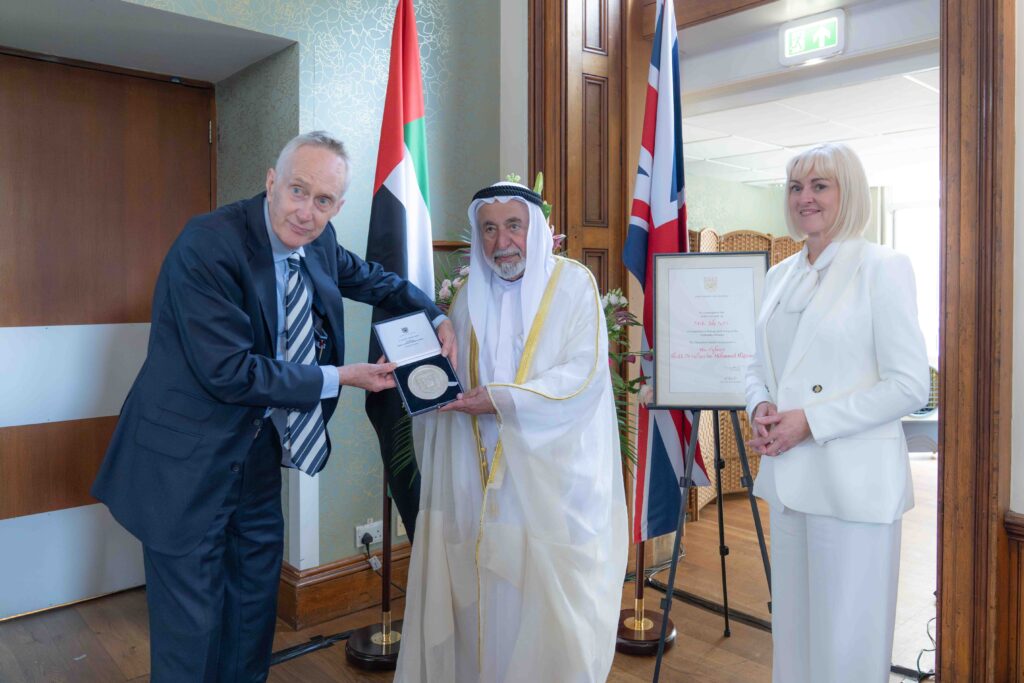
His Highness Sheikh Dr. Sultan bin Muhammad Al Qasimi, Supreme Council Member and Ruler of Sharjah, received the Honorary President’s Medal of the University of Exeter on Thursday, in the presence of His Highness Sheikh Sultan bin Ahmed bin Sultan Al Qasimi, Deputy Ruler of Sharjah and President of the University of Sharjah, and Sheikha Bodour bint Sultan Al Qasimi, President of the American University of Sharjah. The award is presented by the university for the first time in its history.
This came during His Highness the Ruler of Sharjah’s visit to the University of Exeter, during which he received the medal from Sir Michael Barber, the University’s Honorary President. The unveiling of the Al Qasimi Building project, which will be constructed at the university at His Highness’s initiative, and the unveiling of His Highness’s publications corner in the Library of the Institute of Arab and Islamic Studies, also took place. A cooperation agreement was also signed between the Sharjah Council for Higher Education and Scientific Research and the University of Exeter.
His Highness the Ruler of Sharjah was awarded the Honorary President’s Medal of the University of Exeter in recognition of his distinguished contributions to education and scientific research, as well as his distinguished relationship with the University of Exeter. His Highness is also considered a pioneer in cultural, scientific, social, and economic development, and has played a significant role in promoting cultural interaction and dialogue between countries and civilizations at the local, regional, and international levels.
During his speech at the honoring ceremony held in Reed Hall at the University of Exeter, His Highness said: “I am very pleased to return today to the University of Exeter, this prestigious institution that embraced me as a student more than forty years ago, and which has remained deeply rooted in my academic journey and memory ever since.”
His Highness expressed his gratitude for the close and fruitful cooperation with the University of Exeter over the past decades, saying: “I stand before you with deep gratitude for the fruitful path we have traveled together, a path that has brought us together in knowledge, partnership, and shared goals. I feel particularly proud of the enduring cooperation that has continued between the University of Exeter and the Emirate of Sharjah over the past four decades. This cooperation has not only stood the test of time, but has also evolved into a model of academic excellence. At the forefront of this achievement stands the Institute of Arab and Islamic Studies, a distinguished center that houses the Arab World Archives Unit and the Emirati Collection, which together represent a vital contribution to the preservation and study of our cultural heritage.”
His Highness the Ruler of Sharjah highlighted the academic partnerships with the University of Exeter, saying: “Over the years, this collaboration has led to the development of many successful academic partnerships across universities in the Emirate of Sharjah. At Khorfakkan University, the joint Marine Sciences programme with the University of Exeter contributes to the development of studies in coastal and marine ecosystems. At Al Dhaid University, there is cooperation in the field of geology and environmental sciences, which contributes to forming a strong academic foundation in earth science studies for university students. At the same time, the Sharjah Education Academy has introduced innovative programmes in the field of special educational needs, benefiting from the University of Exeter’s long academic experience and its long history in inclusive education.”
His Highness explained that these initiatives reflect a shared vision of investing in people and knowledge, a vision that continues to expand. Evidence of this is the Al Qasimi Building project at the University’s Institute of Arab and Islamic Studies, which was unveiled today to reflect the shared commitment to building inspiring academic environments for future generations.
His Highness expressed his gratitude and appreciation to the University of Exeter’s leadership, faculty members, and partners for his special recognition and for their continued dedication to education, research, and global collaboration. He called for continued building bridges of understanding, discovery, and progress together.
In her speech at the ceremony, Dr. Lisa Roberts, Chancellor of the University of Exeter, praised the vision, leadership, and support of His Highness the Ruler of Sharjah for education. She noted that His Highness’s influence extends to the educational facilities he has helped establish, the partnerships he has strengthened with the university, and his inspiration to many scholars and students.
In her speech, Roberts addressed the work model established by His Highness the Ruler of Sharjah across all universities and higher education institutions in the Emirate of Sharjah, its significant positive impact on education, and its impact on advancing societies at various levels.
She reviewed the historical relations that have linked His Highness the Ruler of Sharjah with the University since the 1980s, which have yielded distinguished academic programmes and projects, the fruits of which have been evident in the extensive cooperation between the universities in the Emirate of Sharjah, which His Highness established and sponsored, and the University of Exeter, which is very proud of these fruitful and ambitious relations and looks forward to developing them in the future.
Martha Holden, a graduate of the Institute of Arab and Islamic Studies, delivered a speech on behalf of the Institute’s students and graduates. She expressed her sincere thanks and appreciation to His Highness the Ruler of Sharjah for his support, which had a significant impact on her educational journey and her exposure to different cultures and understanding of the differences between dialects. This opened up new horizons for her and helped her deepen her knowledge of the Arabic language.
She described her experience at university as inspiring, inspiring her to continue her interest in the Arabic language even after graduation, praising His Highness’s support for her and her colleagues.
The ceremony included an artistic performance by a group of Exeter University students, and a video presentation that highlighted the close relationship between His Highness the Ruler of Sharjah and the University of Exeter since his studies and graduation in 1985. The continued scientific and academic interaction and partnerships with the university continue to this day, when His Highness was awarded the Honorary President’s Medal of the University of Exeter.
His Highness received a commemorative gift from Councillor Ann Jobson, Mayor of Exeter, in appreciation of His Highness’s visit and continued support for the University of Exeter.
During his visit, His Highness the Ruler of Sharjah unveiled the Al Qasimi Building project, which will be established through a generous initiative by His Highness at the Institute of Arab and Islamic Studies, which His Highness had previously established at the University of Exeter in 2001 to support researchers and students and provide scientific sources, historical documents, and references in a specialized institute for Arab and Islamic studies, enabling them to conduct and document studies.
His Highness and the attendees were introduced to the details of the Al Qasimi Building project through several visual presentations. These included the architectural vision of the building, which is based on the building being a distinguished scientific meeting place for students and scholars, reflecting Arab and Islamic civilization and scientific production. It is built on a beautiful geometric shape that constitutes a true addition to the university, with carefully distributed green spaces and places that provide forums for discussion and communication between the building’s visitors. The presentations also covered the building’s facilities, which consist of halls, classrooms, gardens, offices, study areas, and the services that will be provided to visitors, readers, and researchers.
The presentations included an introduction to the most prominent scientific findings of research conducted with the support of the Institute of Arab and Islamic Studies and in partnership with entities in a number of countries, as part of scientific cooperation in various scientific studies, such as archaeology, human existence, and others.
During his visit to the Library of the Institute of Arab and Islamic Studies, His Highness Sheikh Dr. Sultan bin Muhammad Al Qasimi unveiled the corner dedicated to His Highness’s writings, which includes a complete collection of his works, which he donated to the University of Exeter, in addition to a luxury copy of the Historical Dictionary of the Arabic Language.
His Highness the Ruler of Sharjah has published 118 books in various fields of knowledge. Each book reflects a penetrating vision and enlightened thought that demonstrates the depth of his culture and the strength of his faith. His Highness’s books have been translated into more than 20 living foreign languages, including English, French, Chinese, Italian, Hindi, Russian, Spanish, German, Portuguese, Malayalam, Marathi, Urdu, Bengali, Polish, Dutch, Romanian, Persian, Turkish, and Somali.
His Highness’s publications are distinguished by their research depth and academic rigor, and reflect his keen interest in the history of the Arabian Gulf, particularly Sharjah and the Gulf in the modern era. His scholarly research is based on original documents preserved in global archives.
The works of His Highness Sheikh Dr. Sultan bin Muhammad Al Qasimi are the product of a long intellectual and historical journey that began in the 1980s, when His Highness felt the need to correct the false narratives disseminated by colonial powers, which distorted the history of the Arabian Gulf. His first book, “The Legend of Piracy in the Gulf,” published in 1985, marked the beginning of a comprehensive documentation project based on original documents from British, Ottoman, and French archives. Over the years, his works expanded to include various aspects of Gulf history.
His Highness also wrote his autobiography in a narrative work entitled “Self-Narration,” in a style that combined personal documentation with a national vision. He also brought history to the stage through more than twenty plays that reflected Arab issues and their cultural identity. His writings evolved over time from historical responses to academic and theatrical works, forming, in their entirety, a comprehensive cultural project that brought together the ruler, the historian, and the creative thinker.
During his visit to the library, His Highness viewed a collection of important and valuable historical documents, books, and sources, including the thesis he submitted in 1985 to obtain a PhD in History from the University of Exeter with distinction. The thesis was titled “The Myth of Arab Piracy in the Arabian Gulf between 1797 and 1820.”
At the university’s Northcote building, His Highness the Ruler of Sharjah, Chairman of the Sharjah Council for Higher Education and Scientific Research, and Dr. Lisa Roberts, President of the University of Exeter, signed a cooperation agreement between the Council and the University to implement a leadership training program for higher education institutions. The program, titled “Leadership Compass: Shaping the Future of Responsible Governance in Universities,” is an advanced and ambitious training program for transformational executive education, specifically designed for the Sharjah Council for Higher Education and Scientific Research.
The program’s content is aligned with five main objectives that are consistent with the goals of the Sharjah Council for Higher Education and Scientific Research, namely:
Develop strategic leadership capabilities by equipping university leaders with the skills and vision to lead with courage and clarity in the rapidly changing higher education landscape. Enhance institutional governance by encouraging responsible resource management, transparent decision-making, and aligning operations with the institution’s mission and values. Foster a culture of inclusivity and excellence by supporting the development of inclusive, values-based academic environments that prioritize staff well-being, student success, and the integrity of research. Enhance stakeholder engagement and influence, build the capacity to engage effectively with internal and external stakeholders, and promote the university’s civic, social, and global responsibilities. Encourage reflective and collaborative practice by creating space for peer learning, critical reflection, and inter-institutional dialogue, with the goal of inspiring innovation and shared leadership.
On the sidelines of the signing of the agreement, several areas of cooperation and shared interests in educational and academic affairs were discussed, as well as the results achieved from the cooperation between higher education institutions in the Emirate of Sharjah and the University of Exeter.
The honoring ceremony was attended by His Highness the Ruler of Sharjah, His Excellency Mansour Belhoul Al Falasi, UAE Ambassador to the United Kingdom; Sheikh Khalid bin Saud Al Qasimi, Deputy Ambassador of the UAE to the United Kingdom; Abdullah Mohammed Al Owais, Chairman of the Department of Culture; Dr. Khalifa Musabah Al Tunaiji, Chairman of the Department of Agriculture and Animal Resources; Dr. Mansour Mohammed bin Nassar, Chairman of the Sharjah Government Legal Department; Ahmed bin Rakkad Al Ameri, CEO of the Sharjah Book Authority; Dr. Muhadditha Al Hashimi, President of the Sharjah Education Academy; and a number of officials from government agencies and higher education institutions in the Emirate of Sharjah.
From the British side, the ceremony was attended by Lord David Fursden, Her Majesty’s Representative in Devon; Councillor Ann Jobson, Lord Mayor of Exeter; Sir Michael Barber, Honorary President of the University of Exeter; Dr. Lisa Roberts, President of the University of Exeter; and a number of University of Exeter officials. A / M
source/content: wam.ae (headline edited)
____________
______________________________________________
SHARJAH, UNITED ARAB EMIRATES (U.A.E)