Arabs & Arabian Records Aggregator. Chronicler. Milestones of the 25 Countries of the Arabic Speaking World (official / co-official). AGCC. MENA. Global. Ist's to Top 10's. Records. Read & Enjoy./ www.arabianrecords.org
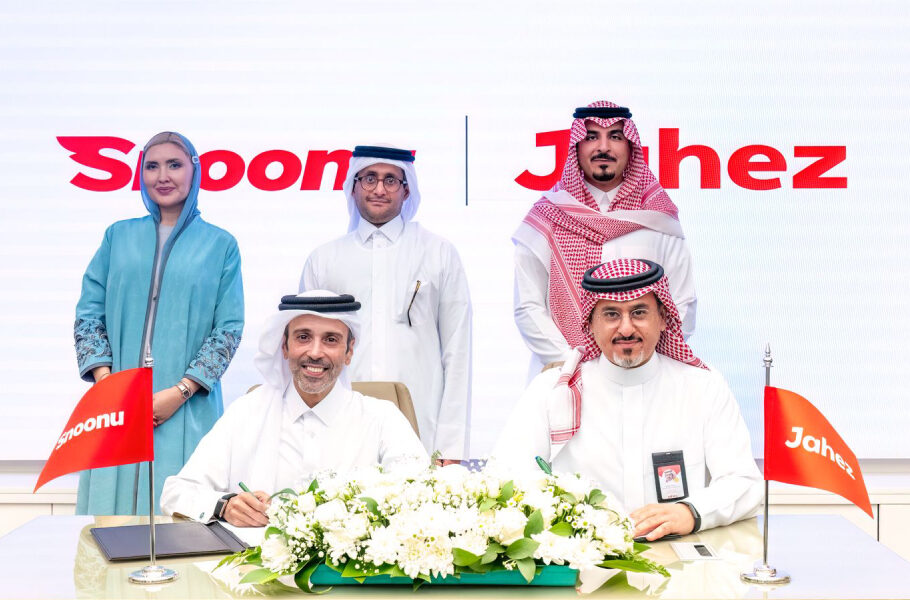
In a groundbreaking move, Qatar’s homegrown tech champion, Snoonu, has joined forces with Jahez Group, a leading integrated ecosystem of on-demand services in Saudi Arabia, setting the stage for a transformative journey in the Gulf’s digital landscape.
The deal sees Snoonu, Qatar’s fastest-growing technology company, valuing the company at over QR 1 billion, making Snoonu the first Qatari tech startup to cross this milestone. This supports its path to becoming Qatar’s first unicorn and establishing one of the most dynamic technology powerhouses in the GCC. This transaction represents a strong vote of confidence in Snoonu’s growth trajectory and will support the company in regional expansion and enhance innovation across its platforms.
“This transformative partnership with Jahez marks a defining moment in Snoonu’s journey,” said Hamad Al Hajri, Founder and CEO of Snoonu. “Together, we are creating a true regional technology champion built on shared values and a common vision for innovation, excellence, and sustainable growth. By joining forces, we are combining complementary strengths and deep market knowledge to set new benchmarks in the GCC’s digital economy. This partnership also reaffirms our unwavering commitment to Qatar, a thriving and dynamic market with immense potential, and supports Snoonu’s continued growth journey. Together, we will continue driving technological advancement, creating meaningful value to our users and merchants, and delivering exceptional experiences at scale.”
Key Highlights:
Empowering Local Innovation: The initiative accelerates Snoonu’s mission to deliver cutting-edge solutions, fostering local talent and attracting bright minds from around the world to contribute to Qatar’s growing tech ecosystem.
Boosting Qatar’s Digital Economy: The investment signifies a robust vote of confidence in Qatar’s digital infrastructure and its potential to lead in the tech arena.
Regional Synergy: Combining Snoonu’s dynamic approach with Jahez’s extensive experience creates a powerhouse poised to redefine the digital experience across the GCC.
This strategic transaction is more than a business deal; it’s a commitment to shaping a future where technology bridges communities, enhances lives, and positions Qatar at the forefront of digital transformation.
Since its launch in 2006, the Sheikh Zayed Book Award has established itself as one of the most prominent literary and cultural awards in the Arab world, and one of the most important international awards in terms of value and influence. This embodies the UAE’s vision of making culture a pillar of sustainable development and a tool for building bridges of dialogue and communication between civilizations.
The award, named after the late Sheikh Zayed bin Sultan Al Nahyan, may God rest his soul in peace, has transformed from a national initiative celebrating knowledge into a prestigious international platform that celebrates creativity and creative individuals, contributing to highlighting the civilized face of Arab culture on the global stage.
Over the course of nineteen years, the award has attracted more than 33,000 entries from nearly 80 countries, honoring 136 winners across ten categories covering diverse intellectual, literary, and cultural fields. These include children’s and young adult literature, young authors, translation, literature, arts and critical studies, manuscript editing, development and nation-building, Arab culture in other languages, and publishing and cultural technologies. The award also includes the “Cultural Personality of the Year” category, which recognizes distinguished contributions to the cultural field. The categories have contributed to strengthening the Arab presence on the international cultural map by honoring writers, thinkers, and publishers who have made a clear impact on the literary and intellectual scene and have contributed to consolidating the concepts of identity, openness, and diversity.
The award’s first cycle began in 2007 with 1,220 nominations. The title of “Cultural Personality of the Year” was awarded to British translator Dr. Denys Johnson-Davies, in recognition of his contribution to the translation of Arabic literature into English.
In the second edition in 2008, the award received 731 entries, and the “Cultural Personality of the Year” award went to former Moroccan Minister of Culture, Mohamed Benaissa.
The third edition in 2009 saw 621 entries, and the prize was won by Spaniard Pedro Martinez Montavez.
The fourth edition, in 2010, honored His Highness Sheikh Dr. Sultan bin Muhammad Al Qasimi, Member of the Supreme Council and Ruler of Sharjah, with the “Cultural Personality of the Year” award. The number of nominations at the time reached 693.
In its fifth edition in 2011, the award received 715 entries, and Chinese orientalist Zhong Jikun won in recognition of his scholarly career in service to the Arabic language.
In the sixth session in 2012, 560 nominations were submitted, and UNESCO won the award in recognition of its role in promoting cultural dialogue.
The seventh session in 2013 saw 1,262 nominations, and the title of “Cultural Personality of the Year” went to His Eminence the Grand Imam Dr. Ahmed El-Tayeb, Sheikh of Al-Azhar.
The eighth edition, in 2014, received 1,482 entries, and the award was presented to the late Saudi King Abdullah bin Abdulaziz Al Saud.
In 2015, the ninth edition registered 1,024 entries, and His Highness Sheikh Mohammed bin Rashid Al Maktoum, Vice President and Prime Minister of the UAE and Ruler of Dubai, may God protect him, won the “Cultural Personality of the Year” award.
In its tenth edition in 2016, the award received 1,169 entries from 33 countries, and French-Lebanese writer Amin Maalouf was named “Cultural Personality of the Year.”
In 2017, the eleventh edition received 1,175 entries from 54 countries, and the award was given to Moroccan thinker Dr. Abdullah Laroui.
The twelfth edition, in 2018, received 1,191 entries, and the “Cultural Personality of the Year” award went to the Arab World Institute in Paris.
In 2019, there were 1,500 nominations from 35 countries, and the award was awarded to academics Dr. Jaroslav Stetkevych and Dr. Susan Stetkevych.
The fourteenth edition in 2020 received 1,900 entries, with the late Palestinian poet and translator Dr. Salma Al-Khadra Al-Jayyousi winning. The fifteenth edition in 2021 saw 2,349 nominations, rising to more than 3,000 nominations from 55 countries in the sixteenth edition in 2022. The award was awarded to critic Dr. Abdullah Al-Ghadami.
The 17th edition, in 2023, received 3,151 nominations from 60 countries, with Egyptian musician Omar Khairat winning the Cultural Personality of the Year award. The 18th edition, in 2024, received 4,240 nominations from across various continents, with the award awarded to the Casa Árabe Foundation in Spain.
The 19th edition, in 2025, saw more than 4,000 nominations from 75 nationalities. The “Cultural Personality of the Year” award went to world-renowned Japanese novelist Haruki Murakami, in recognition of his cross-cultural literary contributions that have helped build bridges of dialogue between East and West.
The 19th edition alone saw the participation of 75 Arab and foreign countries, including five countries participating for the first time: Albania, Bolivia, Colombia, Trinidad and Tobago, and Mali. Egypt topped the list of participating countries, followed by Iraq, Morocco, and Saudi Arabia, while the United States, Britain, and France led the list of foreign countries.
In terms of branches, the Young Author branch came first with 1,034 entries (26%), followed by the Literature branch with 1,001 entries (25%), then the Children’s and Young Adult Literature branch with 439 entries (11%), followed by the Arts and Critical Studies, Development and State Building, Translation branch, Arabic Culture in Other Languages, Manuscript Verification, Publishing and Cultural Technologies, and Cultural Personality of the Year branches.
In 2013, the award established the “Arab Culture in Other Languages” category to honor works published in foreign languages about Arab culture.
In 2023, it launched the “Manuscript Verification” branch, which represents a qualitative addition to supporting heritage.
In 2018, the Translation Grant was launched. From 2019 to mid-2025, it contributed to the publication of 48 translations into 12 languages of prominent literary and intellectual works, such as “The Dinoraf,” “Autumn of Innocence,” and “In the Footsteps of Enayat Al-Zayyat.” These translations have received critical acclaim at international exhibitions and events.
Women’s participation increased significantly by 17% in just three editions, with female nominations rising from 1,042 in the seventeenth edition to 1,218 in the nineteenth. Female authors also won in multiple categories, and female names were included on judging panels and academic councils, further strengthening women’s presence in the cultural landscape.
At the international level, the award has organized more than 200 events in global cities such as Paris, Frankfurt, New York, Tokyo, New Delhi, Madrid, and London, in collaboration with publishing houses, universities, and research centers. It has also developed an advanced electronic platform for receiving nominations and judging, and published periodic reports that support transparency and enhance institutional performance.
The total value of the award is AED 7,750,000 and is granted across ten categories covering literature, translation, children’s literature, young authors, arts and critical studies, Arab culture in other languages, manuscript editing, development and nation-building, publishing and cultural technologies, and the Cultural Personality of the Year. The award is independent and impartial, rewarding excellence and supporting Arab and international creators. Today, nearly two decades after its launch, the Sheikh Zayed Book Award continues its journey as an incubator for creativity and a platform for Arab culture, embodying the UAE’s vision of building a sustainable cultural future.