Arabs & Arabian Records Aggregator. Chronicler. Milestones of the 25 Countries of the Arabic Speaking World (official / co-official). AGCC. MENA. Global. Ist's to Top 10's. Records. Read & Enjoy./ www.arabianrecords.org
Fair was organized by the Muslim World League in cooperation with the Royal Commission for Makkah City and Holy Sites
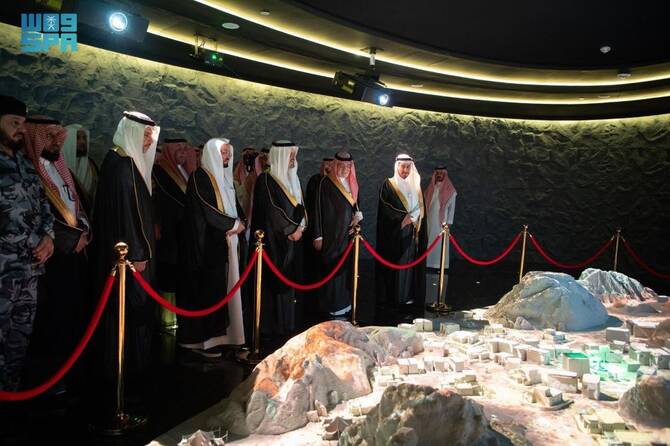
Prince Saud bin Mishaal toured the diverse pavilions and exhibitions, which offer visitors an educational experience on the life of Prophet Muhammad and Islamic civilization
Makkah Deputy Gov. Prince Saud bin Mishaal bin Abdulaziz recently inaugurated the International Fair and Museum of the Prophet’s Biography and Islamic Civilization at the city’s Clock Towers.
The fair was organized by the Muslim World League in cooperation with the Royal Commission for Makkah City and Holy Sites, the Saudi Press Agency reported.
Prince Saud toured the diverse pavilions and exhibitions, which offer visitors an educational experience on the life of Prophet Muhammad and Islamic civilization, using advanced visual and digital technologies.
The fair features a pavilion titled “The Prophet as if You Were with Him,” depicting scenes from Makkah, Madinah, and the migration route.
It includes a panoramic display of the prophet’s chamber, pavilion on prophetic medicine, and presentation of his daily routine.
Prince Saud was also briefed on the accompanying digital platform, which includes a library and encyclopedias translated into major world languages.
He also visited the permanent exhibition showcasing the Kingdom’s efforts to serve the Two Holy Mosques, Qur’an, and Sunnah.
source/content: arabnews.com (headline edited)
______________
Makkah Deputy Gov. Prince Saud bin Mishaal bin Abdulaziz inaugurated the International Fair and Museum of the Prophet’s Biography and Islamic Civilization at the city’s Clock Towers. (SPA)
This year has seen a number of artefacts recovered from the Mediterranean Sea off the coast of Egypt. The area has attracted interest for some time due to ongoing searches for the tomb of Cleopatra VII and Alexander the Great. But the new finds add to our knowledge of the ancient city of Canopus, one of several settlements that have largely been lost to the sea.
The discovery of buildings and an ancient dock is particularly crucial for our understanding of this principal port – one of the most important for the economy of Egypt before the foundation of Alexandria in the 4th century BC.
The Nile Delta is where the river flows into the Mediterranean Sea, and the twin cities of Canopus and Thonis-Heracleion were situated on opposite banks. Canopus was on the western side, at the mouth of the westernmost branch of the Nile. Recovering artefacts from the mouth of the Nile is difficult because much of the material not only lies on the seabed, but is submerged under clay and silt.
The preservation of archaeological material underwater is variable. Metal objects do not fare well, but stone is more durable. Organic materials such as wood can last surprisingly well due to the lack of oxygen in waterlogged places, although they become very vulnerable when removed, so rapid protection is essential.
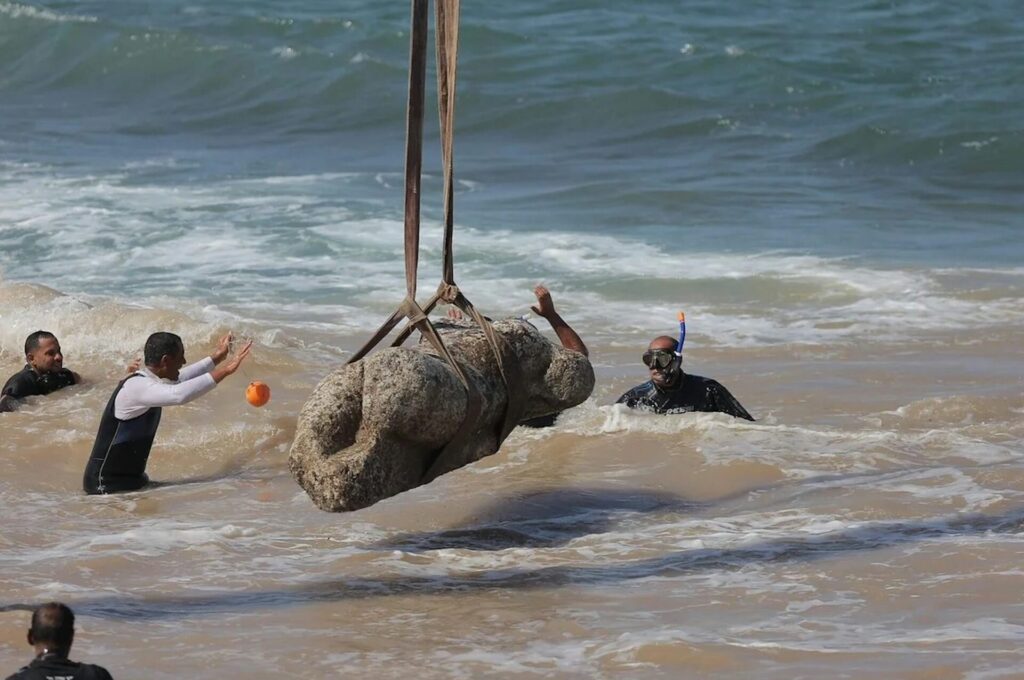
The recent discoveries include the remnants of an ancient harbour and a merchant ship, shedding light on shipbuilding techniques and economic activity.
Statues continue to emerge, building on what we already know of sculptural practices, religion and politics. They offer clues as to the physical appearance of the ancient city.
One of these statues is a huge quartz sphinx holding the cartouches of Pharaoh Ramesses II (carved oval tablets bearing his name). While it is not yet determined how or when that sphinx was brought to Canopus, it emphasises the antiquity of the site. A white marble statue of a Roman nobleman further confirms the city’s status as multicultural and extremely wealthy.
Where Greece and Egypt meet
The foundation date of Canopus is unknown, but the site had been settled for centuries before the Greeks. It was first mentioned in writing in the 6th century BC, in a poem by Solon.
Expanded over time, in a location perfect for trade and military activity in the Mediterranean, Canopus became a key part of the success of the Greek rulers of Egypt. It served the Ptolemaic dynasty well for several centuries before eventually becoming part of the Roman empire around 30BC. However, the coastal position meant that settlements in that area were vulnerable to environmental stresses and earthquakes and rising sea levels eventually submerged them by the 8th century AD.
A large proportion of the western suburbs of Canopus are today underneath the modern Egyptian coastal town of Abu Qir, while the eastern suburbs are underwater.
For ancient people, Canopus was a place of pilgrimage. Countless people travelled to the sanctuaries of the Egyptian gods Osiris and Serapis there to take part in the Mysteries of Osiris. The annual religious festival reenacting the god’s murder, dismemberment and resurrection dated back to the earliest days of ancient Egypt.
The modern site of Abu Qir was also a place of importance to early Christianity, as religious changes took hold across the world.
A sunken city and its treasures
Underwater excavation in the Alexandria area has continued for decades, most notably by French archaeologist Franck Goddio and his team. They work under the auspices of the European Institute for Underwater in collaboration with the Egyptian Ministry of Tourism and Antiquities.
Many initial finds were made during the team’s work in the 1990s-2010s. The British Museum showcased some 200 of its artefacts in their Sunken Cities: Egypt’s Lost Worlds exhibition in 2016. Highlights included a 5.4 metre tall granite statue of Hapy, the personification of the Nile (on loan from the Maritime Museum , Alexandria ) and a massive statue of the Apis bull (from the Graeco-Roman Museum, Alexandria). It showed that Greek rule did not mean the end of Egypt; rather, it was refashioned with a new image.
A sculpted figure of the posthumously deified Arsinoe II, daughter of Ptolemy I, as the Egyptian goddess Isis was also found. It is an intriguing combination of the timelessness of ancient Egyptian statuary, overlaid with the Greek aesthetic, wearing garments rendered in stone so fine they seem transparent.
There is much more to be found beneath the waves, but the strict criteria applied to these underwater excavations mean that most objects will remain there, at least for now, with plans being developed for the world’s first underwater museum.
The targeted nature of the excavations is part of a quest to highlight and celebrate the work being done around underwater heritage. As climate change pushes sea levels ever higher, the need for protection for archaeological sites like Canopus only becomes more pressing.