The initiative aims to ensure that individuals with autism can access meaningful opportunities and social integration worldwide.
Qatar, in collaboration with international partners, has launched the Global Autism Advocacy Coalition (GAAC), calling on the global community to join forces in supporting people with autism and their families.
The initiative, announced during the 80th session of the United Nations General Assembly, aims to move beyond awareness and promote concrete collective action for a more inclusive future worldwide.
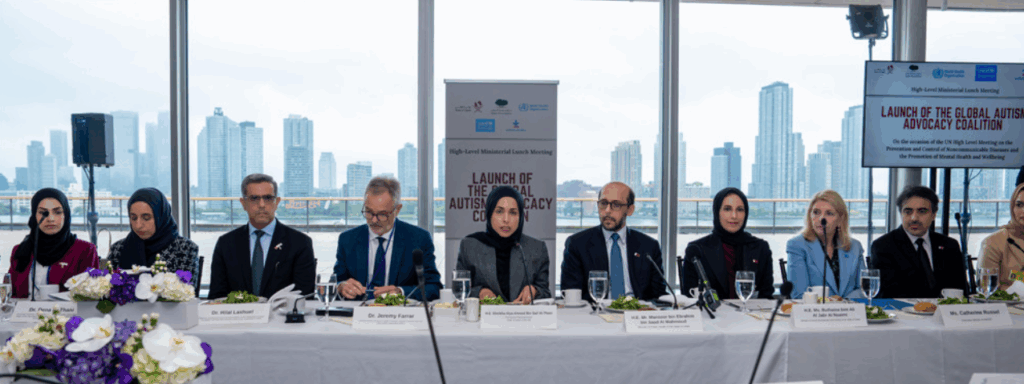
The GAAC, led by Qatar Foundation (QF) alongside the World Health Organization (WHO), UNICEF, and Autism Speaks, was unveiled during the UN’s High-Level Meeting on the prevention and control of non-communicable diseases and the promotion of mental health and well-being.
Current estimates suggest that around 80 million people globally, approximately one percent of the world’s population, are on the autism spectrum, highlighting the urgent need for coordinated international support.
The coalition seeks to advance autism on the global agenda, encouraging governments, NGOs, charities, and private sector partners to allocate resources, develop inclusive policies, and share knowledge across research, education, technology, and community engagement.
Minister of Public Health, Mansoor bin Ebrahim bin Saad Al Mahmoud, described the coalition as “a beacon of what can be achieved when nations unite for good. By working together, we can improve the lives of millions of individuals with autism, helping them reach their full potential and showing the world that collective action delivers hope, dignity, and opportunity,” according to the Ministry of Social Development and Family’s press release.
Buthaina bint Ali Al Nuaimi, Minister of Social Development and Family, highlighted Qatar’s pioneering role in autism support.
“This moment reflects the vision of Her Highness Sheikha Moza bint Nasser, whose leadership has long advanced dignity, inclusion, and opportunity for individuals with autism. In 2017, Qatar launched its first national autism strategy, creating a foundation for inclusive policies and services. Since then, Qatar has championed the rights of the autistic community through early diagnosis, education, and community services, ensuring inclusion at every stage of life,” she said.
She added, “Looking ahead, innovation must remain central to continued progress. For us, innovation is not only about technology, but also about re-imagining how social systems, family support, and community engagement work together so every individual can contribute meaningfully to society.”
Associate Professor Dena Al Thani, Co-Founder of the Autism Sensing Center of Excellence at Hamad Bin Khalifa University, emphasised priority areas for international cooperation, including early diagnosis, investment, and technological innovation in autism assessment and intervention.
Hilal Lashuel, Research, Development, and Innovation Advisor at QF, said: “Having a global voice for autism and launching supportive platforms for individuals with autism has become a global necessity, not a choice. Autism is a worldwide challenge that requires a global response and resources beyond the capacity of any single country or institution. One of the coalition’s main objectives is to strengthen integrated international collective action across all fields, translating decades of hope, investment, and progress into tangible solutions that positively impact individuals with autism and their families.”
Sheikha Moza bint Nasser, Chairperson of Qatar Foundation, has long championed global autism awareness. She said in a post on X: ““I welcome the launch of the Global Autism Advocacy Coalition, marking a milestone that shifts our efforts beyond awareness to collective action. This platform urges the international community to embrace its shared responsibility in addressing autism. As the first coalition of its kind, it will ensure autism becomes an international priority.”
She added, “The State of Qatar’s commitment to the causes of autism extends beyond its national border and is rooted in our belief that every individual deserves the opportunity to thrive and lead a fulfilling life. On this occasion, I urge governments, stakeholders, and development partners to move beyond awareness and commit to concrete collective action, including the meaningful allocation of necessary resources.”
Sheikha Moza’s leadership has been instrumental in raising international attention to autism, with her 2007 proposal leading to the UN General Assembly’s adoption of World Autism Awareness Day, held annually on 2 April.
Through Qatar Foundation programmes, including the Renad Academy, and the newly launched Autism Strategy 2025-2035, Qatar continues to expand inclusivity, research, and support services for individuals with autism, setting a global example for collaboration and meaningful action.
source/content: dohanews.co (headline edited)
____________

___________
QATAR