Annual event at King Faisal Center spotlights heritage, intellectual legacy
The official celebration of the 13th Arab Manuscript Day was inaugurated on Sunday by Prince Turki Al-Faisal, chairman of the board of directors at the King Faisal Center for Research and Islamic Studies.
Held under the theme “The Arab Manuscript: Life of a Nation and Pioneer of Civilization,” the event was organized in collaboration with the Institute of Arabic Manuscripts at the center’s headquarters in Riyadh.
Prince Turki said: “This day calls upon the memory of thought and allows the soul to listen to the echoes of centuries past.”
He added that Arab Manuscript Day went beyond celebrating paper and ink and honored the consciousness and intellectual legacy that shaped Arab and Islamic civilizations.
He recalled that the late King Faisal bin Abdulaziz received a delegation from the Institute of Arabic Manuscripts in Riyadh more than 50 years ago, near the site of the current center.
The meeting, he said, was a moment of “intellectual enlightenment,” during which King Faisal described heritage as a vital part of identity, comparing it to “a rich fountain of culture that never stops flowing.”
Abdulrahman Al-Khunaifer, adviser at the center, said that the day symbolized the convergence of time and place, at which “Damascus, Cairo, Baghdad, and Cordoba meet Riyadh and Diriyah” to celebrate the enduring legacy of the handwritten book.
He added that the center had produced thousands of titles and research projects that had kept the Arab manuscript “alive and beating” throughout history, and that the hosting of this year’s celebration represented the culmination of those efforts.
Three awards were presented during the ceremony: Yahya Mahmoud bin Junaid, a Saudi professor, was named the Heritage Research Personality of the Year in the Arab World.
In his acceptance speech he described heritage as a living tool for understanding modern society and the evolution of intellect, calling for the creation of a comprehensive digital index of heritage books to support researchers.
The award for Heritage Institution of the Year in the Arab World went to the National Laboratory for the Conservation and Restoration of Parchment and Manuscripts in Kairouan, Tunisia. Its director, Manal Rimah, said the recognition was a tribute to Tunisia’s cultural institutions.
The Heritage Book of the Year went to “The Collection of the Gems of Navigation in the Compendiums of the Benefits of Agriculture,” edited by Ihsan Thannoon Al-Thamiri, a professor from Iraq.
He described the work as an encyclopedic documentation of Arab agricultural knowledge, the result of a long period of dedication.
Since its founding in 1983, the center has become one of the leading global institutions in manuscript care. Its collection includes around 30,000 manuscript titles and 150,000 digitized manuscripts, reproduced in collaboration with major libraries and museums worldwide.
The center has also cleaned and restored about 330,000 books, manuscripts, and documents, reinforcing its position as a key scientific and cultural platform for future generations.
“What King Faisal began five decades ago with the Institute of Arabic Manuscripts is now being continued by his sons and grandsons with modern awareness and cultural dedication,” Prince Turki said as he reflected on the Kingdom’s vision of knowledge and culture as pillars of progress.
source/content: arabnews.com (headline edited)
______________
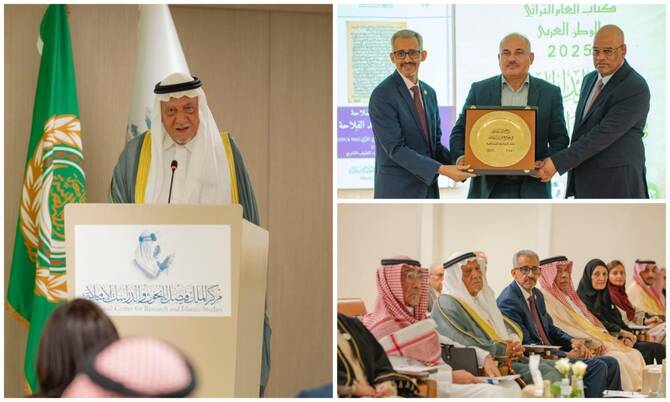
Left: Prince Turki Al-Faisal gives his opening remarks on the occasion of the 13th Arab Manuscript Day at the King Faisal Center for Research and Islamic Studies; Since its founding in 1983, the center has become one of the world’s leading references in the field of manuscript care. It holds around 30,000 manuscript titles and 150,000 digitized manuscripts. (Supplied)
________________
SAUDI ARABIA