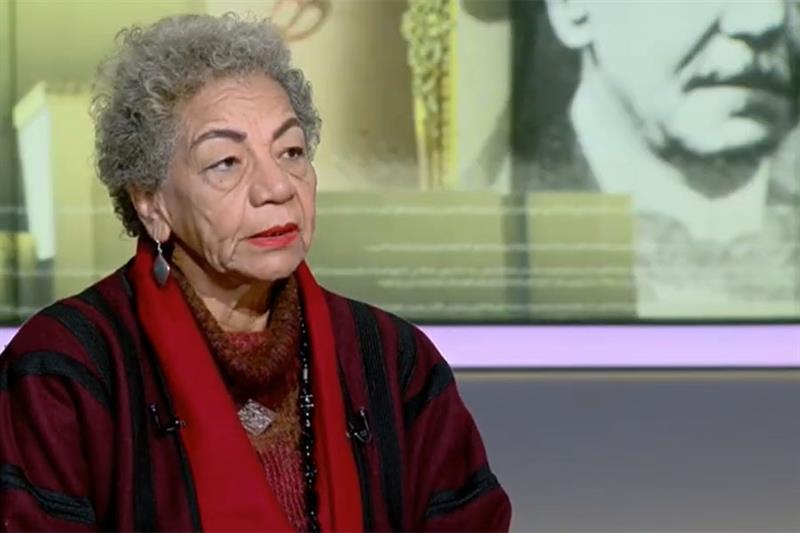
Awarded the inaugural BRICS Literature Award, Egyptian novelist and critic Salwa Bakr reflects on writing from the margins, the hidden forms of violence embedded in social life, and literature’s enduring role in confronting injustice.
This year, Egyptian novelist and critic Salwa Bakr received the inaugural BRICS Literature Award in recognition of her literary contribution.
Established in 2024, the prize honours the literary achievements of authors from BRICS member states: Brazil, Russia, India, China, South Africa, Saudi Arabia, Egypt, the United Arab Emirates, Ethiopia, Indonesia, and Iran. While BRICS primarily functions as a political and diplomatic coordination forum, the award introduces a cultural dimension to the grouping.
Born in Cairo in 1949, Bakr has published seven collections of short stories—a genre with which she is closely associated—as well as seven novels. Her 1998 novel Al-Bashmouri (The Man from Bashmour) was listed by the Arab Writers Union as one of the top 100 Arabic literary works. Translated into several languages, including English by the American University in Cairo Press, the novel revisits the ninth-century revolt of largely Coptic peasants in Egypt’s Delta against the excessive land taxes imposed by Arab governors. Beyond its historical setting, however, the work reflects on the deep commonalities shared by Egyptians, both Copts and Muslims.
Bakr regards the BRICS Literature Award not merely as a personal achievement but as a reflection of what she described as “the strength of Egypt’s soft power.” She also views it as recognition of literary works that engage deeply with life’s struggles, particularly those of marginalized communities.
“Addressing questions of justice among people is something literature is uniquely equipped to do,” Bakr said. “When marginalized groups become the focus of a literary work, they also become the focus of serious questions about justice.”
Such reflection, she argued, extends to what she calls “soft violence”—a form of harm that is often overlooked precisely because it does not present itself as overt brutality. “Soft violence is inflicted through practices of arrogance that may not appear violent but are deeply painful,” she said, adding that its failure to be widely recognized makes it harder to confront or remedy.
Bakr stressed that reflecting on historical injustice is not an exercise detached from contemporary reality. Rather, she sees it as an attempt to adopt a broader perspective that enables deeper engagement with enduring questions of relevance. “This is the point of literature,” she said: to cultivate a more enlightened understanding of history and reality, without lapsing into moralizing or patronizing tones.
For this reason, she resists reading Al-Bashmouri narrowly as a novel about Coptic suffering. “It is a novel about Egyptian peasants—the Bashmourians—who revolted against inflated land taxes imposed by the governors of Egypt,” she said.
Similarly, Bakr rejects rigid labels such as “feminist literature.” “I do not write under a specific banner,” she said. “I reflect on women’s perceptions of themselves and of the world they inhabit.” She emphasized that her work does not promote a confrontation between men and women, but rather examines the social norms that shape women’s status and constrain their lives.
These concerns are powerfully explored in her 1997 novel Al-A’raba Al-Zahabiya La Tazhab Ila Al-Sama’ (The Golden Chariot Does Not Ascend to Heaven). Set largely within a prison cell, the novel centres on Aziza, a young woman who gazes at the sky through her cell window and dreams of building a chariot that could carry her beyond the bars—both literal and social—that confine her. Through this stark setting, Bakr probes the obstacles that hinder women’s lives, as well as the broader realities of poverty, inequality, and the often-unfulfilled yearning for a better existence.
For Bakr, it is among marginalized and grassroots communities that life’s most fundamental questions surface. “This is where the core of life lies,” she said, “and where the essence of a nation’s culture can be sensed.” It is within this milieu, she argued, that one can perceive the accumulated layers of Egyptian history, with all its complexity and contradictions, and grasp an identity shaped over centuries.
Bakr’s sensitivity to these themes is rooted in personal experience. She grew up in a modest neighbourhood in East Cairo and witnessed her mother endure severe financial hardship following her husband’s death. These early experiences, she has said, familiarized her with the challenges faced by Egyptians of limited economic means.
Bakr made her literary debut in 1986 with the short-story collection Zeinat fi Ganazat Al-Ra’is (Zeinat at the President’s Funeral). Her first novel, Wasf Al-Bolbol (The Description of the Nightingale), followed in 1993. Both works examine the social injustices confronting women across different contexts and offer an unflinching critique of repression, particularly that imposed by social convention.
source/content: english.ahram.org.eg (headline edited)
_____________
__________
EGYPT