On her 50th anniversary, We proudly present episode 1 Fathiya Ahmed, the singer of the two regions.
After featuring the Sultana of Tarab Music, the Prince of Arabic Violin, the Master of Buzuq, Hajja Zeinab El Mansouria, the rich music of Yemen, Arab songs of Satire and Resistance, and the Music of Tunis, we proudly introduce Fathiya Ahmed, the singer of two regions – Egypt and Bilad Asham.
Music is a powerful force for healing and reconnecting us with our roots and shared humanity in a world of numerous challenges.
‘From Ocean to Gulf: Heritage Music of the Arab World’ is a new series by Ahram Online, in partnership with the AMAR Foundation (Foundation for Arab Music Archiving and Research). Focusing on the early years of recording in our region, which reflected a modern cosmopolitan repertoire and coincided with the Renaissance era that flourished in Egypt between the mid-19th century and the 30s of the twentieth century, this initiative aims to introduce our audience to the iconic figures of Arab music whose contributions have enriched our intangible cultural heritage and inspired generations worldwide.
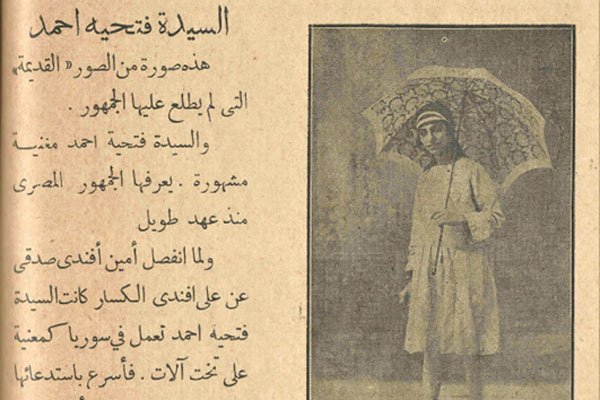
Archive: Young Fatheyia. Photo courtesy of Akram Rayess
Child prodigy female performer
Fathiya Ahmed (1898-1975) was one of three daughters of a Qur’an reciter, Sheikh Ahmed El-Hamzawi. Each of her two sisters, Ratiba and Mufida, had a singing career. She was born in the Kharanfash Alley of Historic Cairo and began her career as a young girl in musical theatres.
She joined the well-known theatre companies until 1927, when she decided to sing solo. She became an important mutriba (Chanter) with takht in the tradition of awâlim. She was one of the singers who carried the practice of wasla into the 20th century. Fathiya also made numerous annual commercial recordings and toured Syria, Lebanon, and Palestine, where she developed a large audience. Because of this, she was named “Mutribat al Qutrayn” (the singer of two regions – Egypt and Bilad Asham).
Dr Sayed Ali Ismail’s book “The Journey of Theatre in Egypt” (2003) states that Fathiya’s first steps took place as a young child when directors of theatrical troupes competed to hire her to sing between acts. This occurred at a time when women started to become active participants in the musical scene in Cairo at the turn of the 20th century. Her theatrical singing brilliance reached its peak in 1918 when she joined Naguib Al-Rihani’s troupe at the Egyptian Theatre (Tiyatro Al-Egbsiyaneh). In 1919, she joined the troupe of Amin Sedqi and Ali Al-Kassar, singing and acting in the play “Rahat Theyk”. In 1921, she performed leading roles in the plays of Munira El-Mahdiyya’s troupe, replacing Munira after she left due to conflicts with her husband, Mahmoud Gaber. Among these plays were “Kalam Fi Sirrak”, “Adha”, “ El-Talata Tabta”, and “Al-Caporal Simon.”
In 1925, Fathiya joined the troupe of Amin Sedqi and Naguib Al-Rihani, where she starred in the plays “Qunsul Al-Wiz”, “Merati fi Al-Gihadiyya”, and “Bint Al-Shabandar”. In 1926, she sang in the play “Laylat Cleopatra” with the Oqasha troupe.
In 1927, she played the role of Cleopatra in the play Cleopatra and Mark Antony by Munira El-Mahdiyya’s troupe, and she also sang between the acts of the play The Emperor with the musical ensemble of Fatma Roshdi’s troupe. The musical composers included Daoud Hosni, Kamel El-Khoula’i, and Ibrahim Fawzi.
When reading the issue of Rose Al-Yusuf magazine dated 2 June 1926, it can be seen that three female singers reached stardom during that period: Fathiya Ahmed, Munira El-Mahdiyya, and Um Kulthoum, with this order being the ranking preference of the public.
This was her final phase of acting and theatrical singing during that period, as she later shifted to singing in casinos and night venues in late 1927, including the Bosphorus Casino and Badia Masabni’s venue. In these performances, she demonstrated her mastery of the art of the Maqam accompanied by a “takht” of selected musicians.
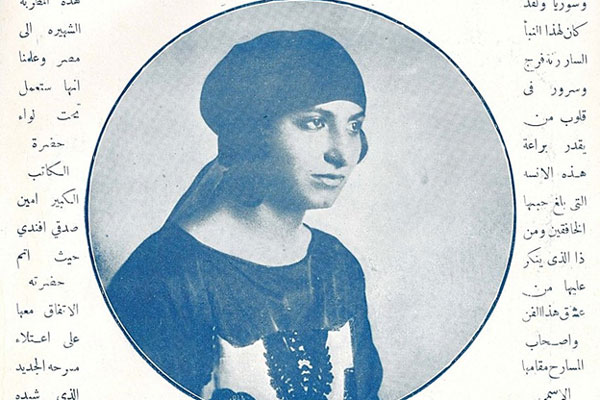
Archive: A news piece informing about Fatheyia’s return to Cairo from Lebanon. Photo courtesy of Dr Sayed Ali Ismail.
Bilad Asham
During this busy period, Fathiya found the time to visit the Levant. In 1921, she set off for the first time to the Levant, where she spent about five years. She felt at home there, and during those years she learned the secrets of musical modes, blending Turkish and Persian modes with the Arab musical tradition. Her performances were met with great enthusiasm. Amer Nadrous, a writer and a record collector from Syria, brings forth some of what she said about her experience in Aleppo: “Singing before its people is an exam that renews itself every night… their ears never miss, and they can always distinguish between what is trivial and what is precious.”
Crowds of thousands would rush to reserve seats in Aleppo’s Luna Park and Al-Shahbandar gardens to hear that unique voice. In Damascus, she performed in Hadikat Al-Umma, enchanting its people while singing adwar, qasā’id, and mawwāl without microphones or any amplifiers. This is in addition to her tours and performances in Jerusalem, Beirut, Nablus, and Tripoli, where audiences welcomed her warmly, and she rivalled the great masters of classical singing. Nadrous adds that the poet Amin ‘Izzat al-Hajin, among many others, praised her in a poem whose opening line says: “Songbird of the East, come back… return the songs of eternity to my ears.”
Travelling with her husband to the Levant to perform became an annual event during that phase of her career. Fathiya even received a special invitation from the King of the Hejaz and Sultan of Najd, Ibn Saud, to sing in his presence. Nadrous informs that her husband provided her with Bedouin poetry quartets to sing at this occasion. Moreover, she took the opportunity to go on pilgrimage while there.
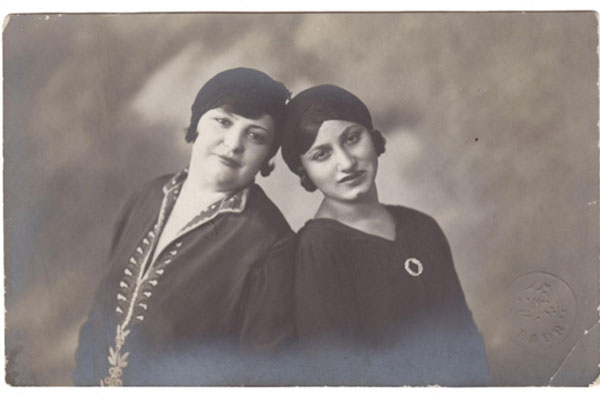
Archive: Fatheyia and her sister Ratiba. Photo courtesy of Dr Ahmad AlSalhi.
Vigorous Years
Dr Fahd El-Faras is a music researcher who was previously the head of the Music Education Department at the Faculty of Education in Kuwait. He is a keen enthusiast of Fathiya’s songs and an avid collector of her original recordings. El-Faras discusses the significance of musical theatre, which he considers to be the setting of her artistic beginnings that shaped her talent and artistic personality. It is an important phase of Touha’s artistic career, spanning three decades from the 1920s to the 1940s, which provided her with the creative space to affirm her artistic status as a leading figure and to demonstrate her unique vocal abilities.
El-Faras adds that through her collaboration with Sayyid Drawiche, Fathiya learned how to sing on stage, face an audience, and master the expressive style of theatrical singing. Moreover, Naguib El Rihani recognised Fathiya’s talent and understood her artistic abilities, which in turn greatly benefited his musical theatre, empowering her to enter the creative scene as both a singer and stage actress. She gives credit to Rihani and indicates that she had learned a great deal from him, including how to handle stage movement, performance techniques, and delivery, from vocal pitch and theatrical singing in connection with the play’s narrative, and how to perform comedy. She also participated with several other theatrical troupes, which gave her an accumulation of extensive experience and confidence in combining acting and singing, making her highly sought after by audiences for musical plays.
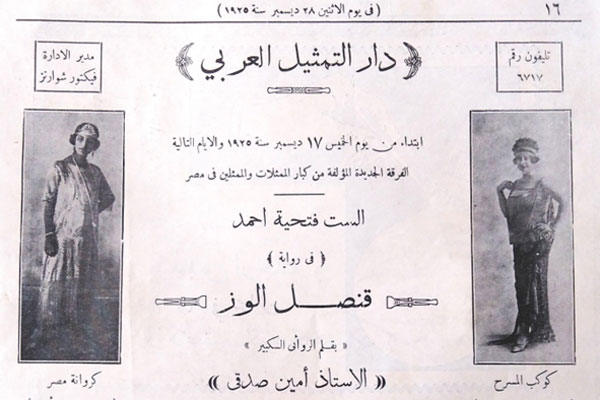
Archive: An Announcement of a play starring Fatheyia Ahmad and Badi’a Masabni. Photo courtesy Amer Nadrous.
Fathiya’s Garden
In 1933, after a long absence from the art scene in which she dedicated her time to raising her children, Fathiya Ahmed formed a musical theatre troupe and established an outdoor venue which she named “Fathiya’s Garden”. Dr Sayid Ali Ismael indicates that she produced and starred in several plays composed by Ibrahim Fawzi in her new space, some of which had nationalistic sentiments consistent with the prevailing political circumstances of that time. In 1934, Fathiya left her own “Garden” and returned once again to singing in other venues and theatres, such as the Ramses Theatre, where she sang in the plays Sondouq Al-Dunya, Awlad Al-Fuqara, and Al-Fajiʿa for Youssef Wahbi’s troupe. Although short-lived, Fathiya’s Garden marks her multiple roles as a female performer: leading a troupe, managing a venue, presenting original shows, and commissioning music. This illustrates Fathiya’s active agency against preset cliches and stereotypes of passive participation despite aggressive competition and changing musical aesthetics and business practices.
During the 1940s, Fathiya participated in the play “Youm elqiyama”, where she performed her famous song “Ya Halawet Eddunia” composed by Sheikh Zakariya Ahmed. This decade also witnessed Fathiya’s transition to musical films, following the dominant trend at that time. Her most important film was “Hanan” (1944), in which she starred alongside Bishara Wakim and Tahia Carioca, directed by Kamal Selim. It featured the landmark song “Ya tara” composed by Qasabji. The other two remaining film participations were limited to providing vocals that were lip-synced by other actors in “Ahlam Ashabab”, starring Farid El-Attrache and directed by Kamel Selim (1942), and “Aida” starring Um Kulthoum and directed by Ahmed Badrakhan (1944).
source/content: english.ahram.org.eg (headline edited)
____________
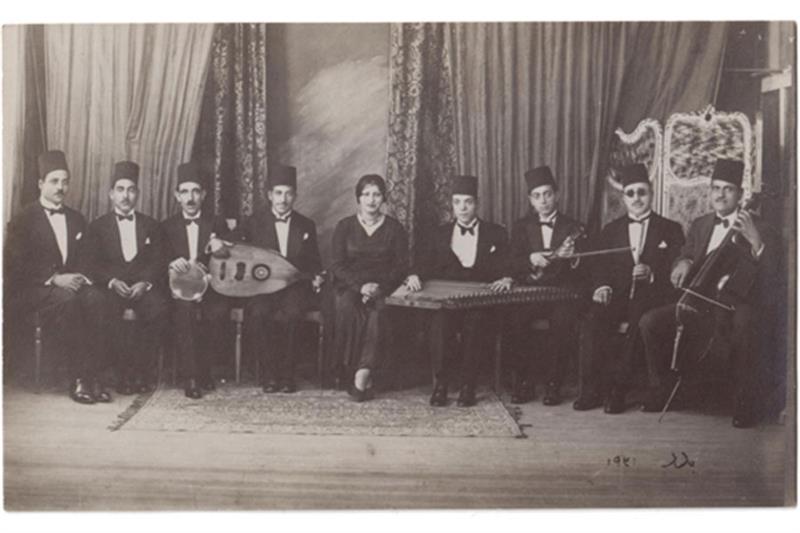
Fatheyia Ahmad and her Takht, 1931 From the archive of Dr Ahmad AlSalhi, Kuwait
__________________