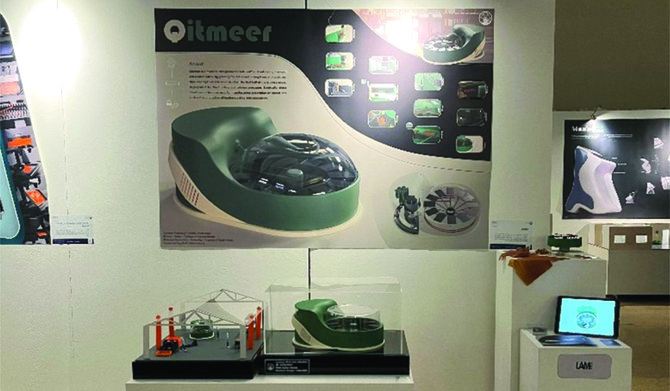
This combination of compassion and technology earned Al-Matrudi’s team multiple global awards this year.
For Dalal Al-Matrudi, innovation began not in a lab but at home, watching a loved one battle multiple sclerosis. What started as empathy soon turned into invention, leading her and her team to develop a smart medical device that is now winning awards on international stages.
“Our innovation is a smart medical device designed to assist patients with multiple sclerosis by providing localized muscle massage controlled through a mobile application,” said Al-Matrudi. “It helps relieve pain, reduce muscle stiffness and improve patients’ comfort and daily mobility.”
The device also connects patients directly with their doctors for real-time monitoring. “In emergency situations, it can instantly alert healthcare providers to ensure the patient receives immediate assistance,” she said.
This combination of compassion and technology earned Al-Matrudi’s team multiple global awards this year, including the Gold Medal with Jury’s Honor, the GCC Patent Office Award, and the Grand Prize at the International Invention Fair of the Middle East, or IIFME, hosted by the Kuwait Science Club. The invention was also recognized at the Geneva International Exhibition of Inventions, one of the most prestigious global platforms for innovation.
For Al-Matrudi, 21, who hails from Riyadh, the project was deeply personal. “Our inspiration came from personal experience — one of my family members suffers from multiple sclerosis, and seeing their daily struggle with pain and mobility challenges deeply affected me,” she said.
Together with her teammates, she transformed that emotional drive into a purpose-driven invention. “We wanted to create something practical and compassionate that could truly improve patients’ lives,” she said.
Under the mentorship of Prof. Dr. Kholoud Al-Muqrin, a distinguished professor of nuclear physics known for empowering young Saudi innovators, the team refined their prototype into an award-winning solution. “Her continuous guidance and scientific insight played a vital role in shaping our project and transforming our idea into a tangible, award-winning innovation,” Al-Matrudi said.
She believes the foundation of every great innovation is care. “We believed that technology should serve humanity, and that small ideas born from care can evolve into meaningful advancements that bring relief and hope to many,” she added.
Months of research, design and testing culminated in an unforgettable moment at IIFME 2025.
“The most emotional moment was standing on stage when our team’s name, Team May, was announced as the Grand Prize Winner,” she said. “I remember holding my teammates’ hands tightly, feeling both disbelief and overwhelming pride.”
For Al-Matrudi, the victory symbolized much more than recognition. “It wasn’t just about the prize — it was about realizing that months of dedication, late nights and countless trials were finally worth it,” she said.
She recalls how their mentor’s tears turned the win into a collective triumph. “I could see tears in everyone’s eyes, especially our supervisor’s, which made it even more special,” she said. “That moment reminded me that passion and persistence can turn ideas into achievements that reach beyond borders.”
Although the invention is not directly tied to her academic major, medical physics, Al-Matrudi says her background gave her the edge she needed to design effectively.
“Studying medical physics enhanced my scientific thinking and deepened my knowledge of how the human body interacts with medical devices,” she said. “This understanding helped me design a solution that is both safe and effective.”
She believes the key to meaningful innovation lies in combining technical knowledge with emotional intelligence. “Gaining international recognition encouraged me to continue combining my medical knowledge with creative thinking to develop innovations that make healthcare more compassionate, practical and accessible for all,” she said.
Al-Matrudi’s story reflects a growing wave of young Saudi women who are redefining the global image of innovation.
“I hope my journey shows Saudi women that ambition and creativity have no limits,” she said. “Science and innovation are not exclusive fields — they welcome curiosity, persistence and passion.”
Her experience also underscores how inclusion fuels progress. “When women step into these spaces, they bring empathy and fresh perspectives that drive real progress,” she said.
Her message is simple but powerful: “I want every Saudi girl with a dream to believe that she can represent her country globally, no matter her field. Our achievements are proof that with teamwork, guidance and confidence, Saudi women can lead the way in shaping the future of science and technology.”
Today, Al-Matrudi stands as one of the brightest examples of how Saudi youth are translating Vision 2030’s goals into real-world impact. Through her invention, she’s proving that innovation is not just about devices, it’s about dignity, hope and humanity.
As she proudly waved the Saudi flag on stage in Kuwait, surrounded by fellow inventors and mentors, Al-Matrudi’s message was clear: Saudi women are not just participating in the global innovation movement, they’re leading it.
source/content: arabnews.com (headline edited)
______________
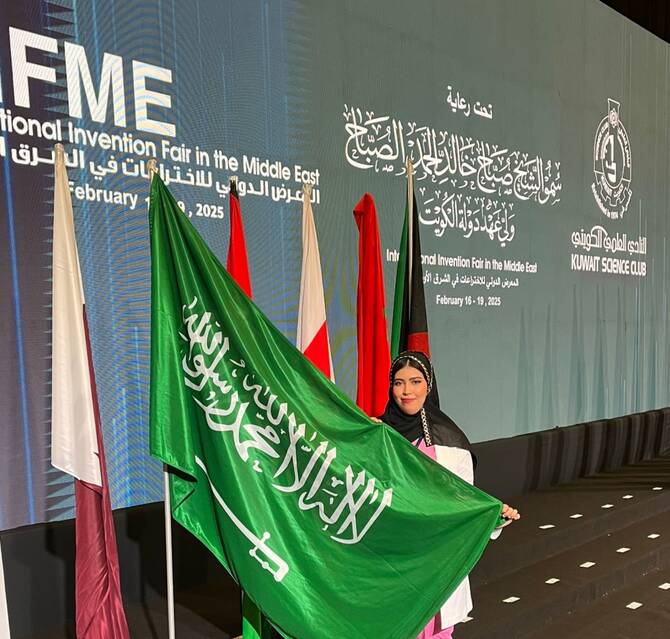
Saudi innovator Dalal Almatrudi proudly holds the Saudi flag after winning the Grand Prize at the International Invention Fair of the Middle East 2025 in Kuwait. (SUPPLIED)
__________________
SAUDI ARABIA