SOMALIA : Ahmed Ismail Hussein, The “King Of Oud,” Has Died Of The Coronavirus – April 2020

“All of my friends who have met him still love him. He has made a huge impact on them just from that one day they saw him.”

Ahmed Ismail Hussein was known as the “King of Oud” because he was the master of the 11- or 13-stringed instrument.

Born in the late 1920s in Somalia, Hussein began playing the oud professionally in the ’40s after falling in love with it in his teens. He was instrumental in making qaraami — singing or speaking while playing the oud or drums — one of the most popular genres of music in Somalia.

In February this year, after a career spanning more than seven decades, Hussein retired. He was considered a founder of modern Somali music. A concert was held in his honor in London. — Hussein moved to the UK in 1974 — with artists whom he handpicked.

Despite his retirement, Hussein, who also went by the name “Hudeydi,” had no intention of slowing down entirely; he had plans to travel to Turkey and Djibouti.

But then he fell ill. Earlier this month, he was taken to Charing Cross Hospital in London. His condition deteriorated, and on April 8 he died from the coronavirus, a week before what would have been his 92nd birthday.

Nadifa Mohamed, a British author, said she spoke to Hussein a few days before his death, when he didn’t even seem to have symptoms. “I think the decline was quite quick from him developing symptoms to him being quite ill in hospital. It was quite shocking,” she told BuzzFeed News.

Despite his age, Hussein was otherwise a fit and healthy person, Mohamed said. “Everyone was like, ‘He was 92 he had a good life’ — but nothing. There was no warning,” she said. “It wasn’t as if he was sick.”

Mohamed said she had been friends with Hussein since 2012, when they met at the annual Hargeisa International Book Fair in Somaliland, a disputed territory that neighbors Somalia. More so than his musical genius, his sense of humor is what really stood out for Mohamed. “He was funny,” she said. “I think that’s the first thing I noticed.” (His nickname was Hudeydi, but he told the BBC in 2003 that he was also known as “‘the King’ because of my hot rhythms. I was always into rock ‘n’ roll and Elvis Presley”)

“Having a friend who is 50 years older than you is unusual, but I think his sense of humor was so young and easy to engage with,” Mohamed said. “And he was very warm. You could turn up to his door. You could bring whoever you wanted. He would feed you. He would make tea or coffee for you, tell you stories. He was very accepting of people, which was very unusual.”

Hussein, she said, had a charm that would make everyone love him from the moment they met him. “It’s the way that I could turn up with a friend to play an instrument or something else, and he’d give me a big hug as he opened the door and he would go to my friend — whoever it may be — and do the same.

Usually when grieving, Somalis tend to visit the home of the deceased’s next of kin for days to offer their condolences and pray. But this is currently impossible during the lockdowns in place across the world.

After Hussein’s death, tributes poured in from Somalis around the world. On the day of his burial, people held absentee funeral prayers .

In a statement, the Kayd Somali Arts and Culture organization said Hussein’s “iconic legacy lives on through his music and in the memories of all of those of us who adored him and continue to do so.”

source/content: buzzfeed.com (headline edited)

_______________
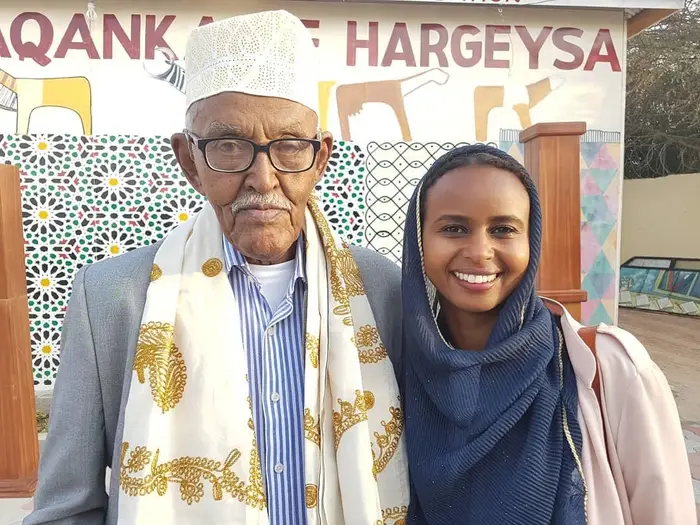

Ahmed Ismail Hussein (left) and Nadifa Mohamed (right), a friend. / Courtesy of Nadifa Mohamed

_________________

SOMALIA / U.K
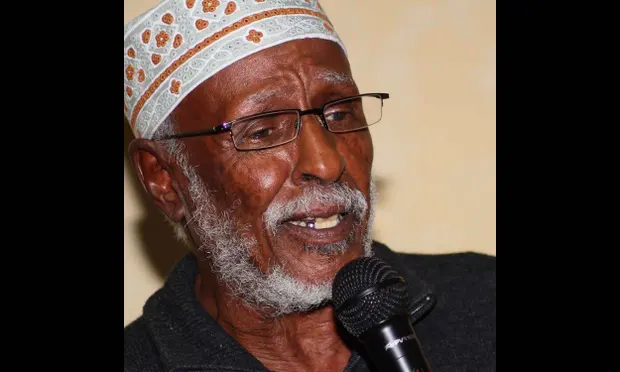
SOMALIA: Mohamed Ibrahim Warsame, one of Somalia’s greatest Poets

Mohamed Ibrahim Warsame, one of Somalia’s greatest poets, dies aged 79.

Somali social media has been flooded with tributes to the man better known as ‘Hadraawi’.

Messages of condolences continue to pour in from around the world following the death of Mohamed Ibrahim Warsame, regarded as one of Somalia’s greatest poets.

Warsame, known as “Hadraawi”, died in Hargeisa, in Somaliland, on Thursday at the age of 79.

Social media has been flooded with tributes and praise for his contribution to Somali language and culture.

“I’m heartbroken to inform you our giant Mohamed Ibrahim Warsame Hadraawi has passed away. Might Allah bless him and grant him Jannah,” Ayan Mahamoud, founder of Kayd Somali Arts and Culture , said on Twitter.

“We will treasure his legacy and the rich scholarly work he left behind,” added Said Salah Ahmed, a poet and playwright who teaches the Somali language at the University of Minnesota in the US.

Hadraawi, which means the “master, or father, of speech”, was regarded as a pillar of modern Somali literature and a strong advocate of peace and democracy.

In 1973, he was imprisoned for five years by the president, Siad Barre, who ruled Somalia until 1991, for speaking against the revolution. His work was banned but he continued to compose poetry upon his release, which were was passed on through word of mouth.

The songs and verses he wrote are full of imagery and metaphor, open to interpretation, which made it hard for the military regime to control. A verse from his poem The Killing of the She-Camel resulted in his imprisonment without trial.

The snake sneaks in the castle:

although it’s carpeted with thorns

still the coward casts off his curses

so the courageous must stretch out his neck;

the cob stallion sells his values

in order to cut a fine figure.

When such cockiness struts forth

and even laughter becomes a crime

our country has unfinished business.

In the early 1990s he called for an end to the civil war, which caused thousands of people to flee Somalia. In 2004, he travelled throughout the country on a “peace march” urging warring parties to stop the violence. His message of reconciliation resonated with Somalis at home and abroad.

He retired a few years ago.

“Poet Mohamed Ibrahim Warsame (Hadraawi) was a symbol of unity and peace,” said the Somali president, Hassan Sheikh Mohamud, in a statement. “He was one of key pillars of Somalia’s art and literature who took a leading role in preserving the Somali culture and promoting the Somali language. His death is felt in every Somali household.”

The EU, Norway, the UK and other friends of Somalia sent condolences and tributes.

“Sending my heartfelt condolences to the people of Somaliland and to all Somalis for the loss of Mohamed Ibrahim Warsame “Hadraawi”, an iconic poet and one of the most eminent and beloved Somali poets of all time,” tweeted Lizzie Walker, head of the Foreign, Commonwealth and Development Office in Hargeisa.

Hadraawi had been called the “Somali Shakespeare”, but Somali singer and songwriter Aar Maanta said: “Hadraawi wasn’t the ‘Somali Shakespeare’ he was the Somali Hadraawi. He was more than a poet; he was a philosopher and a freedom fighter who spent many years in jail for his stance against injustice and dictatorship.

“He wrote some of the most beautiful love songs and poems that Somalis in the Horn of Africa and beyond use as a benchmark.”

Ahmed, who knew Hadraawi since late 1960s, added: “Hadraawi was one of the kindest people I have ever met. His poetry speaks for the voiceless and calls out oppression against the people …. he will be missed so dearly but we will treasure his legacy and the rich scholarly work he left behind.”

Known as a “nation of poets”, poetry is woven into the fabric of Somali society with centuries of oral history, as the Somali language was only written in 1972.

Contemporary Somali poetry, including the works of Hadraawi, has been preserved in books and translated into English.

source/content: theguardian.com (headline edited)

_____________

___________

SOMALIA