SAUDI ARABIA : King Faisal Specialist Hospital performs world’s first robotic intracranial tumor resection surgery

Achievement reflects ‘our growing role in shaping the future of global medicine,’ CEO Dr. Majid Al-Fayyad says

Procedure involved removing a 4.5-centimeter brain tumor with robotic arms from a 68-year-old man who had been experiencing severe headaches

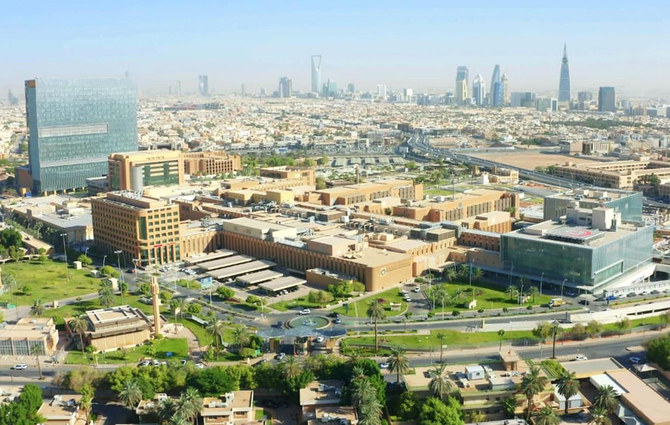
In a historic leap for robotic medicine, the King Faisal Specialist Hospital and Research Centre in Riyadh has performed the world’s first robotic intracranial tumor resection.

This groundbreaking achievement sets a new global standard in neurosurgical precision and recovery.

The procedure involved removing a 4.5-centimeter brain tumor with robotic arms from a 68-year-old man who had been experiencing severe headaches and loss of concentration.

Remarkably, the patient was discharged fully conscious within 24 hours — a recovery time nearly four times faster than that of traditional brain surgeries.

Dr. Homoud Al-Dahash, KFSHRC consultant for skull base tumors and lead surgeon, stated that the robotic system provided exceptional precision and control, which enabled surgeons to navigate critical neurovascular structures with a high level of safety.

“The patient’s same-day discharge, fully conscious and without complications, represents a new benchmark for neurosurgical innovation,” he added.

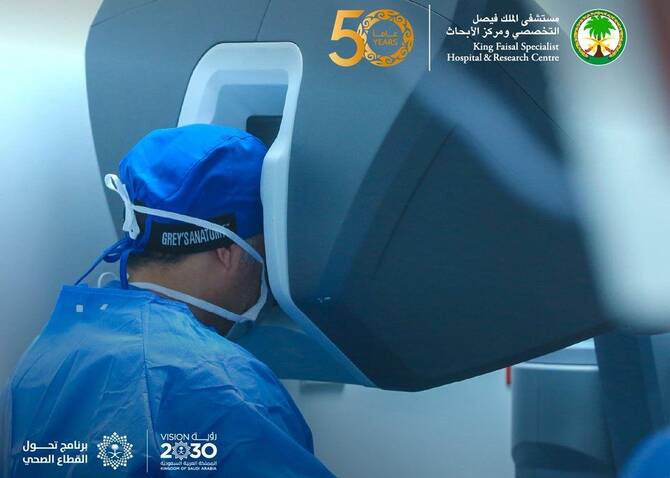
Guided by a 3D optical system, the one-hour surgery enabled surgeons to operate with a clear, magnified view of the brain.

Advanced image-guided navigation technology ensured precise tumor removal while protecting vital areas of the brain.

KFSHRC CEO Dr. Majid Al-Fayyadh linked the milestone to the hospital’s ongoing transformation journey.

“This achievement reflects KFSHRC’s growing role in shaping the future of global medicine,” he said.

“It aligns perfectly with our vision, where innovation and patient-centered care define the future of healthcare.”

Before the advent of robotic neurosurgery, similar procedures required manual removal under a surgical microscope, where precision depended heavily on human steadiness and visual clarity.

Robotic systems now provide enhanced instrument stability, tremor elimination, and superior visualization — redefining global standards of safety and precision in neurosurgical care.

This landmark procedure adds to KFSHRC’s expanding portfolio of robotic surgical breakthroughs.

The institution previously performed the world’s first robotic heart transplant and robotic liver transplant, earning international acclaim and solidifying its standing among the world’s leading centers for robotic and minimally invasive surgery.

KFSHRC has been ranked first in the Middle East and North Africa and 15th globally among the world’s top 250 academic medical centers for 2025.

It was also recognized as the most valuable healthcare brand in the Middle East by Brand Finance 2024 and listed among Newsweek’s World’s Best Hospitals 2025, Best Smart Hospitals 2025, and Best Specialized Hospitals 2026.

These accolades reaffirm its position as a global leader in innovation-driven patient care.

source/content: arabnews.com (headline edited)

___________

King Faisal Specialist Hospital and Research Centre in Riyadh has performed the world’s first robotic intracranial tumor resection. (SPA

__________________

SAUDI ARABIA
SAUDI ARABIA : Robotic-assisted implantation is world’s first performed at King Faisal Specialist Hospital & Research Centre (KFSHRC), Riyadh

Groundbreaking procedure opens new horizons in circulatory support techniques for patients with complex cardiac conditions

Cardiac surgery team, led by Prof. Feras Khaliel, performed the operation through small incisions using remotely controlled high-precision robotic arms

King Faisal Specialist Hospital and Research Centre in Riyadh has performed the world’s first implantation of two artificial pumps for biventricular support using robotic technology on a patient with advanced heart failure.

The groundbreaking procedure opens new horizons in circulatory support techniques for patients with complex cardiac conditions and marks a medical achievement that culminated in the patient’s recovery within a short period following the surgery.

The procedure represents a major advance in the treatment of bilateral heart failure, which was traditionally performed through full sternotomy, an approach associated with higher surgical risks and prolonged recovery.

However, the cardiac surgery team, led by Prof. Feras Khaliel, performed the operation through small incisions using remotely controlled high-precision robotic arms, resulting in reduced blood loss, lower risk of infection, and faster patient recovery.

The milestone reflects the integration of expertise across multiple departments at the hospital, including cardiac surgery, cardiology, anesthesia, critical care, biomedical engineering, and advanced life support.

The procedure was meticulously planned and benefited from 3D imaging technologies, real-time surgical navigation, and innovative solutions. 

source/content: arabnews.com (headline edited)

_____________

KFSHRC has performed the world’s first implantation of two artificial pumps for biventricular support using robotic technology. (X/@KFSHRC)

________________

SAUDI ARABIA

SAUDI ARABIA: Saudi Scientists’ new Bacteria Discovery at King Faisal Specialist Hospital & Research Center could help global fight against antibiotic resistance

Saudi scientists’ use of a special DNA sequencing process to identify a new bacterial species could help in global efforts to combat resistance to antibiotics.

The discovery by experts at Riyadh’s King Faisal Specialist Hospital and Research Center was expected to throw new light on bacterial-drug interactions, fostering innovative therapeutic approaches.

A technique known as whole-genome sequencing was used to spot the new species, stenotrophomonas riyadhensis.

According to the center, the findings will contribute significantly to global antibiotic resistance efforts, while throwing a spotlight on the center’s growing reputation for scientific research and patient care.

In a statement, the center said WGS underscored the “potential of genomic tests in diagnosing and treating bacterial infections, particularly in critical environments like intensive care units and among immunocompromised patients.”

It added that the discovery represented “substantial progress” in the fight to combat antibiotic resistance, the development of pharmaceuticals, and the prevention of disease spread.

The new species, discovered during a 2019 investigation into an outbreak at the center’s intensive care unit, was initially presumed to be a variant of pseudomonas aeruginosa, known for its antibiotic resistance.

However, further WGS analysis revealed that riyadhensis deviated from the pseudomonas genus, belonging instead to the stenotrophomonas family. It exhibited distinct genetic and morphological traits, setting it apart from any other scientifically recognized members.

Head of the center’s infectious disease and immunity department, Dr. Ahmad Al-Qahtani, said: “Traditional bacterial identification methods may lead to misidentification; in contrast, WGS analysis offers a precise and targeted approach that ensures accurate identification and provides detailed insights into resistance mechanisms, proving its significance in disease outbreak investigations and patient care improvements.”

Dr. Reem Almaghrabi, head of transplant infectious diseases at the center’s Organ Transplant Center of Excellence, highlighted the importance of the discovery in the use of advanced technologies, such as WGS, to develop faster and more accurate diagnostic methods.

She said the approach had established the groundwork for scientific collaboration at all levels, enhancing global efforts to combat antibiotic resistance.

Almaghrabi noted that understanding the nuances of new bacterial species, particularly their antibiotic resistance, was crucial in modern healthcare and was the primary means of combating bacterial infections.

“As these bacteria continuously evolve their resistance, they pose a significant and ongoing threat to human health,” she added.

source/content: arabnews.com (headline edited)

__________

A technique known as whole-genome sequencing was used to spot the new species, stenotrophomonas riyadhensis. (Supplied)

_________________

SAUDI ARABIA