MOROCCO : Mohammed VI Museum Marks 50 Years of Green March (on November 06th, 1975) with Special Exhibition.

This year’s commemoration is especially significant, coming just a week after a UNSC resolution placed Morocco’s autonomy plan at the heart of efforts to resolve the Sahara dispute.

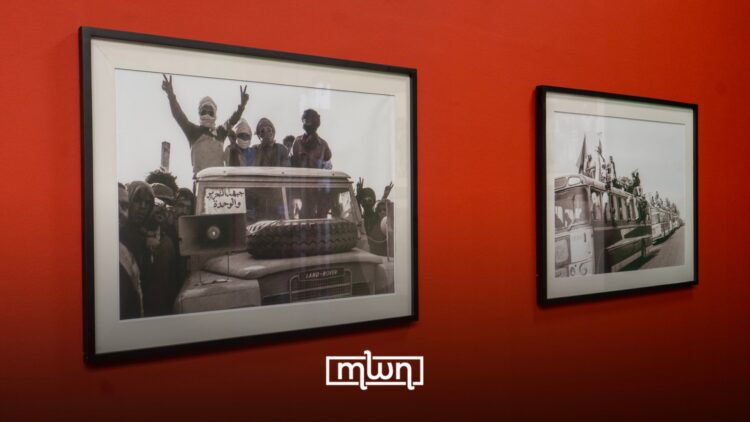
The Mohammed VI Museum of Modern and Contemporary Art in Rabat is commemorating the 50th anniversary of the Green March with a new exhibition titled “50 Years of the Green March: A Memory in Motion.” 

The exhibition pays homage to one of Morocco’s most defining moments and invites visitors to reflect on the enduring values of peace, unity, and loyalty that continue to shape the nation’s identity five decades after the historic march.

Opened this week, the exhibition combines historical documentation with contemporary artistic interpretation. The exhibition includes an evocative collection of photographs that aims to reaffirm the strength of visual memory and its role in preserving national heritage. This is a key element in Morocco’s ongoing narrative of sovereignty and unity.

A tribute to a defining moment

Organized by the National Foundation of Museums (FNM), the exhibition brings together works by renowned Moroccan photographer Daoud Oulad-Syad and a selection from the Rencontres de la Photographie de Marrakech (RPM). Together, they offer a visual journey that captures both the emotion and symbolism of the Green March, which represents a cornerstone of Morocco’s modern history.

Nadia Sabri, Director of the Mohammed VI Museum of Modern and Contemporary Art, emphasized the exhibition’s importance as a bridge between generations.

“What we can really emphasize is that this exhibition provides both visual and historical archives for the public,” she told Morocco World News. 

“It caters to a wide audience, including younger visitors as well as older ones who may have experienced this historic event but do not necessarily remember its key moments, particularly during the march,” Sabri added.

She noted that the exhibition spotlights major figures in the Moroccan photography scene, like Daoud Oulad-Syad, with a photographic series dedicated to the Sahara and the beauty of the desert.

Through Oulad-Syad’s lens, the exhibition moves beyond mere documentation to celebrate the spirit of a nation united under a shared cause. His photographic series dedicated to the Sahara, showcased in the museum’s second gallery, highlights the region’s natural beauty and its deep cultural and emotional connection to the Moroccan people.

The Green March, which took place on November 6, 1975, was a peaceful mass demonstration that changed the course of Moroccan history. Called for by the late King Hassan II, it saw over 350,000 unarmed volunteers, men and women, from all regions of Morocco march southward to reclaim the territory of Western Sahara, then under Spanish occupation.

Carrying Qurans and Moroccan flags instead of weapons, the marchers symbolized Morocco’s unity and commitment to recovering its southern provinces through peaceful means. The event came shortly after the International Court of Justice (ICJ) issued an advisory opinion affirming that Western Sahara was not “terra nullius” (empty land or unclaimed territory) before colonization and that it had historical and legal ties to Morocco.

The enduring significance of the Green March for Morocco

This year’s commemoration carries added significance, as it comes just a week after the United Nations Security Council adopted a new resolution embracing Morocco’s autonomy plan as the most “serious and credible” framework for achieving a lasting and realistic political solution to the regional dispute over the Sahara.

The resolution is widely seen as a diplomatic success for Morocco, as it reinforces international support for its initiative and paves the way for renewed efforts toward a peaceful settlement.

Mehdi Qotbi, artist and President of the National Foundation of Museums, highlighted this connection in his remarks to MWN at the exhibition.

“We are very happy to be celebrating this anniversary today, here at the Mohammed VI Museum of Modern and Contemporary Art … is not only an occasion to mark the anniversary itself, but also to celebrate the diplomatic success achieved thanks to the foresight of His Majesty King Mohammed VI,” Qotbi said.

For him, this success “paves the way for a definitive resolution of the artificial conflict over the Moroccan Sahara and for a better future for the entire region.” The Moroccan artist added that the Foundation and the Museum are proud to take part in this “popular enthusiasm for this cause, for this victory at the United Nations.”

Beyond commemoration, the “Memory in Motion” exhibition aims to spark dialogue about the meaning of the Green March in contemporary Morocco. For many visitors, especially younger ones, the exhibition is an opportunity to connect with a pivotal chapter in Morocco’s collective memory.

source/content: moroccoworldnews.com (headline edited)

__________________

The exhibition includes an evocative collection of photographs that aims to reaffirm the strength of visual memory and its role in preserving national heritage
______________

MOROCCO
MOROCCO : CNDH President Amina Bouayach Receives 2025 Mediterranean Foundation Award in Naples, Italy

Bouayech praised Morocco’s efforts in promoting human rights including recently proposed changes to the country’s family code.

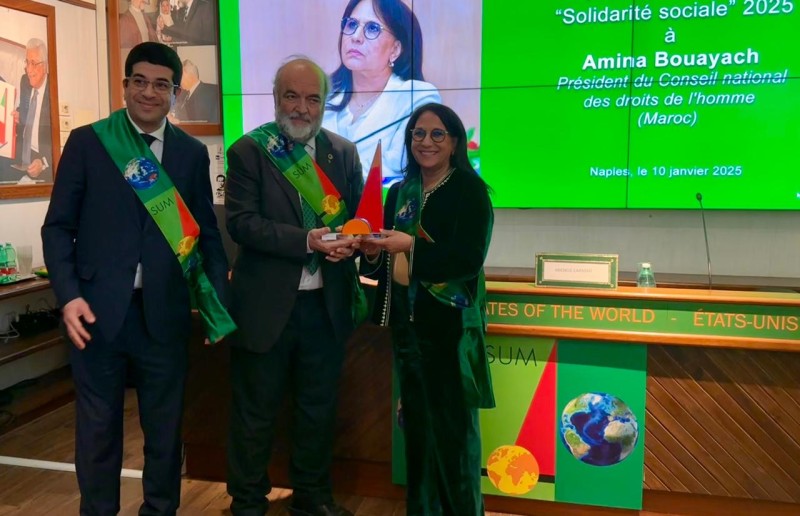
Amina Bouayach, the President of Morocco’s National Human Rights Council (CNDH), has been awarded the 2025 Mediterranean Foundation Award for her contributions to promoting human rights in Morocco and internationally.

The award, presented to her on Friday in Naples, Italy, recognizes individuals or organizations dedicated to upholding the values of human dignity and freedom.

Established by Italian sculptor Mario Molinari, the Mediterranean Prize is a symbol of peace and coexistence between countries. It recognized Bouayach’s work in advancing equality, justice, and fundamental freedoms, the foundation said in a statement.

During the ceremony, President of the foundation, Michael Capasso, along with international jury members and Professor Abdelhak Azouzi, praised Bouayach for her extensive work in human rights.

Bouayach was born in Tetouan, a small city in northern Morocco. For decades, she has been a tireless advocate for women’s and children’s rights, often speaking out against the injustices they face. She has also worked to improve the rights of marginalized groups around the world.

In recognition of her dedication and leadership, King Mohammed VI appointed her as president of CNDH in 2018.

She has also held significant positions in global human rights organizations, including Vice-President of the Global Alliance of National Human Rights Institutions and Vice-President of the International Federation for Human Rights.

In addition to her work in human rights, Bouayach has had a career in diplomacy, having served as Morocco’s Ambassador to Sweden and Latvia.

In her acceptance speech, Bouayach expressed gratitude for the recognition and praised Morocco’s efforts in promoting human rights. She particularly mentioned recent reforms like the vote in favor of a universal moratorium on the death penalty.

“This distinction, while touching me as a woman and activist, is primarily a tribute to my country, Morocco, for its unwavering commitment to the universal values of dignity, justice, and equality,” Bouayech said.

She also mentioned the proposed reforms to Morocco’s family code and they recognize women’s contributions in the household when distributing marital property. “These ambitious reforms, full of hope, aim to strengthen the rights of women and children, bringing significant advancements,” Bouayach said.

CNDH President also noted that the Mediterranean is more than just a geographic area; it is a place rich with shared history, where different cultures have come together to build a common heritage.

She acknowledged the challenges the region faces, such as conflicts and climate change, but stressed that the Mediterranean’s heritage of humanity and diversity offers hope and the potential for renewed dialogue.

In addition, she noted the important role of women in driving social and political change in the Mediterranean, especially in Morocco.

“I dedicate this award to all Mediterranean women who, every day, build bridges between cultures and generations,” she concluded.

source/content: moroccoworldnews.com (headline edited)

____________

_____________

MOROCCO

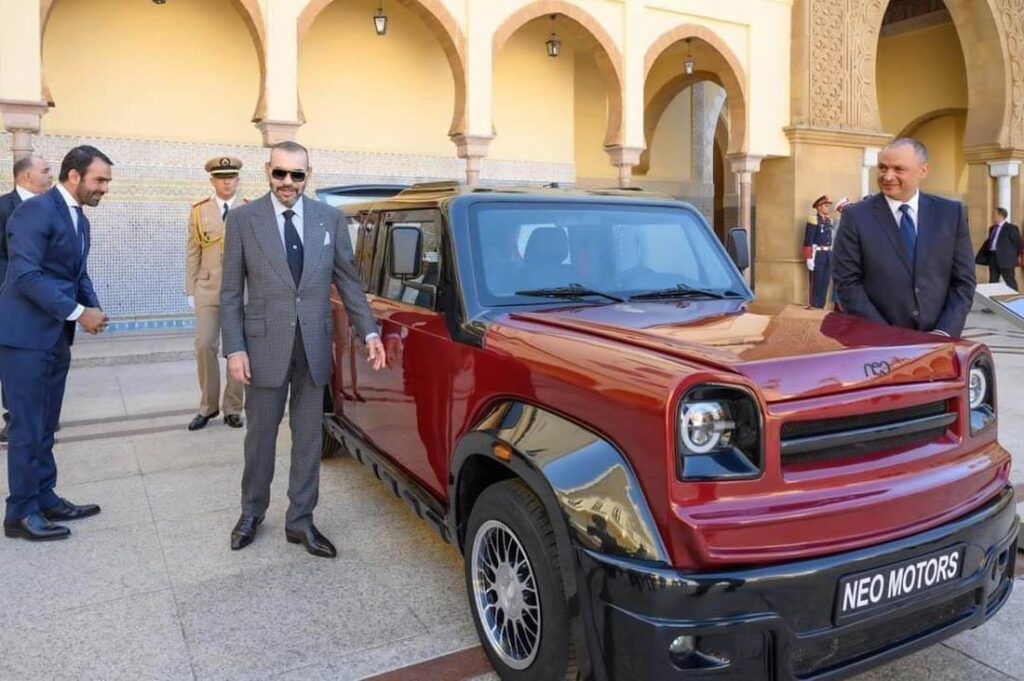
MOROCCO: First “Made in Morocco” car brand NEO’s ‘NamX’ presented to King Mohammed VI

Morocco’s King Mohammed VI presides at the Royal Palace in Rabat the presentation ceremony of the model of the first Moroccan car manufacturer “Neo Motors” and the prototype of a hydrogen vehicle “NamX” developed by a Moroccan.

Morocco’s King Mohammed VI presided, on Monday at the Royal Palace in Rabat the presentation ceremony of the model of the first Moroccan car manufacturer and the prototype of a hydrogen vehicle developed by a Moroccan, two innovative projects that will strengthen the promotion of the “Made In Morocco” label and consolidate the Kingdom’s position as a competitive automotive production platform.

The presentation to the King of the car of “Neo Motors”, a company owned by Moroccan capital, and of the prototype of a hydrogen vehicle of the company NamX, named HUV (Hydrogen Utility Vehicle), underlines the Sovereign’s willingness to encourage and promote the pioneering national entrepreneurial initiatives and the creative capacities, particularly of the Moroccan youth, that these projects embody.

These two industrial initiatives are in line with the High Royal Directions aiming at directing the private sector towards productive investment, in particular in the advanced and future sectors and at stimulating the emergence of a new generation of companies in the Kingdom.

They also confirm the King’s far-sighted vision in terms of sustainable development and the promotion of renewable energies, particularly the emerging field of green hydrogen.

Neo Motors company has set up an industrial unit in Ain Aouda (Rabat-Salé-Kenitra Region), to manufacture motor vehicles for the local market and for export, with a projected annual capacity of 27,000 units and a local integration rate of 65%.

The total projected investment for this project amounts to 156 million dirhams ($15.6 million) and will eventually create 580 jobs.

The final approval of the first vehicle was issued by the National Agency for Road Safety in February 2023. The company has launched the pre-production and plans to inaugurate the industrial unit during the month of June 2023 and to launch the marketing.

This project, which gives birth to the first Moroccan consumer car brand, is carried by national skills. It relies mainly on the ecosystem of local automotive suppliers developed by the Kingdom.

As for the prototype of the hydrogen vehicle of NamX, it was designed in collaboration with the Italian design office and coachbuilder of reference Pininfarina. The interior design of the vehicle has been realized by Moroccan talents.

Indeed, the HUV model will be supplied with hydrogen by a central tank that will be completed by six removable capsules, guaranteeing a significant autonomy and facilitating the hydrogen recharge in a few minutes.

This pilot project places Morocco firmly in the ongoing worldwide momentum to develop new forms of transport that combine efficiency and respect for the environment.

The monarch awarded the Wissam Al Kafaa Al Fikria to Nassim Belkhayat, founder and CEO of Neo Motors company, and Faouzi Annajah, President and founder of NamX company.

source/content: middle-east-online.com (meo) / headline edited

________

The two industrial initiatives are in line with the High Royal Directions aiming at directing the private sector towards productive investment

_____________

MOROCCO