Arabs & Arabian Records Aggregator. Chronicler. Milestones of the 25 Countries of the Arabic Speaking World (official / co-official). AGCC. MENA. Global. Ist's to Top 10's. Records. Read & Enjoy./ www.arabianrecords.org
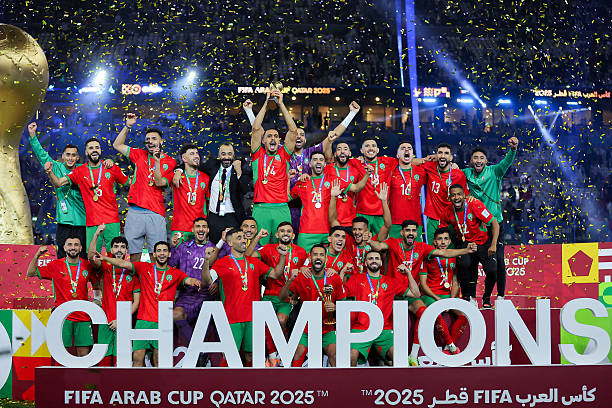
Morocco won the 11th edition of the FIFA Arab Cup with an action-packed 3–2 victory over Jordan in the final.
Exactly three years on from the unforgettable 2022 FIFA World Cup final, Lusail Stadium once again hosted the coronation of a champion. This time, it was the Arab world that came together in Qatar for the FIFA Arab Cup.
After 29 matches over 18 days, Morocco and Jordan were the last two teams left in contention for the title. The Atlas Lions had previously won the tournament in 2012, while Jordan were appearing in their first Arab Cup final, just a few years after losing the Asian Cup final at the same venue.
Before kick-off, there were concerns that the match would not go ahead at all. An unusually heavy downpour in Doha led to the suspension of the third-place match between the UAE and Saudi Arabia, raising doubts about the final. While several events were cancelled due to the weather, the showpiece match proceeded as planned.
Tens of thousands of fans braved thunderstorms to pack Lusail Stadium, and they were rewarded just minutes into the game. Oussama Tannane opened the scoring with a stunning long-range effort from inside Morocco’s own half, giving the Atlas Lions an early lead.
Jordan were unable to find an equaliser before the break, but tournament top scorer Ali Olwan levelled the match just two minutes into the second half with a powerful header. He then put Jordan ahead from the penalty spot in the 68th minute, setting up a dramatic finish.
Morocco’s pressure paid off late on when substitute Abderrazak Hamdallah turned the ball in from close range just three minutes before full time, sending the match into extra time. The veteran striker struck again in the 100th minute, restoring Morocco’s lead. This time, the Atlas Lions held firm to seal a memorable victory.
While the atmosphere of the World Cup was always going to be impossible to replicate, echoes of that tournament were felt throughout the Arab Cup. Fans travelled from across the region, filling stadiums, metro stations and fan zones to create a festival-like atmosphere.
There were memorable moments across the competition. Hosts Qatar endured a difficult campaign and exited at the group stage, while Palestine captured widespread admiration with their first-ever run to the knockout rounds. They pushed World Cup-bound Saudi Arabia to extra time in the quarter-finals before eventually bowing out.
Individual honours were also handed out following the final. Jordan’s Ali Olwan was awarded the Golden Boot, Morocco’s Mehdi Benabid received the Golden Glove, and Morocco’s Mohamed Rabie Hrimat was named Best Player of the tournament.
Attention will now turn to the future, with the FIFA Arab Cup set to return to Qatar for its next two editions in 2029 and 2033.
source/content: dohanews.co (headline edited)
____________
Morroco’s players celebrate with the trophy after winning the FIFA Arab Cup 2025 final football match between Jordan and Morocco at the Lusail Stadium Stadium, in Lusail on December 18, 2025. (Photo by Karim JAAFAR / AFP via Getty Images)
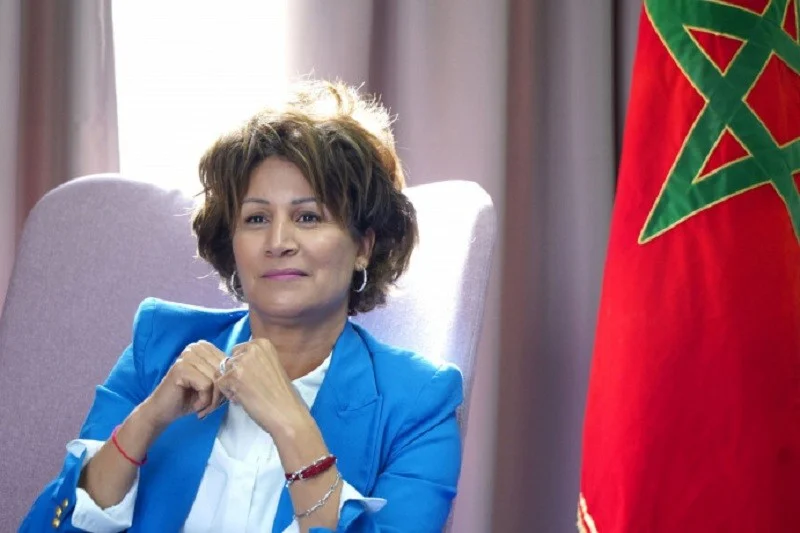
Nezha Bidouane has been granted a new four-year term on the governing board of the International Sport for All Federation (FISPT) following elections held during the organization’s general congress in central Italy.
The Moroccan sports official, who serves as President of the Royal Moroccan Federation for Sport for All, retained her seat as delegates from dozens of countries convened on January 24 and 25 to determine the federation’s future leadership.
Bidouane’s renewed mandate reinforces Morocco’s representation within global sports governance at a time when the country continues to expand its engagement on the international sports stage. Her role reflects sustained efforts to promote wider access to sport, emphasizing community participation and inclusivity beyond elite-level competition.
A former world-class athlete, Bidouane built a distinguished career in athletics, securing multiple international titles in the 400-meter hurdles and earning a bronze medal at the 2000 Sydney Olympic Games. She has since transitioned into sports administration, where she remains actively involved in advancing inclusive and developmental sporting initiatives worldwide.
This year’s commemoration is especially significant, coming just a week after a UNSC resolution placed Morocco’s autonomy plan at the heart of efforts to resolve the Sahara dispute.
The Mohammed VI Museum of Modern and Contemporary Art in Rabat is commemorating the 50th anniversary of the Green March with a new exhibition titled “50 Years of the Green March: A Memory in Motion.”
The exhibition pays homage to one of Morocco’s most defining moments and invites visitors to reflect on the enduring values of peace, unity, and loyalty that continue to shape the nation’s identity five decades after the historic march.
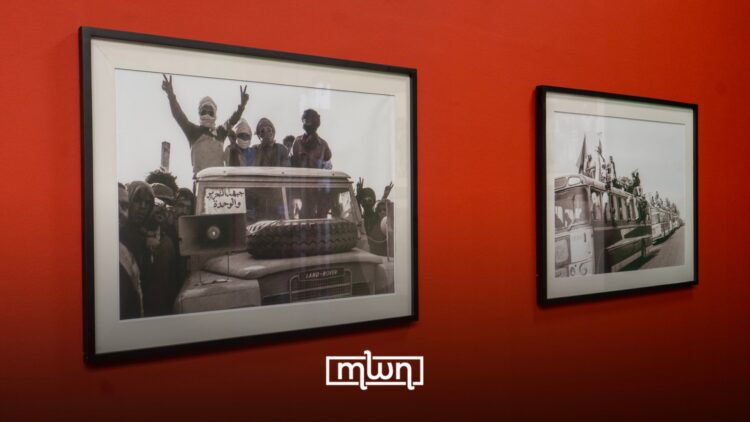
Opened this week, the exhibition combines historical documentation with contemporary artistic interpretation. The exhibition includes an evocative collection of photographs that aims to reaffirm the strength of visual memory and its role in preserving national heritage. This is a key element in Morocco’s ongoing narrative of sovereignty and unity.
A tribute to a defining moment
Organized by the National Foundation of Museums (FNM), the exhibition brings together works by renowned Moroccan photographer Daoud Oulad-Syad and a selection from the Rencontres de la Photographie de Marrakech (RPM). Together, they offer a visual journey that captures both the emotion and symbolism of the Green March, which represents a cornerstone of Morocco’s modern history.
Nadia Sabri, Director of the Mohammed VI Museum of Modern and Contemporary Art, emphasized the exhibition’s importance as a bridge between generations.
“What we can really emphasize is that this exhibition provides both visual and historical archives for the public,” she told Morocco World News.
“It caters to a wide audience, including younger visitors as well as older ones who may have experienced this historic event but do not necessarily remember its key moments, particularly during the march,” Sabri added.
She noted that the exhibition spotlights major figures in the Moroccan photography scene, like Daoud Oulad-Syad, with a photographic series dedicated to the Sahara and the beauty of the desert.
Through Oulad-Syad’s lens, the exhibition moves beyond mere documentation to celebrate the spirit of a nation united under a shared cause. His photographic series dedicated to the Sahara, showcased in the museum’s second gallery, highlights the region’s natural beauty and its deep cultural and emotional connection to the Moroccan people.
The Green March, which took place on November 6, 1975, was a peaceful mass demonstration that changed the course of Moroccan history. Called for by the late King Hassan II, it saw over 350,000 unarmed volunteers, men and women, from all regions of Morocco march southward to reclaim the territory of Western Sahara, then under Spanish occupation.
Carrying Qurans and Moroccan flags instead of weapons, the marchers symbolized Morocco’s unity and commitment to recovering its southern provinces through peaceful means. The event came shortly after the International Court of Justice (ICJ) issued an advisory opinion affirming that Western Sahara was not “terra nullius” (empty land or unclaimed territory) before colonization and that it had historical and legal ties to Morocco.
The enduring significance of the Green March for Morocco
This year’s commemoration carries added significance, as it comes just a week after the United Nations Security Council adopted a new resolution embracing Morocco’s autonomy plan as the most “serious and credible” framework for achieving a lasting and realistic political solution to the regional dispute over the Sahara.
The resolution is widely seen as a diplomatic success for Morocco, as it reinforces international support for its initiative and paves the way for renewed efforts toward a peaceful settlement.
Mehdi Qotbi, artist and President of the National Foundation of Museums, highlighted this connection in his remarks to MWN at the exhibition.
“We are very happy to be celebrating this anniversary today, here at the Mohammed VI Museum of Modern and Contemporary Art … is not only an occasion to mark the anniversary itself, but also to celebrate the diplomatic success achieved thanks to the foresight of His Majesty King Mohammed VI,” Qotbi said.
For him, this success “paves the way for a definitive resolution of the artificial conflict over the Moroccan Sahara and for a better future for the entire region.” The Moroccan artist added that the Foundation and the Museum are proud to take part in this “popular enthusiasm for this cause, for this victory at the United Nations.”
Beyond commemoration, the “Memory in Motion” exhibition aims to spark dialogue about the meaning of the Green March in contemporary Morocco. For many visitors, especially younger ones, the exhibition is an opportunity to connect with a pivotal chapter in Morocco’s collective memory.
The exhibition includes an evocative collection of photographs that aims to reaffirm the strength of visual memory and its role in preserving national heritage
Arab identity, in both historical and anthropological terms, has never been solely about genealogy.
Morocco is, in fact, an Arab country. While this assertion may appear self-evident, it has become a subject of debate in contemporary discourse. Some voices insist that Morocco’s identity lies exclusively in its Amazigh or North African roots, rejecting its place within the Arab cultural sphere. Yet, such claims overlook the complex processes through which cultural affiliations are formed, internalized, and lived. Moroccan Arab identity is neither imposed nor superficial; it is a deeply ingrained civilizational reality that is experienced, performed, and transmitted across generations.
Arab identity, in both historical and anthropological terms, has never been solely about genealogy. It is a cultural and civilizational framework, a shared language, religion, and set of symbolic practices, that transcends bloodlines and geography. The Arab Islamic expansion of the 7th-century introduced Arabic and Islam to what is known now as the Arab World, setting in motion a centuries long process of cultural integration. This integration was not a simple imposition, but a dynamic interaction between incoming and indigenous traditions, producing a distinctly Moroccan expression of Arabness. It is a process in which the Arab and the local coexist, interact, and mutually shape each other.
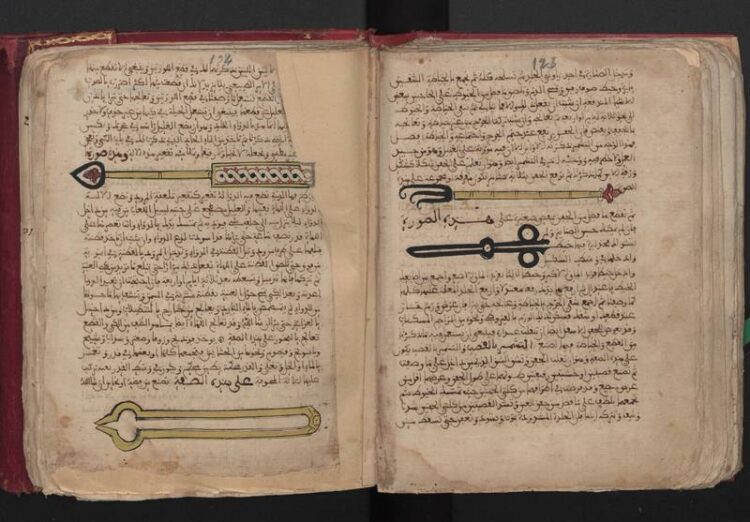
[First Illustration of surgical instruments in history] from Al-Zahrāwī, Al-Taṣrīf liman ‘aǧiza ‘an al-Ta’līf, 30th volume (Surgery). Bibliothèque Nationale du Royaume du Maroc (BNRM), as reproduced on the Islamic Studies Library Blog, McGill University
Morocco is, in fact, an Arab country. While this assertion may appear self-evident, it has become a subject of debate in contemporary discourse. Some voices insist that Morocco’s identity lies exclusively in its Amazigh or North African roots, rejecting its place within the Arab cultural sphere. Yet, such claims overlook the complex processes through which cultural affiliations are formed, internalized, and lived. Moroccan Arab identity is neither imposed nor superficial; it is a deeply ingrained civilizational reality that is experienced, performed, and transmitted across generations.
Language lies at the heart of this Arab identity. Classical Arabic became the medium of religious practice, scholarship, and literary expression, while Moroccan Darija evolved as a vernacular rooted in Arabic but enriched over centuries through interaction with Amazigh and Andalusi traditions, as well as later European influences. Computational linguistic analysis by Mrini and Bond (2018) found that approximately 42% of Moroccan Darija’s lexicon shares at least 60% similarity with Standard Arabic, while only about 3% aligns with French and 2% with Spanish. This demonstrates that, although Darija incorporates foreign and Amazigh influences, its core lexical foundation remains predominantly Arabic (Mrini & Bond, 2018, Putting Figures on Influences on Moroccan Darija from Arabic, French and Spanish Using the WordNet). This linguistic presence is more than practical; it is existential. Arabic provides the conceptual framework through which Moroccans think, communicate, and participate in a shared cultural universe. Anthropologists have long argued that language is the “house of being”, and in Morocco, Arabic offers that house, the structure within which Moroccan society organizes its collective life.
Yet Morocco’s Arab identity is not reductive. Its population is ancestrally diverse, encompassing Amazigh, Arab, sub-Saharan, Andalusi, and Mediterranean lineages. Rather than contradicting Arab identity, this diversity illustrates the inclusive, integrative nature of Arab culture, which historically has absorbed and harmonized a multitude of peoples and traditions. Being Arab in Morocco is thus defined not by ethnicity but by cultural practice, speaking Arabic, engaging with Islamic religious life, and participating in the intellectual and spiritual traditions of the Arab world. This identity is lived and internalized, a product of historical continuity and daily enactment.
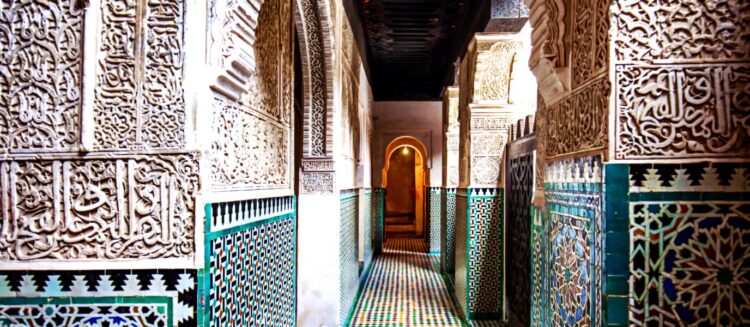
Medersa Bou Inania in Fez
Moroccan Arabness is dynamic and regionally inflected, expressed through a mosaic of Arabic dialects that embody the country’s historical and cultural layering. The pre-Hilali urban dialects, such as Fassi, Meknassi, and Rbati Arabic, spoken in the historic cities of Fez, Meknès, and Rabat-Salé, preserve many features of early Andalusian and Classical Arabic, including the conservative pronunciation of qāf as /q/ and more formal morphosyntactic patterns. In contrast, the Jebli dialect of northern Morocco, prevalent in Tetouan, Chefchaouen, and the Rif region, blends Andalusian, Amazigh, and Spanish influences, producing softer phonetics and a Mediterranean lexicon. The Hilali or ‘Aroubi (Bedouin) varieties, dominant across the Atlantic plains, Chaouia, and Souss, descend from Arab tribal migrations and underpin the speech of rapidly urbanized centers such as Casablanca and Settat. Further south, the Marrakchi dialect represents a transitional form combining urban and Bedouin traits, while Judeo-Moroccan Arabic, historically spoken in Jewish communities in Fez, Essaouira, and Sefrou, incorporates elements from Hebrew and Spanish (Haketía). In the southeast, around Errachidia and the Tafilalet region, daily speech follows Hilali Bedouin patterns, but the area also preserves a rare, literary form of Filali Arabic used in Melhoun poetry and song, reflecting a deep historical connection to Classical Arabic and regional artistic expression. Further south and toward the Sahara, Hassani Arabic, a Bedouin variety influenced by Maghrebi and Saharan linguistic currents, illustrates the continued interplay of migration, trade, and cultural exchange in shaping Moroccan Arabic. Collectively, these dialects illustrate how Moroccan Arabic varies across geography and social history, forming a linguistically plural yet distinctly Arab national identity. These variations reflect the adaptability of the language and, by extension, the adaptability of Arab identity itself. Moroccan Arabness, therefore, is neither monolithic nor static; it evolves through time while maintaining continuity with a broader Arab cultural framework.
Describing Morocco as an Arab country is to acknowledge the primacy of this linguistic, religious, and cultural fabric. Arabic is not merely an official language; it is the deep structure of Moroccan society, shaping poetry, moral discourse, social interaction, and ritual life. Arab identity in Morocco is lived in the streets of Casablanca and Fez, in the rhythms of daily prayer, and in the idioms and expressions of everyday conversation. It is experienced through shared cultural symbols and practices that bind Moroccan society to the larger Arab world while remaining distinctively local.
Recognizing Morocco as an Arab country does not erase its rich cultural diversity; rather, it highlights the central role that Arab language, culture, and religion play in the nation’s historical and contemporary identity. Moroccan Arabness is a living, evolving phenomenon, formed through centuries of interaction, internalized through daily life, and transmitted through language, ritual, and social practice. It reflects a society that is at once rooted in its local context and deeply connected to the broader Arab civilization.
In conclusion, Morocco’s Arab identity is a complex, multidimensional reality, grounded in linguistic, religious, and cultural practices. It is the result of historical processes, dynamic interactions, and the continuous enactment of shared meanings. To affirm that Morocco is an Arab country is not to deny its diversity but to recognize the living fabric of its identity, a fabric woven from Arabic language, Islamic faith, and the symbolic systems.
The Safety Wings drone can detect individuals in distress in water, swiftly navigate to their location, and drop inflatable life buoys.
Three Moroccan students from the Faculty of Sciences and Technologies (FST) in Settat have won a gold medal at the Innovation Week (IWA 2025) for their groundbreaking project, Safety Wings.
A drone that saves lives at sea
The winning project introduces a drone designed to revolutionize aquatic rescue operations.
The Safety Wings drone can detect individuals in distress in water, rapidly fly to their position, and deploy inflatable life buoys.
In contrast to existing buoys that sell for around $300 and are typically disposable, the Moroccan designers developed a reusable model that costs under $20. The only recurring expense is replacing compressed air cartridges.
Through the combination of reusability and affordability, the project provides an essential loophole in global rescue missions. The project is an affordable and scalable solution for impoverished communities with fewer resources but frequent aquatic emergency cases.
From Morocco to the world stage
Salah Bouhlal, Moad Es-Sraoui, Mohamed Kerroum, and Aziz Hraiba (supervisor) developed Safety Wings during their days as FST Settat students.
Their success at IWA 2025 places Morocco on the international innovation map and also shows how youthful scientists can convert pressing humanitarian needs into practical technological solutions.
OFEED, the organizer of the Innovation Week, describes the event as both a premier platform for showcasing and fostering cost-effective innovation and a “global community that believes ideas can become impact when courage meets collaboration.”
Innovation with human impact
Safety Wings is one component of a greater movement toward harnessing new technology for the public good. With their provision of life-saving gear, the Moroccan students seek to leave a positive impact on global standards of safety in aquatic environments, from seaside public beaches to remote fishing villages.
In addition to the Safety Wings team, other Moroccan innovators also figured among the winners of IWA 2025. Their projects spanned diverse fields. This collective achievement reinforced Morocco’s reputation as a hub of creativity and problem-solving on the international stage.
The groundbreaking invention aims to aid those with immune deficiencies and provide treatment for chronic infections in intensive care units where antibiotics are ineffective.
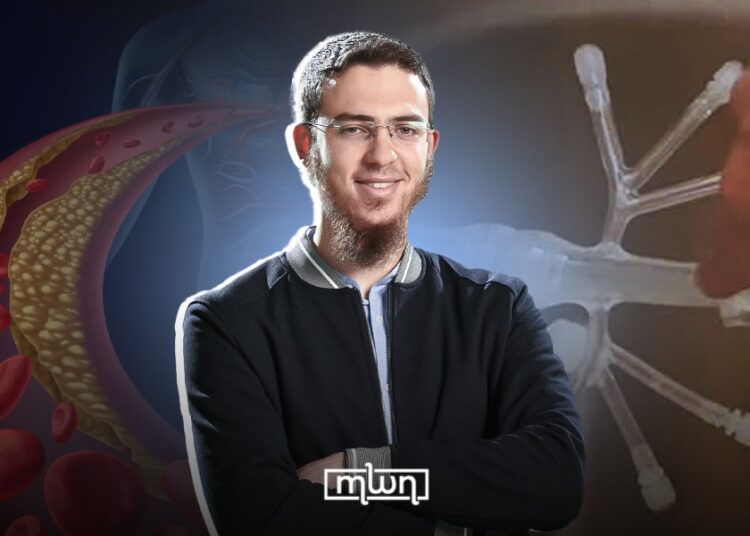
Youssef El Azouzi, a Moroccan neurologist, has announced the successful development of the world’s first device capable of filtering blood from within blood vessels.
The revolutionary invention can direct inflammatory cells and certain white blood cells, potentially helping millions of people suffering from immune deficiencies and improving organ transplant success rates.
In a Facebook post, El Azouzi explained that his device “will contribute to treating tens of millions of people suffering from immune deficiencies and chronic infections in intensive care units where antibiotics are ineffective.” He added that it would “help in organ transplantation without fear of new organ rejection.”
The invention works by redirecting inflammatory cells flowing in the blood away from vessels that nourish newly transplanted organs, preventing rejection.
This mechanism was successfully tested on a 75-kilogram pig in an American laboratory, where the device demonstrated its ability to direct immune cells from the left leg to the right leg without any negative effects on the animal.
“The experiment showed that the device was able to direct immune cells from the left leg to the right leg,” El Azouzi explained in a video documenting his journey to America to register the invention. “This is the first device that controls cell direction from within the vessel itself.”
The scientific experiment involved injecting both thighs of the pig to induce inflammation before placing the device. The device’s role was to direct inflammation-causing cells to only one side, concentrating them there compared to the other side. This would demonstrate the device’s actual control over the pathways of white blood cells flowing in the blood.
El Azouzi revealed that the project cost approximately $250,000 as of March, not including effort and time. “All these resources were provided by benefactors, with no contribution from any public institution or organization,” he noted.
The Moroccan doctor is no stranger to innovation. In 2019, he won the title of best inventor in the Arab world in the 11th season of “Stars of Science” competition in Qatar. His winning invention then was a stent that regulates blood flow for heart patients, offering a potential low-cost alternative to current solutions like heart pumps.
Born in 1991, El Azouzi studied at the American School in Rabat before attending Oxford University for three years. He later moved to Boston University and eventually studied medicine in English at Turkish universities. He is the son of Mustapha El Azouzi, a Moroccan neurosurgeon.
He currently serves as CEO of Aorto Medical Company in the US, where he has been developing this latest invention through three years of hard work, design, and manufacturing.
This Moroccan invention marks a major breakthrough in modern medicine, potentially offering an effective tool for addressing immune deficiency problems and chronic inflammations, while improving the success of organ transplantation procedures.
Youssef El Azouzi, a Moroccan neurologist, has announced the successful development of the world’s first device capable of filtering blood from within blood vessels.
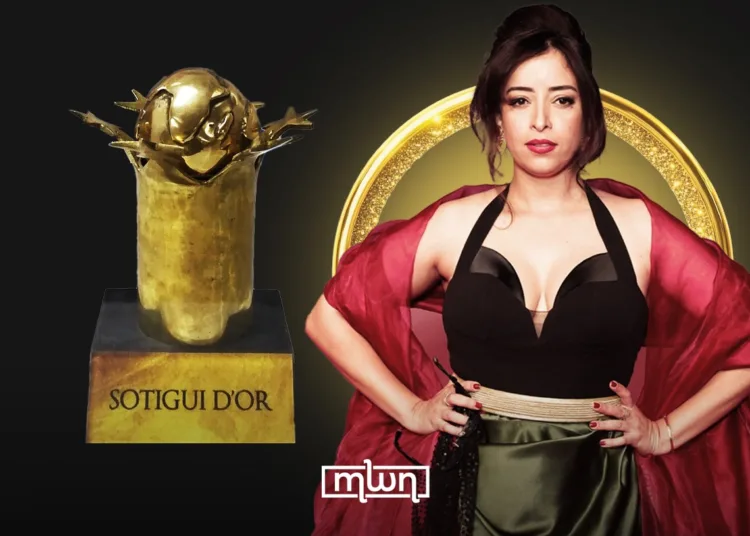
Moroccan actress Nisrin Erradi will represent Morocco at the 10th edition of the Sotigui Awards.
The Academy of African and Diaspora Cinematic Arts announced the list of nominees, featuring Erradi as Morocco’s representative, for this prestigious celebration of African cinema, which takes place from November 12-15 in Ouagadougou, Burkina Faso.
Erradi competes alongside representatives from 19 other nations for the Sotigui d’Or, the ceremony’s top honor. Her nomination also puts her in contention for the 2025 African Public Sotigui Award.
Rising star of Moroccan cinema
Born on August 6, 1989, Erradi has built an impressive career in both Moroccan and international cinema, starting her performance in theater at age six and later studying at the High Institute of Theatrical Arts and Cultural Animation (ISADAC) in Rabat.
Erradi’s experience in ISADAC allowed her to discover her passion for cinematic storytelling through the works of American playwright Tennessee Williams.
The actress has earned recognition across multiple international film festivals.
Most recently, her role in “Everybody Loves Touda,” directed by Nabil Ayouch, earned her the “Artistic Expression” award at the 30th MedFilm Festival in Rome.
Erradi’s breakthrough came with notable performances in films including “Adam” in 2019, “Catch the Wind” in 2017, and “Jahilya” in 2018.
Her international acclaim extends beyond Europe. Erradi cemented her reputation as one of Morocco’s most promising cinematic talents by winning the Best Actress Award at the Durban International Film Festival in South Africa.
This year’s edition of Sotigui Awards focuses on the theme “African Cinema Facing the Challenges of Sexual Harassment: From Indignation to Action.” The theme demonstrates the ceremony’s commitment to addressing important social issues through the film industry.
Festival director Apolline Traoré said: “For the 10 years of the Sotigui Awards, there will be many surprises. We invite you in November to see the innovations. It will be something extraordinary.”
For Erradi, the nomination represents another milestone in a career that continues to bridge Moroccan and international cinema, reflecting the growing influence of North African talent on the global stage.
Ilies is making a name for himself in the football landscape, especially with the Atlas Cubs.
Morocco’s rising star Ilies Belmokhtar has been named the best U17 youth player competing in France at the inaugural Golden Kid Awards.
Le Monde Du Foot reported that Belmokhtar is taking home a well-deserved recognition, rewarding his exceptional 2024-2025 season.
“For this inaugural edition, Ilies Belmokhtar truly shone. Gifted with genuine tactical maturity, he was one of the key architects of AS Monaco’s success in youth competitions this season,” the same source said.
Commenting on his new achievement, Belmokhtar commented that the award is a “great pride.”
“Especially to my parents, I hope they are proud of me,” he said .
The same sports-focused website recalled the triumphs the Atlas Cub has achieved with Morocco , including his U17 Africa Cup of Nations win in April.
The Golden Kid awards seek to recognize the best young developing players in France. The initiative is the fruit of L’Equipe journalist Loic Tanzi and streamer Isoline Almeida.
In May, Ilies Belmokhtar signed his first professional contract with AS Monaco.
Belmokhtar was born in Ivry-sur-Seine in 2008, and joined the AS Monaco Academy in 2023.
In April, the Atlas Cub was among the five players from the national U-17 team selected for the Best XI of the Under-17 AFCON in its 15th edition.
In addition to Belmokhtar, the players chosen for the Best XI include: goalkeeper Chouaib Bellaarouch, right-back Moncef Zekri, central defender Driss Aït Chiekh, and attacking midfielder Abdellah Ouazzane.
Morocco’s AFCON triumph came after a dramatic 0-0 draw against Mali in the final, followed by a 4-2 win in the penalty shootout, securing their spot in football history.
Mrini was widely respected for his deep knowledge and commitment to cultural preservation.
Morocco is mourning the death of Abdelhak El Mrini, the country’s official royal historian and former spokesperson for the Royal Palace. He passed away on Monday evening at the age of 91, after a long career serving Moroccan history and culture.
El Mrini was born in Rabat in 1934. He memorized the entire Quran at a young age and even copied 60 parts of it by hand. Over the years, he became one of Morocco’s most respected literary and cultural figures.
He held several important roles during his life, including Director of Royal Protocol and Decorations. But he was best known for his role as the kingdom’s official historian, as well as his work in preserving Moroccan heritage.
El Mrini had an impressive academic journey. He received a diploma from the Institute of Higher Moroccan Studies in 1960, followed by a degree in literature from the Faculty of Arts in Rabat in 1962.
He later studied in France, where he earned an advanced diploma and a PhD from the Institute of Arab and Islamic Studies at the University of Strasbourg in 1973. He also obtained a State Doctorate in Literature from Sidi Mohamed Ben Abdellah University in Fez in 1989.
El Mrini was also a prolific author who left behind an important literary and historical legacy. Among his most well-known works is “The Moroccan Army Throughout History”, first published in 1968. The book went through several revised editions, with the sixth edition released in 2011 and translated into French in 2000.
He also wrote “Guide for Moroccan Women” in two parts (1993 and 2000), and “An Introduction to Modern Moroccan History” (1996), which covers the period from Sultan Hassan I to King Hassan II.
Other notable titles include “Tea in Moroccan Literature” (1999), “Mohammed V: Studies and Testimonies” (1988), and “The Hassaniyats” (three volumes published between 1975 and 1983), a collection of poems in praise of the late King Hassan II.
Throughout his life, El Mrini made significant contributions to the study and promotion of Moroccan history, and he was widely respected for his deep knowledge and commitment to cultural preservation.
The pact interweaves water security, renewable energy mastery, and industrial sovereignty – binding Morocco’s future with a 1,400 km electricity superhighway, four desalination jewels, and 25,000 employment opportunities in a $14 billion choreography.
The largest private investment in Morocco’s modern history has just been inscribed in the country’s economic annals. Yesterday, the country sealed an extraordinary $14 billion accord with the United Arab Emirates – an injection of unprecedented scale that promises to permanently alter the country’s water and energy equation, while fundamentally reshaping its infrastructure landscape for generations to come.
The ceremonial ink still fresh, the agreement binds Morocco’s government and the National Office of Electricity and Drinking Water (ONEE) with a consortium of financial titans: the Mohammed VI Investment Fund, TAQA Morocco (the local subsidiary of Abu Dhabi’s energy colossus), and Nareva (the energy arm of the royal holding Al Mada).
At MAD 130 billion ($14 billion), this collaboration transcends mere commercial arrangement – it heralds a profound reengineering of critical national infrastructure by 2030.
Central to this ambitious blueprint stands a colossal 1,400-kilometer high-voltage transmission corridor stretching from Western Sahara to Casablanca, complemented by a network of sophisticated seawater desalination facilities.
These projects emerge as the culmination of meticulous diplomatic chess moves, coming just five months after King Mohammed VI’s private visit to Abu Dhabi and 18 months following his official state visit to the Emirati capital, where the groundwork for this Moroccan-Emirati renaissance was carefully laid.
Desert kingdoms understand water’s value. The consortium’s hydric strategy unfolds with architectural precision: a vast network connecting the Sebou and Oum Rabia river basins, engineered to channel 800 million cubic meters annually across thirsty territories.
The first phase of water transfer between the Sebou and Bouregreg basins became operational in August 2023, successfully diverting approximately 350 million cubic meters to the Sidi Mohammed Ben Abdellah dam, critical for supplying drinking water to the Rabat region.
Four jewels in this water crown will rise across Morocco’s map. In Tanger, a 50-million-cubic-meter annual capacity station will quench the industrial thirst of this burgeoning port hub.
Nador’s installation, six times more ambitious at 300 million cubic meters, will transform the eastern region’s hydric calculus. The agricultural heartland of Souss will benefit from Tiznit’s 350-million-cubic-meter facility – the largest of the quartet. Completing this hydraulic network, either Tan-Tan or Guelmim will host a 100-million-cubic-meter operation to serve the arid southern frontier.
These cutting-edge desalination facilities, engineered to operate exclusively on renewable energy, will collectively produce 900 million cubic meters annually.
Notably, they will maintain competitive pricing at or below MAD 4.50 per cubic meter (excluding tax), aligning with national benchmark rates established for ongoing desalination initiatives – all without requiring public subsidies.
The electric heartbeat: Energy sovereignty reimagined
The consortium’s energy infrastructure vision is anchored by a groundbreaking high-voltage direct current (HVDC) transmission network spanning 1,400 kilometers between Morocco’s southern territories and its central economic hub.
This sophisticated “electricity highway” will connect Dakhla to Casablanca with a 3,000 megawatt capacity, dramatically strengthening energy distribution capabilities while catalyzing economic and industrial development throughout the corridor.
This transmission masterpiece will be fed by 1,200 megawatts of fresh renewable capacity, predominantly harvested from the sun-drenched southern provinces. The geographic strategy is to harness the natural abundance of Morocco’s desert regions, translate it into clean energy, and deliver it to industrial centers at competitive rates.
Complementing these renewable ambitions, the Tahaddart complex will undergo a renaissance. This gas-fired installation will see its capacity quadrupled through new combined-cycle units, elevating total output to 1,500 megawatts. This expansion offers crucial ballast to a grid increasingly danced upon by the variable rhythms of wind energy.
The human dividend, capital choreography, and implementation cadence
Beyond pipes and pylons lies perhaps the most valuable yield: people. This grand design promises to spawn over 25,000 employment opportunities through construction and operation, with 10,000 permanent positions taking root after commissioning.
The consortium envisions not merely infrastructure but ecosystem – a fertile soil where technology transfer blooms and local industrial expertise in desalination and renewable energy flourishes. From this terrain will grow new educational pathways and technical specializations, training the standard-bearers of Morocco’s water and energy future.
The financial architecture of this mammoth endeavor will be orchestrated by the consortium, drawing capital from domestic and international financial wellsprings. The urgency is palpable; the project’s partners have pledged to assemble elite technical minds to ensure methodical implementation through 2030.
As with all ventures of this magnitude, regulatory gauntlets must be run, particularly regarding concentration operations. Each project component will be governed by bespoke development agreements between ONEE and the consortium. The first such accord, focusing on Tahaddart’s expansion, has already materialized.
The architects of the alliance
This historic partnership harmonizes complementary strengths. Nareva, Morocco’s private electricity champion, brings 3,200 megawatts of installed capacity producing over 15 terawatt-hours annually. As Africa’s wind energy pioneer, it operates eleven parks totaling 1,810 megawatts alongside the thermal goliath of Safi (1,386 megawatts).
With extensive expertise in electrical transmission infrastructure (exceeding 300 kilometers of high-voltage lines) and advanced water engineering, Nareva currently leads the innovative Amensouss project and is constructing the world’s first exclusively renewable-powered desalination facility in Dakhla.
TAQA Morocco, publicly traded on the Casablanca Stock Exchange since 2013, delivers 34% of Morocco’s national electricity requirements despite representing only 17% of installed capacity.
With a strategic focus on desalination, renewable energy development, low-carbon solutions, and infrastructure networks, the company actively advances national energy transition objectives and water security initiatives.
Its parent organization, Abu Dhabi National Energy Company PJSC (TAQA), operates as a diversified energy and utilities powerhouse with operations spanning 25 countries worldwide.
A diplomatic masterpiece
These accords signal the diplomatic renaissance between Morocco and the Emirates after a period of relative ambiguity. They physically manifest the vision sketched during King Mohammed VI’s December 2023 meeting with Sheikh Mohamed bin Zayed Al Nahyan – a blueprint for collaboration in strategically vital domains.
This official visit established a “renewed partnership” between the Maghreb and Gulf country with announcements of strengthened collaboration in strategic domains including energy and infrastructure development.
The sovereign’s subsequent private voyage proved equally fertile, brokering peace between telecommunications titans Maroc Telecom and Inwi, ending a decade-long legal skirmish and birthing a joint venture to develop 5G infrastructure for international events including the 2025 Africa Cup of Nations and the 2030 World Cup.
For fifteen years, Morocco has methodically invested in renewable energy, which now covers 38% of its electricity needs, with aspirations to reach 52% by 2030. Simultaneously confronting chronic water scarcity, the kingdom has embraced desalination as salvation. This Emirati partnership accelerates both these vital transitions, binding two desert nations in a quest for resource security and sustainable prosperity.