Arabs & Arabian Records Aggregator. Chronicler. Milestones of the 25 Countries of the Arabic Speaking World (official / co-official). AGCC. MENA. Global. Ist's to Top 10's. Records. Read & Enjoy./ www.arabianrecords.org
US Qatari artist and writer Sophia Al-Maria has been announced as the recipient of the 2025 Frieze Artist Award, one of the art world’s most highly anticipated annual commissions.
The award is part of Frieze London, a leading international art fair that will return to Regent’s Park from Oct. 15-19, bringing together more than 280 galleries from 45 countries.
Presented in partnership with Forma, the award supports early- to mid-career artists in debuting new works. This year, Al-Maria will perform “Wall Based Work (a Trompe LOL),” a live stand-up comedy show held daily inside the fair tent.
The work marks Al-Maria’s first attempt at stand-up, in which she will blend sharp humor with her long-standing interest in mythology, empire and pop culture.
“In partnership with Forma, we are proud to continue supporting artist-centered programming,” said Eva Langret, director of Frieze EMEA. “Al-Maria’s debut stand-up promises a collective experience exploring vulnerability, creativity, shared anxieties and LOLs.”
Meanwhile, Chris Rawcliffe, artistic director at Forma, said: “By wielding humor as a tool for survival, Al-Maria not only provokes reflection but actively reshapes the cultural conversation … Al-Maria is more than an artist and critic, she is a catalyst for change, and an indispensable voice in both the art world and the wider social landscape.”
Al-Maria’s proposal was selected by a jury of leading industry professionals, including curator and museum consultant Lydia Yee and the artistic director of exhibitions at Ikon Gallery, Melanie Pocock, artistic director of exhibitions at Ikon Gallery, as well as Langret and Rawcliffe.
Based in London, Al-Maria works across drawing, collage, sculpture, film and writing. Her practice is unified by a focus on storytelling and mythmaking, often reimagining histories and envisioning speculative futures. Her work has been shown at major institutions and biennales, including the Gwangju Biennale, the New Museum and Whitney Museum in New York, the Venice Biennale, and Tate Britain.
With shows that range from political stances to introspective research, Doha’s Mathaf: Arab Museum of Modern Art proves itself to be one of the most authoritative voices for Arab narratives and the Global South in art.
The first impressions viewers get when walking inside the space set up like a unitary installation by Algerian artist Kader Attia, are a big haunting archive, a disquieting museum storeroom. It’s called “The Repair from Occident to Extra-Occidental Cultures” at this particular museum in the Qatari capital. A number of cabinets on the perimeter of the room showcase objects from colonial times: photographs of French admirals and Arab royalty, plus memorabilia, knives, cutlery and weapons.
Pinned rather aggressively on the shelves with metal rods are books from 1800-1900, like La France d’Outre Mer, Occident Noir and The Age of Napoleon, alongside satirical illustrations from magazines. A particularly disturbing one depicts a naive white nurse taking care of wounded African soldiers, who are depicted with malicious grins on their faces. Whether it’s the representation of racist stereotypes, anthropological studies or orientalist perspectives, the selection of materials by Attia shows different aspects of the relationship between coloniser and colonised, and how models of thought carried on in both Western and non-Western cultures.
Among the more harrowing pieces in the installation are several heads sculpted in wood, reminiscent of African statuettes. The features of these faces are distorted, reminding the viewer of the cubist or expressionist effect, that Picasso, Bacon or more recently Marlene Dumas have largely employed in their work. Looking at the anatomy and war surgery books on the shelves — which explain how to reconstruct exploded faces damaged during WW1, and how to attach prostheses — it seems clear that the distortion in the faces references the war wounded. The artist is hinting at the process of repairing historical wounds and abuses by the West towards its colonies, something central to the postcolonial conversation.
The presence of books like Primitive Art and Psychoanalysis summarises one more aspect of the artwork: how the encounter with the “other” is sublimed and transformed in art, and the deep psychological underpinning which lies behind every form of orientalism.
It’s precisely the link between all these seemingly distant concepts that make Kader Attia’s installation so powerful.
The artist leaves it to the viewer to come to terms with that thick, inextricable matter where racist stereotypes, modernism, colonialism, tribal art, sexuality, anthropology, war, imagination and the subconscious meet in a dangerous mix.
The intention of the work, however, is clear. He is examining this magma with a critical eye, in order to move forward and heal the historical wounds from these power dynamics.
Attia’s work is just a small part of the large and rich collection at Mathaf, but it contains one of its most fundamental themes: the creation of an alternative to the non-Western narratives and discourses for history and art history. This seems to be the main mission that the museums in Qatar are highlighting. While in the Western world museums as institutions are increasingly losing their relevance, in the Global South — namely, the parts of the world previously excluded by a Western narrative — museums are fundamental parts in the development of their own art system. In fact, it’s up to these institutions to construct alternative narratives to the West’s by using museums as a central tool.
The permanent collection of Mathaf is a case in point. Offering an excellent survey of 20th and 21st century modern and contemporary art from the Arab world and the Middle East (which is tellingly called “West Asia”), it is highlighting the strong connections of local Qatari and Arab artists with the wider world in Africa, Asia and Europe.
The permanent collection has evolved from an initial donation of a thousand works collected over the past 25 years by Sheikh Hassan Bin Mohammed Bin Ali Al-Thani. Today, it’s continuing to grow, and hosts more than 9,000 artworks by pioneer Arab artists.
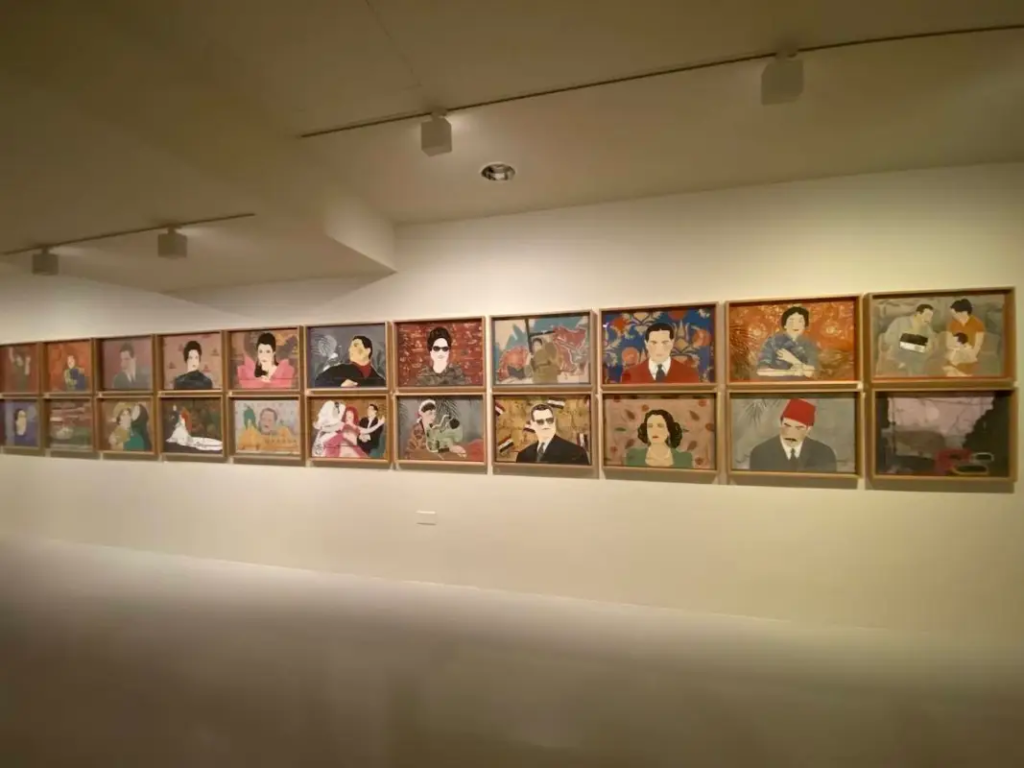
A particularly interesting section of this collection is dedicated to women artists, that has works like “Icons of the Nile” by Egyptian artist Chant Avessidian. This consists of a series of prints and paintings on cardboard representing, in a stylised way, Egyptian icons from modern times, including a number of iconic women.
At the moment, Mathaf is also hosting a temporary exhibition called “Arab Modernism”, which looks at how this current is being articulated in Arab countries, compared with its counterparts around the globe. In the show, we can see not only how Arab artists took visual elements, and techniques from the rich and diverse heritage of the Arab-Muslim world — particularly calligraphy and ornamentation — but also how they mused on the concept of Tajreed. The Arabic term for abstraction, in fact, also means “to strip away” and “purify”, referring to a process of revealing and clarifying through the artistic process itself.
In one room with ochre walls, we can observe how the calligraphic sign was declined to break the division between word and image, opening a space between calligraphy and geometric abstraction. We also find beautiful abstract patterns that intermingle in a big painting by Algerian artist Rachid Koraichi, which is almost tribal in its use of the calligraphic sign and the juxtaposition of primary colours. Etel Adnan, on the other hand, has a much smaller work, part poem, part drawing, where words on paper become abstract lines.
Palestinian Samia Halabi has one painting on show called “The Red One”, an exquisite juxtaposition of touches of colour, which are melodious and musical. Egyptian artist Mounir Canaan, meanwhile, plays on the cubist and modernist usage of pieces of cardboard and wood to create a vibrant image where different plans intersect, creating an effect which is at once aggressive and dynamic.
One of the most beautiful works in the show, though, is by Iraqi artist Hanaa Malallah.
“Secret of Fold Up Squares”, as the name suggests, consists of a series of folded pieces of canvas, burned at their centre. In one of these small squares, almost hidden in the canvas, is a piece of gold, a visually striking and highly evocative detail.
The show lets us observe how shared linguistic and cultural foundations in the Arab world generated a kind of abstraction in the region that stretches far beyond the Western definition of it, or as a simple reaction to academism and realism in art.
A smaller show, “Introspection as Resistance”, is collateral to the Abstraction exhibition. It is dedicated to the mathematical and geometrical work of Iraqi artist Mehdi Moutashar. He has been known as a poet of exactitude and rigour, and his work has been inspired by Abstraction, Minimalism, Op Art and the work of Klein – in its usage of his trademark blue – which is again blended with calligraphy and Arab ornamental patterns.
Overserving graphic motives on the hyper-white walls of the museum, brightly lit, the viewer gets the impression of being catapulted into a different dimension that doesn’t belong to this world, but to computer intelligence.
An early experimenter in geometric abstraction, Moutashar’s work brings mathematical precision and science into art. Looking at the mathematical principles of the universe is, for the artist, a form of introspection. It’s an introspection that bypasses individuals, to connect us with some sort of spiritual truth, a universal order. The artist exemplifies an incessant inquiry and a tireless resistance towards the disorder of the world.
In this sense, the show represents the perfect counterpoint of Kader Attia’s work. Where one acknowledges the impossibility of neatly separating history, imagination, wounding and the mending of wounds, Moutashar launches himself into a Sisyphean attempt to order the work through mathematics.
With these shows, Mathaf proves itself to be one of the most authoritative voices in the Gulf when it comes to speaking about Arab art and its original trajectory. A process of reparation – at least for the art – seems to be possible. One exhibition at a time.