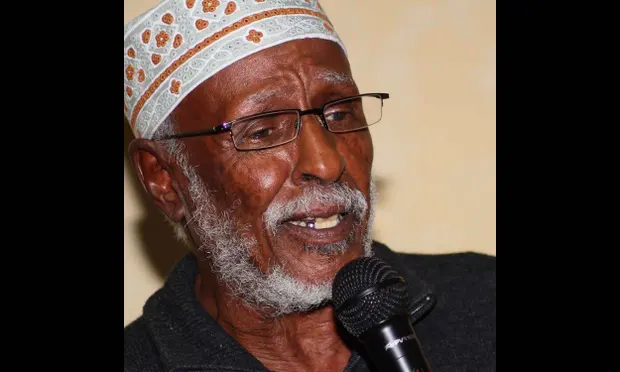
SOMALIA : Goodbye Genius Hadrawi: the Scholar of Philosophers, and the Philosopher of Scholars

The great Somali poet, philosopher and scholar Mohamed Ibrahim Warsame (Hadrawi) passed away on the 18th of August 2022, in Hargeisa, Somaliland.

A national funeral was held in Hargeisa, and many Somalis from all parts of Somalia attended to pay their respects for the last time to the great man. The news of his death had brought tears to the eyes of every Somali, whether they met him or not. when you look around and see people of different walks of life commiserating about his death, you would think their own father had passed away.

He did not give these people materials for them to love him that much, but he acquired their hearts and minds by being sincere and trustworthy with his beliefs. Somalis and non-Somalis compared him to the great poets, philosophers, and scholars of the world, past and present. However, I think he transcends all, he was an ‘ummah’ in his own right.

Allah SWT when he was describing the personality of prophet Ibrahim said “Indeed, Ibrahim was acomprehensive [ummah] devoutly obedient to Allah, inclining toward truth, and he was not of those who associate others with Allah (Quran, 120:16)”. Allah described prophet Ibrahim as “ummah”, and the word ‘ummah’ in the Quran is used either to describe a nation (more than one person), or someone (like prophet Ibrahim) who is so great that his personality and beliefs are different from the society he lives in, and comprehensive that he can stand independently and single-handedly change the society from bad to good. In other words, someone who is not a follower of the majority of people that agrees on wrong decisions.

Instead, ‘ummah’ is a follower of truth even if the majority of people disagree with them. We can safely describe Hadrawi as being an ‘ummah’ in his own right. Because anyone who observes his life and his literary works, soon understands that Hadrawi was not your everyday person. He was an ‘ummah’ because he prided himself on liberty by refusing to be bought.

In the early 1970s, when almost every Somali was clapping in agreement with the communist regime that ruled Somalia from 1969 to 1991, Hadrawi stood up on his own and refused to bow down to oppression.

He was an ‘ummah’ when he freely opted to go to prison and suffer or worse, rather than clap for a tyranny.

In his latest book ‘Hawaale Warran’ he narrates what happened between him and the military regime, and how after he refused to bow down was arrested and put away in jail without justification whatsoever.

In 1973, Hadrawi wrote a play called ‘Aqoon iyo Afgarad’ ‘Knowledge and Consensus’ which he and his fellow poets Mohamed Gariye and Professor Muse Abdi Elmi presented in Lafoole Institution, located outskirt of Mogadishu.

The objective of the play was to advise the Somali people not to seek education outside the country, rather education was available on home soil, and there is no need to waste the nation’s wealth to send students abroad. It is worth mentioning, that at the time, the regime was sending its cadres and the children of revolution leaders to the Soviet Union, Europe and the United States for education and training, in the process, wasting the taxpayers’ hard-earned money. Hadrawi did not like that, hence his play knowledge and consensus’ addressed that.

The 1969 revolution leaders, in particular, the country’s president Mohamed Siyad Barre, did not like the play, and he thought it was anti-revolution and embarrasses his decision to spend a huge amount of the nation’s wealth on sending cadres outside the country.

He summoned Hadrawi to Afisyoni, his air force headquarters. Hadrawi said, men from the national guards took him there, and he met the president sitting under a tree. The president opened the conversation with the remarks “Hadrawi, I know you are anti-revolution, but why every poetry you compose are used against us?”. Hadrawi said, “I tried to convince him, and said, we (poets) compose poetry, and then people take it and interpret it to whatever makes sense to them”. Then the president concluded the meeting by saying “ask me whatever you want, but after today, I don’t want to hear any poetry of yours that people are using against us”. Hadrawi replied by saying “whatever Allah decrees is gonna happen”.

Hadrawi continued his work and created another play called ‘Tawaawac’. The play naked the misery and the disappointments Somalis inherited from the 1960 independence, and how a handful of military officers have hijacked the nation’s hopes after getting rid of colonisers. He likened this to a scenario where people are fighting over the meat of a slaughtered she-camel that was supposed to be spared for daily milking to feed the kids and the elderly. One of the song’s lyrics that Hadrawi created for this play says:

Weligay cad quudheed

Anna qaadan maayoo

Qalanjadan faraha dheer

Wax la qaybsan maayee

This translated into something like:

I will never accept

An offer with contempt

And I will never share anything

With this long-fingers beauty

Hadrawi said, the president, especially hated these four lines above, because he thought that I was taunting him and making fun of his earlier offer of ‘ask me what you want, but stop composing poetry’.

The next thing Hadrawi knew he was snatched from his home in the middle of the night by men from the security services under direct orders from the president. He was arrested without going before a court and thrown in jail at Qansax Dheere, in the Bay region far away from his residence. When asked why they took you all the way to Qansax Dheere, while there are many jails near your residence? He replied they wanted to brainwash me and break me into submission. They said to me you will be released immediately if you ask forgiveness from the father of the revolution (meaning the president).

Hadrawi was an ‘ummah’ when replying to this demand. He said to them “know there will be three scenarios with me, I die and go to my grave, I stay in prison, or I acquire my full freedom [without fearing anyone]”. He stayed in prison for five years, and again, as usual, he was an ummah in prison by continuing his struggle against tyranny. By this time, many Somalis woke up to the cries of Hadrawi from their deep asleep and started to see the tyrannical regime for it really was.

Hadrawi was an ‘ummah’ when the civil war happened in 1988-1991 by manifestly telling the struggle leaders ‘do not replace tyranny with another. He was an ‘ummah’ after the civil war in his ‘Peace Spring’ in 2003, when he travelled on the ground from Hargeisa to Kismayo, stopping in every town between them, literally hundreds of villages.

He was an ‘ummah’ by his devouted love of literature and writing. He comprised a whole poem about the importance of writing, he said:

Qalinkaa wax suureeya

Kugu sima halkaad doonto

Saaxiib kal furan weeye

Sunto fara ku hayntiisa

Weligaa ha si deynin.

Sisin iyo ku beer muufo

lyo laanta saytuunka

Ku gotomi sungaan waarta

Iyo nabadda seeskeeda

Samo iyo ku doon heedhe

Dunidiyo sinnaanteeda

The pen that can imagine for you

And can take you where you want

It is a friend with open heart

Regularly, keep it in your hands

And never let it go

Plant it among sesame and bread

And the branches of olive

And use it to spread in the world

peace, equality and justice

In these short lines, he was an ‘ummah’, the material of philosophy ‘abstraction’ he uses here to emphasise how important is to use writing to seek peace, prosperity, justice and equality, which is nothing short of genius. He was trying to kill one stone with the two old enemies of the human race: poverty and ignorance.

Equally important, he was an ‘ummah’ when he praised the Somali women for their beauty and bravery. He was a great admirer of the Somali women, although depicting their true nature without exaggeration or embellishments. In his poem ‘Horn of Africa Girls’, he said about the Somali women:

Hablo weerar geli kara,
Hablo geela dhicin kara,
Hablo geesi dili kara,
Gobannimona hanan kara,
Hablo talada goyn kara,
Garta madal ka niqi kara,
Garashana iskaga mida,
Quruxdana ka wada goba;
Geesteenna mooyee
Geyi kale ma joogaan
.

Girls that can go to war

Girls that can defend the camel

Girls that can acquire honour

Girls that can make decisions,

And publicly express their opinion,

And equally have high intellects

Girls that all blessed with beauty

Except, in our region,

Can they be found in anywhere else?

The examples of the great man are many, and it is impossible to mention them all in this short article. I would advise any admire to go to his works, and they will find an encyclopedia of knowledge, that will take them a lifetime to study.

Lastly, but not least, he was an ‘ummah’ by leaving instructions on how he wished to be treated after his death. He wrote a poem called ‘will’, in which he advised people to treat his death like any other, he said.

Qofka ii duceeyoow

Rabbigay ku darajee

Qofka iga ducaystoow

Dummaddaada weeyaan.

After many passages of the poem, he pleaded with people that they should not make a fuss about his death and funeral. His grave should not be built but should be left like other graves. People should not make a shrine of his grave, nor should they over-grieve or celebrate his life. In the last few lines, he prays for those who pray for him.

Finally, you lived as an ‘ummah’ and died as an ‘ummah’, there is nothing left to say but goodbye to our beloved teacher, philosopher, poet and role model. Your body might have departed this world, but your ideas and the knowledge you left for us and humanity, are eternal. I am sure people of the other side and angels are welcoming you with roses and open arms—they are congratulating you as you have accomplished your mission here on earth, advised your people and fought bravery in the way of Allah seeking justice, and freedom and equality for all. May Allah shower you with His Forgiveness and Mercy, light up your grave, and may He elevate your status and grant you Jannatul-Firdaus. May Allah resurrect you with the prophets, the steadfast affirmers of truth and the martyrs.

“And whoever obeys Allah and the Messenger – those will be with the ones upon whom Allah has bestowed favour of the prophets, the steadfast affirmers of truth, the martyrs and the righteous. And excellent are those as companions (Quran 69:4)”.

“Verily we belong to Allah and verily to him do we return”.


source/content: hiiraan.com (headline edited)

____________
______________

SOMALIA
SOMALI AMERICAN: ‘I wanted to be underestimated’: How Muna Abdulahi played her way through Netflix’s reality show, ‘The Mole’

Minneapolis poet Muna Abdulahi talks strategy, community and leveraging cultural stereotypes in Netflix’s season two of “The Mole,” where she competed for a $154,000 prize.

Who is the mole? 

For Somali American poet Muna Abdulahi, that question loomed large during her first day on season two of Netflix’s reality game show, “The Mole,” which was filmed in the napier grass fields of western Malaysia. Abdulahi had to figure out who to trust among the other 11 players while aware that one of them might be secretly sabotaging the game, and while navigating cultural differences and working to stay under the radar herself during the six-week filming.

The premise of “The Mole” is simple: contestants work together to build a pot of prize money that only one player will win in the end. Among them is “the mole,” a player tasked with working against the group. After each mental or physical challenge, players take a quiz to identify the mole and the contestant with the lowest score is eliminated. If the mole remains undetected until the end, they win, but if the last player uncovers their identity, that player takes the prize. 

In a game where everyone is out to deceive each other, moments of genuine connection feel like dangerous territory. Off-camera, players share meals, tell stories and laugh together — but beneath the camaraderie, the question remains: Who can you trust when everyone might be lying? 

Abdulahi, who grew up in Willmar, Minnesota, and now lives in Minneapolis, approached the game with a calculated strategy: lean into being underestimated.

“When people first meet me, they see the hijab,” Abdulahi said in a confessional in the first episode. “They see a Muslim woman, somebody who follows other people’s orders, and I’m going to use that to every single advantage.”

Did Abdulahi’s strategy pay off? Watch “The Mole” on Netflix to see how far she goes.

 In an interview with Sahan Journal, Abdulahi reflected on her life as a poet and shared her experience filming the show in July 2023. She discussed what it was like being a Muslim woman in a high-stakes competition balancing trust and suspicion.

The interview has been edited for length and clarity.

Can you share a bit about your journey as a poet in the Twin Cities? What inspired you to start writing? 

I started writing poetry when I was 14. Somalia is known as the nation of poets, so I have family members who are poets, like my grandmother. Being born and raised in the U.S., language was still a barrier because I understood Somali when it was spoken to me but speaking it was a whole other conversation. So, when I was young, there was a part of me that really wanted to find something that connected me to my culture and poetry was it. 

The issue was, I went to predominantly white schools my whole entire life, so a lot of the authors I would read would be old white men. I’m like, “Okay, I have absolutely no ties to these people,” but then I started getting into spoken word poetry and that scene is predominantly BIPOC stories and narratives that I never got to hear growing up. It inspired me to write, and I just never stopped.

How do your experiences as a Muslim woman influence the subjects you write about?

That’s a really good question. I mean, I think everything ties back to our inner child. For me, I never really got to hear BIPOC stories. I still remember the first BIPOC story I read. It was “The Kite Runner.” 

I think when you are not represented in stories, it makes you feel unimportant and as if your experiences are not worthy of being shared. It’s also the media in general. So, my mission when I started writing was to not only give space to our stories, but to give space to the stories that were devalued or silenced or not seen as worthy. 

It feels like there’s two sides of the coin — either our stories are not being shared or, when it is, it’s these perfect stories where Black and brown girls become tokenized and don’t feel worthy unless they’re exceptional. I want to give space to the in-between.

What drew you to “The Mole”? How did you get involved with the show?

I’m a big, big fan of reality TV, specifically reality competition shows like “Big Brother” and “Survivor,” so I’ve always wanted to be a part of it, but I never saw any Muslim people. I remember writing down in my notebook the shows that I want to be a part of, and I had to check off every single one because the structure of the game itself would not meet the necessities and the needs of being a Muslim woman.

In “Survivor,” you’re stranded on this random island and — let’s say you just did a swimming challenge — you’re going to be wet all day, all night. Maybe you have an extra hijab but how would you be able to preserve your values and at the same time play this game? 

It’s the same thing with “Big Brother,” where you’re being filmed 24/7, even when you shower. Even though I love the game, I can’t really do it. What I loved about “The Mole” is that the structure of the game itself is accessible to Muslim women. 

What was it like communicating with producers about what you needed?

So the first thing is prayers. We pray five times a day. The way that these games work is completely fast-paced, so I basically had to tell them, “Hey, I need 10 minutes.” We met in the middle where I was able to move to the side and do my prayers, but that also meant that I was praying in a lot of different places. 

We also didn’t have our phones, but I usually use it to pray at specific times and toward a specific direction to Mecca. I also needed water to make wudu (a cleansing ritual), so there was somebody who literally carried my prayer mat, bottled water and checked the times for me. That was really helpful. It also helped that we were in a Muslim country. There were a lot of prayer rooms already within the city. 

How did you mentally and physically prepare for the show? 

I rewatched a lot of the seasons, and not just the U.S. seasons. I’m also a big fan of the international seasons, so I was watching Netherlands, Belgium and Australia. I wanted to make sure that my game plan was set, but at the same time give myself room to adapt, because that’s the name of the game. 

We don’t really know what we’re getting into. I also prepared by memorizing things, because the objective of the game is, “Who is the mole,” right? We have to remember as much as possible about them: What are they wearing? What color are their shoes? Which car did they get in? 

Those little details would be on the quiz. 

What was your strategy going into the game? 

Originally, my strategy was to play into this stereotype that people have for Muslim women — very timid, shy, quiet, observational, not taking up too much space — so they underestimate me. It worked for that first episode but after that, I had to switch up my game. 

I can’t hide. It’s so much more difficult to hide who you are when you’re with these people all day, but it still worked to my advantage because people still underestimated me. Well, until mid-game when you see them start to question if I was the mole. 

In the first episode, you talked about how people often perceive Muslim women as obedient or timid. As you entered the game and interacted with contestants, did you feel that they had a specific perception of you?

Off the bat, yeah. It was exactly what I thought. I don’t think a lot of people on the show had close Muslim women friends, so I think a lot of the time, people perceive groups of people based on what they see on TV. 

I remember Q [Quaylyn Carter] was like, “Oh my gosh, I thought you were going to be so quiet,” so, I really could have played into that. But Andy (Mintzer) had a lot of knowledge about Muslim culture. Muslim women and men are not supposed to touch the opposite gender’s hand, so I knew that first meeting was going to be so awkward because a lot of people don’t know that, but Andy knew right away.

How did you manage building friendships with contestants while, in the back of your mind, knowing that one of them is sabotaging the game?

To be honest, I came in there like, “I’m not here for friends; I’m here to win,” but a lot of these people are just so likable and so lovely. The mole lies throughout the whole thing, but off-camera, the stress and tension is gone. We’re eating together or driving to the next location and sharing stories about who we are. 

The core of me is centered around community, and even though I wanted to shut it off, those in-between moments really got to me. Some of these friendships are so real. Hannah (Burns), for example, was somebody who I saw as competition or as an enemy, but outside of the game, we were friends, so it was this weird, funny tension where it’s like, “I adore you, but in the game, I’m lying to you up and down.”

I had such a beautiful friendship with Jenn (Jennifer Dasilva-Hassiman), too, and it sucked so bad because she left first. She has such a beautiful spirit. In the beginning, it was difficult coming into this as a minority. 

I know who I am, but I’m also shifting myself a little bit for this game, and as someone who grew up in predominantly white spaces, code switching becomes this mechanism. It was lovely to see Jenn be exactly who she is — this bold, beautiful personality and unapologetically herself. 

One of the key moments from the season was episode five, when you guys had an auction and contestant Neesh Riaz bid the entire pot of $59,500 for an exemption from the quiz.

What was it like watching all of that money you guys worked for drain from the pot?

It was so tense, and it’s funny watching it back from an outside perspective, because it’s been so long. I’m just laughing at my reaction, because it was so serious. What’s so unique about this game is that they take your phone away so you’re truly, one-hundred percent engulfed in this experience. Like, this is your life, and we’re at the halfway point. 

When he took all that money, it just hit me that somebody’s full year of work was gone just like that. 

Honestly, everybody was so mad. There’s so many moments that were not shown. We were outside and we were just like, “What are we doing here?” Even the host had to remind us that there’s still a lot of money coming in, but I think at this point, people were just so tired of losing money and you’re realizing not only are we competing against the mole, we’re competing against other players. So you’re like, “Okay, what are my actual odds here? If I was to win, am I going to be winning a dollar? Is that right?”

How did it feel to get as far as you did? 

It felt so good. A big part of that whole experience ties to the very beginning of our conversation where I didn’t want to come on the show to prove that I’m smart or exceptional. I just wanted to be myself and show all of the complexities that make up a human. 

I’m smart, but I’m also a big personality. I’m a little funny and a little quirky. I don’t have to compromise anything and I can still get to the end. Even though I didn’t win, I still proved that it had nothing to do with who I was or my capabilities and, for that, I feel like my purpose was met. Money would have been amazing but the experience was more fulfilling than I could have imagined.

What was the reaction from your friends and family after the show aired? 

It was really beautiful. My family is my biggest support system and my sisters, especially. It was like a sports game, the way they were cheering for me. 

What about the response from viewers?

Watching the show back was such a healing experience, and then to see the outpour of love in my DMs — that was something I wasn’t prepared for. And to see all these Muslim women come into my messages — it meant so much to me, and I didn’t know how much I needed it. 

It just reaffirmed exactly what I was meant to do. Coming into this next era, I want to continue paving the path so others could walk with me and hopefully, it’ll be easier for the next one, and the next one, and the next one. 

source/content: sahanjournal.com / myahgoff (headline edited)

_____________

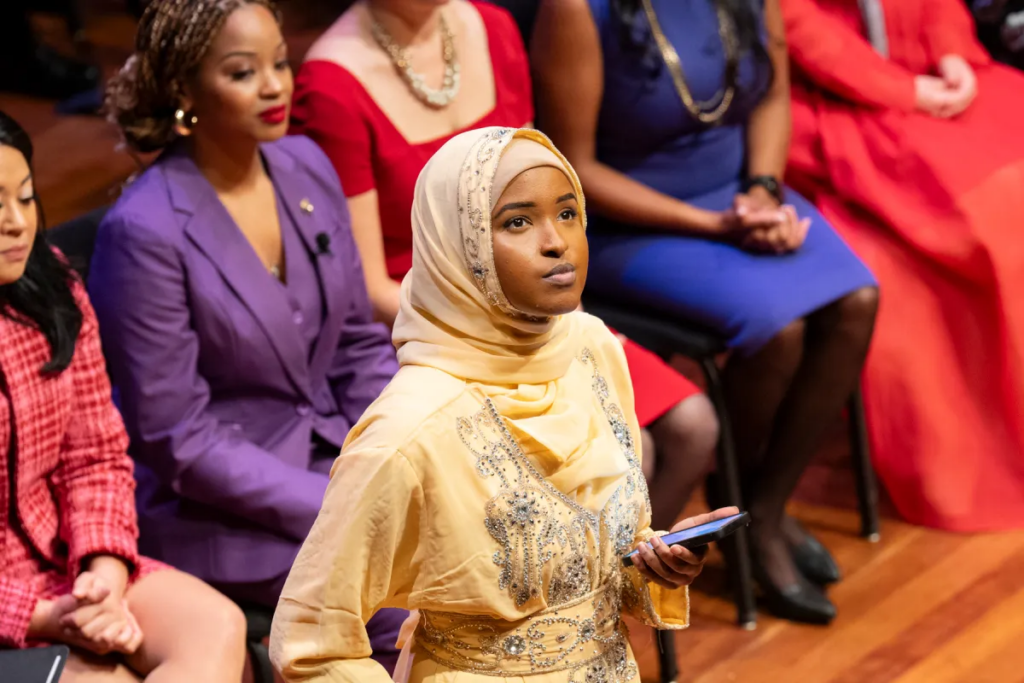
Poet Muna Abdulahi (center) gives a spoken word tribute during the January 9, 2024, inauguration of St. Paul’s historic all-female City Council. The new council sits behind her. Credit: Aaron Nesheim | Sahan Journal

________________________

AMERICAN / SOMALIA

SOMALIA: Mohamed Ibrahim Warsame, one of Somalia’s greatest Poets

Mohamed Ibrahim Warsame, one of Somalia’s greatest poets, dies aged 79.

Somali social media has been flooded with tributes to the man better known as ‘Hadraawi’.

Messages of condolences continue to pour in from around the world following the death of Mohamed Ibrahim Warsame, regarded as one of Somalia’s greatest poets.

Warsame, known as “Hadraawi”, died in Hargeisa, in Somaliland, on Thursday at the age of 79.

Social media has been flooded with tributes and praise for his contribution to Somali language and culture.

“I’m heartbroken to inform you our giant Mohamed Ibrahim Warsame Hadraawi has passed away. Might Allah bless him and grant him Jannah,” Ayan Mahamoud, founder of Kayd Somali Arts and Culture , said on Twitter.

“We will treasure his legacy and the rich scholarly work he left behind,” added Said Salah Ahmed, a poet and playwright who teaches the Somali language at the University of Minnesota in the US.

Hadraawi, which means the “master, or father, of speech”, was regarded as a pillar of modern Somali literature and a strong advocate of peace and democracy.

In 1973, he was imprisoned for five years by the president, Siad Barre, who ruled Somalia until 1991, for speaking against the revolution. His work was banned but he continued to compose poetry upon his release, which were was passed on through word of mouth.

The songs and verses he wrote are full of imagery and metaphor, open to interpretation, which made it hard for the military regime to control. A verse from his poem The Killing of the She-Camel resulted in his imprisonment without trial.

The snake sneaks in the castle:

although it’s carpeted with thorns

still the coward casts off his curses

so the courageous must stretch out his neck;

the cob stallion sells his values

in order to cut a fine figure.

When such cockiness struts forth

and even laughter becomes a crime

our country has unfinished business.

In the early 1990s he called for an end to the civil war, which caused thousands of people to flee Somalia. In 2004, he travelled throughout the country on a “peace march” urging warring parties to stop the violence. His message of reconciliation resonated with Somalis at home and abroad.

He retired a few years ago.

“Poet Mohamed Ibrahim Warsame (Hadraawi) was a symbol of unity and peace,” said the Somali president, Hassan Sheikh Mohamud, in a statement. “He was one of key pillars of Somalia’s art and literature who took a leading role in preserving the Somali culture and promoting the Somali language. His death is felt in every Somali household.”

The EU, Norway, the UK and other friends of Somalia sent condolences and tributes.

“Sending my heartfelt condolences to the people of Somaliland and to all Somalis for the loss of Mohamed Ibrahim Warsame “Hadraawi”, an iconic poet and one of the most eminent and beloved Somali poets of all time,” tweeted Lizzie Walker, head of the Foreign, Commonwealth and Development Office in Hargeisa.

Hadraawi had been called the “Somali Shakespeare”, but Somali singer and songwriter Aar Maanta said: “Hadraawi wasn’t the ‘Somali Shakespeare’ he was the Somali Hadraawi. He was more than a poet; he was a philosopher and a freedom fighter who spent many years in jail for his stance against injustice and dictatorship.

“He wrote some of the most beautiful love songs and poems that Somalis in the Horn of Africa and beyond use as a benchmark.”

Ahmed, who knew Hadraawi since late 1960s, added: “Hadraawi was one of the kindest people I have ever met. His poetry speaks for the voiceless and calls out oppression against the people …. he will be missed so dearly but we will treasure his legacy and the rich scholarly work he left behind.”

Known as a “nation of poets”, poetry is woven into the fabric of Somali society with centuries of oral history, as the Somali language was only written in 1972.

Contemporary Somali poetry, including the works of Hadraawi, has been preserved in books and translated into English.

source/content: theguardian.com (headline edited)

_____________

___________

SOMALIA