Arabs & Arabian Records Aggregator. Chronicler. Milestones of the 25 Countries of the Arabic Speaking World (official / co-official). AGCC. MENA. Global. Ist's to Top 10's. Records. Read & Enjoy./ www.arabianrecords.org
Ryyan Alshebl fled war-torn Syria in 2015, arriving on the Greek island of Lesbos after a harrowing four-hour journey on a rubber boat.
Eight years on, he is the mayor of a German village.
“It was dark and cold and there was not a single light to be seen on Lesbos,” he recalls.
“A few hours ago we had been in a normal Mediterranean town in Turkey. The environment had transformed with the cold and dark, and of course the feelings of fear that go with such a journey.”
Alshebl, then barely 21, was among a huge wave of refugees who arrived in Europe that year.
After landing in Greece, he made his way through Macedonia, Serbia, and Croatia by public transport and on foot, taking 12 days in total to reach Germany.
He eventually ended up at a refugee center at Althengstett, a rural region near the Black Forest.
“In the shared accommodation, where you cannot expect more than a bed, a roof, and some food, for which you are still thankful, you can only do one thing: get back on your feet quickly and invest rapidly in your own future,” he said.
Alshebl soon learned to speak German fluently — “if you are in the countryside you have no other choice” — and landed a traineeship as an administrative assistant at Althengstett town hall.
He earned German citizenship in 2022, a prerequisite for anyone who wants to stand in local elections in Germany.
‘Taking responsibility’
Now 29, he will take up his post as mayor of Ostelsheim, a village near Althengstett, in June.
He is believed to be the first Syrian from the wave of refugees who arrived in Germany in 2015-16 to be elected to a political post.
Alshebl was joined by four friends on his journey to Europe. But he left behind his parents and one brother, though a second brother had already moved to Germany on a student visa.
He said his experience of fleeing Syria and having “to take responsibility not only for (myself) but also for the environment” had given him the drive to go into politics.
“To take on this responsibility at such an age, you learn a lot. Of course, it creates a new person, a new personality,” he said.
Alshebl ran as an independent candidate in the election, winning 55.41 percent of the vote.
But he is also a member of the Greens, “because climate protection is very important” to him.
His victory is all the more striking given that Ostelsheim, a village of 2,700 people, is a traditionally conservative community.
Situated among a cluster of hills, the village is surrounded by rolling fields lined with dry stone walls and hedges.
The far-right Alternative for Germany (AfD) party harnessed anger over the influx of asylum seekers in 2015-16 to win votes and ultimately enter parliament for the first time.
Openness
But Alshebl said he has not seen right-wing extremism personally.
Alshebl believes he was elected because he listened to the people’s concerns — from childcare to digitalization issues.
He admits to not really “feeling anything” on hearing he had won the election in March as he was “overwhelmed”.
But as congratulations poured in from around the world, it became clear that his story was “bigger than a mayoral election in a small community”.
Alshebl believes the fact he triumphed against two other local candidates who grew up in the area says a lot about the mentality of the voters.
“It is a sign that people did not count the origin, but the qualifications. It is a sign of openness to the world,” he said.
Alshebl’s parents, a schoolteacher and an agricultural engineer, belong to Syria’s Druze minority, but he describes himself as not religious.
He has “mixed feelings” about Syria, which he has not been able to visit since living in Germany.
“It is the country where you were born and raised… You long for the people you grew up with,” he said.
“But I am happy that I got this chance to live here at all” when others have not, he said.
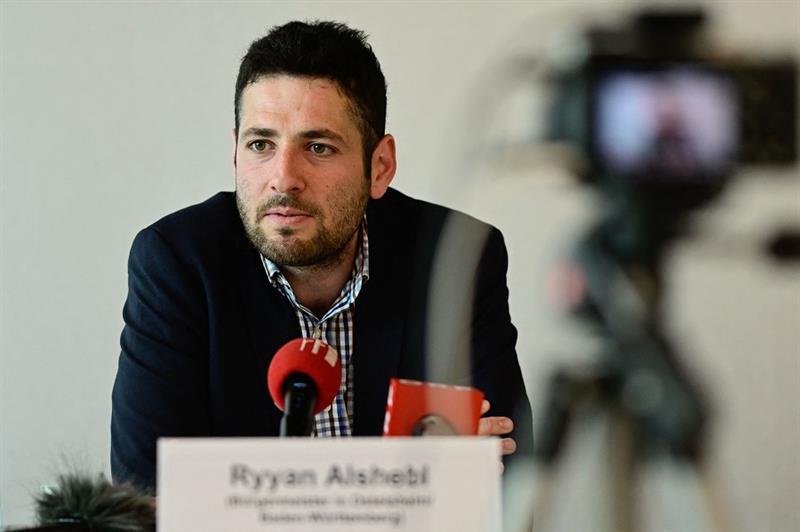
Ryyan Alshebl, mayor of the community of Ostelsheim in Baden-Wuerttemberg, southwestern Germany, addresses a press talk with the Association of the Foreign Press in Germany (VAP) in Berlin, Germany on May 30, 2023. AFP
Five other coders win $50,000 each in awards presented by Dubai Crown Prince for top apps.
A Syrian coder on Wednesday won $1 million (around Dh3.67 million) in the ‘One Million Arab Coders’ contest during an award ceremony in Dubai facilitated by Sheikh Hamdan bin Mohammed bin Rashid Al Maktoum, Crown Prince of Dubai, Chairman of The Executive Council and Chairman of the Board of Trustees of the Dubai Future Foundation.
Six software projects developed by Arab youth from around the world competed for the grand prize, thanks to the programming skills they acquired during their participation in the initiative’s courses.
On Wednesday, during the closing ceremony held at the Museum of the Future in Dubai, Sheikh Hamdan presented the awards to winners, with Mahmoud Shahoud, a Syrian coder who lives in Turkey, taking home the $1 million top prize.
Sheikh Hamdan tweeted: “Today, we honoured the winners of the ‘One Million Arab Coders’ Challenge, the UAE’s initiative to nurture the development of technology skills among Arab youth. 1.85 million Arab participants from 80 countries took part in the initiative along with 3,600 certified trainers.”
He added: “The Challenge opens fresh opportunities for Arab youth and offers a new path for them to achieve their dreams… Congratulations.”
Sheikh Hamdan added: “The ‘One Million Arab Coders’ initiative provided the opportunity for one million Arabs to enter the digital world. It fulfilled the dreams of tens of thousands of Arab programmers from all over the world. Its outcomes and successes will be the basis for many upcoming Arab achievements in the world of technology and coding. One Million Arab Coders’ has paved the way for Arab youth to broaden their horizons and sparked their innovation and creativity in the field of advanced technology.”
He added that the ‘One Million Arab Coders’ initiative, which was launched in 2017 by His Highness Sheikh Mohammed bin Rashid Al Maktoum, Vice President and Prime Minister of the UAE and Ruler of Dubai, has succeeded in becoming a gateway for many Arab youth to use their programming skills to realise their dreams and aspirations.
“We look forward to our Arab coders continuing their pioneering innovations and expanding their achievements. We expect their names and future accomplishments to light up the sky worldwide.
“His Highness Sheikh Mohammed bin Rashid Al Maktoum’s vision for the region’s future is based on investing in the development of the Arab people. The language of programming is one of the pillars of the knowledge economy and a major bridge to a future in which those who possess scientific excellence will have the upper hand,” Sheikh Hamdan concluded.
Shahoud was adjudged winner for his ‘Habit360’ app that helps users create and maintain good habits, allowing them to achieve long-term goals. Shahoud said half of the prize winning will go towards helping Syrian refugees. The rest will be invested in Dubai as Shahoud plans to shift his base to the emirate and start his own business.
Sahoud is a software engineer from Syria who developed Habit360 that helps people build new habits, track their progress and stay motivated. The application has served more than 200,000 users from around the world.
Beside Shahoud, there were five other winners announced on Wednesday.
About the initiative
The ‘One Million Arab Coders’ initiative is supervised by the Dubai Future Foundation and organised under the umbrella of the Mohammed bin Rashid Al Maktoum Global Initiatives.
The closing ceremony held at Dubai’s Museum of the Future on Wednesday was to honour the best Arab talents in coding, and highlight best coding projects developed by graduates of the initiative to serve their communities and create a better future for humanity.
A total of $1.35 million was given away in prizes during the ceremony.
Mohammed Abdullah Al Gergawi, Minister of Cabinet Affairs, Vice Chairman of the Board of Trustees and Managing Director of the Dubai Future Foundation, said: “The ‘One Million Arab Coders’ initiative embodies the vision of His Highness Sheikh Mohammed bin Rashid Al Maktoum [Vice President and Prime Minister of the UAE and Ruler of Dubai] , to provide new opportunities for Arab youth, empowering their contributions to the advancement of technologies globally, and to put a clear Arab footprint in the future of humanity.”
Aimed at youth
He said the initiative aimed mainly at empowering Arab youth around the world with the tools of the future, and providing them with the opportunity to gain new experiences and skills that would help them turn their dreams into successful projects that benefit their societies and have a positive impact on their lives.
“The initiative was a glimmer of hope for Arab youth around the globe that success is not bound by place, age, or obstacles. Rather, success requires insistence on acquiring the experiences and skills that will be needed in the future,” Al Gergawi said.
He pointed out that the initiative was a cornerstone for countless success stories where coding helped create a positive impact on the future of humanity, and spread hope in the Arab region.
Al Gergawi stressed the importance of the initiative’s role in encouraging Arab coders to innovate and start developing software projects that not only meet the needs of their societies, but also foresee and adapt to its future requirements and changes, pointing to the initiative’s success in developing a leading global experience to teach coding skills in an effective manner, which was adopted in Jordan and Uzbekistan.
Saeed Mohammad Al Gergawi, Director, Dubai Future Academy, said: “We have 400 million Arabs and that is a lot of talent. Our criteria is that they had to be impactful, ready to be implemented and creative.”
Other winners
In addition to the grand prize for the ‘One Million Arab Coders’ challenge, the five best projects will receive prizes of $50,000 each, and four of the best trainers participating in the initiative will be honoured with prizes of $25,000 each. The finalists were chosen by a specialised jury that comprises many experts in the fields of entrepreneurship and future technologies.
Egyptian–Canadian Andrew Makram won $50,000 for his app called ‘Najeeb’, a platform for exams, tests and quizzes. “It is a cross-platform tool for teachers and educators to create and share paperless quizzes online. What the app does is that it allows students to access the quiz remotely, submit answers and receive the result instantly. Realtime submitted data are available to educators for revision and evaluation purposes,” he said.
Makram added that it took him a month to develop the app and it is in prototype form.
Egyptian entrepreuner Eman Magdy was another winner who has developed an app for the benefit of working women in Egypt. She won a prize for her initiative to ease the burden of working women in Egypt.
“The app is called 3lfraza. It is a platform to support homestay women in Egypt. Basically homestay women help working women to prepare vegetable and meat cuts and meals. Currently 9,000 women are registered from Egypt. We hope more women for all over the world use this to help one another. The app supports small vendors, helping busy mums in their day to day lives,” she said.
Meanwhile Mohamed ElEskandarany developed an app called ‘Muaahal’ to help youth to develop new skills. “It is a platform that aims to qualify Arab youth and prepare them well in the fields of their choice to work in suitable jobs or to start their own business. In addition, helping companies to find qualified employees, and to solve the problem of unemployment and increase the productivity of youth,” he said.
Another winner, Ammar Salim, won in the initiative for his app called Qeraaty Alnateqa which helps in speaking-reading program for the deaf and mute. “It is a speaking program to teach reading and writing to deaf and mute children. With a new sign language system and tool for converting the sign of only two fingers from the fingers of the hand to spoken letters and words,” said Salim.
Last but not the least, Hasan Mohamed won the prize for his ‘Chat translation app’.
“It is a mobile app that provides a textual and vocal chat for people of different languages in different places around the world ,to convert people’s speech in different languages into written texts, translate texts from one language to another, and convert translated texts into spoken speech again,” said Mohamed.
Software expertise
Sheikh Mohammed launched the ‘One Million Arab Coders’ challenge in July 2021 with the aim of recognising and honouring the achievements of Arab talents in the field of programming and creating an opportunity for participants in the initiative to showcase their innovative projects, developed using programming skills and the experience gained during their participation.
The challenge saw a total of 257 projects submitted by the initiative’s graduates from 50 different countries in various sectors related to programming, technology and entrepreneurship in the areas of website and mobile application development. In order to qualify for the final stage and compete for the million-dollar prize, the nominees were selected according to a set of main criteria, including the project idea, the innovation quality, and ease of use.
Jury
The jury for the final round included Fadi Ghandour, Chairman of Wamda Capital; Bashar Kilani, Managing Director of Accenture Middle East; Dr. Abdul Latif Al Shamsi, Director of the Higher Colleges of Technology; and Ronaldo Mouchawar, Vice President of Amazon Middle East.
Supervised by the Dubai Future Foundation, the ‘One Million Arab Coders’ initiative has seen 1,058,265 people from around the world participate virtually in millions of hours of study and work, as well as tens of thousands of training workshops. Since its launch, 1,500 “Nano Degree” certificates have been awarded to distinguished participants and promising talents. The initiative featured more than 3,600 certified trainers from around the world.
Serving humanity
Led by the Dubai Future Foundation (DFF) and organised under the umbrella of the Mohammed Bin Rashid Al Maktoum Global Initiatives (MBRGI), ‘One Million Arab Coders’ is the largest initiative of its kind in the world. The initiative aims to teach one million young people from the Arab world to code and enable them to launch exceptional projects and programmes that serve Arab societies, drawing on the science and skills gained from their training.
The initiative embodies Sheikh Mohammed’s vision to empower Arab youth with the tools of the future to serve humanity and build a brighter future for the region. The challenge forms part of the UAE’s continuous efforts make a positive impact on the world.
Partnerships
The ‘One Million Arab Coders’ initiative is supported by the Hussein Sajwani – DAMAC Foundation, which focuses on supporting learning opportunities and developing skills to stimulate profitable social and economic participation, and empowering societies in the Arab world to achieve a sustainable future. The Udacity digital learning platform also supported the initiative by offering educational content and training in necessary skills for future jobs. The list of partners of the initiative also included many international technology companies, including Microsoft, Facebook, Oracle, Careem and others.
The initiative also provides the world with a pioneering model for promoting the development of programming skills. It was adopted in the Hashemite Kingdom of Jordan, which launched the ‘One Million Jordanian Coders’ initiative in May 2019. The initiative was introduced with the aim of making Jordan a world leader in the field of programming. The ‘One Million Uzbek Coders’ initiative, launched through a partnership between the governments of the UAE and the Republic of Uzbekistan, was announced in November 2019, with the aim of providing Uzbek youth with an opportunity to acquire skills in programming, artificial intelligence and emerging technologies, to contribute to the development of innovative technology-based solutions and services.
source/content: gulfnews.com (headline edited)
_____________
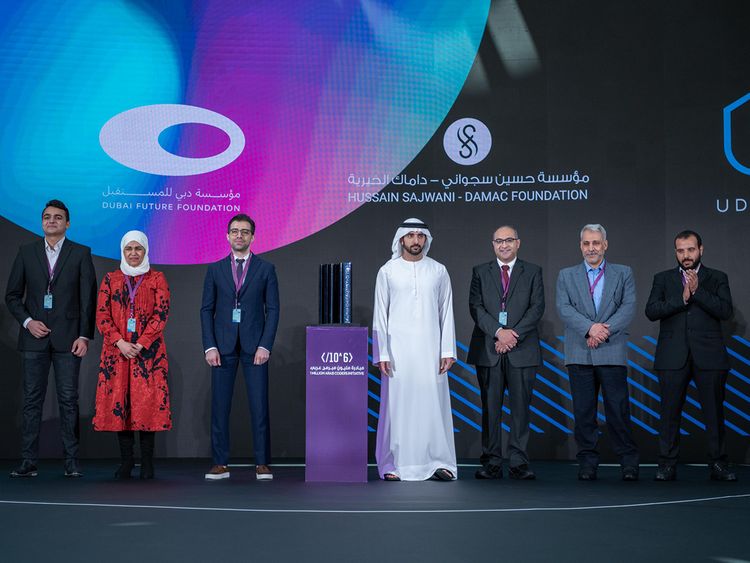
Sheikh Hamdan bin Mohammed bin Rashid Al Maktoum (centre) with the winners / Image Credit: Supplied
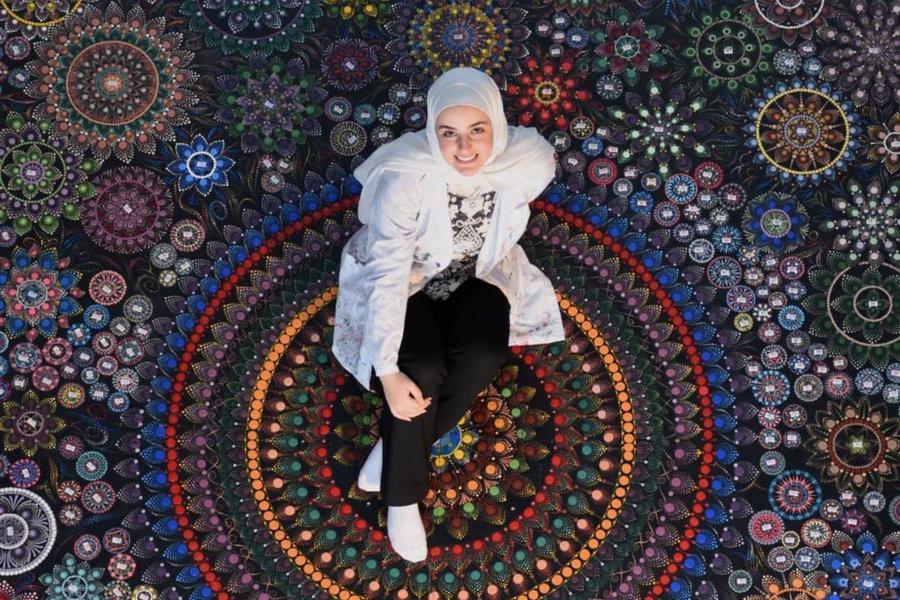
Syrian young artist, Lama Zakaria has recently achieved the first world record in the Guinness World Records for the largest display of mandala in the world, raising the name of Syria high and proving once again the ability of Syrian youth to excel in various scientific and artistic fields.
Lama told SANA’s reporter that she spent two years of continuous and diligent effort for reaching this stage, stressing that she worked with precision and patience to achieve the required symmetry in her painting, which achieved the record for the largest painting of mandala in the world.
She added that the mandala contains 4096 mandala circles of various diameters, colors and various decorations by using special dotting tools and acrylic paints on a 6 mm-thick wooden board.
She pointed out that the painting with dimensions 488 x 488 cm contains a large number of circles overlapping with each other and free circles with flowing lines that enhance cohesion among them.
Zakaria noted that in each quarter of the painting forms a part of a major basic circle that is the center of the painting and its eye-attracting heart, which required work carefully on all colors and various decorative units.
Lama Zakaria, a third-year student at the Faculty of Architecture at al-Baath University, has sought to specialize in mandalas, as she worked individually to learn the origins of this art and master its methods, and participated in several art exhibitions.
source/content: sana.sy (headline edited)
______________
Actress Lama Zakaria – Photo from Lama’s official Instagram page
Syrian girl, 7, who survived horrors of civil war crowned Arab Reading Challenge champion.
Sham Al Bakour named sixth winner of prestigious title at Dubai Opera House awards ceremony.
A Syrian schoolgirl who survived a deadly missile attack during the civil war in her country has been crowned Arab Reading Challenge champion in Dubai.
Sham Al Bakour, 7, was only six months old when her family’s car was struck during violence in Aleppo in December, 2015.
Her father was killed while she and her mother survived the horrific attack.
She has now completed a remarkable journey from tragedy to triumph to win words of praise from Sheikh Mohammed bin Rashid, Vice President and Ruler of Dubai.
In footage released by Dubai Media office, Sheikh Mohammed is seen speaking to Sham as she clutches her winner’s trophy at a ceremony at Dubai Opera House on Thursday.
Her success was met with warm applause by a large audience at the Downtown Dubai culture spot.
“She sustained injuries in the head and at the hospital doctors stitched them,” said Sham’s mother, Manal Matar, 33.
“I have been her support along with my family and her father’s family.
“I noticed she had a passion for memorising texts and Quran verses since she was less than three years old so I supported her.”
A young symbol of hope
She said that Sham has been an inspiration for the children in her family and school.
“Her cousins wait to see what she reads to learn from her.
“Her school mates will certainly be inspired. This challenge will help raise a generation that can rebuild Syria.
“Love of reading must start at a very young age.”
The young literature lover read 70 books to win a competition that attracted 22 million entrants from 44 countries.
When asked about what she would do with the Dh1 million prize money, she said she would give it to her mother.
“We haven’t thought of what to do with the money yet. The focus is on Sham, she is my investment for a better future,” Ms Mattar said.
Sham secured top spot ahead of Adam Al Qasimi from Tunisia in second, and Rashid Al Khateeb from Jordan, in third.
Reading is ‘food for soul and mind’
The young winner said reading offers an opportunity to transport yourself to new places with every turn of a page.
“I’m very happy to win and would like to invite all my friends and all young people to read. Reading is food for soul and mind,” Sham said.
“Reading takes you places, every story introduces you to different people and takes you to a new place.”
The youngster impressed judges with the confidence and clarity with which she expressed her ideas and opinions.
“It was a unanimous decision on Sham, who showed confidence,” said Lailah Al Obaidi, professor in Arabic language and literature at the University of Sharjah, and one of three judges.
“Sham will pave the way for the generation of the future because at this young age, she will be a motivation for more young readers in the Arab world.”
The annual winner is selected based on the pupil’s ability to articulate general knowledge, their critical thinking and communication skills, plus the diversity of books they have selected.
The Arab Reading Challenge was launched by Sheikh Mohammed in 2015 to encourage a million young people to read at least 50 books in a year.
Helping to shape young minds
Noor Aljbour, from Jordan, won Dh300,000, along with the title of Outstanding Supervisor, in recognition of her work guiding and motivating pupils through the challenges of the Covid-19 pandemic.
“The obstacles and the amount of work to prepare for this edition of the reading challenge were huge because its the first to happen after Covid-19,” Ms Aljbour said.
“Pupils returned to schools lacking the passion for reading, this meant that we needed to encourage pupils not only to read but to also pick up on their studies.”
Morocco’s Mukhtar Jasoulet school won the Dh1 million Best School award.
In the category for Arab pupils living in foreign countries, Nada Al Satri from Belgium was named the champion.
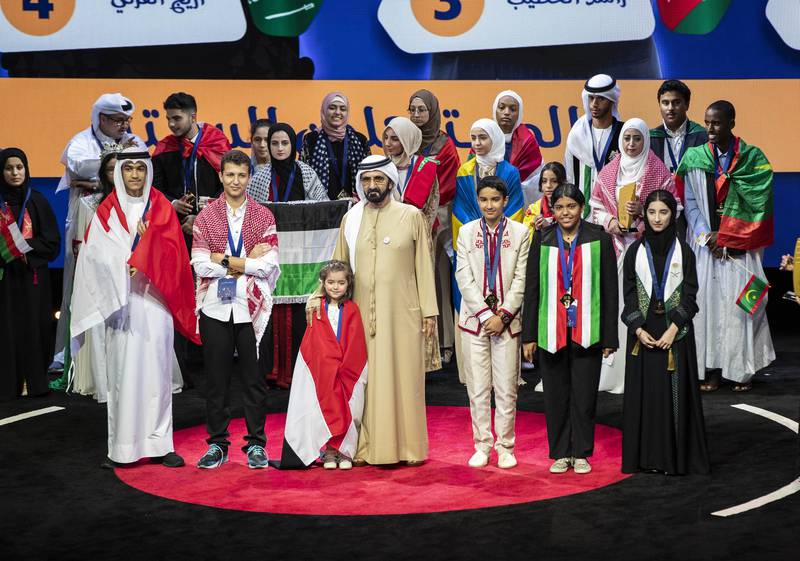
Sheikh Mohammed bin Rashid, Vice President and Ruler of Dubai, with the six finalists at the Arabic Reading competition at Dubai Opera. Left to right, Mohammed Jamil (Bahrain), Rashid Al Khateeb (Jordan), Sham Bakour (Syria), Adam al Qasimi (Tunisia), Ghala Al Enzi (Kuwait) and Areej Al Qarni (Saudi Arabia). All photos: Ruel Pableo for The National
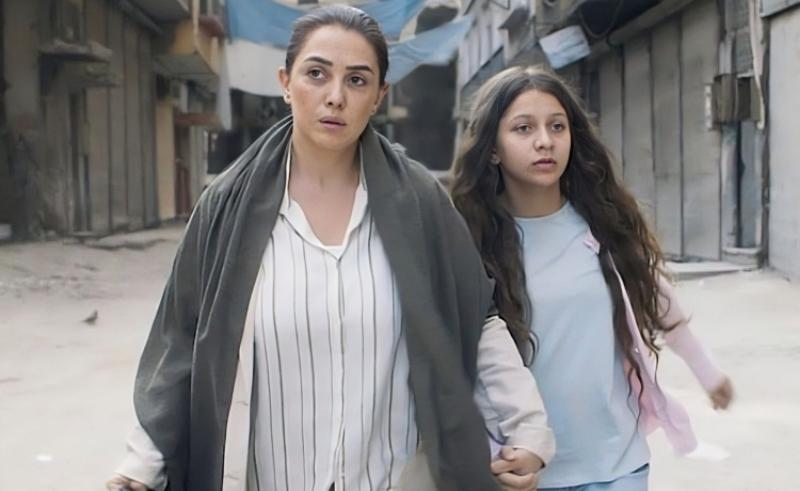
Winner of the Audience Award at Venice Film Festival’s Orizzonti Extra Section, ‘Nezouh’ follows a Syrian family on the verge of becoming refugees.
Syrian film ‘Nezouh’ starring Kinda Alloush and Samer Al Masri, and directed by Syrian filmmaker Soudade Kaadan, won the Audience Award at Venice Film Festival’s Orizzonti Extra Section, supported by Armani Beauty. This is Kaadan’s second win at the festival after ‘The Day I Lost My Shadow’ (2018), her first feature-length film and the winner of Best Debut Film.
The film stars the Cairo-based Syrian actress Alloush, known for her roles in Egyptian and Syrian dramas. She was first introduced to Egyptian audiences in 2009 with her role in ‘Welad El A’am’ and has since starred in multiple films and series including ‘El Maslaha’ (2012), and ‘El Asliyyin (2017). She’s also part of the cast of ‘The Swimmers’ (2022) which debuted at Toronto Film Festival.
‘Nezouh’ is set in war-torn Damascus and tells the story of a Syrian family at a crossroads choosing between fleeing or clinging on to their home. The father, played by Samer Al Masri, refuses to become a refugee while his fourteen-year-old daughter yearns for freedom. The film is inspired by the filmmaker’s personal journey away from Damascus and the effect of the conflict on Syrian women’s social reality.
As the world looks back on the storied life of Queen Elizabeth II, fashion lovers could be pleasantly surprised to find the longest-serving British monarch championed Arab creativity on one of the most memorable days of her life.
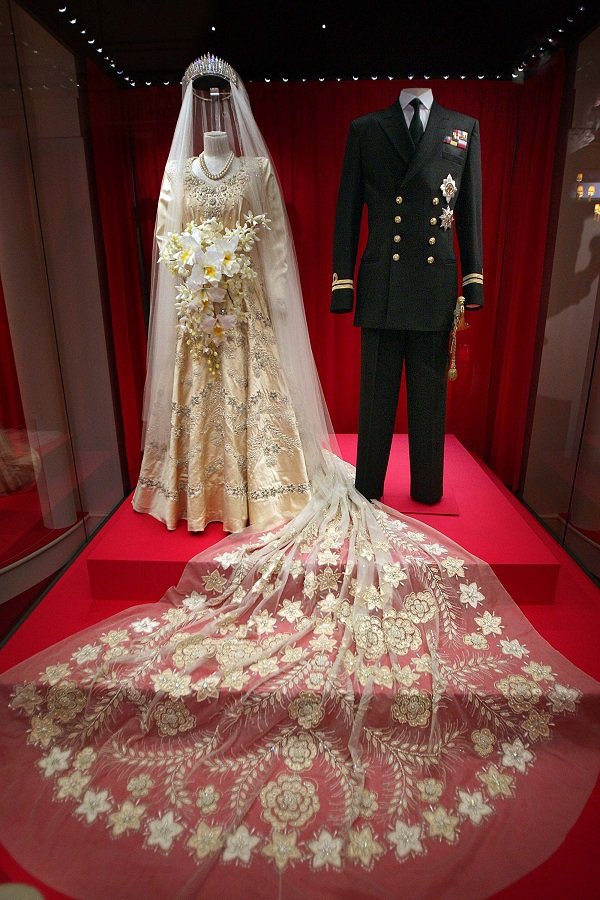
On Nov. 20, 1947, the then-21-year-old princess married naval officer Prince Philip of Greece in a gown created by court designer Norman Hartnell.
The regal dress was made of ivory silk from China — not Japan or Italy given the recent end of World War II — and featured 10,000 seed pearls imported from the US — as well as show-stealing Damask brocade from Damascus, Syria.
The brocade fabric was brought from the Al-Muznar factory in the Bab Sharqi neighborhood of Damascus’s Old City and featured embroidery of “two love birds” exchanging kisses in a pattern known locally as “the lover and the beloved.” Woven with 12-karat gold thread, the brocade fabric was reportedly sent to the queen by Syrian President Shukri al-Quwatli.
The dress was meant to symbolize “rebirth and growth” in Britain after the war, according to the Royal Collection Trust.
It took 350 women seven weeks to make, and featured elaborate floral motifs of jasmine, smilax, lilac and white rose-like blossoms added to the train. The design was inspired by Italian artist Botticelli’s 1482 painting of Primavera.
source/content: arabnews.com (headline edited)
__________
On Nov. 20, 1947, the then-21-year-old princess married naval officer Prince Philip of Greece. (Getty Images)Princess Elizabeth’s wedding dress, designed by Norman Hartnell, and the Duke of Edinburgh’s Royal Naval uniform are displayed at an exhibition at Buckingham Palace on July 27, 2007 in London. (Getty Images)
Once a creator of skyscrapers, the artist and activist has scaled-down his work – but not his ambitions – to enshrine the calamity in his homeland using elaborate models
The sound of a muezzin exhorting Muslim worshippers to hurry to salvation is not one that could often have been heard within the former Regency church of Holy Trinity in the seaside resort of Brighton.
Right on cue, though, the distinctive chant echoes out, filling every nook and cranny of the 200-year-old building, from the galleries to the arched stained-glass windows and timber-clad chancel at either end.
It comes as Mohamad Hafez is recounting the day he fell under the spell of his birthplace, Damascus, having returned to it as a teenager after a 14-year absence.
“Walking down the old city streets looking at mosques right next to churches, and synagogues next to secular galleries and nude sculptures … I went there from a very conservative culture in Saudi Arabia,” Hafez, 37, tells The National.
“Seeing the bustling city life, with merchants and calls to prayer,” he says, pausing to smile at the perfectly timed adhan issuing out of a loudspeaker hidden in one of his artworks, “and bells ringing together with children playing and the car horns, it was very hard not to fall in love with this collective celebration of diversity.”
The recording of the busy streetscape is clearly audible even over the hustle and hammering of the team assembling Hafez’s ‘Journeys from an Absent Present to a Lost Past’ exhibition in the historic residence of the visual arts organisation Fabrica.
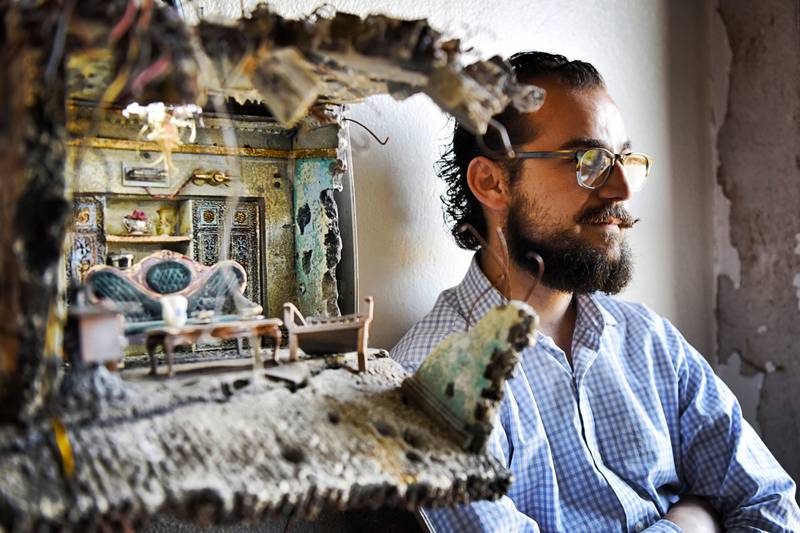
Art handlers wearing blue surgical gloves have already carefully opened the dozen or so timber shipping crates to decant the series of miniature dioramas of his native Syria now hanging on the walls.
Each box was stencilled with FRAGILE in black lettering but the romantic snippets of memories and sounds of a bygone era contained within Framed Nostalgia #3 might arguably have warranted a more strongly worded warning.
It occupies an extra special place in the heart of Hafez — and that of his new wife, Luisa. “That’s the only piece I don’t own,” he says. “It’s owned by her, and I told the guys that if they damage it, they ruin my marriage. Anything else is fair game.”
His immersive process involves the study of photographs of Damascus from before and during the civil war, dimming the lights, brewing Arabic coffee, burning bakhour and incense, and putting on acoustic Middle Eastern music.
What emerges from the induced sentimental state as if, as Hafez puts it, he were a 3D printer are scenes of urban fabric that draw on his training as a corporate architect but come with a political charge.
“I really don’t remember much of the detail, how it comes together,” he says. “It’s a weird feeling. What I enjoy most is that I am discovering this detail as though I am a spectator seeing it for the first time, and that’s very, very fulfilling.”
Frustrated at prevailing narratives, Hafez took a sabbatical from architecture three years ago to focus fully on using his mix of street art, sculpture and activism to respond to thorny issues such as the atrocities in the ongoing conflict or dehumanisation of refugees.
“It is my foot in the door,” he says. “The more the sabbatical continues, the more I’m realising the urgency of the message and sense of agency because there are thousands of architects who can build skyscrapers , thousands.
“But how many of them are Syrian, Arab, Middle Eastern, practising Muslims, raised in Saudi Arabia, educated in the Midwest of the United States, and can talk the talk that will build bridges between people?”
Hafez says the crisis in his homeland has caused a spiritual awakening within him. Which may explain what he was doing on a three-week retreat in Malaysia when he heard news of a concert being held nearby in the capital by the ensemble Al Firdaus that he often listens to in his art studio while working.
Particularly captivated by the cellist Luisa Gutierrez, it wasn’t long before Hafez engineered a visit by Al Firdaus to Yale University, in New Haven, Connecticut, where he is a Silliman College Fellow.
He hosted the ensemble for dinner and invited them to his studio crammed full of paraphernalia, shelves and bins overflowing with scaled-down furniture and toys, dried plants and jewellery, Christmas ornaments and shells, electrical appliance innards and paints.
There, Hafez engaged all the musicians in conversation except for Luisa, who, overwhelmed by the atmosphere, was sitting on a chair staring at the artist’s latest labour of love — Framed Nostalgia #3 — and listening to the evocative audio with tears in her eyes.
“I think what happened is that she clicked into the street scene,” he says. “It’s common for people to come out crying from my exhibitions. Well, fast forward and that became her dowry for our wedding last year.”
Though Hafez was born in Syria, his own tale deviated early on when the family moved to a military compound in Al-Kharj in central Saudi Arabia, where he spent many happy hours supervising the construction of buildings out of whatever he and his playmates could lay their hands on.
Other than the lengthy commute to the elite Najd National School by bus 100 kilometres away in Riyadh, Mohamad never ventured outside the base where his father was head surgeon in the attached hospital.
“There was no need. It was a protected bubble in all respects, and really gave me a true childhood like building forts using found objects. I would boss my friends around, saying ‘No, no, this way, let’s put a window here, you see?’ Twenty years later, I’m going ‘You idiot, you’ve been doing architecture since you were 6 years old.’”
Hafez returned to his birthplace intermittently for holidays that were mostly whiled away in swimming pools, and only properly at the age of 15 when his father took early retirement.
Presided over by his sociable mother, the household became a “cultural salon” that inspired his latest architectural endeavour, Pistachio Cafe , below his studio on the northern shore of Long Island Sound.
It offers the experience of being hosted in what his domicile might have been like, transporting customers with mosaic tables and vintage radios, and bounty made by refugee chefs and cooks such as “the lady who makes shawarma for me from her kitchen at home”.
He is as entranced now with the world’s oldest continuously inhabited city as he was back then when his teenage self would wander its souqs and alleyways with sketch book in hand at any available opportunity.
But for a pupil hitherto accustomed to rubbing shoulders with the upper echelons of Saudi Arabian society, the move to a public school with military uniform and regular training exercises was shocking.
Consequently, Hafez has a deep connection to the words he has spray painted across a vast swathe of black plastic sheeting stretched around several pillars in his exhibition for the Brighton Festival.
This section of “Journeys” replicates the sense of exile felt by those in the refugee and migrant encampment known as the Calais Jungle. Above an evocative stanza borrowed from the Nairobi-born, Somali-British poet Warsan Shire — “No one leaves home unless home is the mouth of a shark” — he has put: I AM JUST A NUMBER.
“I think the whole experience at that school was so traumatic,” he recalls. “I had lost myself. No one cared about ‘What do you want to be?’ I think it’s a big part of me, who I am and why I like working with a lot of universities and high school kids, just to push that fire inside them and make them believe in their intuition.”
The result was that he undertook a course in electrical engineering at Damascus University before following his older siblings to study in the United States when it finally dawned that “every inch of my body was meant to be an architect”.
Hafez would go on to celebrate his first skyscraper at the precocious age of 30, becoming project head designer on an ambitious 48-storey glass and steel office tower in downtown Houston, Texas.
But throughout his studies, a single-entry visa precluded him from visiting Syria because of a travel ban imposed on the citizens of 27 countries after the 9/11 attacks, and later came the Arab uprisings.
Surrounded by the cornfields of Iowa, a homesick Hafez lapsed into depression and was wrought by anxiety. His way of dealing with it, as he explains in ‘A Broken House, the Jimmy Goldblum documentary about his life shortlisted for this year’s Oscars, was deciding that if he couldn’t go home then why not make home?
By night, for a long time, he modelled the destruction of Syria as a sanity-saving outlet to be able to get up and build glistening edifices in his day job with colleagues complaining about the coffee being cold. “‘This is your dilemma right now?’,” Hafez remembers thinking.
It is little wonder that he quotes with conviction the observation of Cesar Cruz, Dean of the Secondary Schools Programme at Harvard, that art should comfort the disturbed and disturb the comfortable.
“With skyscrapers, we design every last detail until the cows come home years before the building sees the light of day. With these,” he gestures around the gallery, “I can break free in my artistic expression. I don’t plan. I work on six or seven pieces at a time so as not to commit too much memory to any one piece, jumping from one to another.”
His store of memories of home is precious and finite. There is no portrait of the four siblings and parents together since 1999, the last time they were all under the same roof. He has been back to Damascus only once, just before the war began in earnest in 2011, when his architectural firm sent Hafez to pitch a project in neighbouring Lebanon.
There has been no other chance to experience the everyday occurrences or family occasions — the funeral of his beloved grandmother, the marriage of a sister, the births that made him an uncle — he has had to miss or risk enforced military service.
Yet, sustained by an inner peace, Hafez conveys hope in person and through the use of verses from the Quran in his art that are intended to counsel patience and raise spirits in dark times.
When asked to translate a particular bit of Arabic script he has incorporated into a scene, he looks gleeful. “Happiness Bakery this way 200 metres,” he explains, laughing. “People have no qualms whatsoever spray painting on a 2,000-year-old wall, putting the advertisement for their shop on a Roman column!”
The humour abounds with graffiti elsewhere saying “I love you”, “Where’s Dad?” and then there’s one in English. Again, it sets Hafez off. “It’s supposed to be ‘No parking’ but with the Arabic accent I’m making fun of our people with ‘No barking please’.”
Accents offer an endless source of amusement to him. One of the consequences of his childhood in the military compound in Saudi Arabia was picking up a multitude of Arabic dialects that Hafez employs on his travels.
“I engage people with their own native dialect, and they go, ‘Whoa, whoa, who are you?’ I love messing with Arabs because nobody can tell that I am Arab. I’m this weird object … I have this curly artist’s moustache, I have a beard, and a little [pony]tail. Then I wear a fancy shirt or a Malaysian garment, and they’re like, ‘Is he Italian? Pakistani? Bosnian? No, he’s Iranian.’”
As a master of misdirection, he concedes that he likes to sneak up on people in the same way that crises do. Audiences are lured in by the beauty of his work, such as Tower of Dreams that features intricate mosaics and floats above a tapestried rug, until the “hot moment when they realise that it looks like an RPG shooting people’s lives and memories into an abyss”.
Perhaps it is the habit of a lifelong outsider but he is also, be warned, a consummate eavesdropper, honing the skill during that side trip to Damascus from Lebanon 12 years ago.
Like a sponge, Hafez took to the streets once again, using his phone to record taxi journeys, calls to prayer, the chattering of locals in cafes that would eventually end up as the multimedia embedded in his works.
“My favourite, favourite, favourite part in everything I do is when I’m a fly on the wall,” he says. “If nobody recognises me around my exhibits, I can just eavesdrop to see how people are reacting. Or you’ll find me in Pistachio Cafe mopping floors, sweeping, putting myself at the service of people, and I observe them enjoying my product, my architectural creation.”
He ends the interview with a short guided tour of his dioramas, pointing out a pleasing crackle or patina here or some rust that has developed there, then stopping at a surveillance camera poking out of one of the facades.
“That’s Big Daddy watching always,” Hafez notes, without the slightest hint of recognition that it would be fair to say much the same of him.
‘Journeys from an Absent Present to a Lost Past’ by Mohamad Hafez is at Fabrica, Brighton, until May 29
http://www.mohamadhafez.com/
source/content : thenationalnews.com (edited)
____________
It has become an obsession in ‘undoubtedly xenophobic, divided times’ for Mohamad Hafez to use his mix of street art, sculpture and activism as a response to thorny issues such as the atrocities of the conflict in Syria or the dehumanisation of refugees. Photo: Fabrica
Syria overtook Afghanistan last year as the country with the highest number of recorded casualties from landmines and explosive remnants of war, a monitoring group said Wednesday.
The Landmine Monitor said Syria had registered the most victims for the first time since its annual reports began in 1999, with 2,729 people either killed or injured.
Colombia recorded the most casualties from 2005 to 2007, and Afghanistan has recorded the most since then until last year.
Globally in 2020, the report said at least 7,073 casualties of mines and explosive remnants of war, including 2,492 deaths, were recorded across 54 territories.
The overall number of casualties was below the peak of 9,440 reached in 2016, but up from 5,853 in 2019.
The 23rd annual report is produced by the Landmine and Cluster Munition Monitor, the research and monitoring arm of the International Campaign to Ban Landmines and the Cluster Munition Coalition NGOs
source/content : english.ahram.org.eg
____________
File Photo: A Syrian army soldier uses a detector to find and clear landmines in a field at a pistachio orchard in the village of Maan, north of Hama, in west-central Syria, June 24, 2020. AFP / pix: english.ahram.org.eg
Razan Al-Sous and her husband Raghid Sandouk fled Syria to start a new life in Yorkshire, leaving behind their dream of setting up their own pharmaceutical company but opening up a new entrepreneurial life in the city of Huddersfield.
With the simple idea of making halloumi-style cheese from cows’ milk and launching a best-selling range of Arabian flavoured cheeses, the innovative pair have won more than 30 awards for their product and gained royal approval from Princess Anne.
When they arrived in Yorkshire, Mr Sandouk’s brother let them run his chicken food outlet and it was there the first Yorkshire Dama Squeaky Cheese was created.
Now they have nine flavours in their range, from plain and chilli to black onion seed, rosemary and mint.
The couple recently won their latest award, for their black pepper squeaky cheese.
n 2017 the couple expanded to new premises and were given a royal seal of approval when Princess Anne officially opened their factory in Sowerby Bridge.
Now the couple have been invited to Buckingham Palace.
This month they won yet another award for their Middle Eastern style cheese, Nabulsi, which contains black onion seeds and has now become a bestseller in the UK.
www.yorkshiredamacheese.co.uk
source/content: thenationalnews.com
________
Syrian cheese maker Razan Al-Sous. / pix: Ashraf Helmi / The National
Majeda Khoury. Chef. Syrian Human rights and Feminist activist.
Syrian migrant, one of her early decisions in London was to join a refugee cooking group run by social enterprise Migrateful. It brings together Londoners and refugees to learn recipes and share a meal.
She gives one or two classes a week, teaching simple but beautiful meals that can be reproduced at home