TUNISIA : Chanting ‘Free Palestine’: The Voice of Hind Rajab receives record ovation in Venice Film Festival

Following its screening, Kaouther Ben Hania’s film The Voice of Hind Rajab (2025) received a 22-minute-long standing ovation — the longest in the Venice Film Festival’s history – culminating in theatre-wide chants to “Free Palestine.”

The film had its world premiere at the 82nd edition of the renowned Venice Film Festival, which runs until 6 September.

The film is also Tunisia’s official submission to the 98th Academy Awards.

The first screening of the film was completely sold out hours before its showing.

Several artists from the film’s cast and crew attended the screening, including lead actor Motaz Malhees, who held a photo of Hind Rajab on the red carpet and raised the Palestinian flag on the stage of the theatre after the film’s conclusion.

The film’s unprecedented success was reflected in the longest standing ovation in the festival’s history, with chants of “Free Palestine” resonating across the hall.

The Tunisian-French co-production also stars Amer Hlehel, Clara Khoury, and Saja Kilani.

“Film anchored in truth”

In a post-screening press conference, Kilani declared that “the Voice of Hind Rajab does not need our defence. This film is not an opinion or a fantasy; it is anchored in truth. Hind’s story carries the weight of an entire people.” 

Film director Ben Hania also commented on Trump’s plans to turn Gaza’s coastline into a “Riviera,” saying, “When I think about Hind playing on the beach, and I think about this project, [I find myself asking] in what world do we live in?”

Hind Rajab
 

The film recounts the events of 29 January 2024, when Red Crescent volunteers received an emergency call. A six-year-old girl named Hind Rajab was trapped in a car under fire in Gaza, pleading for rescue. 

While trying to keep her on the line, they do everything they can to get an ambulance to her. 

The film uses real-life voice recordings between Hind and the Red Crescent correspondents, who attempted to rescue her from the unrelenting Israeli attack.

Explaining her vision for the film, Ben Hania said, “What I wanted was to focus on the invisible: The waiting, the fear, the unbearable sound of silence when help doesn’t come. Sometimes, what you don’t see is more devastating than what you do. At the heart of it is something very simple, and very hard to live with. I cannot accept a world where a child calls for help and no one comes. That pain, that failure, belongs to all of us.”

Kaouther Ben Hania 
 

Kaouther Ben Hania is one of the most acclaimed filmmakers of the Arab World, known for her bold storytelling and cinematic innovation. 

Her 2023 film, Four Daughters, won the L’Oeil d’Or at Cannes and was nominated for Best Documentary at the 2024 Academy Awards. 

Her 2020 feature, The Man Who Sold His Skin, was nominated for Best International Feature and won Best Actor at Venice’s Horizons Section. 

Earlier works like Beauty and the Dogs (2017), Zaineb Hates the Snow (2026), and Le Challat de Tunis (2012) also earned international acclaim.

source/content: english.ahram.org.eg (headline edited)

_____________

The Voice of Hind Rajab gets record 23-minute ovation at Venice premiere

___________

TUNISIA
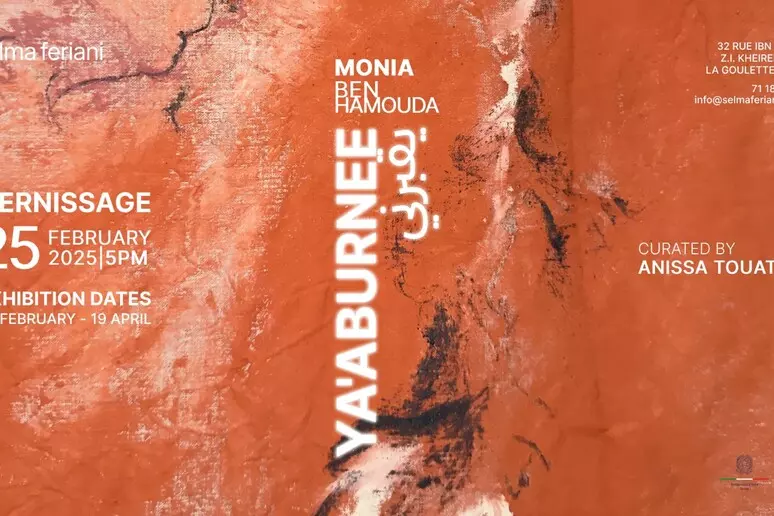
TUNISIAN-ITALIAN : The visual art of Monia Ben Hamouda on show in Tunis

By the Italian Embassy and the IIC.

From 26 February next, Monia Ben Hamouda’s exhibition entitled ‘Ya’aburnee’, curated by Anissa Touati, will be open to the public at the Selma Feriani Gallery in Tunis in partnership with the Italian Embassy and the Italian Cultural Institute of Tunis.


 The exhibition by the Italian-Tunisian artist, who won the prestigious MAXXI BVLGARI PRIZE 2024 last December, takes its name from the Arabic concept that translates as “you bury me”, reflecting the altruistic desire for a loved one to outlive himself.

Love and sacrifice, omnipresent in the exhibition, explore the complex ideas of language, history and understanding through an installation spanning three floors of the gallery, combining painting, sculpture and sound works, blurring our relationship with space.

Ben Hamouda aims to capture the distinctive soundscape of Arab countries, emphasising how these sounds shape cultural identity and perception.

source/content: ansabrasil.com.br

____________

______________________
ITALIAN / TUNISIAN

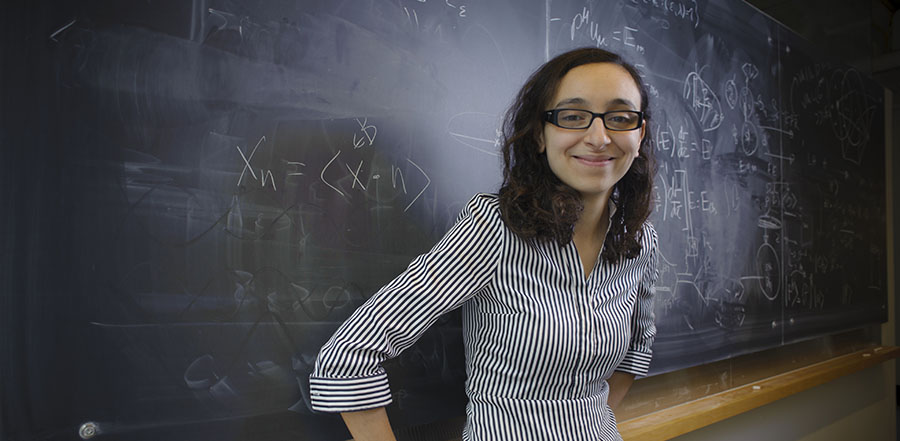
TUNISIA: Tunisian-American Astroparticle Physicist Lina Necib Wins 2023 Valley Prize for Work on Dark Matter

As a child in Tunisia, Lina Necib watched the 1997 film “Contact” and decided to become an astrophysicist. Now at MIT, she studies dark matter’s shadowy clues.

Lina Necib is on the hunt for something invisible.

“It’s a little bit like detective work,” she says. “We have a lot of observational types of evidence, and we’re trying to put all of it together into one picture.”

Necib, an assistant professor of physics at the Massachusetts Institute of Technology, studies dark matter, the elusive stuff that makes up most of the universe’s mass but doesn’t reflect, emit, or absorb light. For her work, Necib has won the 2023 APS Valley Prize, which recognizes early-career physicists for research expected to have a dramatic impact in the field.

In 2020, Necib and her colleagues reported their discovery of a massive stellar stream, a ribbon of stars left over when a galaxy is torn and stretched, orbiting on the outskirts of the Milky Way. Dark matter tugs at these streams, leaving behind fingerprints — evidence of its existence.

Necib believes the stream, dubbed “Nyx” after the Greek goddess of night, might be the remnant of a dwarf galaxy that collided with the much larger Milky Way billions of years ago. To study the stream, her team merged particle physics with cosmological simulations, data from star catalogs, and machine learning — a groundbreaking combination of tools. They published their results in Nature Astronomy.

Necib credits a few other physicists for her successes — “in particular, several women,” including Anna Frebel and Tracy Slatyer at MIT and Mariangela Lisanti at Princeton University.

Mentors as much as colleagues, these women helped Necib adjust to her new faculty role at MIT, which she started during the pandemic and with a newborn baby, she says.

Necib grew up in Tunisia, a small country on Africa’s northern coast, where she says she regularly faced sexist expectations for girls’ behavior and ambitions. One night, when Necib was 8 years old, her family settled in for a movie. The selection? “Contact,” starring Jodie Foster, who plays a scientist searching for aliens. The film opened Necib’s eyes not only to the field of astrophysics, but to a world in which a woman could do astrophysics.

By the end of the movie, Necib had made up her mind: “I’m going to do that!”

She set her sights on college in the U.S. As an undergraduate at Boston University, she leapt into diverse research opportunities, conducting resonance testing of graphene and even joining the search for the Higgs boson at CERN. Her interest in dark matter grew.

During her senior year, at an open house hosted by MIT’s physics doctoral program, Necib struck up a conversation with Jesse Thaler, a theoretical particle physicist. By the end of the chat, Necib knew she wanted to be at MIT.

Necib ultimately asked Thaler to be her dissertation advisor. “He was so enthusiastic about the work that he did. He loved it so much — it was kind of contagious,” she says. “Having an advisor who really put in the time and effort to help me become the physicist that I am changed my life.” Necib earned her doctorate in 2017.

Now in her second year as an assistant professor at MIT, Necib hopes to change cultural attitudes about science careers in Tunisia, where certain professions are given more weight. She wryly summarizes this ranking, starting with the best: “Doctor, engineer, lawyer, failure.”

To topple these perceptions, Necib recently teamed up with Rostom Mbarek, another Tunisian physicist and the Neil Gehrels Prize Postdoctoral Fellow at the Joint Space-Science Institute. The duo just launched an astrophysics podcast entirely in Tunisian Arabic.

In her MIT classroom, Necib strives to debunk outdated perspectives on who does physics.

“I did this experiment last year in one of my first-year physics classes where I asked my students to name physicists,” she recalls. “And all the names they came up with were Nobel Prize winners, but they were also all the same old, Albert Einstein-like examples.”

After that session, Necib had her class learn about more recent work, including the contributions of women and scientists of color to the field.

One of Necib’s “students” is particularly young. Her 17-month-old son can’t yet say “dark matter,” but he has the children’s book “Astrophysics for Babies,” and they go on excursions to Boston’s Museum of Science. He’s a bit young for the exhibits — “he’s just impressed with the escalator,” she says — but she hopes that early exposure will instill in him a love for science.

Meanwhile, her search for dark matter continues. She says that, if someone else solves the mystery of dark matter before she does, it won’t phase her. For her, being a physicist is “really about the people,” like her colleagues, mentors, and students.

“I know amazing people that are doing incredible work,” she says. “Feeling that my work is recognized fills me with so much joy. I hope to pay it forward.”

www.lnecib.com

Liz Boatman is a staff writer for APS News.

source/content: aps.org (APS News), (headline edited)

___________

Lina Necib / Credit: David Sella

__________________________

AMERICAN / TUNISIAN