SAUDI ARABIA : King Faisal Specialist Hospital performs world’s first robotic intracranial tumor resection surgery

Achievement reflects ‘our growing role in shaping the future of global medicine,’ CEO Dr. Majid Al-Fayyad says

Procedure involved removing a 4.5-centimeter brain tumor with robotic arms from a 68-year-old man who had been experiencing severe headaches

In a historic leap for robotic medicine, the King Faisal Specialist Hospital and Research Centre in Riyadh has performed the world’s first robotic intracranial tumor resection.

This groundbreaking achievement sets a new global standard in neurosurgical precision and recovery.

The procedure involved removing a 4.5-centimeter brain tumor with robotic arms from a 68-year-old man who had been experiencing severe headaches and loss of concentration.

Remarkably, the patient was discharged fully conscious within 24 hours — a recovery time nearly four times faster than that of traditional brain surgeries.

Dr. Homoud Al-Dahash, KFSHRC consultant for skull base tumors and lead surgeon, stated that the robotic system provided exceptional precision and control, which enabled surgeons to navigate critical neurovascular structures with a high level of safety.

“The patient’s same-day discharge, fully conscious and without complications, represents a new benchmark for neurosurgical innovation,” he added.

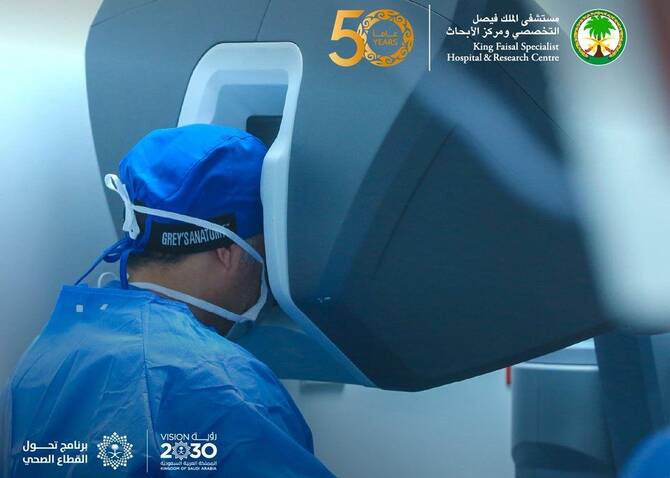
Guided by a 3D optical system, the one-hour surgery enabled surgeons to operate with a clear, magnified view of the brain.

Advanced image-guided navigation technology ensured precise tumor removal while protecting vital areas of the brain.

KFSHRC CEO Dr. Majid Al-Fayyadh linked the milestone to the hospital’s ongoing transformation journey.

“This achievement reflects KFSHRC’s growing role in shaping the future of global medicine,” he said.

“It aligns perfectly with our vision, where innovation and patient-centered care define the future of healthcare.”

Before the advent of robotic neurosurgery, similar procedures required manual removal under a surgical microscope, where precision depended heavily on human steadiness and visual clarity.

Robotic systems now provide enhanced instrument stability, tremor elimination, and superior visualization — redefining global standards of safety and precision in neurosurgical care.

This landmark procedure adds to KFSHRC’s expanding portfolio of robotic surgical breakthroughs.

The institution previously performed the world’s first robotic heart transplant and robotic liver transplant, earning international acclaim and solidifying its standing among the world’s leading centers for robotic and minimally invasive surgery.

KFSHRC has been ranked first in the Middle East and North Africa and 15th globally among the world’s top 250 academic medical centers for 2025.

It was also recognized as the most valuable healthcare brand in the Middle East by Brand Finance 2024 and listed among Newsweek’s World’s Best Hospitals 2025, Best Smart Hospitals 2025, and Best Specialized Hospitals 2026.

These accolades reaffirm its position as a global leader in innovation-driven patient care.

source/content: arabnews.com (headline edited)

___________

King Faisal Specialist Hospital and Research Centre in Riyadh has performed the world’s first robotic intracranial tumor resection. (SPA

__________________

SAUDI ARABIA
SAUDI ARABIA : Robotic-assisted implantation is world’s first performed at King Faisal Specialist Hospital & Research Centre (KFSHRC), Riyadh

Groundbreaking procedure opens new horizons in circulatory support techniques for patients with complex cardiac conditions

Cardiac surgery team, led by Prof. Feras Khaliel, performed the operation through small incisions using remotely controlled high-precision robotic arms

King Faisal Specialist Hospital and Research Centre in Riyadh has performed the world’s first implantation of two artificial pumps for biventricular support using robotic technology on a patient with advanced heart failure.

The groundbreaking procedure opens new horizons in circulatory support techniques for patients with complex cardiac conditions and marks a medical achievement that culminated in the patient’s recovery within a short period following the surgery.

The procedure represents a major advance in the treatment of bilateral heart failure, which was traditionally performed through full sternotomy, an approach associated with higher surgical risks and prolonged recovery.

However, the cardiac surgery team, led by Prof. Feras Khaliel, performed the operation through small incisions using remotely controlled high-precision robotic arms, resulting in reduced blood loss, lower risk of infection, and faster patient recovery.

The milestone reflects the integration of expertise across multiple departments at the hospital, including cardiac surgery, cardiology, anesthesia, critical care, biomedical engineering, and advanced life support.

The procedure was meticulously planned and benefited from 3D imaging technologies, real-time surgical navigation, and innovative solutions. 

source/content: arabnews.com (headline edited)

_____________

KFSHRC has performed the world’s first implantation of two artificial pumps for biventricular support using robotic technology. (X/@KFSHRC)

________________

SAUDI ARABIA

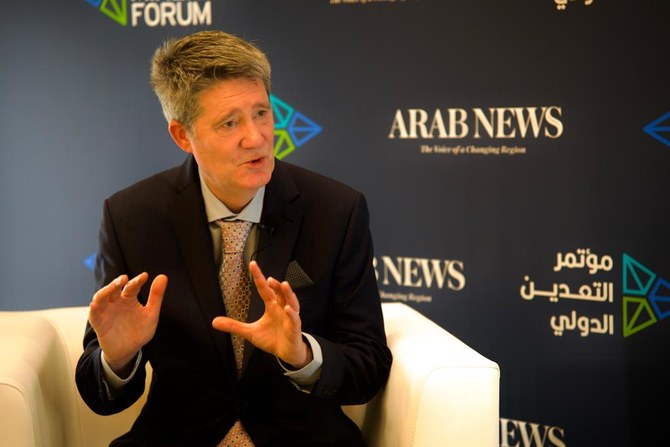
SAUDI ARABIA: AI will help find high-potential Mining targets in World’s First ‘Geoscience Data Analytics Center’

Saudi Arabia is set for a groundbreaking technological venture in the mining sector with the launch of the Geoscience Data Analytics Center. 

Commissioned by the Saudi government, the facility is expected to commence operations later this year. 

Speaking to Arab News at the Future Minerals Forum, Commissioner Rob Wood emphasized the interdisciplinary nature of the center and the significance of developing new programs to train professionals with hybrid skills. 

Wood said: “It will be the very first of its kind globally. It will become operational probably in late 2024.” 

Saudi Arabia boasts 31 critical minerals and strategic resources, ranging from gold, and silver to nickel and cobalt. 

The Kingdom is poised to establish a third industrial pillar centered on mining, with potential reserves estimated at $2.5 trillion, as Wood also highlighted the significance of the Kingdom’s commitment to diversify its economy. 

He emphasized that the Geoscience Data Analytics Center would play a pivotal role in utilizing AI to uncover potential mining deposits. 

The $2.5 trillion estimate, Wood clarified, is extrapolated from the known data available, emphasizing that extensive land exploration and data collection support this estimation. 

“The amount of land that we’ve actually explored and done data collection for. So, we know that there is a significant amount of opportunity left within the Kingdom that we haven’t explored yet,” he noted. 

Wood explained that there is a need to establish new interdisciplinary programs, where geologists will be trained in computer science. 

He highlighted novel aspects of the center, such as state-of-the-art robotic labs for core scanning and cumulative effects research.

“Literally, nobody on the planet is doing what we’re talking about,” he claimed, adding: “The intent is that the Kingdom will, in fact, have complete control and will be running the center for decades to come.” 

Wood elaborated on the ongoing data collection efforts, stating that the gathered information will be fed into a new artificial intelligence platform capable of conducting analytics to identify high-potential mining targets. 

The commissioner emphasized the use of AI in modeling mineral deposits, stating, “We’re using machine learning to uncover these high-potential deposits very early in the process.” 

He acknowledged the formidable challenge in the mining sector, particularly the difficulty in identifying new targets, referred to as “greenfields,” which he termed as a highly risky endeavor. 

“So frequently, they can go out and do a full drilling program and come back with nothing, and you spend literally hundreds of millions of dollars for potentially no result whatsoever.” 

To address this challenge, Wood unveiled the ambitious plan to use advanced artificial intelligence to de-risk the costs associated with finding new targets. 

“What we’re looking to do is, in fact, de-risk those costs on the mining companies by using advanced artificial intelligence to, in fact, actually find these new targets,” he explained. 

The commissioner emphasized the significance of addressing environmental and social impacts in the mining sector, stating: “One of the things the center is going to be doing is actually complex environmental and social impact research.” 

In conclusion, Wood highlighted the uniqueness of Saudi Arabia’s position in undertaking this venture, stating: “The discovery of oil is substantially easier than the discovery of minerals. Minerals require sophisticated analytics to find these new deposits.” 

As the Kingdom embarks on this groundbreaking initiative, Wood expressed his optimism, stating, “It’s an exciting time to be in Saudi Arabia.” 

source/content: arabnews.com (headline edited)

_________

Rob Wood, commissioner of the Geoscience Data Analytics Center, speaking to Arab News.

_________________

SAUDI ARABIA