LEBANON : “A voice for the voiceless”: As-Safir founder and beacon of Arab journalism Talal Salman passes away at 85

Talal Salman, veteran journalist and founder of the iconic As-Safir newspaper, died on 25 August 2023 aged 85 after a long career in which he championed the rights of the oppressed and made his paper a “voice for the voiceless”.

On Friday 25 August, Talal Salman, the founder and publisher of the iconic Lebanese daily newspaper daily newspaper “As-Safir” passed away aged 85.

Salman remains one of the Arab world’s most prominent journalists and As-Safir, rightly, as a shining beacon of Arab journalism in its modern history

He was one of the few Arab journalists who always aspired for journalism to be a medium where opinions could be freely expressed, and made it a place in which he affirmed his commitment to national, nationalist and social issues.

When his dream of establishing an independent newspaper became reality in 1974, he succeeded in making it a genuine platform for Arab issues and the Palestinian cause, and it quickly became one of the largest Arabic-language independent newspapers. 

“Salman remains one of the Arab world’s most prominent journalists and As-Safir, rightly, as a shining beacon of Arab journalism in its modern history”

“As-Safir” became an important laboratory for ideas and opinions. Over more than 40 years, intellectual and political debates flared within its pages, and it became a forum where various intellectual and cultural experiences from the Arab world and Lebanon converged. This made it a rare experiment in Arab journalism, a place where Lebanese, Palestinian, Syrian, Egyptian, Iraqi, Jordanian, and Tunisian voices at various times would come together.

Talal Salman was born in 1938 in the northeastern town of Shmustar. His father was a sergeant in Lebanon’s Internal Security Force (ISF), a job which required him to move with his family to various regions in Lebanon for various postings. Due to this, Salman never settled in one place or attended a fixed school. Perhaps this forced mobility played a role in shaping his political outlook later on, as it allowed him to discover different regions of Lebanon and to develop a broad understanding of Lebanon’s people – their internal divisions and rural nature.

His political awareness began to emerge following Egypt’s 23 July Revolution of 1952, which played a huge role in alerting his attention to politics. Additionally, his presence in the town of Moukhtara in the Chouf district in the early 1950s exposed him to certain aspects of the Lebanese reality.

Moukhtara was the stronghold of the prestigious Jumblatt family, leading figures in Lebanon’s Druze community. While living there he got to know Kamal Jumblatt, who inspired an entire generation of Lebanese youth who aspired for social justice and sought to connect Lebanon with Arab causes, Arab identity, and Palestine.

Salman would become an Arab nationalist without affiliating with any of the nationalist parties, such as the Ba’ath, although later on, he formed close relationships with founders of Arab Nationalist Movement, like George Habash and Hani al-Hindi, in addition to Ghassan Kanafani and Mohsin Ibrahim, who were closely associated with the pan-Arab, left-wing movement.

Salman’s passion for language began in his childhood; he was enchanted by the few books in his parent’s home, and had started writing articles for the magazine al-Anbaa before leaving school. After completing secondary school in 1955, he moved to Beirut with today’s equivalent of $200 from his father and started looking for work at a newspaper.

Passion for language

Salman’s passion for language began in his childhood; he was enchanted by the few books in his parent’s home, and had started writing articles for the magazine al-Anbaa before leaving school. After completing secondary school in 1955, he moved to Beirut with today’s equivalent of $200 from his father and started looking for work at a newspaper.

“Salman would become an Arab nationalist without affiliating with any of the nationalist parties, such as the Ba’ath, although later on, he formed close relationships with founders of Arab Nationalist Movement, like George Habash and Hani al-Hindi”

He initially found a job at Al Sharq newspaper as an unpaid proof reader, before swiftly transitioning to “cutting” – he would cut out stories from other papers in the morning and rewrite them for publishing in Al Sharq in the afternoon.

1956, the year Salman’s journey into the media world began was the year of the Tripartite Aggression against Egypt (the Suez Crisis) – and it was as though this major event was setting the tone for a journalistic career focused on the major Arab issues of the day, such as Arab unity, Palestine, Algeria and social justice.

Nor was it surprising, considering his background living in areas suffering from marginalization, poverty, injustice, and lack of government care, that he developed a clear sensitivity to social injustice and a strong awareness of the need to fight against it.

A meeting of minds

It wasn’t long before Salman moved to another paper, where he was given the crime and accidents beat. Every day he would walk to the police station, the courts, ambulance centres and fire stations to gather the day’s news. Then, he would walk back to his workplace to provide the summary of his day to the editorial secretary.

In 1958, after protests broke out against the rule of then President Camille Chamoun, renowned journalist Salim Lawzi, editor-in-chief of the pro-Nasser Al Hawadeth magazine at the time, was arrested, and held in Karantina Hospital – as more fortunate prisoners were at that time.

By chance, Salman’s father was chief officer at the hospital guard station, and his son visited regularly. This led to the aspiring young man meeting the veteran journalist who had worked in Palestine and Egypt before returning to Lebanon to set up the weekly magazine.

Following their meeting, Salman joined Al Hawadeth, where he was suddenly the colleague of well-known journalists like Shafiq al Hout, Nabil Khoury, and the artist Niazi Jaloul.  He went from proofreading to preparing the readers section, to writing his own column and then moved into the investigations department. It was not long before he was made sub-editor and he wasn’t even 20 – a testimony to both his journalistic talent and his hard work developing the magazine during a period Lawzi was forced into exile.

However, perhaps the most significant event in his professional and personal life was his meeting with President Gamal Abdel Nasser in Damascus in early 1958. His image alongside Nasser remained on proud display in the As-Safir offices for many years afterwards.

Salman’s rapid rise in journalism also saw him become a figure noticed – and targeted – by Lebanon’s authorities. In August 1961 he was arrested, interrogated and held for 20 days by Lebanon’s General Security services, charged with maintaining ties with Ahmed El-Saghir Jaber (representative of the Algerian Liberation Front in Lebanon), smuggling weapons to Algerian revolutionaries, and plotting military coups in some Arab countries.

“Salman’s rapid rise in journalism also saw him become a figure noticed – and targeted – by Lebanon’s authorities”

In the decade before he founded As-Safir, Salman moved between three magazines – Assayad, Al Ahad and Al-Hurriya. He had plenty of opportunity to delve into secrets and the hidden stories and backgrounds of notable figures and events, and became acquainted with many of the most brilliant Arab authors, artists, politicians and activists of the time. All the information he was absorbing would become part of his arsenal when it came to his own project – the As-Safir daily newspaper.

On 26 March 1974 the first issue was published, carrying two slogans: “the newspaper of Lebanon in the Arab world and the newspaper of the Arab world in Lebanon”, and “the voice of the voiceless”.

Almost instantly, the paper was under attack – in its first year 16 lawsuits were raised against it, following a legal challenge mounted by the Banks Association in Lebanon. However, the nature of those targeting the paper only highlighted how effectively it was beginning to champion the rights of the marginalised, and confront the political system and capitalist stakeholders in the country.

Since its early days, As-Safir’s pages carried illustrious names in contemporary Arab thought and literature, and it also opened its pages to myriad intellectual and political trends, such as Nasserism, Baathism, Arab nationalists, Syrian nationalists, secularists, and communists with their various Soviet, Maoist, and Trotskyist tendencies.

When Lebanon’s civil war broke out in 1975, As-Safir adopted an unwavering political stance: a complete rejection of the civil war, and a total distancing from the right-wing political forces who’s destructive policies had led to the outbreak of the fighting.

While it unequivocally rejected the war, As-Safir’s stance of sympathy and solidarity with the programme of the Lebanese National Movement and the Palestinian resistance was staunch. Its writers were made famous for their condemnation of Egyptian President Anwar Sadat’s visit to Jerusalem in November 1977, and its front page on the first day of the visit was headlined: “The Scoundrel visits the Usurper”.

Both the newspaper and Salman were targeted in terrorist attacks multiple times. In 1981, an attempt to destroy his house with four timed rockets, was foiled just minutes before they were set to launch. Explosive devices were placed near As-Safir’s offices on 28 March and 5 April 1984.

That July, there was an assassination attempt on him in front of his house, resulting in injuries to his jaw and various parts of his body. However, neither As-Safir nor its founder were intimidated, and both continued to be faithful to their nationalist and progressive principles.

During Israel’s invasion of Lebanon in 1982, As-Safir was the only Lebanese newspaper that didn’t cease publication. Its daily headlines were rewritten on Beirut’s walls as a form of the city’s resilience and it became known for headlines like “Beirut burns but doesn’t raise the white flags”.

A shining era in the history of Lebanese journalism came to an end in 2017 with the closure of the pioneering, left-wing, pan-Arab experiment which was embodied for over 40 years by the As-Safir newspaper, as well as the end of the liberal, right-wing An Nahar in 2012 with Ghassan Tueni’s death.

Talal Salman’s contribution, both to journalism in Lebanon, and to the country’s political and cultural history, is huge, and he and As-Safir are owed a debt for the bold stances they took countless times and the brilliant, enlightening and incisive content they provided in its pages.

This was Talal Salman, who never stopped brimming with kindness, humility and generosity; and who burned with pain and grief at what the situation of the Arab world has come to, who spent his twilight years continuing to read, research and write in his never-ending pursuit of an Arab renaissance.

This is an edited and abridged translation from our Arabic edition. To read the original article click here.

Translated by Rose Chacko

This article is taken from our Arabic sister publication, Al-Araby Al Jadeed and mirrors the source’s original editorial guidelines and reporting policies. Any requests for correction or comment will be forwarded to the original authors and editors.

source/content: newarab.com (headline edited)

____________
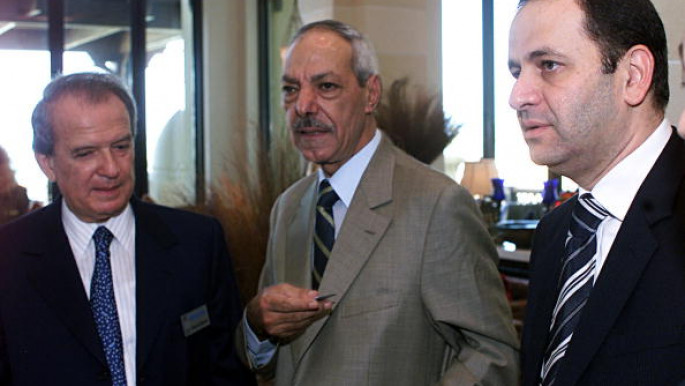
From L to R: Lebanese Minister of Economy and Trade Marwan Hamadeh, Talal Salman and Pierre al-Daher, head of the independent Lebanese Broadcast Corporation (LBC) television attend the opening session of the 2003 Arab Media Summit in Dubai [Nasser Younes/AFP via Getty]

____________

LEBANON
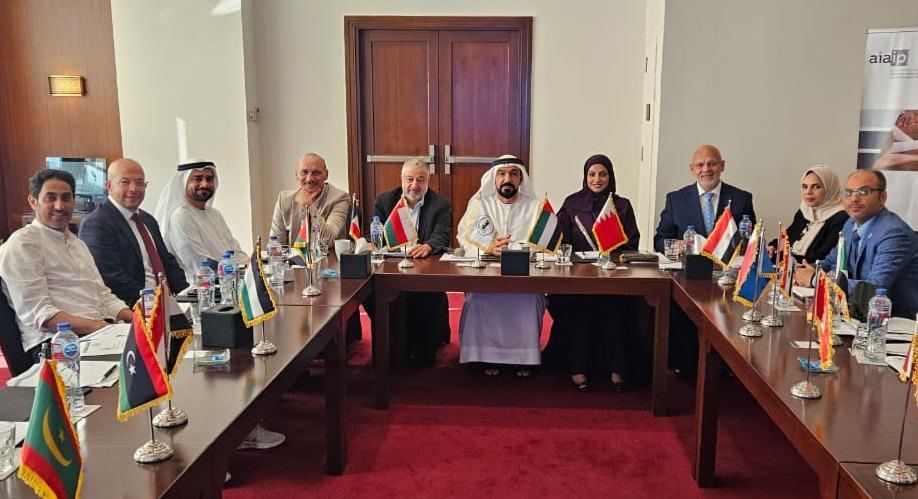
U.A.E / ARAB : Al-Obaidli elected president of the Arab Federation for Intellectual Property

 The Extraordinary General Assembly of the Arab Union for the Protection of Intellectual Property Rights (AUPIPR) held its meeting in Cairo, with the participation of approximately 76% of members. The meeting discussed an agenda that addressed organizational issues aimed at strengthening the union’s presence on the Arab and regional levels.

The Assembly elected the Board of Directors members, including Major General Dr. Abdul Quddus Abdul Razzaq Al Obaidli, Sheikh Abdul Wahab Al Mandhari, Attorney Zayed Al Shamsi, Asma Abdul Aziz Al Najdi, Counselor Mohammed Bakr Istitieh, Ayat Hamdi Refaat, Hazza Al Shammari, Mohammed Shafiq Al Khalili, and Counselor Shaker Jalala.

The elected council held its first meeting, where Major General Dr. Abdul Quddus Al-Obaidli was chosen as President of the Union, Sheikh Abdul Wahab Al-Mandhari as Vice President, and Counselor Osama Musa Al-Baytar was appointed Secretary-General.

The new president emphasized that the next phase will witness the launch of qualitative projects in the field of intellectual property aimed at spreading awareness and promoting innovation in the Arab world. Memoranda of understanding will also be signed with prestigious Arab and international institutions and universities, and specialized training programs will be launched on intellectual property issues, artificial intelligence, and blockchain, contributing to supporting the knowledge economy.

The Arab Federation for the Protection of Intellectual Property Rights operates within the framework of the Council of Arab Economic Unity of the League of Arab States. Headquartered in Cairo since its founding in 2005, it has contributed to spreading the culture of intellectual property and supporting entrepreneurship for two decades.

The election of its new leadership confirms its commitment to continuing this mission with a renewed vision and broader horizons

source/content: wam.ae (headline edited)

_____________

__________________________________________

UNITED ARAB EMIRATES (U.A.E) / ARAB

TUNISIA : From waste to wealth: How this Tunisian startup is turning olive residue into clean energy

Entrepreneur Yassine Khelifi is hoping to redirect agricultural waste into alternative energy sources to help ease the burden in Tunisia.

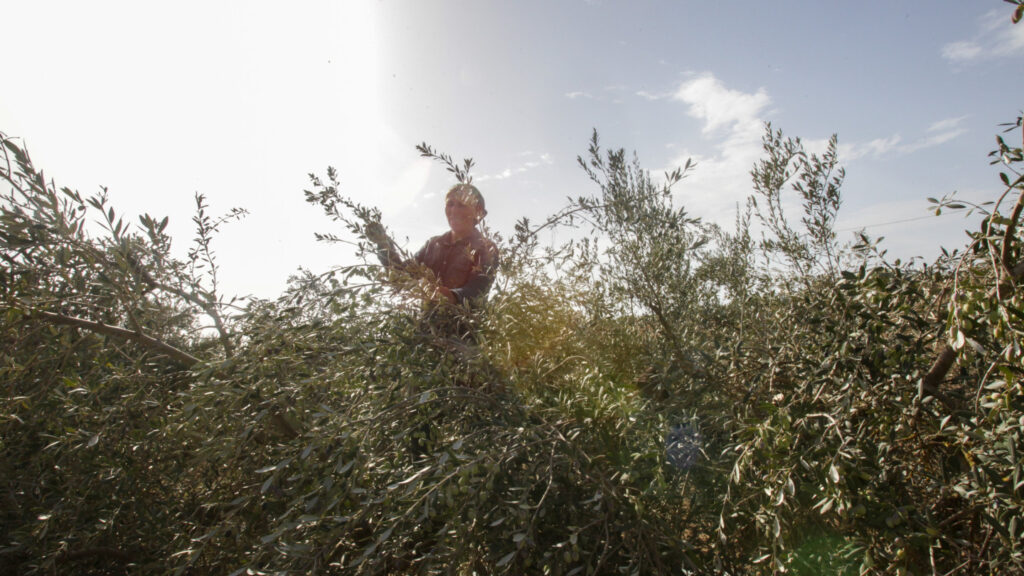
In a northern Tunisian olive grove, Yassine Khelifi’s small workshop hums as a large machine turns olive waste into a valuable energy source in a country heavily reliant on imported fuel.

Holding a handful of compacted olive residue — a thick paste left over from oil extraction — Khelifi said: “This is what we need today. How can we turn something worthless into wealth?”

For generations, rural households in Tunisia have burned olive waste for cooking and heating or used it as animal feed.

The International Olive Council estimated Tunisia will be the world’s third-largest olive oil producer in 2024-2025, with an expected yield of 340,000 tonnes. The waste generated by the oil extraction is staggering.

Khelifi, an engineer who grew up in a family of farmers, founded Bioheat in 2022 to tackle the issue. He recalled watching workers in olive mills use the olive residue as fuel.

“I always wondered how this material could burn for so long without going out,” he said. “That’s when I asked myself: ‘Why not turn it into energy?'”

Beyond profit, Khelifi hopes his startup helps “reduce the use of firewood as the country faces deforestation and climate change”.

Employees transport truckloads of olive waste at his workshop, stacking it high before feeding it into the processing machines.

The material is then compacted into cylindrical briquettes and left to dry for a month under the sun and in greenhouses before being packaged and sold.

The soul of olives 

Khelifi began developing his idea in 2018 after he travelled across Europe searching for a machine to turn the olive paste into long-burning fuel.

Unable to find the right technology, he returned to Tunisia and spent four years experimenting with various motors and mechanical parts.

By 2021, he had developed a machine that produced briquettes with just eight percent moisture.

He said this amount significantly reduces carbon emissions compared to firewood, which requires months of drying and often retains more than double the amount of moisture.

Bioheat found a market among Tunisian restaurants, guesthouses, and schools in underdeveloped regions, where winter temperatures at times drop below freezing.

But the majority of its production — about 60 percent — is set for exports to France and Canada, Khelifi said.

The company now employs 10 people and is targeting production of 600 tonnes of briquettes in 2025, he added.

Selim Sahli, 40, who runs a guesthouse, said he replaced traditional firewood with Khelifi’s briquettes for heating and cooking.

“It’s an eco-friendly and cost-effective alternative,” he said. “It’s clean, easy to use, and has reduced my heating costs by a third.”

Mohamed Harrar, the owner of a pizza shop on the outskirts of Tunis, praised the briquettes for reducing smoke emissions, which he said previously irritated his neighbours.

“Besides, this waste carries the soul of Tunisian olives and gives the pizza a special flavour,” he added.

‘Protect the environment’ 

Given Tunisia’s significant olive oil production, waste byproducts pose both a challenge and an opportunity.

Noureddine Nasr, an agricultural and rural development expert, said around 600,000 tonnes of olive waste is produced annually.

“Harnessing this waste can protect the environment, create jobs, and generate wealth,” he said.

Nasr believes repurposing olive waste could also help alleviate Tunisia’s heavy dependence on imported fuel.

The country imports more than 60 percent of its energy needs, a reliance that widens its trade deficit and strains government subsidies, according to a 2023 World Bank report.

Fuel and gas shortages are common during winter, particularly in Tunisia’s northwestern provinces, where households struggle to keep warm.

Redirecting agricultural waste into alternative energy sources could ease this burden.

Yet for entrepreneurs like Khelifi, launching a startup in Tunisia is fraught with challenges.

“The biggest hurdle was funding,” he said, lamenting high-interest bank loans. “It felt like walking on a road full of potholes.”

But now his goal is “to leave my mark as a key player in Tunisia’s transition to clean energy”, he added. “And hopefully, the world’s, too.”

Climate-induced droughts drying up MENA’s olive oil production

A report on climate change by the World Meteorological Organization had found that “the warming has been more rapid in Africa than the global average,” adding that “increased temperature has contributed to a 34% reduction in agricultural productivity growth in Africa since 1961,” a greater drop “than any other region in the world.”

In an ominous note, the report also observed that “the warming trend for North Africa, around 0.41 °C/decade between 1991 and 2021, was higher than the warming trend for all the other African sub-regions.”

Heat waves pose a serious risk to the production of olive oil in North Africa, which accounts for much of the world’s supply. According top provisional data from the IOC, Morocco produced 160,000 metric tons of olive oil between October 1, 2020, and September 30, 2021, making that country the world’s fifth-biggest producer.

Tunisia, the world’s sixth-largest producer during that period, recorded 140,000 metric tons. Algeria and Egypt together had 100,000 metric tons.

With climate change becoming a more persistent aspect of everyday life, the consequences for olive oil look set to grow worse.

The Tunisian National Observatory for Agriculture predicts that Tunisia’s production of olive oil may drop 35 percent from its 1981-2010 average by 2050 and 70 percent from that average by the turn of the century. Production in Algeria, Egypt, Libya, and Morocco seems unlikely to fare much better in the face of global warming.​​​​​​​

source/content: newarab.com (headline edited)

___________

_____________

TUNISIA

SAUDI ARABIA : WORLD’s BEST : Riyadh hospital completes 10 kidney transplants in 48 hours

King Faisal Specialist Hospital sets record on World Organ Donation Day

Program ‘opens door’ for patients without suitable donor, it says

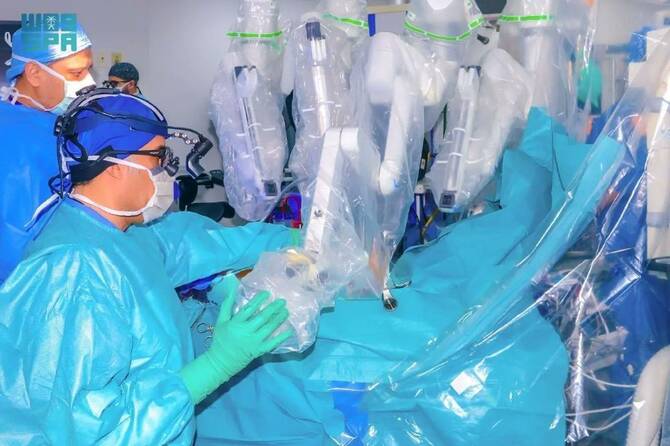
The King Faisal Specialist Hospital and Research Centre this week set a world record by performing 10 kidney exchange transplants in just 48 hours.

The achievement coincided with World Organ Donation Day, which falls on Aug. 13 and aims to raise awareness of the importance of organ donation.

Dr. Ehab Abufarhaneh, deputy executive director of the hospital’s Organ Transplant Center of Excellence, told Arab News: “KFSHRC performed the kidney exchange transplants over two consecutive days setting a global record. This happened with a great team led by Dr. Khaled Almashary and Dr.Tariq Ali of the department of kidney and pancreas transplant.

“This initiative opens a door for many patients who have no suitable donor.”

The KFSHRC said the record was for the highest number of such procedures conducted within a two-day span at a single center.

“This milestone reinforces the hospital’s position as a global leader in organ transplantation. It also reflects its high clinical readiness, the seamless coordination of its multidisciplinary medical teams and the advanced systems for managing donor-recipient matching, alongside its extensive experience in executing complex transplant procedures,” it said.

Paired kidney transplantation is an innovative approach where two or more incompatible donor-recipient pairs swap kidneys to achieve compatible transplants. The process significantly improves compatibility rates and offers hope to patients who face challenges in finding a suitable match within their families.

Last year, the KFSHRC celebrated another milestone with the completion of its 500th transplant since the program was launched in 2011. Since the creation of its organ transplantation program in 1981, it has successfully performed more then 5,000 kidney transplants, placing it among an elite group of global transplant centers.

Last year it conducted 80 pediatric kidney transplants, more than any other facility in the world for the period.

By leveraging its skilled workforce, advanced technologies and the integration of research and clinical programs, the KFSHRC aims to deliver world-class treatment while enhancing the Kingdom’s position as a leader in organ transplantation.

In 2023 and 2024 it ranked first in the Middle East and North Africa region and 15th globally on the list of the world’s top 250 academic medical centers and was last year recognized as the most valuable healthcare brand in the Kingdom and the Middle East by Brand Finance rankings.

It also ranked among the world’s 250 best hospitals in 2024 and was included in Newsweek magazine’s list of best smart hospitals for 2025.

source/content: arabnews.com (headline edited)

___________

KFSHRC set a global record by performing 10 kidney exchange transplants in just 48 hours, coinciding with the World Organ Donation Day. (SPA)

__________________

SAUDI ARABIA

SOMALIA : Goodbye Genius Hadrawi: the Scholar of Philosophers, and the Philosopher of Scholars

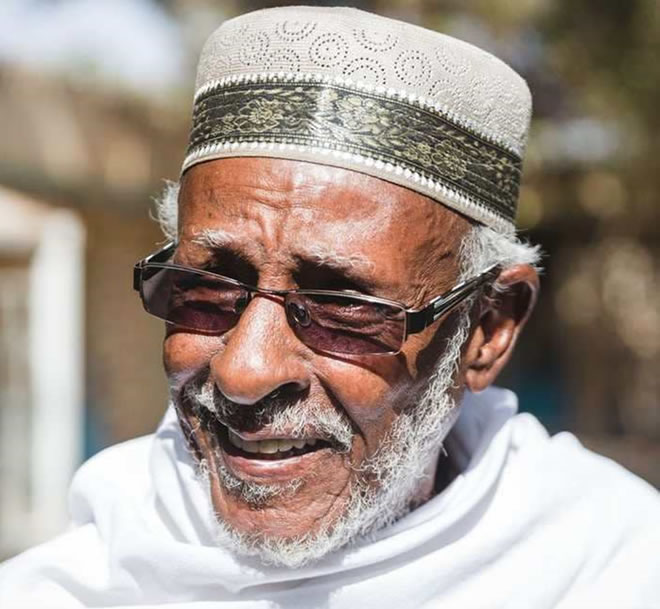
The great Somali poet, philosopher and scholar Mohamed Ibrahim Warsame (Hadrawi) passed away on the 18th of August 2022, in Hargeisa, Somaliland.

A national funeral was held in Hargeisa, and many Somalis from all parts of Somalia attended to pay their respects for the last time to the great man. The news of his death had brought tears to the eyes of every Somali, whether they met him or not. when you look around and see people of different walks of life commiserating about his death, you would think their own father had passed away.

He did not give these people materials for them to love him that much, but he acquired their hearts and minds by being sincere and trustworthy with his beliefs. Somalis and non-Somalis compared him to the great poets, philosophers, and scholars of the world, past and present. However, I think he transcends all, he was an ‘ummah’ in his own right.

Allah SWT when he was describing the personality of prophet Ibrahim said “Indeed, Ibrahim was acomprehensive [ummah] devoutly obedient to Allah, inclining toward truth, and he was not of those who associate others with Allah (Quran, 120:16)”. Allah described prophet Ibrahim as “ummah”, and the word ‘ummah’ in the Quran is used either to describe a nation (more than one person), or someone (like prophet Ibrahim) who is so great that his personality and beliefs are different from the society he lives in, and comprehensive that he can stand independently and single-handedly change the society from bad to good. In other words, someone who is not a follower of the majority of people that agrees on wrong decisions.

Instead, ‘ummah’ is a follower of truth even if the majority of people disagree with them. We can safely describe Hadrawi as being an ‘ummah’ in his own right. Because anyone who observes his life and his literary works, soon understands that Hadrawi was not your everyday person. He was an ‘ummah’ because he prided himself on liberty by refusing to be bought.

In the early 1970s, when almost every Somali was clapping in agreement with the communist regime that ruled Somalia from 1969 to 1991, Hadrawi stood up on his own and refused to bow down to oppression.

He was an ‘ummah’ when he freely opted to go to prison and suffer or worse, rather than clap for a tyranny.

In his latest book ‘Hawaale Warran’ he narrates what happened between him and the military regime, and how after he refused to bow down was arrested and put away in jail without justification whatsoever.

In 1973, Hadrawi wrote a play called ‘Aqoon iyo Afgarad’ ‘Knowledge and Consensus’ which he and his fellow poets Mohamed Gariye and Professor Muse Abdi Elmi presented in Lafoole Institution, located outskirt of Mogadishu.

The objective of the play was to advise the Somali people not to seek education outside the country, rather education was available on home soil, and there is no need to waste the nation’s wealth to send students abroad. It is worth mentioning, that at the time, the regime was sending its cadres and the children of revolution leaders to the Soviet Union, Europe and the United States for education and training, in the process, wasting the taxpayers’ hard-earned money. Hadrawi did not like that, hence his play knowledge and consensus’ addressed that.

The 1969 revolution leaders, in particular, the country’s president Mohamed Siyad Barre, did not like the play, and he thought it was anti-revolution and embarrasses his decision to spend a huge amount of the nation’s wealth on sending cadres outside the country.

He summoned Hadrawi to Afisyoni, his air force headquarters. Hadrawi said, men from the national guards took him there, and he met the president sitting under a tree. The president opened the conversation with the remarks “Hadrawi, I know you are anti-revolution, but why every poetry you compose are used against us?”. Hadrawi said, “I tried to convince him, and said, we (poets) compose poetry, and then people take it and interpret it to whatever makes sense to them”. Then the president concluded the meeting by saying “ask me whatever you want, but after today, I don’t want to hear any poetry of yours that people are using against us”. Hadrawi replied by saying “whatever Allah decrees is gonna happen”.

Hadrawi continued his work and created another play called ‘Tawaawac’. The play naked the misery and the disappointments Somalis inherited from the 1960 independence, and how a handful of military officers have hijacked the nation’s hopes after getting rid of colonisers. He likened this to a scenario where people are fighting over the meat of a slaughtered she-camel that was supposed to be spared for daily milking to feed the kids and the elderly. One of the song’s lyrics that Hadrawi created for this play says:

Weligay cad quudheed

Anna qaadan maayoo

Qalanjadan faraha dheer

Wax la qaybsan maayee

This translated into something like:

I will never accept

An offer with contempt

And I will never share anything

With this long-fingers beauty

Hadrawi said, the president, especially hated these four lines above, because he thought that I was taunting him and making fun of his earlier offer of ‘ask me what you want, but stop composing poetry’.

The next thing Hadrawi knew he was snatched from his home in the middle of the night by men from the security services under direct orders from the president. He was arrested without going before a court and thrown in jail at Qansax Dheere, in the Bay region far away from his residence. When asked why they took you all the way to Qansax Dheere, while there are many jails near your residence? He replied they wanted to brainwash me and break me into submission. They said to me you will be released immediately if you ask forgiveness from the father of the revolution (meaning the president).

Hadrawi was an ‘ummah’ when replying to this demand. He said to them “know there will be three scenarios with me, I die and go to my grave, I stay in prison, or I acquire my full freedom [without fearing anyone]”. He stayed in prison for five years, and again, as usual, he was an ummah in prison by continuing his struggle against tyranny. By this time, many Somalis woke up to the cries of Hadrawi from their deep asleep and started to see the tyrannical regime for it really was.

Hadrawi was an ‘ummah’ when the civil war happened in 1988-1991 by manifestly telling the struggle leaders ‘do not replace tyranny with another. He was an ‘ummah’ after the civil war in his ‘Peace Spring’ in 2003, when he travelled on the ground from Hargeisa to Kismayo, stopping in every town between them, literally hundreds of villages.

He was an ‘ummah’ by his devouted love of literature and writing. He comprised a whole poem about the importance of writing, he said:

Qalinkaa wax suureeya

Kugu sima halkaad doonto

Saaxiib kal furan weeye

Sunto fara ku hayntiisa

Weligaa ha si deynin.

Sisin iyo ku beer muufo

lyo laanta saytuunka

Ku gotomi sungaan waarta

Iyo nabadda seeskeeda

Samo iyo ku doon heedhe

Dunidiyo sinnaanteeda

The pen that can imagine for you

And can take you where you want

It is a friend with open heart

Regularly, keep it in your hands

And never let it go

Plant it among sesame and bread

And the branches of olive

And use it to spread in the world

peace, equality and justice

In these short lines, he was an ‘ummah’, the material of philosophy ‘abstraction’ he uses here to emphasise how important is to use writing to seek peace, prosperity, justice and equality, which is nothing short of genius. He was trying to kill one stone with the two old enemies of the human race: poverty and ignorance.

Equally important, he was an ‘ummah’ when he praised the Somali women for their beauty and bravery. He was a great admirer of the Somali women, although depicting their true nature without exaggeration or embellishments. In his poem ‘Horn of Africa Girls’, he said about the Somali women:

Hablo weerar geli kara,
Hablo geela dhicin kara,
Hablo geesi dili kara,
Gobannimona hanan kara,
Hablo talada goyn kara,
Garta madal ka niqi kara,
Garashana iskaga mida,
Quruxdana ka wada goba;
Geesteenna mooyee
Geyi kale ma joogaan
.

Girls that can go to war

Girls that can defend the camel

Girls that can acquire honour

Girls that can make decisions,

And publicly express their opinion,

And equally have high intellects

Girls that all blessed with beauty

Except, in our region,

Can they be found in anywhere else?

The examples of the great man are many, and it is impossible to mention them all in this short article. I would advise any admire to go to his works, and they will find an encyclopedia of knowledge, that will take them a lifetime to study.

Lastly, but not least, he was an ‘ummah’ by leaving instructions on how he wished to be treated after his death. He wrote a poem called ‘will’, in which he advised people to treat his death like any other, he said.

Qofka ii duceeyoow

Rabbigay ku darajee

Qofka iga ducaystoow

Dummaddaada weeyaan.

After many passages of the poem, he pleaded with people that they should not make a fuss about his death and funeral. His grave should not be built but should be left like other graves. People should not make a shrine of his grave, nor should they over-grieve or celebrate his life. In the last few lines, he prays for those who pray for him.

Finally, you lived as an ‘ummah’ and died as an ‘ummah’, there is nothing left to say but goodbye to our beloved teacher, philosopher, poet and role model. Your body might have departed this world, but your ideas and the knowledge you left for us and humanity, are eternal. I am sure people of the other side and angels are welcoming you with roses and open arms—they are congratulating you as you have accomplished your mission here on earth, advised your people and fought bravery in the way of Allah seeking justice, and freedom and equality for all. May Allah shower you with His Forgiveness and Mercy, light up your grave, and may He elevate your status and grant you Jannatul-Firdaus. May Allah resurrect you with the prophets, the steadfast affirmers of truth and the martyrs.

“And whoever obeys Allah and the Messenger – those will be with the ones upon whom Allah has bestowed favour of the prophets, the steadfast affirmers of truth, the martyrs and the righteous. And excellent are those as companions (Quran 69:4)”.

“Verily we belong to Allah and verily to him do we return”.


source/content: hiiraan.com (headline edited)

____________

______________

SOMALIA

SUDAN : From el-Obeid to the Arctic: The secret mission that saved over 2,000 seeds from Sudan

To safeguard a vital part of Sudanese agricultural heritage, scientists quietly moved copies of strategic crops to the frozen chambers of the Svalbard vault in Norway.

In December 2023, the civil war that had broken out the previous April between the Sudanese Armed Forces (SAF) and the Rapid Support Forces (RSF) took a troubling turn when the paramilitary group seized the country’s second-largest city, Wad Madani, in a swift offensive.

The sudden fall of Wad Madani, under circumstances that are not yet fully clear, dealt a heavy blow to the regular army and came as a shock to the hundreds of thousands of people, many of them displaced from Khartoum, who had come to see the city as a safe refuge.

The RSF’s advance quickly triggered a new mass displacement of people and disrupted the work of humanitarian agencies that had relocated to the city after the war broke out.

Like in other areas they have passed through, RSF fighters extensively looted Wad Madani and widespread abuses against the population were documented.

Although it drew little attention at the time, Sudanese scientists also issued a call to protect one specific facility in Wad Madani: the city’s seed bank, the most important in all of Sudan.

“We did not expect that the RSF would attack Wad Madani,” Ali Zakaria Babiker, director of the gene bank, told Middle East Eye. 

“But when they did, all the staff fled the city to safer places.”

“We expected they would attack the gene bank,” he admitted, “because ever since they attacked Khartoum, [everyone] had already suffered a lot.”

Hidden cargo to evade checkpoints

Before the war, Sudan’s seed bank, managed by the Agricultural Plant Genetic Resources Conservation and Research Centre (APGRC), housed a collection of more than 17,000 accessions of crops and plant species, including sorghum, millet, wheat and sesame.

The collection, started in 1982, was a reflection of the crop diversity of Sudan, a country with rich biodiversity and a long agricultural tradition. 

It also served as a repository for its agricultural genetic material, considered essential for both local and global food systems.

After fleeing Wad Madani, some APGRC staff met in el-Obeid, the capital of the North Kordofan region, where a subnational gene bank is located, holding copies of most of the material they had left behind.

One of their initial moves was to install a solar power system at the backup facility, ensuring a stable electricity supply to keep the freezers running and safeguard the seed copies.

At the same time, however, the staff began to develop a plan to extract as many copies of the seeds as possible and transfer them to a location where they could be safe.

“El-Obeid was also under threat from the RSF, so we went there straight away and took some duplicate accessions to dispatch them,” Babiker explained.

Their plan involved preparing more than 2,000 seed samples and sending them from el-Obeid to the icy chambers of Svalbard’s seed vault, located on the Norwegian island of Spitsbergen, deep in the Arctic and more than 7,000km from the capital of North Kordofan.

“[We decided to] dispatch them to Svalbard so that we would have a duplicate copy outside the country,” Babiker said. 

One of their initial moves was to install a solar power system at the backup facility, ensuring a stable electricity supply to keep the freezers running and safeguard the seed copies.

At the same time, however, the staff began to develop a plan to extract as many copies of the seeds as possible and transfer them to a location where they could be safe.

“El-Obeid was also under threat from the RSF, so we went there straight away and took some duplicate accessions to dispatch them,” Babiker explained.

Their plan involved preparing more than 2,000 seed samples and sending them from el-Obeid to the icy chambers of Svalbard’s seed vault, located on the Norwegian island of Spitsbergen, deep in the Arctic and more than 7,000km from the capital of North Kordofan.

“[We decided to] dispatch them to Svalbard so that we would have a duplicate copy outside the country,” Babiker said. 

“I did it to ensure that at least some of the seeds were preserved beyond Sudan’s borders.”

The scale of the mission was daunting: if they succeeded, APGRC staff would have managed to secure more than a quarter of Sudan’s seed collection in the depths of the earth.

The seeds selected included crops that have been grown in the region for thousands of years, amongst them key varieties of pearl millet and sorghum –  a crop vital to Sudan’s food security, known for its drought resistance, and part of the country’s agricultural and cultural heritage.

“These [were] some of the main staple crops in Sudan, and also some of the oldest,” Babiker noted. 

“They are essential for food security not only in Sudan, but also for the region – and for global food security as well.”

Before heading to one of the northernmost corners of the world, the seeds had to be taken out of el-Obeid as discreetly as possible and transported all the way to Port Sudan – the main port of the country, located in the northeast –  from where they could be sent abroad.

Babiker described it as an “exciting” mission, particularly at the start, given that the RSF controlled almost all routes in and out of El Obeid. 

To avoid potential trouble at checkpoints, the APGRC staff asked the truck driver transporting the seeds to load their boxes first, and only then pile on the rest of the load.

“The mission took more than 10 days because, for security reasons, it didn’t follow a normal road but routes unfamiliar to the RSF,” said Babiker, who added that no APGRC staff travelled with the shipment to avoid drawing attention.

After those 10 days on the road, the seeds finally made it to Port Sudan, although Babiker said the seed packages were scattered across the truck and had to be collected and organised.

Still, the first half of the journey – and the most challenging part – was now behind them.

Sudan Post to the rescue

Once in Port Sudan, the shipment of seeds to Svalbard was made possible because the Sudan Post courier service was still operating despite the war, said Nelissa Jamora of Crop Trust, an organisation dedicated to safeguarding the world’s crop diversity that supported the entire mission.

“Sudan Post was still functioning, at least in Port Sudan. So it was [arranged] through the regular postal service,” she told MEE, noting that there were three boxes of seeds in total.

On their way to Svalbard, the seeds made a stop at the Nordic Genetic Resource Center (NordGen), an organisation dedicated to safeguarding the Nordic region’s genetic resources. 

There, the centre helped sort, catalogue, re-pack, and document the shipment from Sudan.

“It was a few days’ work for our seed technicians, but an investment well worth its price considering the importance of these seeds for the future of Sudan’s agricultural sector,” said Johan Axelsson, head of NordGen’s seed laboratory.

The seeds finally arrived at the seed vault on 25 February 2025, together with seed shipments sent by 19 other gene banks.

Established in 2008, the Svalbard Global Seed Vault has its storage area more than 100 metres inside a mountain, carved into solid rock and shielded by 40 to 60 metres of stone.

The mountain mass has a stable temperature ranging from -3 to -4 degrees Celsius, but the seed storage area is equipped with a cooling system that keeps it constantly at -18 degrees.

With more than 1,350,000 seed samples, the Svalbard Global Seed Vault is currently the largest backup facility for seeds and crop diversity in the world.

Owned by Norway, the site is operated by three partners: the country’s Ministry of Agriculture and Food, NordGen and Crop Trust.

Gene banks from all over the world can store backup copies of their seeds there free of charge and with no legal transfer of ownership, the seeds always remain property of the depositor.

Sudan made its first deposit in 2019 and today holds 1,884 accessions, a distinct, uniquely identifiable sample of seeds, from 15 different species, according to Svalbard’s website.

Jamora said that the difference from the more than 2,000 seeds initially sent by the APGRC from el-Obeid was likely due to some packages arriving in less-than-optimal condition and not making it into the final set, although they are preserved by NordGen and can be returned.

The mission to evacuate Sudan’s seeds was funded through an emergency reserve launched in 2021 by Crop Trust and the secretariat of the International Treaty on Plant Genetic Resources under the supervision of the UN Food and Agriculture Organization (FAO), to assist gene banks that are under threat.

In Sudan’s case, Crop Trust had been collaborating with the local gene bank before the war through a project called BOLD (Biodiversity for Opportunities, Livelihoods and Development).

“The mission aimed to secure as many seeds as possible,” Jamora noted.

Fears vindicated

Sudan’s army recaptured Wad Madani in January, and when the APGRC staff returned to their facilities, their worst fears were confirmed: the bank’s freezers, computers and servers had been looted, and the seed bags were torn open, their contents scattered across the floor.

However, with the support and funding from the emergency reserve jointly run by Crop Trust and the Plant Treaty, efforts to rebuild and start over are already under way.

For now, the gene bank is still assessing the losses, but it is also beginning to rebuild its seed collection despite limited state funds and power cuts that often last more than 12 hours a day.

When the situation stabilises, the centre hopes to be able to assess the state of its seeds and move into a regeneration phase, but this will require new freezers and other equipment.

During a meeting with the director of Sudan’s Agricultural Research Corporation (ARC) and FAO representatives, the governor of Gezira State – where Wad Madani is located – Tahir al-Khair, pledged to try to install a new cold storage facility for the gene bank.

In the meantime, at least, the seeds stored in the Svalbard vault remain safe, waiting for the day they can once again serve their country.

“We felt very relieved and reassured once we made sure we had these duplicate copies outside Sudan,” Babiker said.  

source/content: middleeasteye.net (headline edited)

____________

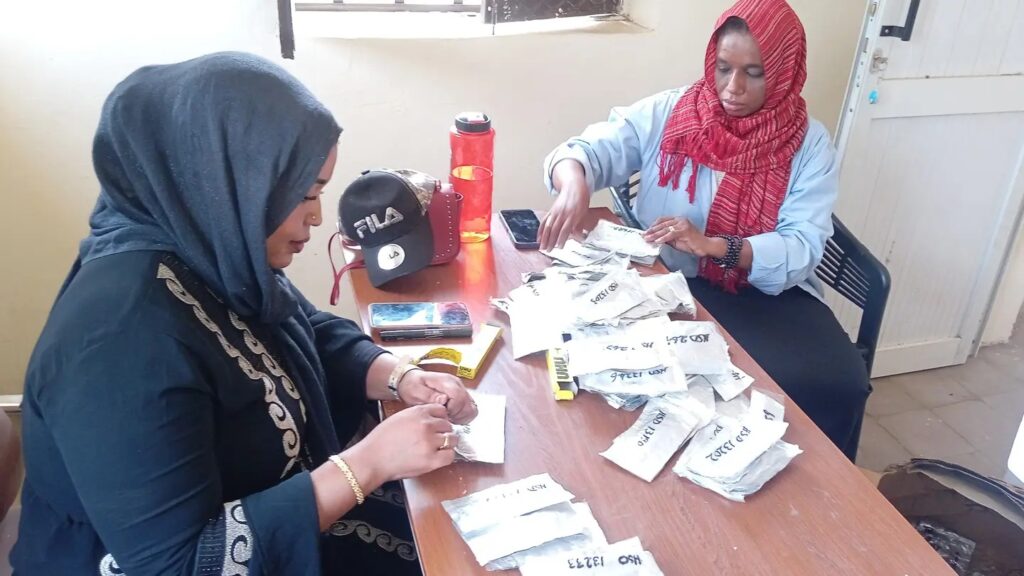
Seeds from Madani are prepared for dispatch to Norway (Supplied/Ali Zakaria Babiker) / Wad Madani. Photo Ali Zakaria Babiker

___________

SUDAN

OMANI team develops strong, biocompatible dental filling

An innovative team from the Oman Dental College has successfully developed a dental filling using Omani Portland cement reinforced with carbon nanoplates, creating the first material that combines exceptional strength with complete biocompatibility for dental tissues. This breakthrough opens new horizons in global dental treatments.

Malak Khalifa Al Harthy, a member of the research team “Pulp49,” told Oman News Agency (ONA) that the innovation stemmed from observing how traditional fillings often lack a balance between “strength” and “biocompatibility.” This prompted the team to develop a new composite that achieves this challenging balance.

She explained that the composite is a dental filling made by integrating Omani cement with graphene sheets, resulting in a material with high mechanical efficiency and significant biocompatibility. This has led to clear and rapid restoration of surrounding dental tissues.

The development of the composite took approximately five years of research and experimentation, undergoing initial cell-level testing followed by animal trials in collaboration with the Mounted Police Command. It is now in the second phase of human trials, with preliminary results showing highly promising indicators.

Regarding the expected benefits of this composite in dentistry, she noted that it provides a cost-effective solution while enhancing the longevity and efficiency of dental treatments. This represents a major advancement in dental materials, offering improved outcomes for both patients and dentists.

Among its key advantages is high biocompatibility, as the integration of carbon nanoplates enhances the material’s positive interaction with biological tissues while reinforcing its mechanical properties. This makes it particularly suitable for complex and challenging dental applications.

Additionally, the composite supports tissue regeneration by mimicking an ideal environment for the rebuilding cells in surrounding dental tissues. This effect is attributed to the synergistic interaction between the carbon nanoplates’ properties and the calcium ion-based reaction of Portland cement with physiological body fluids.

The composite also exhibits superior sealing capabilities, with the increased volume and unique properties of the nanoplates enhancing its ability to fill gaps and voids, making it ideal for applications requiring tight seals or water resistance.

The innovation has been officially recognized, securing a patent in the Sultanate of Oman and international registration. The team is currently finalizing the last stages of development after receiving essential support from the Ministry of Higher Education, Research, and Innovation, paving the way for its introduction to local and eventually global markets.

Addressing the challenges faced during the project, she explained that the team encountered difficulties in achieving the ideal composition, requiring multiple rounds of testing, experimentation, and model adjustments before finalizing the approved formula.

She emphasized the substantial support received, with the Oman Dental College providing necessary resources and the ROP Mounted Police contributing to trials. She also acknowledged the direct support of Dr. Abu Bakr Qateeshat, Head of Graduate Studies, Research, and Development at the college, and Dr. Aida Al-Wahaibi, as well as the encouragement from family, which served as a major motivator in achieving this milestone.

Regarding her selection to represent Oman at the International Invention, Innovation, and Technology Exhibition (ITEX) in Malaysia in 2025, she described it as an opportunity to showcase Omani youth’s capabilities and their role in delivering innovative solutions that elevate Oman’s global standing, while also facilitating knowledge exchange with innovators worldwide.

 In closing, Malak Khalifa Al-Harthy affirmed that Omani youth are capable of remarkable achievements when they believe in their ideas and channel their creativity toward serving society—especially when innovation is genuine, addresses real needs, and contributes to the nation’s progress. -ONA

source/content: timesofoman.com (headline edited)

___________

__________

OMAN

ARAB JOURNALISTS : Here are the names of the 4 (four) Al Jazeera journalists Israel killed in Gaza

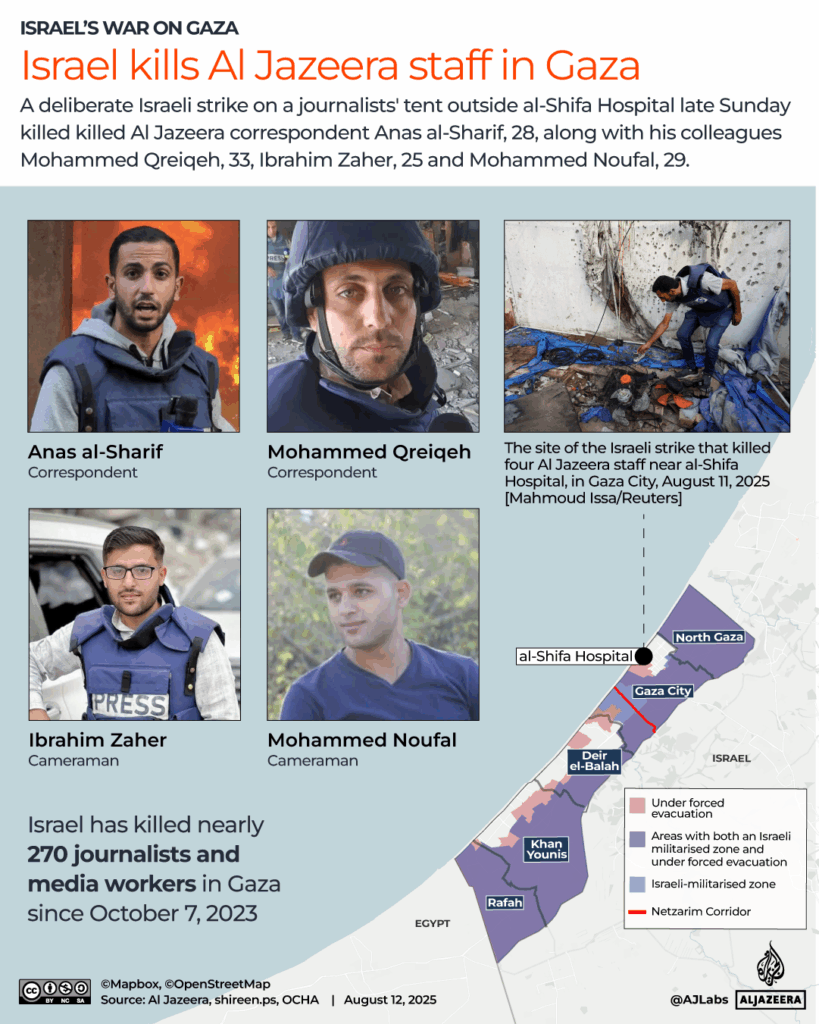
Israel has killed nearly 270 journalists and media workers since it launched its war on Gaza.

Al Jazeera journalist Anas al-Sharif, 28, has been killed along with three of his colleagues in a deliberate Israeli attack on a media tent sheltering journalists outside the main gate of Gaza City’s al-Shifa Hospital.

Al Jazeera reporter Hani al-Shaer said an Israeli drone hit the tent about 11:35pm (20:35 GMT) on Sunday.

In total, seven people were killed in the attack, including Al Jazeera correspondent Mohammed Qreiqeh, 33, and Al Jazeera cameramen Ibrahim Zaher, 25 and Mohammed Noufal, 29.

(Al Jazeera)

Israel deliberately kills Al Jazeera journalists

This is not the first time Israel has targeted Al Jazeera journalists covering the war in Gaza. Before Sunday night’s attack, at least five Al Jazeera journalists had been killed by Israel.

Interactive_AlJazeera_journalists_killed_March25_2025-1742903334

[Al Jazeera]

On December 14, 2023, Al Jazeera cameraman Samer Abudaqa was targeted by an Israeli air strike while reporting alongside Gaza bureau chief Wael Dahdouh, who was injured in the same attack.

Abudaqa was left to bleed to death at the Farhana school in Khan Younis, where they were filming, as emergency workers were blocked by the Israeli military from reaching the site.

On January 7, 2024, Wael’s eldest son and fellow Al Jazeera journalist, Hamza Dahdouh, was killed in a missile strike on the vehicle he was travelling in in Khan Younis.

On July 31, 2024, Ismail al-Ghoul and his cameraman Rami al-Rifi were killed in an Israeli attack on the Shati refugee camp despite their vehicle bearing clear media markings and both wearing vests identifying themselves as members of the news media.

On December 15, Israel killed Al Jazeera journalist Ahmed al-Louh in an air strike in central Gaza’s Nuseirat camp.

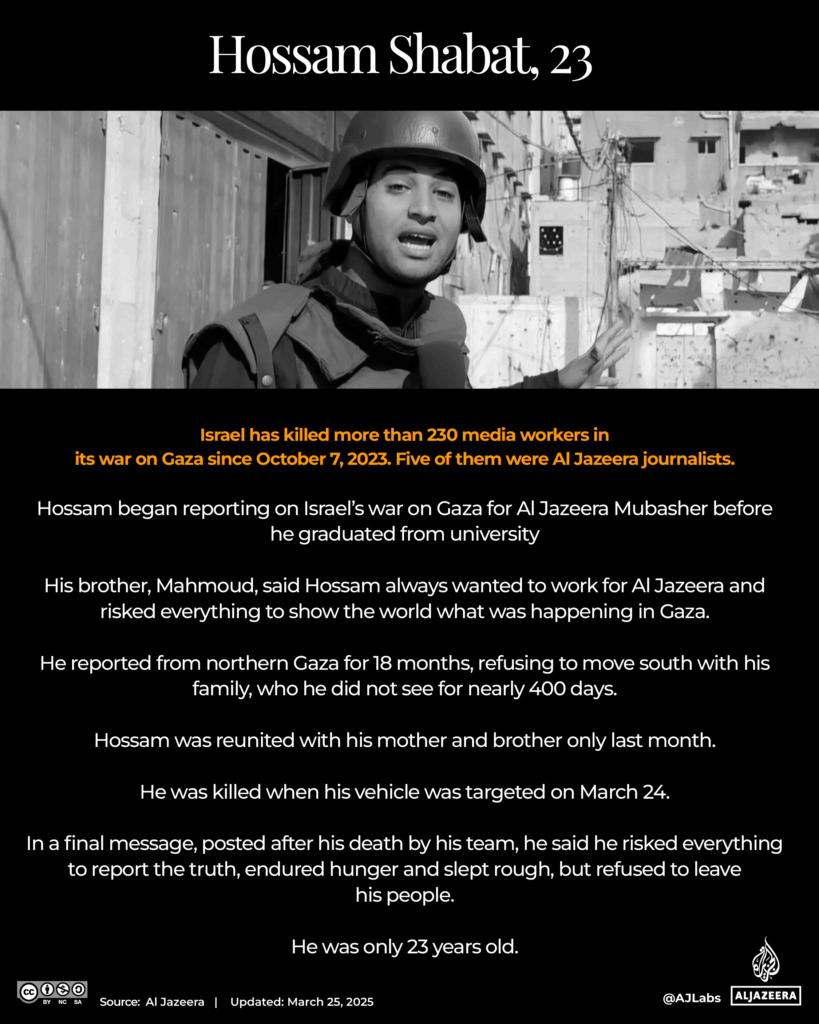
On March 24, Hossam Shabat, 23, was killed in an Israeli attack in the eastern part of Beit Lahiya in northern Gaza.

[Al Jazeera]

Gaza: The deadliest war for journalists

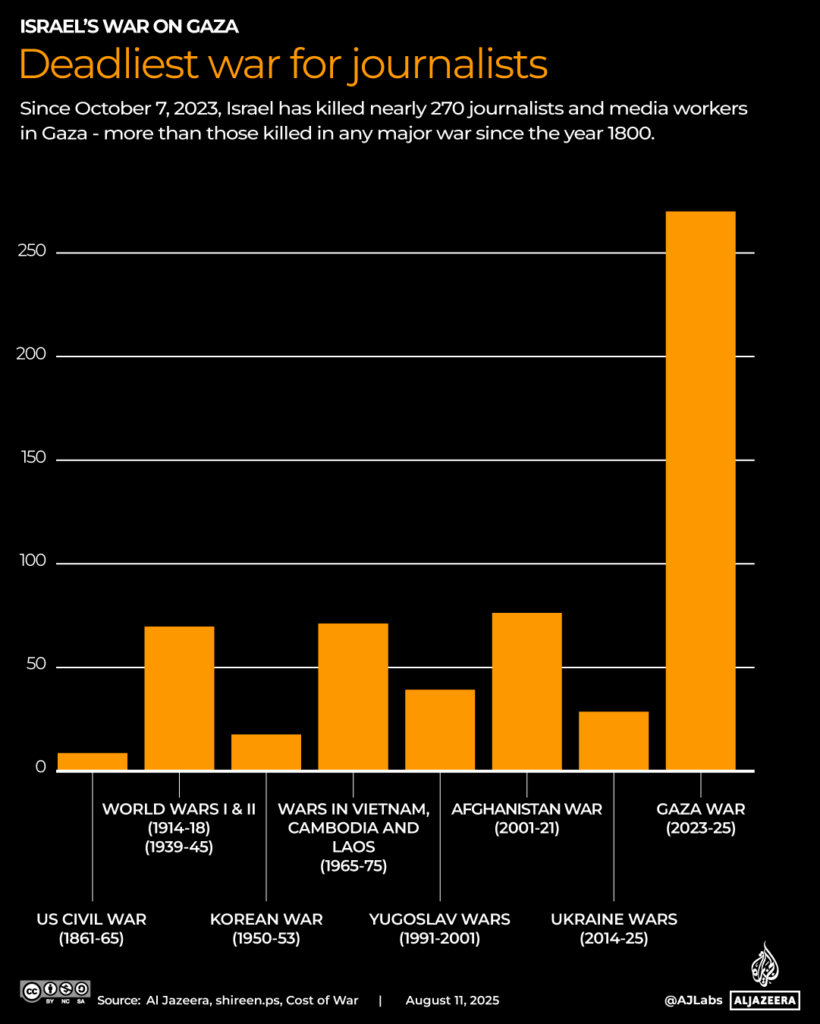
Israel’s war on Gaza has been the single deadliest conflict for journalists.

​​According to Brown University’s Costs of War project, more journalists have been killed in Gaza since the war began on October 7, 2023, than in the US Civil War, World Wars I and II, the Korean War, Vietnam War, the wars in the former Yugoslavia and the post-9/11 war in Afghanistan – combined.

[Al Jazeera]

According to Reporters Without Borders, known by its French acronym RSF, 2024 was the deadliest year for journalists with more than 120 killed. Since the start of this year, more than 50 journalists and media workers have been killed by Israeli attacks in Gaza.

source/content: aljazeera.com (headline edited)

SAUDI ARABIA hosts first regional deployment of OpenAI models through HUMAIN-Groq partnership

Deployment will enable developers, researchers, and enterprises to access AI tools previously limited by infrastructure or compliance constraints

Groq CEO said partnership expands company’s reach into Middle East

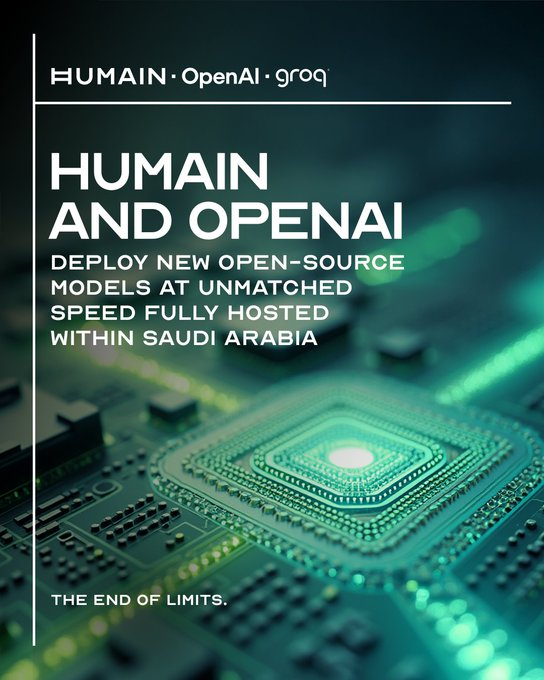
Saudi Arabia has become the first country in the region to host OpenAI’s newly released publicly available models through a deployment announced by HUMAIN and Groq.

The gpt-oss-120B and gpt-oss-20B models are operated on Groq’s high-speed inference infrastructure located within HUMAIN’s sovereign data centers in the Kingdom. 

The move is part of broader efforts to localize advanced artificial intelligence infrastructure, aligning with national regulatory and data sovereignty requirements. Saudi Arabia’s deployment of OpenAI’s open-source models within domestic infrastructure supports a wider strategy to diversify its economy and position itself as a key player in global AI.

Under Vision 2030, the Kingdom envisions a digital economy powered by AI, investing heavily in sovereign compute infrastructure to support emerging markets across Africa and Asia.

HUMAIN, a company backed by the Public Investment Fund, said the deployment will enable Saudi-based developers, researchers, and enterprises to access AI tools that were previously limited by infrastructure or compliance constraints. 

Groq, a US-based company specializing in AI inference hardware, provides a custom-built processing platform designed to deliver consistent, high-speed performance. 

HUMAIN CEO Tareq Amin described the development as a step forward in achieving technological self-reliance. 

“With the deployment of OpenAI’s most powerful open models, hosted right here inside the Kingdom, Saudi developers, researchers, and enterprises now have direct access to the global frontier of AI — fully aligned with our national regulations and data laws,” he said. 

The company claims that the gpt-oss-120B model operates at more than 500 tokens per second, while the gpt-oss-20B exceeds 1,000 tokens per second on its platform. 

The establishment of HUMAIN by PIF in May, backed by commitments from Nvidia, AMD, Cisco, and Amazon Web Services, illustrates this push, with multi‑billion‑dollar agreements to expand local AI compute capacity, data centers, and foundational models. 

The infrastructure is positioned as fully sovereign, meaning all data handling complies with Saudi regulations. 

This could be significant for organizations in the public and private sectors that require local hosting of data-intensive applications. The companies did not disclose commercial terms or usage projections. 

Groq CEO Jonathan Ross said the partnership expands the company’s reach into the Middle East. 

“Our partnership with HUMAIN gives us a powerful regional and globally central presence in one of the fastest-growing AI ecosystems on the planet,” Ross said. 

The announcement builds on a partnership first disclosed in May and aligns with Saudi Arabia’s national strategy to become a competitive player in global AI development. 

HUMAIN had previously stressed its ambition to develop AI capabilities across infrastructure, foundational models, and sector-specific applications. 

source/content: arabnews.com (headline edited)

__________

_________________

SAUDI ARABIA

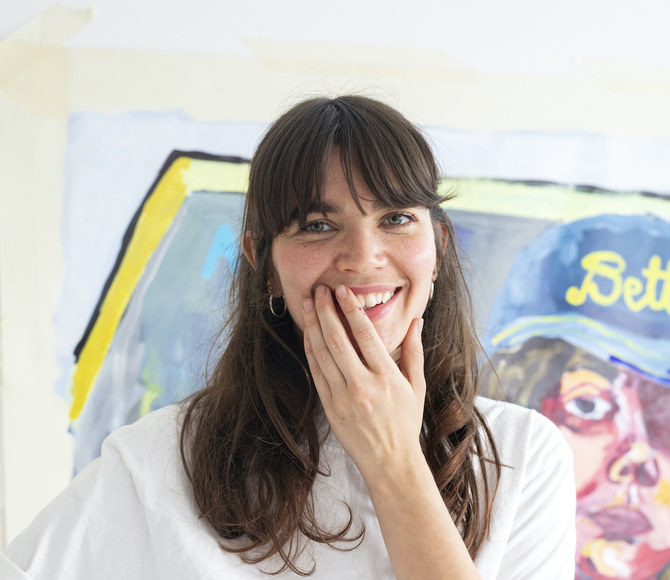
TUNISIAN-FINNISH artist Dora Dalila Cheffi: ‘Satellite Image of a Once-Great Metropolis’ 

The Finnish-Tunisian painter discusses her vivid multilayered piece, completed under quarantine in Tunis.

This is a breakfast scene from last summer, when my friend Petra was visiting my studio in Tunisia — a place that is very significant to my work. 

My representative and I usually think about the titles of my works and we started researching the name ‘Petra.’ It’s a town in Jordan and it used to once be a great metropolis. And I thought that’s such a good metaphor for what I’m feeling about the world now: We thought that our whole world was something so great, but then it can easily be shaken by a pandemic. When you look back at the history of great metropolises, they, in the end, have come to ruins.

To me, there’s also the personal way of thinking about this situation: you understand that something needs to break in order for something new to come out of it. The whole world is now in a situation where everybody’s plans are cancelled and they have to rethink things. 

The ‘satellite image’ part represents the table, and its shapes can indicate that it kind of looks like Earth, as if it’s taken from above. I don’t really know why I love using bold and bright thick layers of color, but for me, color is always something that has so many nuances. And now that I can paint, and manipulate the colors and the shapes, there’s just something that’s magical about it. 

The colors are happy ones, but sometimes the subjects are not necessarily. I don’t want to just create beautiful images. Personally, I need to have a story. 

I can’t really paint if I’m not feeling good, but that doesn’t mean that I’m only painting happy things. With this particular painting I struggled a lot, because it looked good but I felt like it wasn’t ready. 

So I kept changing some of the colors and shapes but then I had to end up changing everything. When it was finally ready, I just felt that all the pieces of the puzzle are complete and there’s not even a doubt about it. It was kind of like when you fall in love with someone; you just know. 

source/content: arabnews.com (headline edited)

___________

Dora Dalila Cheffi is Tunisian-Finnish multimedia artist. (Supplied)

_______________________

FINNISH – TUNISIAN