G.C.C States : Saudi Arabia Unites UAE, Qatar, Oman, Bahrain, and Kuwait: The GCC Powerhouses Redefining Heritage Tourism with Jaw-Dropping Cultural Projects That Will Change the Region Forever!

Heritage has become an important pillar of national identity and tourism across the Gulf Cooperation Council (GCC). Saudi Arabia, the United Arab Emirates, Qatar, Oman, Bahrain and Kuwait are investing in museums, restored districts and conservation projects that foreground local history. Projects range from museums and historic districts to botanical gardens, geoparks and open‑air heritage trails. This article highlights key initiatives under development or about to launch. Details are drawn exclusively from official or government‑verified sources; a list of references is provided at the end.

Saudi Arabia

Saudi Arabia’s flagship heritage project is Diriyah Gate, which surrounds At‑Turaif—the mud‑brick citadel of the first Saudi state. A royal decree brought UNESCO recognition. The Diriyah Gate Development Authority is building Najdi‑style hotels and a mixed‑use square that opened in 2024, creating a neighbourhood where cafés, shops and cultural venues reinforce the historic character.

Further north, the Royal Commission for Al‑Ula is executing the Journey Through Time masterplan, which divides the valley into heritage districts and pairs archaeological preservation with museums, eco‑lodges and interpretive trails through 2035. The commission is also developing Khaybar Heritage Village, connecting it with Al‑Ula and Tayma to form a “living museum” that showcases thousands of years of history.

United Arab Emirates

In Sharjah, the Heart of Sharjah project is revitalising the city’s historic core. Led by the government’s Investment and Development Authority (Shurooq), the five‑phase programme is preserving houses, souqs and mosques and repurposing them as museums, workshops and cafés. Completion is expected in 2025, with the restored district seeking UNESCO World Heritage nomination.

Abu Dhabi is building the Saadiyat Cultural District on Saadiyat Island. Its centrepiece, the Zayed National Museum, will open in December 2025 and celebrate the life of Sheikh Zayed and the UAE’s heritage. The museum will stand alongside new institutions such as the Guggenheim Abu Dhabi, complementing the Louvre Abu Dhabi and establishing the island as a cultural hub.

Qatar

Qatar Museums is developing Dadu, Children’s Museum of Qatar, the nation’s first children’s museum. While construction continues, Dadu Gardens has opened as an outdoor space where children learn about gardening and sustainability through play. The broader museum will nurture creativity and support national education goals.

Three other museums will diversify the country’s cultural offering. The Lusail Museum, scheduled to open in 2029 on Al Maha Island, will showcase Orientalist art. The Art Mill Museum, due in 2030, will convert a historic flour mill on Doha’s corniche into galleries and a public park. The Qatar Auto Museum will explore the history and future of cars through exhibitions and workshops.

Oman

Oman’s Ministry of Heritage and Tourism funds community‑led restoration of forts, mosques and other traditional structures. In 2024 it supported more than twenty projects to preserve vernacular architecture and encourage tourism.

The country is also completing the Oman Botanic Garden, a 500‑hectare conservation site near Muscat. Developed between 2021 and 2025, it will protect more than 1,450 native plant species in biomes replicating desert, mountain and coastal environments. After a 2025 handover to Muscat Municipality, the garden is expected to open soon.

Bahrain

Bahrain celebrates its pearling heritage through the Pearling Path, a 3 km route in Muharraq. Managed by the Bahrain Authority for Culture and Antiquities, it links offshore oyster beds with restored merchant houses and mosques and narrates how pearls were harvested and traded. Inscribed on UNESCO’s World Heritage List in 2012, the path is still being restored; Siyadi House is being converted into a pearling museum.

Kuwait

Kuwait is diversifying tourism with projects highlighting geology and modern history. The Kuwait Geopark will showcase desert landscapes and archaeological sites north of Kuwait City. A UNESCO‑backed initiative in Al‑Ahmadi (2024–2025) is documenting the town’s souq, cinema and neighbourhoods and planning heritage‑based regeneration. In Kuwait City the cabinet has revived a delayed Heritage Village that envisages a hotel, shops and villas inspired by traditional architecture.

Conclusion

Heritage has become a driver of tourism across the GCC. Saudi Arabia is transforming Diriyah and Al‑Ula into living museums. The UAE is reviving historic quarters and erecting new museums in Sharjah and Abu Dhabi. Qatar is creating attractions for children, art lovers and car enthusiasts. Oman couples community restoration with a vast botanic garden. Bahrain narrates its pearl‑diving legacy along a restored path. Kuwait is highlighting geological landscapes and mid‑century towns while reviving a heritage‑themed village. Collectively, these projects show a regional commitment to preserving the past while shaping diverse tourism futures.

These efforts are rewriting the region’s tourism story.

Reference List

  1. Diriyah Gate Development Authority. Diriyah Gate timeline and preservation vision[1].
  2. Royal Commission for Al‑Ula. Journey Through Time masterplan and Khaybar development[2][3].
  3. Sharjah Government. Heart of Sharjah project details and restoration timeline[4][5].
  4. Department of Culture & Tourism – Abu Dhabi. Saadiyat Cultural District and Zayed National Museum opening date[6].
  5. Qatar Museums. Dadu Gardens and vision for Dadu Children’s Museum[7]; Art Mill Museum due to open 2030[8]; Qatar Auto Museum concept and design[9].
  6. Visit Qatar. Lusail Museum overview and 2029 opening schedule[10].
  7. Oman News Agency / Federation of Arab News Agencies. Ministry of Heritage and Tourism support for heritage restoration initiatives[11]; Oman Botanic Garden completion and handover for opening[12][13].
  8. Bahrain Authority for Culture and Antiquities. Pearling Path project description and components[14].
  9. Kuwait Times (quoting KUNA and Ministry of Information). Kuwait Geopark initiative and heritage significance[15]; UNESCO Core Data Portal. Heritage and Identity for Al‑Ahmadi’s sustainable development, Phase 1 (2024–2025)[16]; Zawya Projects. Revival of Kuwait Heritage Village project endorsed by cabinet[17].

source/content: travelandtourworld.com (headline edited)

_____________
_______________________________________________________________________

GCC STATES / BAHRAIN / KUWAIT / OMAN / QATAR / SAUDI ARABIA / U.A.E
SAUDI charitable foundation celebrates World Arabic Language Day with UNESCO in Paris

El-Enany highlighted the importance of the partnership between UNESCO and the foundation, which he said allows the organization to increase the scale of its ambition in the work it does.

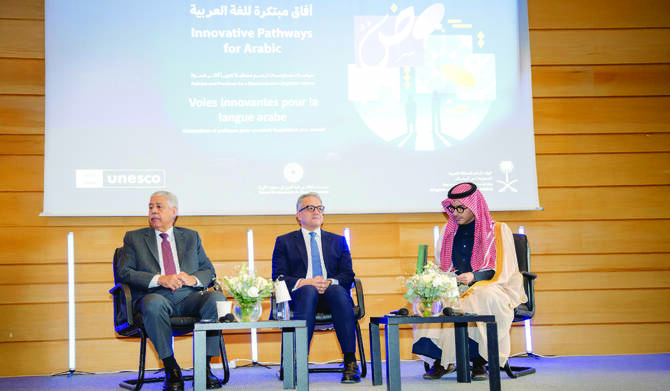
The charitable Sultan bin Abdulaziz Al-Saud Foundation and the UN Educational, Scientific and Cultural Organization celebrated World Arabic Language Day with an event in Paris this week under the theme “Innovative Pathways for Arabic: Policies and Practices for a More Inclusive Linguistic Future.”

Organized in collaboration with the Kingdom’s permanent delegation to UNESCO, it brought together a distinguished group of international leaders, policymakers, experts, intellectuals and specialists in linguistic and cultural affairs from around the globe, organizers said, to underscore the global standing of the Arabic language and its pivotal role in promoting cultural diversity and dialogue among civilizations.

The participants included Khaled Ahmed El-Enany, director general of UNESCO; Abdulelah Altokhais, Saudi Arabia’s permanent delegate to the organization; and Saleh Ibrahim Al-Kholaifi, the foundation’s director general.

In his speech at the event, El-Enany highlighted the importance of the partnership between UNESCO and the foundation, which he said allows the organization to increase the scale of its ambition in the work it does. A number of key projects are planned as part of the collaboration, he added.

source/content: arabnews.com (headline edited)

________________

The participants included Khaled Ahmed El-Enany, director general of UNESCO; Abdulelah Altokhais, Saudi Arabia’s permanent delegate to the organization; and Saleh Ibrahim Al-Kholaifi, the foundation’s director general. (Supplied)

_________________

SAUDI ARABIA

G.C.C States : How Water Towers Became Architectural Landmarks Across the Gulf

Across the GCC, water towers represent rare cases where infrastructure becomes architecture, fusing modernist design and urban symbolism to create landmarks that shape skylines and cultural memory.

Throughout the Gulf region, water towers represent special cases where infrastructure becomes engaging architecture. These towers push beyond their practical purpose, using different forms and public programming to create visual landmarks and destinations.

Rather than treating water storage as an invisible utility, governments snatched an opportunity to signal ambition and modernity, marking their emerging architectural identity. Spherical forms, inverted cones, and futuristic silhouettes turned practical structures into symbols, shaping how cities present themselves.

Together, these towers reveal how functional engineering can become urban character…

Burj al‑Khazzan — Saudi Arabia 

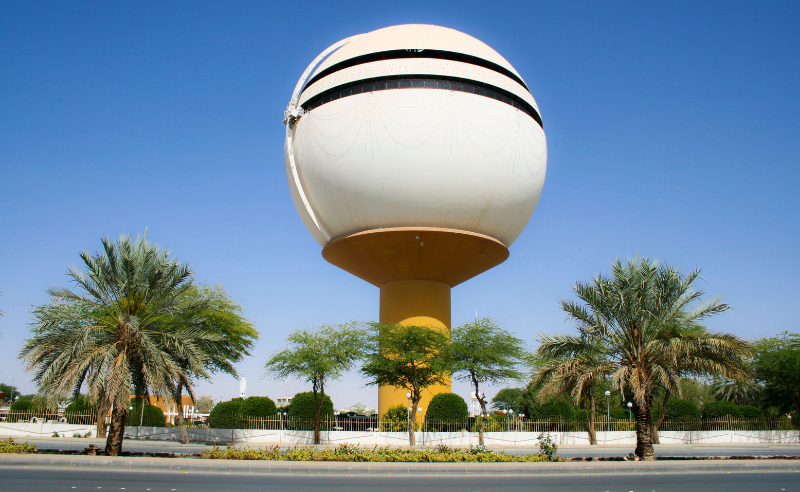
This tower, designed by Swedish architect Sune Lindstrom, is an early example of transforming infrastructure into a city landmark. Upon its completion in 1971, it was the tallest structure in Saudi Arabia standing at 61 metres. Its mushroom-shaped structure featuring an inverted cone top reflects iconic modernist silhouettes, solidifying its place as one of the memorable water towers of the region.

Al-Khobar — Saudi Arabia

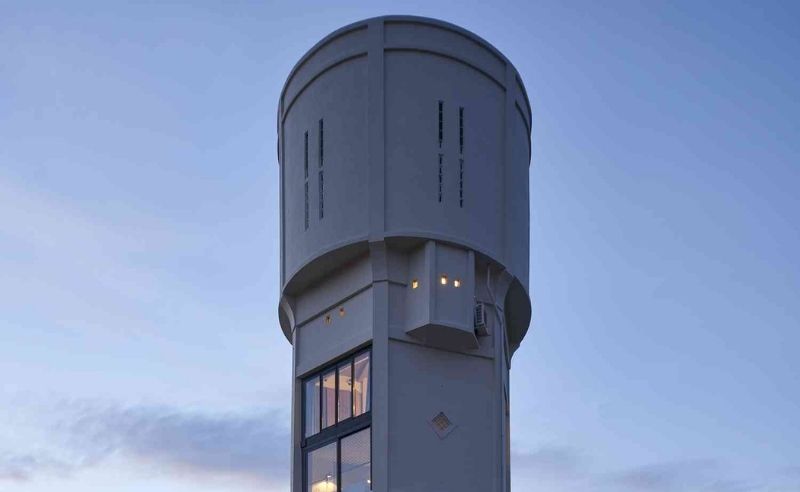
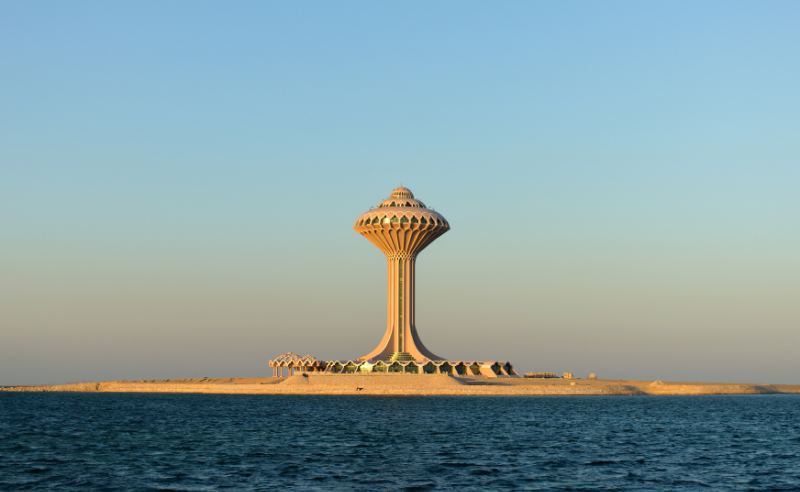
Originally a 90 meter water storage tower on an island off the Khobar’s corniche, this tower was designed using modernist and utilitarian architecture — standard of late 20th century Gulf infrastructure. The cylindrical concrete tower features simple geometric forms emphasising efficiency over ornamentation.

Currently, Al Khobar Water Tower is undergoing redevelopment employing fluid, wave-like futurist architecture. With plans to open green spaces, restaurants, and other leisure facilities, the tower transforms from functional infrastructure into a civic landmark.

Kuwait Towers — Kuwait

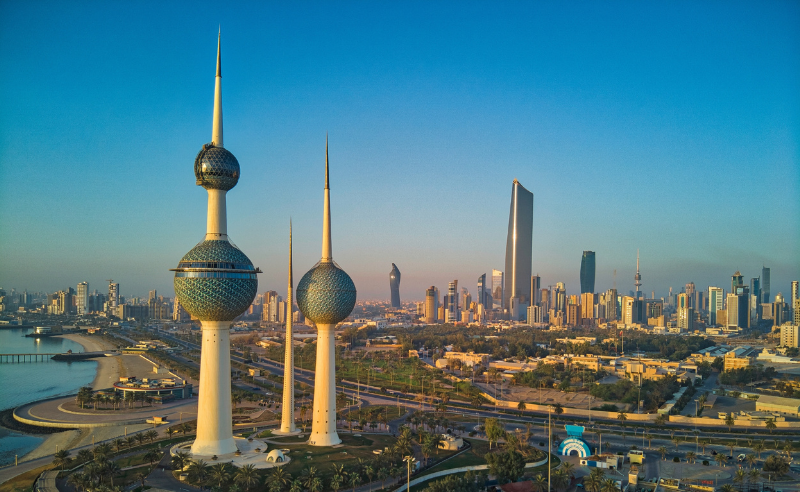
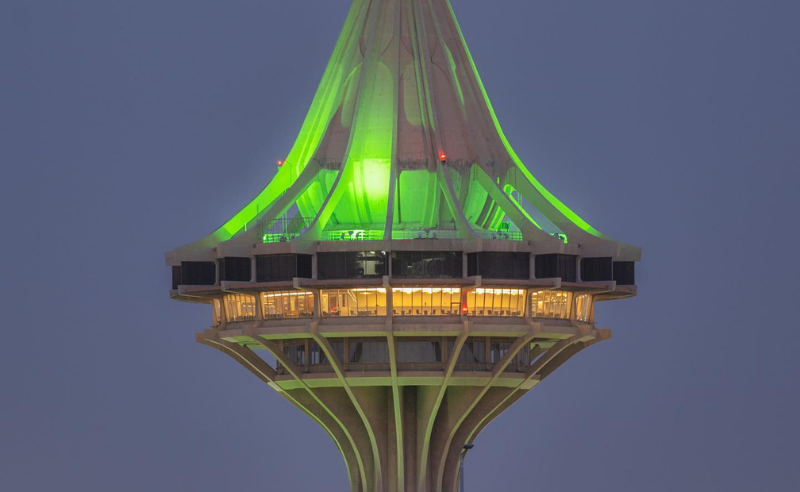
Featuring three towers with spherical water tanks, the Kuwait Towers use modernist-futuristic design to blend utility with sculptural elegance. Designed by Swedish architect Malene Bjørn, its spherical forms, clad in blue, green, and grey tiles, make them a defining element of the city’s skyline and a symbol of Kuwait’s modernisation. Representing the key integration of civic identity with tourism, the towers fuse functional storage with a revolving restaurant and rotating observation deck.

Buraidah Water Tower — Saudi Arabia

Rising above the city of Buraidah, the water tower doubles as a regional landmark. Completed in the late 20th century, it reaches 66 meters and features a cylindrical form with a public restaurant encircling the water tank. Its design balances utilitarian purpose with subtle modernist touches, ensuring its position as one of the city’s most distinctive buildings.

Burj Al Kharj — Saudi Arabia

Dominating the skyline of Al Kharj, this tower is the pinnacle of utility, public engagement, and civic identity. This 105 meter tower features a revolving restaurant, auditorium, exhibition hall, and landscaped park. Its cylindrical form and modernist design reflect 20th century Gulf architecture alongside multiuse infrastructure. The towers’ clean lines, geometric shapes, and integration of public spaces reflect an approach to design that treats infrastructure as both utilitarian and as a civic landmark.

Mushroom Towers — Kuwait

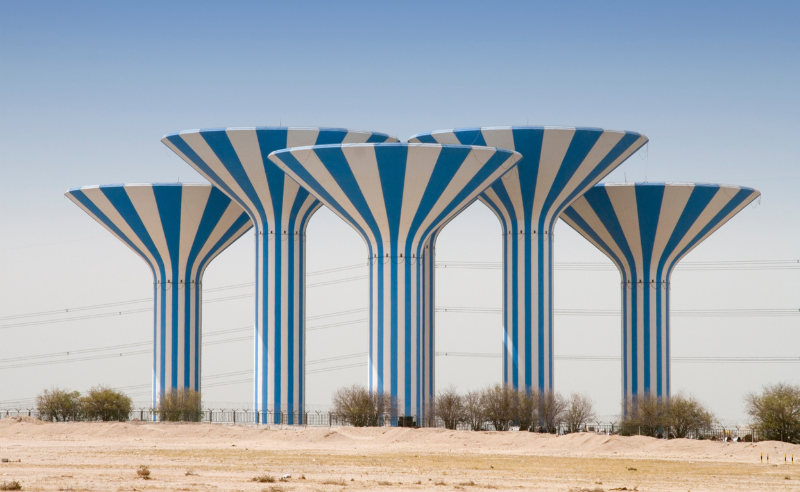
Including a distinctive network of 31 total water towers, the Mushroom Towers combine functional engineering with visually striking silhouettes. Each tower features a slender cylindrical shaft topped by a flaring, mushroom shaped tank, creating a recognisable profile. While primarily functional, their repeated form and unmistakable blue strips transform standard, necessary infrastructure into an architectural statement, illustrating whose systematic design can contribute to the development of urban identity and aesthetics.

Al Khazzan Park Tower — UAE

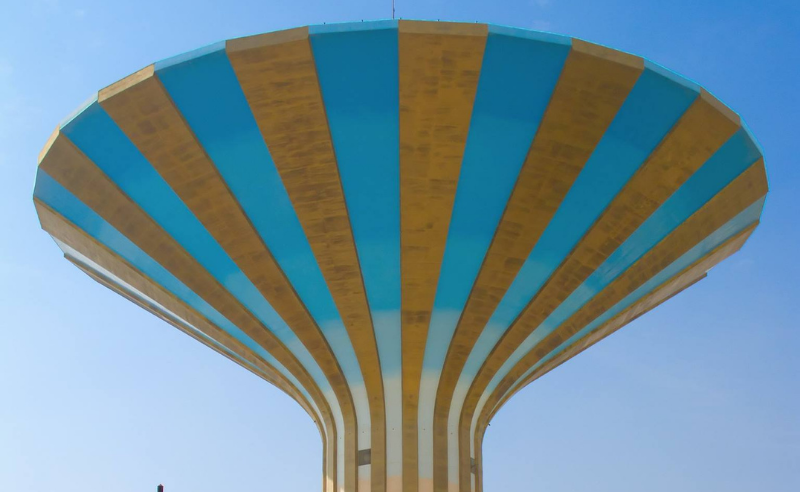
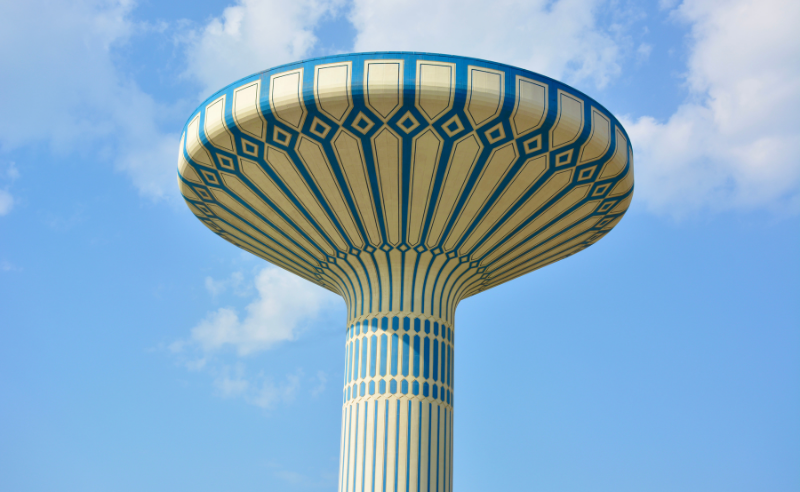
This water tower, the defining landmark of Al Khazzan Park, features a blue and white patterned tank standing about 40 meters high. Dubai Municipality rehabilitated the site as Al Khazzan Park, keeping the tower as a focal point while adding shaded lawns, a children’s play area, a small café-library and a ground-mounted photovoltaic array so the park operates as a zero-energy public space.

The project was framed as both an urban-greening and heritage-conservation effort, restoring an older community park from the 1970s–1980s era and preserving the tower as one of the neighbourhood’s most recognisable civic monuments.

source/content: cairoscene.com (headline edited)

__________

____________________________________________

GCC STATES / Kuwait, Saudi Arabia, U.A.E)

ABU DHABI, U.A.E : Zayed Authority for People of Determination sets new Guinness World Record

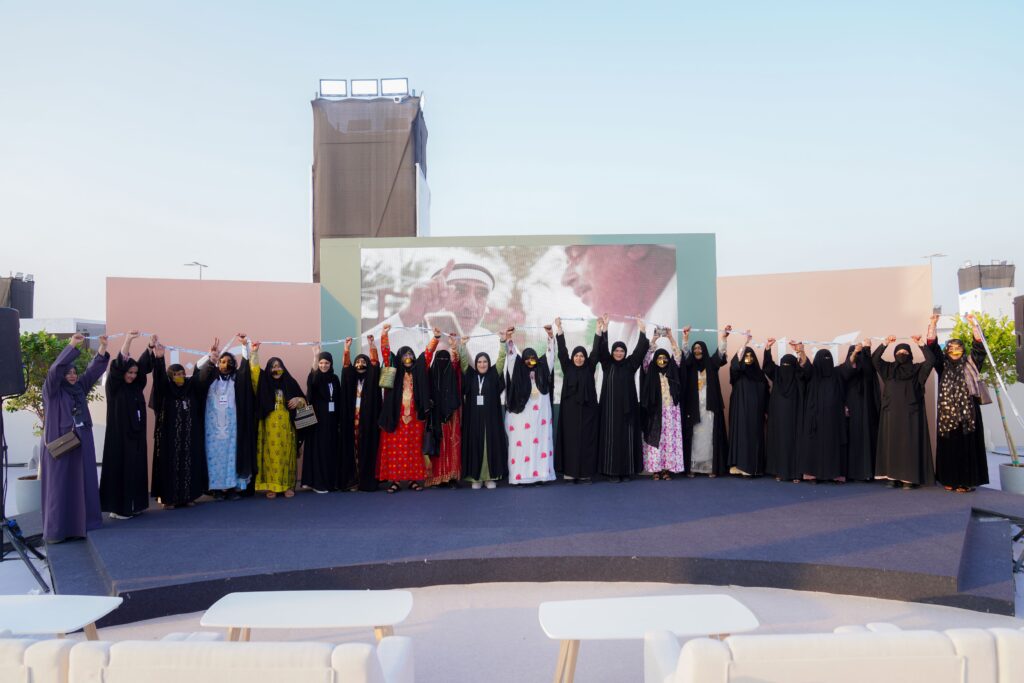
Zayed Authority for People of Determination has added a new achievement to the UAE’s international record, following the official recognition by Guinness World Records of the world’s longest chain of lanyards, measuring 663.53 metres.

The record-breaking chain consists of 1,300 lanyards, handcrafted by people of determination, with the participation of 13 national entities that contributed to turning the idea into reality.

This symbolic initiative carries a global message to raise awareness of hidden disabilities, reflecting the Authority’s ongoing commitment to enhancing community understanding of the needs of this group and fostering more inclusive and empathetic environments. The official announcement of the record took place during the Fifth Abu Dhabi Family Forum, in the presence of an international adjudicator from Guinness World Records, and was witnessed by families, institutions, and participating entities.

The project was implemented at the Authority’s Innovation Centre, where people of determination took part in designing, assembling, and coordinating the lanyards, supported by forum partners from national entities. These included: Sheikha Fatima Programme for Excellence and Artificial Intelligence; the Office of the Minister of Tolerance and Coexistence; Khalifa bin Zayed Al Awwal School; the Khalifa Empowerment Programme Team “Aqdar”; the National Archives and Library; the Emirates Red Crescent; Little Smarty Nursery; the Emirates Businesswomen Council; Air Arabia; Abu Dhabi Sports Council; the Family Care Authority; Hemaya Schools for Education – Dubai Police; and the Department of Culture and Tourism – Abu Dhabi. The efforts of these entities were integrated across the stages of production, printing, and community support to deliver this unique achievement.

Abdullah Abdulali Al Humaidan, Director General of Zayed Authority for People of Determination, affirmed that this global record reflects the vision of the wise leadership in establishing an inclusive and sustainable society. He noted that the participation of people of determination in executing the project embodies their creative capabilities and provides them with broader opportunities to excel and contribute to national achievements.

His Excellency added, “This record is not merely a new certificate in the UAE’s achievements register; it is a message that embodies the values of empowerment, respect, and humanity. It affirms that achievements are realised when efforts come together, and that people of determination are capable of achieving the impossible when provided with a supportive environment and committed partners.”

He further emphasised the Authority’s continued commitment to launching high-impact initiatives that highlight the capabilities of people of determination, strengthen their role in the UAE’s development journey, and contribute to new global achievements that reflect national competence and the spirit of determination and perseverance.

The sunflower lanyard is recognised globally as a symbol for raising awareness of hidden disabilities, aiming to enhance community awareness and encourage institutions to provide more understanding and supportive environments for this group.

The forum witnessed strong engagement from families and community members, who followed the moment the record was officially validated in the Guinness World Records registry—an event that reflects the scale of the work accomplished by the Authority and its partners, and highlights the vital role they play in raising community awareness of hidden disabilities.

source/content: wam.ae (headline edited)

____________

_______________________________________________

Abu Dhabi, UNITED ARAB EMIRATES (U.A.E)

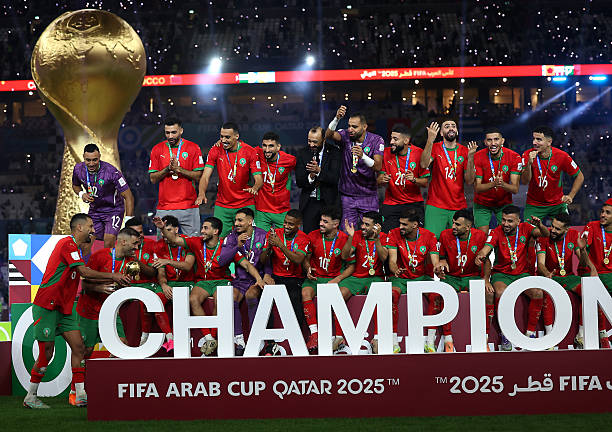
MOROCCO crowned FIFA Arab Cup champions after dramatic final in Lusail

Morocco won the 11th edition of the FIFA Arab Cup with an action-packed 3–2 victory over Jordan in the final.

Exactly three years on from the unforgettable 2022 FIFA World Cup final, Lusail Stadium once again hosted the coronation of a champion. This time, it was the Arab world that came together in Qatar for the FIFA Arab Cup.

After 29 matches over 18 days, Morocco and Jordan were the last two teams left in contention for the title. The Atlas Lions had previously won the tournament in 2012, while Jordan were appearing in their first Arab Cup final, just a few years after losing the Asian Cup final at the same venue.

Before kick-off, there were concerns that the match would not go ahead at all. An unusually heavy downpour in Doha led to the suspension of the third-place match between the UAE and Saudi Arabia, raising doubts about the final. While several events were cancelled due to the weather, the showpiece match proceeded as planned.

Tens of thousands of fans braved thunderstorms to pack Lusail Stadium, and they were rewarded just minutes into the game. Oussama Tannane opened the scoring with a stunning long-range effort from inside Morocco’s own half, giving the Atlas Lions an early lead.

Jordan were unable to find an equaliser before the break, but tournament top scorer Ali Olwan levelled the match just two minutes into the second half with a powerful header. He then put Jordan ahead from the penalty spot in the 68th minute, setting up a dramatic finish.

Morocco’s pressure paid off late on when substitute Abderrazak Hamdallah turned the ball in from close range just three minutes before full time, sending the match into extra time. The veteran striker struck again in the 100th minute, restoring Morocco’s lead. This time, the Atlas Lions held firm to seal a memorable victory.

source/content: dohanews.co (headline edited)

___________

LUSAIL CITY, QATAR – DECEMBER 18: Morocco celebrate with the trophy after winning the FIFA Arab Cup 2025 Final match between Jordan and Morocco at Lusail Stadium on December 18, 2025 in Lusail City, Qatar. (Photo by Mohamed Farag – FIFA/FIFA via Getty Images)

_____________

MOROCCO

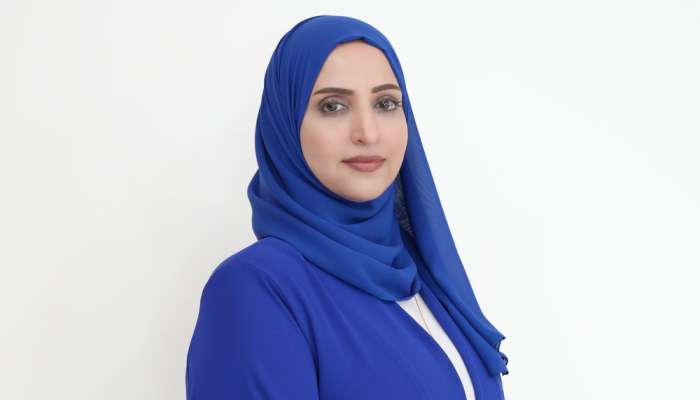
OMAN : Dr. Jokha Abdullah Al Shukaili elected head of Arab Network for Quality Assurance in Higher Education

Dr. Jokha Abdullah Al Shukaili, CEO of Oman Authority for Academic Accreditation and Quality Assurance of Education, was on Wednesday elected head of the “Arab Network for Quality Assurance in Higher Education”, with effect from 1 January 2026, for a period of four years.

Dr. Jokha’s election caps up a professional career full of accomplishments in developing policies and standards of educational quality and academic accreditation, both locally and regionally.

Dr. Jokha takes credit for significantly enhancing the status of the Sultanate of Oman at international forums, thanks an aptitude to espouse the best global practices in ensuring top quality in higher education.

Dr. Jokha also played a major role in consolidating regional and international cooperation through active participation in specialized networks and authorities, in addition to promoting the exchange of experiences with leading global institutions.

Dr. Jokha’s election to the position reflects the great confidence attached to the Sultanate of Oman, represented by Oman Authority for Academic Accreditation and Quality Assurance of Education. It also affirms the prestigious status of national competencies and their ability to lead regional and international initiatives.

The accomplishment also contributes to the realization of the objectives of Oman Vision 2040, which focuses on building an advanced educational system that supports innovation and scholarly research.

The election of Dr. Jokha to the position constitutes an indicator of the progress made by the Sultanate of Oman in the field of higher education. It reflects Oman’s commitment to apply the best international practices in educational quality assurance and academic accreditation, making Oman’s competitive educational system up-to-date at regional and international levels.

source/content: timesofoman.com (headline edited)

______________

_________

OMAN

‘FIFA ARAB CUP Qatar 2025’ opens with touching theme of regional unity

The performance served as a link connecting the region’s past, present, and future, highlighting its profound civilisational heritage.

The FIFA Arab Cup Qatar 2025 kicked off on Monday evening at the Al Bayt Stadium with a stellar opening ceremony that placed great emphasis on the region’s rich culture with various prominent artists.

Loud chants and applause from 61,475 fans echoed across the stadium when Qatar’s Amir Sheikh Tamim bin Hamad Al Thani entered the venue to inaugurate the major ceremony ahead of the Qatar vs Palestine game.

The 15-minute show then started with the narration of Syrian artist Rashid Assaf and scenes of Jerusalem as well as two doves of peace, echoing Qatar’s support for the Palestinian cause especially in mega events.

The pitch dazzled with Arab patterns and vibrant lights reflecting the region’s culture as the performers came in with the traditional clothes of their home countries. The ceremony told the stories of Arab generations, where each performer from a different country shared a piece of their homeland.

The greater emphasis was still on the region’s united support for the Palestinian cause even in sports, highlighting it as one of the Arab Cup’s key themes. The performance served as a link connecting the region’s past, present, and future, highlighting its profound civilisational heritage.

The appearance of Palestinian singer Rola Azar in her traditional thobe, or embroidered dress, as she stood under the spotlight further emboldened the message of solidarity.

Qatar unveils sponsors for Arab Cup and U-17 World Cup 2025

The joint performance of all the Arab countries’ national anthems, an iconic moment reminiscent of the 2021 FIFA Arab Cup in Qatar, was the part that the audience waited for. Azar alongside Lebanese artist Mohamed Chaker made the moment more memorable.

The three-dimensional light shows made the evening more magical as the stadium’s heartbeats pounded louder for the faceoff between Qatar and Palestine—both of which share a strong sense of unity.

Spectators who spoke to Doha News ahead of the match echoed their joint support for both teams, with many carrying the Palestinian and Qatari flags or wearing the keffiyeh and the Qatari football jersey at the same time.

The game later ended with Palestine’s 1-0 victory over Qatar, but celebrations were seen on both sides of the pitch.

Qatar’s Amir also took to his social media to congratulate Palestine’s national team on their win in the opening game.

“We in the State of Qatar are pleased to welcome our Arab brothers to the Arab Cup[…] Congratulations to the Palestinian national team on its victory in today’s opening match,” Sheikh Tamim said on X.

source/content: dohanews.co (headline edited)

___________

______________________

ARAB / Doha, QATAR

SYRIAN-AUSTRALIAN : ‘Hero’ Ahmed Al-Ahmed who disarmed Bondi gunman recovers in hospital as donations pour in

Sydney resident Ahmed Al-Ahmed seized rifle from one of the gunmen

Ahmed was shot in hand and arm his family says

PM said Ahmed showed ‘best of humanity’

 Donations for a Sydney man who wrestled a gun from one of the alleged attackers during a mass shooting at Bondi Beach have surged past A$1.1 million ($744,000), as he recovers in hospital after surgery for bullet wounds.

Forty-three-year-old Ahmed Al-Ahmed, a Muslim father-of-two, hid behind parked cars before charging at one of the gunmen from behind, seizing his rifle and knocking him to the ground.

Prime Minister Anthony Albanese said Ahmed’s bravery saved lives.

“What we’ve seen in the last 24 hours was the worst of humanity in a terrorist act. But we also saw an example of the best of humanity in Ahmed Al Ahmed running toward danger, putting his own life at risk,” Albanese told state broadcaster ABC News.

He was shot twice by a second perpetrator, Albanese said. Ahmed’s family said he was hit in the hand and arm.

Australian police on Monday said a 50-year-old father and his 24-year-old son carried out the attack at a Jewish celebration on Sunday afternoon, killing 15 people in the country’s worst mass shooting in almost 30 years.

HAILED A HERO FOR DISARMING THE GUNMAN

Ahmed’s father, Mohamed Fateh al Ahmed, told ABC News in an interview that his son was an Australian citizen and sells fruits and vegetables.

“My son is a hero. He served in the police, he has the passion to defend people.”

“When he saw people lying on the ground and the blood, quickly his conscience pushed him to attack one of the terrorists and take away his weapon,” Mohamed Fateh said.

Jozay Alkanji, Ahmed’s cousin, said he had had initial surgery and may need more.

AHMED PICTURED IN HOSPITAL

Tributes have poured in from leaders both abroad and at home.

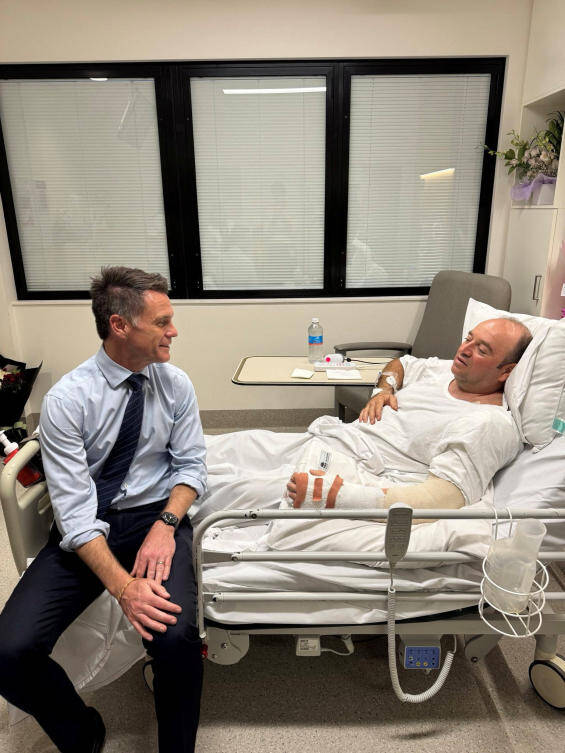
Chris Minns, the premier of New South Wales, where Sydney is located, said in a social media post he visited Ahmed at St. George Hospital and conveyed the gratitude of people across the state.

“Ahmed is a real-life hero,” his post said. “Thank you, Ahmed.” A photo showed Minns at his bedside, and Ahmed propped on pillows with his left arm in a cast.

US President Donald Trump called Ahmed “a very, very brave person” who saved many lives.

A GoFundMe campaign set up for Ahmed has raised more than A$1.1 million within one day. Billionaire hedge fund manager Bill Ackman was the largest donor, contributing A$99,999 and sharing the fundraiser on his X account.

SUPPORTERS THANK AHMED FOR SAVING LIVES

Outside St. George Hospital, strangers came to show their support.

Misha and Veronica Pochuev left flowers for Ahmed with their seven-year-old daughter, Miroslava.

“My husband is Russian, my father is Jewish, my grandpa is Muslim. This is not only about Bondi, this is about every person,” Veronica said.

Yomna Touni, 43, stayed at the hospital for hours to offer assistance on behalf of a Muslim-run charity also raising funds for Ahmed.

“The intention is to raise as much money as possible for his speedy recovery,” she said. ($1 = 1.5047 Australian dollars) (Writing by Praveen Menon; Editing by Michael Perry, Saad Sayeed, Alexandra Hudson)

source/content: arabnews.com (headline edited0

___________

New South Wales Premier Chris Minns visits Ahmed Al-Ahmed, who was identified on social media as the bystander who hid behind parked cars and seized a rifle from one of the gunmen during the deadly shooting at Bondi Beach on Sunday, at a hospital in Sydney, Australia, December 15, 2025, in this picture obtained from social media. (@ChrisMinnsMP via X/via Reuters)

______________________

AUSTRALIA / SYRIA

PALESTINE : Sheikh Mohammed congratulates Dr Suad Amiry Winner of Great Arab Minds Award in Architecture and Design

Dr Suad Amiry recognised for decades of heritage conservation work.

His Highness Sheikh Mohammed bin Rashid Al Maktoum, Vice President and Prime Minister of the UAE and Ruler of Dubai, on Sunday congratulated the winner of the 2025 Great Arab Minds Award in the Architecture and Design category.

Sharing his congratulations on social media, Sheikh Mohammed said: “We congratulate the winner of the Great Arab Minds Award in the Architecture and Design category for 2025, Dr Suad Amiry from Palestine, founder of the Riwaq Centre for Architectural Conservation.”

He praised Dr Amiry for her pioneering efforts to preserve Palestinian architectural heritage, highlighting her work in restoring and reusing historic buildings in ways that strengthen urban identity.

Dr Amiry, who leads the Riwaq Centre, was recognised for her role in one of the largest architectural documentation projects in Palestine. The initiative produced a registry of more than 50,000 historic buildings and contributed to the revival of 50 historic centres.

Her projects have also created job opportunities and training for craftsmen working with traditional building materials, while actively involving local communities in restoring their villages.

Sheikh Mohammed extended his “heartfelt congratulations to Dr Suad Amiry for her well-deserved recognition and decades of dedication”. He also prayed for the protection of Palestine, saying: “May God protect Palestine and breathe new life into its historic villages and buildings, ensuring its heritage endures as long as the Arab memory lives on.”

Dr Amiry’s research has been widely recognised for its detailed documentation of traditional Palestinian homes, including stonework, flooring, decorative features and architectural layouts that reflect the richness of the region’s built heritage.

The Great Arab Minds Awards honour influential figures whose work has made a lasting impact on Arab culture, scholarship and society.

source/content: gulfnews.com (headline edited)

_________________

Dr Suad Amiry / @HHShkMohd/X

_______________

PALESTINE

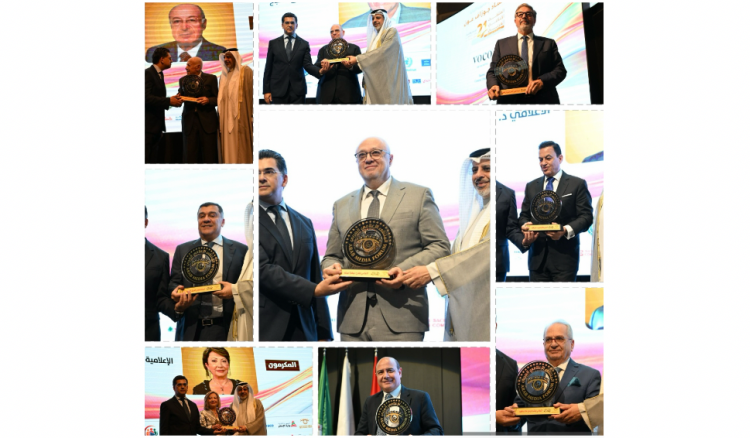
ARAB Media Forum Opens in Beirut: Minister Morcos Honors Prominent Journalists

The Arab Media Forum kicked off in Beirut on Wednesday with an opening ceremony honoring a group of distinguished journalists and media figures. Minister of Information Dr. Paul Morcos and Secretary-General of the Arab Media Forum Madi Abdullah Al-Khamis presented the awards.

Honorees included Yolande Khoury, Rafic Khoury, Jacques Wakim, Nicolas Sabbagh, producer Sadiq Al-Sabah, Dr. Sami Kleib, Mounir Al-Hafi, Fares Yawakim, and Rose Farah Zamel (Warda), among others. 

The event also recognized MEA Chairman Mohammad El-Hout, research CEO Mohammad Ali, Voco Hotel GM Roy Yougharios, and Phoenicia Hotel Director Marie Choueiri.

Minister Paul Morcos himself was also honored for his role in reviving Lebanon’s media vision and strengthening Arab media cooperation.

source/content: nna-leb.gov.lb (headlines edited0

______________

________

ARAB