Jabal An-Nabī Shuʿayb is the peninsula’s highest peak, a geological archive, a cultural landmark, and a reminder of how landscapes shape, absorb, and outlast history.
Yemen is often described as the birthplace of Arabia—not as a poetic claim, but as a fact grounded in geography and history. This is the land where ancient kingdoms like Sheba, Himyar, and Qataban rose and fell; where Arabic, in some of its earliest and most foundational forms, took shape. It’s also where coffee was first cultivated and traded—long before it became a global commodity or a café menu item, it was simply a Yemeni crop, shipped from the port of Mocha.
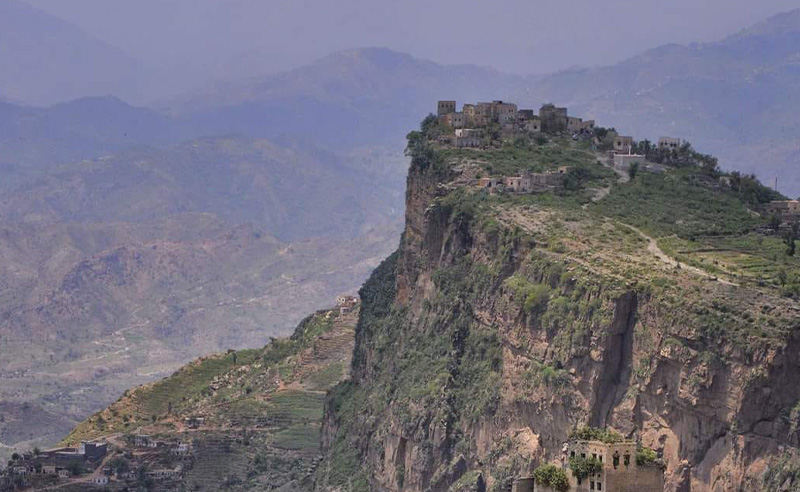
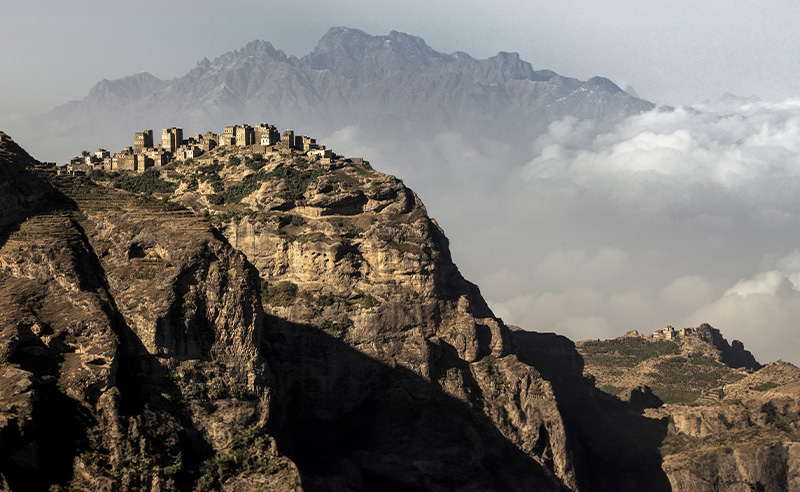
Yet beyond the ruins of ancient states and the legacy of coffee, Yemen is, at its core, a landscape. One defined by steep altitudes, deep valleys, and a quiet kind of permanence. Nowhere is that more clearly felt than in Jabal An-Nabī Shuʿayb—the highest peak in Yemen, the Arabian Peninsula, and the Arabian tectonic plate. Rising 3,666 meters above sea level, just west of Sana’a in the Harazi subregion of the Sarawat range, this mountain doesn’t shout for attention. It doesn’t need to.
Unlike iconic peaks elsewhere, it hasn’t been claimed by tourism. No guided treks. No glossy brochures. But for the communities who live nearby, it holds quiet weight—an enduring presence that doesn’t require explanation or decoration.
Part of that significance is rooted in its name. The mountain is named after Shuʿayb ibn Mahdam ibn Dhī-Mahdam al-Hadūrī, a prophet distinct from the better-known Shuʿayb of Midian. According to classical Islamic historians such as Al-Hamdani, he was sent to the people of Mikhlaf Hadhur, an ancient region in western Yemen. His message, however, was rejected, and he was ultimately killed by the very people he was sent to guide. In response, divine punishment followed: God is said to have sent Bakht Nasr—often identified with Nebuchadnezzar—who destroyed their town.
Because of this legacy, many locals believe that Shuʿayb’s tomb lies somewhere on the mountain itself. The site has since carried both religious reverence and historical meaning. In fact, the mountain is also referred to as Jabal Hadhur, echoing its place within the region once known as Mikhlaf Hadhur.
Even so, the significance of Jabal An-Nabī Shuʿayb isn’t only spiritual or cultural—it’s geological as well. The mountain is a prominent part of the Tertiary volcanic series that forms much of Yemen’s rugged highlands. Its rock formations have attracted scientific attention, most notably from Dieter R. Fuchs, a German mineralogist who conducted extensive research on their geochemical composition and petrogenesis. His studies, which culminated in a full academic thesis, explored the origins and formation processes of this volcanic terrain, placing Jabal An-Nabī Shuʿayb firmly within the broader narrative of Earth’s geological evolution.
Although the summit isn’t snow-capped like peaks in Lebanon or Syria, it’s not untouched by winter. Snowfall has been reported at the top, and frost is common during colder months. Wind conditions are severe—gusts at the summit can be intense, often making the area difficult to access or stay on for long. In April 2019, Ahmad Zein Al-Yafei, a security officer from Dubai, claimed to have reached the summit in 69 hours, where he raised a Dubai Police flag—a rare account of a successful ascent to the restricted peak.
Taken together, the mountain exists at the intersection of myth, memory, and matter. It doesn’t seek to represent Yemen—but in many ways, it reflects it: layered, complex, and not easily reduced.
Unfortunately, amid decades of conflict, Yemen has come to be seen almost exclusively through the lens of war. International attention rarely moves beyond political breakdowns or emergency headlines. But behind those headlines is a country with a landscape that defies reduction—mountains like Jabal An-Nabī Shuʿayb, volcanic highlands, untouched coasts, and fertile valleys that continue to shape daily life. Yemen’s natural beauty hasn’t vanished—it’s just been overshadowed. And remembering that matters. Because a place isn’t defined only by what breaks it, but also by what quietly holds.
source/content: cairoscene.com (headline edited)
_____________
___________
YEMEN