The internationally acclaimed Damascene painter Sara Shamma will represent Syria at the 61st International Art Exhibition – La Biennale di Venezia, which scheduled to run from May 9 through November 22, 2026.
This year’s pavilion titled ‘The Tower Tomb of Palmyra’, will be represented at the National Pavilion of Syria, located in the open-air courtyard of the University Institute of Architecture of Venice’s Cotonificio campus. The exhibition is commissioned by the Syrian Ministry of Culture, and curated by Yuko Hasegawa, art critic and director of the 21st Century Museum of Contemporary Art, Kanazawa, Japan.
“I had long envisioned building a tower inspired by the Palmyra tomb housed at the National Museum of Damascus since 2016,” Shamma told Al Arabiya English. “When the Ministry of Culture invited me to undertake this project, I felt deeply honored and profoundly excited.”
The National Museum of Damascus holds remnants of Palmyra’s tower tombs, first- to third-century AD limestone mausoleums distinguished by their multi-level design and carved reliefs. Although several tower tombs, such as the Tower of Elahbel, were destroyed in situ in 2015 during the Syrian civil war (2011–2024), key sculptural artifacts remain housed at the National Museum of Damascus.
The project involves the construction of a tower-like structure inspired by the Tower Tombs of Palmyra. The installation will house between 18 and 20 paintings, each measuring approximately two meters by two meters. Visitors will enter the structure and experience the works from within, surrounded by the paintings arranged along a polygonal interior – either nine or ten sides – with an overall interior height of approximately four meters.
The tower itself will rise to a height of approximately fifteen to sixteen meters, with a diameter of roughly ten meters. Due to its scale and architectural complexity, the project requires serious commitment. Work on the paintings began in October 2025 and is in its final stages.
The Venice Biennale is one of the oldest and most significant international Biennales, bringing together national pavilions from around the world, each striving to present its strongest cultural representation.
“While awards are presented, the true importance of the Biennale lies in participation itself rather than in prizes,” Shamma said.
Syria was unable to participate in the 2024 edition. The 2026 Biennale therefore marks the country’s first participation following the collapse of the former Syrian regime, signaling a new chapter in Syria’s cultural and international presence. This moment reflects a period of profound transition, and the emergence of a new Syria.
The project will include sound recordings from the Palmyra desert, along with scent elements derived from the region’s plants, sand, and soil.
Hasegawa has mentioned in a press release that “‘Sara Shamma’s work transcends national narratives, using Palmyra’s history to explore universal ideas of memory, loss, and cultural resilience. The exhibition invites audiences to experience these themes through an immersive artistic experience, and positions Syria firmly within global contemporary art discourse.”
Shamma’s practice centers on hyper-realistic oil painting as a means of examining death, grief, and the human condition, often articulated through self-portraiture and representations of children. Addressing themes commonly suppressed within contemporary culture, her work reflects on loss and mortality as formative forces of meaning.
Influenced by the Syrian conflict, her work draws on lived experience and photography to create powerful, emotionally charged images.
In previous interviews, Shamma has also described beginning her paintings without a predetermined outcome, working directly on the canvas, while drawing on a consciously induced subconscious state. Her work has received international recognition, with works included in prominent public and private collections across the world.
Shamma’s final exhibition in Syria before the outbreak of the civil war took place at the Art House in January 2011. Titled Birth, it presented a series of works created during her pregnancy, radiating a profound sense of optimism, joy, and serenity.
At the beginning of the Syrian civil war in 2011, Shamma adapted by bringing parts of her studio into her home to continue her work. By the end of 2012, however, a car bomb explosion near her home prompted her to relocate to Lebanon, her mother’s homeland.
Shamma relocated to London with her family in 2016 on an Exceptional Talent Visa, following twenty years of sustained professional and personal engagement with the city.
From November 2024 to January 2025, the National Museum of Damascus presented Sara Shamma: Echoes of 12 Years, a poetic installation of 27 large-scale works spanning the full breadth of her practice and reflecting a twelve-year psychological and philosophical journey.
Shamma continues to live and work between London and Damascus.
______________
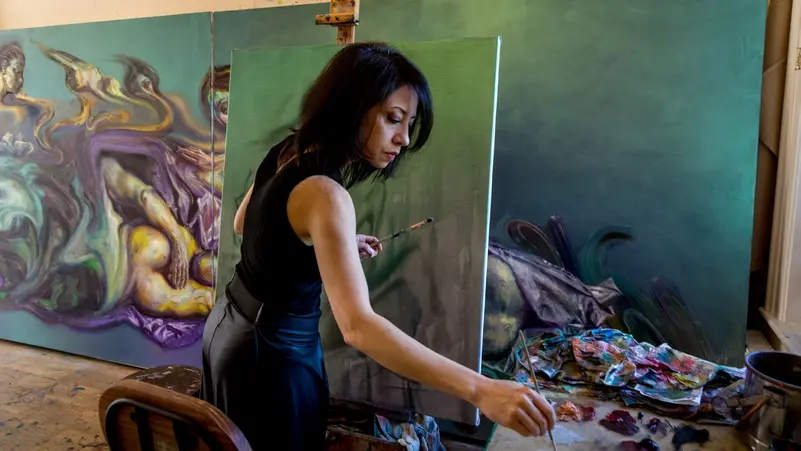
Sara Shamma is shaped by the Syrian conflict. Working from life and photographic references, she uses oil paint to achieve hyper-realism, incorporating transparent lines and movement to convey distance and an expansive emptiness. (Supplied)
_____________
SYRIA / U.K.