Arabs & Arabian Records Aggregator. Chronicler. Milestones of the 25 Countries of the Arabic Speaking World (official / co-official). AGCC. MENA. Global. Ist's to Top 10's. Records. Read & Enjoy./ www.arabianrecords.org
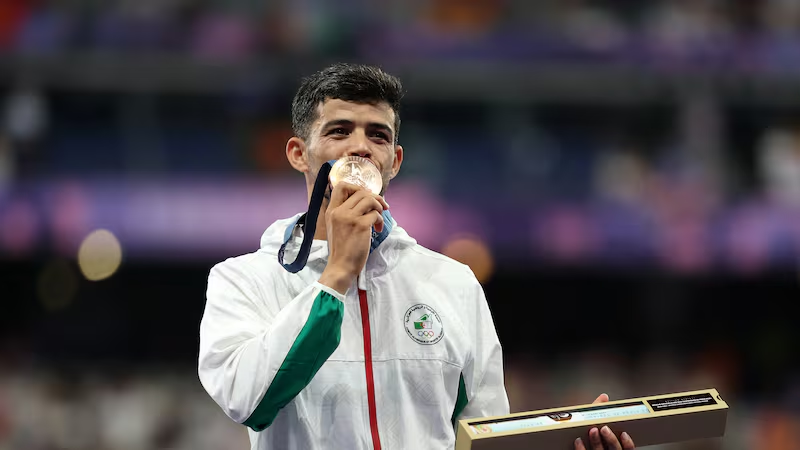
Runner clinches third place and joins gold medallists Kelif and Nemour.
Djamel Sedjati won a bronze medal in the 800m final in Paris on Saturday to help Algeria to achieve their most successful Olympic Games.
He joins gold medal winners Kaylia Neymour and Imane Khelif on the podium at these Games.
Pre-race favourite Sedjati was beaten by Kenya’s Emmanuel Wanyonyi and world champion Marco Arop of Canada at the Stade de France on Saturday night.
Wanyonyi clocked a personal best of 1 min 41.19 secs, with Arop taking silver just one-hundredth of a second behind in a North American record. Sedjati finished in 1:41.50.
After the race, Wanyonyi, 20, said: “This race was tough for me. I felt more pressure because I knew it’s not easy. Sedjati is not easy (to beat), he’s a tough guy.”
Sedjati said: “I won the bronze medal, but I wanted the gold medal.
“It was a very fast race. I didn’t start very well, but I’m very happy with the medal after the medals from Kaylia Nemour in gymnastics and Imane Khelif in boxing.
“I’m very proud to bring home the third medal for Algeria. It’s one of the fastest Olympic finals in history, with four runners on 1:41. I already did my maximum to ensure I got on the podium. I’m happy with this bronze medal.”
Boxer Khelif defeated China’ Yang Liu to win the final of the women’s 66kg division to take gold on Friday night.
The 25-year-old, who has seen her campaign in Paris overshadowed by a gender controversy, defied her critics as she comprehensively outboxed Yang to earn a richly deserved unanimous decision in front of thousands of noisy Algerian fans at Roland Garros.
Khelif, who only started boxing eight years ago, scored again and again with her jab and backed it up with her signature straight right hand as she swept all three rounds 5-0 for the biggest win of her career.
“I’m very happy. For eight years this has been my dream and I’m now the Olympic champion and gold medallist,” said Khelif. “I’ve worked for eight years, no sleep, eight years tired. Now I’m Olympic champion.
“I want to thank all the people who have come to support me. All the people from Algeria and all the people at my base. I want to thank all the team, my coach. Thank you so much.”
Nemour produced “the performance of her life” to become the first Algerian and African to win an Olympic gymnastics medal with gold on the uneven bars on Sunday.
The 17-year-old took the title ahead of China’s Qiu Qiyuan, with American Sunisa Lee snatching bronze with the final performance of the session. Defending champion Nina Derwael of Belgium finished fourth.
“I’m so shocked, it’s the dream of all my life. I can’t believe it has happened, I’m speechless,” said Nemour.
Morocco’s Mohamed Tindouflt finished in 12th place.
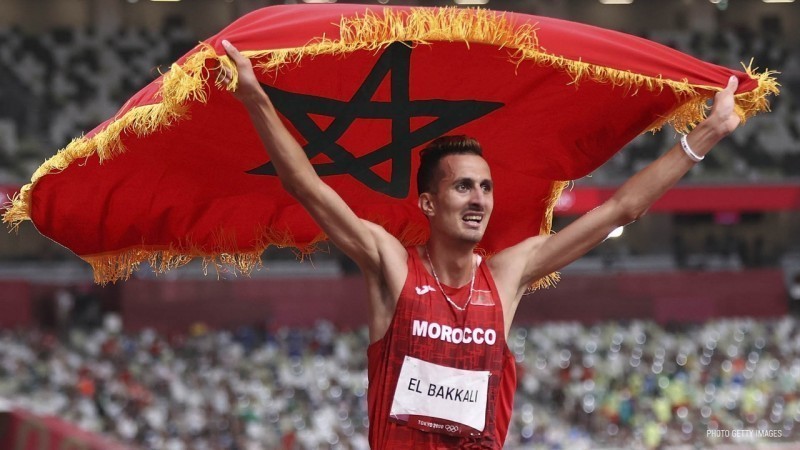
In a spectacular finale at the Paris 2024 Olympics, Moroccan runner Soufiane El Bakkali delivered an unsurprising and outstanding performance, securing the gold in the men’s 3,000m steeplechase.
El Bakkali crossed the finish line first with a time of 8:06:05.
El Bakkali demonstrated remarkable resilience during the race, initially starting in fifth and fourth positions.
Despite the challenging beginning, the Moroccan runner advanced through the field.
Throughout the rounds, Ethiopian runners dominated the competition.
El Bakkali however moved between third and fourth positions and also faced other challenges that saw him in seventh position, but he surged forward in the final minutes to do what he has always done for the past years.
Meanwhile, Mohamed Tindouft finished in 12th place. But the Moroccan representative did also show positive signs and was able to lead the race in the last minutes.
The second position was clinched by the US runner, Kenneth Rooks with a time of 8:06:41. Kenya’s Kibiwot was fourth and was followed by Tunisia’s Jhinaoui.
Soufiane Bakkali’s historic podium finish has brought immense pride and celebration to Morocco, marking a significant achievement after several heartbreaking defeats and early exits by Moroccan representatives at the Paris Olympics.
El Bakkali won two gold medals at the World Athletics Championships, triumphing in both 2022 and 2023.
His long list of achievements includes a third-place finish at the 2019 African Games and a second-place finish at the 2018 African Championships.
At the 2020 Tokyo Olympics, El Bakkali secured gold in his specialty event with a time of 8:08.90, finishing ahead of Ethiopia’s Girma and Kenya’s Benjamin Kigen.
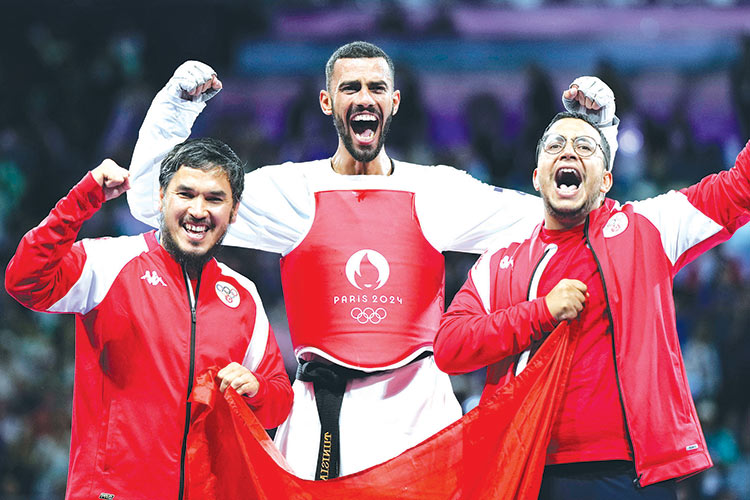
Firas Katoussi of Tunisia created history as he defeated Iranian fighter Mehran Barkhordari, who upset Alessio in the quarterfinals, to claim the gold medal in the 80kg category of Taekwondo at the Paris Olympics.
In a cagey first round, the taller Katoussi did a very good job at thwarting Nickolas’ attacks and won it by a judge decision. Nickolas took all the risks in the second round, but Katoussi landed a body kick with only two seconds left that sealed his victory.
Nickolas began his tournament against Farzad Mansouri — an athlete from Afghanistan who competes for the Refugee Olympic Team.
Nickolas looked pumped as he entered the venue. He shouted and made a few dance moves, then threw himself into the fight.
On the eve of his taekwondo competition at the Paris Olympics, after slumbering for two weeks on a cardboard bed at the athletes village, Nickolas made sure he would sleep like a baby.
He booked a room in a hotel near the Grand Palais, the lavish building where taekwondo events are held.
“I slept on these cardboard beds, and then last night I had one of the best sleeps of my life,” Nickolas said.
The improved bedding did not have the desired effect. The 23-year-old Nickolas looked well-rested and started his journey on a high-octane pace but lost in the semifinals of the 80-kilogram tournament. Nickolas was then defeated by world champion Simone Alessio in a bronze-medal contest.
The US team did not end the day empty-handed, though. Teammate Kristina Teachout, who was beaten in the quarterfinals of the women’s 67-kilogram division, recovered in style to win a bronze medal after going through a repechage phase.
“I’ll probably cry about it later, but I’m so grateful,” Teachout said. “This is the culmination of everything that’s important to me and all that I’ve put into my craft.”
The 18-year-old Teachout grabbed a US flag and celebrated her medal by running around the octagonal-shaped combat area, warmly embracing her coach.
Teachout had defeated Anastasija Zolotic – the first US woman to win a gold medal in the sport in Tokyo – at the US Olympic trials.
Like Nickolas, Alessio failed to reach the final. He was given a second chance through repechage and set up a meeting with Nickolas that pitted the top two ranked athletes in the category against each other.
Nickolas, who lost to Alessio in the final at last year’s world championships, harassed his rival from the start with relentless attacking moves but could not find his target. Alessio was clinical. The Italian landed two kicks in each round and that was again to once again deny Nickolas.
“He’s a monster in the division and other people have gotten him and I just haven’t clicked that code yet,” said Nickolas, who started taekwondo when he was 3. “I’ve failed. And that’s what happened and it hurts.”
Teachout started her day with a bang in the women’s 67-kilogram event by taking out world champion Magda Wiet-Henin of France. But the 18-year-old from Palm Bay, Florida, then lost a tight encounter with Viviana Marton of Hungary,
She then beat Ruth Gbagbi of Ivory Coast in repechage and fought Song Jie of China for bronze. Song was conservative but Teachout seized all of her few opportunities in the first round and continued to apply a relentless pressure to win in two rounds.
“I’ve always had the harder route in sports,” said Teachout, who was slowed by a hamstring injury in her first year. “And even getting (this bronze). It wasn’t the best, it was the hardest route to get a medal. Having to go through the motions of losing and, you know, get it back together and fight. So yeah, it’s been an emotional journey.”
Agencies
source/content: gulftoday.ae (headline edited)
__________
Tunisia’s Firas Katoussi (centre) celebrates with his coaches after winning the gold medal in the men’s 80kg Taekwondo final match. Associated Press
Noor Slaoui, a 29-year-old Moroccan, has become the first Arab female equestrian to represent Africa and the Middle East after qualifying for the Paris 2024 Olympics, it was announced on Wednesday.
The professional rider has officially qualified for the Olympics, becoming one of two representatives from Africa and the Middle East, a media statement said.
Slaoui’s journey to this prestigious event marks a significant milestone in her career and for the region’s equestrian sports.
The 29-year-old is dedicated to promoting the development of equestrian sports in the MENA region, with the aim of inspiring greater representation in the coming years.
“I am honored and excited to represent my region at the Paris 2024 Olympics. This journey has been a testament to the dedication and support of my team and the incredible bond with my horses,” she said.
Slaoui said that she looked forward to challenging herself and showcasing the talent from the MENA region on the Olympic stage. “While medals are a goal, my focus is on building a strong foundation for success in the years to come,” she said.
Her passion for horses began in childhood while exploring Morocco’s landscape on horseback. This early love of animals and nature evolved into a dream of making a career of her equestrian interests.
After attaining her baccalaureate at 18, Slaoui took a gap year and moved to France. She earned her riding instructor certification at the National Riding School in Saumur, setting her on the path to equestrian sports and competition.
Later, she moved to the UK to pursue her journey and studied political science at the University of Warwick. It was during that time that when she discovered eventing, often described as the “triathlon of equestrian sports.”
Working with professional riders to refine her skills, the Moroccan managed to balance her practical experience and academic studies.
After meeting her coach and business partner, Deborah Fellous, on graduation they launched her professional riding career, representing group F — “Africa & Middle East” — on the international stage.
Currently, they manage a professional yard in England, home to 17 horses, dedicated to breeding, training and preparing them for top-tier competitions.
Over the past seven years, Slaoui has achieved several notable milestones, becoming the first Moroccan female rider to compete internationally in eventing, and representing the MENA region at the World Championships for Young Horses in 2022 and 2023.
She also participated in Nations Cup events and secured top 10 finishes in 4-star competitions.
source/content: arabnews.com (headline edited)
__________
Noor Slaoui, a 29-year-old Moroccan, has become the first Arab female equestrian to represent Africa and the Middle East after qualifying for the Paris 2024 Olympics. (Supplied)
Khelif defeated Anna Luca Hamori of Hungary 5:0 in the quarterfinals of the women’s 66-kilogram bout
She will win at least a bronze medal after defeating Hamori for the second victory of her tumultuous second trip to the Olympics
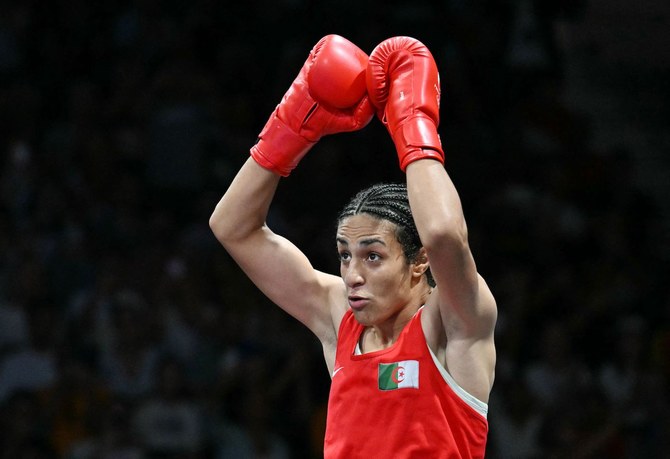
Boxer Imane Khelif of Algeria clinched a medal Saturday at the Paris Olympics following days of sharp scrutiny and online abuse as misconceptions about her gender have exploded into a larger clash about identity in sports.
Khelif defeated Anna Luca Hamori of Hungary 5:0 in the quarterfinals of the women’s 66-kilogram bout.
Khelif will win at least a bronze medal after defeating Hamori for the second victory of her tumultuous second trip to the Olympics.
Khelif was faced international scrutiny after the banned International Boxing Association claimed Khelif failed an unspecified eligibility test for women’s competition last year. She then won her opening bout Thursday when opponent Angela Carini of Italy tearfully abandoned the fight after just 46 seconds.
The unusual ending became a sharp wedge to drive into an already prominent divide over gender identity and regulations in sports, drawing comments from the likes of former US President Donald Trump, “Harry Potter” writer J.K. Rowling and others falsely claiming Khelif was a man or transgender.
At a Paris Games that has championed inclusion and seen other outcry over an opening ceremony performance featuring drag queens, LGBTQ+ groups say the hateful comments could pose dangers to their community and female athletes. IOC President Thomas Bach on Saturday defended Khelif and fellow boxer Lin Yu-ting of Taiwan. Khelif and Lin were disqualified in the middle of last year’s world championships by the International Boxing Association, the now-banned former governing body of Olympic boxing, after what it claimed were failed eligibility tests for the women’s competition.
Both had competed in IBA events for several years without problems, and the Russian-dominated body — which has faced years of clashes with the IOC over judging scandals, leadership decisions and financial issues — has refused to provide any information about the tests, underscoring its lack of transparency in nearly every aspect of its dealings, particularly in recent years.
“Let’s be very clear here: We are talking about women’s boxing,” Bach said Saturday. “We have two boxers who are born as a woman, who have been raised a woman, who have a passport as a woman, and who have competed for many years as women. And this is the clear definition of a woman. There was never any doubt about them being a woman.”
The IBA, which received the unprecedented punishment of being banned from Olympic participation in 2019 following years of conflict with the IOC, disqualified Khelif last year for what it said were elevated levels of testosterone.
The IBA, which is led by an acquaintance of Russian President Vladimir Putin, has not released more details on the tests, calling the process confidential.
“What we see now is that some want to own the definition of who is a woman,” Bach added. “And there I can only invite them to come up with a scientific-based new definition of who is a woman, and how can somebody being born, raised, competed and having a passport as a woman cannot be considered a woman?
“If they are coming up with something, we are ready to listen,” Bach added. “We are ready to look into it, but we will not take part in a sometimes politically motivated cultural war.”
Khelif will clinch at least a bronze medal in her second Olympics after failing to medal at the Tokyo Games held in 2021.
Khelif will face Janjaem Suwannapheng of Thailand in the 66-kg semifinals on Tuesday at Roland Garros. Suwannpheng, a silver medalist at last year’s world championships, upset defending Olympic champion Busenaz Surmeneli a few minutes before Khelif’s victory.
Lin, also a two-time Olympian, will clinch her first medal Sunday if she beats Svetlana Staneva of Bulgaria. Lin won her opening bout Friday comfortably over Uzbekistan’s Sitora Turdibekova.
Amid the scrutiny, both Khelif and Lin have received only cheers from the crowds at North Paris Arena.
“What is going on in this context in the social media, with all this hate speech, with all this aggression and abuse, and fueled by this agenda, is totally unacceptable,” Bach said.
The reduced field at the Paris Olympics boxing tournament — which has the fewest number of total boxers since 1956 — means that many fighters can clinch medals with just two victories. Boxing awards two bronze medals in each weight class, which means every semifinalist wins a medal.
The Olympic sport reached gender parity for the first time in Paris, inviting 124 men and 124 women just 12 years after women’s boxing made its Olympic debut.
source/content: arabnews.com (headline edited)
_________
Algeria’s Imane Khelif reacts prior the match against Hungary’s Anna Luca Hamori in the women’s 66kg quarter-final boxing match during the Paris 2024 Olympic Games at the North Paris Arena, in Villepinte on August 3, 2024. (Photo by MOHD RASFAN / AFP)
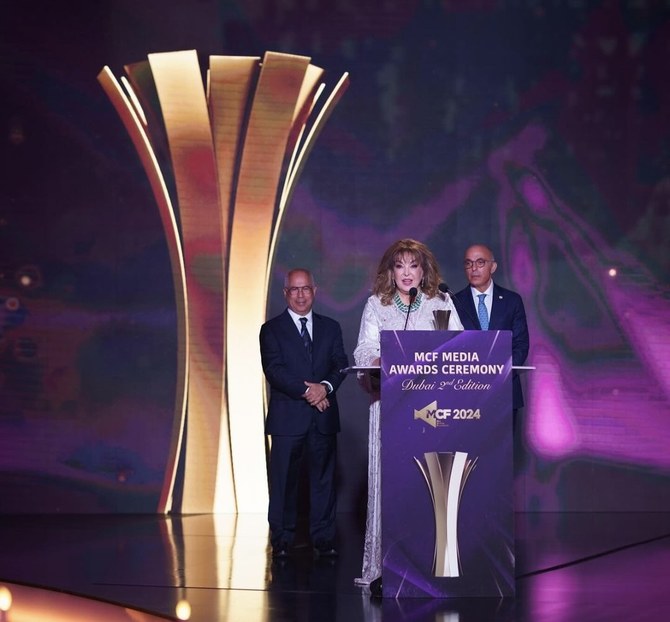
The MCF Awards ceremony was held on in Dubai, UAE, for the second year
Mamdouh Al-Muhaini, general manager of Al Arabiya and Al Hadath, received the Excellence in the Media Industry Award
Acclaimed international journalist and broadcaster Baria Alamuddin was celebrated at the May Chidiac Foundation Media Awards for her valuable contributions to the Arab world’s media industry.
Alamuddin, an Arab News columnist, editor of the Media Services Syndicate and former foreign editor of Al-Hayat newspaper, accepted the Antoine Choueiri Special Tribute for Lifetime Achievement during Tuesday’s ceremony.
Presenting the accolade were Pierre Choueiri, CEO and chairman of the leading media representation group in the Middle East, Choueiri Group, and Lebanon’s ambassador to the UAE, Fouad Chehab Dandan.
The annual MCF Awards, hosted by Dubai for the second year in a row, recognized the contributions of several other prominent figures in the Arab media industry.
Awards were presented by MCF President May Chidiac and other notable media personalities, including Lebanese journalist and writer Samir Atallah, CEO of International Media Investments and former CNN Commercial Worldwide president Rani Raad, and Beirut Institute founder and executive chairman Raghida Dergham.
Mamdouh Al-Muhaini, general manager of Al Arabiya and Al Hadath, accepted the Excellence in the Media Industry Award.
The Excellence in Media Award went to Nadim Koteich, general manager of Sky News Arabia, International Media Investments, to recognize his commitment to excellence and his impact on the media landscape over the past two decades.
Palestinian journalist Heba Akila, best known for her coverage of the Israeli onslaught on the Gaza Strip, was recognized for her Courage in Journalism.
Anas Bukhash, entrepreneur and podcast presenter of ABTalks, accepted the Content Development Award from award-winning international journalist Hadley Gamble and Bahraini business pioneer Akram Miknas, who heads Promoseven Holdings.
Award-winning investigative journalist and television host at France 2, Elise Lucet, received the Engaged Journalist Award, presented by Nobel laureate Ouidad Bouchamaoui and Lebanese Member of Parliament Ghassan Hasbani.
The Outstanding Media Performance Award was presented to American journalist and war reporter Ben Wedeman, CNN’s Beirut-based senior international correspondent.
Founded by journalist and former Lebanese Minister for Administrative Development May Chidiac, the foundation is a not-for-profit organization dedicated to research and development in the fields of media, international affairs, women’s rights, democracy and social welfare, among others, with the aim of establishing Lebanon as a proactive player in the Middle East and global economy.
source/content: arabnews.com (headline edited)
_____________
Alamuddin received the Antoine Choueiri Special Tribute for Lifetime Achievement at the MCF Awards ceremony in Dubai. (MCF/Instagram)
The story of the company, which owns the catalog of the legendary singer Umm Kulthum, mirrors Egypt’s complex and troubled past.
Nestled at the heart of Egypt’s bustling capital lies a vibrant and enchanting district known as Wust el-Balad — in English, downtown Cairo. Suffused with a symphony of artistic expression and architectural marvels, its streets weave a splendid historical tapestry, seamlessly blending influences from various epochs. With each step, one can witness a captivating fusion of Islamic, European and Art Deco styles, monuments to the city’s diverse past.
Venturing deeper into the labyrinthine alleyways, one discovers hidden art studios, artisan workshops and sidewalk cafes, where the lingering aroma of fresh-brewed coffee welcomes writers and thinkers to gather, exchange ideas and fuel their creative endeavors. Even the residential streets, like Champollion Street, are alive with the hum of car mechanics, bakeries and miscellaneous workshops, interspersed with essential eateries such as the renowned Abou Tarek koshary joint.
Yet tucked away discreetly on a serene side street at the end of Champollion Street lies a hidden gem: Sawt el-Qahira (literally “the sound of Cairo,” self-identified in Latin characters as SonoCairo), a retail store belonging to the state-owned Egyptian record label that emerged as the most prominent music label in the Arab world from the 1960s to the 1980s, which has become a testament to the city’s forgotten cultural heritage.
The entrance to the store is unmistakable, adorned with a bright blue banner proudly displaying the iconic Sawt el-Qahira logo. Flanking the entrance are captivating photographs of Egypt’s legendary musicians, with the illustrious figure of Umm Kulthum, also known as Kawkab el-Sharq (Star of the East), taking center stage. As one steps inside, the store reveals a modest collection primarily dedicated to Umm Kulthum’s timeless music. Amid the shelves are CDs, DVDs, cassette tapes and a select few remastered vinyl records. While Umm Kulthum shines as the most prominent figure, the quaint space also pays homage to other luminaries from Egypt’s golden age of art and culture, including Mohammed Abdel Wahab, Abdel Halim Hafez, Sayed Darwish and many more.
But the relentless march of time has left its mark on Sawt el-Qahira. The store exudes an air of neglect, as if lost under shifting tides. Even though Sawt el-Qahira was the first Arab-owned record label in the Middle East and played a crucial role in empowering local artists and spreading Egyptian music across the Arab world, the once-vibrant space marks the absence of its storied past. Now all that remains are forlorn products of nostalgia, their presence veiled beneath a thin layer of dust. So how was it that Sawt el-Qahira managed to fade out of history? The story of the company’s troubled history and slow demise interweaves with that of the warring political agendas that transformed Egypt.
It begins in July 1952, when a group of Egyptian army officers known as “al-dubbat al-ahrar” — the Free Officers — removed King Farouk from power, with popular support from the masses. The coup d’etat, led by Gamal Abdel Nasser, ushered in a period of profound sociopolitical and economic change that included agrarian reforms, massive urbanization and an unprecedented industrialization drive that transformed Egypt from a colonized kingdom into a modern republic.
The new revolutionary government embraced an anti-imperialist agenda, which manifested through Arab nationalism and international nonalignment. In 1954, Nasser became prime minister of the new republic, and quickly began nationalizing key industries, starting with the British- and French-owned Suez Canal Company in 1956. By October 1961, Nasser had embarked on a major nationalization campaign that targeted, among other things, foreign-owned businesses, foreign trade, banking and large-scale industry. Among the lesser-known victims of Nasser’s nationalization drive was Egypt’s private sector record manufacturing company.
During the early to mid-1950s (the precise date is difficult to confirm, due to discrepancies) the Egyptian singer-songwriter Mohamed Fawzi founded Misrphon, a music production company intended to support his musical film work. At the time, Fawzi was one of the country’s seminal composers, having worked with such eminent singers as Shadia, Sabah and Leila Mourad. He was celebrated for the originality of his music, as well as his role in developing a modern Egyptian musical style. Fawzi was both prolific and patriotic, having produced Egyptian and Arab nationalist music (including a liberation song for Algeria that became that country’s national anthem following independence). His nationalism was even apparent in his choice of the name Misrphon — “Misr” is Arabic for Egypt, making his chosen name, effectively, the “sound of Egypt.”
At the time, there were very few music production facilities in Egypt, especially ones that were Egyptian-owned. Records were pressed in Europe before being imported to Egypt, an economically taxing process that increased shipping costs and raised retail prices significantly. Fawzi sought to eliminate this inequality in music production by building a modern, Arab-owned record factory in Egypt — the first of its kind in the Arab world and Africa. Fawzi then lured Egypt’s leading singers of the day to record at his facility by appealing to their nationalism and offering artists a share of royalties rather than a lump-sum payment. He managed to sign a number of important artists, including Shadia, Sabah and, most importantly, Umm Kulthum. By 1959, Fawzi had expanded his company to include a state-of-the-art recording studio and a retail outlet. He also rented his studios and factory to other music recording companies in the Arab world.
By 1960, Misrphon had begun to turn a profit. Adverts for the music production company were regularly published in magazines and periodicals, alerting readers that “Misrphon presents the most famous female and male singers performing their latest songs.” Fawzi had achieved his dream. He had established the Arab world’s first record factory and had brought the country’s top stars into his vision for Egypt’s musical future. He had cemented his status as a visionary and, having secured his musical legacy, dedicated himself to the continued growth of his beloved company.
Unbeknownst to him, in a matter of months, he would become the latest victim of Nasser’s growing political ambitions.
In 1961, Nasser issued a wide array of socialist decrees in his attempt to transform Egypt’s socioeconomic structure. One of his measures was Law 117, which nationalized the remaining banks and large-scale industry. Another was Law 118, which allowed the Egyptian government to assume partnership in certain companies and foundations.
Philips Orient, a Dutch manufacturing company that owned 50% of Fawzi’s Misrphon, was among the entities targeted by the Egyptian government. After nationalizing Philips Orient, the Egyptian government placed Misrphon under the administrative supervision of the Egyptian General Institution for Theater and Music. Though Fawzi still held 50% of Misrphon shares and, on paper, the position of managing partner with full administrative control and liability, he had effectively lost control of Misrphon. Even his personal villa, which contained a recording studio, was seized by the government.
Fawzi was offered the position of artistic advisor to the (de facto state-owned) Misrphon, which came with a small office and a modest salary for his labors. Understandably, he chose to turn down the offer. He eventually sold his remaining shares for a pittance to Sawt el-Qahira, the state-run company founded on the ashes of Misrphon in 1964.
Robbed of his company and passion, Fawzi fell into a depression and died from a rare disease in 1966, aged 48. He had produced what would be his final composition eight months earlier, a patriotic song titled “Umm el-Balad” (“Mother of the Country”).
In the meantime, Sawt el-Qahira continued to grow. Under the supervision of the Ministry of Culture, it established a second manufacturing company and began constructing gramophones to sell at a modest price to boost record sales. The company also expanded its operations to include a wider range of cultural, educational and religious recordings.
In its takeover of Misrphon, the Egyptian government had retained a significant catalog of recorded music, as well as contracts with important artists. This cultural capital played a pivotal role in Nasser’s strategy of using soft power to further Arab nationalism. Recognizing that Sawt el-Qahira provided him with cultural as well as economic resources, the president used the likes of Umm Kulthum — who happened to be under contract with Misrphon — to galvanize support for his nationalist agenda. Sawt el-Qahira even worked in tandem with Egyptian state radio to export Egyptian music and culture across the Arab world, and Nasser often broadcast his political speeches following Umm Kulthum’s performances.
Umm Kulthum was especially important to Sawt el-Qahira. Her contract with Misrphon, which included exclusive rights to her earlier works, essentially gave the state monopolistic control of one of Egypt’s most important cultural assets. In 1964, the same year that the Egyptian state assumed full control of Misrphon and transformed it into Sawt el-Qahira, Umm Kulthum and her longtime rival and fellow sensation Mohammed Abdel Wahab collaborated to release “Enta Omry” (“You Are My Life”) — a seminal song that helped establish Sawt el-Qahira and distracted from Nasser’s political failings and growing totalitarian policies.
As a symbol of pan-Arabism and source of Egyptian pride, exclusivity over Umm Kulthum’s oeuvre would remain Sawt el-Qahira’s greatest achievement. It would also be the source of long-standing litigation regarding the rights to her work, even after Nasser himself left the political scene.
Nasser’s sudden passing in September 1970, at the age of 52, marked the beginning of a turbulent period in Egypt’s history. Following Nasser’s death, his vice president Anwar Sadat assumed the presidency and embarked on a path that diverged from Nasser’s ideology.
Sadat’s rise to power brought about a new era characterized by a series of transformative policies and reforms. One of the most notable changes came in 1971, when Sadat launched the Corrective Revolution, purging prominent figures associated with Nasser’s regime. This marked a shift in leadership and a departure from Nasser’s populist approach. However, it was Sadat’s “Infitah” (Open Door) policies that had the most far-reaching implications for Egypt. The Infitah aimed to liberalize the economy, attract foreign investment and encourage private enterprise. It marked a significant departure from the socialist policies pursued by Nasser, as Sadat sought to integrate Egypt into the global economy and foster economic growth.
The Infitah resulted in the relaxation of state control over various sectors, the privatization of some industries and the encouragement of foreign investment. However, it also resulted in devastating socioeconomic disparities that widened the already significant wealth gap. It also decimated social welfare, public education and the health care sector. By the late 1970s, even Sawt el-Qahira was facing the challenges of a new market.
In 1973, the state-controlled company began manufacturing cassettes to meet the growing demand for a more convenient, portable and cost-effective way of listening to music. While Sawt el-Qahira had maintained monopolistic control of Egypt’s vinyl market — and thus the music industry as a whole — for more than a decade, Sadat’s Infitah policies meant that privately owned cassette companies were beginning to emerge within Egypt, flooding the market with products outside state control. What resulted was a significant shift in Egypt’s music scene, with the state no longer dominating the country’s cultural output. Nevertheless, the Egyptian government attempted to exert control in other areas, mainly through influencing what was considered permissible music.
“Glossy photographs, accompanying the Ministry of Information’s history of Sawt al-Qahira, show Egyptian employees working diligently in the company’s state-of-the-art facilities in Alexandria,” writes Andrew Simon in his acclaimed book, “Media of the Masses: Cassette Culture in Modern Egypt.” He adds: “Women manage master recordings, while men handle packaging, the creation of cassette cases, and the printing of cassette sleeves and posters. If examined together, these images convey a clear message. Sawt al-Qahira’s cassette division shared nothing in common with the so-called ‘companies’ blasted by critics for producing ‘vulgar’ tapes. For one, the label was not limited to a single room or a sidewalk kiosk. It operated out of not one, but two, well-lit, technologically advanced factories.”
In 1977, the Egyptian government issued a decree renaming Sawt el-Qahira Record Company to Sawt el-Qahira for Audio and Visuals — a change that emphasized the company’s shifting priorities. Within a matter of years, Sawt el-Qahira would stop manufacturing records entirely.
Unable to compete against the onslaught of private labels and bootleg tapes, Sawt el-Qahira traded in golden-age nostalgia and religious recitations, which had risen in popularity as Islamic conservatism took hold in Egypt during the 1970s and ’80s. This trend continued following Sadat’s assassination at the hands of an Islamist fundamentalist army officer in 1981 and throughout his successor Hosni Mubarak’s tenure as president.
Today, Sawt el-Qahira’s religious catalog continues to enjoy a prominent place on the company’s official website — a catalog that includes Quranic recitations and the teachings of the controversial Muslim scholar Metwali el-Sharawi. The company also produces an array of religious television programming, including popular Ramadan shows such as “Muhammad: The Prophet of God.”
Sawt el-Qahira’s website does not appear to have been updated in several years. The most recent post available on the site, dated 2021, consists of a news release announcing a significant legal victory for the company. The announcement highlights that Cairo’s Economic Court ruled in favor of Sawt el-Qahira, affirming its exclusive rights to Umm Kulthum’s catalog. This ruling came as a result of a highly publicized lawsuit initiated by the family of the late star.
While Sawt el-Qahira no longer resembled the vision of its late founder, it continued to maintain an iron grip over one of the country’s most lucrative assets.
Shortly before the COVID-19 pandemic overwhelmed the world, Egypt hosted the 51st Cairo International Book Fair. Amid the bustling maze of stalls stood a modest booth adorned with the distinctive Sawt el-Qahira banner, and within this unassuming space a myriad of products lay on display: dusty cassettes, CDs and a collection of religious teachings. Among the array of relics sat a cheaply constructed gramophone equipped with built-in USB and Bluetooth connections.
When asked about the strange display by a journalist in attendance, a Sawt el-Qahira official revealed that the products were nostalgic and were meant to be viewed as “antiques.” He also stressed that once the company’s remaining stock of cassettes runs out, it is unlikely they will ever produce more, since the machines that manufacture them no longer work.
While Sawt el-Qahira hoped to capitalize on its latest attempt at nostalgic marketing, its participation in the book fair ended up showcasing the hollowed remains of a decayed industrial giant.
As the vinyl spins and the echoes of history reverberate through the grooves, Sawt el-Qahira is a musical map of Egypt’s complex and troubled past. Founded by a visionary artist, the record label’s journey has been a reflection of the nation’s trajectory over the past few decades. From its roots as a passion project empowering Egyptian musicians, through its evolution into a tool for propaganda under state control, to its current role as a peddler of nostalgia and religious teachings, Sawt el-Qahira stands as a vivid reflection of the country’s leaders over the second half of the 20th century and the visions that each had for Egypt: a culturally and politically independent state, a socialist republic, a modern player on the international field. And now, perhaps, Sawt el-Qahira mirrors the Egyptian government: a military dictatorship that relies on a bygone era of Egyptian culture to legitimize its rule, while actively repressing expression and activities that lead to cultural production.
source/content: newlinesmag.com (headline edited) / Karim Zidan
_________
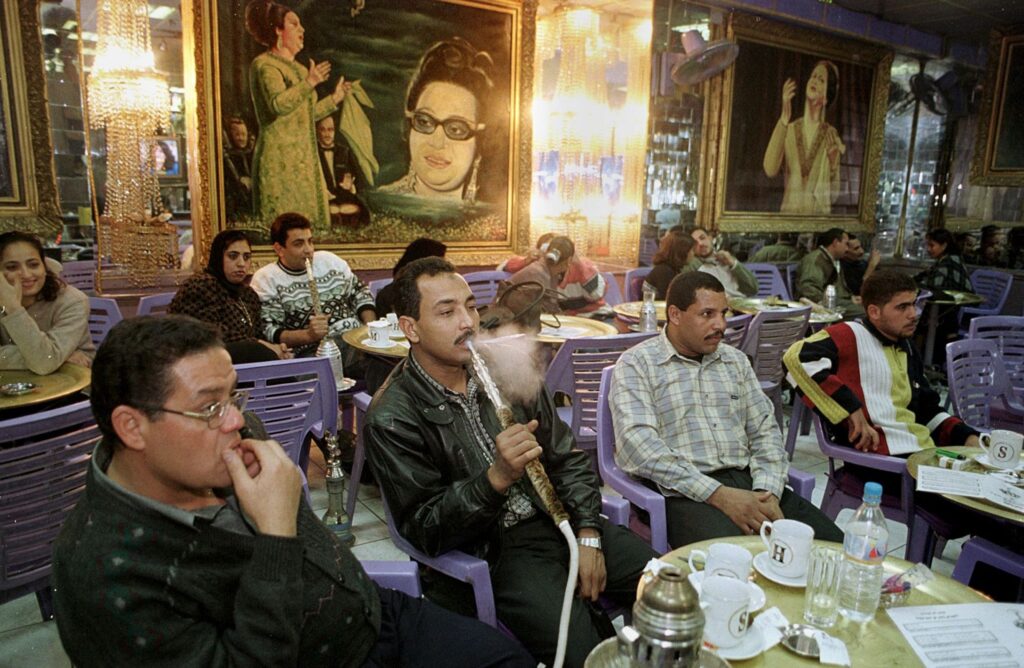
Egyptians watch the last episode of an Egyptian series on the life of the Arab world’s most famous singer Um Kalthoum 15 January at a coffee shop that bears the name “Kawkab al-Sharq,” one of many nicknames of the legendary Egyptian diva. Television stations across the Middle East have been broadcasting the series “Um Kalthoum,” sending sales of her songs soaring 25 years after her death. (Photo by MOHAMMED AL-SEHITI / AFP) (Photo by MOHAMMED AL-SEHITI/AFP via Getty Images)
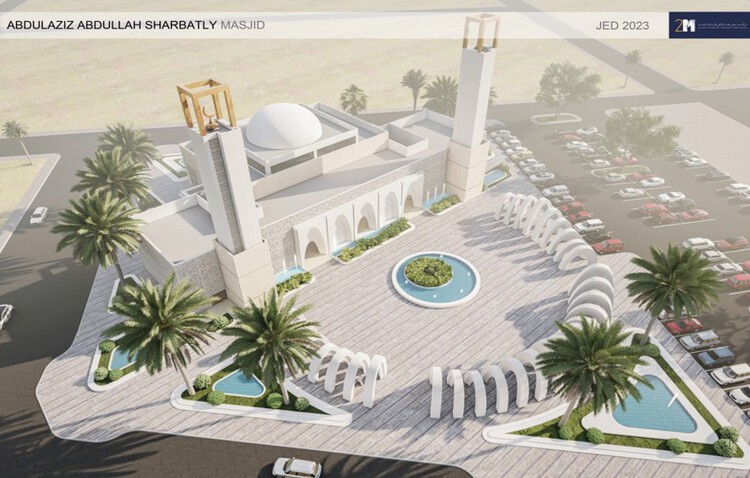
The Kingdom of Saudi Arabia is now home to the world’s first 3-D-printed mosque, spanning an area of 5,600 sqm. Located within the Al-Jawhara suburb of Jeddah, the mosque stands as a tribute to the late equestrian Abdulaziz Abdullah Sharbatly. The project by Forsan Real Estate utilizes cutting-edge 3D printing technology from Guanli.
The mosque’s construction was completed within six months and spearheaded by Wajnat Abdulwahed, the spouse of the late Abdulaziz Abdullah Sharbatly. Aimed at fostering serenity amongst worshipers while integrating natural light, the mosque also features distinctive minarets, creating a landmark within the neighborhood.
The inauguration of the mosque positions Saudi Arabia as a technological hub, surpassing the United Arab Emirates’ projected timeline for a similar endeavor. Dubai announced an initiative to construct the world’s first 3D-printed mosque last May. As a new and complex technique, the successful completion of the world’s 3D-printed religious infrastructure holds potential for the future of architecture and design.
The project has garnered global attention, showcasing the limitless possibilities of 3D printing technology in construction. In an interview with Arab News, Abdulwahed stressed the importance of “not losing the essence that mosques must embody, while also adhering to general conditions such as emphasizing the values of the King Salman Urban charter, the architectural details in the cultural heritage of Hejazi architecture and presenting them in a contemporary format.”
Iraqi American Zenovia Jafar was over the moon for “having made it” as she was crowned winner of the Miss Arab USA 2024 pageant in Arizona on Sunday.
“My experience with Miss Arab USA is one of the best experiences of my life. When I walked in, I had no idea what was going to happen, if I was even going to win. But most importantly, when I walked in, I will honestly say that winning was the only thing on my mind. I didn’t think about anything else,” Jafar told Arab News in an interview.
“But once I actually got there, I realized the friendships and the connections I’ve made with the people here is priceless and it is far more important than winning … I genuinely wanted to connect with every single person that I met, and I think that’s what helped me win Miss Arab USA. Because I focused more on genuine connection and doing what I need to do. And I was committed to just being myself,” she added.
When asked about her goals going forward, the Michigan resident said: “I’m going to be using my platform to raise awareness on issues regarding people who are … from underdeveloped communities, people who are in need. I’m going to be raising more money for charities. I’m here to serve Miss Arab USA and use my voice to amplify the voices of people who are not heard all over the world.”
Jafar’s family moved to the US — having escaped the war in Iraq and spent two years in Syria after — in the late 90s, when she was a toddler.
“When I moved here, I remember one thing that my mother told us is that we should never forget our roots and where we come from. My mother was committed to teaching us how to read and write and speak Arabic. And that is something that I am so grateful to my mother for because I can read Arabic, I can write Arabic, I can speak Arabic, I can understand many Arabic dialects. And I never let go of who I was and where my family came from. And I think that’s something that is so important when you grow up away from home, is to stay connected to who you are. Because at the end of the day, all you have is your roots,” she said.
When asked if she had any advice for young Arab American women, Jafar said: “I will say that as an Arab woman, it is very, very important to push your limits and always do things outside of your comfort zone because you will never grow as a person if you are stuck in your comfort zone. Always push yourself to be better.”
source/content: arabnews.com (headline edited)
________________
Iraqi American Zenovia Jafar (centre) was over the moon for “having made it” as she was crowned winner of the Miss Arab USA 2024 pageant in Arizona on Sunday. (Supplied)
Our research shows the impact Arab and Middle Eastern inventors have had on innovation in the U.S.
Although Donald Trump’s administration believes that “making America great again” involves limiting certain visitors and immigrants from entering the country, data shows that immigrants from the Middle East have consistently made innovative contributions to the United States. Examples range from GE inventor Hassan Kamel Al-Sabah, a Lebanese-born innovator in the 1920s and 30s to Farouk Al-Baz, the NASA and MIT scientist, originally from Egypt, who helped plan the Apollo landing, to Algerian-born Elias A. Zerhouni, director of the National Institutes of Health.
Immigrants from Muslim-majority countries have contributed to American ideals and icons. A Saudi and two Moroccans were part of the core team of scientists that recently discovered the seven planets around the star Trappist-1; Shahid Khan, a Pakistani-born entrepreneur, was on the cover of Forbes representing The American Dream in 2012; a Syrian immigrant is often credited with the invention of the ice cream cone, and famously, the child of another Syrian immigrant created the iPhone.
Despite these positive stories, there is little research on the extent of Arab inventors’ contributions to American innovation. So we set out to document it.
What’s in a name?
We started by matching Arabic first names with international patent applications filed under the Patent Cooperation Treaty (PCT) from people residing in the U.S. and around the world. This approach has been used before in the study of ethnic innovation in the U.S. as well as in the study of female inventors.
First names like Mohammad, Ali or Omar are not unique to Arabs and some Arabs may have non-Arabic names such as George or Anthony. We tried to mitigate this issue by excluding non-Arab variations of Arabic names that are common for non-Arab Muslims. Another shortcoming is that we are not able through names only to know whether someone is U.S.-born or foreign-born. This overlap between Muslim and Arab identity is not relevant because both are targeted in Trump’s immigration policy. For this piece, we’ll refer to both groups as Arab inventors.
We found that 8,786 U.S. PCT patent applications from 2009-2013 had at least one Arab or Muslim inventor. 3.4 percent of patent applications had at least one Arab or Muslim inventor from a population that represents only 0.3 percent of the total population of the U.S. As patents usually have multiple inventors and Arab inventors often co-patent with non-Arabs, 2961 patents or 1.2 percent can be contributed to only Arab inventors.
Where Arab inventors are found
In fact, the U.S. is the main home for Arab inventors globally, distantly followed by France (513 patent applications), Canada (361), Germany (342), Saudi Arabia (307), Japan (279) and the United Kingdom (273).
Not only is the U.S. the centre of Arab inventors, but since 2000, their share of patent applications has increased 137 percent. With 1134 in California alone, Arab or Muslim innovation is more than doubly represented in a single state than in France.
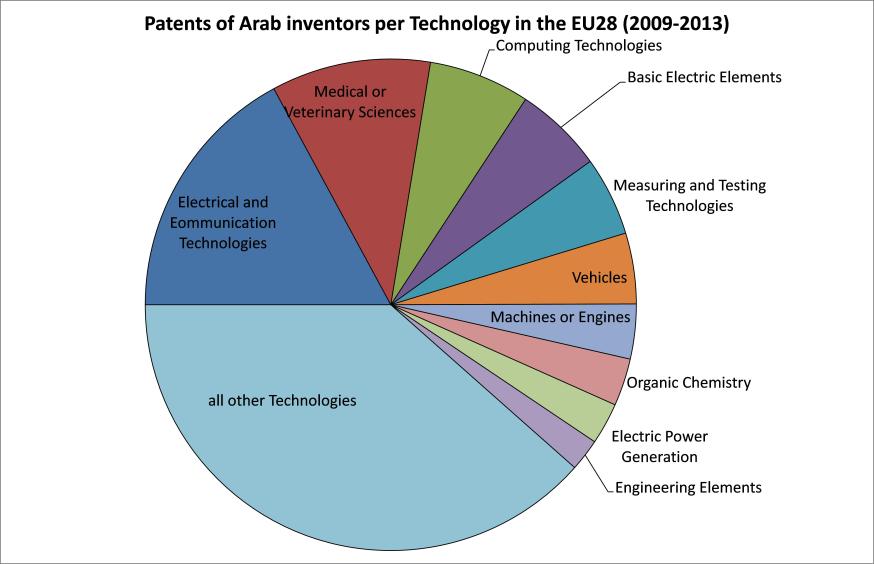
Arab inventors show some specialisation in the fields of information and communication technologies, as well as medical and veterinary sciences. They are statistically over-represented in electrical and communication technology, computing, calculating and counting.
America’s tech scenes in Silicon Valley, Boston and elsewhere show Arab inventors contributing significantly to America’s global innovation prowess. Tech entrepreneurs, such Amr Awadallah, co-founder of Cloudera, Rana El Kalioubi of Affectiva, and Mo Gawdat of Google, are a few examples of Arab inventors making major contributions.
Who comes to America
Looking at visa patterns, the bulk of Arab inventors settle in the U.S. through immigration channels such as family reunion and as refugees. This has an implication for the current immigration debate. In 2013, there were approximately 1.02 million immigrants from Arab countries residing in the U.S., representing 2.5 percent of the nation’s 41.3 million immigrants. About 43 percent of Arab immigrants (ages 25 and over) had a bachelor’s degree or higher, compared to 28 percent of all immigrants and 30 percent of native-born adults. Skilled Arab immigrants thus are arriving to the U.S. on non-skilled visas as people from MENA generally do not benefit from the H1-B visa, receiving collectively less than 10 percent of total visas granted to foreign-born skilled workers. While there were around 108,000 students from MENA in the U.S. in 2016, not many were PhD candidates at U.S. universities.
The recent visa ban of citizens from six countries from the Middle East and Africa has negative implications for the American innovation system. Not only do immigrants from these countries tend to be in possession of higher education levels than average population or other immigrant groups, research also points to positive impact on trade between sending and receiving countries. In fact, research suggests that highly skilled individuals in business development roles generate over ten times the value of trade than average migrants. Highly educated immigrants in general are also most conducive to trade flows. President Trump should examine the evidence about how “great” innovation in the U.S. can be, thanks to inventors from all over the world, before banning visitors from the Middle East and North Africa.