Arabs & Arabian Records Aggregator. Chronicler. Milestones of the 25 Countries of the Arabic Speaking World (official / co-official). AGCC. MENA. Global. Ist's to Top 10's. Records. Read & Enjoy./ www.arabianrecords.org
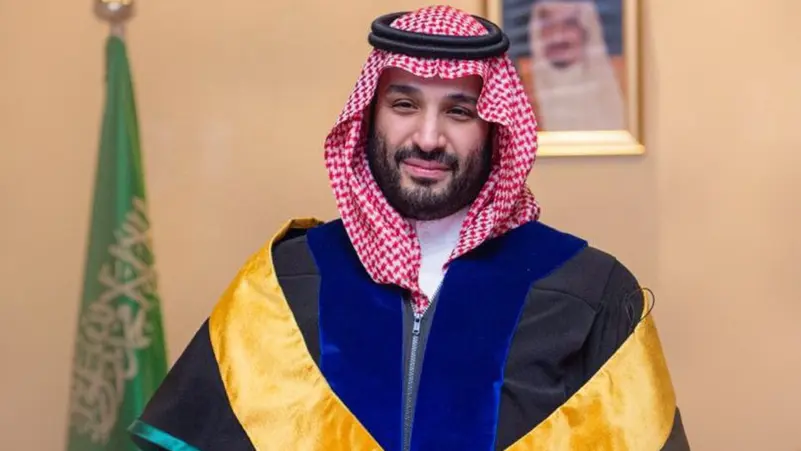
Saudi Arabia’s Crown Prince Mohammed bin Salman has been named the most influential Arab Leader of 2022 according to a poll conducted by Russia Today.
The Kingdom’s Crown Prince and Prime Minister won the online vote by a landslide with 62.3 percent voting in favor of the revolutionary leader. He earned 7,399,451 of the total 11,877,546 million votes, the international TV news network’s website said on Tuesday.
The percentage of votes received by Mohammed bin Salman reportedly breaks all previous records. It also makes it the second time in a row that the Saudi Crown Prince has won the RT vote-based title.
UAE President Sheikh Mohamed bin Zayed Al Nahyan came second on the list with 2,950,543 million votes, accounting for 24.8 percent of the total votes.
Egypt’s President Abdel Fattah el-Sisi came in third place with 1,387,497 million votes.
The Saudi leader has earned international reputation for spearheading a liberalization movement in the country while taking steps to attract diverse investment to reshape the oil-dependent economy.
He has been brandished as a women’s rights champion for various empowerment efforts including lifting a decades-old ban on women driving and easing guardianship rules.
All these changes tie into the passion project of the Saudi leader called Vision 2030, a multitude of reforms established by the Crown Prince to elevate the Kingdom past the 21st century.
source/content: english.alarabiya.net / Al-Arabiya English
____________
Saudi Arabia’s Crown Prince and Prime Minister Mohammed bin Salman. (Twitter)
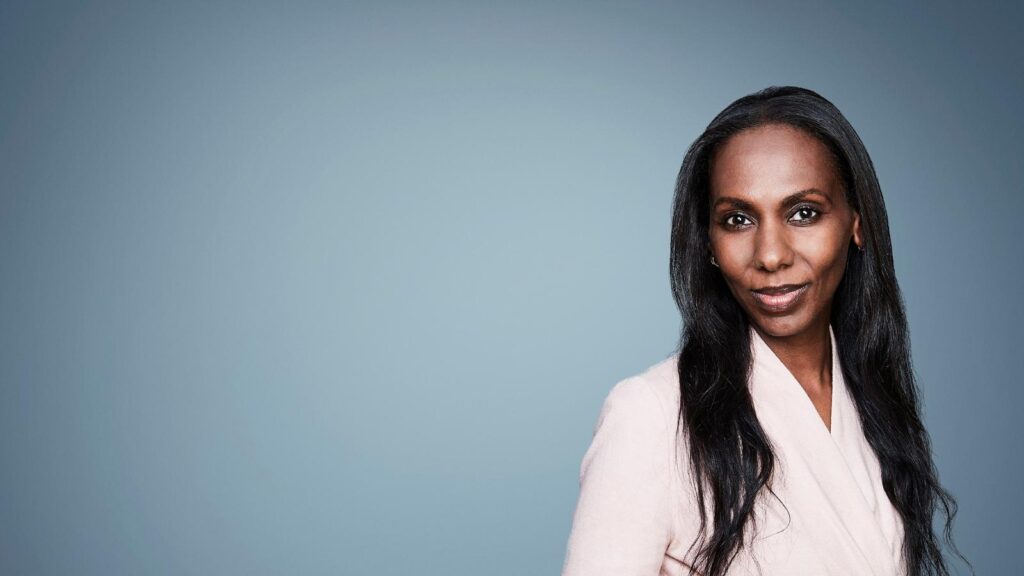
CNN has promoted senior international correspondent Nima Elbagir to the role of chief international investigative correspondent.
A London-based Sudanese journalist, Elbagir has broken countless stories for CNN from war and crisis zones, reporting on human rights abuses in places like Ethiopia’s Tigray region, Libya, Democratic Republic of the Congo, Nigeria and Yemen. In 2017, her undercover reporting exposed migrants being sold at slave auctions in Libya and prompted responses from the government and the United Nations.
Elbagir has scooped up numerous awards in her career, including the Royal Television Society’s Television Journalist of the Year Award in 2020, a duPoint Award, a Polk Award in 2017, the International Center for Journalists 2018 Excellence in International Reporting Award, the 2018 IWMF Courage in Journalism Award, a 2019 Gracie Award, and the LA Press Club’s 2019 Daniel Pearl Award.
Elbagir joined CNN in Feb. 2011 as a full-time reporter based at network’s Johannesburg bureau, before later moving to Nairobi, Kenya. Prior to joining CNN as a freelancer in 2010, Elbagir worked in various capacities for the UK’s Channel 4 for a number of years from 2005: she freelanced from Kabul, Afghanistan for Channel 4 News; reported for the Unreported World documentary strand; and both reported and presented for Channel 4 News and More4 News.
source/content: adweek.com/TVNewser/CNN-Revolving Door (headline edited)
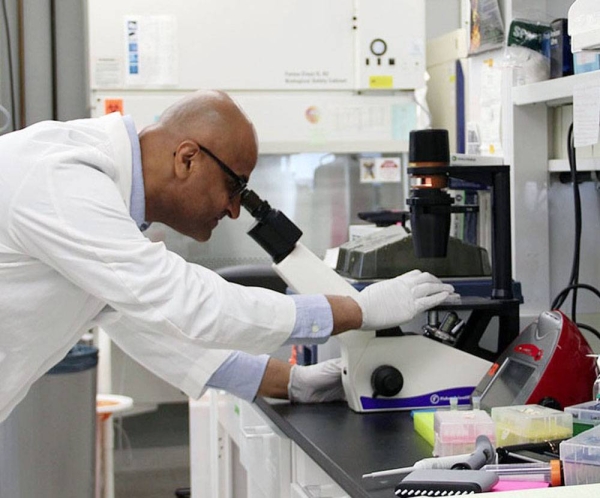
A team from the King Abdullah University of Science and Technology and Al-Hasa-based Palms and Dates Center has been awarded the 2022 International Date Palm Innovative Technology Excellence Prize.
Presented by the National Center for Palm and Dates, the award was made in recognition of the team’s fiber-optic distributed acoustic sensor, which is used in the early detection of red palm weevils in date palm trees.
Tackling infestations of red palm weevils has been a long-standing problem across the Middle East, Southeast Asia, Europe and other parts of the world.
The winning team comprised Dr. Islam Ashry, Dr. Chun Hong Kang and Prof. Boon S. Ooi from the KAUST Photonics Laboratory and Dr. Yousef Alfehaid and Eng. Abdulmonem Alshawaf from the PDC, which operates under the Ministry of Environment, Water and Agriculture.
HIGHLIGHTS
• Infestations of red palm weevils a major problem across the Middle East.
• Researchers from KAUST-PDC collect $53,000 in prize money.
As well as the prestige, the team collected SR200,000 ($53,000) in prize money. The award was announced at the 3rd International Dates Conference and Exhibition, which ran from Dec. 7-10 in Riyadh. Their design beat off the challenge of 65 other submissions for the prize.
Ashry said the team was honored to have won such a prestigious award and paid tribute to his colleagues at the Photonics Laboratory and the PDC who helped in the development, testing and deployment of the technology.
“This recognition motivates us to continue improving, optimizing and advancing this technology to a new level,” he said.
According to the NCPD, the event provided “a unique combination of scientific research and commercial strategy to exchange scientific knowledge and innovative technologies to enhance the safe production and commercialization of these extraordinary super-fruits.”
The Kingdom is home to some 33 million date palm trees, producing about 1 million tons of dates a year, or 20 percent of global production. In the Middle East region alone about $8 million is spent every year fighting infestations of weevils.
“Our RPW-detecting technology uses a fiber-optic distributed acoustic sensor,” Ashry said. “It is the first of its kind and offers a more scalable approach (than) other detection methods, such as microphone probe, computer-based tomography and visual inspection.”
Kang said the team’s system used fiber-optic cables wound around individual tree trunks.
“Acoustic signals generated by the weevil larvae inside a trunk can be picked up by the cable and transmitted back to an interrogator system,” he said.
“The collected signals are then analyzed and processed through a machine learning algorithm to identify each tree’s infestation status.”
Ashry and Kang are now working with various organizations within the Kingdom, including the PDC, MEWA, NEOM, the Royal Commission for AlUla and the Tabuk Agricultural Development Co., on the deployment of their technology.
These test applications will help to improve the sensitivity of the sensor systems so they can be used on large-scale farms.
“Our research efforts align well with … Saudi Vision 2030 in terms of diversifying the economy, especially for the date palm sector,” Ashry said.
Ooi said: “Our technology offers a unique and low-cost solution to protect the large number of date palm trees in the country through early infestation detection.”
source/content: arabnews.com (headline edited)
____________
(L to R): KAUST Research Scientist Dr. Islam Ashry and Prof. Boon S. Ooi receive the 2022 International Date Palm Innovative Technology Excellence Prize from the NCPD on behalf of their team. (Supplied)
Sharjah HQ of waste management operator Beeah aims to lay foundations for a greener future.
A striking Sharjah building in the shape of a sand dune is primed to be a beacon of sustainability and serve as a fitting legacy for renowned architect Zaha Hadid.
The headquarters of waste management operator Beeah was the last project designed by Zaha Hadid before her death in 2016.
Her team constructed a modern masterpiece across 9,000 square metres, using sustainable materials to create a building with 40 per cent of its power provided by the sun.
Illuminated, sweeping staircases take visitors up to an art gallery on the first floor, with screens showing a time-lapse video to explain the building’s five year construction.
Now open to full capacity of 500 workers, the building is breaking new ground in how to provide a sustainable working environment.
Green vision
“We aim to operate as sustainably as possible, and used recycled materials in the construction of the building,” said Nada Taryam, managing director of Beeah HQ, which manages waste management across the country.
“Native plants have been used in the landscaping and reduced the amount of water consumption.
“A power pack stores excess energy from the photovoltaic panels, so we have a holistic strategy to achieve sustainability.
“Every project has its own specific requirements when energy comes into play, but the basis on which we have built this design can be learnt from.
“All of these sustainability measures can be taken and applied to other projects.”
The building’s high thermal mass allows heat to be absorbed during the day and dissipated at night to encourage cooling, while its curved structure allows the flow of natural sunlight to reduce the energy required for lighting.
An artificial intelligence system enables the building near the Alsajaa industrial area to learn to become more efficient as more people use it.
Its developers say it conforms to the highest standards of energy efficiency in the world.
Windows are positioned to reduce solar glare, while special glass cuts radiant thermal energy to keep the building cooler during summer.
While the glass limits the entry of infrared and ultraviolet light, solar panels supported by Tesla-made battery packs capture the power of the sun and store it to run the building’s air conditioning system.
The building’s components and management systems are integrated to maintain and improve its efficiencies.
Conference rooms are equipped with technology to automatically transcribe meeting minutes and email them to participants.
The building is the third in the UAE to be designed by Zaha Hadid architects, following the Sheikh Zayed Bridge, opened in Abu Dhabi in 2010, and The Opus hotel and apartments complex opened in Business Bay, Dubai, in 2018.
“As it learns from its occupancy, this building could potentially become one of the most sustainable buildings in the UAE,” said Ms Taryam.
“Certain decisions were taken, such as using glass reinforced panels on the ceiling which refract the sunlight so contribute to its efficiency and temperature control.
Defying convention
“There is a misconception about what these kind of buildings should look like, and we have defied that.
“There isn’t a rule book to say green buildings should be lined with solar panels. We have proved we can integrate architecture as well as sustainability to create something iconic.
“Zaha Hadid has something that distinguishes her from any other architect of her time. Every project of hers has its own context, but her ideas are adapted for each specific project.”
The headquarters of Sharjah waste management operator Beeah was the last project designed by Iraqi architect Zaha Hadid before her death in 2016. All photos: Andrew Scott / The National
The official names for the new minerals are elaliite and elkinstantonite.
Canadian researchers said the rock was found in rural Somalia two years ago, but locals believe it is much older.
They call the stone Nightfall, and say it is documented in poems, songs and dances that stretch back five generations. It is used today to sharpen knives.
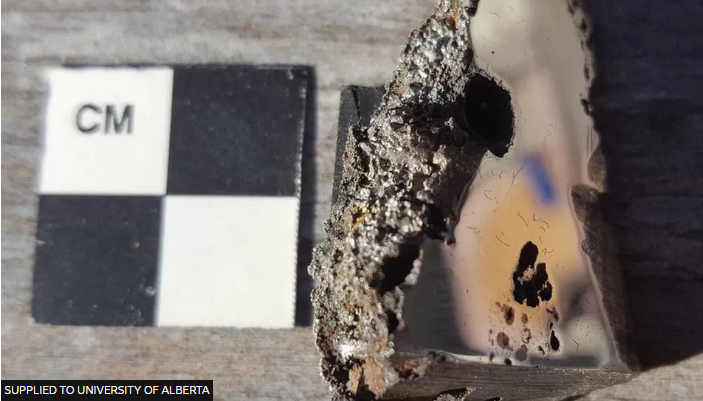
A huge meteorite that fell to Earth contains two minerals never seen before on our planet, scientists say.
Canadian researchers said the rock was found in rural Somalia two years ago, but locals believe it is much older.
They call the stone Nightfall, and say it is documented in poems, songs and dances that stretch back five generations. It is used today to sharpen knives.
The official names for the new minerals are elaliite and elkinstantonite.
They were identified by scientists at the University of Alberta who looked at a 70g fragment from the 15-tonne meteorite, which is said to be the ninth-biggest to reach our planet and is about 90% iron and nickel.
The name “elaliite” honours the fact that the meteorite was unearthed in the district of El Ali in Somalia, and “elkinstantonite” is named after Nasa expert Lindy Elkins-Tanton.
“Lindy has done a lot of work on how the cores of planets form, how these iron nickel cores form, and the closest analogue we have are iron meteorites. So it made sense to name a mineral after her and recognise her contributions to science,” said Prof Chris Herd who curates the University of Alberta’s meteorite collection.
A third, as-yet unidentified mineral, is being analysed by the university’s researchers who now hope to get their hands on more of the meteorite – not only to see what else they might discover, but also how it could be used on Earth.
“Whenever there’s a new material that’s known, material scientists are interested too because of the potential uses in a wide range of things in society,” Prof Herd said of the “exciting” research.
source/content: the-star.co.ke (Star) / BBC News, Africa (headline edited)
Egypt’s Suez Canal Authority (SCA) was named as the best Arab government institution in the second edition of the Arab Government Excellence Award.
SCA Chairman Osama Rabie received the award on Thursday during a ceremony held at the Arab League (AL) premises in Cairo to announce the winners of Arab Government Excellence Awards.
This Arab competition is organised under the auspices of Sheikh Mohammed bin Rashid, the ruler of Dubai and Prime Minister of the UAE.
The 72-kilometre-long Suez Canal – which connects the Mediterranean and the Red Seas – is the shortest maritime route between Asia and Europe and is the fastest crossing from the Atlantic Ocean to the Indian Ocean.
Around 12 percent of the world’s trade passes through the canal.
The world’s longest man-made canal without locks is one of Egypt’s main sources of foreign currency.
In 2022, the Suez Canal’s revenue hit a record $7.9 billion, up from $6.3 billion in the previous year.
The total number of vessels that crossed the canal this year reached 23,400, up from 21,700 in 2021.
Meanwhile, total cargoes that crossed the canal this year hit a record high of 1,420 billion tons, up from 1,220 billion tons in 2021.
The Egyptian Ministry of Communications and Information Technology was also picked as the best Arab ministry
Mawadah Muhtasib, an emerging Saudi artist who reversed the typeface of the Arabic language, is well on her way to becoming a prominent name in the global art scene.
From learning her mother’s technique of writing backward at age 13 to exhibiting in London and New York City, Muhtasib has generated international intrigue in the art of Arabic by creating the first reversed Arabic calligraphy, or calligraffiti, typeface.
Her messages are not only meant to be read, but are also designed to be deciphered. Engaging her audience with the challenge of decoding letters is a large part of experiencing the artwork itself.
“It’s about expanding your human capabilities into creating the impossible. And this is exactly what I have been trying to do,” she told Arab News in an exclusive interview.
FASTFACT
The Arabic language is one of the richest art forms, the artist says, but in modernity, it is difficult to appreciate the depths of something that has become so ordinary.
Born out of a quest to layer the heritage of Arabic letters with innovative graffiti art methods, her work dares to be the first of its kind, granting her Dubai’s Art Bus competition award and a chance to show her work at exclusive showcases.
As graffiti art surged in popularity in 2013, Muhtasib experimented with mural painting alongside a novel group, hoping to develop a boundaryless form of art.
With a vision to modernize the traditional, she created a decorative typeface that mixed Arabic and Latin, written from left to right.
It’s about expanding your human capabilities into creating the impossible.
Mawadah Muhtasib
Muhtasib said: “We are so used to Arabic calligraphy when it comes to Thuluth calligraphy, Al-Kufi, Al-Naskh, and so on, and we just read that way and pass it on.
“When I’m doing my Arabic calligraphy, people sit and stare at my work for hours trying to figure out what these letters are, and the moment they realize it’s Arabic, they start to analyze and see all these letters in a different form that we as Arabic speakers are not used to.”
The Arabic language is one of the richest art forms, the artist says, but in modernity, it is difficult to appreciate the depths of something that has become so ordinary.
The goal is not only to get the viewer to read but to actively reflect on the beauty and form of each stroke and letter within the alphabet.
Muhtasib now passes on her craft through community workshops exclusively for women, most recently at Saudi’s largest light-based festival, Noor Riyadh.
“In my workshops, I do not teach people to write in reverse … I’m basically giving you the key of how to use the tools of starting to practice in the form of Latin calligraphy,” she said.
As soon as students understand the anatomy of the font family, Muhtasib introduces slanted brushes, layering techniques and stroke pressure. From the first session, students are sent home with a new creative form of expression. “The soul of a person is laid out on a page,” she said.
Writing in reverse is not new; the artist’s mother passed down the habit after having to write backward to maintain privacy at work. Alongside that, she passed down her passion for creative innovation.
While most calligraphers in the Kingdom were mimicking Western methods, Muhtasib, at 16 years old, was inspired and encouraged by Tunisian artist eL Seed and Saudi Moroccan artist Shaker Kashgari.
“I took that trick that my mom taught me years ago on how to write and then I changed it into a decorative typeface,” she said.
The concept was designed to preserve the rich heritage of the Arabic language. For foreigners, it offers a chance to engage in the language and learn its history.
“This is Arabic calligraphy in reverse that I took, improved, adjusted and made into a different form. But viewers will also wonder how it actually looked like (originally) and this will make a lot of people go in-depth and learn more about Arabic calligraphy,” Muhtasib said.
The philosophy behind the Typeform has gained interest from international luxury brands such as Louis Vuitton, Carolina Herrera, Montblanc, Sephora and more, resulting in several collaborations.
Muhtasib urges creators to push the boundaries of art and culture.
With calligraphy, “your sky’s the limit,” she said.
source/content: arabnews.com (headline edited)
____________
Mawadah Muhtasib now passes on her craft through community workshops exclusively for women. (Supplied)
Oussama Mellouli became only the fourth swimmer to compete at six Olympic Games when he dived off the pontoon at Odaiba Marine Park on Thursday and then set his sights on Paris 2024 when he will be 40.
The Tunisian made his Olympic debut at Sydney 2000 and has now competed at five subsequent editions to join Therese Alshammar and Lars Frolander – both of Sweden – and Derya Buyukuncu of Turkey in an exclusive club.
The 37-year-old won gold in the 1500 free at Beijing 2008 followed four years later by bronze in the longest event in the pool as well as the open water title at London 2012.
He was 20th at Odaiba Marine Park on Thursday almost eight minutes behind winner Florian Wellbrock who delivered a masterclass in open water swimming.
Mellouli almost didn’t make it to Tokyo at all because of an ongoing dispute with the Tunisian Swimming Federation which saw him announce his retirement last month.
Days later, however, he confirmed he would race in Japan after Tunisian Olympic Committee president Mehrez Boussainpledged to mediate between Mellouli and the federation.
Mellouli though said the dispute had affected his training and subsequent performance, saying:
“I think I could have done a better job. Considering the last five weeks since Setubal (the FINA qualifying race), I’m a bit disappointed about (not being) a bit more in the fight.
“I think I wasn’t in the race for the first three loops and then I was below average in the last four loops.
“I think the poor situation that I’ve been in after my qualifier, I think a lot of extra stuff that’s been happening in my preparation didn’t get me in top form and top condition.
“After the qualifier I was hoping the situation could have been better so I could be in a better condition.”
It seems that Mellouli doesn’t want to end his career on such a note and when asked if he intended to compete in France, Mellouli said:
“I honestly hope so. I think I have more to prove.”
Should he do so, the eight-time world medallist would become the first swimmer to compete in seven Olympics after Alshammar attempted to qualify for the Sweden team in the women’s 4×100 free this year although her bid came to an end at the Sette Colli meet in June.
Thursday’s race saw Wellbrock win by more than 25 seconds ahead of Kristof Rasovszky and European champion Gregorio Paltrinieri and add to his bronze in the 1500m freestyle.
The German now holds the Olympic and world titles and Mellouli said:
“He did an amazing job, congratulations to the German team.
“Florian is a superstar. He has shown tremendous skills in the pool and today dominated the 10k so congrats.”
The first morning of swimming finals at the Tokyo Aquatics Centre featured Mellouli’s fellow Tunisian Ahmed Hafnaoui who won the 400 free from lane eight, prompting an outburst of emotion and unconfined joy.
Hafnaoui described Mellouli as a “legend” and said he aspired to be like him, a legacy of the older man’s success in the pool since he claimed his first global medal with 400IM bronze at the 2013 World Championships in Barcelona.
“I hope so,” said Mellouli.
“I’m very proud of him, words can’t describe how proud I am of him. I know the 400 freestyle is a very tough event, I think my best finish was fifth.
“He is a mature athlete at a young age.”
He added:
“That was great for Tunisian swimming, for Arab swimming, for north African swimming.
“I’m very proud of the kid. He shook the world and did an amazing job, an inspirational job.”
The Sheikh Zayed Festival witnessed an intense public turnout that exceeded the barrier of one million visitors, followers and viewers of the festival, who gathered in the Al Wathba area, coming from inside and outside the country, to celebrate the welcome of the New Year 2023.
The various events attracted visitors, especially the huge fireworks and drone shows, where 4 records were broken in the Guinness Book of Records.
The festival squares were crowded with crowds, and the Al Wathba area was filled with followers and viewers of the drone shows and fireworks, which lasted for about 60 minutes for the first time, for the Guinness Book of Records to record this great achievement.
Amid feelings of happiness and joy, the largest fireworks display and the largest drone show lit up the sky of Al Wathba. The largest fireworks display, which lasted for more than 40 continuous minutes and broke three records in the Guinness Book of Records in terms of quantity, time and shape, won the admiration of visitors. In addition to the largest display of “Drones”, using more than 3,000 drones, a message was drawn in the sky of Al Wathba, welcoming the New Year at the end of its interesting show.
Al-Waleed Othman, an arbitrator of the Guinness Book of Records, confirmed that the Sheikh Zayed Festival was able to break 4 records at the same time, 3 of which are related to fireworks and a new record related to “Drones”, explaining that the most number of helicopter fireworks thrown in 30 seconds or more was recorded. The number of fireworks launched in 30 seconds (wheels), the most repeated fireworks in 30 seconds, in addition to the largest formation of a quick response code by drones.
Othman said: We are pleased to be present at the Sheikh Zayed Festival in the New Year’s celebrations, and we extend our congratulations to the organizers of the festival, who used to break records annually in order to please the audience.
The festival’s audience was keen to document the wonderful moments of the various shows on their mobile phones and share them on social media. The impressive performances were also broadcasted on the festival’s social media.
The Emirates Fountain and laser performances won the admiration of the festival-goers, young and old, with their dazzling musical and laser shows.
The Pavilions of World Civilizations also allocated a lot of international artistic and folklore shows, turning the festival into a global artistic carnival in celebration of New Year’s Eve, whether by holding concerts on the stages of the Pavilions of Civilizations or by participating in the march of world civilizations that roamed all parts of the festival, presenting popular performances in traditional clothes of countries. participation.
Visitors to the Sheikh Zayed Festival expressed their happiness with the international and diverse folklore and artistic events and performances, including the activities of the Heritage Village, the city of recreational games, the children’s city, the arts area, go-karting competitions, Crazy Cars, the Garden of Lights and Flowers, in addition to the Selfie Street area, the Museum of Sweets and many others.
A new modern landmark in the capital of the Kingdom, the Light Ball, has been named by Guinness World Records as the largest illuminated LED ball in the world, with an estimated height of 35 meters.
Located at Boulevard World, the exterior of the ball emanates bright lighting that flickers in different patterns, while the interior boasts a 220-seat theater equipped with state-of-the-art features.
Guests can recline in their seats facing a 360-degree circular screen. The short films presented in the theater are five minutes long, with varying genres suitable for families to enjoy. The shows run every 30 minutes daily from 3:30 p.m. to 10:30 p.m.
In addition to cultural experiences, Boulevard World includes the largest artificial lake in the world. Visitors can take part in boat and submarine rides in the lake — a first for Riyadh Season.
There are also distinctive entertainment options, such as Combat Village, Super Hero, the largest sphere in the world and cable car trips between Boulevard World and its neighboring zone, Boulevard Riyadh City.
The zone offers visitors other entertainment experiences as well, such as Boulevard Pier, Discovery, Realistic Monopoly, The Mountain, Area 15, Ninja Warriors and Fun Zone for children.
source/contents: arabnews.com (headline edited)
___________
Located at Boulevard World, the exterior of the ball emanates bright lighting that flickers in different patterns, while the interior boasts a 220-seat theater equipped with state-of-the-art features. (Supplied)