Arabs & Arabian Records Aggregator. Chronicler. Milestones of the 25 Countries of the Arabic Speaking World (official / co-official). AGCC. MENA. Global. Ist's to Top 10's. Records. Read & Enjoy./ www.arabianrecords.org
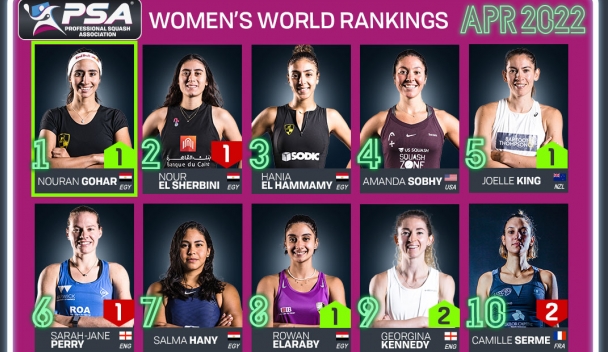
Egypt’s Nouran Gohar has ended compatriot Nour El Sherbini’s 17-month reign as the World No.1 after the PSA Women’s World Rankings for April were released today (April 1).
Gohar has been in sensational form throughout the 2021-22 season and has won the last four PSA World Tour Platinum events in a row, including the Windy City Open presented by the Walter Family and the CIB Black Ball Open last month.
Those wins have seen her leapfrog El Sherbini to claim the World No.1 spot for the second time in her career and for the first time since October 2020.
Hania El Hammamy and Amanda Sobhy stay at No.3 and No.4, respectively, while New Zealand’s Joelle King returns to the top five for the first time since May 2019 after reaching the semifinals of both the Windy City Open and Black Ball Open in March.
England’s Sarah-Jane Perry moves down to No.6 ahead of Salma Hany at No.7, while Rowan Elaraby reaches a career-high ranking of No.8 after reaching her first Platinum semi at the Black Ball Open.
Women’s Top 10 – April 2022 / pix: pic: psaworldtour.com
Meanwhile, Georgina Kennedy rises to her career-high ranking of No.9 after achieving back-to-back quarter finals at the Windy City Open and Black Ball Open, the former seeing her reach the last eight of a Platinum event for the first time. France’s Camille Serme – who has been sidelined since September, 2021 due to a leg injury – completes the top 10.
USA’s Olivia Fiechter drops out of the top 10, while Belgium’s Nele Gilis rises a spot to a joint career-best No.12 ranking. India’s Joshna Chinappa is also on the move as she moves up to No.13, ahead of Tesni Evans at No.14 and Nadine Shahin who remains at No.15.
Nada Abbas rises five places to reach No.16, while Hollie Naughton drops down a spot to joint No.17 with Olivia Clyne. Emily Whitlock stays at No.19, while England’s Lucy Turmel moves up six spots to break into the top 20 for the first time. It’s the first time in over two years that there have been three Englishwoman have been ranked inside the top 20 at the same time.
Egypt’s Nour El-Sharkawy is the biggest mover on the women’s tour this month. The 18-year-old appeared at the Black Ball Open in March and enjoys a 186-place rise to a career-high No.147 ranking.
source/content: psaworldtour.com (edited)
_____________
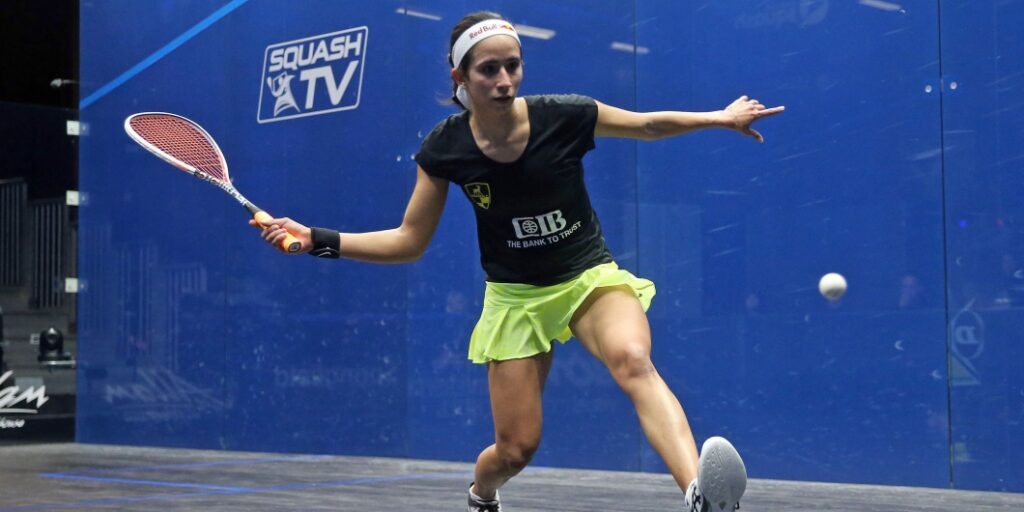
Nouran Gohar in action at the Allam British Open / pic: psaworldtour.com
Bahrain women created a world record as they smashed the highest total in a T20I inning – 318 – against Saudi Arabia in match seven of GCC Women’s T20I Championship, played at Al Amerat Cricket Ground, Oman.
Saudi Arabia won the toss and opted to field first. Bahrain women smacked the SA bowlers right from the beginning, especially Tharanga Gajanayake. While Rasika Rodrigo only scored 13 off 11 balls, Tharanga continued smack the bowlers from the other end.
Deepika Rasangika joined Tharanga and the duo added 255 runs in 16.4 overs – the highest partnership for the second wicket and second-highest partnership in a women’s T20I match. Tharanga remained unbeaten at 94 off 56 with the help of 17 fours. Deepika, on the other end, scored 161 from 66 balls with the help of 31 fours – becomes first women cricketer to score 150+ in a T20I game.
Bahrain scored 318 runs in the 20 overs, but interestingly they didn’t hit any six through the innings; a record 50 boundaries were hit in the inning. Saudi Arabia conceded 50 runs in extra runs – 34 wides, 13 no-balls, 2 byes, and 1 leg bye.
Before this, the highest total scored in a T20I inning was by Uganda Women – 314 vs Mali in 2019.
Maira Khan conceded the most runs for Saudi Arabia – 68 in four overs. Emaan Ejaz took the sole wicket of the inning but conceded 63 runs in her fours overs.
There was a clear contrast between the two bowling cards. The best Saudi Arabian bowler conceded 13 runs an over and the worst bowler for Bahrain conceded 3.5 runs an over.
In reply, Saudi Arabia women could only score 49 runs and lost eight wickets. They lost the match by 269 runs – the second-highest win in terms of runs in a women’s T20I game.
The first world expo held in the Middle East ends in style.
After 182 days of diverse and rich activities and events, which enjoyed by millions of visitors from across the world, the curtain of Expo 2020 Dubai, the first world expo held in the Middle East, Africa and South Asia (MEASA) region and the first hosted by an Arab nation, came down on Thursday, March 31, 2022, at the iconic dome-structured Al Wasl Plaza.
The six-month-long exposition, staged under the central theme, “Connecting Minds, Creating the Future”, defied the tremendous challenge of the COVID-19 pandemic, delivering a resounding success.
By organising the world greatest show amidst such challenges, the UAE has removed the world ”impossible” from its lexicon to present a wonderful edition in the event’s long history as His Highness Sheikh Mohammed bin Rashid Al Maktoum, Vice President, Prime Minister and Ruler of Dubai, said in an audio message delivered at the closing ceremony of the mega global event.
We will not be exaggerating if we repeat what millions of visitors have said that Dubai’s remarkable success offered a great challenge for those to come.
Expo 2020 Dubai, which brought together 192 participating nations, is not a mere event that tells the culture and history of participating countries, rather than an invitation to engage and share visions to address challenges facing the humanity.
The UAE selection of the theme, ”Connecting Minds, Creating the Future” as a headline for its campaign to host the exhibition, did not come by chance. The UAE used to look to the future with proactive visions. Despite humanity’s passing through the most difficult and challenging time due to the COVID-19 pandemic and its negative effects on the economies of the world, there was no confusion in the UAE’s approach and calculations.
Projects did not stop or affected by slowness, delay or hesitation. Rather, they continued in an unprecedented harmony that encouraged the international community participate and engage with confidence enhanced by millions of visitors who and their families enjoyed events and activities that many of them may not be able to repeat again and they will proudly tell them to the future generations.
Since the International Exhibitions Bureau (BIE) announced on 27th November 2013 in Paris that Dubai had won the bid to host Expo 2020, no one doubted the UAE’s ability to present to the world the most beautiful and brightest image of an event that had been exclusively hosted by certain cities in regions far away from the Middle East and North Africa.
As usual, the UAE has a proven track-record in areas of communication and fresh innovative concepts and ideas which have been turned into reality over the past decades. An indicator of success of Expo is that the large number of visitors came from outside the country.
Over six months, Expo 2020 Dubai brought together over 190 participating nations, including multilateral organisations and academic institutions, in a defining moment to exchange new ideas and perspectives, inspire meaningful change and create a brighter future for all under the theme, ”Connecting Minds and Creating the Future” through sustainability, mobility and opportunity.
There is no better place and environment than Dubai and the UAE in general to discuss these issues that of major concern to the world. This was clearly reflected in the World Government Summit 2022, which was the best conclusion to an exceptional event.
It was an opportune coincidence that hosting this event preceded the UAE’s Golden Jubilee celebrations in 2021, as the UAE shared its visions, ideas and rich experience in development with the world in an event that chronicles the World Expo events a new.
The UAE deserves deepest congratulations for the remarkable success of Expo 2020 Dubai as the world welcomes Expo 2025 Osaka in Japan.
Opinion: by: Mohammed Jalal Al Rayssi is the Director-General of the Emirates News Agency (WAM)
source/content: gulfnews.com (edited)
____________
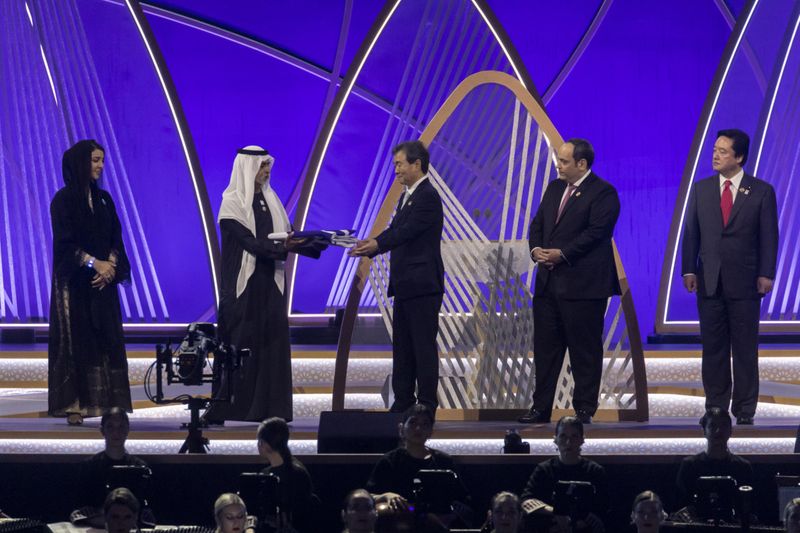
Sheikh Nahayan Mabarak Al Nahayan (L2), UAE Minister of Tolerance and Coexistence and Commissioner General of Expo 2020 Dubai, hands the BIE flag to His Excellency Jai-chul Choi (C), President of the Bureau International des Expositions (BIE) during the Expo 2020 Dubai Closing Ceremony at Al Wasl alongside Her Excellency Reem Al Hashimy (L), UAE Minister of State for International Cooperation and Director General, Expo 2020 Dubai, His Excellency, Dimitri Kerkentzes (R2), Secretary General of the Bureau International des Expositions (BIE), the governing body of World Expos and His Excellency Wakamiya Kenji (R), Minister for the 2025 World Expo in Osaka, Japan. Image Credit: Expo 2020 Dubai
Awards made for services to Islam, Arabic language, literature, medicine, and science.
The winners of this year’s King Faisal Prize on Tuesday received their awards at a glittering ceremony staged in Riyadh.
The annual gongs — held under the auspices of King Salman — are the most prestigious in the Muslim world and recognize outstanding achievement in services to Islam, Islamic studies, Arabic language and literature, medicine, and science.
The service to Islam prize was jointly awarded to former Tanzanian President Ali Hassan Mwinyi and Egyptian scholar Prof. Hassan Mahmoud Al-Shafei.
The Arabic language and literature award went to Prof. Suzanne Stetkevych and Prof. Muhsin Al-Musawi from the US.
American Prof. David Liu secured the medicine prize while the science accolade was shared by Prof. Martin Hairer of the UK and Prof. Nader Masmoudi of Tunisia.
The Islamic studies prize, that this year focused on the Islamic heritage of Al-Andalus, was withheld because the nominated works did not meet the necessary criteria.
Mwinyi was honored for actively participating in Islamic advocacy and promoting religious tolerance. He established Islamic schools and translated many resources and references in hadith, jurisprudence, and the Prophet Mohammad’s biography into Swahili, the language spoken by millions of people in East Africa.
Al-Shafei, who was president of the Academy of the Arabic Language in Cairo from 2012 to 2020, held several academic positions and established a series of institutes concerned with Al-Azhar. He also contributed to the establishment of the International Islamic University in the Pakistani capital Islamabad.
The Arabic language and literature prize was jointly presented to Stetkevych, chair of the department of Arabic and Islamic studies at Georgetown University, and Al-Musawi, professor of Arabic and comparative literary studies at Columbia University.
Stetkevych’s extensive research and numerous works have analyzed Arabic literature with unmatched depth from the pre-Islamic period to the Nahda/revivalist period. Her research approach, which is characterized by its application of varied methodologies, resulted in the renewal of the critical perspective and methods of studying classical Arabic poetry.
The research and studies of literary critic and novelist Al-Musawi have had a great impact on Arabic studies students and researchers in the Arab world and the West, through his distinctive methods of presentation, analysis, critical interpretation, and openness to Arab and international creative texts in prose and poetry.
Meanwhile, the medicine prize concentrated on gene-editing technologies. Its winner Liu, director of the Merkin Institute for Transformative Technologies in Healthcare, invented the first so-called base editor to make alterations on DNA and genes by replacing letters in the DNA base.
Hairer, chair in probability and stochastic analysis at Imperial College’s mathematics department, was one of the science prize recipients. His work has been in the general area of probability theory with a focus on the analysis of stochastic partial differential equations. He recently developed the theory of regularity structures which gave a precise mathematical meaning to several equations that were previously outside the scope of mathematical analysis.
The other joint science award winner, Masmoudi, a professor of mathematics at the New York University of Abu Dhabi, unlocked the mystery surrounding many physics problems which have remained unsolved for centuries.
He found a flaw in (Leonhard) Euler’s mathematical equations, which for more than two centuries had described the motions of fluids under any circumstance. Masmoudi discovered that the equations did not apply to all circumstances, as previously thought, and his findings helped to solve a raft of conundrums related to fluid-modeling, such as weather predictions.
Each winner received a $200,000 prize, a 24-carat gold medal, and a certificate written in Arabic calligraphy signed by the Chairman of the prize board, Prince Khalid Al-Faisal.
source/content : arabnews.com (edited)
_____________
Winners of 2022 King Faisal Prize awards honored in Riyadh. (SPA)
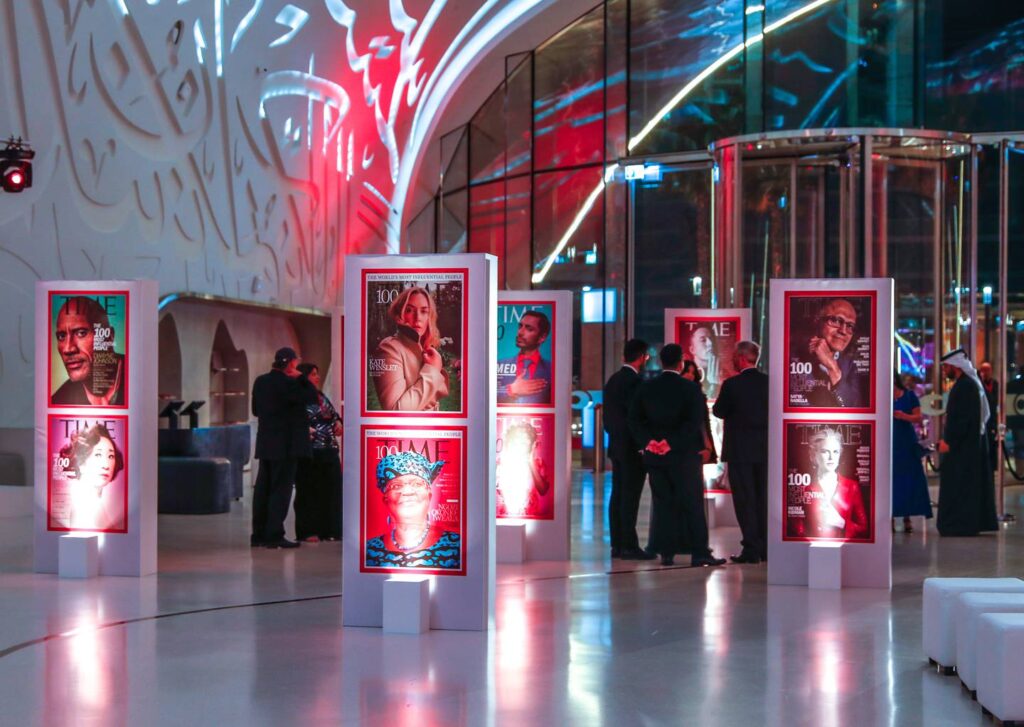
The inaugural Time 100 Gala and Impact Awards was held at Dubai’s Museum of the Future . The ceremony was the first major event to take place at the museum since its opening on February 22.
The landmark was lit with a touch of Time’s red as regional leaders and cultural figures gathered alongside members of the global Time 100 community.
Notable personalities who attended the red carpet event included civil rights activist Amanda Nguyen, who was named in Time’s first Women of the Year list this month; Omotola Jalade Ekeinde, Nigerian singer, actress and philanthropist; French-Tunisian contemporary artist el Saeed; US model Tyra Banks; and Sheikha Lubna Al Qasimi , the first woman to hold a ministerial position in the UAE.
Sheikha Lubna was formerly the minister of state for tolerance, minister of state for international co-operation and development, and minister of economy and planning
The winners
Minister of State for Advanced Technology Sarah Al Amiri was among the award recipients. Chairwoman of the UAE Space Agency and the UAE Council of Scientists, Ms Al Amiri was honoured for her role in helping to take the UAE to Mars.
British-Ghanian architect Sir David Adjaye, whose designs include the National Museum of African American History and Culture in the US, as well as the Abrahamic Family House in Abu Dhabi, was also honoured for his work.
Mr Adjaye was honoured, according to Time, for “reorienting the world’s attention and shining a light on cultures from every corner of the world”.
Tony Elumelu was also a winner of the Impact Awards. The Nigerian economist was honoured for his efforts, through his eponymous foundation, in empowering African entrepreneurs to create jobs on the continent.
Bollywood star Deepika Padukone was also among the winners. The actress was recognised for her advocacy work on mental health..
Makeup artist and founder of Huda Beauty, Huda Kattan, was awarded the prize for “disrupting what it means to be beautiful”.
The Iraqi-American entrepreneur launched her skincare line Wishful in 2020 with a campaign that featured Kattan and the company staff without filters or makeup.
Will.i.am was also a winner of the inaugural Impact Awards. The Black Eyed Peas founder was praised as much for his music as his philanthropy, and his work advocating forward-thinking tech and artificial intelligence strategies.
Pop star Ellie Goulding was also named a winner for being “a champion and protector of the environment”.
source/content: thenationalnews.com (edited)
______________
The inaugural Time 100 Gala and Impact Awards was the first major event at Dubai’s Museum of the Future since its opening ceremony on February 22. Victor Besa / The National
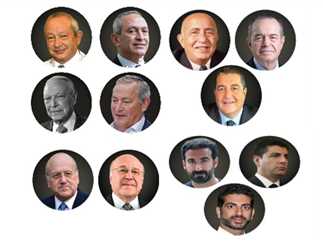
Forbes Magazine revealed that Egypt and Lebanon are the homes of the wealthiest Arab billionaires for 2021.
The magazine’s annual report noted that the total wealth of the richest Arab families increased to US$55 billion this year, as compared to US$47.3 billion in 2020.
This year’s list includes 22 Arab billionaires including ten who belong to four families. They are the Sawiris and Mansour families from Egypt and the Mikati and Hariri families from Lebanon. The combined fortunes of the four families amount to US$29 billion.
Egypt’s Nassef Sawiris topped the list of Egyptian and Arab billionaires, with a net wealth estimated by Forbes at about US$9.1 billion, while the combined wealth of his family is about US$14 billion.
The two Lebanese brothers, Taha and Najib Mikati, have a fortune of US$5.4 billion, while the Mansour family is worth US$5.1 billion. The total wealth of the sons of late Lebanese Prime Minister Rafik Hariri is $US4.5 billion.
Since 2018, the magazine has not added Saudi billionaires to its list.
Forbes Middle East took a deeper dive into the four richest Arab families. Egyptian billionaires accounted for the largest share of the wealth with US$19.1 billion, while the Lebanese came in second with US$9.9 billion.
The Sawiris family
Members: Nassef, Naguib, and Samih, as well as their late father, Onsi Sawiris
Combined net worth: US$14 billion
Country: Egypt
The Sawiris family is the richest in Egypt, with a net worth estimated at about US$14 billion, most of which is from Nassef Sawiris, who owns $9.1 billion, as he owns a six percent stake in Adidas and a five percent stake in Madison Square Garden Sports, listed in New York. He is also the owner of the NBA’s Knicks and the NHL’s Rangers.
In addition, Nassef manages OCI, one of the largest producers of nitrogen fertilizers in the world, with factories in Texas and Iowa. Its shares are traded on Euronext Amsterdam and the billionaire has a 33 percent stake in it. Nassef also owns various investments, including shares in cement giant Lafarge and Orascom Construction.
He is followed by his brother Naguib Sawiris, who made his fortune from investing in the telecommunications sector, as he sold Orascom Telecom to the Russian telecommunications company VimpelCom, currently renamed VEON, in a deal that included shares and billions of dollars in liquidity in 2011. Naguib chaired the board of directors of Orascom Holding, which invests in one of the largest asset management companies in Egypt, and internet company Italiaonline, among other investments.
The third brother, Samih Sawiris, is rooted in the tourism sector. He developed the Red Sea tourist city of Gouna and has stakes in several companies, including 5.62 percent in OCI NV, 65 percent in Orascom Development Holding, and 6.3 percent in Orascom Construction. The combined value of these stakes is about US$680 million. The fortune of the father, Onsi Sawiris, who passed away a few weeks ago, was about US$997 million. This wealth has not yet been distributed to his heirs, and he still has a stake in OCI NV and Orascom Construction.
Nassef Sawiris’ fortune has witnessed a significant jump during the past 15 months, from US$5 billion in April 2020 to US$9.1 billion today.
The Mikati family
Members: Taha and Najib Mikati
Combined net worth: US$5.4 billion
Country: Lebanon
The two brothers, Taha and Najib Mikati, founded the (M1) Holding Group in the Lebanese capital, Beirut.
The group’s investments include stakes in South African Telecom (MTN), fashion retailers such as Pepe Jeans, and luxury properties in New York, London, and Monaco.
Najib and his brother Taha founded Investcom in 1982, which specialized in the sale of satellite phones, at the height of the civil war in Lebanon. The brothers expanded into Africa, building cell phone towers in Ghana, Liberia, and Benin, among other countries. Investcom became a public company listed on the London Stock Exchange in 2005. In 2009, South Africa’a MTN bought the shares of the two Mikati brothers for US$3.6 billion.
Najib Mikati served as the Prime Minister of Lebanon from 2011 to 2013 and is now serving as PM-designate after Saad Hariri stepped down in July.
The fortune of the two brothers grew from US$4.3 billion in April 2020 to US$5.4 billion on July 17, 2021.
The Mansour family
Members: Mohamed, Youssef, and Yassin Mansour
Combined net worth: $5.1 billion
Country: Egypt
The three brothers, Mohamed, Youssef and Yassin Mansour, gathered their wealth through the huge Mansour family group, which was founded by their late father Lotfi Mansour in 1952 and currently has about 60,000 employees.
Mohamed Mansour established General Motors dealerships in Egypt in 1975, becoming one of the largest distributors of its cars in the world. The group also has exclusive distribution rights for Caterpillar equipment in Egypt and seven other African countries. Mohamed Mansour was Minister of Transport under the Hosni Mubarak regime between 2006 and 2009.
As for Youssef Mansour, he heads the board of directors of the giant family group, and also supervises the consumer products department, which includes the supermarket chain “Metro”, as well as individual distribution rights for “L’Oreal” products in Egypt.
While Yassin Mansour is a shareholder in the group founded by his father, he also chairs the board of directors of Palm Hills Development, one of the largest real estate developers in Egypt. The Mansour Group owns the exclusive rights to franchise the famous brand in the ready-to-eat food sector McDonald’s in Egypt, and is the exclusive distributor for the cigarette brand Gauloises.
Mohamed Mansour’s net worth is US$2.5 billion, while Youssef’s is US$1.5 billion, and Yassin’s US$1.1 billion. The family’s net worth has decreased since April 2020 from US$7.4 billion to US$5.1 billion as of July 17, 2021.
The Hariri family
Members: Bahaa, Ayman, and Fahd Hariri
Combined net worth: $4.5 billion
Country: Lebanon
Bahaa, Ayman and Fahd Hariri are the children of the late Lebanese Prime Minister Rafic Hariri. They inherited their fortunes from their father.
In 2008, Hariri sold his stake in Saudi Oger contracting and construction company to his brother Saad Hariri, the former Prime Minister of Lebanon, who was dropped from the billionaire list in 2019, while Fahd sold his share to his brother Saad in 2012 and Ayman also in 2014.
Bahaa Hariri founded and headed the Horizon Group, a real estate holding company with investments in Amman, and Beirut. He also owns the majority stake in Globe Express Services, a company that provides logistics services in more than 100 countries.
Meanwhile, Ayman Hariri invests in startups through the New York-based company Red Sea Ventures. Among its investments is Nest, which is now part of Google. He is also the co-founder and CEO of Vero, an ad-free social e-platform which allows users to share music, videos, and photos.
As for Fahd Hariri, the youngest son of the late billionaire Rafic Hariri, he invested part of his money in the real estate sector in New York, Paris, and Monte Carlo, and is currently investing in the besieged Lebanese banks, as well as developing residential properties in Beirut.
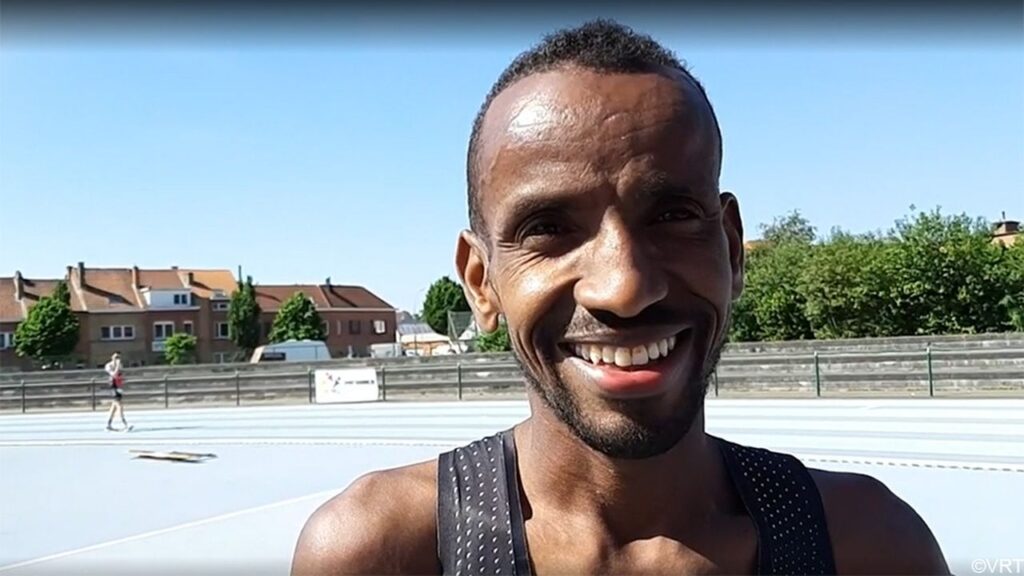
Bashir Abdi’s bronze medal in the marathon at the Olympic Games in Tokyo is a victory that will go down in the history books. He came to Belgium as a refugee from Somalia as a 13-year-old boy. Speaking after taking bronze in Tokyo, Bashir Adil told VRT Sport that “I always wanted to thank my new country by winning a medal”.
The scenes of Bashir Abdi being encouraged on by his best friend and training buddy, the Dutch athlete Abdi Nageeye, as they both reached the finishing line will be one of the enduring memories of this summer’s Tokyo Olympics. Bashir Abdi’s bronze medal was the first medal for Belgium in the Olympic marathon event since Karel Lismont’s medal 45 years ago.
A great sporting achievement for a man that is delighted to be able to give something back to a country that he came to as a teenage refugee and that he is proud to call home. “I always want to thank my new country by giving it a medal. At the European Championships I was successful and won silver and now I am on the podium at the Olympic Games. Hopefully more will follow in the future”.
But what about the past? Who is Bashir Abdi and how did he get to where he is? A couple of months ago Bashir Abdi was a guest in our nightly topical discussion programme ‘De Afspraak’. Then he said “I was 13 years old in 2002 when I arrived in Ghent (East Flanders) with my father, sister and brother. People know me from sport, my achievements as a runner, but few people know about my journey from Somalia to Belgium”. In an effort to change this Bashir’s Dutch teacher a book about his life.
“It was all new I didn’t speak the language; it was a completely different culture, and the weather was cold. First, I was in a football club because in Somalia the only sport on TV or in the paper is football. I didn’t even know that other sports existed. Then I come into contact with athletic and that was something that greatly appealed to me. Running on my own and forgetting about everything that I had gone through gave me so much fulfilment. Society has helped me”.
A key figure in Abdi story is his mother “It is thanks to her that I came to Belgium. She has recognition as a political refugee, and she initiated a family reunification procedure. It took years before I was reunited with her”.
Bashir Abdi’s mother died of cancer in 2011. In the interview he told of what her last words to him were “She call us together on the final day of her life and said, ‘this country has meant so much to all of you, be good people’. She was the one that always supported me being an athlete while the rest of the family felt that it was a waste of time”.
When he was asked by our colleague Phara de Aguirre if he would be running for his Mum on 8 August, Bashir Abdi said “Absolutley, I hope that she will be looking down watch my performance from up there”.
There were inspiring scenes as the winners of Arabian Business’ inaugural KSA Women Excellence Awards were revealed at a special ceremony, a glittering evening at the Riyadh Marriott on Mother’s Day with an audience of more than 150 attendees, the winners were revealed.
Before the winners were announced, a fireside chat with Arabian Business Editor in Chief Scott Armstrong heard from Mae Al Mozaini, CEO of nusf – The Arab Institute for Women’s Empowerment, who told the room: “What an exciting time it is to be a Saudi woman – we are the number one most educated women in the region and 10 in the world.”
Meanwhile, Hawazen Almaddah, Group Head of Corporate Communications at IFFCO Group, captivated the room with her ‘letter to her future self’.
Mae Al Mozaini, founder and CEO of The Arab Institute for Women’s Empowerment – Nusf
Secondly, Samar Alshorafa, who is the founding CEO of She is Arab.
And finally, Carla Sertin, ITP Group Editor, who leads brands such as Oil & Gas Middle East, Construction Week, Utilities Middle East, to name but a few.
Editor in Chief Scott Armstrong said: “The journey to today has been breathtaking, and if you plot the line graph for women into Saudi’s future, the potential is incredible.
“As the proud father of an irrepressible daughter and husband to an unstoppable wife, I’m delighted to be here in Riyadh to celebrate the achievements of inspiring women, especially on Mother’s Day here in the Gulf.”
The Winners:
Business – Woman of the Year
Highly Commended: Maria Medvedeva, Vice President, Mastercard, Saudi Arabia and Bahrain.
Winner: Mona Althagafi, KSA Country Director with Serco.
Education – Woman of the Year category
Winner: Alia Albazie – Director of Special Education with the Tatweer Company
Business – Energy – Woman of the Year
Winner: Dr. Abeer Al-Olayan, General Director at the Ministry of Energy
Entrepreneurial – Woman of the Year
Highly Commended: Nour Al Hassan, the Founder and CEO of Tarjama
Winner: Sheikha Aldosary, founder and managing director of Saudi Women’s Stories
Finance – Woman of the Year
Winner: Tala Al Jabri
Government – Woman of the Year
Highly commended: Reem AlSuwaiyel, Executive Director -Board of Directors General Secretariat at the Diriyah Gate Development Authority
Winner: Dur Essam Kattan, the Deputy Minister for Communications and Media at the Ministry of Culture (MoC), Saudi Arabia
Inspirational – Woman of the Year
Dr. Hibah Shata, owner of Maharat Learning
Linah Alhabeeb, the Associate Director for Human Capital Development at the Diriyah Gate Development Authority (DGDA)
Nouf Aljalaud, currently Customer Success Manager at SITA covering Border Management Service Management
Nouf Abdullah Al Rakan- Nouf founder Qiyadat Global
Law – Woman of the Year
Highly commended: Tala AlJahlan who led the legal and compliance department during the Saudi G20 presidency
Winner: Nasreen Alissa of The Law Firm of Nasreen Alissa
Media – Woman of the Year
Winner: Ghada Alrumayan, group chief marketing and communications officer at the national community developer, ROSHN
Medical – Woman of the Year
Highly commended: Dr Tamara Sunbul, Medical Director of Clinical Informatics with Johns Hopkins Aramco Healthcare (JHAH)
Winner: Taghreed Alghaith of the National Health Economics and Policies at the Saudi Health Council (SHC)
Rising Star – Woman of the Year
Highly commended: Albandari AlajlanDental Department Manager at Dallah Hospital
Winner: Abeer Algwaiz, Design Assistant Manager at the Diriyah Gate Development Authority (DGDA)
Science and Technology – Woman of the Year
Highly commended: Maha Alnuhait, GM of Sustainability with stc
Winner: Dr. Noha Alharthi, Technology Lead at NEOM
Startup – Woman of the Year
Winner: Muzon Ashgar, Muzon Bodycare
Special Recognition – Woman of the Year
Special Recognition – Woman of the Year: Mae Al Mozaini (L), The Arab Institute for Women’s Empowerment
Highly commended: Samiha Ahmed of the Ireland- Saudi Arabia Business Council
Winner: Mae Al Mozaini, The Arab Institute for Women’s Empowerment
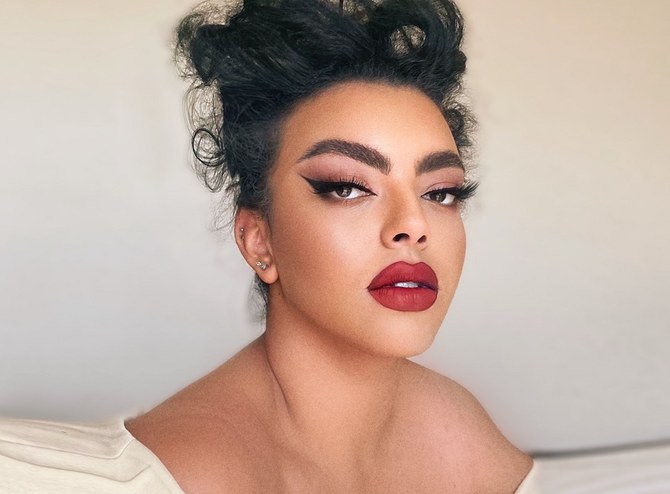
The Arab Fashion Council, a non-profit organization representing the fashion industry in the Middle East and North Africa, has named Dubai-based Tunisian model Ameni Esseibi as its new ambassador.
The announcement coincided with the launch of Arab Fashion Week, which includes 28 shows divided into three main programs, namely couture on Thursday and Friday, ready-to-wear from March 26 to 28, and events that will run throughout the five-day gathering.
Esseibi prides herself on being the Arab Fashion Council’s first-ever plus-size ambassador.
She said: “I feel proud. This is a huge step to acknowledge every woman, which is just the first milestone toward a new era for the fashion and retail industries to update the standards boldly and make them more inclusive for every woman. With my new title, I thrive on being a role model for self-confidence.”
The 24-year-old, considered the first plus-size model in the Middle East, is a staunch advocate for inclusivity and diversity in the fashion industry.
Esseibi’s new role marks the first time that the Arab Fashion Council has acknowledged a plus-size model as an envoy, a move it hopes will show its commitment to making a difference in the fashion industry when it comes to inclusivity and tolerance.
Mohammed Aqra, the Arab Fashion Council’s chief strategy officer, said: “It strategically encourages designers to take a step closer to include diverse profiles of the consumers, offering a wider choice for them at offline and online retail.
In addition to being a council ambassador, Esseibi has worked with a number of esteemed brands including Jean Paul Gautier and H&M and has featured in the pages of multiple publications including Vogue Arabia and Elle Arabia.
source/content: arabnews.com
_________
Ameni Esseibi prides herself on being the Arab Fashion Council’s first-ever plus-size ambassador. Supplied
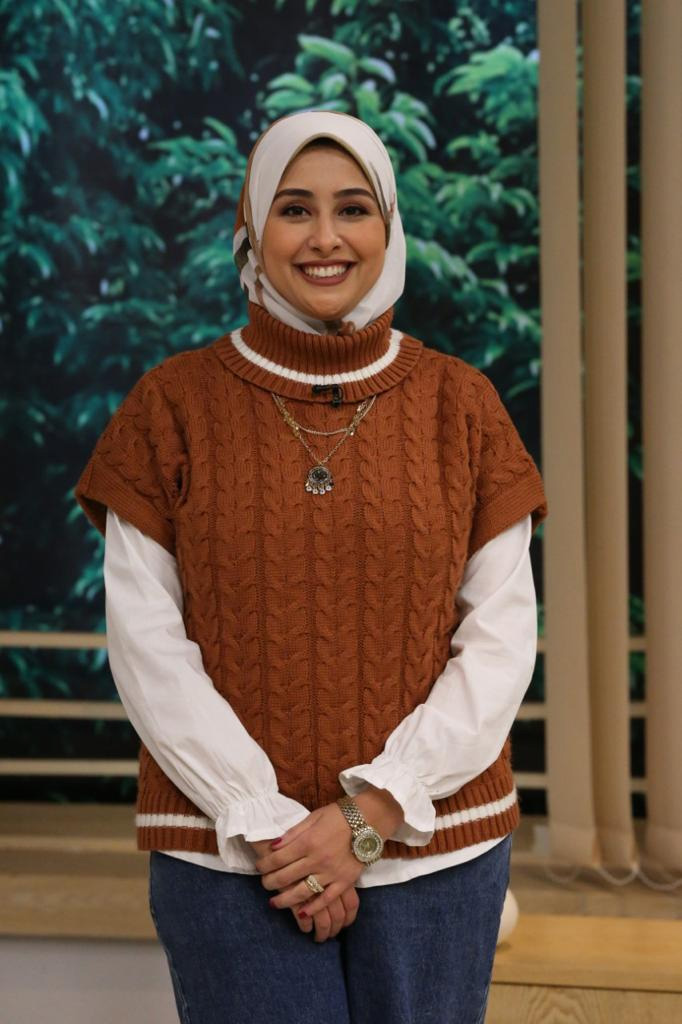
Fashion design was part of my study at a very young age and I started my career 10 years ago,” says Egyptian designer Esraa Adel, who graduated from a vocational-technical high school’s ready-made garments department.
Adel specialises in women’s casual wear designs après midi, soiree and much more. She launched her own line of soiree dresses under the title Fashion Corner Brand.
“I took a course to learn sign language for two months to be able to communicate with the hearing-impaired, then introduced changes to the course content to fit their needs. I offer patron (sewing patternmaking) courses using sign language too,” she adds.
Adel stresses that her stern belief in social work and making a difference for people prompted her to help the hearing-impaired with opportunities to start their own businesses.
She teaches drawing mannequins for different female body types, how to choose the right dress for the right body shape, patron drawing and the basics of sewing..
The mobile app ‘Professional Course forTailoring Clothes with Patron’ was released two years-ago and is available on the Android play store in Arabic version.
“70 percent of users are hearing-impaired and people with disabilities,” Adel says.
The idea for the app won the top prize at the Tamkeen Competition in 2020, which aims to develop software and mobile phone applications for people with disabilities and is held under the auspices of the Ministry of Communications and Information Technology.
El-Khalifa Computer Group is an Egyptian Software Company that turned the idea for the app into reality.
“The company is the owner and it plans out the entire process. It generates the idea, app design, software, and financial part,” Adel says.
The company received a grant from the ministry to give the hearing-impaired sewing courses in Cairo.
“I was the only one to give this kind of course in Egypt,” Adel adds. “I am responsible for shooting the videos and creating accessible material and scientific subjects for the application.”
“The app content helps users master tailoring. It takes two months to study before the user can launch their own project,” she adds.
The app consists of 30 tutorial videos for woman’s wear. It includes how to take accurate body measurements and using sewing machines, needles, scissors and fabrics. It shows applicants the full steps of the tailoring process and how to get the best finish for the final product.
The “fabrics dictionary” is a newly added option that is not available in other sewing apps. It has a full list of fabric types and a video on how to identify them by touch. The fabric glossary is for sewing terms, expressions, and terminology.
The app has three features: sign language, audio, and text for the hearing-impaired.