Yehia Abdel-Tawab, First Ballet Dancer in Egypt

Russian tribute to Yehia Abdel-Tawab, first ballet dancer in Egypt

Yehia Abdel-Tawab, one of the pioneers of ballet in Egypt and the recipient of the Medal of Merit from late President Gamal Abdel-Nasser, has been honored by the Egyptian Association of Graduates of Russian and Soviet Universities (EAGRSU) and the Russian House in Cairo for his contribution in strengthening Egyptian-Russian relations through his artistic career.

The EAGRSU and the Russian House held a seminar titled ‘The Ballet in Egypt and Russian Experiences’ earlier this week in honour of Abdel-Tawab, who is a professor of ballet at the Academy of Arts.

The seminar, held at the Russian Cultural Centre in Dokki, was moderated by President of the Association Sherif Gad and attended by director of the Russian Cultural Centres in Egypt Marat Gatin, dean of the Ballet Institute in Cairo Atef Awad, former dean of the Ballet Institute Sherif Bahader, member of the board of directors of the association Samia Tawfik, and Ballet Institute professor Tahani Hassan.

Abdel-Tawab also stressed that ballet in Egypt has a strong foundation, and with the efforts made by the state to build new opera houses, there will be many specialized ballet companies, and called for more cooperation with Russian experts in order to exchange experiences.

Former dean of the Ballet Institute Bahader said that Abdel-Tawab is considered one of Egypt’s first pioneers in the art of ballet, and one of the greatest ballet dancers in the entire world.

“He is also one of the first dancers in double dance in Egypt and the Arab world.”

Professor of ballet Tahani Hassan expressed her pride in her teacher at the Ballet Institute Abdel-Tawab, pointing out that all his students learned from him commitment, as he was accurate in timing and executing movements.

During the event, a documentary film on the history of the art of ballet in Egypt was shown, and Gad presented a certificate of honour on behalf of the association to Abdel-Tawab in appreciation of his great artistic career.

source/content: english.ahram.org.eg

__________

(L-r) Marat Gatin, Sherif Bahader, Tahani Hassan, Yehia Abdel-Tawab, Atef Awad, and Sherif Gad photo credit of the Russiaan Centre

__________

EGYPT

‘Aqsa Week 2022’, 2nd edition February 24th – 02nd March, 2022. Al-Aqsa Mosque – Islam’s 3rd Holiest Site.

50 countries to take part in Aqsa Week 2022 to promote love of mosque, raise awareness

A UK-based initiative to shed light on the Al-Aqsa mosque in Jerusalem has gone global for the second year in a row, with more than 50 countries set to take part, according to organizers.

Aqsa Week 2022, which will run from Feb. 24 to March 2, is being organized by the British-based Friends of Al-Aqsa (FOA) — a NGO concerned with defending the human rights of Palestinians and protecting the Al-Aqsa Sanctuary.

FOA said that during the week, which they anticipate to be the biggest one yet, mosques, universities, local councils and parliaments will hold talks, workshops and other activities and educational events to highlight the mosque’s heritage, and bring global focus to its issues.

Aqsa Week, which was launched by FOA in 2017, aims to inform people of Al-Aqsa and its history and significance, as well as the dangers faced by Al-Aqsa and the Palestinian people.

Al-Aqsa is Islam’s third holiest site and is in close proximity to religions sites significant to Jews and Christians, making the area a flashpoint in the Palestinian-Israeli conflict. The Israeli government has on occasion prevented Muslim worshippers from accessing the mosque.

Several of the FAO events will be streamed live on their social media accounts, as well as TV and radio, and they have chosen #LoveAqsa as this year’s hashtag.

source/content: arabnews.com

_______

Friends of Al-Aqsa illustration. (Twitter)

__________________________

JERUSALEM, PALESTINE

Eng. Ahmed Mekky, First Egyptian Appointed the Head of Fiber Optic Connect MENA Council

The Fiber Connect Council MENA has announced the appointment of Eng. Ahmed Mekky, Chairman and CEO of Benya Group, as Chairman of the council for a two-year term, succeeding Mr. Juan Colina. His appointment for this esteemed role, marks the first time an Egyptian assumes this position.

Eng. Mekky has been involved with the council in his capacity as a member of the Board of Directors since 2011, and was nominated for his role as Chairman of the council, in light of his endless contributions to the ICT industry on a global level and particularly for his extensive experience in the field of optical fibers.

Benya Cables, a subsidiary of Benya Group, began with ambitious plans to build the region’s largest optical fiber factory, and is now months away from materializing that reality.

Fiber Connect Council MENA has a mandate to exponentially increase the deployment of high-speed fiber networks, to connect consumers, businesses, governments and organizations, with the products and services needed to enhance quality of life, make a sustainable impact on the environment, boost business competition and develop apps to ultimately transform the way people live and businesses operate.

The Council’s Board of Directors is comprised of a notable cohort of member organizations such as Corning, Prysmian MEFC, OFS, Etisalat, and Oman Broadband. The board was formed in 2011 as an initiative launched by the founding members, and since inception, now boasts a member and partner count over 50 prominent industry leaders.

Kholoud Al-Dergham, Director General of Fiber Optic Connect Council MENA, welcomed the appointment of Eng. Ahmed Mekky as the Council’s new Chairman, highlighting “his expert record and experience in this field as invaluable assets to the Council, as well as a unique opportunity to invest that kind of experience, to accomplish the council’s objectives to expand the use of fiber optics”.

Eng. Ahmed Mekky is one of the most influential and prominent leaders in the ICT sector. In 2017, he founded Benya Group, formerly known as “Fiber Misr Systems,” and its affiliates with the goal of accelerating the Middle East and Africa’s digital transformation.

Prior to that, he launched Gulf Bridge International (GBI) in 2008 to build and operate the first underwater cable network, stretching over 40,000 kilometers and connecting 25 nations.

In 2011, he was appointed to the SAMENA Council’s Telecommunications Committee, and was selected on the Board of Governors (PTC).

Eng. Mekky has received various honors in recent years, including the “Telecom Review” award for best CEO in the area of enterprises offering services in telecom infrastructure for three consecutive years (2019, 2020 and 2021)

source/content: egyptian-gazette.com

__________

_________

EGYPT

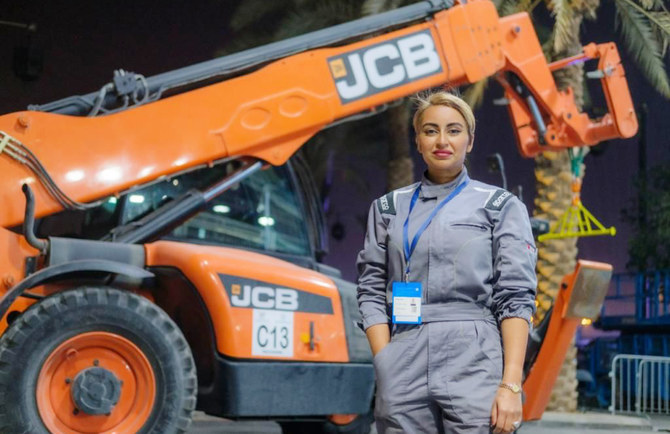
Merryhan Al-Baz First Saudi Female Crane Driver & World’s First Female Crane Driver in Race Competition, ensures safety procedures at E-Prix

Merryhan Al-Baz’ has been taking apart cars and indulging her curiosity in the world of vehicles since she was 13 years old.

This passion for motors and engines, inherited from her father, lead the now 30-year-old to participate in the Diriyah E-Prix 2022 as a recovery marshal last month, becoming the world’s first female crane driver in race competitions.

“No one ever thought a woman could enter this field — the world of mechanics is a male dominated career. Fortunately, in my household, my mother and father always support any talents, ideas, or anything you desire to do,” Al-Baz told Arab News.

Al-Baz explained that there are four types of marshals at the E-Prix; fire, recovery, flag, and trackside. On the ground, authorities saw her capabilities and assigned her to join the recovery marshal team.

Recovery marshals must clean up the circuit immediately after an accident happens in order for a race to continue its course.

Al-Baz is a self-taught mechanic, with her educational background completely different from her career path.
“I actually studied psychology and media in Lebanon, but I see myself in the world of cars,” she said.
Al-Baz registered at an institute in Jeddah to receive a certificate to pursue her career in a more official manner. Her autodidactic reputation earned her a position as an instructor too, and she hopes that she will be able to open her own automobile repair shop in the near future.

source/content: arabnews.com

__________

Merryhan Al-Baz, 30-year-old Saudi woman with passion for motors and engines, becomes the world’s first female crane driver in race competitions. (Supplied)

_________________

SAUDI ARABIA

Saudi Arabia Declares ‘Feb. 10th – Arabian Leopard Day’

Saudi Arabia has declared Feb. 10 as “Arabian Leopard Day” in a bid to raise awareness of the endangered big cat.

The move, which was announced by the Council of Ministers last month, is part of the Kingdom’s efforts to protect the species, which is now classed as critically endangered, from extinction.

The Arabian leopard is the chief predator in Saudi Arabia and plays a major role in the Kingdom’s culture. But overhunting and a lack of natural prey means there are now fewer than 200 left in the wild.

In December 2020, Prince Badr Bin Farhan, the minister of culture and governor of the Royal Commission for AlUla, established the Global Fund to Protect the Arabian Leopard from Extinction in the Sharaan Nature Reserve. Its aim is to sustain the leopard population and its prey, and protect its natural habitat.

Images of the Arabian Leopard were projected onto buildings and monuments across Saudi Arabia and the UAE on Feb.10.

In recent years, the commission and the National Center for Wildlife have been working on a number of initiatives to protect the big cat. Among these is expanding a breeding program within the Sharaan reserve.

Also, last year, Princess Reema bint Bandar Al-Saud, Saudi Arabia’s ambassador to the US, launched the nonprofit foundation Catmosphere to raise awareness of the many endangered cat species around the world, including the Arabian leopard.

The Kingdom also works closely with Panthera, which is devoted to the conservation of the world’s wild cat species.

The Arabian leopard lives in high mountains and is native to Saudi Arabia, Yemen, Oman and the UAE. Anyone found hunting the animal in the Kingdom faces a fine of SAR400,000 ($106,000) — rising to SAR30 million for repeat offenders — and up to 10 years in prison.

source/content: arabnews.com

______________

The Arabian leopard is the chief predator in Saudi Arabia and plays a major role in the Kingdom’s culture. (SPA)

________________

SAUDI ARABIA

First Egyptian Aviators: A Brief History

The first Egyptian aviator set out to fly from Berlin to Cairo on 25 January 1930 and arrived one day later on 26 January, now celebrated as Egypt’s National Civil Aviation Day.

Mohamed Sedki the Egyptian pilot who took off from Berlin, and went from one place to Europe with another plane until he arrived in Cairo on January 26, 1930 / pix: egyptian-gazette.com

One of the most intriguing chapters in Egyptian history records early attempts by the country’s aviators to fly solo from Mohamed Sedki the Egyptian pilot who took off from Berlin, and went from one place to Europe with another plane until he arrived in Cairo on January 26, 1930Europe to Egypt, with 26 January, Egypt’s National Civil Aviation Day, marking the first successful flight of Egyptian pilot Mohamed Sedki from Berlin to Cairo in 1930.

Sedki’s success and earlier attempts earned the support of former king Fouad, always interested in supporting exploration and discoveries whether in the air or on land. But how much do we know today about these attempts and of the Egyptian pioneers who courageously flew these planes, sometimes risking their lives?

The successful attempt by Sedki in January 1930 to fly from Europe to Egypt was preceded by other unforgettable attempts.  

There were those by Ahmed Hassanein Pasha, a legendary figure in the history of aviation. Better known for his exploration of the Western Desert, he was one of the most powerful men in various governments under king Fouad and king Farouk and an adventurer at heart, attempting to fly from Europe to Egypt several times before 1930.

His wish was to fly from Egypt to London in a small plane across the Mediterranean. On his first attempt, he succeeded in flying over the Mediterranean, but a few hours later his plane crashed in southern France and was destroyed. However, Hassanein survived to continue to pursue his obsession, and he bought another small plane to fly again.

This time, the plane fell in Switzerland, but Hassanein once again escaped death and decided to buy a third plane and try again. On his third attempt, the plane fell in Italy, and Hassanein was so seriously injured that the Italian doctors that rescued him considered he had died. But according to the story told in celebrated journalist Mustafa Amin’s book Unforgotten Figures, Hassanein recalled the words of Egyptian poet laureate Ahmed Shawki and described himself as a layth or lion.

He started repeating the words “courage lion” to himself at the hospital in an attempt to defeat death. The words seemed to work magic, and he surprised his doctors with a speedy recovery despite his condition.

Whether true or not, the story speaks of Hassanein’s unrelenting spirit. Rather than give up on further attempts at flying after his near death, Hassanein made a fourth endeavour to fly to Europe. A few days after leaving the hospital, he bought a fourth plane. But half an hour before flying, one of the technicians boarded the plane to do a final check, and five minutes later the plane turned into a ball of fire, with Hassanein watching in disbelief.

This was the fourth and last attempt that sealed Hassanein’s flying adventures and put an end to his aspirations.

The Egyptian Eagle

Hassanein’s plane was named Faiza after one of king Fouad’s daughters, also the name of the first plane that successfully crossed the Mediterranean to land in Egypt in 1930 piloted by “Egyptian Eagle” Mohamed Sedki.

The plane Sedki flew was a small one-seater that weighed 250 kg and had a 40 horsepower engine. Sedki used it to fly from Berlin to Alexandria, where he landed at the Abu Kir airport on 25 January. He had started his epic flight across Europe on 12 January, passing through the former Czechoslovakia, the former Yugoslavia, and Italy all the way to Egypt in unfavourable weather. Governor of Alexandria Hassan Sabry Pasha welcomed him at the Airport, before he flew again to Heliopolis Airport in Cairo, arriving on 26 January.

Sedki’s successful flight caused a sensation at the time, as thousands of people cheered him on at Heliopolis Airport, where a model plane made of flowers awaited him. Captain Goldsmith, in charge of the Abu Kir Airport at the time, exclaimed that Sedki’s was the smallest airplane he had ever set his eyes on. In Cairo, Sedki’s feat was celebrated at a formal ceremony that included representatives of king Fouad, such as Yehia Pasha, as well as prince Abbas Halim, prime minister Mustafa Al-Nahhas Pasha, minister of transport Mahmoud Al-Nokrashi, and the delegated German minister.

Kamal Elwi, another Egyptian pilot who had learned to fly before Sedki and whose private plane was the first registered plane in Egypt, was also present during the ceremony. It was graced by the presence of poet laureate Ahmed Shawki, the same poet who had earlier called Hassanein the lion. Sedki, Shawki said, was like a young Egyptian leader coming back from battle crowned with victory, adding that he saw in Sedki’s face the lines of a true ancient Egyptian, with this being the secret behind his courage.

His words chimed with the rising sense of Egyptian nationalism and pride in Egypt’s roots at a time of British colonisation, a pride that manifested itself in the literary sphere with works dedicated to Egypt’s past like Shawki’s own magnificent play The Death of Cleopatra.

The royal reception Sedki received was complemented by king Fouad’s awarding him the Gold Medal of Excellence and a gift of LE1,000 for his services to the nation. His successful flight also resulted in the establishment of the first club for Egyptian aviation in Cairo, which held another celebration for Sedki as Egypt’s first international pilot on 29 January 1930. Sedki was awarded a share in the club to the value of LE50.

Together with Kamal Elwy, and Talaat Harb, founder of the first Egyptian bank, Sedki called for the establishment of EgyptAir, Egypt’s first airline company. His success was considered a national feat at a time when the British were reluctant to allow Egypt to enter the field of aviation, since Britain had its own airline company operating in Egypt and did not want the competition.

One obstacle that Sedki encountered when trying to realise his dream was obtaining the approval of the British to fly to Egypt from abroad, an approval that he only obtained after long weeks of anticipation. Harb said during the celebration that before Sedki’s success, Egypt had been deprived of having its own pilots and its own national airports, but now that Sedki had debunked British claims that the Egyptians were unable to act as pilots, there was hope that they could be equal to other nations in the field of aviation.

A series of domestic flights followed Sedki’s international flight as he flew to Upper Egypt, first to Luxor and then to Aswan before flying back to Luxor. From there, he flew to Minya and Assiut on 27 March. Yet, for all this, Sedki did not stay in the limelight for long, and on 27 June that same year he flew back to Germany, claiming that the government in Egypt had not given him the proper appreciation, offering him a minor post with a meagre salary and barely enough to look after his plane.

He rejected the job offer and left Egypt from Heliopolis Airport, the same one where he had received a hearty welcome on his successful arrival earlier the same year.

Graduate Number 34

Al-Nadi /pix: english.ahram.org.eg

Between Sedki’s solo flight in 1930 and 1933, 33 male pilots graduated from Egypt’s School of Aviation. But graduate number 34 was certainly different, as this time the graduate was Lotfia Al-Nadi, the first Egyptian and African woman aviator to earn a pilot’s licence after US pilot Amelia Earhart with whom she exchanged letters.

In a later interview explaining her decision to train as a pilot, Al-Nady said that “I was young, eager to learn things and to accomplish something, but there were few directions that I could pursue. I read about a programme for flying that was being established,” and this was invitation enough for her to join. She was 26 when she flew her first plane from Alexandria to Cairo after training for just 67 days.

However, Al-Nadi’s career as a pilot was not an easy one. She had a reluctant mother and an initially unsupportive father, and she had to find a way to afford her flying lessons and to take them secretly. Kamal Elwy, the then director of EgyptAir, offered her a job as a telephone operator and secretary with the company, and Al-Nadi used her salary to pay for flying classes. Her secret was later revealed when her father saw a picture of her in the international press.

She was finally able to appease her father and earn his support when she took him as her first passenger on a ride above Cairo and around the Pyramids. “I took my father for a flight,” she later said. “At first, he sat stiffly, but then I noticed that his head was swiveling to the right and left. I asked him about it after we landed, and he told me he had been frightened, but then he had decided that he was in the hands of his daughter. He knew that if we crashed, we would crash together, so he relaxed and began to enjoy the flight.”

Al-Nadi’s singular career was undertaken at a moment that overlapped with the fight for women’s rights in Egypt and for women’s rights to education. Not surprisingly, Hoda Shaarawi, the famous Egyptian feminist leader of the time, honoured Al-Nadi and held a fundraising drive for her so that she could buy a plane of her own.

Among her adventures, Al-Nadi recalls how on one occasion her engine failed and she had to land in the desert where she was helped by Bedouin and given a bony mule to ride on her way back to Cairo. “I often laughed that the mule was more dependable than my Moth airplane,” she said.

Sadly, Al-Nadi’s remarkable aviation career ended abruptly in the early 1950s when she had a tragic accident while landing that left her with a broken spine. She left Egypt for Switzerland for a long period of treatment, remaining in the country for many years. Eventually, she was awarded Swiss nationality.

In 1989, Al-Nady was given the Order of Merit, the highest distinction of the Egyptian Aerospace Education Organisation. She returned to Egypt permanently, dying in the country in 2002 at the age of 95. Today, she is considered to have opened the way for other women pilots, among them Linda Masoud, the first female pilot coach, and Aziza Moharram, the first female director of the Aviation Academy, not to mention other pilots like Dina Al-Sawy, Hasnaa Taymour, and Heba Darwish.

Less well known than Al-Nadi, yet equally important to the history of Egyptian aviation is Esmat Ahmed Fouad, another woman who learnt to fly but did not obtain a pilot’s license.

Esmat’s story remains inspiring because she joined the School of Aviation and was flying at the age of just 14. Her two sisters, Kadreya and Aisha, followed suit and also learnt to fly. But the three sisters could not obtain pilot’s licenses as they were under the age of 17. They did not pursue flying careers, which is why in his book Civil Aviation in Egypt author Abdel-Latif Al-Sabbagh considers Al-Nadi to be the real pioneer of Egypt’s women aviators.

EgyptAir

The stories of individual endeavours to fly solo internationally interweave with the story of commercial flights in Egypt and the attempt to establish the national airline Egypt Air.

In 1924, the Ministry of Transportation formed a committee to launch commercial flights in Egypt, and this suggested the establishment of the Egyptian Civil Aviation Authority (ECAA), whose mission would be to oversee air navigation and the country’s newly established airports. The project was highly acclaimed at the time, as it was needed to organise the arrival and departure of international planes. It was planned to establish the ECAA within five years.

In the same year, a group of Egyptian businessmen headed by Hassan Anis Pasha started to establish a company for commercial flights in Egypt. After much searching for the right types of plane, they recommended one made entirely of metal with three engines and the capacity to carry 12 passengers and two tons of merchandise. This project signalled the establishment of EgyptAir, Egypt’s national airline. In 1927, the government established the ECAA, and between 1927 and 1929 it sent three missions to train abroad.

EgyptAir was not formally established until 1931, when, thanks to the Egyptian young people who had received their training abroad, the idea of civil aviation eventually saw a revival after years of stagnation. Almaza Airport, the country’s first, was established in the same year — the earlier Heliopolis Airport mainly served the British air force, and other flights were not allowed to use it.

The history of civil aviation in Egypt is an inspiring one, a story of persistence, hope, and freedom for a whole country to have the right to fly. Stories of Egypt’s early aviators cannot fail to make future flights with EgyptAir more meaningful, and they deserve to be commemorated in a national museum dedicated to civil aviation, something which at present does not exist.

It is perhaps high time we thought of establishing such a museum in order to remind ourselves of the meaning of National Civil Aviation Day and to keep the day alive.

*A version of this article appears in print in the 3 February, 2022 edition of Al-Ahram Weekly.

source/content: english.ahram.org.eg / Sally Abed

_____________

pix : egyptian-gazette.com

________

EGYPT

UAE-Bahraini Nanosatellite Light-1 Launched Successfully into Orbit from International Space Station : February 2022

The UAE-Bahraini Light-1 CubeSat was successfully launched into orbit from the International Space Station, in cooperation with the Japan Aerospace Exploration Agency (JAXA).

Light-1 CubeSat is a collaboration initiative of the UAE Space Agency, Bahrain’s National Space Science Agency, Khalifa University of Science and Technology, and New York University (NYU) Abu Dhabi.

JAXA coordinated the launch from the Tsukuba Space Centre (TKSC) in Japan, and the event was broadcast live on social media channels. It was also live-streamed on Bahrain’s NSSA National TV and JAXA.

The Light-1 CubeSat represents the region’s first scientific mission to monitor and study Terrestrial Gamma-ray Flashes (TGFs) from thunderstorms and lightning. Data gathered from the Light-1 CubeSat, which aims to leverage space science to support sustainable economic growth, will be shared globally to support scientific analysis and encourage cooperation with research centres around the world.

The team that worked on the design and development of Light-1 bus consists of 22 university students from Khalifa University including nine Bahrainis, 10 Emiratis, and three international students, advised by Dr. Firas Jarrar, Manager, Yahsat Space Lab, Assistant Professor, Mechanical Engineering.

The NYU Abu Dhabi team of five Emirati students and five international students, who worked on the development of the payload called Rapid Acquisition Atmospheric Detector (RAAD – Arabic for ‘thunder’), was advised by Dr. Francesco Arneodo, Programme Head of Physics, and Dr. Mallory Roberts, Professor of Physics”

source/content: wam.ae

______________________

_______________________________________________

UNITED ARAB EMIRATES (U.A.E) / BAHRAIN

Egyptian Composer Hesham Nazih Honoured with Special Award by Movie Music UK Critic

Jonathan Broxton, a veteran music critic with Movie Music UK, has included the Pharaoh’s Golden Parade music by Hisham Nazih in his choices for best works of 2021.

Broxton is a Los Angeles-based British film music reviewer who for over the past two decades has written reviews published on Movie Music UK, an internationally renowned online platform dedicated to monitoring and writing about new developments in film music.

Each year, Broxton, who is also a member of the International Film Music Critics Association, sums up the year and picks his favourite works from the film industry from all around the globe.

In his latest entry titled Movie Music UK Awards 2021, Broxton highlighted the Pharaoh’s Golden Parade with music by Egyptian composer Hesham Nazih.

In April 2021, 22 royal mummies of ancient Egyptian kings and queens were transferred from the Egyptian Museum in Tahrir to their final destination at the National Museum of Egyptian Civilisation in Fustat, in a large ceremony that was broadcast live internationally.

As Broxton explains in his review, “the whole thing was a grand, spectacular celebration of Egyptian culture, featuring light and laser displays, and parades of men and women in traditional dress accompanying these ancient rulers to their new resting places.”

Speaking about the United Philharmonic Orchestra under the baton of Egyptian conductor Nader Abbasi, Broxton calls Nazih’s music a “spectacular orchestral and choral glory, bold, dramatic, intense, thematically rich, and mesmerizing when combined with the visuals of these long-dead kings and queens making their journey through contemporary Cairo. There are layered vocals with men and women intoning in superb call-and-response fashion, vivid cello ostinato, swirling string figures, bold explosions of brass.

Born in 1972, Nazih is an Egyptian film and television series score composer. His career has involved composing music for a number of successful films, including Hysteria, Sleepless Nights (2003), Tito (2004), Ibrahim Labyad (2009), Elfeel El-Azraq (The Blue Elephant, 2014), The Treasure (2017), The Treasure 2 (2019), Sons of Rizk (2019), among others. 

Nazih also wrote the music for Born a King, a 2019 historical coming-of-age drama film directed by Agustí Villaronga. The film was a coproduction between the UK and five Arab countries.

His scores for the television series include Sharbat Louz (Almond Nectar, 2012), Niran Sadiqa (Friendly Fire, 2013), and Al-Aahd (The Covenant, 2015).

Over the years, he collaborated with a number of well-known directors including Sherif Arafa and Marwan Hamed, with whom he worked on several occasions.

Nazih’s work for El-Asliyyin (2017) brought him the Best Music award at the Cairo National Festival for Egyptian Cinema (2018). For his contribution to the film music scene, he was also awarded the Faten Hamama Excellence Award at the 40th Cairo International Film Festival (2018).

source/content: english.ahram.org.eg

_______

_________

EGYPT

World’s Largest Hand-Knotted Carpet Housed in Sheikh Zayed Grand Mosque, Abu Dhabi – UAE.

 The Sheikh Zayed Grand Mosque’s main prayer hall housed the world’s largest carpet, a unique masterpiece with dazzling beauty and design. The carpet was hand-knotted by a group of the world’s most skilled artists and weavers.

The wool and cotton carpet was hand-crafted by around 1,200 artisans. It is 5,400 square metres, with 40 knots per 6.5 centimetres and 2.5 billion knots for the entire carpet, weighing 35 tons after completion.

Despite its enormous size, the carpet was designed as a single piece, which qualified it for the Guinness Book of Records in 2017 as the largest carpet in the world. Its knotting took approximately 12 months.

With unique harmony and integration of aesthetic elements, the carpet covers the floor of the main prayer hall and magnifies its splendour. The hand-woven carpet has an astonishing design, looking like a reflection of the above chandelier. Its background features a variety of 25 natural colours from traditional herbs, including local madar roots, pomegranate peels, leaf veins, and others.

The carpet is predominately green, bringing a sense of calm and comfort to the place. To maintain the beauty of the design, a shaving technique was used to define the rows of worshipers on the carpet.

The carpet weaving took place in three large workshops on a built-up area of 5,000 square metres. The carpet’s high-quality materials, colours, and creative design make it one of Sheikh Zayed Grand Mosque’s finest elements. It is carefully supervised by Sheikh Zayed Grand Mosque Centre, with its maintenance work taking more than 12 days according to thoughtful plans by specialized teams.

source/content: wam.ae

__________

_________________________________________

ABU DHABI, UNITED ARAB EMIRATES

English Loanwords and the Arabic Origins of ‘Magazine’

During the Arab occupation of Iberian Peninsula their language spread throughout the area and entered Latin.

A large number of words from donor languages have been absorbed in English, mostly from Latin, French, Greek and the Germanic languages. But many more entered the lexicon during centuries of the British Empire that at one time spanned all continents. Familiar English words often have foreign origins, with research discovering more links beyond the British Isles.

Unknown to many, English speakers all speak a little bit of Arabic, thanks to history. In the early eighth century, Arab fighters invaded and took control of the Iberian Peninsula, modern-day Spain and Portugal. During the occupation, their language spread throughout the area, and entered Latin, the language spoken by the locals, and over the next several centuries, Christian-led forces took control of the peninsula. But by this time the language spoken there had been forever influenced by the Arabic language. As Latin began to influence English, some of the Arabic words were passed on.

John Simpson, editor of the third edition of Oxford English Dictionary (OED), offers the example of ‘magazine’, which is of Arabic origin. The word’s history was not mentioned in earlier editions, but the word ultimately derives from makhazin, the Arabic term meaning ‘a storehouse’, which appears in a Latin form magazinus in an Italian document of 1214. He writes: “The Italian form magazzino (recorded from 1348) is the source of Middle French magasin (recorded from 1409, and from 1389 in the form maguesin).

The English word derives from the French, and is first recorded in 1583, in the sense ‘a place where goods are kept in store’. Many of the later English senses parallel earlier meanings in other European languages, but it is of some interest that the meaning ‘periodical publication’ is an English innovation, not recorded in its French form until later. Needless to say, one of the essential components of a viable etymology for a loanword such as ‘magazine’ is an established record of cultural contact between speakers of the languages involved, as is here the case with Arabic, Italian, and French. Not surprisingly, the Arabic word also appears in various forms in early Spanish.”

Other Arabic-origin words in English include: camphor, carat, caravan, cotton, elixir, kohl, monsoon, nadir, safari, serendipity, sofa, sugar, syrup, henna, jar, tariff, zenith, admiral, arsenal, alchemy, assassin, azimuth, algebra, coffee, lemon.

Another major non-European donor to the language is the Indian subcontinent. The link between India and Britain began in 1600, when the East India Company was formed. Over the centuries a large number of Indian words entered the English language, the most prominent collection being Hobson-Jobson: A Glossary of Colloquial Anglo-Indian Words and Phrases, and of Kindred Terms, Etymological, Historical, Geographical and Discursive, by Henry Yule and AC Burnell, published in 1886. It had over 2,000 entries, but independent India has continued to lend more words to the language.

Indian words recently recorded in OED include ambari, Angrezi, chuddies, kirana, satta, shishya, udyog and updation.

According to Pingali Sailaja of the University of Hyderabad, there are five major types of words in Indian English that are distinct from words seen across other varieties of English: borrowings from Indian languages; novel constructions through processes of affixation and compounding; hybrid constructions which bring together English and Indian languages; loan translations or calques; and, words that are used with different meanings from those one finds in other varieties.

The British Council collated 10 ‘surprising’ expressions of Indian English: ‘I am doing my graduation in London’, ‘I passed out of college’, ‘My neighbour is foreign-returned’, ‘My daughter is convent-educated’, ‘I belong to Delhi’, ‘Where’s the nearest departmental store?’, ‘My teacher is sitting on my head’, ‘My friend is eating my brain’, ‘Monkey cap’, ‘Why This Kolaveri Di?’

source/content: khaleejtimes.com / Prasun Sonwalkar

___________

pix: filephoto / khaleejtimes.com

_____________________

ARABIC LANGUAGE