Arabs & Arabian Records Aggregator. Chronicler. Milestones of the 25 Countries of the Arabic Speaking World (official / co-official). AGCC. MENA. Global. Ist's to Top 10's. Records. Read & Enjoy./ www.arabianrecords.org
Al-Samaani and Tabbi will serve in their roles for two years.
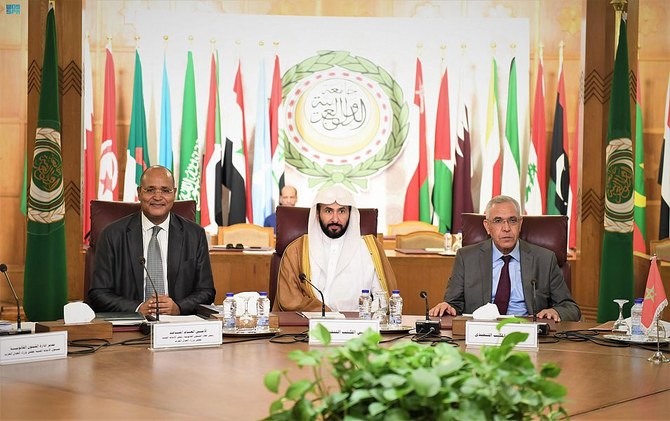
Saudi Justice Minister Waleed Al-Samaani has been elected head of the executive office of the Council of Arab Justice Ministers, the Saudi Press Agency reported.
Abdul Rashid Tabbi of Algeria was elected deputy head. Both will serve in their roles for two years.
The announcement came on Wednesday during the 71st session of the executive office, held at the Arab League’s headquarters in Cairo.
source/content: arabnews.com (headline edited)
__________
Saudi Justice Minister Waleed Al-Samaani attends 71st session of the executive office of the Council of Arab Justice Ministers. (SPA)
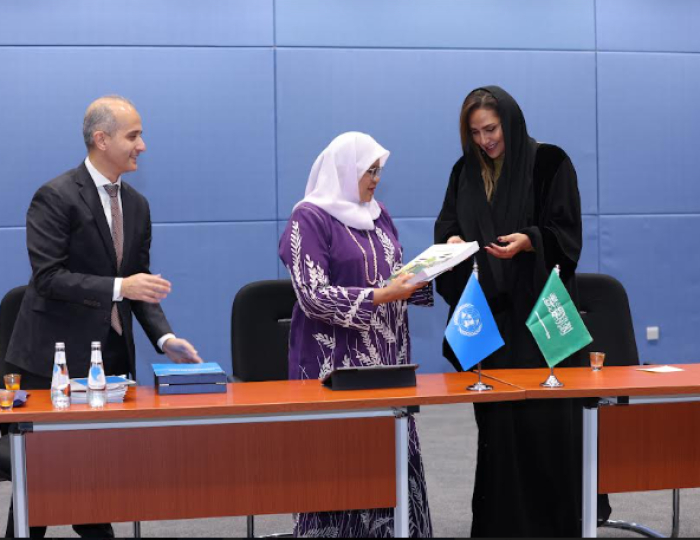
Her Royal Highness (HRH), Princess Lamia Bint Majed Al Saud, the Secretary General of Alwaleed Philanthropies, was reappointed as the UN-Habitat Goodwill Ambassador for the Arab region for a second term during a meeting held at the UN-Habitat premises in Riyadh.
As the first ever UN-Habitat Goodwill Ambassador for the Arab region appointed in 2020, HRH shed the light on key urban issues through her engagement with UN-Habitat activities and events, including the tenth session of the World Urban Forum 2020 and World Habitat Day Global Observance 2020.
HRH further advocated for topics, including Cities free from Violence against Women and Girls and COIVID-19 response in urban areas, as well as supported resource mobilization for a number of projects, targeting housing for the most vulnerable groups, COVID-19 response and climate action, spanning Iraq, Palestine, Sudan, Yemen, and Tunisia.
“I am greatly honoured to have been appointed for the second time as the UN-Habitat Regional Goodwill Ambassador for the Arab world. Our partnership with UN-Habitat will support our efforts to address issues around urbanization and its implications on societies, economies and environments. We promise to continue building bridges for a more compassionate, tolerant and accepting future along with our key partners.”
HRH signed her appointment letter in the presence of Maimunah Mohd Sharif, UN-Habitat Executive Director, Erfan Ali, UN-Habitat Regional Representative for the Arab States and Ayman El-Hefnawi, UN-Habitat Head of Office in Saudi Arabia.
“In the past three years during UN-Habitat’s cooperation with HRH Princess Lamia bint Majid Al Saud as UN-Habitat’s regional Goodwill Ambassador, HRH has shown the utmost commitment to the advocacy for the UN-Habitat mandate to realise more sustainable, resilient and inclusive cities,” Sharif commented.
UN-Habitat is keen on continuing the cooperation with HRH for the years 2022, 2023 and beyond in all relevant areas, including climate action, urban crisis response, housing and advocating the realization of better cities for all.
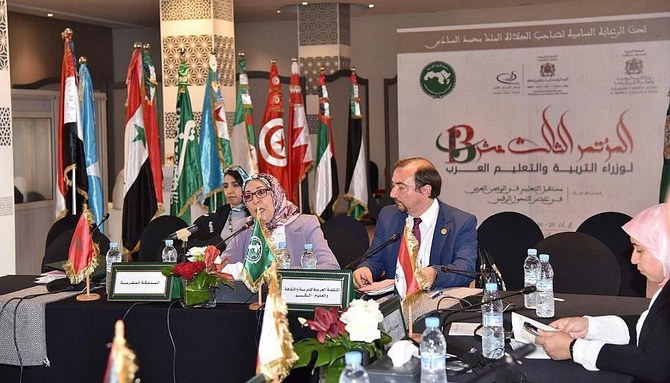
Mawhiba representatives told the 13th Conference of Arab Ministers of Education in Rabat that its ‘Gifted Arabs’ initiative had identified and was supporting people in 16 Arab countries
Secretary-General Dr. Amal bint Abdullah Al-Hazaa said that the program allows Saudi leadership to share their expertise and discover, nurture, and empower talent around the Arab world
More than 600 ‘gifted’ students have been granted support to realize their academic talents under an initiative launched by a Saudi foundation, an education conference has been told.
Leaders from Mawhiba, or the King Abdulaziz and his Companions Foundation for Giftedness and Creativity, Mawhiba, told the 13th Conference of Arab Ministers of Education in Rabat, Morocco, that its ‘Gifted Arabs’ initiative had identified and was supporting people in 16 Arab countries.
Secretary-General Dr. Amal bint Abdullah Al-Hazaa said that the program allows Saudi leadership to share their expertise and discover, nurture, and empower talent around the Arab world.
Dr. Khaled Al-Sharif, director general of Mawhiba’s Center of Excellence, said that 606 students were identified in the first and second rounds of the ‘Gifted Arabs’ initiative’s recruitment.
The initiative has provided the talented students with qualitative enrichment and academic programs to develop their knowledge and capabilities, he added.
Mawhiba said that its efforts were part of its vision to empower talent and creativity to further prosperity.
The conference, “Future of Education in the Arab World in the Digital Transformation Era,” was held on May 29 and 30.
source/contents: arabnews.com (headline edited)
___________
Mawhiba has grant aided 606 students under its ‘Gifted Arabs’ initiative. (SPA)
The authority said the forum is an opportunity to learn from regional and global experiences and to share best practices in safeguarding competition and combating monopolistic practices.
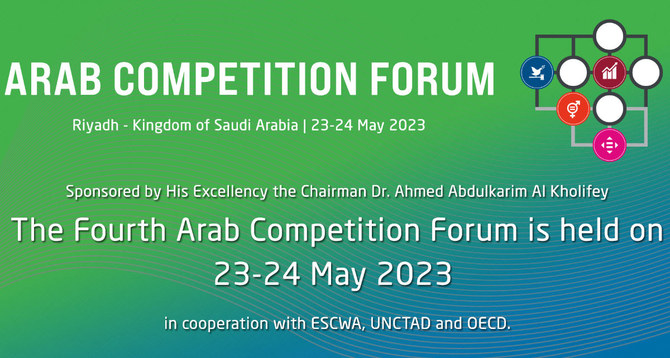
Saudi Arabia will host the fourth Arab Competition Forum, organized by the UN Economic and Social Commission for Western Asia, the UN Conference on Trade and Development, and the Organization for Economic Co-operation and Development.
The General Authority for Competition said that Saudi Arabia’s hosting of this forum emanates from its pioneering role in organizing events and forums aimed at upgrading the level of cooperation with other Arab countries to enhance fair competition in the markets, raising the level of consumer welfare in Arab countries, and stimulating enterprises to develop and innovate.
The event will take place from May 23–24 with the involvement of other competition agencies from fellow Arab countries and more than 15 experts and representatives from international agencies and organizations involved in the competition.
The authority said the forum is an opportunity to learn from regional and global experiences and to share best practices in safeguarding competition and combating monopolistic practices.
It focuses on discussing mergers and acquisitions, as well as enhancing the effectiveness of competition authorities in developing countries.
It also examines best practices for planning and conducting market studies as well as concerns arising from abuse of dominance in digital markets.
The forum was first launched in 2020 and aimed at establishing a continual knowledge-sharing platform on competition policy and enforcement for Arab stakeholders.
It advances advocacy and knowledge, builds capacity on best practices in competition across the Arab region, and facilitates coordination and collaboration at the national, regional and international levels.
Sheikha Bodour bint Sultan Al Qasimi, the President of the American University of Sharjah (AUS), has been honoured as one of Fast Company Middle East’s Most Creative People in Business 2023, specifically recognised in the “Bringing Good Things to More People” category.
Expressing her gratitude upon receiving the award, Sheikha Bodour humbly acknowledged the recognition, expressing surprise and appreciation. She described creativity as the act of transforming something from nothing and finding innovative solutions to problems. Sheikha Bodour expressed her delight if her creative endeavors have contributed to addressing challenges. Reflecting on the words of Steve Jobs, she emphasised that those who dare to believe they can change the world are the ones who actually do. Sheikha Bodour emphasised the importance of thinking differently to make a meaningful impact, highlighting the shared trait among all the nominees for the award.
In addition to this prestigious accolade, Sheikha Bodour has been recognised for her innovative thinking and leadership in various initiatives for the greater good, with a particular focus on literacy, reading, and culture.
One of her notable accomplishments was the establishment of the Emirates Publishing Association in 2009, a non-profit trade association dedicated to developing and professionalising the UAE’s publishing industry. Sheikha Bodour’s international perspective led the EPA to obtain membership in the International Publishers Association (IPA) in Geneva, a historically Western-led organisation. She also played a pivotal role in piloting IPA committees and initiatives before being elected as its vice-president from 2019 to 2020.
Sheikha Bodour’s commitment to making a difference in the literary world extended beyond the UAE. In 2019, she formed a partnership between the IPA and Dubai Cares, resulting in the Africa Publishing Innovation Fund (APIF). The fund invested $800,000 in 18 projects from 2020 to 2022, promoting indigenous languages, literacy, education, library access, and accessible book publishing for visually impaired readers. The APIF continues to positively impact thousands of people across 20 countries.
During her presidency of the IPA from 2021 to 2022, Sheikha Bodour faced the challenges posed by the COVID-19 pandemic, which significantly impacted the book industry. However, she successfully unified the global publishing community by redefining it as a balanced ecosystem comprising interconnected stakeholders.
Advocacy for women’s representation was a core aspect of Sheikha Bodour’s tenure as IPA president. She actively promoted female inclusion in committees, discussion panels, and meetings. Her efforts resulted in her successors as president and vice-president both being women. In 2025, when the vice-president assumes the top role, she will become the third consecutive woman to lead the organisation.
In 2019, Sheikha Bodour established “PublisHer” in response to the underrepresentation of women in leadership positions within the publishing industry. PublisHer serves as an interactive platform that amplifies the voices of women in the industry and provides practical support to help them advance their careers.
Sheikha Bodour’s long-standing determination led to Sharjah earning the esteemed status of World Book Capital City in 2019. Her innovative year-long program prioritised inclusivity, and as a lasting legacy, she conceptualised the remarkable House of Wisdom, a cultural hub and library that focuses on fostering human interaction and enlightenment.
Furthermore, in 2016, Sheikha Bodour launched the Kalimat Foundation, which aims to provide access to books for Middle Eastern children affected by conflict or visual impairment. The foundation empowers vulnerable young individuals by equipping them with knowledge and ideas by giving them books in accessible formats. So far, it has touched the lives of 162,000 disadvantaged children in 31 countries in Asia, Africa, Europe, and Latin America.
During their eight-day stay on the ISS, the team will aim to conduct 20 research projects.
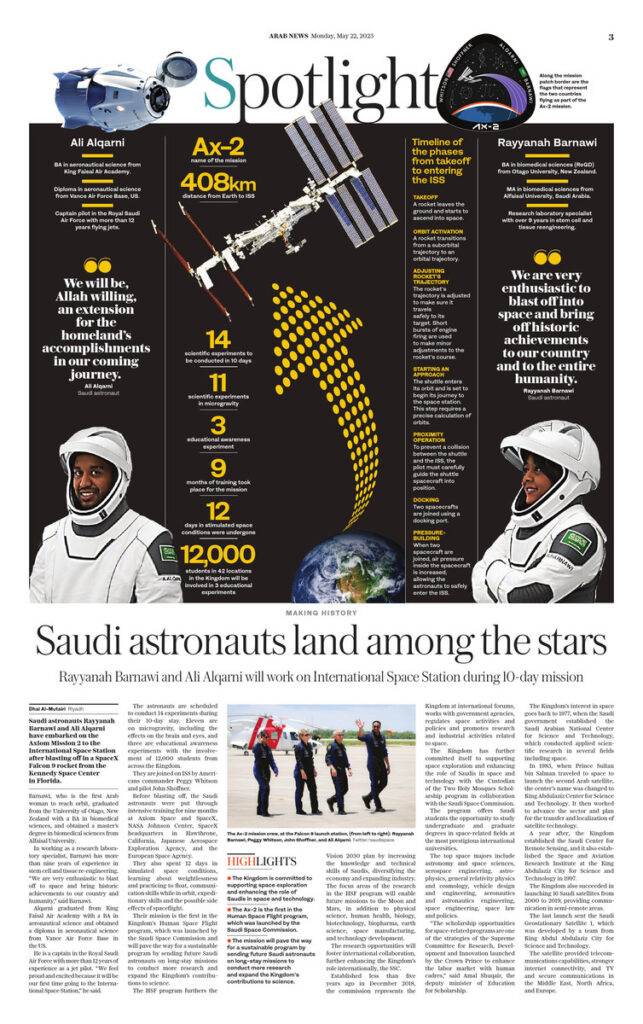
Saudi Arabia made history on Sunday as its first female astronaut, Rayyanah Barnawi, and her colleague Ali Al-Qarni launched toward the International Space Station (ISS).
The duo were on board the Axiom Space 2 mission, which launched at 5:37 p.m. (EDT time). Astronaut Peggy Whitson and business pioneer and pilot John Shoffner are also part of the mission.
Before the launch, Barnawi, a breast cancer researcher, expressed her excitement and honor at representing Saudi Arabia and the Saudi Space Commission as the country’s first female astronaut. She highlighted her passion for research and described the opportunity as a dream come true for everyone involved.
During their eight-day stay on the ISS, Whitson, Shoffner, Al-Qarni, and Barnawi aim to conduct 20 research projects. Among them are 14 projects developed by Saudi scientists, covering various areas such as human physiology, cell biology, and technology development.
The launch was with a SpaceX Falcon 9 rocket, and had a backup launch opportunity scheduled on Monday at 5:14 p.m in case of a launch failure.
It’s the same spot where Saudi Arabia’s first astronaut, Prince Sultan bin Salman, soared in 1985.
On Saturday astronaut Al-Qarni shared pictures on his Twitter account the contents of his space travel bag.
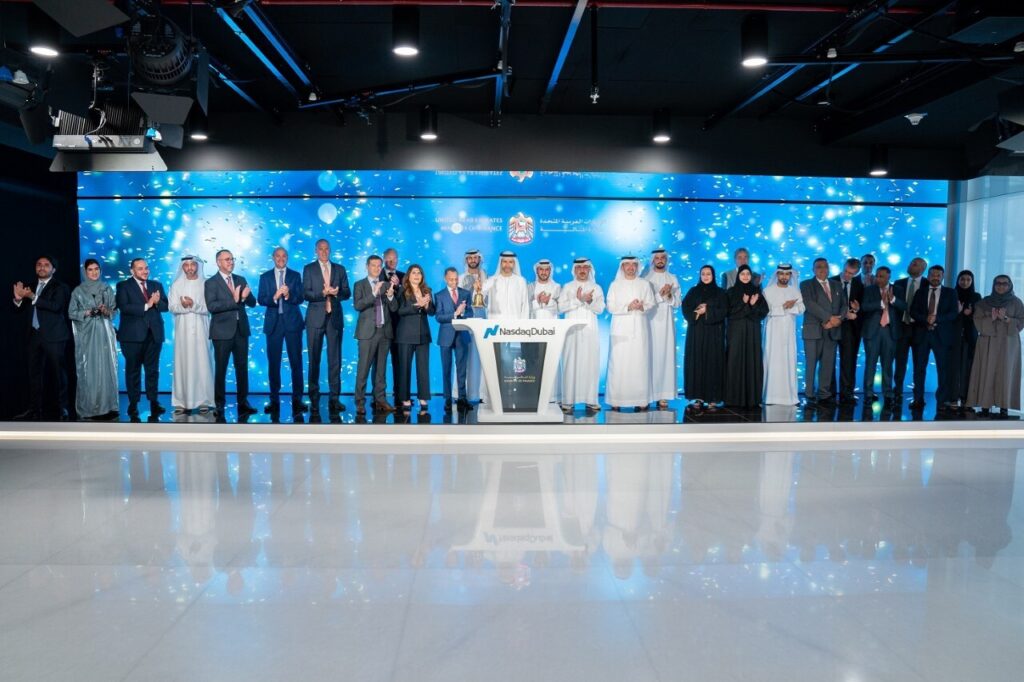
Mohamed Bin Hadi Al Hussaini, Minister of State for Financial Affairs, rang the market-opening bell to celebrate and mark listing the domestic Dirhams Islamic Treasury Sukuk (T-Sukuk) on Nasdaq Dubai.
The United Arab Emirates, represented by the Ministry of Finance (MoF) as the issuer and in collaboration with the Central Bank of the UAE (CBUAE) as the issuing and paying agent, has announced launching dirham-denominated Islamic Treasury Sukuk (T-Sukuk), with a benchmark auction size of AED1.1 billion.
The launching of Dirham-denominated Islamic Treasury Sukuk (T-Sukuk) includes a series of issuances, in order to attract a new category of investors and support the sustainability of economic growth.
Total issuance of AED1.1 billion
The issuance of T-Sukuk is aimed at enhancing the UAE’s economic competitiveness by providing high-quality Islamic assets at competitive prices. This will support the Central Bank of the UAE in managing liquidity within the banking sector and boosts the size of financial investments, which will reflect positively on the country’s economy, investment environment, per capita income, and gross national income.
The bell-ringing ceremony was attended by a number of senior officials from the Ministry of Finance, Central Bank of the UAE, Nasdaq Dubai, and the CEOs of the eight banks that were onboarded as primary dealers, in addition to other senior officials from various relevant authorities.
The inaugural issuance of the Dirham-denominated Islamic Treasury Sukuk programme witnessed a strong demand through the eight primary bank dealers, with bids received worth AED8.3 billion, and an oversubscription by 7.6 times.
The strong demand was across both tranches, with a final allocation of AED550 million for the two-year tranche, and AED550 million for the three-year tranche, with a total issuance of AED1.1 billion. Other tranches of Islamic Treasury Sukuk will be issued with various tenures of up to five years initially, followed by a 10-year sukuk at a later date.
Reaffirming UAE’s position in Islamic economy
Al Hussaini noted that issuing the T-Sukuk contributes to expanding the scope of Islamic banking and is one of the most important tools for managing monetary policy and liquidity to finance development programmes and projects.
The T-Sukuks are Sharia-compliant financial certificates for trading in the secondary market along with the main distributors, reflecting the current return on investment. These sukuk will also contribute to stimulating the securities market and strengthening the base of Islamic securities, providing safe and rewarding investment alternatives, and attracting new segments of local and international investors.
He emphasised that the success of the first auction is another testament to the UAE’s creditworthiness as one of the most advanced and competitive economies in the world, reaffirming its position as a leading investment hub in the field of the Islamic economy.
Al Hussaini said, “The issuance of Islamic Treasury Sukuk is a new step towards achieving the comprehensive and sustainable economic and social development objectives of the UAE. It contributes to the development of the financial market and the investment environment in the country by attracting financial investments and rejuvenating the local financial and banking sector to diversify funding sources, which cements the UAE’s position as a global hub for the Islamic economy.”
Efficiency of UAE’s financial sector
Khaled Mohamed Balama, Governor of the Central Bank of the UAE, said, “The T-Sukuk programme’s first issuance, denominated in UAE Dirhams, reinforces the UAE’s competitive position as a developed global financial centre.
The programme has succeeded in diversifying financial markets activities, enhancing infrastructure to support Sharia-compliant investment options and alternatives, and strengthening the resilience and stability of the financial system. This milestone will also support in bolstering financial investments and promoting greater confidence among local and international investors in the UAE’s financial system, leading to further strategic growth across the sector and fortifying the UAE’s role in the global Islamic economy.”
He added, “The remarkable success of the first auction for the issuance of T-Sukuk denominated in UAE Dirhams is a testament to the soundness of the financial and economic policies, the robust creditworthiness, and the efficiency of the UAE’s financial sector. It also supports the UAE’s stimulating investment environment globally to diversify investment and financial alternatives and continue sustainable growth underpinned by future visions and plans. We are pleased to have partnered with the Ministry of Finance in enhancing the UAE’s financial markets and improving the investment environment in the country.”
Dubai as global centre for Sukuk listings
Hamed Ali, CEO of Dubai Financial Market and Nasdaq Dubai, said, “The issuance of the T-Sukuk is an important development for the UAE capital markets attracting diversified investment categories to the country and providing an important investment tool for Islamic banking. The listing today further strengthens Dubai’s position as one of the largest centres for Sukuk listings globally with US$77.67 billion total value of Sukuk listed in Dubai.
This opens the path for regional and international investors to strengthen their links with the UAE government as well as to expand their investment options in the UAE. At Nasdaq Dubai, our mission supports the UAE Central Bank’s ambitious strategy to develop a strong fixed-income market in the UAE by providing investors with investment opportunities in sovereign issuances and a more effective yield curve gauge in debt instruments.”
The Ministry of Finance onboarded eight banks, namely Abu Dhabi Islamic Bank (ADIB), Dubai Islamic Bank (DIB), Abu Dhabi Commercial Bank PJSC (ADCB), Emirates NBD, First Abu Dhabi Bank (FAB), HSBC, Mashreq, and Standard Chartered as Primary Dealers to participate in the T-Sukuk primary market auction and to actively develop the secondary market.
Qatar Motor and Motorcycle Federation (QMMF) President Abdulrahman bin Abdullatif Al Mannai has hailed the continuous successes achieved by Qatari champion Nasser Al Attiyah at the global stage, the latest of which was his Dakar Rally 2023 title victory for a second time in a row and the fifth overall.
Al Mannai said that Al Attiyah winning the Dakar Rally title is a great achievement for Qatar motorsports and sports in general, especially since this is his fifth victory at the tough international event following his earlier wins in 2011, 2015, 2019 and 2022.
Al Mannai explained that such achievements are not strange for the champion driver who has been winning titles and bringing victories to Qatari sports and motorsports in particular, noting that he is used to ascending the podiums in all forums, which makes him the most prominent Qatari sportsperson in the recent years.
Al Mannai stressed that Al Attiyah has become a key figure in the world of desert rallies whether at the global level or in the Middle East, considering that his successive achievements are a great incentive for all Qatari drivers to follow the same path and achieve titles and championships.
The QMMF president congratulated Al Attiyah on this great achievement, which serves as a motivation for him to continue victories this season in various competitions, wishing him success and continuing the same professional approach that he follows in managing his team and its participation in various international tournaments.
Al Mannai also noted that Al Attiyah’s victory this year was due to the strong strategy he followed, as he pressed in the early stages and led the rally by a comfortable margin and then fought the rest of the stages with the aim of maintaining the lead and not taking risks.
Al Mannai also stressed that Al Attiyah is a role model for all Qatari youth, not only for those in motorsports but for all sportpersons, which raises the ceiling of ambitions to achieve many achievements and raise the name of Qatar high at all international forums.
It is noteworthy that Al Attiyah first participated in the Dakar Rally in 2004, and during his presence in twenty editions he was able to win the title five times in 2011, 2015, 2019 and 2022, and occupied the runner-up position on five occassions in 2010, 2016, 2018, 2020 and 2021.
Toyota Gazoo Racing’s Qatari driver Nasser Saleh Al Attiyah celebrates with co-driver Mathieu Baumel of France, Qatar Motor and Motorcycle Federation President Abdulrahman bin Abdullatif Al Mannai and officials after winning his fifth Dakar Rally title in Saudi Arabia, on Sunday. PIC: RED BULL
Students of King Abdulaziz University won 41 medals during their participation in the 48th Geneva International Exhibition of Inventions.
The recently concluded exhibition saw 825 exhibitors from 44 countries take part with more than 1,000 inventions.
The head of innovation at the university, Dr. Iqbal Ismail, told Arab News: “Other Saudi universities are also participating. However, the participation of King Abdulaziz University at this exhibition is the largest and has been ongoing since 2016.”
Dr. Hana Al-Naim, acting president of the university, praised the achievements of the university’s male and female students, which have contributed both to the community and the Kingdom’s ranking, regionally and globally, in the field of creativity and innovation.
The students came from the university’s various colleges including departments of medicine, engineering, information technology and nursing.
Rahaf Alem and Raghad Al-Jundi won the International Federation of Inventors Association Award for the invention of a laser blood disease detector, also winning the gold medal.
A special prize from Taiwan was awarded to student Faisal Al-Subaie for inventing a cistern made from palm fronds to provide irrigation water.
Ahmed Al-Zahrani, Saleh Bakraa, Marwan Al-Jadaani, and Mohammed Al-Khamis also won the special award for their automated diagnostic platform.
The silver medal was awarded to Duaa Al-Shabani, Lama Al-Jelani, Gaitha Al-Khatami, Emtinan Yamani, and Hadeel Al-Lazori for their invention of an antimicrobial agent for dialysis patients.
Several Saudi inventions received the bronze medal. Safwan Hashim and Abdullah Abu Thyab won it for their renewable-energy car umbrella and Abdullah Al-Khotami for his work on protective glasses that shield wearers from thermal diseases.
Hala Mogarbel, Shahad Asiri, and Shatha Al-Sulami won the bronze medal for their urinary catheter holder invention.
Dina Al-Shibeeni, Marwa Bakour, and Hind Al-Rashid also won the bronze medal for the invention of an artificial intelligence gardening system.
The invention of a bedsore-proof bed earned Bateel Bajamal, Rena Al-Qahtani, Joud Hakami, Asmaa Bahmeed, and Shahad Al-Nahdi the bronze medal.
Shathar Al-Shabak, Jumana Al-Madhoun, Njoud Al-Ghamdi, and Raneem Saati were also awarded for their invention of “Minqath,” a drowning warning system.
Finally, Sumayah Baamer, Raniya Baksh, Rahaf Al-Saeed, and Deema Majashi won the bronze medal for school environment safety measures using artificial intelligence.
Ismail said: “There is no doubt that such student participation will have a great impact on raising a generation that thinks and researches in a scientific way and develops appropriate solutions to the problems facing the…community.”
He added that the exhibition constitutes an important opportunity to transform inventions into products that can be manufactured and marketed inside and outside the Kingdom.
Al-Naim will honor the exhibition’s winning students in a ceremony on Wednesday.
Five other coders win $50,000 each in awards presented by Dubai Crown Prince for top apps.
A Syrian coder on Wednesday won $1 million (around Dh3.67 million) in the ‘One Million Arab Coders’ contest during an award ceremony in Dubai facilitated by Sheikh Hamdan bin Mohammed bin Rashid Al Maktoum, Crown Prince of Dubai, Chairman of The Executive Council and Chairman of the Board of Trustees of the Dubai Future Foundation.
Six software projects developed by Arab youth from around the world competed for the grand prize, thanks to the programming skills they acquired during their participation in the initiative’s courses.
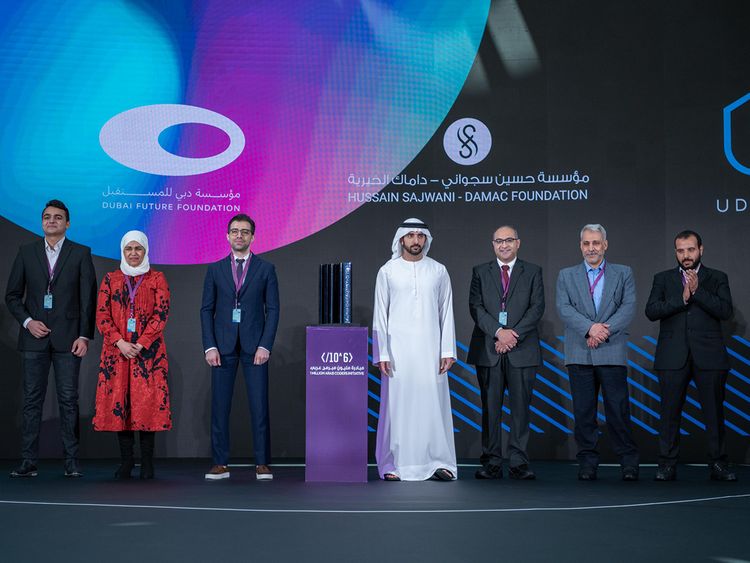
On Wednesday, during the closing ceremony held at the Museum of the Future in Dubai, Sheikh Hamdan presented the awards to winners, with Mahmoud Shahoud, a Syrian coder who lives in Turkey, taking home the $1 million top prize.
Sheikh Hamdan tweeted: “Today, we honoured the winners of the ‘One Million Arab Coders’ Challenge, the UAE’s initiative to nurture the development of technology skills among Arab youth. 1.85 million Arab participants from 80 countries took part in the initiative along with 3,600 certified trainers.”
He added: “The Challenge opens fresh opportunities for Arab youth and offers a new path for them to achieve their dreams… Congratulations.”
Sheikh Hamdan added: “The ‘One Million Arab Coders’ initiative provided the opportunity for one million Arabs to enter the digital world. It fulfilled the dreams of tens of thousands of Arab programmers from all over the world. Its outcomes and successes will be the basis for many upcoming Arab achievements in the world of technology and coding. One Million Arab Coders’ has paved the way for Arab youth to broaden their horizons and sparked their innovation and creativity in the field of advanced technology.”
He added that the ‘One Million Arab Coders’ initiative, which was launched in 2017 by His Highness Sheikh Mohammed bin Rashid Al Maktoum, Vice President and Prime Minister of the UAE and Ruler of Dubai, has succeeded in becoming a gateway for many Arab youth to use their programming skills to realise their dreams and aspirations.
“We look forward to our Arab coders continuing their pioneering innovations and expanding their achievements. We expect their names and future accomplishments to light up the sky worldwide.
“His Highness Sheikh Mohammed bin Rashid Al Maktoum’s vision for the region’s future is based on investing in the development of the Arab people. The language of programming is one of the pillars of the knowledge economy and a major bridge to a future in which those who possess scientific excellence will have the upper hand,” Sheikh Hamdan concluded.
Shahoud was adjudged winner for his ‘Habit360’ app that helps users create and maintain good habits, allowing them to achieve long-term goals. Shahoud said half of the prize winning will go towards helping Syrian refugees. The rest will be invested in Dubai as Shahoud plans to shift his base to the emirate and start his own business.
Sahoud is a software engineer from Syria who developed Habit360 that helps people build new habits, track their progress and stay motivated. The application has served more than 200,000 users from around the world.
Beside Shahoud, there were five other winners announced on Wednesday.
About the initiative
The ‘One Million Arab Coders’ initiative is supervised by the Dubai Future Foundation and organised under the umbrella of the Mohammed bin Rashid Al Maktoum Global Initiatives.
The closing ceremony held at Dubai’s Museum of the Future on Wednesday was to honour the best Arab talents in coding, and highlight best coding projects developed by graduates of the initiative to serve their communities and create a better future for humanity.
A total of $1.35 million was given away in prizes during the ceremony.
Mohammed Abdullah Al Gergawi, Minister of Cabinet Affairs, Vice Chairman of the Board of Trustees and Managing Director of the Dubai Future Foundation, said: “The ‘One Million Arab Coders’ initiative embodies the vision of His Highness Sheikh Mohammed bin Rashid Al Maktoum [Vice President and Prime Minister of the UAE and Ruler of Dubai] , to provide new opportunities for Arab youth, empowering their contributions to the advancement of technologies globally, and to put a clear Arab footprint in the future of humanity.”
Aimed at youth
He said the initiative aimed mainly at empowering Arab youth around the world with the tools of the future, and providing them with the opportunity to gain new experiences and skills that would help them turn their dreams into successful projects that benefit their societies and have a positive impact on their lives.
“The initiative was a glimmer of hope for Arab youth around the globe that success is not bound by place, age, or obstacles. Rather, success requires insistence on acquiring the experiences and skills that will be needed in the future,” Al Gergawi said.
He pointed out that the initiative was a cornerstone for countless success stories where coding helped create a positive impact on the future of humanity, and spread hope in the Arab region.
Al Gergawi stressed the importance of the initiative’s role in encouraging Arab coders to innovate and start developing software projects that not only meet the needs of their societies, but also foresee and adapt to its future requirements and changes, pointing to the initiative’s success in developing a leading global experience to teach coding skills in an effective manner, which was adopted in Jordan and Uzbekistan.
Saeed Mohammad Al Gergawi, Director, Dubai Future Academy, said: “We have 400 million Arabs and that is a lot of talent. Our criteria is that they had to be impactful, ready to be implemented and creative.”
Other winners
In addition to the grand prize for the ‘One Million Arab Coders’ challenge, the five best projects will receive prizes of $50,000 each, and four of the best trainers participating in the initiative will be honoured with prizes of $25,000 each. The finalists were chosen by a specialised jury that comprises many experts in the fields of entrepreneurship and future technologies.
Egyptian–Canadian Andrew Makram won $50,000 for his app called ‘Najeeb’, a platform for exams, tests and quizzes. “It is a cross-platform tool for teachers and educators to create and share paperless quizzes online. What the app does is that it allows students to access the quiz remotely, submit answers and receive the result instantly. Realtime submitted data are available to educators for revision and evaluation purposes,” he said.
Makram added that it took him a month to develop the app and it is in prototype form.
Egyptian entrepreuner Eman Magdy was another winner who has developed an app for the benefit of working women in Egypt. She won a prize for her initiative to ease the burden of working women in Egypt.
“The app is called 3lfraza. It is a platform to support homestay women in Egypt. Basically homestay women help working women to prepare vegetable and meat cuts and meals. Currently 9,000 women are registered from Egypt. We hope more women for all over the world use this to help one another. The app supports small vendors, helping busy mums in their day to day lives,” she said.
Meanwhile Mohamed ElEskandarany developed an app called ‘Muaahal’ to help youth to develop new skills. “It is a platform that aims to qualify Arab youth and prepare them well in the fields of their choice to work in suitable jobs or to start their own business. In addition, helping companies to find qualified employees, and to solve the problem of unemployment and increase the productivity of youth,” he said.
Another winner, Ammar Salim, won in the initiative for his app called Qeraaty Alnateqa which helps in speaking-reading program for the deaf and mute. “It is a speaking program to teach reading and writing to deaf and mute children. With a new sign language system and tool for converting the sign of only two fingers from the fingers of the hand to spoken letters and words,” said Salim.
Last but not the least, Hasan Mohamed won the prize for his ‘Chat translation app’.
“It is a mobile app that provides a textual and vocal chat for people of different languages in different places around the world ,to convert people’s speech in different languages into written texts, translate texts from one language to another, and convert translated texts into spoken speech again,” said Mohamed.
Software expertise
Sheikh Mohammed launched the ‘One Million Arab Coders’ challenge in July 2021 with the aim of recognising and honouring the achievements of Arab talents in the field of programming and creating an opportunity for participants in the initiative to showcase their innovative projects, developed using programming skills and the experience gained during their participation.
The challenge saw a total of 257 projects submitted by the initiative’s graduates from 50 different countries in various sectors related to programming, technology and entrepreneurship in the areas of website and mobile application development. In order to qualify for the final stage and compete for the million-dollar prize, the nominees were selected according to a set of main criteria, including the project idea, the innovation quality, and ease of use.
Jury
The jury for the final round included Fadi Ghandour, Chairman of Wamda Capital; Bashar Kilani, Managing Director of Accenture Middle East; Dr. Abdul Latif Al Shamsi, Director of the Higher Colleges of Technology; and Ronaldo Mouchawar, Vice President of Amazon Middle East.
Supervised by the Dubai Future Foundation, the ‘One Million Arab Coders’ initiative has seen 1,058,265 people from around the world participate virtually in millions of hours of study and work, as well as tens of thousands of training workshops. Since its launch, 1,500 “Nano Degree” certificates have been awarded to distinguished participants and promising talents. The initiative featured more than 3,600 certified trainers from around the world.
Serving humanity
Led by the Dubai Future Foundation (DFF) and organised under the umbrella of the Mohammed Bin Rashid Al Maktoum Global Initiatives (MBRGI), ‘One Million Arab Coders’ is the largest initiative of its kind in the world. The initiative aims to teach one million young people from the Arab world to code and enable them to launch exceptional projects and programmes that serve Arab societies, drawing on the science and skills gained from their training.
The initiative embodies Sheikh Mohammed’s vision to empower Arab youth with the tools of the future to serve humanity and build a brighter future for the region. The challenge forms part of the UAE’s continuous efforts make a positive impact on the world.
Partnerships
The ‘One Million Arab Coders’ initiative is supported by the Hussein Sajwani – DAMAC Foundation, which focuses on supporting learning opportunities and developing skills to stimulate profitable social and economic participation, and empowering societies in the Arab world to achieve a sustainable future. The Udacity digital learning platform also supported the initiative by offering educational content and training in necessary skills for future jobs. The list of partners of the initiative also included many international technology companies, including Microsoft, Facebook, Oracle, Careem and others.
The initiative also provides the world with a pioneering model for promoting the development of programming skills. It was adopted in the Hashemite Kingdom of Jordan, which launched the ‘One Million Jordanian Coders’ initiative in May 2019. The initiative was introduced with the aim of making Jordan a world leader in the field of programming. The ‘One Million Uzbek Coders’ initiative, launched through a partnership between the governments of the UAE and the Republic of Uzbekistan, was announced in November 2019, with the aim of providing Uzbek youth with an opportunity to acquire skills in programming, artificial intelligence and emerging technologies, to contribute to the development of innovative technology-based solutions and services.
source/content: gulfnews.com (headline edited)
_____________
Sheikh Hamdan bin Mohammed bin Rashid Al Maktoum (centre) with the winners / Image Credit: Supplied