Arabs & Arabian Records Aggregator. Chronicler. Milestones of the 25 Countries of the Arabic Speaking World (official / co-official). AGCC. MENA. Global. Ist's to Top 10's. Records. Read & Enjoy./ www.arabianrecords.org
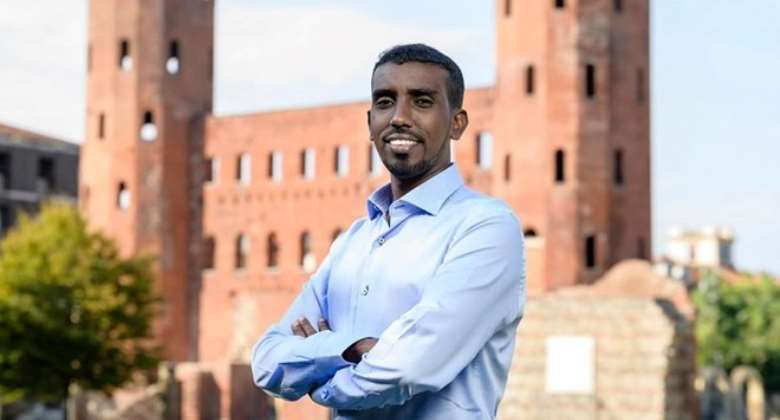
Somali immigrant who conquered the high seas for seven months in 2008 elected Councillor in Italy.
He braved the desert and the high seas at the height of turmoil in Mogadishu in 2008 and for seven months, Abdullahi Ahmed Moalim kept the dream alive against the odds of the dangerous journeys taken by many Somalis but survived by a few.
This week, Moalim was elected a Councillor in Turino City in Italy becoming the first Somali immigrant to occupy the position in about 25 years. He garnered 1112 votes in City Council elections conducted on October 17, 2021
Upon arrival in Italy in 2008, Moalim integrated into his new home and eight years later in 2016, he was granted citizenship.
“I declared my candidature in July after the Democratic Party convinced me to run for the seat in October elections. We launched a two months campaign which was fruitful and helped us secure the seat,” Moalim said in a media interview.
Asked about his priorities, Moalim said he aspired to fight Islamophobia and was intend on seeking the Council’s approval for a day every month to create awareness on countering Islamophobia.
Moalim now joins the ranks of Mohamed Aden Sheikh who was elected to Turino City Council in 1997.
He also enters the club of growing number of Somalis who have been elected into office in countries such as Canada and the US.
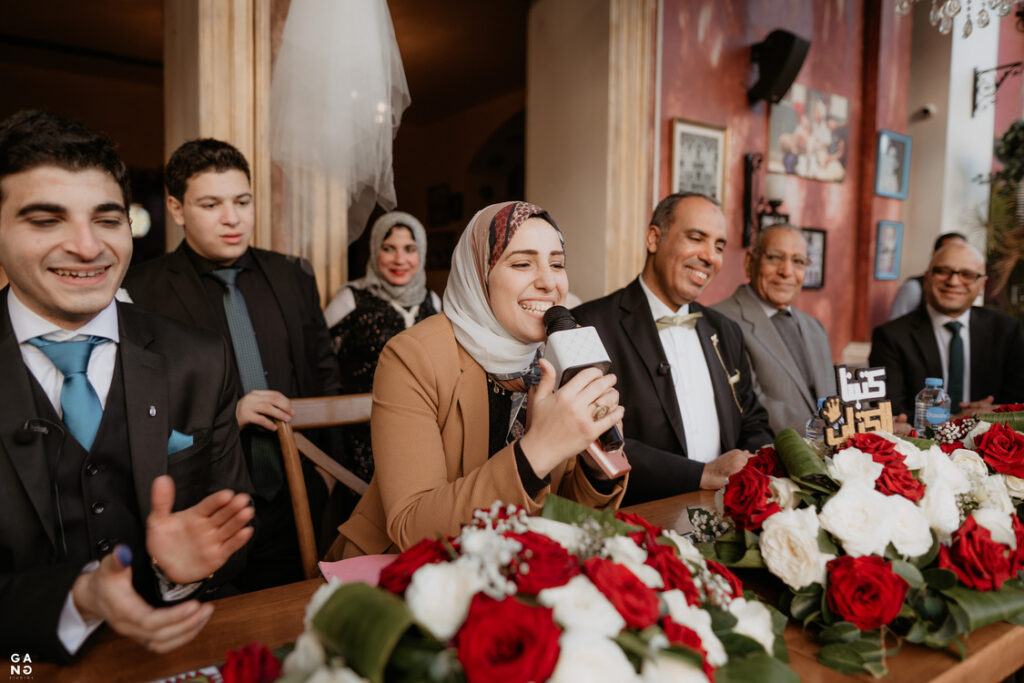
In December 2020, Zeinab el Kawashti married a couple, Sondos and Karim, in front of their family and friends. In a different time and place, this would have been a normal occurrence, yet it was the first time any of the guests had seen a woman as a marriage officiant.
This is not odd, given that female Ma’azin (Muslim marriage officiants) are extremely rare.
The first-ever female marriage officiant in Egypt was Amal Soliman; she was hired in 2018 by the Egyptian family court and has since then married more than 300 couples. Many were inspired by Soliman, among them El Kawashti.
El Kawashti is a female M’azoun, a mother of three, and an Azhar Law and Religious Studies graduate.
To become a Ma’zoun in Egypt, one must have at least a Bachelor’s degree. Ma’azin are restricted to their jobs as officiants, with no further commitments. There are around 45 requirements to become a Ma’zoun in Egypt, including age. As of 2014, a Ma’zoun can only be between the ages of thirty and forty. The requirements also include maintaining optimal physical wellbeing.
source/content : egyptianstreets.com
___________
Zeinab El Kawashti officiating at a katb ketab. Photo Credit: Sondos Moussa
Latifa Ibn Ziaten . French-Moroccan Activist. President, Association for Youth and Peace (IMAD).
Zayed Award for Human Fraternity has empowered me to continue fighting: Latifa Ibn Ziaten.
Anti-extremist French-Moroccan activist Latifa Ibn Ziaten, President of the Association for Youth and Peace (IMAD), called on countries participating in Expo 2020 Dubai to support the efforts aimed at supporting peaceful coexistence and combatting extremism.
She also lauded the UAE’s efforts to encourage social peace and promote the principles of tolerance and human fraternity.
In an exclusive interview with the Emirates News Agency (WAM), Latifa Ibn Ziaten, winner of the award in 2021, expressed her appreciation for the award.
“I am proud to be here in the UAE, the country that gave me the opportunity to win the Zayed Award for Human Fraternity, which empowered and motivated me to continue my journey and fight to help marginalised youths,” she said.
“We need to help each other, most notably the youth who engage in terrorism. I will explore the reasons that led them to choose extremism, as people are not born terrorists, but factors, such as misery, ignorance, desperation and specific lifestyles, have led them to become prey for terrorism,” she added.
Ibn Ziaten said that she delivered several lectures in Abu Dhabi on terrorism and participated in seminars on how to save the youth from terrorism, in addition to delivering lectures in Morocco, the US, India and Mali. In France, she has worked with the Ministry of Education and conducts weekly lectures to raise the awareness of the youth.
After her son was killed in a terrorist attack in 2021, Latifa Ibn Ziaten has dedicated herself to promoting tolerance and countering terrorism.
Top winners of the 17th edition of Algeria’s international Quran competition were awarded in a ceremony on Sunday, February 28th
Zeinab Bin Yousuf won claimed the title of the event. Yahya Bilal Yousuf from Bahrain and Syrian Abd al-Rahman Mohammad Hardan ranked third.
The ceremony was attended by a host of Algerian Quran activists and officials.
Representatives from 48 countries took part in this edition, which was held virtually due to the coronavirus pandemic.
The contestants went to Algeria’s embassies and consulates in their country to take part in the competition via video links.
Members of the panel of judges were from Algeria, Egypt, and Guinea.
According to Algeria’s Awqaf ministry, Wa Rattil al-Quran Tartila (referring to verse 4 of Surah a-Muzmmil that orders reciting the Quran in Tarteel) was the motto of this year’s competition.
Unlike previous editions that were held in the holy month of Ramadan, this edition was organized in the lunar Hijri month of Rajab on the occasion of Lailat-Al-Miraj, the day when Prophet Muhammad (PBUH) ascended to all the seven stages of heaven.
Launched in 2004, Algeria’s international Quran contest is held annually on memorization of the Holy Quran with the participation of young people under the age of 25.
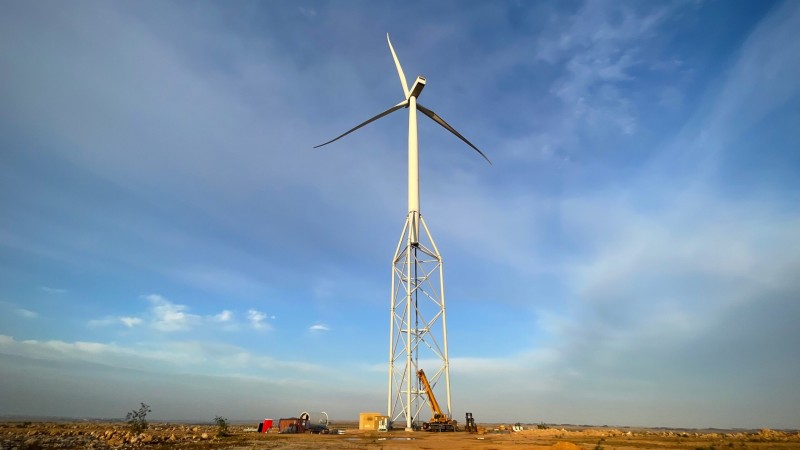
The state-of-the-art wind turbine in Morocco’s Oualidia is expected to generate an annual average of 2.500 MW/h, reducing CO2 emissions by 2.500 tonnes every year.
The 144-meter tall structure, part of the InnoVent’s Oualidia wind farm, provides a milestone thanks to high production capacity and cost-efficiency.
Construction work for the turbine began in 2019 following a deal between Morocco’s government and Spanish renewable energy company Nabrawind Technologies.
The installation is the first “self-erecting turbine” for Nabrawind Technologies.
Aside from breaking the continental height record for turbines, the Nabralift tower is special on grounds of the innovative construction method. The company used an innovative self-erecting system to construct the tower, without the need for conventional large-size cranes.
Built in collaboration with French developer InnoVent, the turbine additionally breaks the record for the tallest turbine constructed with a self-erecting system.
The innovative construction model was also cost-optimal as the tower only needed 80 square-cubic meters of concrete for its foundation, down from 500 square-cubic meters necessary for structures of such height, lowering cost by 60%.
Tunisia bid a final farewell on June 1 to the prominent historian and scholar of Islam – Hichem Djait, whose input was seminal to research on critical periods of Islamic history. From sociological, philosophical and anthropological perspectives, Djait’s publications offer insight into key issues facing the interpretation of Islamic history and the interaction of Islam with modernity.
Born in 1935 in Tunis to an erudite family in Islamic jurisprudence, Djait received a conservative education in his immediate milieu before attending the Sadiki high school in Tunis, which opened the gates for him to French and Western culture in general. He received an advanced degree in history in France in 1962. Afterwards, he obtained a Ph.D. in Islamic history from the Sorbonne University in Paris in 1981.
In a comment on his learning journey from Tunis to Paris, he said: “My discovery of philosophy was decisive. It was a conquest and a spiritual awakening, and I do not mean that only in a metaphysical sense, but also at the level of psychology, ethics and logic. It was then that preconceived certainties began to melt away and I discovered biology and the theory of evolution, and all of this amazed me and astonished me at the same time.” (See a related article, “Do Human Evolution and Islam Conflict in the Classroom?”)
Djait, who died at age 86, spent nearly half a century investigating Islamic history and Arab culture. He was an emeritus professor at the University of Tunis and a visiting professor in several renowned higher education institutions, including McGill University, in Montreal, and the University of California at Berkeley. He was also a member of the European Academy of Sciences and Arts, chairman of the Tunisian Academy of Sciences, Letters and Arts, and a member of the International Scientific Committee that produced Unesco’s eight-volume General History of Africa.
His stay in the West inspired him to write Europe and Islam, a book that sheds light on the interplay between Islam and Western civilization. His magnum opus remains The Great Fitna (La Grande Discorde), a groundbreaking work in the study of a major period of Islamic history in line with a rigorous academic approach.
His focus shifted more towards writing the biography of the Prophet Muhammad using scientific lenses in what has been described as a bold approach to Islamic history that breaks away from the sacralization that permeates the work of many Arab scholars on the subject. His goal was to rewrite prophetic tradition in a scientific way that combines comparative history with anthropological insight.
In this respect, he made it clear that a distinction should be made between historical thought, historiography and the philosophy of history. This book was written in three parts and puts the genesis of Islam in its historical context. (See a related article, “A New Perspective on the Last Days of the Prophet.”)
Djait received a constellation of distinctions and prizes, including being named Arab Cultural Personality of the Year by the Arab Institute for Research and Publishing in Beirut in 2016, and being honored in 2018 by a group of Arab researchers who dedicated to him a book that sheds light on his rich academic and intellectual journey.
source/content: www.al-fanarmedia.org (edited for length)
_____________
Hichem Djait died June 2021 at age 86. The Tunisian scholar spent nearly half a century investigating Islam’s place in history and in the modern world (Photo: from Facebook).
The Industry convenes for Dubai Diamond Conference 2022.
DMCC – the world’s flagship Free Zone and Government of Dubai Authority on commodities trade and enterprise – today hosted its flagship Dubai Diamond Conference (DDC) held under the theme “The Future of Diamonds”.
In his opening remarks, Ahmed Bin Sulayem, Executive Chairman and Chief Executive Officer, DMCC, announced that the UAE reached the top spot globally as a rough diamond hub, trading over USD 22.8 billion worth of rough diamonds in 2021. The country’s polished segment continues to grow at pace, closing in on the current market leader.
Since 2015, the UAE has increased its rough diamonds trade by 76%, overtaking Belgium as the world’s leading rough trade hub. The total diamond trade in the UAE grew by 83% between 2020 and 2021, demonstrating both the industry’s resilience and Dubai’s critical role in the global sector. Dubai boasts direct flights to other diamond hubs across the world, including mining countries in Africa and manufacturing centres in India, resulting in a connected supply chain with Dubai at its centre. Additionally, Dubai is home to the two Kimberly Process (KP) offices in the UAE, making the emirate the only entry point for rough diamonds in the country.
Ahmed Bin Sulayem, Executive Chairman and Chief Executive Officer, DMCC, and Chairman, Dubai Diamond Exchange, said: “I am humbled to share that in 2021, Dubai, UAE, became the number one rough diamond trading hub in the world. With USD 22.8 billion in rough trade last year, we are continuing to grow thanks to the trust and support received from so many of our guests here today – we accomplished this together. This major milestone clearly demonstrates the determination of both Dubai and DMCC in advancing the global industry.
DMCC’s Dubai Diamond Exchange is the largest diamond tender facility in the world and home to over 1,100 diamond companies, providing members and industry professionals with state-of-the-art infrastructure, facilities and services to trade with confidence.
source/content: mediaoffice.ae
__________
(L to R) Bruce Cleaver-CEO, De Beers, Iris Van Der Veken – Exec Director, Responsible Jewellery Council, Amit Dhamani – CEO & MD, Dhamani Jewels Group and Ahmed Bin Sulayem – CEO & Exec Chairman, DMCC
In 1851, the Great Exhibition set out to bring culture, history and innovations together in one place — London — for the world to see. Since this inaugural world expo, however, more than 85 percent of the global events have been hosted by either European or North American cities.
Some notable exceptions are the expos held in Asia, including Osaka in 1970, Aichi in 2005 and Shanghai in 2010, almost all of which set attendance records. But to date, these major events have been predominantly northern and western hemisphere affairs.
That is why Expo 2020 Dubai has been such a big deal, not just for world expos but also for the Middle East and North Africa region as a whole, with the Arab world occupying center stage for the first time.
As host, the UAE has offered the very essence of Arab hospitality, first by dedicating a pavilion to every participating nation, and, second, by giving every nation its own “national day” throughout the event. Saudi Arabia’s day fell on Jan. 7.
Expo 2020 Dubai has also had a distinctly Arab feel. The site is peppered with traditional Arabic design features, on its sunshades, water fountains and even public seating.
It is a well-known expo fact that pavilion positioning is everything, often indicating a nation’s global significance and its relationship with the host. With masterful design planning, the UAE was able to place participating Arab countries at the heart of the action, giving them greater visibility and prominence.
Naturally, the UAE pavilion is the largest, occupying the prime position. Its immediate neighbor is the impressive, world record-setting Saudi Arabian pavilion, and close by are Morocco, Palestine, Egypt, Kuwait and other Arab countries.
The Saudi pavilion achieved three Guinness World Records for the largest interactive light floor, the longest interactive water curtain and the largest interactive digital screen mirror. But it is not alone in showcasing avant-garde architecture ideas.
While the expo lives up to its theme of “Connecting Minds, Creating the Future,” it also offers a visible celebration of Arab cultures and nations on a global stage.
Themes celebrating the past are normally divided between the ancient past, such as the Bronze Age settlements of Failaka Island in Kuwait, and the more recent past, before the rapid urbanization of the last half-century.
Indeed, the Arab pavilions go to great lengths to pay homage to the feats and wisdom of past generations. For example, the first exhibit in the UAE pavilion features a stylized desert, with the soft, fine sand of Emirati dunes used as a projection surface for old film reels paying tribute to Sheikh Zayed Al-Nahyan, the UAE’s founding father.
In the nearby Vision Pavilion, dedicated to Sheikh Mohammed bin Rashid Al-Maktoum, a guided video tour begins with the story of his stay with a Bedouin leader in the desert as a child, and the lasting impact that connection with the land made on him as a leader.
In the Saudi pavilion, ancient cultural sites, such as the tombs in Al-Hijr, At-Turaif District and the AlUla valley, are featured in a striking visual tour of the rich cultural history and natural beauty of the Kingdom.
In the Oman pavilion, meanwhile, a focus on frankincense highlights the sultanate’s eye-catching landscape and long trading history.
Far from focusing exclusively on their glorious past, Arab pavilions look to the future. Many have a concrete vision that highlights targets set in order to achieve desired development outcomes.
Saudi Arabia has put sustainability at the heart of its vision for the future, Vision 2030, which seeks to diversify its economy, alongside a pledge to reach net-zero carbon emissions by 2060.
Egypt has its own Vision 2030 plan, announced in 2016, which sets out eight national targets aligned with the UN’s Sustainable Development Goals, focusing on an inclusive economy, education and the environment.
In this vein, Kuwait’s pavilion addresses the resilience of its earliest settlements, while a stylized water tower at the pavilion’s center highlights the ways in which humans have carefully managed its natural resources in order to flourish there.
Although Lebanon’s pavilion is much more austere compared with other Arab offerings, its message is a strong reminder of the resilience of its people.
Taken together, Arab participants in Expo 2020 Dubai have made good use of this global stage to highlight their achievements, heritage, ambitions and fortitude. In this sense, the expo can be considered an Arab triumph.
source/content: arabnews.com
___________
Expo 2020 Dubai has been such a big deal, not just for world expos but also for the Middle East and North Africa region as a whole, with the Arab world occupying center stage for the first time. (AFP/AN Photo)
Russian tribute to Yehia Abdel-Tawab, first ballet dancer in Egypt
Yehia Abdel-Tawab, one of the pioneers of ballet in Egypt and the recipient of the Medal of Merit from late President Gamal Abdel-Nasser, has been honored by the Egyptian Association of Graduates of Russian and Soviet Universities (EAGRSU) and the Russian House in Cairo for his contribution in strengthening Egyptian-Russian relations through his artistic career.
The EAGRSU and the Russian House held a seminar titled ‘The Ballet in Egypt and Russian Experiences’ earlier this week in honour of Abdel-Tawab, who is a professor of ballet at the Academy of Arts.
The seminar, held at the Russian Cultural Centre in Dokki, was moderated by President of the Association Sherif Gad and attended by director of the Russian Cultural Centres in Egypt Marat Gatin, dean of the Ballet Institute in Cairo Atef Awad, former dean of the Ballet Institute Sherif Bahader, member of the board of directors of the association Samia Tawfik, and Ballet Institute professor Tahani Hassan.
Abdel-Tawab also stressed that ballet in Egypt has a strong foundation, and with the efforts made by the state to build new opera houses, there will be many specialized ballet companies, and called for more cooperation with Russian experts in order to exchange experiences.
Former dean of the Ballet Institute Bahader said that Abdel-Tawab is considered one of Egypt’s first pioneers in the art of ballet, and one of the greatest ballet dancers in the entire world.
“He is also one of the first dancers in double dance in Egypt and the Arab world.”
Professor of ballet Tahani Hassan expressed her pride in her teacher at the Ballet Institute Abdel-Tawab, pointing out that all his students learned from him commitment, as he was accurate in timing and executing movements.
During the event, a documentary film on the history of the art of ballet in Egypt was shown, and Gad presented a certificate of honour on behalf of the association to Abdel-Tawab in appreciation of his great artistic career.
source/content: english.ahram.org.eg
__________
(L-r) Marat Gatin, Sherif Bahader, Tahani Hassan, Yehia Abdel-Tawab, Atef Awad, and Sherif Gad photo credit of the Russiaan Centre
The Fiber Connect Council MENA has announced the appointment of Eng. Ahmed Mekky, Chairman and CEO of Benya Group, as Chairman of the council for a two-year term, succeeding Mr. Juan Colina. His appointment for this esteemed role, marks the first time an Egyptian assumes this position.
Eng. Mekky has been involved with the council in his capacity as a member of the Board of Directors since 2011, and was nominated for his role as Chairman of the council, in light of his endless contributions to the ICT industry on a global level and particularly for his extensive experience in the field of optical fibers.
Benya Cables, a subsidiary of Benya Group, began with ambitious plans to build the region’s largest optical fiber factory, and is now months away from materializing that reality.
Fiber Connect Council MENA has a mandate to exponentially increase the deployment of high-speed fiber networks, to connect consumers, businesses, governments and organizations, with the products and services needed to enhance quality of life, make a sustainable impact on the environment, boost business competition and develop apps to ultimately transform the way people live and businesses operate.
The Council’s Board of Directors is comprised of a notable cohort of member organizations such as Corning, Prysmian MEFC, OFS, Etisalat, and Oman Broadband. The board was formed in 2011 as an initiative launched by the founding members, and since inception, now boasts a member and partner count over 50 prominent industry leaders.
Kholoud Al-Dergham, Director General of Fiber Optic Connect Council MENA, welcomed the appointment of Eng. Ahmed Mekky as the Council’s new Chairman, highlighting “his expert record and experience in this field as invaluable assets to the Council, as well as a unique opportunity to invest that kind of experience, to accomplish the council’s objectives to expand the use of fiber optics”.
Eng. Ahmed Mekky is one of the most influential and prominent leaders in the ICT sector. In 2017, he founded Benya Group, formerly known as “Fiber Misr Systems,” and its affiliates with the goal of accelerating the Middle East and Africa’s digital transformation.
Prior to that, he launched Gulf Bridge International (GBI) in 2008 to build and operate the first underwater cable network, stretching over 40,000 kilometers and connecting 25 nations.
In 2011, he was appointed to the SAMENA Council’s Telecommunications Committee, and was selected on the Board of Governors (PTC).
Eng. Mekky has received various honors in recent years, including the “Telecom Review” award for best CEO in the area of enterprises offering services in telecom infrastructure for three consecutive years (2019, 2020 and 2021)