EGYPT: Squash: Sherbini and Farag Claim PSA World Championship Titles in Chicago

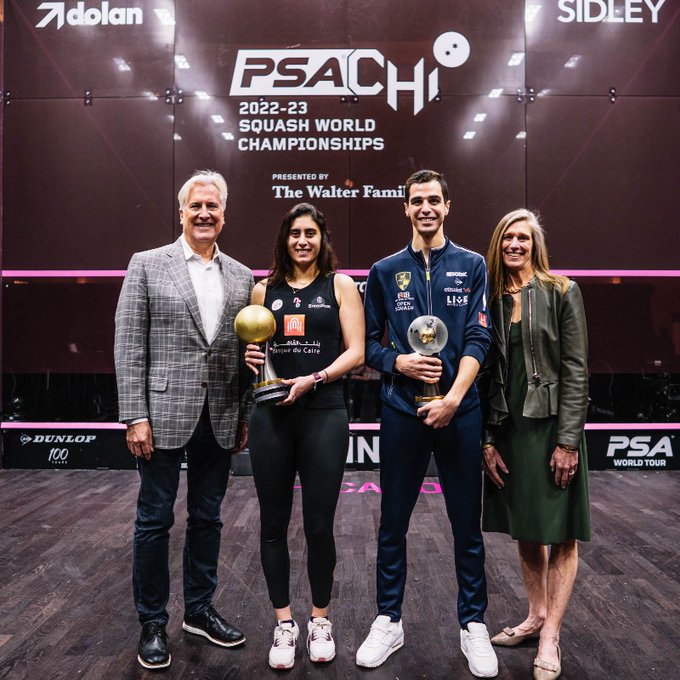
Egyptian duo Nour El Sherbini and Ali Farag retained their respective world titles in Chicago with straight-game wins over Nouran Gohar and Karim Abdel-Gawad early on Friday.

World No.1 Sherbini needed 38 minutes to beat Nouran Gohar 3-0 (11-6, 11-4, 12-10) and clinch her seventh World Championship title.

“I am over the moon to win my seventh World Championship,” El Sherbini was quoted as saying on PSA World Tour after the game.

The 27-year-old El Sherbini was in superb form in Chicago, winning her third World Championship title. She is now just one short of the current women’s record of eight, held by Malaysian legend Nicol David.

Her streak of five women’s World Championship titles in a row is matched only by David.

“It is huge and special for me and I cannot believe I did it, I am so happy,” the Egyptian squash star said.

I am happy that I am closer to Nicol’s [David] record. She is a legend and what she did was amazing and unbelievable,” El-Sherbini said, adding “I have always been looking up to her, so to put my name beside her is something special and huge for me.”

The men’s final saw World No.4 Ali Farag become the second Egyptian ever after Amr Shabana to win four men’s World Championship trophies.

The 31-year-old Farag needed 44 minutes to beat Karim Abdel Gawad 3-0 (12-10, 11-6, 11-6).

“The emotions are so raw, it is so hard to put it into words,” Farag said. “It is so special. No matter how many times you go through it, it is even more special than the time before. Especially against such a champion like Karim, I am super relieved and super happy,” he added.

“Two months ago, we played a practice match and we were limping, and the standard would not have even earned us a place in the World Championship, let alone the final. To come all the way through to reach the final is a very proud achievement for the two of us.”

Farag – like El Sherbini before him – has now won all three World Championships held in Chicago.

The PSA World Championships is the most prestigious tournament in squash, with $1,000,000 in total player compensation split equally between the male and female athletes.

source/content: english.ahram.org.eg (headline edited)

__________

pix: worldsquashchamps.com

_________

EGYPT

SAUDI ARABIAN Students Win 41 Medals in ‘Geneva Invention Awards’ at the 48th Geneva International Exhibition of Invention

Students of King Abdulaziz University won 41 medals during their participation in the 48th Geneva International Exhibition of Inventions.

The recently concluded exhibition saw 825 exhibitors from 44 countries take part with more than 1,000 inventions.

The head of innovation at the university, Dr. Iqbal Ismail, told Arab News: “Other Saudi universities are also participating. However, the participation of King Abdulaziz University at this exhibition is the largest and has been ongoing since 2016.”

Dr. Hana Al-Naim, acting president of the university, praised the achievements of the university’s male and female students, which have contributed both to the community and the Kingdom’s ranking, regionally and globally, in the field of creativity and innovation.

The students came from the university’s various colleges including departments of medicine, engineering, information technology and nursing.  

Rahaf Alem and Raghad Al-Jundi won the International Federation of Inventors Association Award for the invention of a laser blood disease detector, also winning the gold medal.

A special prize from Taiwan was awarded to student Faisal Al-Subaie for inventing a cistern made from palm fronds to provide irrigation water.

Ahmed Al-Zahrani, Saleh Bakraa, Marwan Al-Jadaani, and Mohammed Al-Khamis also won the special award for their automated diagnostic platform.

The silver medal was awarded to Duaa Al-Shabani, Lama Al-Jelani, Gaitha Al-Khatami, Emtinan Yamani, and Hadeel Al-Lazori for their invention of an antimicrobial agent for dialysis patients.

Several Saudi inventions received the bronze medal. Safwan Hashim and Abdullah Abu Thyab won it for their renewable-energy car umbrella and Abdullah Al-Khotami for his work on protective glasses that shield wearers from thermal diseases.

Hala Mogarbel, Shahad Asiri, and Shatha Al-Sulami won the bronze medal for their urinary catheter holder invention.

Dina Al-Shibeeni, Marwa Bakour, and Hind Al-Rashid also won the bronze medal for the invention of an artificial intelligence gardening system.

The invention of a bedsore-proof bed earned Bateel Bajamal, Rena Al-Qahtani, Joud Hakami, Asmaa Bahmeed, and Shahad Al-Nahdi the bronze medal.

Shathar Al-Shabak, Jumana Al-Madhoun, Njoud Al-Ghamdi, and Raneem Saati were also awarded for their invention of “Minqath,” a drowning warning system.

Finally, Sumayah Baamer, Raniya Baksh, Rahaf Al-Saeed, and Deema Majashi won the bronze medal for school environment safety measures using artificial intelligence.

Ismail said: “There is no doubt that such student participation will have a great impact on raising a generation that thinks and researches in a scientific way and develops appropriate solutions to the problems facing the…community.”

He added that the exhibition constitutes an important opportunity to transform inventions into products that can be manufactured and marketed inside and outside the Kingdom.

Al-Naim will honor the exhibition’s winning students in a ceremony on Wednesday.

source/content: arabnews.com (headline edited)

KUWAIT: New World Record for Largest Bisht, Breaks Previous World Record. 48 days of hard work pays off

Guinness-accredited arbitrator honours owner of Bisht Al Baghli exhibition.

Guinness Book of Records recognizes Kuwait’s impressive bisht achievement

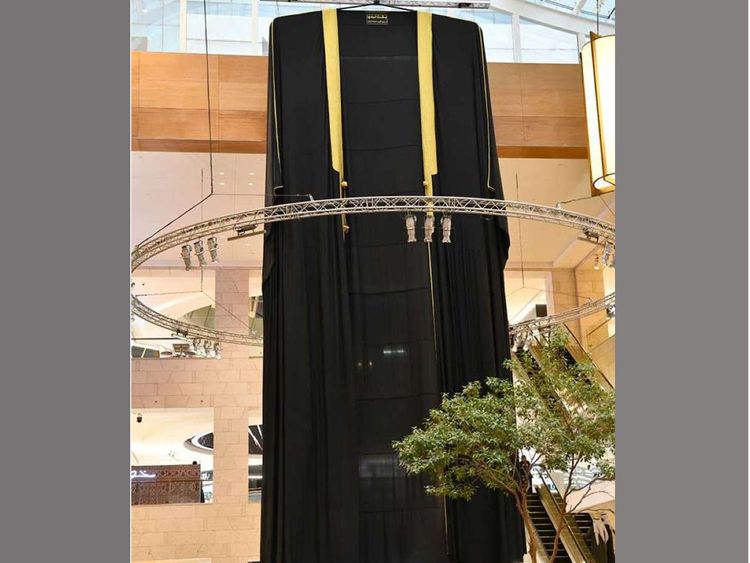
Kuwait has set a new world record for the largest bisht in the world. The impressive garment, measuring 17 by 16 meters, broke the previous record of 17 by 9 meters held by Saudi Arabia, Kuwait News Agency (KUNA) reported.

The bisht was produced under the supervision of the Al Baghli Exhibition for the Bisht Industry, a well-known establishment in Kuwait famous for its high-quality traditional garments. Its sewing took a total of 48 days, with the team of craftsmen working tirelessly to ensure every detail was perfect.

The achievement has been recognized by the Guinness Book of Records, with Guinness-accredited arbitrator Kenzi Al Dafrawi honouring Riyad Al Baghli, owner of the Bisht Al Baghli exhibition.

A bisht is a long cloak traditionally worn over a thobe or kandura at special occasions or celebrations in Middle Eastern countries.

The garments are typically black, but also come in white and brown, and are made from a light, often sheer, material with gold trimming.

Traditionally, they are worn at times of celebration, for weddings, Eid and significant festivals. Historically, they were a winter garment, reserved for keeping the wearer warm on colder nights.

source/content: gulfnews.com (headline edited)

___________

The impressive garment measures 17 by 16 meters. / Image Credit: Kuna

___________

KUWAIT

ARAB AMERICAN: The Ray Hanania Radio Show returns with a series of Arab American exclusive interviews

  • Syrian American Mayor Khairullah says Biden should end ‘racism’ against Muslims and Arabs
  • ‘I don’t think it is fair to make a documentary to show that Cleopatra was Black. This is changing history,’ says Egyptologist Zahi Hawass

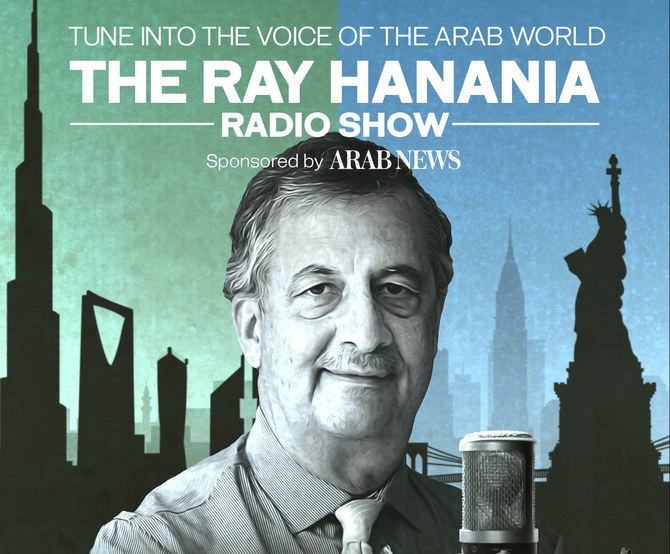
The Ray Hanania Radio Show, a weekly program sponsored by Arab News, kicked off its third season on Thursday with an explosive episode last night. It featured as its first guest Syrian American Mayor Mohamed T. Khairullah, who was controversially banned from the White House Eid celebration.

During his appearance on the show, Khairullah slammed President Joe Biden, saying it is his responsibility to end the “racism” and “discrimination” against Muslims and Arabs that is a part of the system.

The Ray Hanania Radio Show, which first aired in October 2020 ahead of the US elections at the time, hosts a wide array of guests tackling crucial topics in the Arab world.

One such topic tackled this season is the recent Netflix docuseries controversy surrounding the casting of Adele James, a Black actress, as Cleopatra, whom historians agree was of Greek origin.

The furor came from Egyptians and other Arabs accusing the producers of the film of appropriating their culture. The Ray Hanania Radio Show thus hosted world-renowned Egyptologist Zahi Hawass who set the facts straight.

“Cleopatra was a Macedonian…I really think that the reason this film is shown now (is) because some people want to say that the origins of Ancient Egypt were Black,” he said on the show, adding, “I don’t think it is fair to make a documentary to show that Cleopatra was Black. This is changing history.”

Continuing with the topic of Arab representation in Hollywood was Arab News’ very own Editor-in-Chief Faisal J. Abbas.

On the show, Abbas cited Arab American writer and academic Jack Shaheen and his book “Reel Bad Arabs,” which says that, out of 1,000 films, Arabs were only presented or portrayed positively in 12 percent of them.

“As Arabs, we should not wait for Hollywood, and we should not wait for people with Orientalist agendas to tell our story. We should be the masters of our own destiny, we should be the masters of our own storytelling,” Abbas said.

“I’ll tell you one more thing before we conclude. Actions speak louder than words.”

The Ray Hanania Radio Show is broadcast live on WNZK AM 690 Radio in Greater Detroit and on WDMV AM 700 in Washington D.C. every Wednesday at 5pm EST / 12am KSA, also available on all Arab News podcast channels.

source/content: arabnews.com (headline edited)

_________

____________________________________________________________

AMERICAN / ARAB AMERICAN / PALESTINIAN HERITAGE

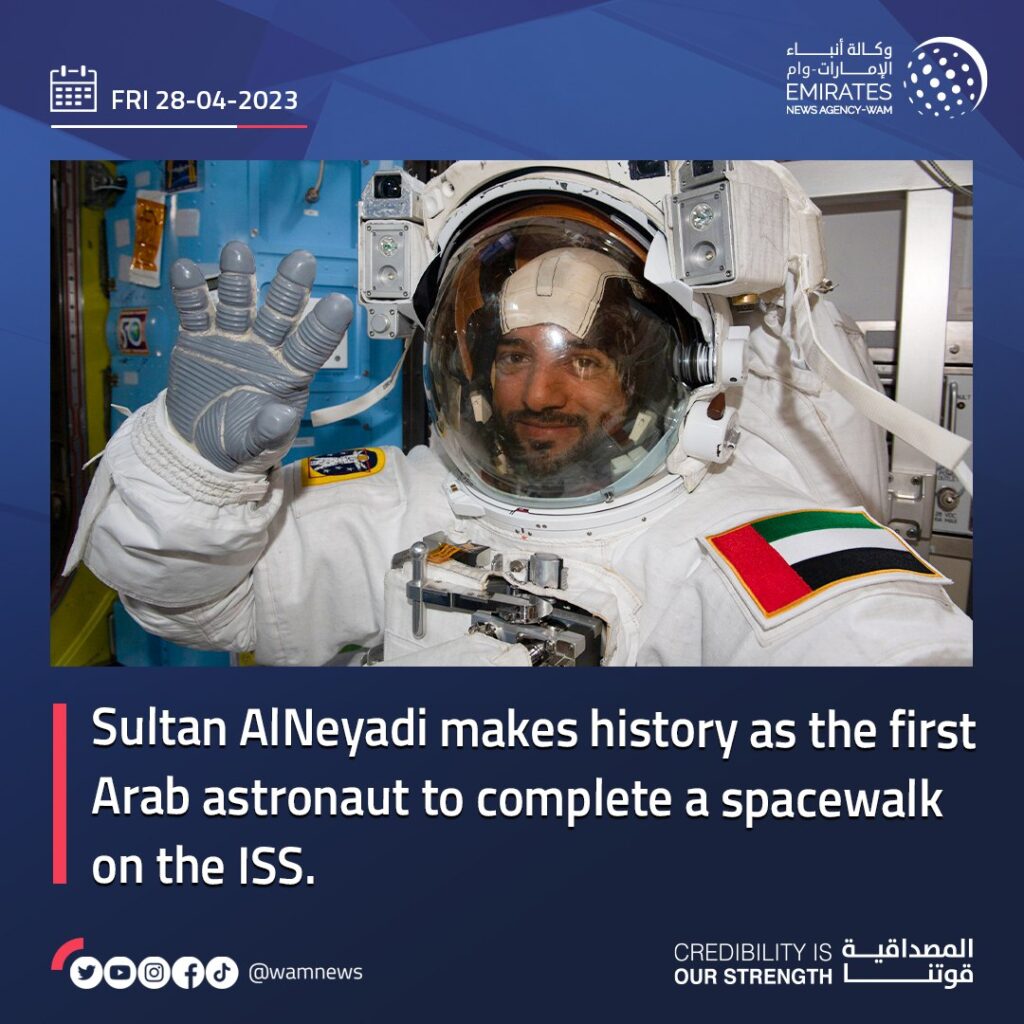
U.A.E: Sultan AlNeyadi makes History as the First Ever Emirati, First Ever Arab and First Ever Muslim Astronaut to Complete a Spacewalk on the ISS

The Mohammed Bin Rashid Space Centre (MBRSC) achieved a new milestone on Friday when astronaut Sultan AlNeyadi ventured out of the International Space Station (ISS) and completed his spacewalk. With the conclusion of the mission task, the UAE commemorates AlNeyadi as the first Arab to undertake a spacewalk during Expedition 69, currently underway on the ISS. This accomplishment marks an important step forward for the Arab world’s participation in space exploration.

His Highness Sheikh Mohammed bin Rashid Al Maktoum, Vice President and Prime Minister of the UAE and Ruler of Dubai, said: “After three years of intensive training, today we see Sultan AlNeyadi on his first spacewalk, carrying out several tasks outside the International Space Station. AlNeyadi is the first ever Emirati, first Arab and first Muslim astronaut to perform a spacewalk.”

His Highness Sheikh Mohammed bin Rashid added: “It is a fact that many stars have Arabic names. Arabs are capable and innovative. Our focus on science and investment in youth will shape our future.”

The historic first Arab spacewalk lasted 7.01 hours in the vacuum of space on the starboard side of the International Space Station’s truss structure, accomplishing two key objectives. One of the objectives of the Extravehicular Activity (EVA), undertaken by AlNeyadi along with NASA Flight Engineer Stephen Bowen, was to work on a series of preparatory tasks which involved routing power cables, which was successfully concluded. These cable works were completed as a precursor to the installation of the Space Station’s fourth roll-out solar array, known as the International Space Station Roll-Out Solar Array (iROSA), which is scheduled to be delivered on the upcoming SpaceX Dragon cargo mission. The next objective was to retrieve a crucial Radio Frequency Group (RFG) unit. This communications antenna, or RFG will stay bolted on the station for now due to the difficulty of removing it.

Prior to embarking on their spacewalk, AlNeyadi and Bowen underwent a two-hour oxygen purge to eliminate nitrogen from their bodies. Following this, Warren Hoburg and Frank Rubio assisted the astronauts in donning their spacesuits – a major operation in itself. It took both AlNeyadi and Bowen an additional hour to put on their spacesuits and safety gear before entering the airlock to gradually reduce the pressure to a safe level for opening the exterior hatch.

Bowen was out of the hatch connecting his cable to the outside of the hull before anchoring AlNeyadi’s line outside as well. AlNeyadi then disconnected from the inside of the airlock and commenced the tasked activities.

AlNeyadi’s progress during the spacewalk was observed by Hazzaa AlMansoori, the Expedition 69 increment lead, from the NASA ground station in Houston.

Key safety checks of Sultan’s spacewalk
Prior to the spacewalk, a thorough set of checks were conducted to ensure the safety of the astronauts. During their high-altitude walk outside the ISS, AlNeyadi and Bowen had to contend with two major challenges: radiation and extreme temperatures. The surrounding environment in space can reach scorching temperatures of up to 120 degrees Celsius in the sunlight and drop as low as -150 degrees Celsius when the sun is out of sight. While the spacesuit is geared to handle all this, careful management of the suit during the mission was also a task at hand.

Another pressing concern, even after all the necessary precautions were taken, was the threat of space debris. It is not uncommon for space debris to come dangerously close to the orbital outpost, posing a significant risk to the crew.

Hamad Obaid AlMansoori, Chairman, MBRSC, said, “The UAE Mission 2 is a truly inspiring endeavour that embodies the spirit of Emirati excellence and determination to achieve greatness in all our pursuits. From its inception as the longest Arab space mission to the historic appointment of the first Arab increment lead on an ISS expedition, and now continuing with the groundbreaking achievement of the first Arab spacewalk by Sultan AlNeyadi, this mission has set a new standard for excellence in space exploration. Under the patronage of the wise leadership, this remarkable milestone not only represents the UAE’s unwavering commitment to consolidating its position as a dominant force in space, science, and technology but also serves as a powerful motivator for future generations to strive for knowledge and innovation with boundless enthusiasm and dedication.”

Salem Humaid AlMarri, Director General, MBRSC, said, “Sultan AlNeyadi’s spacewalk has generated an unprecedented level of excitement and interest within the public, underscoring the immense significance of this mission. We are grateful to our visionary leadership for their unwavering support and guidance, which has enabled us to realise this ambitious goal and set the stage for even greater achievements in the future. While Sultan is conducting ground-breaking scientific experiments on the ISS, the addition of the spacewalk showcases yet another dimension of the UAE’s remarkable expertise in space exploration. This milestone achievement will play a critical role in restoring the International Space Station to its full operational capability, cementing the UAE’s position as a leading contributor to the global space community. “

Adnan AlRais, Mission Manager, UAE Astronaut Programme, MBRSC, said, “The historic achievement of the first-ever Arab spacewalk by Sultan AlNeyadi, as part of the longest Arab space mission in history, represents a remarkable milestone for the UAE. From the outset of the UAE Astronaut Programme journey, our astronauts have always set their sights on achieving the extraordinary, and with unparalleled skill and determination, they have risen to the challenge in a way that has captivated the world’s attention. As we celebrate this momentous achievement, we look eagerly to the future with great anticipation, as a new cadre of UAE professionals prepares for future missions that will enable them to further showcase our nation’s growing capabilities in the field of space exploration.”

Two months in space
AlNeyadi will soon be completing two months in space after launching from Cape Canaveral in Florida with his Crew-6 team members on 2 March. For his second month aboard the Space Station, AlNeyadi conducted multiple experiments, including several key ones, such as:

• Collecting air samples from the Destiny and Columbus laboratory modules before cleaning the Veggie space botany facility. The samples were analysed for research purposes.
• Sending approximately 1,950 kg of valuable scientific experiments and other cargo back to Earth on a Dragon cargo spacecraft, as part of the 27th contracted cargo resupply mission to the International Space Station (ISS). The spacecraft splashed down off the coast of Tampa, Florida in the US earlier this month.
• Setting up the hardware for the CapiSorb Visible Systems fluid physics study. This experiment investigates the potential of using a liquid-based carbon dioxide removal system to promote more efficient space-based solutions and advanced Earth-bound applications.
• Treating samples In the Kibo laboratory module for the Engineered Heart Tissues-2 experiment using Kibo’s Life Sciences Glovebox. This research may help doctors treat, as well as prevent, space-caused heart conditions and Earth-bound cardiac disorders.
• Working on two technology experiments. In the first experiment, AlNeyadi demonstrated the use of a 3D printer to manufacture tools, components, and experiments on the orbital outpost. The second experiment entailed collecting and stowing samples in a science freezer for a study exploring the biomanufacturing of pharmaceuticals in space.

The UAE Astronaut Programme is one of the projects managed by MBRSC under the UAE’s National Space Programme and funded by the ICT Fund of the Telecommunications and Digital Government Regulatory Authority (TDRA), which aims to support research and development in the ICT sector in the UAE and promote the country’s integration on the global stage.

source/content: wam.ae (headline edited)

___________

___________________________________

UNITED ARAB EMIRATES (U.A.E)

SAUDI ARABIA: GLOBAL RECORD: Red Sea Global (RSG) takes up Most Ambitious Horticultural Endeavor ‘in Human History’ to Raise over 25 million Plants

Saudi Arabia’s biodiversity is set to reap huge benefits thanks to Red Sea Global planning the “single most challenging horticultural endeavor ever attempted in human history,” the company has announced.

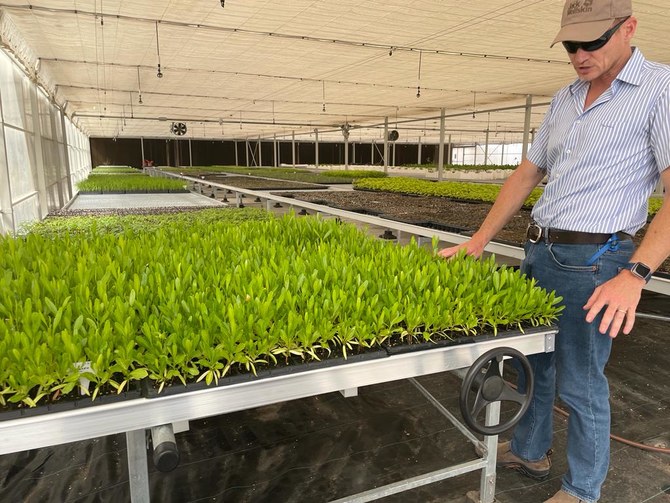
RSG’s fully operational nursery aims to raise over 25 million plants in the Red Sea Project and the ultra-luxury destination AMAALA by 2030, reducing the Kingdom’s reliance on importing foreign plant species and promoting the growth of native flora. 

It will also produce over 30 million seedlings, which according to Grant Shaw, senior nursery director at RSG, is “incredibly exciting for horticulturalists.” 

“If you think about 25 million plants in the time frame we’re talking about, it’s never been attempted before. It’s like the single most challenging horticultural endeavor ever attempted in human history in the middle of the desert.”

He added: “With our designers, we’ve looked at what can we use natively and then what can we enhance with some adaptive species.” 

“Some of the species you see in this region will never be seen anywhere else in the world because they can’t grow elsewhere,” Shaw concluded. 

The Red Sea region’s exceptional year-round climate allows for adding a broad range of plants, including cultivated, adapted and native plants, said Fahd Al-Habely, the company’s assistant director of the environmental program department. 

Consequently, the company has implemented two initiatives. One is collecting native seeds across the Kingdom, and the other is transplanting mature trees. 

With a mandate to increase biodiversity in the area by 30 percent, the company has a “laser-like focus on sustainability,” he explained.   

Though the nursery mainly comprises plants native to Saudi Arabia, the giga-project has also been sourcing desert plant species worldwide, including Australia, where the climate is similar to the Kingdom. 

Saudi Arabia has successfully planted over 12 million trees in the past five years through the National Center for Vegetation Development as it moves toward achieving its sustainability goals as part of the Saudi Green Initiative, stated the annual report issued by the National Transformation Program for 2022. 

According to the report, more than 22 percent of the treated water in the Kingdom was reused while recording a 35 percent increase in desalinated water production capacity since 2018. 

Some of the other achievements include the release of up to 921 endangered animals in national parks and reserves, the first birth of the Arabian oryx at the King Salman Royal Reserve, and the first birth of the Idmi gazelle at the Ibex Reserve.  

source/content: arabnews.com (headline edited)

____________

RSG’s fully operational nursery aims to raise over 25 million plants in the Red Sea Project and the ultra-luxury destination AMAALA by 2030, reducing the Kingdom’s reliance on importing foreign plant species and promoting the growth of native flora. (Supplied)

_________________

SAUDI ARABIA

EGYPT: Shehab Allam Breaks World Record for Longest Swim Wearing Handcuffs by Swimming 11 Km.

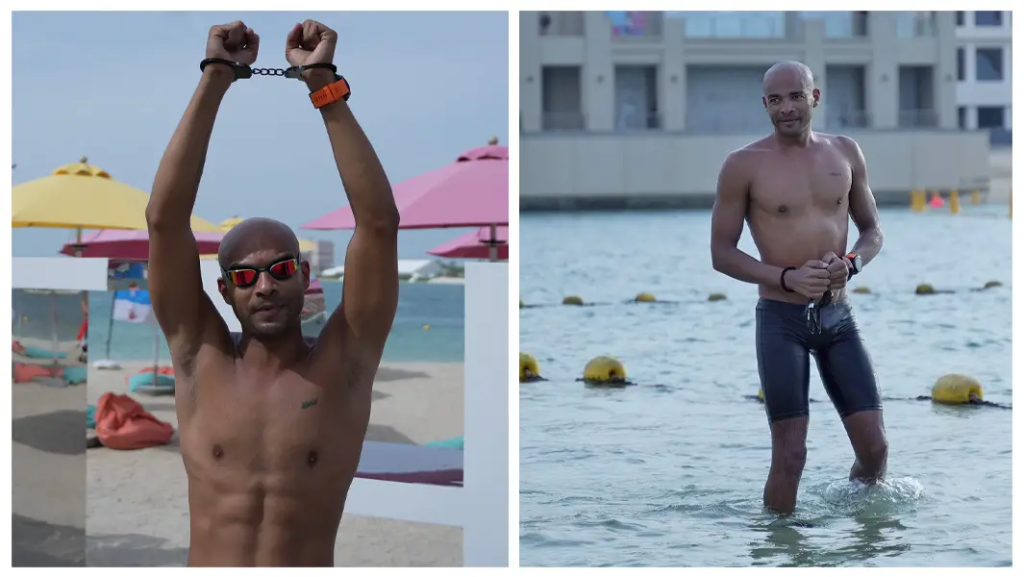
Shehab Allam, a swimmer and coach from Dubai, has broken the Guiness World Record for the longest swim wearing handcuffs by swimming over 11km (6.8 miles) continuously with the cuffs on. 

With his swim, Allam broke the record previously held by American Ben Katzman, who set the old record by swimming 8.6km (5.3 miles) in a Virginia swimming pool in February 2022. 

Notably, the 31 year-old Allam did not opt to complete his swim in a pool, instead using a marked area of approximately 164 yards in the Arabian Gulf, swimming laps between two buoys. During his attempt, he had an official with him to ensure his recorded distance was accurate. 

According to Allam, he hit the 50 lap mark, surpassing the previous record, and made it his goal to hit 70 laps to surpass 11km. He told The National, “At 50 laps I realized I had gone past the record, so kept going. I hit the 10km mark and then felt good so kept on swimming until I had done 70 laps — so it was more than 11km in the end.”

“It feels amazing to be a Guinness Record holder, this is my biggest achievement — and was a longer swim than the Dubai Canal,” said Allam. 

This was not Allam’s first attempt at a record-breaking swim, as he previously became the first person to ever swim the length of the 25km Dubai Canal back in 2020.

Of both of his swims, Allam said, “Being In the record books makes me feel like a superhero, and I want to stay there.” He plans to take an attempt at breaking the World Record for the furthest swim in handcuffs and leg chains next, which is currently held by Dolphin Ratheesh, who swam 10km wearing both devices back in November 2020. 

source/content: swimswam.com (headline edited)

___________

pix : guinnessworldrecords.com

__________

EGYPT

SAUDI ARABIA: Dr. Mohammed bin Yahya Al-Sayel, Member of the UN’s Global Geospatial Knowledge and Innovation Center (UN-GGKIC)

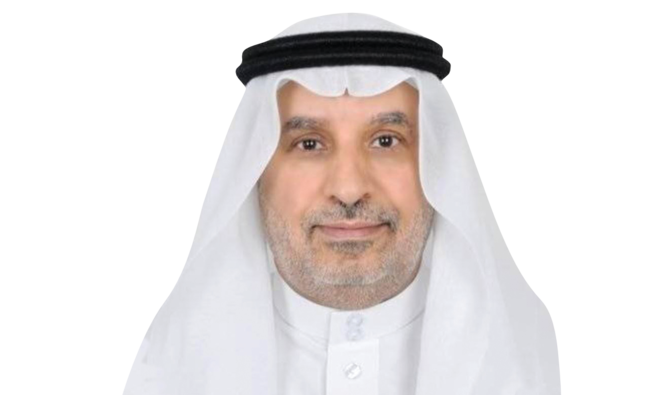
Mohammed bin Yahya Al-Sayel has been appointed to become a member of the UN’s Global Geospatial Knowledge and Innovation Center following a royal decree on April 16.

The UN-GGKIC aims to build geospatial capabilities and competencies at the global level, develop centers of knowledge and innovation in countries, and benefit from the mechanisms, techniques, and analysis used in the field of geospatial information.

The center is working on implementing the Integrated Geospatial Information Framework to improve and strengthen work on managing national geospatial information for achieving sustainable development goals.

Al-Sayel has been the regional coordinator for Arab countries at the International Society for Photogrammetry and Remote Sensing since January.

Al-Sayel, who has also been the president of the Kingdom’s General Authority for Survey and Geospatial Information since 2021, was nominated for his new position by the board of directors at the ISPRS.

The general authority is mandated with developing national capacities in the sector, in cooperation with universities and specialized institutes with its counterparts in other countries, international bodies, and organizations related to the sector.

The ISPRS is a non-governmental organization devoted to the development of international cooperation for the advancement of photogrammetry, remote sensing, and their applications.

Al-Sayel received a bachelor’s degree in civil engineering in 1984 from Roger Williams University, Rhode Island, US. He also received a high diploma in geodesy and map production from the Royal School of Military Survey.

He was granted a master’s degree in geomatics in 1994 from the University of Toronto, Canada, and obtained a doctorate in surveying engineering and geospatial information from Leibniz University Hannover, Germany.

Al-Sayel has taken a number of advanced training courses on geographic information and global positioning systems. He has attended several training courses on negotiations and boundary delimitation at Durham University in the UK.

Al-Sayel, who is both the CEO of Quality Geospatial Engineering Co. and Vision Intelligence, a digital sustainability solution-providing company, has risen in the military to the rank of major general and was an assistant director at the General Directorate of Military Survey. He was also the head of the boundaries and documents department.

He is the secretary-general of the Cooperative Society of Moringa and Desert Plants, one of the first Saudi cooperative societies aiming at increasing the country’s vegetation.

Al-Sayel is a consultant member of the Saudi Council of Engineers and a member of the American Imaging and Geospatial Information Society, and the ISPRS.

source/content: arabnews.com (headline edited)

____________

Mohammed bin Yahya Al-Sayel

_________________

SAUDI ARABIA

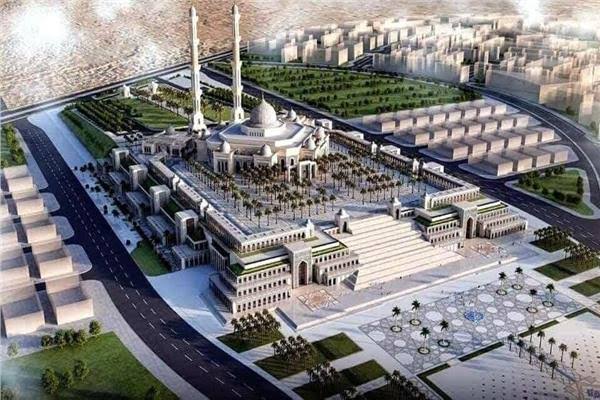
EGYPT: Egypt’s Islamic Cultural Center & the Misr Mosque with 03 Guinness World Records

President Abdel-Fattah al-Sisi listened to an explanation of the details of  Egypt’s Islamic Cultural Center and the Egypt’s Grand Mosque, during his visit to the New Administrative Capital  at dawn, Thursday, to join workers for the first suhoor in the blessed month of Ramadan.

According to the explanation, Egypt’s Grand Mosque obtained three international certificates from the Guinness World Records.

The first was for the largest pulpit in the world with a height of 16.6 meters, handcrafted from the finest types of wood.

The second and third were for the main chandelier of the mosque, being the heaviest chandelier in the world of 50 tons, and it being the largest chandelier with a diameter of 22 meters and four levels.

Egypt’s Islamic Cultural Center in the New Administrative Capital is a great achievement and one of the most important projects established in the New Administrative Capital.

The Islamic Cultural Center was established in the new capital on an area of 15,000 square meters. It has a large place for services, as well as a group of spacious and multi-storey garages, with a capacity of about 4,000 cars.

source/content: egyptindependent.com (headline edited)

___________

Egypt’s Grand Mosque in the New Administrative Capital

_________

EGYPT

SAUDI ARABIA: Saudi Girls Shine at European Girls’ Mathematical Olympiad 2023

  • The EGMO is an international competition in mathematics targeting female high school students whose commitment to mathematics goes beyond the usual school curriculum
  • To participate at the EGMO, students must qualify first at a national competition, after which they, together with their advisors, form their respective national delegations

Two Saudi girls have achieved advanced positions in the European Girls’ Mathematical Olympiad 2023, which is being held in Slovenia from April 13-19.

The EGMO is an international competition in mathematics targeting female high school students whose commitment to mathematics goes beyond the usual school curriculum.

To participate at the EGMO, students must qualify first at a national competition, after which they, together with their advisors, form their respective national delegations.

“Saudi Arabia, represented by King Abdulaziz and his Companions Foundation for Giftedness and Creativity (Mawhiba) and the Ministry of Education won two medals in the EGMO 2023 in Slovenia,” Mawhiba tweeted on Tuesday.

The young talents have raised Saudi Arabia’s medal tally to 26 in all editions of the EGMO, in which 213 students representing 55 countries are currently participating.

Saudi students Jana Ali Saad Al-Dosar from the Eastern Region and Fatimah Hassan Mohammed Bu Ali from Al-Ahsa won a bronze medal and a certificate of appreciation, respectively.

Mawhiba’s Secretary-General Dr. Amal bint Abdullah Al-Hazzaa congratulated the winners and expressed gratitude to King Salman and Crown Prince Mohammed bin Salman for their support of higher education, which led to these achievements.

Al-Hazzaa noted that the students’ successes embody the integration between Kingdom’s institutions and its commitment to advancing young talents through education and training in line with international standards.

She also praised the cooperation between Mawhiba, the Ministry of Education, and the King Abdullah University of Science and Technology, a partnership that aims to develop Saudi human capital and increase competitiveness in the labor market in line with the National Transformation Program and Saudi Vision 2030.

The Saudi girls participating in the EGMO 2023 have undergone intensive training to develop their scientific skills and were nominated to participate based on the results they achieved in the training forums held by Mawhiba.

The EGMO was initially launched in the UK, which hosted its first edition in April 2012 with 19 participating countries.

The international competition aims to motivate more female students to participate in the International Mathematical Olympiad, where girls currently constitute only 10 percent of the participating students.

This is Saudi Arabia’s 11th participation in the EGMO. The Kingdom has achieved two gold medals, six silver medals, 12 bronze medals, and six certificates of appreciation.

The EGMO 2023 awards are scheduled to be distributed on Wednesday during a final ceremony.

source/content: arabnews.com (headline edited)

____________

Fatimah Hassan Mohammed Bu Ali and Jana Ali Saad Al-Dosar. (Twitter/Mawhiba)

_________________

SAUDI ARABIA