Arabs & Arabian Records Aggregator. Chronicler. Milestones of the 25 Countries of the Arabic Speaking World (official / co-official). AGCC. MENA. Global. Ist's to Top 10's. Records. Read & Enjoy./ www.arabianrecords.org
A record-setting night sees the Egyptian striker secure his place in history.
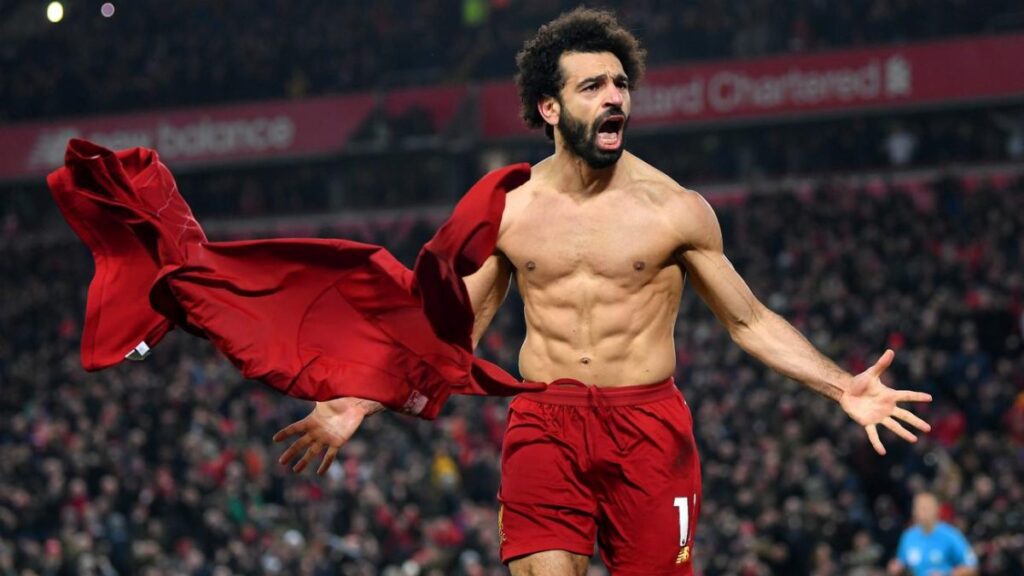
Mohamed Salah secured his place in Liverpool (and Premier League) history with a remarkable performance on a very special night as his side beat rivals Manchester United 7-0.
With two second half goals the talismanic Egyptian striker became Liverpool’s all-time top goalscorer English Premier League, with his 129th and 130th goals putting him on top of the list above club legends Robbie Fowler (128), Steven Gerrard (120) and Michael Owen (118).
“This record was in my mind since I came here, I think after my first year I was always chasing that record, so to break it today, against United, with that result, was unbelievable,” Mo Salah told Sky Sports after the game. “I’m going home to celebrate with the family, have a chamomile tea and sleep!”
However, the record was not the only one that Salah secured in the game, as his double also made him Liverpool’s leading scorer against United in the Premier League era, with 10 goals.
Manchester United is one of Liverpool’s biggest rivals – if not the biggest – and the scoreline was its largest ever victory against United in any competition.
“I have some good records at Liverpool. To be fair, as long as we achieve something with the team that’s the most important thing for me,” Mo Salah said to the Liverpool Echo.
“I’m so happy and proud to break records and win trophies in a team like Liverpool. I don’t want to be in a smaller team and I’m the only one breaking records and that’s it.”
source/content: esquireme.com / Matthew Priest (headline edited)
Dubai – Dubai is the also the most record-breaking city not just within the country but also across the Mena region.
The UAE is far ahead in achieving the Guinness World Records regionally as the country boasts 425 GWRs with 34 of them were achieved in 2020 alone.
Dubai is the also the most record-breaking city not just within the country but also across the Middle East and North Africa (Mena) region.
“The UAE is currently home to 425 Guinness World Records titles, making it the biggest record-breaking country in the Mena region… Dubai has the lion share of titles in the country with around 60 per cent of the overall number,” said Danny Hickson, senior events production manager at Guinness World Records Ltd in Dubai.
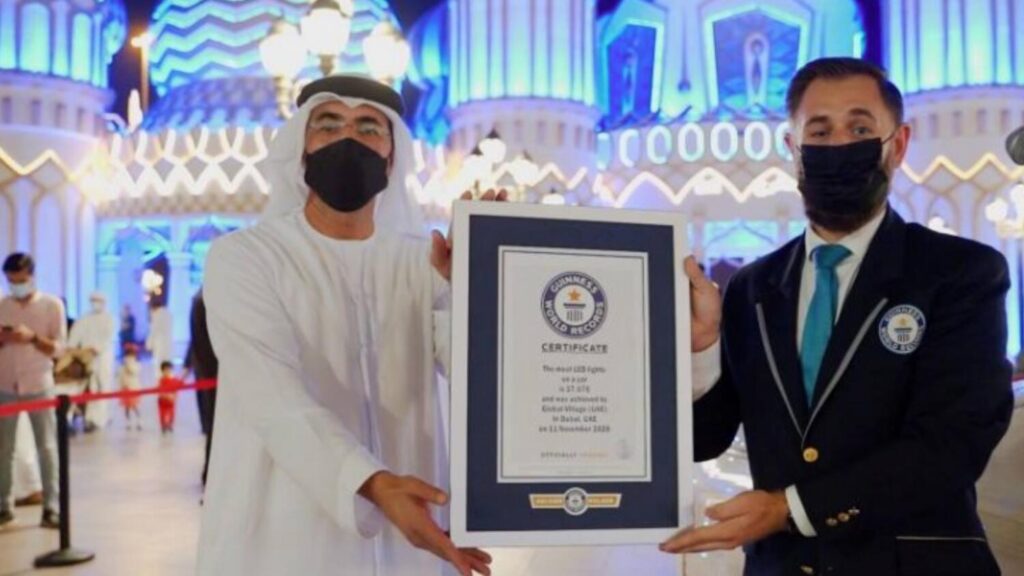
Global Village, a multicultural family entertainment destination, achieved two records in November alone. The first record was set by having the most LED lights ever on a car. The vehicle had 36,676 LED lights. The feat began two weeks ago as the park achieved the record for the most videos in a music medley video following the Rockin’1000 Season 25 opening concert.
Global Village aims to break 25 records this season as part of its Silver Jubilee anniversary celebrations.
Emirati shipbuilder Obaid Jumaa bin Majid Al Falasi also made it into the history by building the world’s largest dhow, a wooden Arabic boat, measuring 91.47-metre long and 20.41-metre wide. That is equal to the length and almost half the width of a standard American football field floating over the Indian Ocean.
Dubai’s Nakheel Mall, too, recently broke the record for the world’s largest fountain, measuring a whole 7,327 m2. The record breaking fountain named The Palm Fountain was designed a with tricks including colour and brightness controls.
The emirate is also home to the world’s tallest hotel – 75-storey Gevora Hotel, measuring 356.33 metres tall from the group level to the top.
Danny Hickson said Saudi Arabia comes second with 96 Guinness World Records titles, while Egypt is not far in the third place with 93 titles.
On September 23, Saudi Arabia achieved the Guinness World Record for the largest fireworks display in multiple cities as the display consisted of 962,168 fireworks.
“What’s brilliant about breaking world records with brands in the UAE is that there is almost a chance to do something different with the heritage. Brands and individuals think it is impossible to be break world records, but we believe everyone is amazing in his own way, and we are here to make their achievement Officially Amazing!,” said Hickson.
“We have seen the tallest house of cards build in 12 hours, sat on top of a washing machine, to demonstrate its reduced vibrations and noise levels; and an iconic car brand celebrated its 80th anniversary by breaking the record for the largest loop the loop in a car! Would we find amazing talents among Khaleej Times readers?,” concluded Hickson.
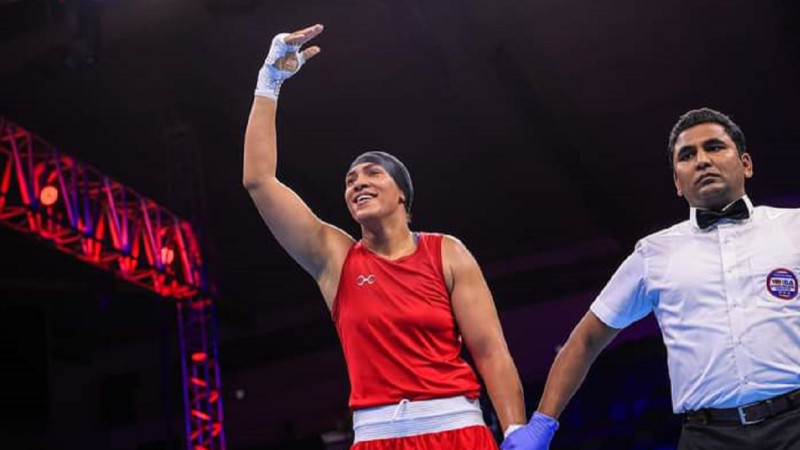
Moroccan boxer Khadija El Mardi won the gold medal on Sunday in New Delhi, India, during the Women’s World Amateur Boxing Championships.
The national champion El Mardi, who competed in the heavyweight division (Over 81kgs), won the women’s world boxing championship by defeating the Kazakh Kungeibayeva Lazzat.
El Mardi has achieved a number of victories over the years, including the title of African champion in 2022, a victory at the African Games in Rabat in 2019, a silver medal at the World Championships in 2022, and this year’s Mohammed VI Trophy gold medal.
Born in Casablanca in 1991, El Mardi’s everlasting commitment and heroic efforts to achieve success have made her name stand out.
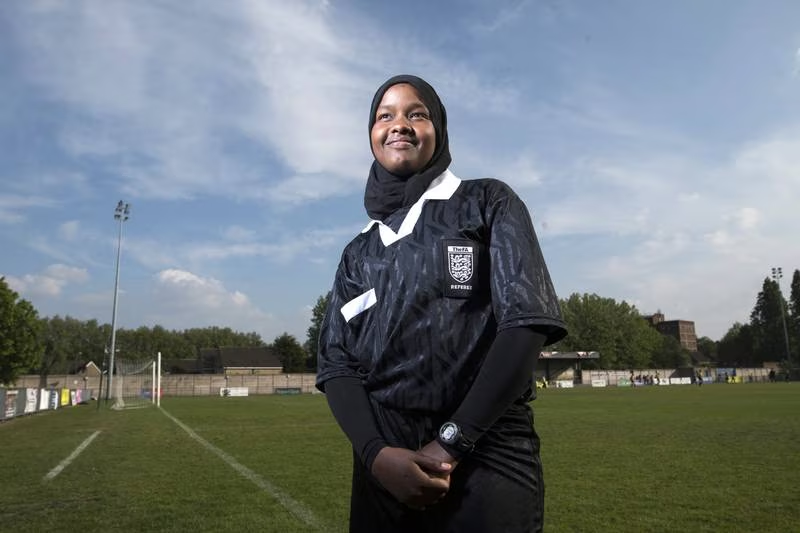
As a child, she took part in the game she loves against a backdrop of civil war. Now, Britain’s first black female Muslim referee fights for the rights of others as a role model for inclusivity.
A cold, cloudy Sunday morning in West London and 22 grown men are on a football pitch playing in one of the capital’s minor leagues. The standard is not particularly good but nonetheless there is something remarkable about the fixture.
As the tackles fly in, a 1.6-metre-tall figure wearing match officials’ kit and a headscarf brandishes a yellow rectangular piece of plastic.
“My philosophy is that everyone deserves a chance,” Jawahir Roble, Britain’s first black female Muslim referee, tells The National. “But if they keep repeating fouls, I book them.
“I like to control the game first and then I’ll use my cards. The game is not about me. It’s about them having fun and making good memories.”
The contest finishes with a 3-1 home win but, for Roble, 29, the more important result is not the score at the final whistle — it’s that the players amble over to shake her hand and say thank you. Confirmation, she says, of a job well done.
Her extraordinary achievements have been recognised with an MBE in King Charles IIIs first New Year Honours List for services to the Football Association and volunteering work with the education and social inclusion charity Football Beyond Borders.
It is a feat perhaps rivalled only by the journey that has brought her to within tantalising distance of collecting the silver medal at a forthcoming investiture at Buckingham Palace.
Musing on how far she has come, Roble herself once said: “Who would ever think a black, Somali-born immigrant girl with eight siblings could ref a men’s game in England with a hijab on?”
Jawahir Jewels (JJ), as she is commonly known because of the Arabic meaning of her first name, was born in Mogadishu, where she could often be found barefoot in a four-a-side competition with her siblings, kicking scrunched up cloth wrapped in sticky tape around the courtyard of the family home.
Her parents, Mahdi, a grocer, and Safya, sometimes watched the rough and tumble from the sidelines with Jamila, the baby too small to take part, until the moments when the country’s civil war came perilously close. Then, play was suspended as everyone scarpered inside to relative safety.
“You did have to be careful,” Roble recalls. “You could hear gunfire, people screaming sometimes, loud bangs and explosions. I was scared. There were lots of kidnappings and crazy stories.
“But, as a child, it was also very carefree and fun and happy. We still had to get our school and mosque work done. We got told off so many times. But we learnt the system — do our chores and then we could go outside. We had to earn the right to play football.”
After Friday prayer, they would rendezvous with friends to play on a larger patch of muddy ground outside the house, or on the beach at Xeebta Liido by the Somali Sea a half-hour drive away.
The walls of the bedroom shared with her two younger sisters, Amina and Fatima, featured images of David Beckham and, intriguingly given Roble’s future career path, the controversial Italian defender Marco Materazzi, whose aggressive style amassed an inordinate number of bookings.
“With the obsession I have with football, you would think that someone encouraged me or a teacher influenced me. But, no, I just fell in love with it out of nowhere. At heart, I am a complete tomboy.”
As tensions heightened and the war escalated in the early 2000s, the siblings’ outside excursions were curtailed and Mahdi, who had applied for British visas and bought suitcases, put in motion a hitherto secret escape plan.
Ten-year-old JJ, forced to swelter in a coat in anticipation of the colder weather ahead, was taken in a packed eight-seater van to the airport for the 6,400km flight to London.
“We got told: ‘We have to move out.’ No time to tell anyone or sell the shop,” Roble says. “Dad gave it to a relative to look after.
“I remember thinking to myself, ‘We’re not coming back here for a long, long time’.”
Landing at Heathrow nine hours later was a shock. “Oh, my goodness, the place seemed massive. So many different people. Like there’s white people, there’s Chinese people. I’m only used to seeing black people. One of my siblings reached out to touch someone’s bright blonde hair.
“I thought: ‘Wow, this is the real world.’”
First stop was Sudbury in north-west London for a few weeks with a relative, then a temporary hotel stay in Kilburn before they were allocated a council house in the shadow of the largest football stadium in the UK.
“Can you imagine?” she asks with an infectious laugh. “Wembley! We could see the stadium — the home of football — from our house. Just amazing. Something I’ll never forget.”
Roble had thought that only players or special fans were allowed into the hallowed grounds but she has since been twice: on a Chalk Hill Primary School trip (“I couldn’t imagine someone like me could go … It was surreal); and last summer when England’s Lionesses beat Germany 2-1 in the European Championships final (“That was incredible”).
In their new garden, the serious rivalry resumed, one team captained by the oldest Roble sister, the other by the oldest brother, and a lemon or potato for a football.
But, after much pleading, her parents soon handed over £3 ($3.69) for a coveted purchase that enabled JJ, who at that time spoke no English, to overcome the language barrier and fit in more quickly at school.
“Because the kid that has the ball gets the friends,” she explains, smiling. “The first words I learnt I think were, ‘pass, pass’ and ‘shoot!’”
The restrictive uniform of long black skirt, white shirt, school shoes and hijab did little to stop Roble from playing every spare minute, skipping breakfast and lunch to take to the field before lessons, in break times and after the final bell.
“Sometimes kids at primary school teased me. Teachers asked how I could play dressed like that. I was like, ‘This is it, this is what Muslim people wear. You have to be covered up.’
“My religion was not an issue. As long as you’re just a nice person, they would accept you in the group. Being a Muslim is about being a good person, being modest and doing what makes you happy.”
When a supportive PE teacher spotted how well Roble was performing in sports, the first seeds of discord were sowed with her parents who expressed a strong preference for their children to excel instead at maths and English.
“My dad actually sat me down and said: ‘You came all the way from Somalia, all the way from the war just so you can play football? We want you to make use of this country’s opportunities. At least learn to be something that can help other people, like a doctor.’”
But, in Roble’s characteristically headstrong way, fulfilling her father’s ambitions was never a realistic outcome.
At 14, she thought the moment she had dreamt of had arrived. Players from Queens Park Rangers’ women’s team visited the secondary school for a coaching session and to seek out talent for the club’s academy.
Roble put in the work, showing off her pace and left-footed skills in the attacking and defensive duties of a centre midfielder.
“I was one of four or five girls who got a letter inviting me to trial. I was so excited. I’m on the bus and I’m reading this letter over and over again. All that letter needed was a parent’s name and a signature.”
When she arrived home, however, her mother tore up the invitation in an act that even now, 15 years later, causes Roble pain to recount.
Heart-broken at her life’s ambition being thwarted, the resigned teenager eventually left school early to begin a design technology course at college.
While there, she took the level one and two coaching badges with Middlesex Football Association before a referee shortage led to her being asked to step in at the last minute, with no experience, to take charge of an under-sevens girls’ match.
“The parents were very nice to me and the girls said how nice it was to have a female referee. So, from that, I continued volunteering as a referee for a whole year at junior level.”
That prompted the FA to fund her formal referee training. “I said to myself: ‘I have to continue, get braver, do different leagues, different age groups.’ Next thing you know I’m doing men’s and women’s. It happened so fast. Within four years, I was doing adult games.”
After joining the women’s pathway, Roble advanced to National League Level 3 and is now determined to progress to the Women’s Championship and Super League, and who knows where after that?
Along the way, she has garnered a clutch of accolades, including the FA Respect Match Official Award 2017 and being named on the BBC’s 100 Women 2019, as well as that MBE on the same honours list as the England head coach Sarina Wiegman, captain Leah Williamson, and players Lucy Bronze, Beth Mead and Ellen White.
When she’s not teaching at a special needs school in London, Roble dedicates herself to promoting inclusivity, defying stereotypes, demolishing barriers and clearing a path for future generations.
There are, she says, no limits to what can be achieved: “Only I can stop myself, and I’m not going to do that.”
Fitness is a priority, and she has also spent countless hours watching YouTube clips of professional referees such as the former Premier League’s Mark Clattenburg to study their positioning during play and how they control the game.
Further inspiration came last November when an all-female on-field refereeing team led by Stephanie Frappart took charge of a men’s World Cup game for the first time in the match between Germany and Costa Rica.
Even her parents are coming around to their daughter’s deep involvement with football, though Roble sounds as though she is meeting them halfway.
“I understand now that they wanted the best for me and to make sure I was protected and safe. They told me, ‘We don’t want any hatred towards you.’ I’ve told them it’s not like that.
“At the end of the day, I’m spreading positivity. I’m sharing my sports journey with young girls, you know, who like me are interested in football. Maybe if they hear my story, they can use it to inspire them and have a shortcut instead of what I did.”
What she did, ultimately, was find the courage to tackle the norms within the Somali community and succeed on her own terms.
“My faith encourages sports, my faith encourages a healthy lifestyle,” Roble says. “I feel like [the issue] was more to do with cultural concerns. Because our culture says girls should be at home, not getting involved in men’s sports. Girls should be shy, keep on the low, low. I’m sorry but that’s not me.
“I have challenged it. Now, in my Somali community, most of them are: ‘Oh, wow, you’re doing a great job.’ And I’m like, ‘So who was the problem? Do you have anything to say now?’”
It is the same toughness displayed when Roble encounters disbelieving looks from players and coaching staff as she walks to her happy place on the pitch or a decision is criticised.
As with all referees, she has received verbal abuse but says it’s nothing she can’t deal with. Despite her diminutive size, Roble’s big personality, confidence and forthright retorts make for a commanding presence — and there is always the “power” of the red and yellow cards in her pocket.
Her story might have had moments of isolation, sometimes in the family setting and at least initially in an unfamiliar country as a refugee, but she seems undaunted by the “loneliness” of the referee presiding over two teams.
“I have accepted that,” Roble says of the latter. “Once I get on the pitch, I feel like everyone is my team. I feel totally free, like nothing else matters. There is no stress, nothing.
“I wanted to be a footballer so, in a way, I am kind of living that dream. It is where I belong.”
When she’s not teaching at a special needs school in London, Jawahir Roble is dedicated to defying stereotypes, demolishing barriers and clearing a path for future generations. Photo: Shutterstock
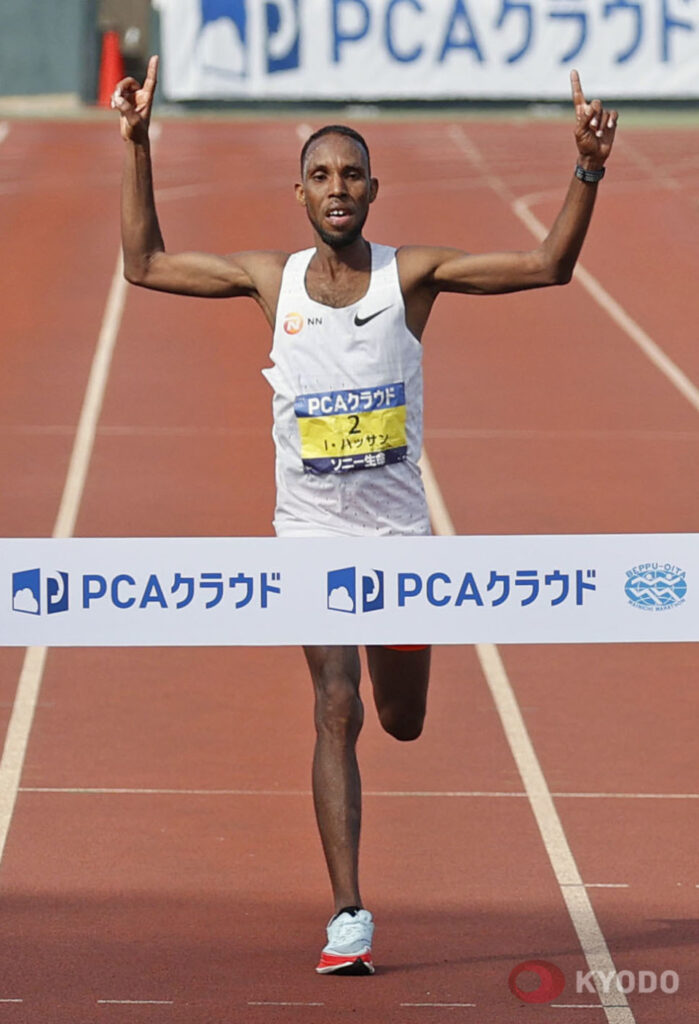
Ibrahim Hassan of Djibouti won the Beppu-Oita Mainichi Marathon in Oita, southwestern Japan, with a meet record of 2 hours, 6 minutes and 43 seconds Sunday.
Kenya’s Daniel Kipchumba crossed the finish line five seconds later for second place, and Japan’s Tsubasa Ichiyama placed third in 2:07:44.
The 71st edition of the race started in front of the Umitamago aquarium and finished at J-Lease Stadium.
“With the win and course record, I’m very, very happy,” the 26-year-old Hassan said. “The course was very good.”
Aoyama Gakuin University’s Shungo Yokota came in fourth in 2:07:47, setting the marathon record for a Japanese student runner.
Ibrahim Hassan of Djibouti crosses the finish line at J-Lease Stadium to win the Beppu-Oita Mainichi Marathon in Oita, southwestern Japan, on Feb. 5, 2023. (Kyodo)
Saudi Arabia Football Federation president will be part of powerful arm of world football’s governing body.
Saudi Arabia on Wednesday returned to the powerful Fifa Council with their federation head Yasser Al Misehal getting elected at the AFC Congress held in Bahrain.
Who is Yasser Al Misehal?
Al Misehal is the president of the Saudi Arabian Football Federation (SAFF), and has presided over a period of unprecedented change and progress in Saudi football, under the patronage of Saudi Crown Prince Mohammed bin Salman.
The men’s national team pulled off one of the biggest shocks in tournament history when they beat tournament favourites Argentina at the World Cup in Qatar late last year, a feat Al Misehal described in a December interview with The National as “one of the most historical moments for the Saudi nation “.
A member of both Fifa’s and the Asian Football Confederation’s Disciplinary Committees, Al Misehal also served as chairman of the Saudi Pro League from June 2016 to October 2017.
According to his LinkedIn page, Al Misehal studied Sport Management at Sorbonne University Abu Dhabi from 2014 to 2015 and has a Bachelor’s degree in finance from King Fahad University of Petroleum and Minerals.
An avid sports fan since childhood, Al Misehal is an honorary member of Al Ettifaq Football Club.
How has he changed Saudi football?
Under Al Misehal’s patronage Saudi football has undergone major changes. Saudi age-group sides have enjoyed recent success, with the Under-23s clinching the Asian Cup in Uzbekistan in June, and the U20s triumphing at the Arab Cup on home soil in August.
According to the SAFF, the organisation is responsible for the development and up-skilling of more than 3,000 national coaches – more than at any time in the country’s history – and 1,700 referees across the kingdom.
In the past three years, Saudi Arabia has invested heavily in women’s football as both grass-roots player development and the establishment in 2021 of a first women’s national team. The kingdom has also introduced an inaugural women’s football league and girls’ school league.
Latest figures show there are now 520 registered players across 25 clubs in the league, and almost 50,000 girls in the inaugural schools’ league.
Meanwhile, the Saudi Pro League is able to attract superstars like Cristiano Ronaldo, who in December joined Riyadh-based Al Nassr on what is believed to be the most lucrative contract in world football.
What is the Fifa Council?
The Fifa Council is the main decision-making body of the organisation, outside the Fifa Congress. The council is a supervisory body that sets the vision for the organisation and for global football.
It has members from six confederations, with the AFC getting seven spots in the 37-member council.
Al Misehal’s elevation to the Fifa Council restores Saudi Arabia’s presence in the decision-making position at world football’s governing body after an absence of 21 years. Al Misehal will automatically become a member of the Asian Executive Office, too.
What next for Saudi Arabia?
Saudi Arabia has grand plans for football. On Wednesday, the country won the hosting rights for the 2027 AFC Asian Cup. Saudi Arabia was the only country left in the race after India withdrew their candidature as potential hosts .
The 2023 Asian Cup will be hosted by Qatar. It was previously set to be held in China but the country withdrew because of its Covid-19 guidelines. Qatar won the tournament’s last edition, in 2019, which was hosted by the UAE.
Saudi Arabia is also looking host the 2026 women’s Asian Cup, which will be another milestone in the journey of women’s sports in the kingdom.
However, the biggest target is said to be a bid for the hosting rights of the 2030 Fifa World Cup, with Saudi Arabia reported to be considering a joint proposal with Egypt and Greece.
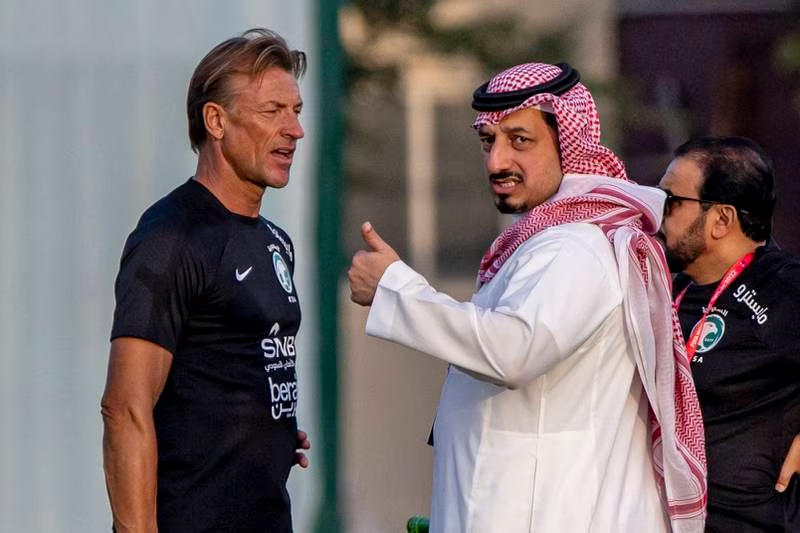
Yasser Al Misehal, right, president of the Saudi Arabian Football Federation, with national team coach Herve Renard during a training session ahead of the 2022 Fifa World Cup in Qatar. EPA
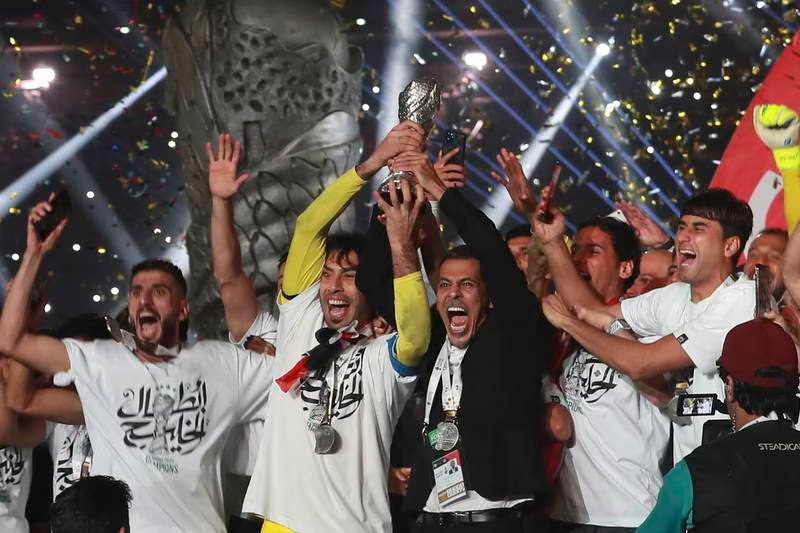
Despite a crush that killed two people, the match went ahead and Iraq beat Oman 3-2 to win the 25th title.
At least two people died and more than 60 were injured after a crush at Iraq’s Basra International Stadium hours before the Gulf Cup final in which Iraq were crowned champions.
The match went ahead despite Iraq’s state news agency confirming one person had died and 60 were injured, while provincial health authorities said a young female doctor had also died.
Hamza Ahmed, 26, from Baghdad, died after being caught up in the incident, his brother Omar told The National. He had been in Basra since the start of the tournament. His brother, cousin and friend were injured.
The Arab Gulf Football Federation announced the match would go ahead as scheduled, and Iraq claimed the trophy after a close encounter.
Iraq opened the scoring through midfielder Ibrahim Bayesh after 24 minutes. Ten minutes into added time Omani midfielder Salaah Al Yahyaei levelled from a penalty, sending the match into extra time.
Midfielder Amjad Attwan put Iraq ahead after 116 minutes with another penalty, but three minutes later Omani striker Omar Al Malki levelled again with a header.
Iraqi defender Manaf Younis scored the winning goal two minutes into added time.
Thousands of fans had walked to the 65,000-capacity stadium on Thursday morning before the match, with many prevented from entering.
A video posted on social media, apparently from the scene, showed fans crying for help as others were pushed along by the moving crowd.
Authorities later opened the gates of the stadium to relieve the pressure, allowing ticket holders to enter. Later they closed all gates but one, which was kept open for Omani fans.
They also opened nearby Al Minaa Stadium, which has a 30,000-seat capacity, for fans to watch the game on screens.
Calm soon returned to the area.
“After consultations with concerned parties in sultanate of Oman and to ensure the safety of the Omani citizens, and as a support to the brothers in the Republic of Iraq to make the final match a success, it has been decided to bring back fans who are still at Basra International Airport,” the Oman Football Federation said earlier.
It urged Omani fans still outside the stadium not to enter, but later it allowed fans to head to the stadium after securing their seats.
Meanwhile, Oman Air cancelled at least one flight to Basra.
The deadly incident came hours after the Governor of Basra, Asaad Al Eidani, called on fans not to gather outside the stadium, especially those without tickets.
“This could lead to a stampede and [the] perfect image of our country, hosting this event, could be tarnished only a few hours before the final ceremony,” Mr Al Eidani said late on Wednesday.
“We call upon you to abide to security forces guidelines to ensure the safety of the citizens,” he said, adding that dozens of big screens had been set up around the city for those without tickets.
Iraqi Prime Minister Mohammed Shia Al Sudani has travelled to Basra and met organisers to discuss the incident.
Mr Al Eidani warned fans that the Arab Gulf Cup Football Federation may be forced to move the match to another venue outside Iraq if measures were not taken to stop such incidents, prompting many of them to withdraw.
At the end of the match, Iraqi players hugged each other as they cried.
The fans shouted: “Long live Iraq” and “Oh Iraq, we are ready to sacrifice ourselves for you.”
Outside the stadium and in Baghdad, fireworks lit up the sky while some shot into the air live ammunition despite warning from Iraqi Interior Ministry.
Thousands of fans poured on to the streets after the match, waiving Iraqi flag and dancing. Cars were honking in rhythmic succession as fans cheered: “Go, go the Lions of Mesopotamia.”
“That’s not only a precious triumph, but a precious joy that we need so much and waited for a long time,” Abbas Mohammed said, driving his car in a Baghdad street while hoisting the Iraqi flag.
“It’s a bittersweet achievement,” said Ali Yassir, standing near by.
“Unfortunately, the day started with a tragedy that made all of us sad. That trophy is for those who lost their lives or were wounded while trying to attend the match.
Mr Al Sudani congratulated the Iraq team.
“The cup is Iraqi,” he said. “We are proud of our lions.”
He also thanked those who were behind making the tournament a success.
The eight-team tournament kicked off on January 6, bringing together teams from Iraq, Yemen and the six Gulf Co-operation Council states — the UAE, Saudi Arabia, Kuwait, Bahrain, Oman and Qatar.
Iraq is hosting the biennial regional competition for the first time in more than four decades, after enduring wars, diplomatic isolation and instability after the 2003 US-led invasion that toppled Saddam Hussein.
Iraqis have celebrated the event as a triumph of sports diplomacy, part of continuing efforts to heal a political rift between their country and its Gulf neighbours, and recovery as a footballing nation.
They hoped hosting the event would turn a new page in the country’s troubled history and represent a crucial step towards full national recovery, mainly by attracting sorely needed foreign investment.
Fifa banned Iraq from hosting international matches between 2003 and 2018, because of the poor security situation. It lifted the ban early last year.
Since late Wednesday, fans have flocked to Basra from other parts of Iraq, snarling traffic.
The local government in Basra announced an official holiday on Thursday in an attempt to clear the roads.
The Iraqi Interior Ministry is asking the public to celebrate in a “civilised way” and avoid celebratory gunfire. It has said it will arrest those who shoot into the air.
On Monday, Iraq beat Qatar 2-1 and hours later Oman beat Bahrain 1-0 to set up the final match of the tournament.
Iraq is hosting the eight-nation football tournament for the first time in more than 40 years.
The Gulf Cup began with fanfare on Friday in Iraq’s southern city of Basra, sparking hopes of a bright future for the country’s embattled football prospects.
For Iraqis, hosting the biennial event will turn a new page in the troubled history of their country, boost relations with Gulf neighbours and represent a crucial move towards full national recovery.
Iraqi Prime Minister Mohammed Shia Al Sudani formally kicked off the tournament, hailing it as a “historic moment” which demonstrates “brotherhood among the Arab brothers in the Gulf”.
“Dear sport fans, thanks for your presence,” he said. “On your behalf and in the name of Iraq, we welcome the brothers, the visitors, the teams and the fans in the land in Iraq, the land of Mesopotamia and Basra.
“We wish all teams success and enjoyment to the fans.”
Mr Al Sudani was joined by Fifa President Gianni Infantino, Iraq’s Speaker of Parliament Muhammad Al Halbousi and the heads of the Gulf football federations.
As the sun set over the port city, the mood in and around Basra International Stadium was festive and electric with anticipation.
By the afternoon, more than 10,000 foreign fans had arrived in the city, located a short distance from Iraq’s borders with Kuwait and Iran, an official from Basra’s provincial government said.
Thousands of people gathered at the stadium, known as the Trunk of the Palm, its design inspired by the southern city’s palm trees. It was filled to its 65,000-person capacity with more soaking up the atmosphere outside.
Some fans pushed the guards back at one gate, breaking into the stadium perimeter, but no large disruption was caused.
As the ceremony began, poet Hazim Jabir, actress Enas Talib, actor Jawad Al Shakarchi and singer Hussam Alrassam took to the field, dressed in elaborate costumes in a performance that told the story of the city’s rich history and culture.
Once the ceremony wrapped up, the tone in the stadium shifted from excitement to intense focus as Iraq and Oman faced off in the first game of the tournament.
Travel to the stadium before the ceremony and opening matches snarled up traffic in the city. Others walked to the stadium, waving the Iraqi flag or wrapping it around their shoulders. Songs welcoming the participating teams blared from cars.
Those who couldn’t secure tickets packed the public square to see the opening ceremony on a big screen.
“Thank God the opening ceremony was very beautiful and well organised; I didn’t expect that, to be honest,” Ali Ibrahim told The National as he joined hundreds of fans in the city’s Tayaran Square.
Mr Ibrahim, 23, and his cousin were draped in the Iraqi flag.
“We are very proud of our Basra, which has become an international city now,” he said.
“It is really amazing to see the tournament eventually kicked off after waiting so many years,” Dhirgham Amir told The National.
Mr Amir, 20, came with his brother and sister to Al Tayaran Square.
“This will definitely change how Iraq looks like to the whole world as a dangerous place ravaged with terrorism,” he said, putting his nine-year old sister on his shoulders.
“A bright future mainly in sport is waiting Iraq,” he added.
The biennial Arabian Gulf Cup first took place in 1970. The last time it was held in Iraq was in 1979, when the hosts were crowned champions. Iraq also won in 1984 and 1988.
The event features teams from the Gulf Co-operation Council countries — Kuwait, Saudi Arabia, Bahrain, Oman, Qatar and UAE — as well as Iraq and Yemen.
The most recent event was held in 2019 in Qatar and was won by Bahrain.
A bright future
“It is a step forward to retain Iraq’s normal position in the fields of sport, culture and society,” Basra Governor Asaad Al Eidani said before the start of the tournament. “It is a message to the whole world that we are capable.”
The UN Assistance Mission for Iraq echoed those sentiments.
“By hosting the cup, Iraq showcases the unifying power of sports and its ability to harbour peaceful and respectful competition. We wish Iraq and its people a successful tournament,” the agency wrote on Twitter.
The eight teams playing in the tournament are divided into two groups.
Group A consists of Iraq, Saudi Arabia, Oman and Yemen, while Group B features the UAE, Bahrain, Kuwait and Qatar.
The winners and runners-up of each group proceed to the semi-finals on January 16 — where the winners of Group A play the runners-up of Group B, and the Group B winners take on the runners-up from Group A.
On January 19, the winners of the semi-finals meet in the Gulf Cup final.
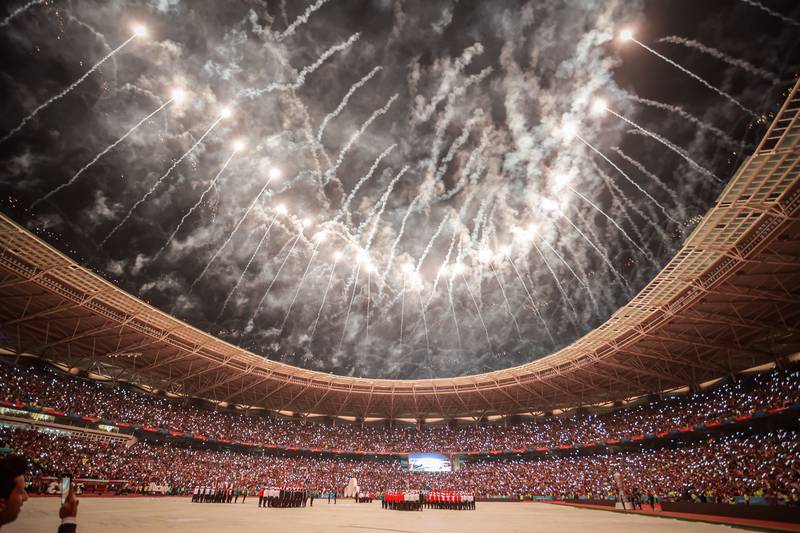
Fireworks light up the sky over the Basra International Stadium during the opening ceremony of the 25th Arabian Gulf Cup in Basra, southern Iraq, on Friday, January 6. Getty
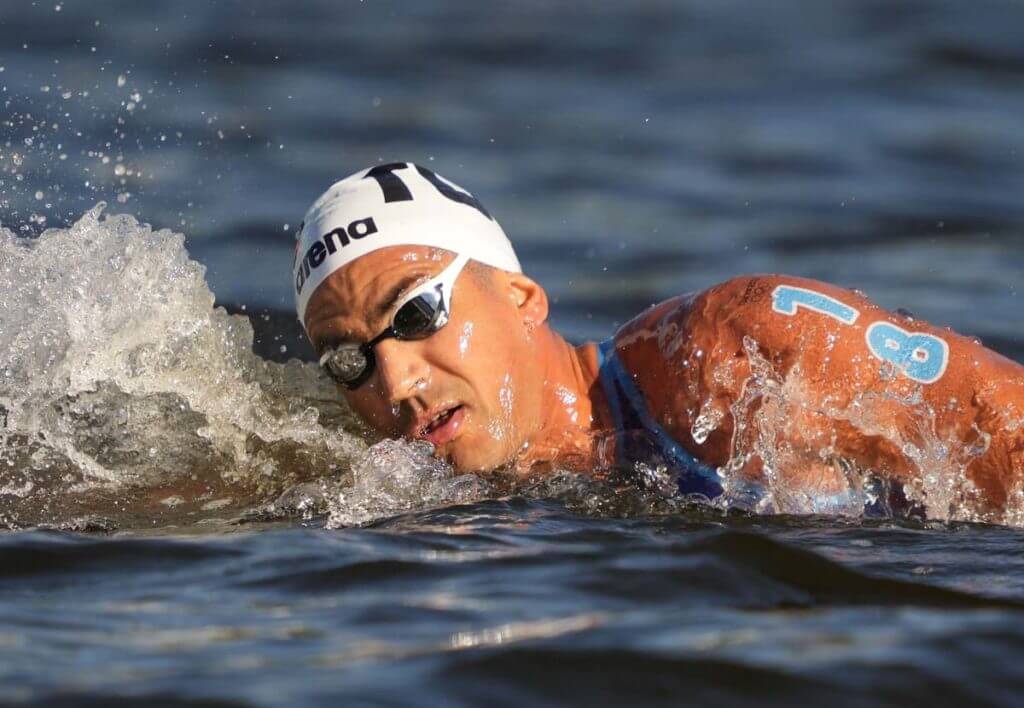
Oussama Mellouli became only the fourth swimmer to compete at six Olympic Games when he dived off the pontoon at Odaiba Marine Park on Thursday and then set his sights on Paris 2024 when he will be 40.
The Tunisian made his Olympic debut at Sydney 2000 and has now competed at five subsequent editions to join Therese Alshammar and Lars Frolander – both of Sweden – and Derya Buyukuncu of Turkey in an exclusive club.
The 37-year-old won gold in the 1500 free at Beijing 2008 followed four years later by bronze in the longest event in the pool as well as the open water title at London 2012.
He was 20th at Odaiba Marine Park on Thursday almost eight minutes behind winner Florian Wellbrock who delivered a masterclass in open water swimming.
Mellouli almost didn’t make it to Tokyo at all because of an ongoing dispute with the Tunisian Swimming Federation which saw him announce his retirement last month.
Days later, however, he confirmed he would race in Japan after Tunisian Olympic Committee president Mehrez Boussainpledged to mediate between Mellouli and the federation.
Mellouli though said the dispute had affected his training and subsequent performance, saying:
“I think I could have done a better job. Considering the last five weeks since Setubal (the FINA qualifying race), I’m a bit disappointed about (not being) a bit more in the fight.
“I think I wasn’t in the race for the first three loops and then I was below average in the last four loops.
“I think the poor situation that I’ve been in after my qualifier, I think a lot of extra stuff that’s been happening in my preparation didn’t get me in top form and top condition.
“After the qualifier I was hoping the situation could have been better so I could be in a better condition.”
It seems that Mellouli doesn’t want to end his career on such a note and when asked if he intended to compete in France, Mellouli said:
“I honestly hope so. I think I have more to prove.”
Should he do so, the eight-time world medallist would become the first swimmer to compete in seven Olympics after Alshammar attempted to qualify for the Sweden team in the women’s 4×100 free this year although her bid came to an end at the Sette Colli meet in June.
Thursday’s race saw Wellbrock win by more than 25 seconds ahead of Kristof Rasovszky and European champion Gregorio Paltrinieri and add to his bronze in the 1500m freestyle.
The German now holds the Olympic and world titles and Mellouli said:
“He did an amazing job, congratulations to the German team.
“Florian is a superstar. He has shown tremendous skills in the pool and today dominated the 10k so congrats.”
The first morning of swimming finals at the Tokyo Aquatics Centre featured Mellouli’s fellow Tunisian Ahmed Hafnaoui who won the 400 free from lane eight, prompting an outburst of emotion and unconfined joy.
Hafnaoui described Mellouli as a “legend” and said he aspired to be like him, a legacy of the older man’s success in the pool since he claimed his first global medal with 400IM bronze at the 2013 World Championships in Barcelona.
“I hope so,” said Mellouli.
“I’m very proud of him, words can’t describe how proud I am of him. I know the 400 freestyle is a very tough event, I think my best finish was fifth.
“He is a mature athlete at a young age.”
He added:
“That was great for Tunisian swimming, for Arab swimming, for north African swimming.
“I’m very proud of the kid. He shook the world and did an amazing job, an inspirational job.”