Arabs & Arabian Records Aggregator. Chronicler. Milestones of the 25 Countries of the Arabic Speaking World (official / co-official). AGCC. MENA. Global. Ist's to Top 10's. Records. Read & Enjoy./ www.arabianrecords.org
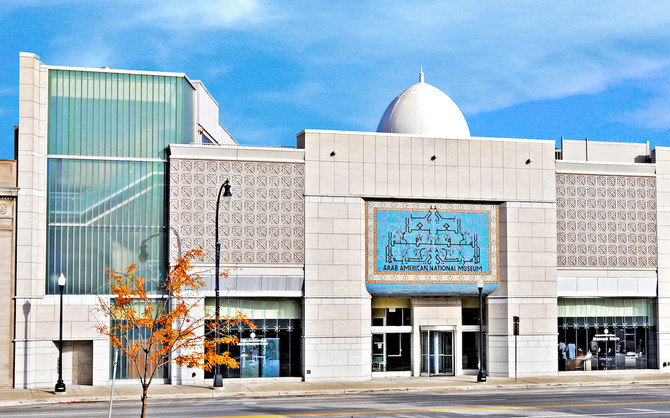
After the COVID-19 pandemic sparked a near-two-year closure, the Arab American National Museum in Dearborn, Michigan, has finally reopened its doors to visitors.
Founded in 2005, AANM bills itself as America’s first and only museum devoted to telling the stories of Arab-American history and culture. Its location is apt; Dearborn is home to the largest Arab community in the US — around 40 percent of the city’s population is of Lebanese, Syrian, Yemeni, Iraqi, or Palestinian origin.
eaturing a courtyard, a fountain, and thematic spaces, the interior of AANM pays homage to Middle Eastern and North African design and architectural aesthetics. Through its galleries, the museum details Arabs’ varied contributions to humanity, and the phases of Arab immigration: the challenges of coming to America, the challenges of establishing a life there, and the impact of Arab-Americans in the public and private spheres.
It tells the stories of peddlers, entrepreneurs, scholars, military men and women, artists, and entertainers. There are some important but relatively unknown names highlighted. Take Ruth Joyce Essad, a fashion designer born in 1908, for example. She became one of Detroit’s first couturiers — dressing socialists and singers, including big-band vocalist Dinah Shore. Another interesting personality is the Syrian business owner Leon B. Holwey, who claimed to have co-invented the ice-cream cone in the early 1900s.
On a national level, the profile of Arab-Americans was raised last year by President Joe Biden, who made history by establishing National Arab American Heritage Month, which will take place in April every year.
source/content: arabnews.com
_________
The Arab American National Museum is in Dearborn. (Supplied) / arabnews.com
50 countries to take part in Aqsa Week 2022 to promote love of mosque, raise awareness
A UK-based initiative to shed light on the Al-Aqsa mosque in Jerusalem has gone global for the second year in a row, with more than 50 countries set to take part, according to organizers.
Aqsa Week 2022, which will run from Feb. 24 to March 2, is being organized by the British-based Friends of Al-Aqsa (FOA) — a NGO concerned with defending the human rights of Palestinians and protecting the Al-Aqsa Sanctuary.
FOA said that during the week, which they anticipate to be the biggest one yet, mosques, universities, local councils and parliaments will hold talks, workshops and other activities and educational events to highlight the mosque’s heritage, and bring global focus to its issues.
Aqsa Week, which was launched by FOA in 2017, aims to inform people of Al-Aqsa and its history and significance, as well as the dangers faced by Al-Aqsa and the Palestinian people.
Al-Aqsa is Islam’s third holiest site and is in close proximity to religions sites significant to Jews and Christians, making the area a flashpoint in the Palestinian-Israeli conflict. The Israeli government has on occasion prevented Muslim worshippers from accessing the mosque.
Several of the FAO events will be streamed live on their social media accounts, as well as TV and radio, and they have chosen #LoveAqsa as this year’s hashtag.
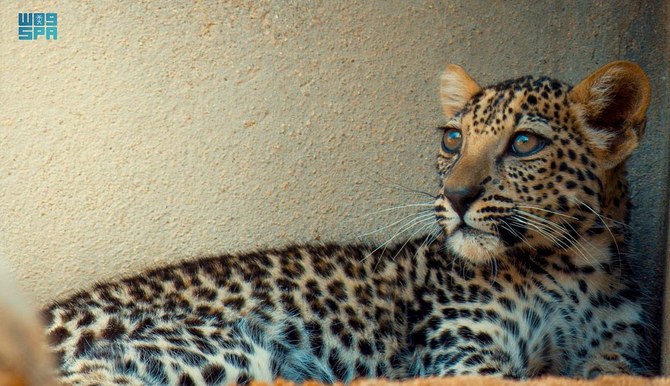
Saudi Arabia has declared Feb. 10 as “Arabian Leopard Day” in a bid to raise awareness of the endangered big cat.
The move, which was announced by the Council of Ministers last month, is part of the Kingdom’s efforts to protect the species, which is now classed as critically endangered, from extinction.
The Arabian leopard is the chief predator in Saudi Arabia and plays a major role in the Kingdom’s culture. But overhunting and a lack of natural prey means there are now fewer than 200 left in the wild.
In December 2020, Prince Badr Bin Farhan, the minister of culture and governor of the Royal Commission for AlUla, established the Global Fund to Protect the Arabian Leopard from Extinction in the Sharaan Nature Reserve. Its aim is to sustain the leopard population and its prey, and protect its natural habitat.
Images of the Arabian Leopard were projected onto buildings and monuments across Saudi Arabia and the UAE on Feb.10.
In recent years, the commission and the National Center for Wildlife have been working on a number of initiatives to protect the big cat. Among these is expanding a breeding program within the Sharaan reserve.
Also, last year, Princess Reema bint Bandar Al-Saud, Saudi Arabia’s ambassador to the US, launched the nonprofit foundation Catmosphere to raise awareness of the many endangered cat species around the world, including the Arabian leopard.
The Kingdom also works closely with Panthera, which is devoted to the conservation of the world’s wild cat species.
The Arabian leopard lives in high mountains and is native to Saudi Arabia, Yemen, Oman and the UAE. Anyone found hunting the animal in the Kingdom faces a fine of SAR400,000 ($106,000) — rising to SAR30 million for repeat offenders — and up to 10 years in prison.
source/content: arabnews.com
______________
The Arabian leopard is the chief predator in Saudi Arabia and plays a major role in the Kingdom’s culture. (SPA)
The first Egyptian aviator set out to fly from Berlin to Cairo on 25 January 1930 and arrived one day later on 26 January, now celebrated as Egypt’s National Civil Aviation Day.
Mohamed Sedki the Egyptian pilot who took off from Berlin, and went from one place to Europe with another plane until he arrived in Cairo on January 26, 1930 / pix: egyptian-gazette.com
One of the most intriguing chapters in Egyptian history records early attempts by the country’s aviators to fly solo from Mohamed Sedki the Egyptian pilot who took off from Berlin, and went from one place to Europe with another plane until he arrived in Cairo on January 26, 1930Europe to Egypt, with 26 January, Egypt’s National Civil Aviation Day, marking the first successful flight of Egyptian pilot Mohamed Sedki from Berlin to Cairo in 1930.
Sedki’s success and earlier attempts earned the support of former king Fouad, always interested in supporting exploration and discoveries whether in the air or on land. But how much do we know today about these attempts and of the Egyptian pioneers who courageously flew these planes, sometimes risking their lives?
The successful attempt by Sedki in January 1930 to fly from Europe to Egypt was preceded by other unforgettable attempts.
There were those by Ahmed Hassanein Pasha, a legendary figure in the history of aviation. Better known for his exploration of the Western Desert, he was one of the most powerful men in various governments under king Fouad and king Farouk and an adventurer at heart, attempting to fly from Europe to Egypt several times before 1930.
His wish was to fly from Egypt to London in a small plane across the Mediterranean. On his first attempt, he succeeded in flying over the Mediterranean, but a few hours later his plane crashed in southern France and was destroyed. However, Hassanein survived to continue to pursue his obsession, and he bought another small plane to fly again.
This time, the plane fell in Switzerland, but Hassanein once again escaped death and decided to buy a third plane and try again. On his third attempt, the plane fell in Italy, and Hassanein was so seriously injured that the Italian doctors that rescued him considered he had died. But according to the story told in celebrated journalist Mustafa Amin’s book Unforgotten Figures, Hassanein recalled the words of Egyptian poet laureate Ahmed Shawki and described himself as a layth or lion.
He started repeating the words “courage lion” to himself at the hospital in an attempt to defeat death. The words seemed to work magic, and he surprised his doctors with a speedy recovery despite his condition.
Whether true or not, the story speaks of Hassanein’s unrelenting spirit. Rather than give up on further attempts at flying after his near death, Hassanein made a fourth endeavour to fly to Europe. A few days after leaving the hospital, he bought a fourth plane. But half an hour before flying, one of the technicians boarded the plane to do a final check, and five minutes later the plane turned into a ball of fire, with Hassanein watching in disbelief.
This was the fourth and last attempt that sealed Hassanein’s flying adventures and put an end to his aspirations.
The Egyptian Eagle
Hassanein’s plane was named Faiza after one of king Fouad’s daughters, also the name of the first plane that successfully crossed the Mediterranean to land in Egypt in 1930 piloted by “Egyptian Eagle” Mohamed Sedki.
The plane Sedki flew was a small one-seater that weighed 250 kg and had a 40 horsepower engine. Sedki used it to fly from Berlin to Alexandria, where he landed at the Abu Kir airport on 25 January. He had started his epic flight across Europe on 12 January, passing through the former Czechoslovakia, the former Yugoslavia, and Italy all the way to Egypt in unfavourable weather. Governor of Alexandria Hassan Sabry Pasha welcomed him at the Airport, before he flew again to Heliopolis Airport in Cairo, arriving on 26 January.
Sedki’s successful flight caused a sensation at the time, as thousands of people cheered him on at Heliopolis Airport, where a model plane made of flowers awaited him. Captain Goldsmith, in charge of the Abu Kir Airport at the time, exclaimed that Sedki’s was the smallest airplane he had ever set his eyes on. In Cairo, Sedki’s feat was celebrated at a formal ceremony that included representatives of king Fouad, such as Yehia Pasha, as well as prince Abbas Halim, prime minister Mustafa Al-Nahhas Pasha, minister of transport Mahmoud Al-Nokrashi, and the delegated German minister.
Kamal Elwi, another Egyptian pilot who had learned to fly before Sedki and whose private plane was the first registered plane in Egypt, was also present during the ceremony. It was graced by the presence of poet laureate Ahmed Shawki, the same poet who had earlier called Hassanein the lion. Sedki, Shawki said, was like a young Egyptian leader coming back from battle crowned with victory, adding that he saw in Sedki’s face the lines of a true ancient Egyptian, with this being the secret behind his courage.
His words chimed with the rising sense of Egyptian nationalism and pride in Egypt’s roots at a time of British colonisation, a pride that manifested itself in the literary sphere with works dedicated to Egypt’s past like Shawki’s own magnificent play The Death of Cleopatra.
The royal reception Sedki received was complemented by king Fouad’s awarding him the Gold Medal of Excellence and a gift of LE1,000 for his services to the nation. His successful flight also resulted in the establishment of the first club for Egyptian aviation in Cairo, which held another celebration for Sedki as Egypt’s first international pilot on 29 January 1930. Sedki was awarded a share in the club to the value of LE50.
Together with Kamal Elwy, and Talaat Harb, founder of the first Egyptian bank, Sedki called for the establishment of EgyptAir, Egypt’s first airline company. His success was considered a national feat at a time when the British were reluctant to allow Egypt to enter the field of aviation, since Britain had its own airline company operating in Egypt and did not want the competition.
One obstacle that Sedki encountered when trying to realise his dream was obtaining the approval of the British to fly to Egypt from abroad, an approval that he only obtained after long weeks of anticipation. Harb said during the celebration that before Sedki’s success, Egypt had been deprived of having its own pilots and its own national airports, but now that Sedki had debunked British claims that the Egyptians were unable to act as pilots, there was hope that they could be equal to other nations in the field of aviation.
A series of domestic flights followed Sedki’s international flight as he flew to Upper Egypt, first to Luxor and then to Aswan before flying back to Luxor. From there, he flew to Minya and Assiut on 27 March. Yet, for all this, Sedki did not stay in the limelight for long, and on 27 June that same year he flew back to Germany, claiming that the government in Egypt had not given him the proper appreciation, offering him a minor post with a meagre salary and barely enough to look after his plane.
He rejected the job offer and left Egypt from Heliopolis Airport, the same one where he had received a hearty welcome on his successful arrival earlier the same year.
Graduate Number 34
Al-Nadi /pix: english.ahram.org.eg
Between Sedki’s solo flight in 1930 and 1933, 33 male pilots graduated from Egypt’s School of Aviation. But graduate number 34 was certainly different, as this time the graduate was Lotfia Al-Nadi, the first Egyptian and African woman aviator to earn a pilot’s licence after US pilot Amelia Earhart with whom she exchanged letters.
In a later interview explaining her decision to train as a pilot, Al-Nady said that “I was young, eager to learn things and to accomplish something, but there were few directions that I could pursue. I read about a programme for flying that was being established,” and this was invitation enough for her to join. She was 26 when she flew her first plane from Alexandria to Cairo after training for just 67 days.
However, Al-Nadi’s career as a pilot was not an easy one. She had a reluctant mother and an initially unsupportive father, and she had to find a way to afford her flying lessons and to take them secretly. Kamal Elwy, the then director of EgyptAir, offered her a job as a telephone operator and secretary with the company, and Al-Nadi used her salary to pay for flying classes. Her secret was later revealed when her father saw a picture of her in the international press.
She was finally able to appease her father and earn his support when she took him as her first passenger on a ride above Cairo and around the Pyramids. “I took my father for a flight,” she later said. “At first, he sat stiffly, but then I noticed that his head was swiveling to the right and left. I asked him about it after we landed, and he told me he had been frightened, but then he had decided that he was in the hands of his daughter. He knew that if we crashed, we would crash together, so he relaxed and began to enjoy the flight.”
Al-Nadi’s singular career was undertaken at a moment that overlapped with the fight for women’s rights in Egypt and for women’s rights to education. Not surprisingly, Hoda Shaarawi, the famous Egyptian feminist leader of the time, honoured Al-Nadi and held a fundraising drive for her so that she could buy a plane of her own.
Among her adventures, Al-Nadi recalls how on one occasion her engine failed and she had to land in the desert where she was helped by Bedouin and given a bony mule to ride on her way back to Cairo. “I often laughed that the mule was more dependable than my Moth airplane,” she said.
Sadly, Al-Nadi’s remarkable aviation career ended abruptly in the early 1950s when she had a tragic accident while landing that left her with a broken spine. She left Egypt for Switzerland for a long period of treatment, remaining in the country for many years. Eventually, she was awarded Swiss nationality.
In 1989, Al-Nady was given the Order of Merit, the highest distinction of the Egyptian Aerospace Education Organisation. She returned to Egypt permanently, dying in the country in 2002 at the age of 95. Today, she is considered to have opened the way for other women pilots, among them Linda Masoud, the first female pilot coach, and Aziza Moharram, the first female director of the Aviation Academy, not to mention other pilots like Dina Al-Sawy, Hasnaa Taymour, and Heba Darwish.
Less well known than Al-Nadi, yet equally important to the history of Egyptian aviation is Esmat Ahmed Fouad, another woman who learnt to fly but did not obtain a pilot’s license.
Esmat’s story remains inspiring because she joined the School of Aviation and was flying at the age of just 14. Her two sisters, Kadreya and Aisha, followed suit and also learnt to fly. But the three sisters could not obtain pilot’s licenses as they were under the age of 17. They did not pursue flying careers, which is why in his book Civil Aviation in Egypt author Abdel-Latif Al-Sabbagh considers Al-Nadi to be the real pioneer of Egypt’s women aviators.
EgyptAir
The stories of individual endeavours to fly solo internationally interweave with the story of commercial flights in Egypt and the attempt to establish the national airline Egypt Air.
In 1924, the Ministry of Transportation formed a committee to launch commercial flights in Egypt, and this suggested the establishment of the Egyptian Civil Aviation Authority (ECAA), whose mission would be to oversee air navigation and the country’s newly established airports. The project was highly acclaimed at the time, as it was needed to organise the arrival and departure of international planes. It was planned to establish the ECAA within five years.
In the same year, a group of Egyptian businessmen headed by Hassan Anis Pasha started to establish a company for commercial flights in Egypt. After much searching for the right types of plane, they recommended one made entirely of metal with three engines and the capacity to carry 12 passengers and two tons of merchandise. This project signalled the establishment of EgyptAir, Egypt’s national airline. In 1927, the government established the ECAA, and between 1927 and 1929 it sent three missions to train abroad.
EgyptAir was not formally established until 1931, when, thanks to the Egyptian young people who had received their training abroad, the idea of civil aviation eventually saw a revival after years of stagnation. Almaza Airport, the country’s first, was established in the same year — the earlier Heliopolis Airport mainly served the British air force, and other flights were not allowed to use it.
The history of civil aviation in Egypt is an inspiring one, a story of persistence, hope, and freedom for a whole country to have the right to fly. Stories of Egypt’s early aviators cannot fail to make future flights with EgyptAir more meaningful, and they deserve to be commemorated in a national museum dedicated to civil aviation, something which at present does not exist.
It is perhaps high time we thought of establishing such a museum in order to remind ourselves of the meaning of National Civil Aviation Day and to keep the day alive.
*A version of this article appears in print in the 3 February, 2022 edition of Al-Ahram Weekly.
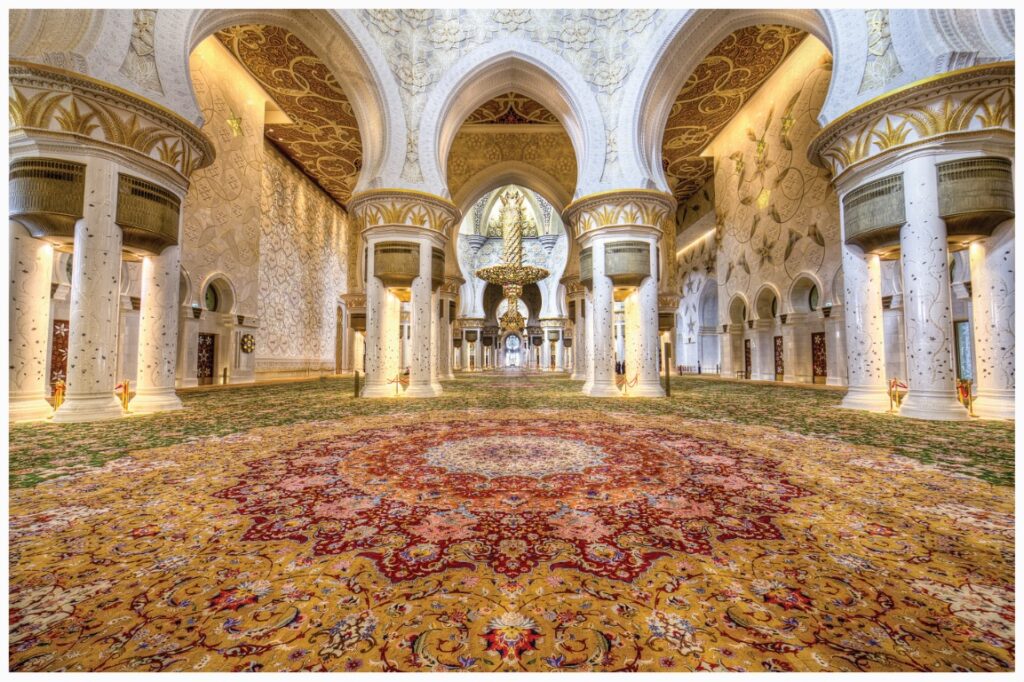
The Sheikh Zayed Grand Mosque’s main prayer hall housed the world’s largest carpet, a unique masterpiece with dazzling beauty and design. The carpet was hand-knotted by a group of the world’s most skilled artists and weavers.
The wool and cotton carpet was hand-crafted by around 1,200 artisans. It is 5,400 square metres, with 40 knots per 6.5 centimetres and 2.5 billion knots for the entire carpet, weighing 35 tons after completion.
Despite its enormous size, the carpet was designed as a single piece, which qualified it for the Guinness Book of Records in 2017 as the largest carpet in the world. Its knotting took approximately 12 months.
With unique harmony and integration of aesthetic elements, the carpet covers the floor of the main prayer hall and magnifies its splendour. The hand-woven carpet has an astonishing design, looking like a reflection of the above chandelier. Its background features a variety of 25 natural colours from traditional herbs, including local madar roots, pomegranate peels, leaf veins, and others.
The carpet is predominately green, bringing a sense of calm and comfort to the place. To maintain the beauty of the design, a shaving technique was used to define the rows of worshipers on the carpet.
The carpet weaving took place in three large workshops on a built-up area of 5,000 square metres. The carpet’s high-quality materials, colours, and creative design make it one of Sheikh Zayed Grand Mosque’s finest elements. It is carefully supervised by Sheikh Zayed Grand Mosque Centre, with its maintenance work taking more than 12 days according to thoughtful plans by specialized teams.
Monastery has three churches, most important of which is underground Church of St Paul.
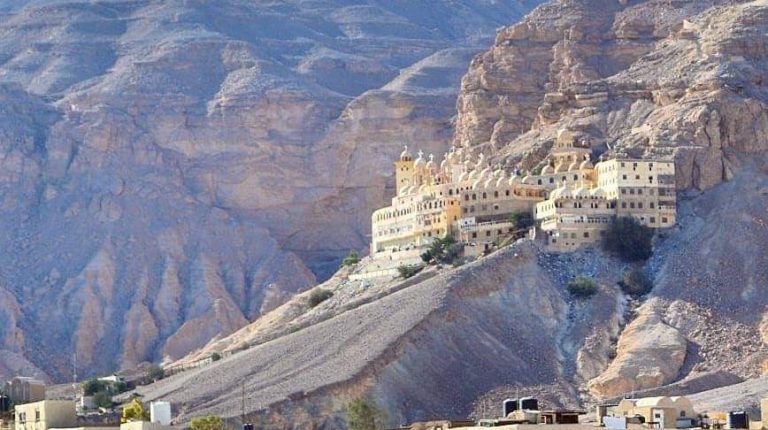
The Monastery of St Paul the Anchorite, also known as the Monastery of the Tigers, is a Coptic Orthodox monastery dating back to the 4th Century CE located in Egypt’s Eastern Desert, near the Red Sea Mountains.
Located about 155 km south east of Cairo, the monastery gained the moniker the Monastery of the Tigers due to its isolated location out in the wilderness of Egypt’s desert moonscape. It covers an area of about five acres of land, and is a rectangular shape of 200 metres long by 100 metres wide.
By the 5th Century CE, the monastery was built over the cave where St Paul the Anchorite lived for more than 80 years.
St Paul, also known as St Paul of Thebes, or Anba Bola in Arabic, was a Coptic Orthodox saint born in Alexandria in 228 CE. Following his father’s death, the teenage Paul decided to become a hermit and live a simple life.
At the age of 16, he converted to Christianity and escaped Alexandria to avoid Roman persecution. According to one story, God sent Paul an angel who guided him to Egypt’s arid Western Desert, where he could live alone as a hermit.
The same story relates how God sent Paul a crow every day carrying half a loaf of bread to feed him. One day St Anthony joined Paul, and when the crow came, it had a full loaf of bread. St Paul then realised that it was God who had sent St Anthony, after 80 years of his worshipping in solitude.
As legend tells it, when St Paul died St Anthony saw two lions standing by the door of the cave in which the former had made his home. The lions approached the corpse, and used their claws dug in the ground, for St Anthony put St Paul’s body into the hole for burial.
It is for this reason that St Paul’s icon in any Coptic museum in Egypt shows him flanked by two lions with a crown above his head.
The first travel narrative associated with the monastery belongs to an anonymous pilgrim from the Italian city of Piacenza who visited the tomb of St Paul the Anchorite between the years 560 CE and 570 CE. The pilgrim is not to be confused with Antoninus Martyr.
The first monks to occupy the monastery were some of the disciples of Anthony the Great, after they learned the story of St Paul the Anchorite. It may have been occupied by Melkites for a short period, although they were followed by Egyptian and Syrian monks.
The Syrians may have had a sustained existence at the monastery, for it appears that they also occupied the monastery during the first half of the 15th Century, after which their presence disappeared. According to an isolated Ethiopian reference, the 70th Coptic Orthodox Pope, Gabriel II (1131–45 CE), was banished to the monastery of St Paul the Anchorite for three years.
Throughout its history, the monastery has suffered from several Bedouin raids, the worst of which occurred in 1484. This particularly painful attack saw all the monks murdered and the monastery plundered, following which the Bedouins occupied the building for 80 years.
The monastery was rebuilt under the patronage of Pope Gabriel VII of Alexandria (1526-69 CE), then attacked and destroyed again towards the end of the century. The monastery was deserted for 119 years, then extensively reconstructed and repopulated by monks from St Anthony’s Monastery, under the patronage of Pope John XVI of Alexandria (1676-1718 CE).
The monastery has three churches, the most important of which is the underground Church of St Paul that contains the hermit’s cave and burial place. Its walls are painted with well-preserved frescoes, and the ceiling is hung with ostrich eggs, symbols of the resurrection. The larger Church of St Michael has a gilded icon of John the Baptist’s severed head.
There is no public transportation to St Paul’s Monastery and, as the original hermit intended, it is a long journey from civilisation to get there. Visitors can take the bus from Cairo to Hurghada and get off at the turn-off for St Paul’s Monastery, following which there is a 13 km uphill trek to the monastery itself. This may sound daunting at first, but the road is well-paved and has plenty of traffic.
The Monastery of St Paul is an incredibly important site in Egypt’s long and varied history, and is the second ancient Coptic Christian monastery tucked away in the Eastern Desert.
Visitors may also view some of the manuscripts in the monastery’s possession, which includes a Coptic language version of the “Divine Liturgy”. A tour of the site may include a trip up the tower, and a glimpse of the “Pool of Mary” where Mary, the sister of Moses, washed her feet during the Exodus.
Along with the nearby Monastery of St Anthony, the Monastery of St Paul is quite possibly the most impressive structure in the desert. It is for this reason that it is included in several Egyptian desert tours.
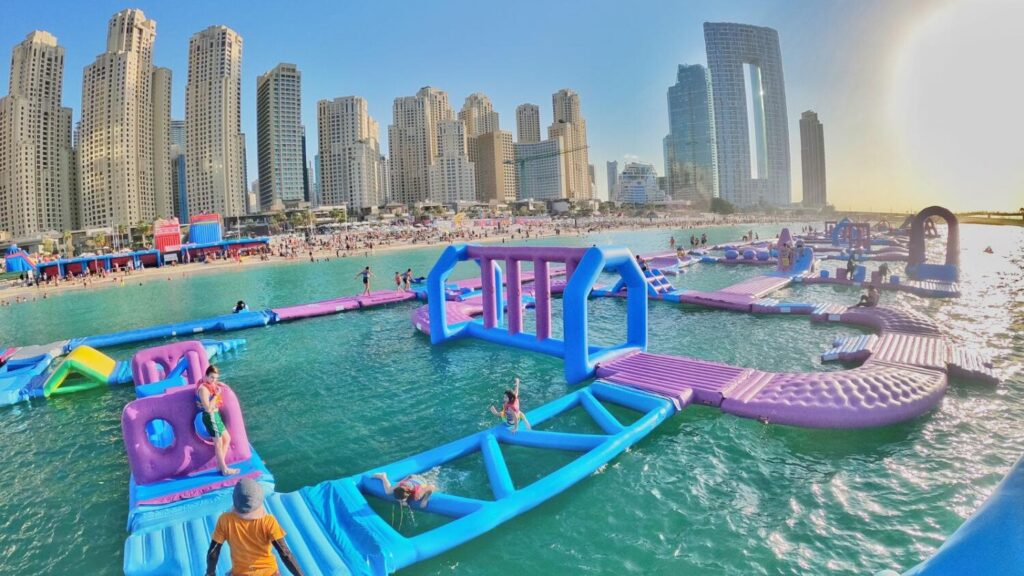
AquaFun, anchored in the Gulf waters alongside the JBR beach, has received a Guinness World Record certificate for being the world’s largest inflatable water park.
Launched for the first time in 2016, AquaFun has now expanded to three times its original size to reach 42,400 square metres. It currently forms the words ‘I love (heart symbol) Expo 2020 Dubai’, which can be seen from aircraft flying into Dubai.
It features over 72 obstacles and operates all year round. Prices start from Dh155 for an all-day pass ticket.
Ahmed Al Khaja, CEO of Dubai Festivals and Retail Establishment (DFRE), said: “To secure another world record for Dubai during such an important event in our calendar, the Dubai Shopping Festival, is a moment of real pride for the city.
Ahmed Ben Chaibah, CEO & Founder of AquaFun, said the aim with the project five years ago was to enrich the Dubai Marina and JBR areas’ offerings.
Emirate bagged yet another world record in the final week of its shopping festival.
Ras Al Khaimah ushers in New Year with record-breaking firework drones flying at 1,055.8 meters high (over 1KM) and 452 firework drones simultaneously launching a breathtakingly choreographed ‘Happy New Year’ message in the sky
Spectacular #RAKNYE 2022 fireworks show sets two GUINNESS WORLD RECORDS™ titles, mesmerising thousands of visitors
12-minute show with over 15,000 firework effects pays glorious tribute to the nation as it marks its 50th anniversary
The dazzling show marked a moment for people to reunite, with visitors arriving to Ras Al Khaimah from across the world to celebrate the New Year
Two GUINNESS WORLD RECORDS™ titles set for the ‘Most Remote Operated Multirotors/Drones Launching Fireworks Simultaneously’ and ‘Highest Altitude Multirotor/Drone Firework Display’
Welcoming hundreds of thousands of spectators from around the world, the Ras Al Khaimah New Year’s Eve Celebrations (#RAKNYE 2022) dazzled all with a never-before-seen fireworks display that smashed two GUINNESS WORLD RECORDS™ titles.
Rising majestically from the Arabian Gulf, the fireworks display featured innovative pyrotechnic drone performances, over 15,000 effects, spanning an area of over 4.7 kilometres. The 12-minute spectacle was specially choreographed to reflect the joy of reunion with six themes set to epic orchestral music.
A Six-Act Show of Wonders
#RAKNYE 2020 fireworks display was conducted in a six-act sequence starting with the countdown just before midnight setting the stage for an ephemeral theatre of wonder. Ushering in the New Year with a spectacular tower of lights at a height of 1,055.8 metres (over 1 km) taller than any building in the world. This was followed by the ‘Happy New Year’ message written in the sky with firework drones, the sequence lit up the arena in multiple hues. These two sequences broke two new GUINNESS WORLD RECORDS™ for Ras Al Khaimah.
Record-breaking feats
Setting the first GUINNESS WORLD RECORDS™ title for the ‘Highest Altitude Multirotor/Drone Fireworks Display’ was the tower of fireworks 1,055.8 metres high, taller than any skyscraper in the world.
The second GUINNESS WORLD RECORDS™ title was for the ‘Most Remote Operated Multirotors/Drones Launching Fireworks Simultaneously’, when 452 drones launched fireworks simultaneously to create the ‘Happy New Year’ visual in the sky.
More than 5,000 hours of work went into preparing for the show that also deployed over 130 sea pontoons and a fleet of hundreds of pyrotechnic drones.
A community event like no other
Many others followed the celebration live on raknye.com.
Ras Al Khaimah had welcomed 2021 with a dazzling 10-minute fireworks show that underlined the UAE’s message of hope, peace and achievements. Ras Al Khaimah also made history with the New Year’s Eve Gala of 2020, which broke the GUINNESS WORLD RECORDS™ titles for the ‘Most remote operated Multirotors/drones launching fireworks simultaneously’ and the ‘Longest Firework Waterfall.’ The Emirate secured two GUINNESS ORLD RECORDS™ titles for the ‘Longest chain of fireworks’ and the ‘Longest straight-line fireworks display’ with the 2019 New Year’s Eve Fireworks.
Morocco’s bid to host the first African office of the World Tourism Organization (UNWTO) was ratified at the 24th session of the Organization’s General Assembly.
The bid was approved amid strong competition from four other African countries, and UNWTO’s first regional office will open in Marrakech.
Morocco’s bid to host the first African office of the World Tourism Organization (UNWTO) was ratified at the 24th session of the Organization’s General Assembly.
The bid was approved amid strong competition from four other African countries, and UNWTO’s first regional office will open in Marrakech.
Ammor led the Moroccan delegation at UNWTO’s General Assembly, which was attended by more than 500 government officials and several tourism professionals from member countries.
Morocco’s participation shed light on the village of Sidi Kaouki in the province of Essaouira as “Best Tourism Village 2021.”
The seaside village of Sidi Kaouki was selected from more than 170 villages from 75 countries, echoing Morocco’s continuous efforts to build an eco-friendly destination for global tourism.
source/content: moroccoworldnews.com
___________
UNWTO Regional Office for Africa to Open in Marrakech. Credits: UNWTO
Minister of Culture Dr. Ines Abdel-Daim said Egypt being chosen as the capital of Islamic culture for 2022 attests to Egypt’s outstanding cultural role in the world.
Ines Abdel-Daim said Cairo is a city of diversity and cultural richness reflecting many of the salient features of human civilisation in general and the Islamic civilisation in particular, as it has always been a meeting-point of civilisations, old and modern, and a unique centre of art, intellect, and creativity.
Director General of the Islamic World Educational, Scientific, and Cultural Organisation (ICESCO) Salim bin Mohammad Al-Malik participated in the gathering that took place in the Cairo Opera House’s Small Hall to elaborate on the details marking the start of the festivity.
source/content: english.ahram.org.eg
_________
Egyptian Minister of Culture Ines Abdel-Daim and Director General of the ISESCO Salim bin Mohammad Al-Malik during the press conference in Cairo on Tuesday (photo courtesy of Egyptian cabinet)