Arabs & Arabian Records Aggregator. Chronicler. Milestones of the 25 Countries of the Arabic Speaking World (official / co-official). AGCC. MENA. Global. Ist's to Top 10's. Records. Read & Enjoy./ www.arabianrecords.org
US Qatari artist and writer Sophia Al-Maria has been announced as the recipient of the 2025 Frieze Artist Award, one of the art world’s most highly anticipated annual commissions.
The award is part of Frieze London, a leading international art fair that will return to Regent’s Park from Oct. 15-19, bringing together more than 280 galleries from 45 countries.
Presented in partnership with Forma, the award supports early- to mid-career artists in debuting new works. This year, Al-Maria will perform “Wall Based Work (a Trompe LOL),” a live stand-up comedy show held daily inside the fair tent.
The work marks Al-Maria’s first attempt at stand-up, in which she will blend sharp humor with her long-standing interest in mythology, empire and pop culture.
“In partnership with Forma, we are proud to continue supporting artist-centered programming,” said Eva Langret, director of Frieze EMEA. “Al-Maria’s debut stand-up promises a collective experience exploring vulnerability, creativity, shared anxieties and LOLs.”
Meanwhile, Chris Rawcliffe, artistic director at Forma, said: “By wielding humor as a tool for survival, Al-Maria not only provokes reflection but actively reshapes the cultural conversation … Al-Maria is more than an artist and critic, she is a catalyst for change, and an indispensable voice in both the art world and the wider social landscape.”
Al-Maria’s proposal was selected by a jury of leading industry professionals, including curator and museum consultant Lydia Yee and the artistic director of exhibitions at Ikon Gallery, Melanie Pocock, artistic director of exhibitions at Ikon Gallery, as well as Langret and Rawcliffe.
Based in London, Al-Maria works across drawing, collage, sculpture, film and writing. Her practice is unified by a focus on storytelling and mythmaking, often reimagining histories and envisioning speculative futures. Her work has been shown at major institutions and biennales, including the Gwangju Biennale, the New Museum and Whitney Museum in New York, the Venice Biennale, and Tate Britain.
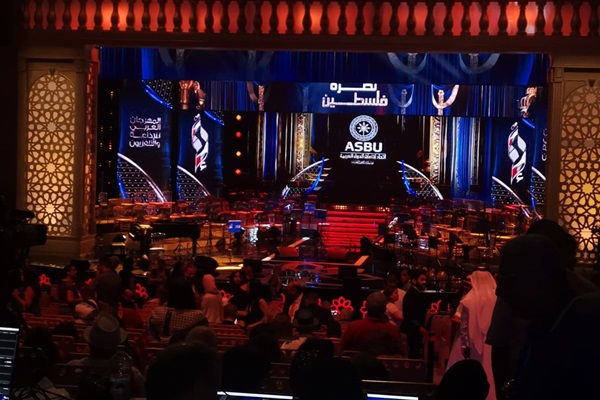
The opening ceremony concluded with a musical performance by Lebanese artist Ragheb Alama, with proceeds dedicated to supporting the people of Palestine.
Abdelrahim Suleiman, Director General of the Arab States Broadcasting Union (ASBU) and Mohammed bin Fahd Al-Harthi, President of ASBU and CEO of Saudi Broadcasting Authority (SBA), presented the awards to the winners of the 24th Arab Radio and Television Festival that was held in Tunis from June 26 to 29.
Part of the Text is Missing, a Kuwaiti TV show won the award for Best Arab TV Programme at the festival.
Saudi Broadcasting Authority (SBA) secured four radio and TV awards, including the second prize in the health programmes category for “Mental Health: Violence in Schools.” In the TV category, Saudi Arabia won three awards, including the second prize in the news category for talk shows, honouring the Saudi street programme on its episode about Vision 2030. Heritage in the Maqam of Hijaz took first prize in the general documentary films and programmes category, while the Saudi social drama series Al-Arbaji 2 secured second place in the social series category.
Additionally, the SBA received the second prize in the 2024 news exchange competition and also, the second prize in the 2024 programme exchange competition. The festival also honoured the judging panels for its radio and television competitions and distributed the exchange awards.
Qatar Media Corporation won three awards. Qatar TV took first prize for the documentary film Museums in Qatar, showcasing the distinctive museums of the country, and secured the second prize for Programme Exchanges of 2023 within the festival’s Arab Radio and Television competition in Tunisia. Qatar Radio won second prize in the “Notable Arab Figures” category.
The Ministry of Information, represented by the Sultanate of Oman Radio and the Sultanate of Oman Television, along with the private media institution Al Wisal, bagged 10 awards. Sultanate of Oman TV won four awards, including the Arab Joint Television Production Award for the documentary Holding Breaths, produced by the Ministry of Information and directed by Issa al Subhi.
Meanwhile, the Palestine Public Broadcasting Corporation (PBC) secured six awards. The radio programme Psychological Counseling in Times of War claimed first prize, while Radio Flash on school violence also earned top honours. Additionally, PBC received first prizes for radio news exchanges and a television report dedicated to the late journalist Mohammad Abu Hattab, a correspondent for Palestine TV killed by Israeli troops in Gaza. Furthermore, PBC was awarded second prize for the cultural programme Sadanat al-Riwaya and another award for the film Noura, produced by Palestine TV.
In an interview with The New Arab, Nahil Bishara’s grandchildren speak about their grandmother’s artistic legacy and her role in preserving Palestinian identity.
History is full of remarkable yet forgotten women whose stories have yet to be told.
One such case is the late Palestinian artist and designer Nahil Bishara, an active and erudite woman who sought to preserve her Palestinian identity through endless creativity despite living through constant political instability in her homeland.
“Generally, artists at the time created art to sell, but she never created art to sell. She created art to anchor her Palestinianness”
Nearly three decades after Nahil Bishara’s passing, her grandchildren are ready to share her story with the world.
“She was always up to something artistic,” the artist’s UAE-based grandson, Assad Bishara, told The New Arab.
“She was somebody who wanted to master any kind of artistic medium she could get onto her hands. Whatever she got her hands on, she created something out of it,” Assad added.
Echoing this sentiment is his sister, Talia Bishara, a public relations specialist in culture, who fondly remembers her grandmother as a woman of taste of the Sixties era.
“She was an elegant woman, whose hair was styled in a chignon with a million pins,” recalled Talia.
“She wanted to project an image. Her persona in society was also very important. Generally, artists at the time created art to sell, but she never created art to sell. She created art to anchor her Palestinianness.”
From Ramallah to Jerusalem
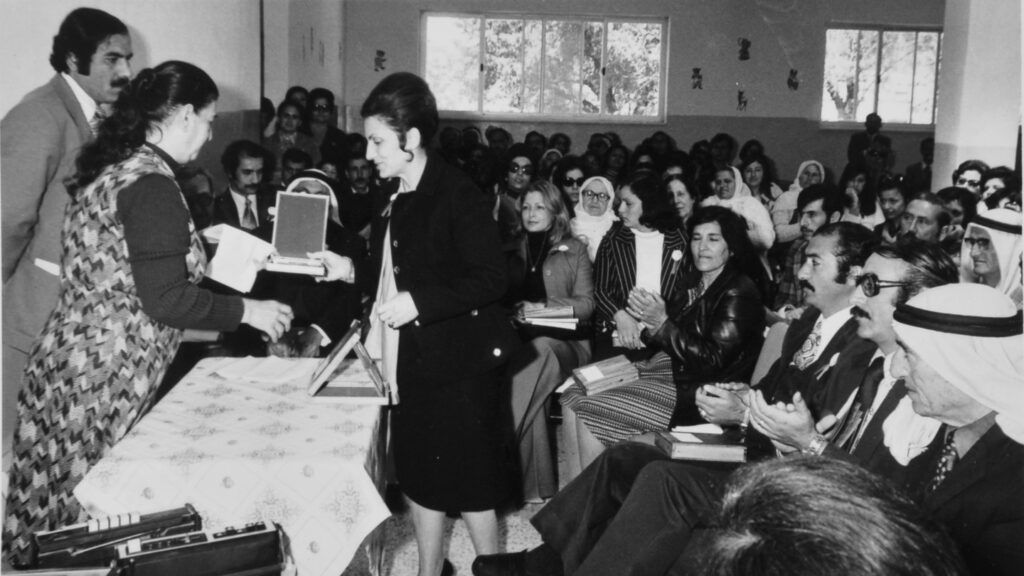
Nahil was born in Ramallah in 1919, shortly after the end of the First World War, and spent most of her life in Jerusalem, where she nurtured her artistic talent.
In 1940, at the age of 21, the artist married Dr Assad Bishara, a renowned gynaecologist who, as Talia claimed, “a whole generation of Palestinians were born under his hands.”
According to Talia, Dr Assad was open-minded and supportive of his wife’s dreams.
As Talia puts it, “Whenever I speak about my grandmother, I have to speak about my grandfather too. He was a larger-than-life person. He wasn’t the type that restricted her to staying at home and raising a family. She did those things, but on top of that, she was exploring her artistic talent and supporting her community of Palestinian women.”
Beyond her personal achievements, Nahil also lived through important political events of the twentieth century, including the Nakba — the mass displacement of Palestinians — which led to the Israeli occupation in 1948.
‘A force and an avant-gardiste’
During this period, Nahil was offered a rare opportunity to study in England, but she refused, choosing instead to remain in her country as an act of defiance.
A woman who made history, she became the first Arab and Palestinian to study art at the Bezalel School of Arts and Crafts in Jerusalem, which had been founded as a Jewish art institution in the early 1900s.
Interestingly, at the time, Nahil was one of the few Palestinian artists to formally study art. But her education didn’t stop there.
Always striving to expand her mind and skill set, she undertook a design course by correspondence with an American university in Washington, DC. Then, in the 1960s, Nahil found herself in the Italian city of Perugia, where she studied classical painting and ceramics.
Known for always being on the move, Talia shared, “All her life, my grandmother loved art. She was a force and an avant-gardiste. She wanted to be ahead of everyone in her time.”
‘She wanted to constantly create’
To this day, Nahil is remembered as a Renaissance woman.
The educated artist spoke four languages (including Italian and French), tried her hand at stitching, woodworking, and glassblowing, hosted cultured dinners, volunteered at refugee camps, and mastered interior decoration.
Her most significant project was decorating the interior of the Young Men’s Christian Association (YMCA) building in Jerusalem, which was later converted by the Israelis into a hotel called Aelia Capitolina. Today, the hotel is known as the Legacy Hotel.
“People were visiting Jerusalem from all over the world. I think she felt a responsibility to show the world a different image of Palestine”
By using locally sourced materials, Nahil designed its chandelier (made with Palestinian refugees), crafted wooden tables, and donated around 30 of her paintings to the establishment.
“I think she saw that there was power in creation, rather than focusing on destruction. She wanted to constantly create,” explained Talia.
“People were visiting Jerusalem from all over the world. I think she felt a responsibility to show the world a different image of Palestine.”
Another momentous event in Nahil’s career occurred in 1964 when she was commissioned by the Kingdom of Jordan to create a bust of Pope Paul VI in honour of his pilgrimage to Palestine. Today, the bust sits in the Vatican.
‘Capturing everything she could to preserve Palestine’
Exploring Nahil’s artistic legacy, she was known for creating religious landscapes, depictions of Palestinian refugees, and floral arrangements, the latter of which her husband particularly enjoyed.
“She was concerned with the preservation of identity because it was being erased”
Her grandchildren believe that her art carries a strong message beneath the surface, with Assad sharing, “For her, it was about capturing everything she could to preserve Palestine. She was concerned with the preservation of identity because it was being erased.”
During The New Arab’s interview, Talia showed her grandmother’s artwork of female refugees, one of whom is holding a child, painted in 1948.
Talia explained that she was literally holding a piece of history in her hands, adding, “When I watch the news today, it’s like history is repeating itself,” referring to the ongoing bombardment in Gaza.
“A portion of our civil society has been cut off and turned into refugees who live in tents, and this was something that had to be captured,” commented Assad on the theme of displacement in Nahil’s art.
Celebrating a forgotten artist
In 1997, Nahil died of cancer, yet her memory remains alive in the hearts and minds of her family and friends.
Recently, the once-forgotten Nahil has slowly been re-entering the public sphere. Thanks to Talia, Nahil’s name now appears in Google searches, and some of her artworks have found homes in public cultural institutions, such as the Barjeel Art Foundation in the UAE and Dar El Nimer in Lebanon.
According to Talia, some museums have expressed interest in acquiring Nahil’s work since she became more vocal in sharing her grandmother’s story.
For Talia, this recognition has motivated her to one day publish a catalogue of Nahil’s artworks.
“My whole life I wanted to do something for her,” Talia said.
“I didn’t study art but I know its importance and can feel it. I started connecting with art people, but it wasn’t an easy journey. It fuelled me even more after the 7 October attacks,” she added.
“Everyone should be interested in championing these names and putting them on the stage because you need the past… The past is your present. It’s our role to preserve it.”
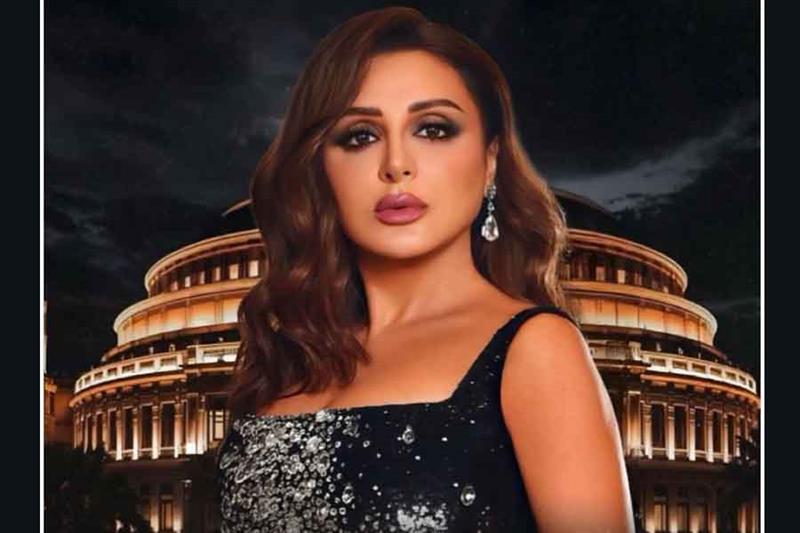
Egyptian star Angham will perform at London’s Royal Albert Hall on 23 September, marking a significant cultural milestone as the first Egyptian female artist to grace the iconic stage.
Angham’s performance on this stage comes 58 years after the legendary Egyptian singer and musician Abdel Halim Hafez performed on it in 1967 and received one of the greatest ovations of his career.
The September performance will celebrate Angham’s extraordinary career, spanning over three decades.
Throughout her long artistic journey, Angham has become one of the most influential voices in the Arab world, captivating audiences across the Middle East and North Africa.
“With her powerful vocals, emotional depth, and rich discography, Angham continues to inspire generations and break new grounds in Arabic music as the true enduring voice of Egypt,” read a press release.
Her legacy
Angham was born in 1972 to a family of artists. Her father, Mohamed Ali Soliman, was a composer, violinist, and singer. Her mother was the renowned artist Magda Abdel-Haleem.
She started her career alongside her father in the late 1980s before graduating from the Cairo Conservatory and embarking on her independent path.
Angham has released over 25 albums, including Fil Rokn El Baeed El Hady (In The Far Distant Corner, 1987), Awal Gawab (First Letter, 1988), Shokran (Thank You, 1989), Shayfak (I See You, 1992), Betheb Meen (Who Do You Love?, 1997), Bahibbik Wahashteeny (Loving You, I Miss You, 2005), Mahaddesh Yehasebni (Do not Judge Me, 2010), Ahlam Bareaa (Innocent Dreams, 2015), Rah Tezkerny (You Will Remember Me, 2018), Hala Khassa Geddan (Very Special Case, 2019), and Mazh (What?, 2020).
The star performs extensively in Egypt and across the Arab world.
Royal Albert Hall
London’s Royal Albert Hall, one of the world’s most iconic concert venues, was opened in 1871 by Queen Victoria and named in memory of her husband, Prince Albert.
The hall is renowned for hosting a wide range of events, from classical concerts and opera to rock performances, sporting events, and the annual BBC Proms.
Among the top names that have graced the stage of this hall are Adele, The Beatles, Eric Clapton, Luciano Pavarotti, Diana Ross, cellist Yo-Yo Ma, pianists Lang Lang and Martha Argerich, and world-renowned orchestras conducted by Herbert von Karajan and Sir Simon Rattle.
The hall has also hosted high-profile events, such as Cirque du Soleil.
Its distinctive circular architecture and domed roof make it a landmark of Victorian design and a centrepiece of British cultural life.
Presale tickets for Angham’s concert will start from Wednesday, 30 April, followed by general sale on Friday, 2 May.
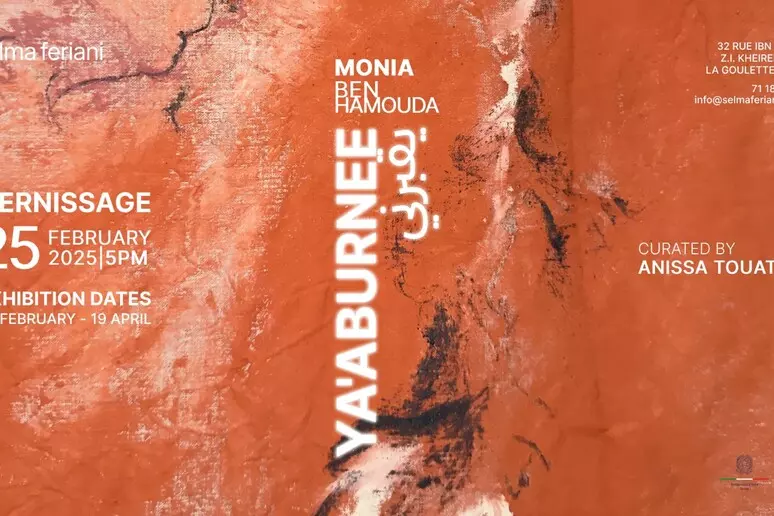
From 26 February next, Monia Ben Hamouda’s exhibition entitled ‘Ya’aburnee’, curated by Anissa Touati, will be open to the public at the Selma Feriani Gallery in Tunis in partnership with the Italian Embassy and the Italian Cultural Institute of Tunis.
The exhibition by the Italian-Tunisian artist, who won the prestigious MAXXI BVLGARI PRIZE 2024 last December, takes its name from the Arabic concept that translates as “you bury me”, reflecting the altruistic desire for a loved one to outlive himself.
Love and sacrifice, omnipresent in the exhibition, explore the complex ideas of language, history and understanding through an installation spanning three floors of the gallery, combining painting, sculpture and sound works, blurring our relationship with space.
Ben Hamouda aims to capture the distinctive soundscape of Arab countries, emphasising how these sounds shape cultural identity and perception.
With shows that range from political stances to introspective research, Doha’s Mathaf: Arab Museum of Modern Art proves itself to be one of the most authoritative voices for Arab narratives and the Global South in art.
The first impressions viewers get when walking inside the space set up like a unitary installation by Algerian artist Kader Attia, are a big haunting archive, a disquieting museum storeroom. It’s called “The Repair from Occident to Extra-Occidental Cultures” at this particular museum in the Qatari capital. A number of cabinets on the perimeter of the room showcase objects from colonial times: photographs of French admirals and Arab royalty, plus memorabilia, knives, cutlery and weapons.
Pinned rather aggressively on the shelves with metal rods are books from 1800-1900, like La France d’Outre Mer, Occident Noir and The Age of Napoleon, alongside satirical illustrations from magazines. A particularly disturbing one depicts a naive white nurse taking care of wounded African soldiers, who are depicted with malicious grins on their faces. Whether it’s the representation of racist stereotypes, anthropological studies or orientalist perspectives, the selection of materials by Attia shows different aspects of the relationship between coloniser and colonised, and how models of thought carried on in both Western and non-Western cultures.
Among the more harrowing pieces in the installation are several heads sculpted in wood, reminiscent of African statuettes. The features of these faces are distorted, reminding the viewer of the cubist or expressionist effect, that Picasso, Bacon or more recently Marlene Dumas have largely employed in their work. Looking at the anatomy and war surgery books on the shelves — which explain how to reconstruct exploded faces damaged during WW1, and how to attach prostheses — it seems clear that the distortion in the faces references the war wounded. The artist is hinting at the process of repairing historical wounds and abuses by the West towards its colonies, something central to the postcolonial conversation.
The presence of books like Primitive Art and Psychoanalysis summarises one more aspect of the artwork: how the encounter with the “other” is sublimed and transformed in art, and the deep psychological underpinning which lies behind every form of orientalism.
It’s precisely the link between all these seemingly distant concepts that make Kader Attia’s installation so powerful.
The artist leaves it to the viewer to come to terms with that thick, inextricable matter where racist stereotypes, modernism, colonialism, tribal art, sexuality, anthropology, war, imagination and the subconscious meet in a dangerous mix.
The intention of the work, however, is clear. He is examining this magma with a critical eye, in order to move forward and heal the historical wounds from these power dynamics.
Attia’s work is just a small part of the large and rich collection at Mathaf, but it contains one of its most fundamental themes: the creation of an alternative to the non-Western narratives and discourses for history and art history. This seems to be the main mission that the museums in Qatar are highlighting. While in the Western world museums as institutions are increasingly losing their relevance, in the Global South — namely, the parts of the world previously excluded by a Western narrative — museums are fundamental parts in the development of their own art system. In fact, it’s up to these institutions to construct alternative narratives to the West’s by using museums as a central tool.
The permanent collection of Mathaf is a case in point. Offering an excellent survey of 20th and 21st century modern and contemporary art from the Arab world and the Middle East (which is tellingly called “West Asia”), it is highlighting the strong connections of local Qatari and Arab artists with the wider world in Africa, Asia and Europe.
The permanent collection has evolved from an initial donation of a thousand works collected over the past 25 years by Sheikh Hassan Bin Mohammed Bin Ali Al-Thani. Today, it’s continuing to grow, and hosts more than 9,000 artworks by pioneer Arab artists.
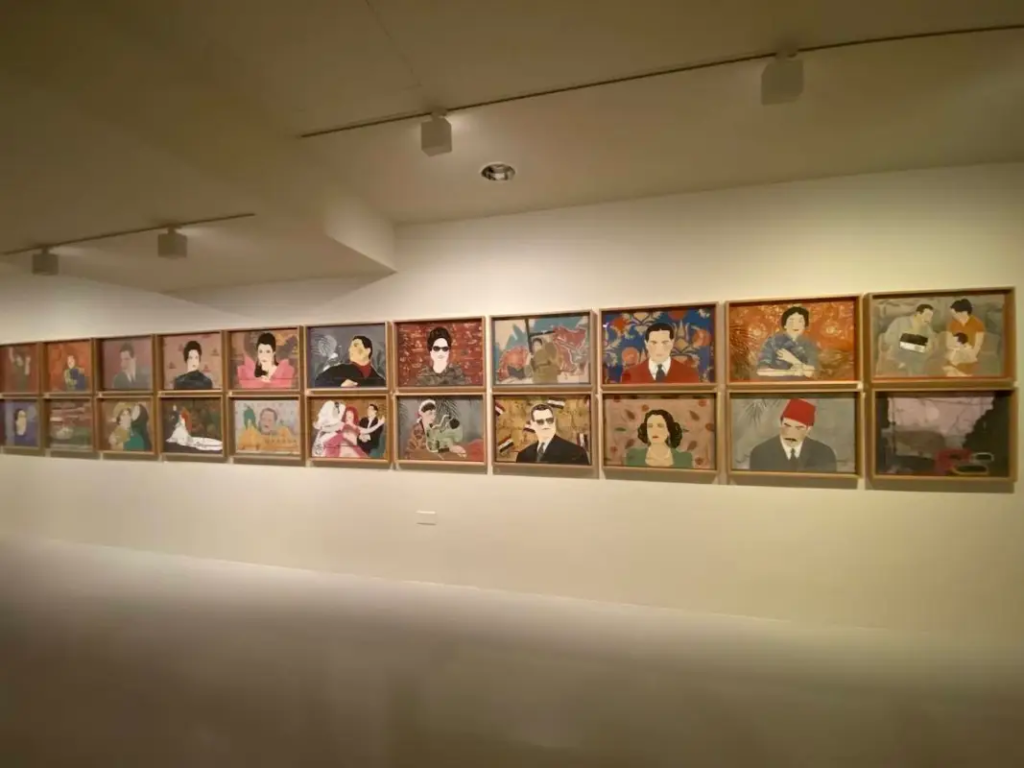
A particularly interesting section of this collection is dedicated to women artists, that has works like “Icons of the Nile” by Egyptian artist Chant Avessidian. This consists of a series of prints and paintings on cardboard representing, in a stylised way, Egyptian icons from modern times, including a number of iconic women.
At the moment, Mathaf is also hosting a temporary exhibition called “Arab Modernism”, which looks at how this current is being articulated in Arab countries, compared with its counterparts around the globe. In the show, we can see not only how Arab artists took visual elements, and techniques from the rich and diverse heritage of the Arab-Muslim world — particularly calligraphy and ornamentation — but also how they mused on the concept of Tajreed. The Arabic term for abstraction, in fact, also means “to strip away” and “purify”, referring to a process of revealing and clarifying through the artistic process itself.
In one room with ochre walls, we can observe how the calligraphic sign was declined to break the division between word and image, opening a space between calligraphy and geometric abstraction. We also find beautiful abstract patterns that intermingle in a big painting by Algerian artist Rachid Koraichi, which is almost tribal in its use of the calligraphic sign and the juxtaposition of primary colours. Etel Adnan, on the other hand, has a much smaller work, part poem, part drawing, where words on paper become abstract lines.
Palestinian Samia Halabi has one painting on show called “The Red One”, an exquisite juxtaposition of touches of colour, which are melodious and musical. Egyptian artist Mounir Canaan, meanwhile, plays on the cubist and modernist usage of pieces of cardboard and wood to create a vibrant image where different plans intersect, creating an effect which is at once aggressive and dynamic.
One of the most beautiful works in the show, though, is by Iraqi artist Hanaa Malallah.
“Secret of Fold Up Squares”, as the name suggests, consists of a series of folded pieces of canvas, burned at their centre. In one of these small squares, almost hidden in the canvas, is a piece of gold, a visually striking and highly evocative detail.
The show lets us observe how shared linguistic and cultural foundations in the Arab world generated a kind of abstraction in the region that stretches far beyond the Western definition of it, or as a simple reaction to academism and realism in art.
A smaller show, “Introspection as Resistance”, is collateral to the Abstraction exhibition. It is dedicated to the mathematical and geometrical work of Iraqi artist Mehdi Moutashar. He has been known as a poet of exactitude and rigour, and his work has been inspired by Abstraction, Minimalism, Op Art and the work of Klein – in its usage of his trademark blue – which is again blended with calligraphy and Arab ornamental patterns.
Overserving graphic motives on the hyper-white walls of the museum, brightly lit, the viewer gets the impression of being catapulted into a different dimension that doesn’t belong to this world, but to computer intelligence.
An early experimenter in geometric abstraction, Moutashar’s work brings mathematical precision and science into art. Looking at the mathematical principles of the universe is, for the artist, a form of introspection. It’s an introspection that bypasses individuals, to connect us with some sort of spiritual truth, a universal order. The artist exemplifies an incessant inquiry and a tireless resistance towards the disorder of the world.
In this sense, the show represents the perfect counterpoint of Kader Attia’s work. Where one acknowledges the impossibility of neatly separating history, imagination, wounding and the mending of wounds, Moutashar launches himself into a Sisyphean attempt to order the work through mathematics.
With these shows, Mathaf proves itself to be one of the most authoritative voices in the Gulf when it comes to speaking about Arab art and its original trajectory. A process of reparation – at least for the art – seems to be possible. One exhibition at a time.
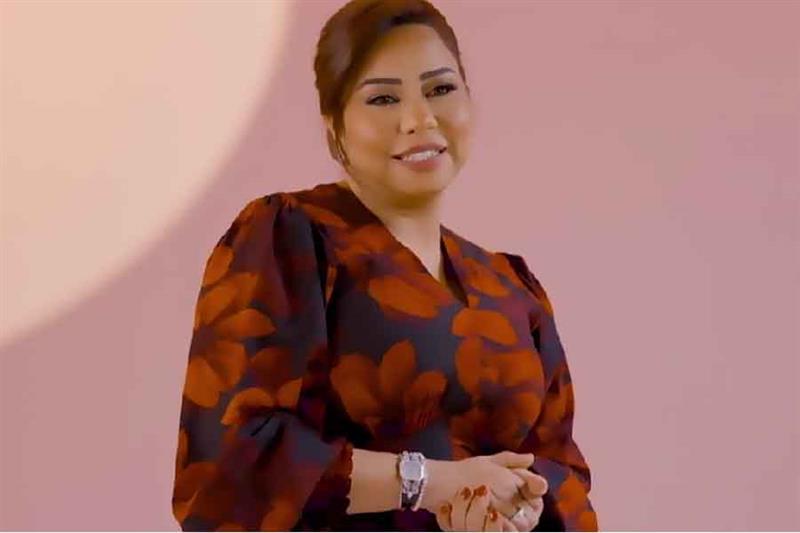
Egyptian singer Sherine Abdel-Wahab became the first Arab artist to be awarded at the Billboard Women in Music Awards.
Sherine, 43, claimed the title of Billboard Arabia, a partnership between Billboard and SRMG, a Saudi-integrated media group.
She became one of seven winners of the Global Force Awards at Billboard Women in Music, part of the Billboard Awards held at the YouTube Theatre in Los Angeles on 7 March.
Global Force also included Annalisa (Billboard Italy), Maria Becerra (Billboard Argentina), Sarah Geronimo (Billboard Philippines), Nini Nutsubidze (Billboard Georgia), Tia Ray (Billboard China), and Luísa Sonza (Billboard Brasil).
Sherine was awarded for her Kalam Eineh at No. 1 and El-Watar El-Hassas at No. 2 which topped Billboard Arabia’s global flagship charts.
In her acceptance speech, Sherine expressed her appreciation for Billboard, saying “I am very proud you enjoyed my work, and of course, I am thrilled and proud that there is a music award specially for women. I hope that my work will always reach the entire world.”
Billboard Arabia was launched in June 2023 to shed light on Arab artists, while pledging “to be the premiere global destination for artists with Arab roots.”
According to Billboard Arabia, the platform follows the well-established parameters set by Billboard over eight decades, drawing data from leading digital streaming platforms like Spotify, Anghami, YouTube, and Apple Music, reflecting Arab music preferences globally.
In its inaugural year, Billboard Arabia included ElGrandeToto, Marwan Pablo, Amr Diab, and Ahmed Saad in its top five Arab artists.
Renowned artist who died in Beirut this week spent 2 decades studying and working in Rome, and had his work showcased across the world.
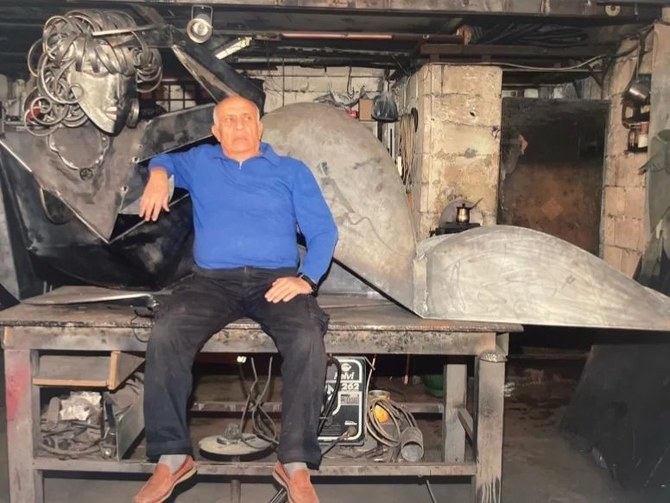
The veteran Lebanese master Hussein Madi, renowned for his vibrant paintings, has died in Beirut. Often called the “Lebanese Picasso,” Madi crafted his own visual language, peppered with bird motifs, curvy women, and geometrical symmetry, that made his bold oeuvre look instantly recognizable amongst Arab art enthusiasts.
Fellow artists and gallerists took to social media to offer their condolences. On Instagram, the Lebanese artist Abed Al-Kadiri posted some old snapshots of Madi in his studio and wrote. “Today at his burial ceremony Madi joined his flock of birds, flying alone, united with himself, just as he always lived.”
Maliha Tabari, founder of Dubai’s Tabari Artspace, said that Madi was the first artist she worked with in 2003, which proved to be an invaluable experience. “I’ll never forget the afternoons that would turn to evenings spent on his balcony in Beirut, delving into intense discussions of form explained by him through the curve of a pomegranate or a bird’s wing,” Tabari posted. “We lost not only a key figure from our region’s art journey, but also a father figure.”
Madi, who was also a sculptor, printmaker, educator and press illustrator, was born in the southern Lebanese town of Shebaa in 1938. While his parents reportedly did not approve of his artistic pursuits, it was his encouraging grandfather that saw potential in Madi. He left his parents’ home at the tender age of 19. He reportedly supported himself financially by submitting caricatures to newspapers in Lebanon and Iraq.
In the early 1960s, Madi was a student at the Lebanese Academy of Fine Arts. He later went on to have an international education, by traveling to the exciting art capital of Rome, in 1963, where he enrolled at the Accademia di Belle Arti.
He would spend nearly the next two decades of his life in Rome, before returning for good to Lebanon in 1986, while the civil war was still happening. “I bitterly regret not having remained in Rome because of all the frustrations I endured since my return to Beirut. In fact, civil war drastically affected the course of my life,” Madi once said.
In Lebanon, Madi devoted himself to his canvas, showcasing his work in several art galleries in Beirut. For 10 years, starting in 1982, Madi was also president of the Lebanese Art Association.
Madi’s paintings offer a visually appealing melange of thick lines, repetitive patterns, angular shapes, natural scenes, and bright colors. There is an element of spontaneity, presented in an orderly fashion. His images are also populated with figures, holding a book, a musical instrument — or simply reclining. “Despite all the mishaps, I was deeply happy. My work celebrated life,” he said.
Over the years, Madi’s artworks have been featured in auction sales at Christie’s and Sotheby’s. His works have also been acquired by regional and international art institutions including the Barjeel Art Foundation (Sharjah), Dalloul Art Foundation (Beirut), Mathaf: Arab Museum of Modern Art (Doha), Jordan National Gallery of Fine Arts (Amman), British Museum (London) and Institut du Monde Arabe (Paris).
source/content: arabnews.com (headline edited)
____________
Renowned artist Hussein Madi who died in Beirut this week spent 2 decades studying and working in Rome, and had his work showcased across the world. (Instagram)
An Iraqi artist celebrated his culture and history by recreating a mythical beast in a whopping piece of art that took him a whole year to complete, according to Guinness World Records.
The Iraqi young artist, Ali Al-Rawi, created a work of art depicting the ancient Assyrian winged bull by wrapping copper wires around nails attached to wooden boards to create the largest wire art, measuring 203.76 square meters.
The Assyrian winged bull, known as ‘The Lamassu,’ is a mythological hybrid composed of the head of a human, the body of a bull, and the wings of a bird.
This giant artwork extends over the space of approximately 15 car parking spaces, and it took a whole year to complete.
Around 89 thousand nails and 250 kilograms of pure copper formed into wires of 35,714 meters were used on the surface of 18 wooden planks.
Al-Rawi works as a physician assistant in the city of Ramadi in the Iraqi western governorate of Anbar. His artistic talent grew from scribbling on a school bench to now creating epic pieces of art with wires.
Al-Rawi was inspired after seeing a German artist using that technique in 2016.
After a long search online, he couldn’t find anything to teach him how to do it, so he practiced until he mastered the technique on his own.
“I drew a sail at the beginning. But after that, it took me a lot of experimenting to select the usable materials,” Al-Rawi explained.
“I decided on copper wires and one-inch nails with small heads in order not to affect the shape of the work, to make sure the monuments insulate heat, moisture and scratching, as wood is also coated with three materials to serve this purpose,” Al-Rawi added.
Al-Rawi worked hard over the course of a year and had to cover the board’s entire dimensions with wires of different colors to meet the requirements of breaking the world record.
Al-Rawi moved the entire artwork to several different locations in Iraq to carry out the final measurements and filming.
source/content: iraqinews.com (headline edited)
_________
The Iraqi artist Ali Al-Rawi holding Guinness World Records certificate. Photo: Guinness World Records
Brazilian Henrique Tabchoury has listened to Arabic music records with his Lebanese father since he was a child and saw him get emotional with the songs of his homeland. Jamil Abrão Tabchoury was born in Tripoli, Lebanon, in 1917 and came to Brazil with his family in 1927 when he was nine.
After he died in 1988, Henrique inherited around 300 Arabic records from his father. Since then, he has dedicated his free time to rescuing, collecting, and cataloging Arab music material, many of them recorded in Brazil, as a way of honoring his father and the Arab colony that came to Brazil in the first diaspora in the late 19th century and early 20th.
A trained agronomist, Tabchoury works in agribusiness and, since the 2000s, started buying Arabic records for his collection, which today has around 4,000 pieces – some are not Arabic. He recently received a donation of 22 albums by Arab and Brazilian artists from the Arab Brazilian Chamber of Commerce (ABCC).
Tabchoury searches for Arabic music records in advertisements, used bookstores, antique shops, and websites. He collects Arab discography produced in Brazil and already has around 60 albums by Arab artists who lived and recorded in the country for labels such as Continental, Odeon, Arte-fone, and RCA Victor. The recordings were made between 1927 and 1935, and the collection includes records by artists such as Nagib Hankash and Nagib Mubarak.
“It’s a retrieval of the history of the Arab colony in Brazil; these artists were of fundamental importance for the community; they were an encouragement for the Arabs who came to Brazil,” said Tabchoury to ANBA.
The albums are mainly from Syrian and Lebanese artists. “I guess most are Lebanese artists as many sing odes to Lebanon, and 90% to 95% are Christian Arabs,” said Tabchoury. In his assessment, over half of these are Orthodox Christians, and less than half are Maronite Christians.
Of the 4,000 discs in his collection, he has already cataloged and digitalized around 580, and nearly 400 are Arabic music. “Cataloged, including private and serial recordings, we have 390 Arab 78rpm records produced in Brazil, apart from LP albums (vinyl), compact, and 10-inch records,” he informed. He intends to digitalize his entire collection and later launch a website with the music catalog and information about the artists.
One of his goals is to find all Arabic records of private recordings made in Brazil until the 1970s. After the 1970s, recordings from abroad began to arrive here,” he said. He also wants to find more old Arabic records, whether recorded in Brazil or not.
“Many people keep records for sentimental value, and some don’t know what to do and throw them in the trash. I’m looking for these records in my spare time; I go to other cities and talk to families. I have no commercial interest; my collection has a historical background and is a source of homage to the Arabs in Brazil,” he declared.
Tabchoury has already been to Araxá, Barretos, Uberaba, Goiânia, Curitiba, Porto Alegre, and Pindamonhangaba, among other Brazilian municipalities with Arab communities. “I want people to know I’m building this collection,” he said. He accepts donations and also buys records.