Arabs & Arabian Records Aggregator. Chronicler. Milestones of the 25 Countries of the Arabic Speaking World (official / co-official). AGCC. MENA. Global. Ist's to Top 10's. Records. Read & Enjoy./ www.arabianrecords.org
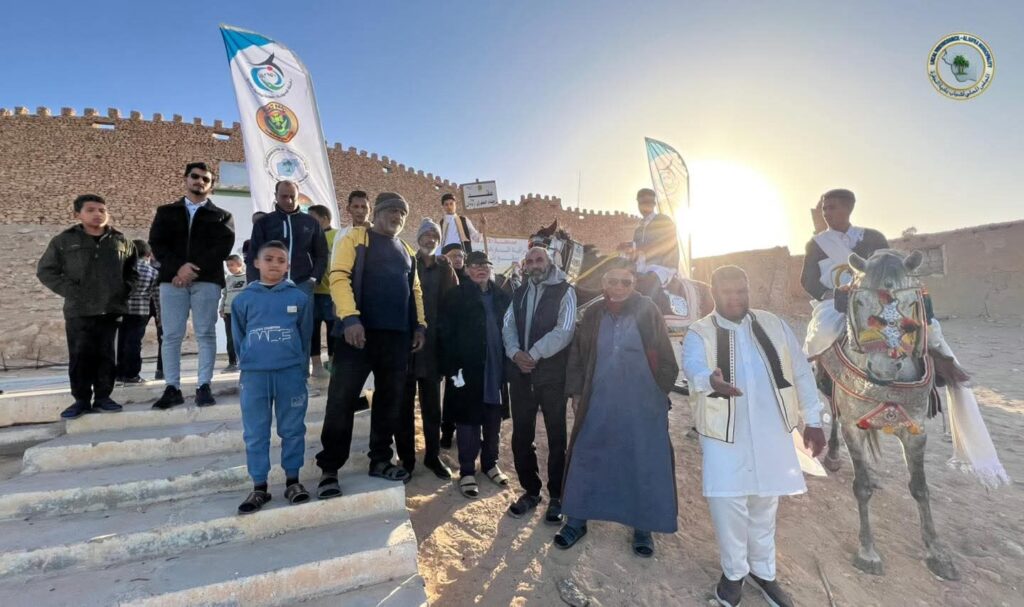
The residents of Wadān commemorated the 111th anniversary of the Battle of Qarat al-Tawza, which took place in 1915 between Libyan resistance fighters and the invading Italian forces.
The local youth council of the Jufra municipality organized a celebration on this occasion, during which several speeches were delivered praising the sacrifices and bravery of their ancestors in confronting the heavily armed Italian forces, who suffered heavy losses in lives and equipment, despite the limited resources and weapons of the heroic resistance fighters.
The celebration included equestrian displays, highlighting the prominent role horses played in the battles of the Libyan resistance and their importance at that time. The event also featured the lighting of the torch of resistance, the recitation of Surah Al-Fatihah in remembrance of the martyrs of the Battle of Qarat al-Tawza, and the laying of flowers in memory of the martyrs of Wadān who fell in the battles against colonialism.
The event was attended by youth from the National Agency for Voluntary Efforts, the Tozeur Martyrs Camping and Summer Resort Center in Wadān, the Scout and Guide Troop, the Cultural Forum, the Wadān Heritage and Tourism Association, and the Tozeur Martyrs Equestrian Club.
The program also included a detailed historical account of the Battle of Qarat Tozeur, a review of the heroic deeds of our ancestors in defense of the homeland, and the participation of a select group of poets who recited patriotic poems that embodied pride in history and struggle, and affirmed the deep sense of belonging and loyalty to the sacrifices of the martyrs.
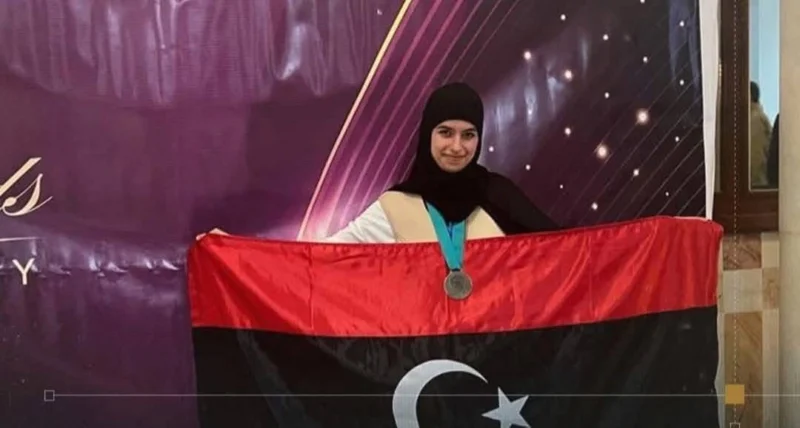
A young Libyan scientist has secured a bronze medal at the International Festival of Science and Technology (I-FEST) 2025 in Tunisia after developing a patented natural antibiotic.
Halima Al-Khazali, 18, from Bayda, claimed third place among 800 international competitors for her invention of an antibiotic derived from wormwood and other herbs. Her achievement adds to Libya’s growing reputation in scientific innovation.
The breakthrough came after five months of rigorous research into a traditional Libyan remedy for dental infections, culminating in Al-Khazali obtaining a patent for her discovery.
This latest success follows her previous gold medal at the Bosnia and Herzegovina Science Olympiad (BOSEPO) 2025, where she finished first among 300 participants.
Al-Khazali’s accomplishments highlight both her exceptional scientific talent and Libya’s potential contributions to global scientific research, making her an inspirational figure for young people across Libya and the broader Arab world.
Three Libyan companies won awards at the Athens International Olive Oil Competition , the Libyan Export Promotion Centre (LEPC) announced yesterday.
’’Once again, Libyan olive oil is in the advanced ranks in the world in terms of quality in the Athens International Competition for the year 2025’’ the LEPC said.
At the competition, the Mishkah and Celine companies won gold medals. The Mountain Olive Company won the bronze medal as the best excellent olive oil. The Mishkat company also won the award for the best Shamlali variety in the same competition.
This is the tenth edition of the Athens International Competition with the participation of 630 contestants from different countries of the world.
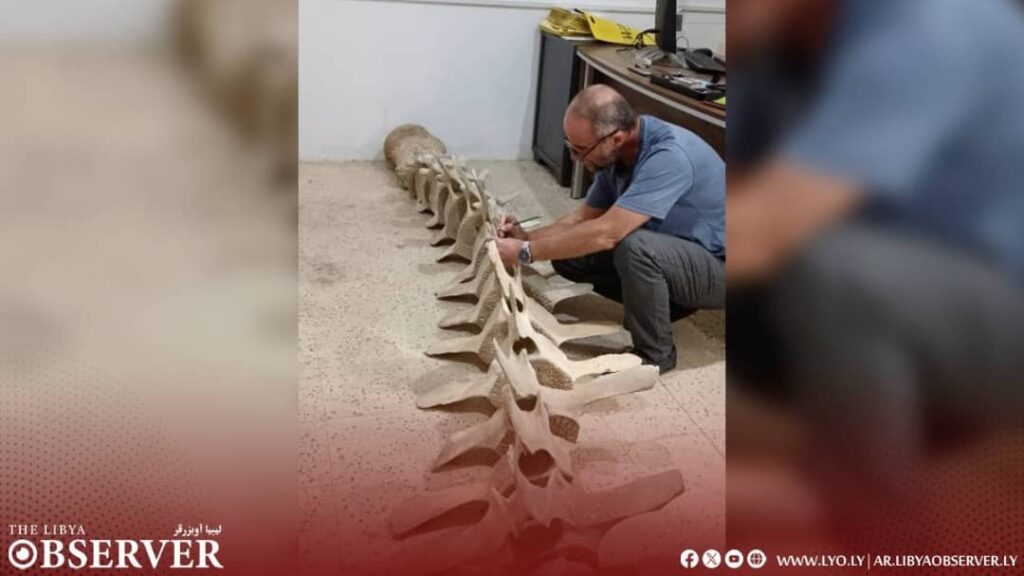
The Benghazi Department of Antiquities is preparing to begin restoration and display work on a whale skeleton belonging to the baleen whale group, previously discovered in the Qasr Al-Sahabi area, approximately 100 kilometres south of Ajdabiya.
The department stated that it has formed a scientific team tasked with cleaning and reinforcing the skeleton to preserve its structure ahead of a scientifically sound and safe relocation to its permanent exhibition site.
Officials noted that the discovery will be a significant addition to the city’s future museum and will help raise environmental and scientific awareness among visitors and enthusiasts.
The fossilized skeleton is estimated to be around five million years old, dating back to the Miocene epoch, making it one of the rarest geological discoveries in the region.
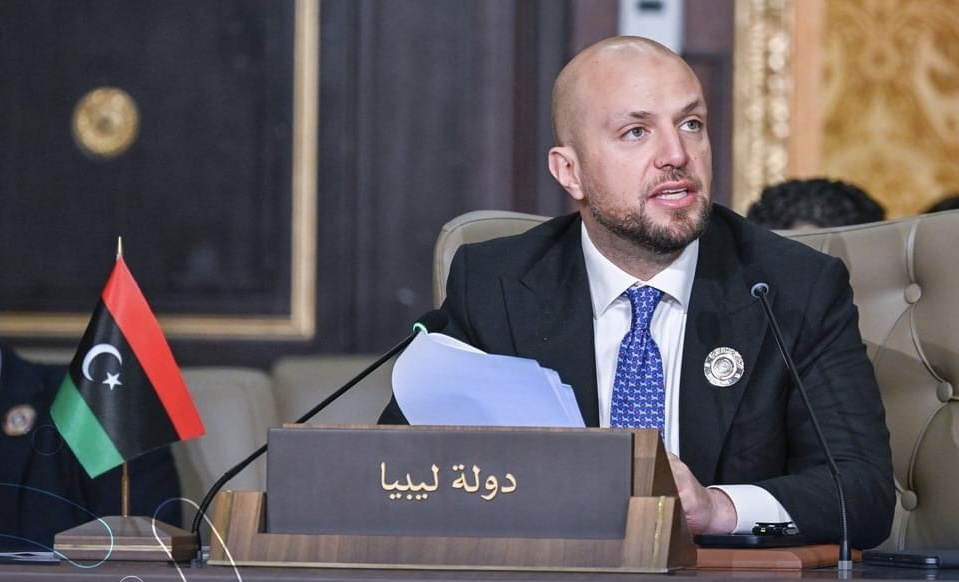
The Council of Arab Information Ministers approved the internal bylaws of the Arab Institute for Peace and Journalism, for which the Libyan capital, Tripoli, was chosen as its headquarters.
This came during the activities of the 54th regular session, held in the Bahraini capital, Manama, in which the Minister of State for Communication and Political Affairs, Walid Al-Lafi, participated.
In his speech, Al-Lafi welcomed the steps aimed at establishing and approving the internal system and organizational structures of the Institute, as it is the first international institution affiliated with the League of Arab States with its permanent headquarters in Tripoli, calling for the completion of the steps for the opening.
Al-Lafi stressed the responsibility that the Arab media bears through various digital, media and audio interfaces, toward the massacres taking place in Gaza. He also reiterated Libya’s support for Arab initiatives aimed at stopping the aggression, exposing the crimes of the occupation, and supporting youth initiatives in social media platforms in support of the Palestinian Cause.
Al-Lafi also called on Arab Information Ministers to participate in the activities of the Tripoli Media Days in its third edition, which will be held at the end of next December, coinciding with Libya’s celebrations of the 73rd anniversary of independence.
Bayt Ali Gana (“Ali Gana’s House” in Arabic) finally opened this year, and seeks to offer both retrospection and hope in the country.
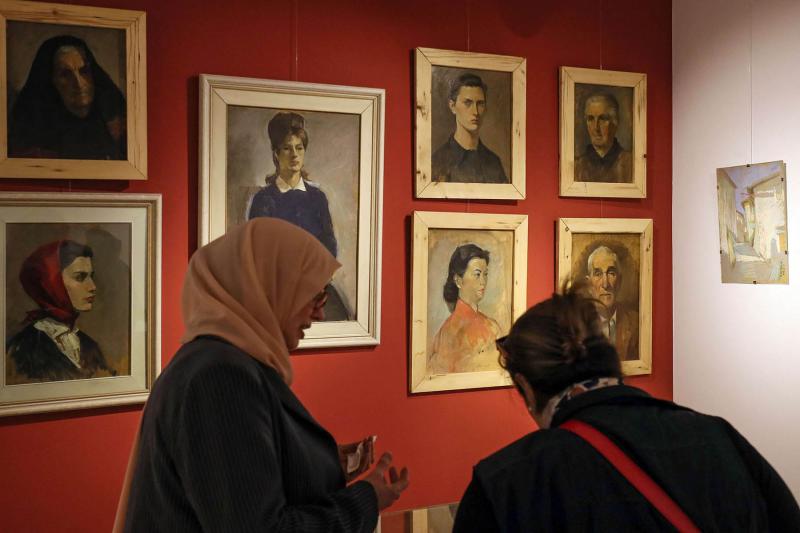
A seemingly ordinary villa in the heart of Tripoli holds a lifetime of works by the late Libyan artist Ali Gana, whose family has turned his house into a unique museum.
In the North African country still grappling with divisions and conflict after the fall of long-time dictator Muammar Gadhafi in 2011, “art comes last”, said Hadia Gana, the youngest of the artist’s four children.
A decade in the making and with the help of volunteers, she had transformed the classic-style Tripolitian villa her father had built, before dying in 2006 at age 70, into “the first and only museum of modern art in Libya”, Gana said.
Bayt Ali Gana (“Ali Gana’s House” in Arabic) finally opened this year, and seeks to offer both retrospection and hope in a country constantly threatened by violence and where arts and culture stand largely neglected.
“It is seen as something superfluous,” Gana said, adding that galleries in the war-torn country often focus solely on selling pieces rather than making art more accessible.
Once past a lush garden, visitors reach the museum’s permanent exhibition of paintings, sculptures and sketches by the masterful Ali Gana.
Other rooms include temporary exhibitions, and offer space for seminars and themed workshops.
Set on a wall, an old shipping container houses an artist residency for “curators and museologists” whose skills are scarce in Libya, said Hadia Gana.
Libyan artists had long been subject to censorship and self-censorship under Gadhafi’s four-decade rule, and “we couldn’t express ourselves on politics”, recalled Gana, 50, a ceramic artist.
Art “must not have barriers”, she said, proudly standing in the family-owned space for artistic freedom.
Bayt Ali Gana appears timeless, though the villa bears some signs of the unrest that followed the overthrow and death of Gadhafi.
A road sign riddled with bullets hangs from the gate that separates the museum from the private residence.
Mortar shells turned upside down sit among flowers in the garden, where visitors are offered cold drinks or Italian espressos in a setting that replicates Cafe Said, once owned by Ali Gana’s father in the old medina of Tripoli.
During the unrest that began in 2011, Hadia Gana said she feared “losing everything if a rocket hit the house”.
Then came the idea of creating a museum in the hopes of conserving her father’s precious works and archives.
Sporadic fighting, water or electricity cuts, and forced isolation due to the COVID-19 pandemic have piled challenges on the family’s mission, while the Ganas steered clear of state funding or investors to maintain the independence of their nascent institution.
Gradually, the house morphed into a cultural centre celebrating Ali Gana’s calling to “teach and educate through art”, said his daughter.
It “is not a mausoleum”, but a hub of creativity and education, she said.
Gana’s archives also document traditional crafts and trades, some of which have now completely disappeared.
After taking power in a 1969 coup, Gadhafi had imposed a ban on all private enterprise, and “for 40 years, crafts became an outlawed activity”, said the late artist’s oldest son Mehdi, who now lives in the Netherlands.
He said that in his lifetime, Ali Gana took on a mission to “build archives in order to link Libya’s past to a possible future”.
It is “the nature of the family” to preserve and share knowledge, said matriarch Janine Rabiau-Gana, 84.
Hadia Gana lamented that while museums should be educational spaces, “here in Libya, we don’t have that notion yet”.
She said she wanted to avoid “making it a museum where everything is transfixed”.
Instead, “I wanted something lively, almost playful, and above all a place that arouses curiosity in all its beauty.”
The award-winning international correspondent talks frontline reporting, wearing the hijab on television, and how her personal connection to the Middle East makes her a better storyteller
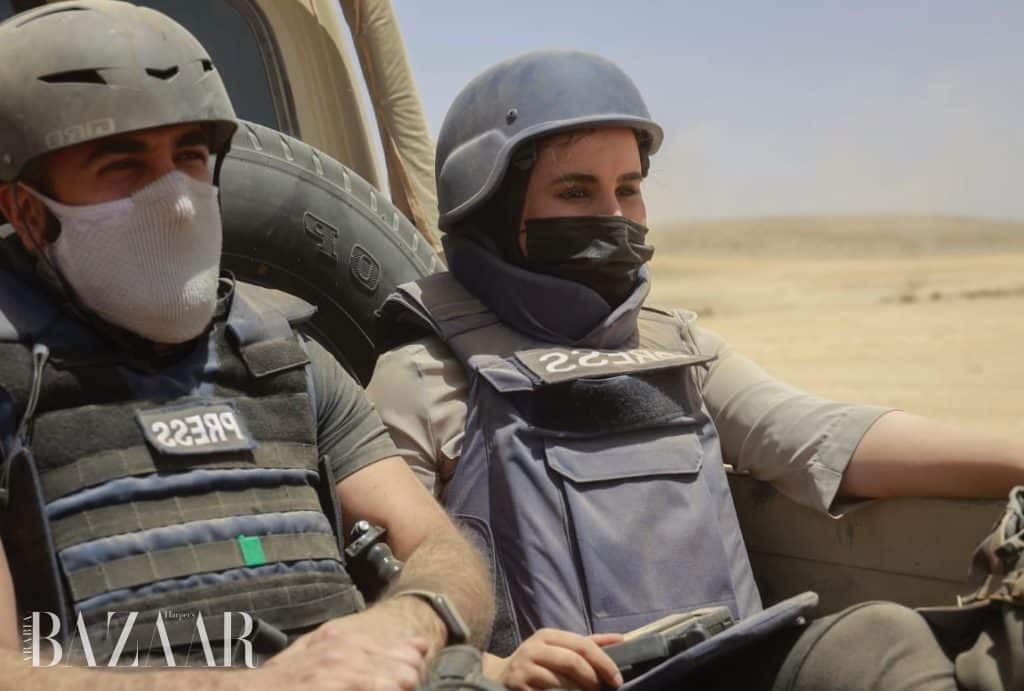
In Autumn 2019, when Turkey launched its incursion into northern Syria, 23-year-old Nada Bashir packed her camera and flew to northern Iraq to cover the story. At the time she was a freelance producer for CNN in London “pretty fed up of constantly being on the Downing Street shift and covering Brexit. I knew I wanted to be in the Middle East but wasn’t perhaps experienced enough,” she says. “So I decided to just go by myself… I felt very passionate about what was happening and I knew I wanted to be a part of it.”
It was a bold decision – both her first solo story and first solo trip to a hostile environment – but the risk paid off. Just five years later, she is an award-winning international correspondent who has reported from the frontlines of the conflict in Yemen and the devastating 2023 earthquake in Turkey.
Now 28, Nada is speaking from her home in West London. She flew in yesterday from Cyprus where she was covering aid ships heading to Gaza, and she will likely be dispatched again imminently although she doesn’t know when or where. She’ll pack a book and headphones but otherwise, “it’s all tech gear, medical kit and body armour”.
Unpredictable as this career may be, it is one that she has dreamt of since she was a teenager, watching the Arab Spring unfold: “We were all glued to the TV, seeing what was happening across the Middle East and back home. That was the moment for me when I was like, ‘actually this is what I want to do’.”
Back home is Libya from where Nada’s family originate, although her parents – her father was an aircraft engineer and her mother is a nursery teacher – left before she was born. “My dad was a pro-democracy activist,” she says. “He spent more than 30 years essentially in exile…It was something that we were all aware of, something that we talked about a lot.” It meant that growing up in Brighton, on England’s south coast, “the news was constantly on” but Nada never considered that she might one day be on screen herself. The middle of five siblings, she was “very shy” at school: “I vividly remember being forced to do a presentation, feeling like I was about to faint and going red in the face. I never ever would have pictured myself doing this.”
But after becoming involved in student TV while studying Politics and East European Studies at University College London, securing the internship at CNN and impressing her editors with her story from northern Iraq, an on camera career beckoned. “I spent so much of my childhood consuming news about what was happening at home and a lot of it coming from Western networks. There were a lot of things where you watched it and felt like the story of your people, your region, wasn’t being told fairly, properly or accurately,” she says. “Still there are times when I watch coverage and it’s frustrating because there’s a real lack of understanding around some of the cultural dynamics.
Being Arab isn’t essential to reporting on the Middle East, she says, but it does break down barriers: “Just being able to speak to people in their language, understanding their culture… Having that connection has made me a better storyteller.” The stories she tells are often difficult ones and they stay with her – the elderly Syrian refugee who lost his family in the Turkish earthquake, the 11-year-old Moroccan girl who guided her around a makeshift burial ground after the earthquake there last September, the Palestinian teenager detained without charge in the West Bank. Reporting on the war in Gaza has been particularly poignant: “Talking about the Palestinian cause is something that no Arab person hasn’t done. That is part of our cultural identity in a sense. That history is interlinked with all of the Middle East.”
Within the first week of war breaking out, Nada was in Jordan and Oman covering anti-war protests. Since then she has reported from Lebanon and Egypt but it is her time in the occupied West Bank – her first visit there – that has been most affecting. “That was a part of the story that we felt was being completely overlooked,” she says. “It’s not a new story. Palestinians in the West Bank have been marginalised, treated as second class citizens for decades”. She describes this reporting as “the most challenging” of her career to date, finding her objectivity over such a “polarising” story called into question. “There are so many assumptions about where your personal views might lie because of your cultural or religious background,” she says. “I am a visibly Muslim woman. My name is Arab. It’s very clear where I’m from…But with a story like this, it’s very difficult not to feel like your journalism is being undermined by assumptions of where you might stand.”
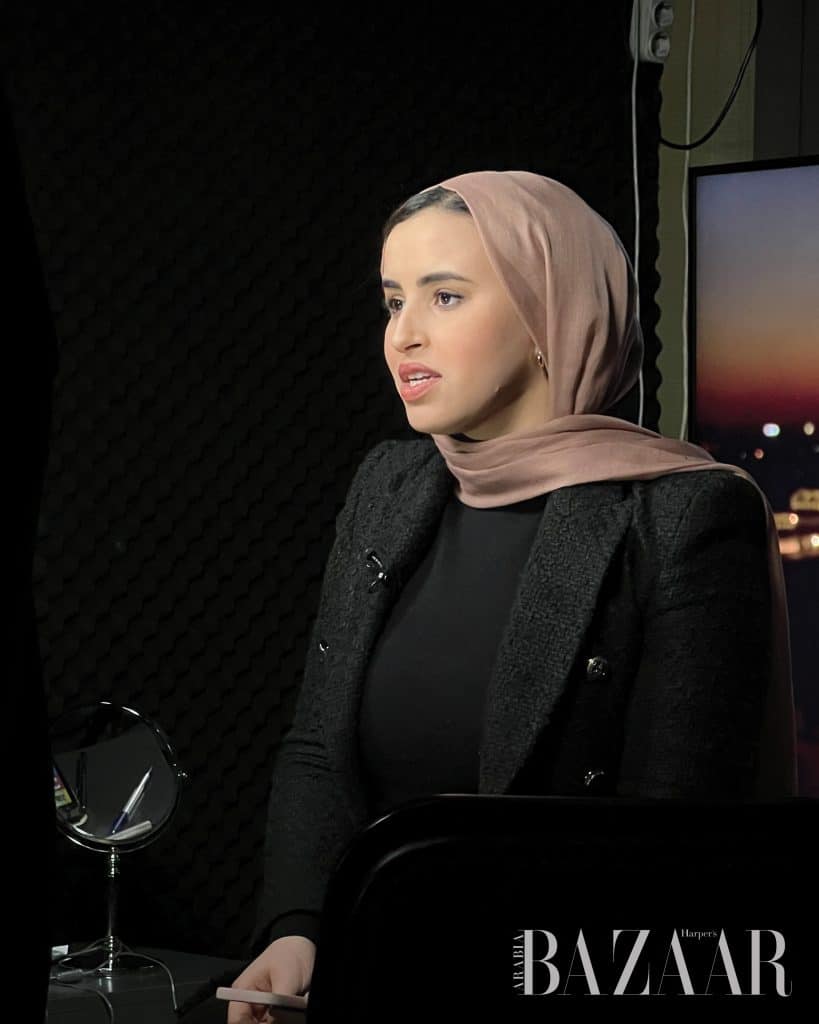
Many of those assumptions come from the fact that Nada wears the hijab. When she first started at CNN, she was “apprehensive at first – working for an American network and what that might mean in terms of how I fitted into that. Thankfully it’s never been an issue.” Being on air though, “has been slightly different”. Most difficult was reporting from London on the anti-regime protests in Iran. “For me, it’s a personal choice. You should have the freedom to choose whether you wear it…Covering the story was very important to me but I had a lot of backlash because a lot of people couldn’t understand how I could cover that, as somebody who chooses to wear the hijab, given that many women there were risking their lives and being persecuted for choosing not to.” On the flip side, she has also received “so many” messages from young hijab-wearing women who also aspire to be journalists: “I know that feeling because I felt like whenever I saw somebody wearing a hijab on TV.”
Today she feels like that when she sees the wider Arab diaspora experience represented, like in American comedy-drama, Ramy: “You feel the connection to it… It’s a blend of cultures and that is something that we identify with.” And when so much of her own work focuses on amplifying the voices of those suffering great hardship, she is grateful that there is increasingly space to celebrate the Arab world. “It’s sad because I think growing up, the only thing you’d really hear about the Middle East was war or conflict or political issues,” she says. “And there’s so much more to the region. There’s so much history, so much culture, so many people doing incredible things in different industries. It’s nice to see those aspects being showcased now, in magazines, in TV, in film, in music. To see that actually there’s a different side to the region, which has always been there. It just hasn’t really been given the platform.”
What Nada truly hopes is that when things improve in the Middle East, she will be there to report on it: “I can only hope that at some point there will be a positive change and I will get to cover that as well.” For now though, she has her bags packed, ready to head wherever the story takes her next: “It’s extraordinary; it’s a privilege and I wouldn’t change it for the world”.
Images Supplied / From Harper’s Bazaar Arabia’s May 2024 Issue
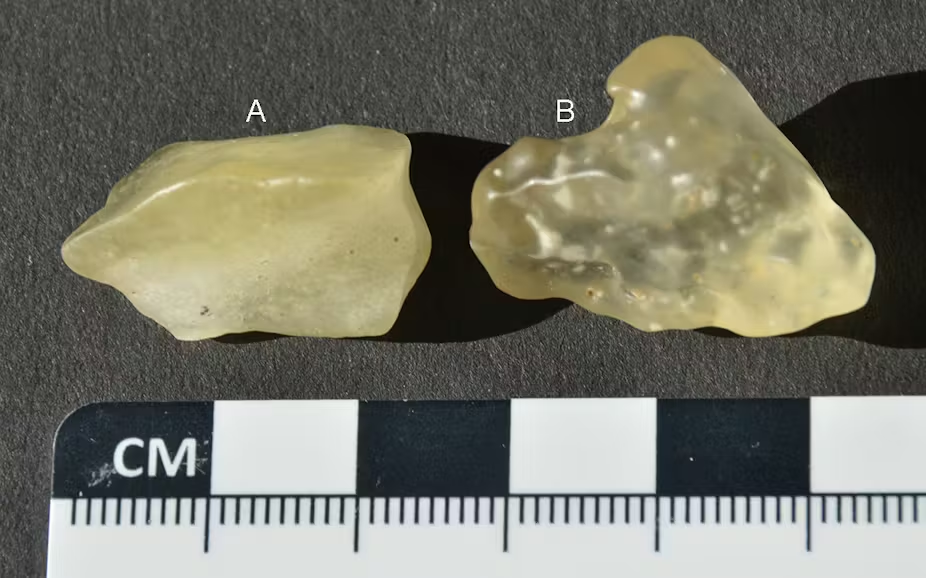
The Great Sand Sea Desert stretches over an area of 72,000km² linking Egypt and Libya. If you find yourself in a particular part of the desert in south-east Libya and south-western parts of Egypt, you’ll spot pieces of yellow glass scattered across the sandy landscape.
It was first described in a scientific paper in 1933 and is known as Libyan desert glass . Mineral collectors value it for its beauty, its relative rarity – and its mystery. A pendant found in Egyptian pharaoh Tutankhamun’s tomb contains a piece of the glass . Natural glasses are found elsewhere in the world; examples include moldavites from the Ries crater in Europe and tektites from the Ivory Coast. But none are as rich in silica as Libyan desert glass, nor are they found in such large lumps and quantities.
The origin of the glass has been the subject of debate among scientists for almost a century. Some suggested it might be from volcanoes on the moon. Others propose it’s the product of lightning strikes (“fulgurites” – glass that forms from fusion of sand and soil where they are hit by lightning). Other theories suggest it’s the result of sedimentary or hydrothermal processes; caused by a massive explosion of a meteor in the air; or that it came from a nearby meteorite crater .
Now, thanks to advanced microscopy technology, we believe we have the answer. Along with colleagues from universities and science centres in Germany, Egypt and Morocco, I have identified Libyan desert glass as originating from the impact of a meteorite on the Earth’s surface.
Space collisions are a primary process in the solar system, as planets and their natural satellites accreted via the asteroids and planet embryos (also called planetesimals) colliding with each other. These impacts helped our planet to assemble, too.
Under the microscope
In 1996 scientists determined that the glass was close to 29 million years old. A later study suggested the source material was composed of quartz grains, coated with mixed clay minerals and iron and titanium oxides.
This latter finding raised more questions, since the proposed age is older than the matching source material in the relevant area of the Great Sand Sea desert. To put it simply: those source materials didn’t exist in that location 29 million years ago.
For our recent study, a co-author obtained two pieces of the glass from a local who had collected them in the Al Jaouf region in south-eastern Libya.
We studied the samples with a state-of-the-art transmission electron microscopy (TEM) technique, which allows us to see tiny particles of material – 20,000 times smaller than the thickness of a paper sheet. Using this super-high magnification technique, we found small minerals in this glass: different types of zirconium oxide (ZrO₂).
Minerals are composed of chemical elements, atoms of which form regular three-dimensional packaging. Imagine putting eggs or soda bottles on the shelf of a supermarket: layers on top of layers to ensure the most efficient storage. Similarly, atoms assemble into a crystal lattice that is unique for each mineral. Minerals that have the same chemical composition but different atomic structure (different ways of atom packaging into the crystal lattice) are called polymorphs.
One polymorph of ZrO₂ that we observed in Libyan desert glass is called cubic zirconia – the kind seen in some jewellery as a synthetic replacement for diamonds. This mineral can only form at a high temperature between 2,250°C and 2,700°C.
Another polymorph of ZrO₂ that we observed was a very rare one called ortho-II or OII. It forms at very high pressure – about 130,000 atmospheres, a unit of pressure.
Such pressure and temperature conditions provided us with the proof for the meteorite impact origin of the glass. That’s because such conditions can only be obtained in the Earth’s crust by a meteorite impact or the explosion of an atomic bomb.
More mysteries to solve
If our finding is correct (and we believe it is), the parental crater – where the meteorite hit the Earth’s surface – should be somewhere nearby. The nearest known meteorite craters, named GP and Oasis, are 2km and 18km in diameter respectively, and quite far away from where the glass we tested was found. They are too far and too small to be considered the parental craters for such massive amounts of impact glass, all concentrated in one spot.
So, while we’ve solved part of the mystery, more questions remain. Where is the parental crater? How big is it – and where is it? Could it have been eroded, deformed or covered by sand? More investigations will be required, likely in the form of remote sensing studies coupled with geophysics.
Before you go …
90,000 experts have written for The Conversation. Because our only agenda is to rebuild trust and serve the public by making knowledge available to everyone rather than a select few. Now, you can receive a curated list of articles in your inbox twice a week. Give it a go?
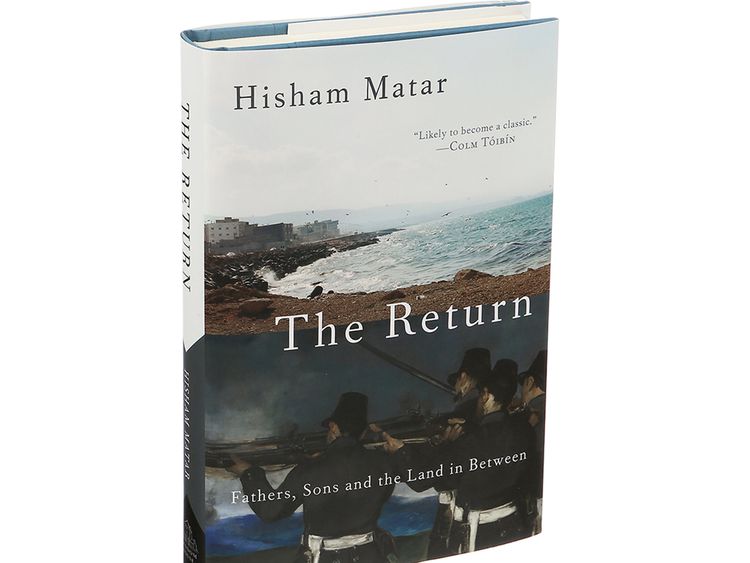
“The Return” is a meditation on human condition, an exploration of the bonds of family.
In his poignant and deeply affecting memoir, “The Return,” Hisham Matar invites readers on a journey into the heart of his native Libya, a journey marked by love, loss, and the relentless pursuit of truth.
As the acclaimed author of “In the Country of Men,” Matar brings his exquisite storytelling prowess to bear on the exploration of his own family’s harrowing ordeal amid the turbulent political landscape of their homeland.
The narrative begins with a pivotal moment in Matar’s life, when at the tender age of nineteen, his world was shattered by the abduction of his father, a courageous man. The elder Matar’s disappearance cast a long shadow over the family, leaving them grappling with uncertainty and anguish.
Yet, amid the darkness, Matar clung to a flicker of hope, a stubborn belief that his father may yet be found. It is this unwavering hope that propels him forward, driving him to embark on a decades-long quest for answers.
Against the backdrop of upheaval and societal transformation, Matar chronicles his return to Libya, a homeland he once fled as a child. With his mother and wife by his side, he confronts the ghosts of his past and navigates the complexities of a country in flux.
Through evocative prose and piercing insight, Matar captures the essence of a nation on the cusp of profound change, grappling with the weight of its history and the promise of its future.
“The Return” transcends the confines of a mere memoir; it is a meditation on the human condition, an exploration of the enduring bonds of family and the resilience of the human spirit.
Nature of love and loss
Matar’s storytelling takes the readers to the heart of Libya, immersing them in its sights, sounds, and emotions. With each turn of the page, we are drawn deeper into the labyrinth of Matar’s inner world, as he grapples with questions of identity, belonging, and the nature of love and loss.
At its core, “The Return” is a testament to the power of storytelling to illuminate the darkest corners of our collective experience, offering solace, catharsis, and ultimately, redemption.
Matar paints a poignant portrait of the human spirit’s capacity to endure and find solace in the face of uncertainty. Beyond mere memoir, “The Return” stands as a testament to the strength of hope, offering inspiration to all who confront life’s tribulations.
source/content: gulfnews.com /ahmad nazir (headline edited)
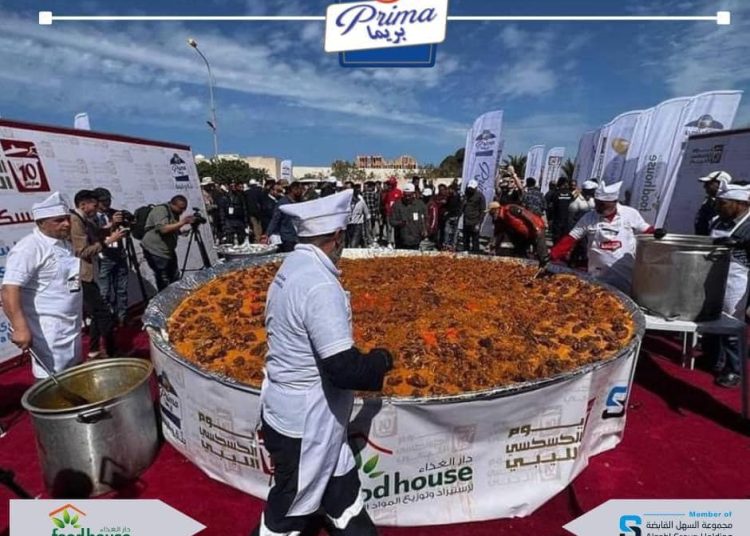
The organisers and sponsors of the Third Libyan Couscous Day 2023 reported that the event succeeded in breaking the world record for the largest couscous dish. They reported that a dish was prepared weighting over 2,500 kgs.
The event was held on Friday in the historic city of Sabrata and is organised by the Libyan Intangible Heritage and Cultural Organization (NGO). It aims to inform the world that couscous is a national Libyan dish and is part of its heritage – along with Tunisia, Algeria and Morocco.
The event was sponsored by a leading Libyan couscous manufacturer.