Arabs & Arabian Records Aggregator. Chronicler. Milestones of the 25 Countries of the Arabic Speaking World (official / co-official). AGCC. MENA. Global. Ist's to Top 10's. Records. Read & Enjoy./ www.arabianrecords.org
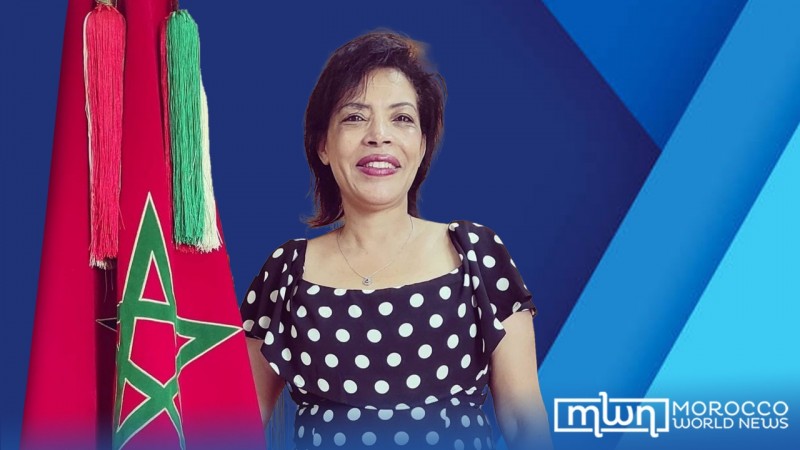
Sibaha is the director of the “Atlas Lionesses: Hear Them Roar!” documentary that honored Morocco’s Women’s Football Team.
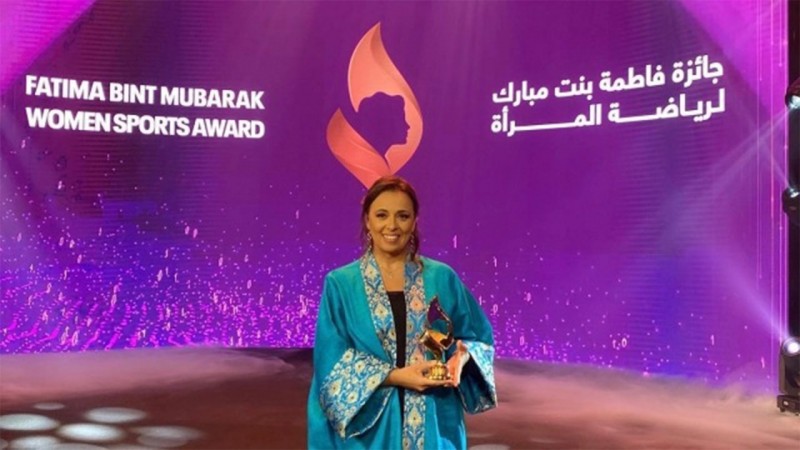
The Moroccan journalist Aziza Nait Sibaha has won the sixth “Fatima Bint Mubarak” Women Sports Award, crowning her as the Arab world’s “best sports journalist.”
Presented on September 17 in Abu Dhabi, the award is the region’s first of its kind aimed at empowering women and celebrating their sports achievements.
The “Fatima Bint Mubarak” Prize was awarded to different winners in several categories, including sports management, training, research, sports sponsorship, and women of determination.
The value of the prizes totaled AED 1,700,000 ($462,824).
Different trophies were awarded to nine competitors, individuals and teams, including Egypt’s Giana Farouk Mahmoud, who was named the “best Arab sportswoman,” and Shamma Yousef Al Kalbani, who won the “best Emirati athlete” award.
Egyptian Ahmed Gouda won the prize for the “best young athlete,” while his compatriot Rehab Ahmed Radwan was awarded the prize for the “best Paralympic athlete.”
The “best coach” award went to Faris Al-Assaf from Jordan, while the Jordanian Women’s Football Association took the award in the “ Youth Development Programs” category.
The Egyptian Weightlifting Federation won the award for “best team,” while the “Emirates International Endurance Village” earned the prize for “best innovative sports initiative.”
The celebrated Tunisian tennis player Ons Jaber won the award for “Sports Personality of the Year in the Arab World.”
In her speech at the award ceremony, the representative of Fatima Bint Mubarak Ladies Sports Academy, Maryam Al-Mansouri, said that all categories of the award have seen strong competitiveness in recent months. This proves the talent, willingness, and ambition of Arab sportswomen, she stressed.
Al-Mansouri concluded: “We hope to see Arab women continue to take the lead in local and international sports events, and this award will contribute to the birth of new achievements in the Arab women’s sports career.”
As Egypt promotes the trail of the Holy Family as a major tourist experience, Ahram Online republishes an account of stops and cities where the Virgin Mary, Joseph and Jesus found safety and shelter in the country.
“Now when Jesus was born in Bethlehem of Judaea in the days of Herod the King, behold, there came wise men from the east to Jerusalem, saying, Where is he that is born King of the Jews? For we have seen his star in the east, and are come to worship him.”
(Matthew 2:1-2)
———-
The story of the holy family’s journey from Palestine to Egypt has long been recorded with dedication by historians and authors around the world. Many look upon the journey as a mark in the history of Egypt, not merely a religious event. Egyptians look with fondness and pride on the passage of the holy mother and her child through the land of Egypt, and the fact that they found solace here.
The flight to Egypt
The Virgin Mary gave birth to Jesus in Bethlehem of Judaea in Palestine. Upon his birth, wise men preached to the people of the city, declaring that Jesus was the chosen one, and that, “according to prophecies” they had seen in the stars, he would become the next king of the Jews. Upon hearing the news, King Herod was overcome by terror at the possibility of losing his throne. He decided that killing Jesus was the only way to protect his royal status.
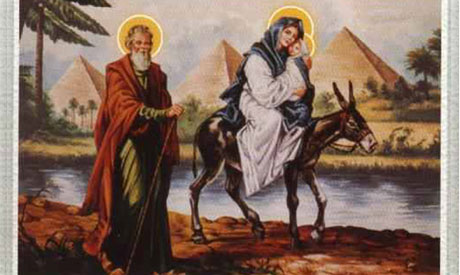
In a dream, Joseph, the carpenter, was ordered by God to escort Jesus and his mother to Egypt, where they would find refuge. Both Western and Eastern traditions agree that the method of transport most likely used by the holy family on their journey to Egypt would have been a donkey. In this situation, the Virgin Mary would have been seated on the donkey, holding the child Jesus in her arms and Joseph would have walked by their side, leading the way.
The holy family in Sinai
Keller writes in his book, The Bible as History (1955): “A day’s journey from Gaza brought the holy family to the ancient township of Jenysos, which is mentioned by Herodotus, the Greek historian.” Today, this village, which is part of the Gaza Strip, is known as Khan Younis. “The next town on the holy family’s route would have been Raphia (Rafah), the frontier town between the Gaza Strip and the province of Egypt.”
Continuing for another 44 kilometres, beyond Raphia, and after almost two days of traveling, the mother and child reach Wadi Al-Arish, a point at which they are safe enough to obtain food and shelter. The holy family passes by other towns in Sinai such as Al-Muhammadia and Al-Farma, located 35 kilometres east of El-Qantara City. Churches from the 5th and 6th century have recently been discovered in Al-Farma.
Route to the Nile Delta
The holy family continued on its trip to the Nile Delta, stopping at the city of Musturod, only 10 kilometres from Cairo. “The Virgin Lady”, a 12th century church, was found in the city.
Keller adds in his book: “The city of Musturod was again visited by the holy family on their return journey to Palestine.” After leaving Musturod and passing by Belbes, the holy family travel west to the Valley of Natroun, crossing the western branch of the Nile (the Rasheed branch).
The holy family in Cairo
The movie Journey of the Holy Family portrays the settlement of the blessed family in Al-Mataraya district near Ein Shams (Old Heliopolis). They find shade under a sycamore tree that came to be known as “Mariam’s Tree,” which has evolved into an engrossing attraction for religious tourists. The holy “Mayron oil,” or the “Chrism,” is nowadays prepared from the oil of the tree.
An ancient church was built in the area by the name of “The Virgin Mary” and is visited by people to this day. Paintings can be found inside the church, including maps of the holy family’s journey, as well as a statue of Jesus and his blessed mother guarded by Joseph the Carpenter.
In his book The Geography of Coptic Egypt (1989), French historian Amelenio narrates some of the stories passed down about the miracles of “Mariam’s Tree.”
One such story tells how “the French army sat by the tree, drank from its well and wrote their names on its stems.” It is believed that some of the wounded soldiers were healed by its oil. Amelenio adds: “Al-Matarya district became the most popular shrine in Egypt; a place where people flooded to for blessings and spiritual remedies.”
The second district visited by the holy family in Cairo was Al-Zeitun, where a church by the name “The Virgin Mary” was constructed in Toman Bey Street. It is said that appearances of the blessed lady were witnessed around the domes of the church up until recent years.
Another spot visited by the holy family was Zowela Avenue on at Been El-Soreen Street in El-Gamaleya district. An ancient church is found there with the same name, “The Virgin Mary”. It is considered one of the largest churches in Egypt and is distinguished by its basaltic style.
The holy family moved on to “Old Egypt” (Al-Fustaat) where they dwelled for a short time in a cave in Abi Serja’s Church, within the walls of the Roman Babylon fortress. “The cave is about 20 feet tall, 15 feet wide and does not have any windows,” as described by Amelenio, who believes the holy family’s stay in the cave did not exceed a week. After leaving Al-Fustaat, they moved to Maadi district and settled at the location where the Virgin Mary Monastery and church were later built by the Nile.
Amelenio explains that during Ottoman rule in Egypt, the church had a marina for boats allocated for the transport of people and soldiers traveling to and from Egypt. Some villages in Upper Egypt were visited by the holy family such as Assiut and Minya. In the book History of the Coptic Nation, author Samy Saleh records that the holy family took the same route on their journey back to Palestine. They first go to Maadi, passing through Old Egypt, then follow the road to Ein Shams, back to the city of Mustorod, and finally El-Arish, and from there to Gaza.
The trail of the blessed
At present, many Egyptian historians and archeologists are calling for a project to track each town or city visited by the holy family, so as to make it easier for tourists to visit the blessed spots, thus reviving the symbolism of the holy journey and its message of peace and goodwill to all men.
Navigating AIDA IV through new Suez Canal on opening day: Meet Egypt’s 1st female shipmaster.
Marwa El-Selehdar reveals how she became Egypt’s first female shipmaster and her journey to be part of the new Suez Canal celebrations.
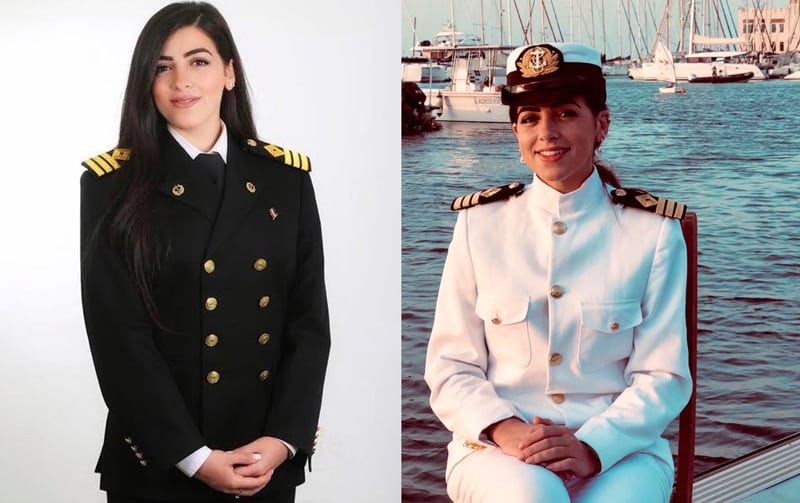
As the government promoted the new Suez Canal as “Egypt’s gift to the world,” Marwa El-Selehdar, the country’s first and youngest female shipmaster, received the good news.
The 24-year-old would assist in navigating a naval vessel through the new waterway during the opening celebrations on 6 August, she was recently informed.
“I never thought that my dream would finally come true. I am going to be part of the inauguration as a second naval officer on the deck of the training ship AIDA IV,” El Selhdar told Al-Ahram newspaper.
El-Selehdar believes that her participation as the youngest and first Egyptian and Arab female shipmaster would bolster the image of the “civilised Egyptian women.”
“I was filled with joyous fear when I first learned about my participation.”
A 2012 graduate of the Arab Academy of Science, Technology and Maritime Transport (AASTMT) in the coastal city of Alexandria, El-Selehdar said that becoming a shipmaster was a childhood dream.
“In my first time ever training on board a ship, [My] Captain Abdel Hamid El-Qady and the rest of the crew made me feel at home,” El-Selehdar recalled.
Initially enrolled as a student in the maritime transport department at AASTMT, El-Selehdar was later encouraged to move to the marine navigation department at the school when she found out that there were no rules that prohibit females from studying to become shipmasters, she said in a television interview back in 2010.
Her determination to join the marine navigation department was further fuelled when she heard that a female student from the African Island of Djibouti won a scholarship to study at the department.
“I challenged myself and asked for a transfer from the maritime transport department to the marine navigation department. Amid a wave of refusals, this was the battle I had to fight in order to achieve my dream,” El-Selehdar said.
As she joined a male-dominated profession, El-Selehdar says that her mother encouraged her [as a woman] to continue on the path she chose.
Egypt has been preparing for grand celebrations for the opening ceremony of the new Suez Canal waterway on Thursday.
On Tuesday, nine swimmers who belong to the Egyptian Paralympics team – set to compete in the 2016 Rio de Janeiro Paralympics — crossed the new waterway holding a huge Egyptian flag.
Incoming visitors to the country had their passports stamped with “Egypt’s gift to the world” by Customs authorities.
After fulfilling her first dream of becoming a shipmaster, El-Selehdar is ready to achieve her second dream of living through the opening of the new canal.
“I always thought this project was a major one, but I never realised we would actually witness this remarkable and extraordinary event,” El-Selehdar said.
source/content: english.ahram.org.eg (headline edited) text / pix: marineinsight.com
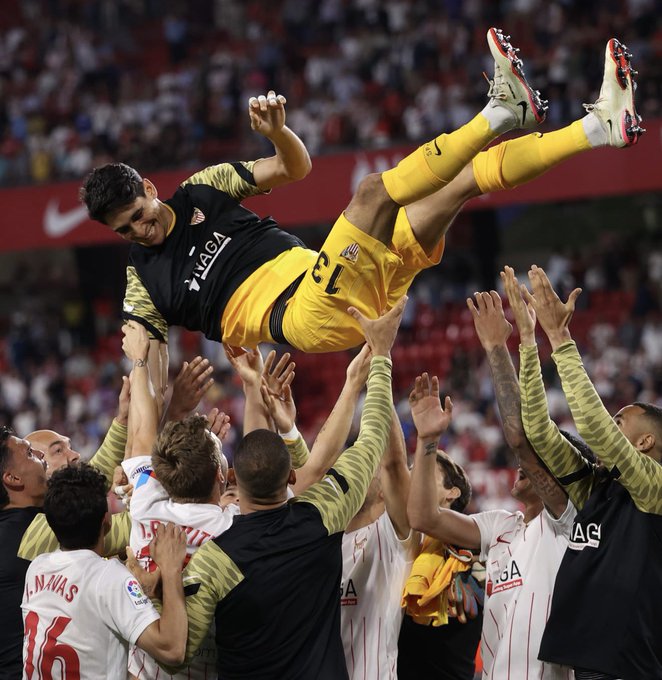
Moroccan goalkeeper Yassine Bounou, who plays for Sevilla FC, has become the first ever Arab goalkeeper to win the Spanish football league’s best goalkeeper award, the Ricardo Zamora Trophy.
Morocco and Sevilla FC goalkeeper Yassine Bounou has made history as the first Arab goalkeeper to win the Ricardo Zamora Trophy, which is awarded to the Spanish football league’s best goalkeeper of the season.
The coveted trophy, which has been awarded since 1958, is handed to the La Liga keeper with the lowest goals-to-games ratio, having played a minimum of 60 minutes in at least 28 matches.
Bounou, who has played for Sevilla since 2019, conceded 24 goals in 31 matches during the 2021-2022 season, finishing ahead of Real Madrid and Belgium goalkeeper Thibaut Courtois who conceded 29 goals, while 32 goals were scored against Real Sociedad’s Alex Remiro. Bounou also received 13 clean sheets, meaning that no goal was conceded in those matches.
The Morocco international first joined Sevilla on loan for a year, before signing a permanent four-year contract with the Andalusian giants in 2020.
The goalkeeper, who is nicknamed ‘Bono’ by football fans, is also the first ever Sevilla player to win the award.
He also became the second African to win the prize after Cameroonian Jacques Songo’o, who played for Deportivo La Coruna and was awarded the trophy in 1997.
Bounou’s efforts also lead to Sevilla’s fourth-place finish in La Liga, enabling the team to qualify for next season’s UEFA Champions League, alongside Spanish heavyweights Real Madrid, Atletico Madrid and Barcelona.
Canada-born Bounou, who has earned 40 caps for the Moroccan national team, will be one of the Arab players to watch in this year’s FIFA World Cup in Qatar, where the Atlas Lions will be making their sixth appearance.
source/content: english.alaraby.co.uk (The New Arab) (headline edited)
A women’s rights advocate and secretary general of the Moroccan climate coalition, Laila Amili is now working to build a bridge between Moroccan associations and the All-African-Movement Assembly.
From August 29 to 31, pan-African activists from across Africa and the Diaspora will gather in Arusha, Tanzania, for the All-African-Movement Assembly (AAMA) conference promoting justice, peace, and dignity.
AAMA organized a first validation conference in August 2016 in Arusha, gathering 272 people from 40 countries from across the continent.
The pan-African movement is built on five pillars : fighting for more civic and political action; promoting women’s rights and individual freedoms across the continent; advocating for the right to equity and dignity; promoting democratic and corruption-free governance; and calling for climate and environmental justice.
Morocco’s Lingering Gender Injustices
Laila Amili, president of Mains Libres (Free Hands), a Moroccan association fighting for girls and women’s rights, joined the AAMA two months ago. She’s a socialist, a founding member of the Arab feminist network Tha’era, and a climate activist.
In conversation earlier this week with Morocco World News, Amili spoke passionately of her new challenge: working to build a bridge between the pan-African movement AAMA and Moroccan associations.
“We hope to promote African solidarity to build the future we want as Africans: the right to peace, social inclusion, and prosperity for Africans all around the world,” Amili said.
For the Moroccan activist, sharing different experiences from different African actors would be a way to build progress for women’s rights. In Morocco, much of Amili’s activism revolves around fighting against underage marriage and domestic violence, as well advocating for greater female visibility in leadership positions.
It’s been three years since Mains Libres first launched its fight to forge substantive changes in the Moudawana, the Moroccan family code. In particular, the group has ceaselessly called for both the criminalization of child marriages and the protection of divorced mothers’ rights to keep their children.
Underage Article 175 and 176 of the current Moroccan family code, a divorced mother loses child custody if she remarries and her child is over 7 years old.
For Mains Libres, Amili said, “the child should stay with her mother until 15, even if she decides to remarry.”
And when legislative change does occur, as was the case in 2018 with the parliament’s adoption of Law 103.13 about violence committed against women, Amili insists that effective implementation should follow. Legislative change is only meaningful if it actually leads to tangible impact or perceptible changes in the everyday lives of the women who have long borne the weight of gender inequality.
Embracing Africa
“I see that these struggles are common in most African countries,” Amili said. “That’s why a lot of people are willing to join AAMA and participate in African solidarity.”
She recalled that after the first AAMA regional convention in Rabat on July 28, 2022, more Moroccan associations expressed keen interest in pan-African cooperation. This was a notable, emphatic, and overdue break from a long tradition, Amili argued, pointing out that Moroccan activists previously tended to work a lot with Arab or European countries. Now is the time to value and participate in pan-African solidarity, she insisted.
The AAMA summit in Tanzania is even more relevant amid the slow post-COVID across Africa. For Amili, one main reason for the event’s particular significance is the opportunity to discuss with fellow pan-African activists the far-reaching consequences that the pandemic has on the lives of many women across their continent, especially those who were already living in a precarious financial situation.
According to a March 2021 information note from Morocco’s High Commission for Planning (HCP), women were by far the hardest hit by the COVID-induced unemployment in the North African country.
The World Needs Solidarity
In addition to the devastating socio-economic disruptions brought about or further exacerbated by the COVID crisis, people – especially women – from the Global South are also the principal victims of the emerging ecological challenges.
“Us, people from the South, are the ones who are suffering more and more, because of poverty and increasing drought,” Amili said. “Poor people are the main victims of climate change.”
Amili is also the secretary general of the Moroccan coalition for climate justice, a gathering of 230 associations. Having participated in numerous international climate conventions in that role, she deplores the lack of women in leadership decisions.
One of the priorities of the Moroccan climate coalition is to heighten awareness about climate justice to make it “real” and not only written on official papers, said Amili.
Over the past months, one of Amili’s many activities – or duties – as the president of the coalition has been to travel to rural, marginalized areas to raise awareness about the climate and share vital information about environmental challenges with underserved communities whose lives and livelihoods have long been upended by rampant changes that they do not know of, let alone understand.
For Amili, the world can meet several of the challenges it faces if enough people are taught – or learn – to nurture a certain disposition toward empathy and solidarity when making sense of global challenges.
“We need solidarity for peace, human dignity, and human rights,” she said. “One hand can’t build anything, it’s with two, three, or four hands that we can achieve our goals.”
I like the idea of making people dream through creation, says Ali.
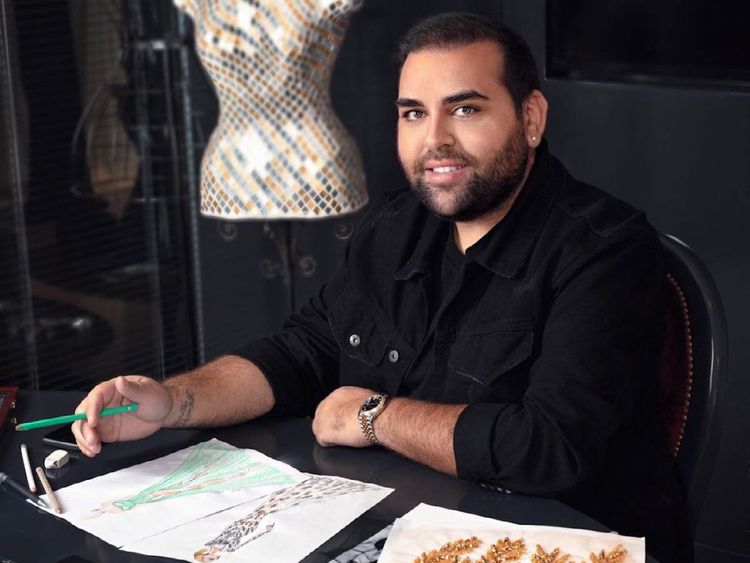
Tunisian designer Ali Karoui is best known for his red carpet haute couture as the favoured creator for fashion icons such as Cristiano Ronaldo’s girlfriend Georgina Rodriguez.
He chatted to The Kurator exclusively about being at the zenith of the world of fashion.
What draws you toward the world of haute couture instead of ready-to-wear?
I like this idea of making people dream through creation… And the rarity and the mystery that surrounds the world of haute couture.
Your interest in fashion began at an early age – how did your upbringing in Tunisia inspire you to go into fashion design?
I was lucky enough to grow up in an environment where women are treated like queens. I was looking at the closets of famous couturiers when I was a child, especially that of my grandmothers and mother, and that’s what gave me the love that I have today for haute couture.
You now dress A-listers and celebrities all over the world – does this create additional pressure to impress and attract attention with your designs?
Yes, of course, it creates a bit of stress because the more we are known the more demand there is on us, and it means more work for me and my team, but it is so enjoyable to see your creations worn by celebrities on the world’s biggest red carpets. It is a consecration for each artist to see his work recognized.
How did you first start collaborating with Georgina Rodriguez and in a way creating her signature look for her?
I met the beautiful Georgina at the Cannes festival in 2019. Her stylist contacted me to try one of my dresses that she saw in a picture. As she said on Netflix, I’m not trying to change her, she fell in love with my work and since then we are inseparable.
Your style can be interpreted as somewhat risqué – has this affected your career early on and did you face resistance in the Arab world of fashion design?
In no case did it affect my career, on the contrary, my style has made me known all over the world. You must believe in your dreams and continue to move forward, that is the key to success.
What kind of influence did Azzedine Alaïa have on you?
Azzedine Alaïa was a visionary. I had the chance to meet him several times. He gave hope to young Tunisian fashion designers, and allowed us all to dream that for us too, it was possible…
Who are some other fashion designers that you respect or that you looked up to early in your career?
There are many… I was in love with the vision of Gianni Versace, Thierry Mugler, Jean Paul Gaultier, and the master, Alaïa. Legends!
Do you keep an eye out on young and up-and-coming designers from the North Africa and Middle East region?
Of course! Many of them have a very bright future
source/content: gulfnews.com
_____________
Tunisian designer Ali Karoui is drawn to the “mystery that surrounds the world of haute couture”.Image Credit: Instagram @alikaroui
Moroccan athlete Salaheddine Benyazide won the bronze medal in the men’s 3000m steeplechase race on Saturday, as part of the Cali 2022 World Athletics U20 Championships, Columbia.
The young athlete was able to snatch the third place with a time of 8 minutes, 40 seconds, and 62 milliseconds, coming right behind the Ethiopians Samuel Duguna and Samuel Firewu.
Duguna achieved a time of 8 minutes, 37 seconds, and 92 milliseconds, while Firewu’s time came in at 8 minutes, 39 seconds, and 11 milliseconds.
The time is Benyazide’s fourth best in this race category, with his personal best being 8 minutes, 19 seconds, and 63 milliseconds, achieved earlier this year in Rabat.
The medal is Benyazide’s first on the world stage. Having been active in Morocco’s athletic scene since 2021, the 19 year-old athlete started participating in international races in 2022.
Celebrations and support have been pouring in following the young Moroccan’s medal, and many have hailed Benyazide’s success on the global stage as an achievement not only for Morocco, but for Arab athletics in general.
As he is participating in more international events this year, the young athlete is widely expected to represent Morocco more often on the world stage in the coming years, following in the footsteps of other Moroccans to preserve the country’s increasingly stellar athletics record.
Ethiopian athletes took the gold and silver medals in the race.
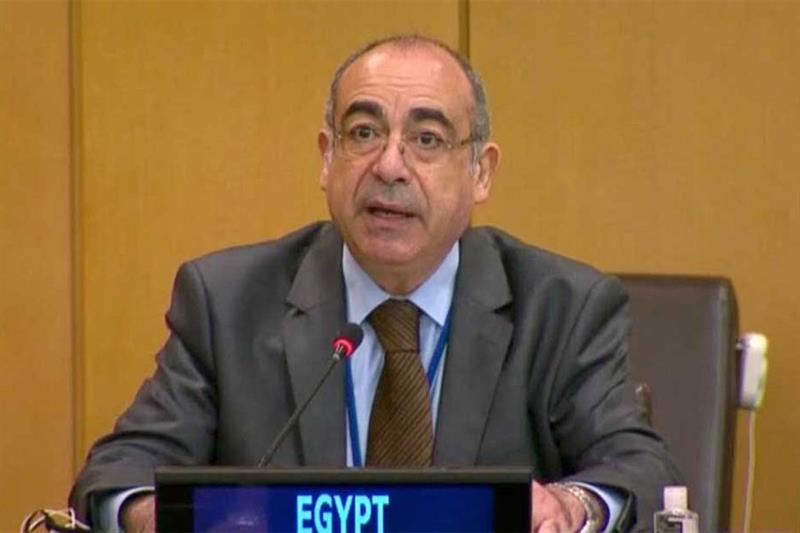
Secretary-General of the United Nations Antonio Guterres has appointed Egypt’s former permanent representative to the UN Mohamed Idris as a member of the Advisory Group of the United Nations Peacebuilding Fund, the Egyptian foreign ministry announced .
The appointment is in appreciation of the Egyptian diplomat’s efforts during Egypt’s 2021 presidency of the UN Peacebuilding Commission and as an affirmation of Egypt’s leadership in enhancing the effectiveness of the UN peacebuilding structure since its establishment in 2005, the foreign ministry said in a statement.
This is the fourth time an Egyptian has been appointed as a member of the Advisory Committee of the United Nations Peacebuilding Fund, representing African countries, it added
The members of the Advisory group have an important role in advising the UN Secretary-General on the programmes and activities of the Peacebuilding Fund in accordance with requests from Member States and overseeing the implementation of the programmes of the Fund, a large part of which is located on the African continent, the ministry said.
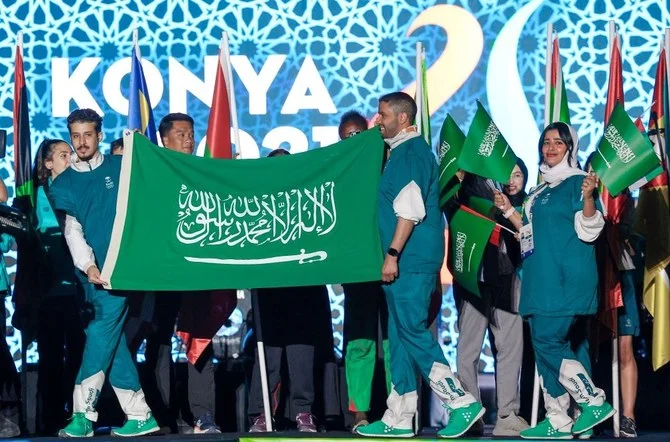
Team Saudi returned home to the Kingdom after collecting a record 24 medals at the 5th Islamic Solidarity Games held in Konya, Turkey, from Aug. 9-18.
They won two gold, 12 silver, and 10 bronze medals. The previous record was 11 medals at the 2017 Islamic Solidarity Games in Baku.
The competition saw the participation of 54 countries and 4,000 athletes.
The Saudi team placed 15th in the overall country standings, and its weightlifting athletes scooped 11 medals between them (one gold, six silver, and four bronze).
Athletics came second with five medals (four silver and one bronze), Karate with three medals (gold and two bronze), table tennis with two medals (one silver and one bronze), Paralympic swimming with one bronze medal, and finally a silver medal in the U23 football competition.
The Saudi weightlifting team won their first medals when Abdullah Al-Biladi delivered three bronzes on the opening day.
Siraj Al-Saleem delivered three silver medals in the 61kg event. On Thursday, Mansour Al-Saleem won gold in the 55kg event. Additional weightlifting medals came from Ali Al-Othman, who delivered a silver and a bronze.
Saudi track and field athlete Yousef Masrahi came second in the 400m race. His teammate Mazin Al-Yasin came third to secure the bronze in the same event.
Karate silver medalist at the Tokyo Olympics, Tarek Hamdi, secured first place on the podium after defeating his Azerbaijani opponent Ismayilov Gurban to win gold.
Hamdi said: “I’m thankful for all the support we get from SOPC (Saudi Olympic and Paralympic Committee) president Prince Abdulaziz and his VP Prince Fahad and all the Saudi karate fans and people who believed in me. I dedicate this success to them, and hopefully, our next goal is (the) Riyadh Asian Games 2034, where we hope to meet you all.”
Saud Al-Bashir and Sultan Al-Zahrani brought the other two bronze medals in Karate.
At the closing ceremony, SOPC vice president Prince Fahd bin Jalawi and the head of the Saudi delegation congratulated all the medal winners.
He also extended his appreciation and thanks to Turkish President Recep Tayyip Erdogan and Minister of Youth and Sports Dr. Muhammad Muharram Kasaboglu for successfully hosting the games.
source/contents: arabnews.com (headline edited)
__________
Saudi’s delegation claimed a total of 24 medals at the 5th Islamic Solidarity Games in Turkey. (SOPC)
Project shines a light on the cultural exchange between Algeria, France and Italy during the 1960s.
Zineb Sedira has outlined plans for her presentation at the French pavilion at this year’s Venice Biennale (23 April-27 November), revealing that the project will focus on Algerian cinema of the 1960s and 1970s and its links to the Italian and French film industries. The subject matter is timely as 2022 is the 60th anniversary of Algeria achieving independence from France. On 5 July 1962, Algeria became a sovereign state after an eight-year war which resulted in the deaths of at least 400,000 Algerians.
Sedira is the first artist of Algerian descent to be selected as the country’s representative. Sedira, who was born in Paris to Algerian parents, attended college in London, completing her undergraduate studies at Central Saint Martins school of art. She is now based in South London.
Sedira revealed her ideas for the cinematographic installation Dreams have no titles in an online press briefing held 18 February, outlining how she initially researched the history of Algerian film for an exhibition at the Jeu de Paume in Paris in 2019. Her passion for cinema was sparked by childhood trips to the local cinema in the 1960s in her home town of Gennevilliers outside Paris (these film outings were made with her father every Thursday when school was closed).
This interest developed further during her time as a student in London. “As part of postcolonial studies, I came across [the philosopher] Frantz Fanon and [the 1966 film] The Battle of Algiers. In France, I never came across those people because The Battle of Algiers was still censored in France [in the late 1970s and early 1980s],” she said. “There were no intellectual role models to me of Algerian origin; in England, I discovered there was a wealth of [Algerian] men, women and filmmakers.”
For the pavilion piece, Sedira carried out research at the Cinémathèque in Algiers, discovering that many films financed by the state of Algeria at the time were also co-produced with Italian and French filmmakers. “So when I was asked to propose an idea for the French pavilion, I thought of the Mostra [Venice Film Festival]. I thought it was interesting to do something around the three countries,” she said. Sedira wants to focus on the cooperation between France, Italy and Algeria— and the solidarity between the trio of nations—though her Venice “project goes beyond that”, the artist stresses.
Sedira visited numerous film archives in Algeria, France and Italy as part of the research process. “In Italy, [we visited] Venice, Turin and Bologna. We discovered a film that had disappeared,” says Yasmina Reggad, the co-curator of the French pavilion, referring to Les Mains Libres made by the Italian director Ennio Lorenzini in 1964.
“It was the first international film collaboration between Algeria and another country [Italy],” said Sedira, but after 1966 Les Mains Libres was lost. She eventually found the forgotten work in a small archive in Rome. “It is an important film for anyone interested in post-1962 Algerian history,” she adds.
The French pavilion project aims to be a starting point for discussions on other topics such as colonialism, collective and individual histories, national identity and the fight against racism. “The notion of a nation begs to be critiqued and challenged. What is a nation at the end of the day? It is a big fiction to believe that when you draw a certain line, everyone who happens to be behind this line is of the same mentality and culture,” said Sam Bardaouil, the co-director of the Hamburger Bahnhof in Berlin along with Till Fellrath (the duo have also co-curated the French pavilion).
“In a sense, a pavilion is an attempt to give a physical form to a fiction, so to use fiction in the language of cinema as a way to critique nation and belonging is such an intelligent and timely way to discuss these issues,” Bardaouil said.
The three pavilion curators will participate in a film to be shown in the pavilion. “We’ll be turned into actors and actresses,” said Reggad. Bringing together an artistic community was paramount, added Sedira, who relished the opportunity “to work with friends, to be surrounded by friends”. The film production will also include members of the crew and her son. “I was playing on the aesthetic and structure in cinema in the 1960s in low-budget films when one would play many roles,” she said
The pavilion project will also include a “conversation” with the UK pavilion artist, Sonia Boyce, and the Swiss representative, Latifa Echakhch. “Sonia was my neighbour for many years and she taught me at one point when I was studying art in London,” said Sedira.
At the briefing, the curators also discussed the three accompanying journals linked to the pavilion project. Each issue refers to a city—Algiers, Venice, and Paris—that has played an integral part in Sedira’s practice. “The journal is an extension of what the project entails inside the pavilion. The cities mark the phases of Zineb’s life, they become entry points to questions that are related to the themes that will be discovered in the film and installation in the pavilion,” said Bardaouil. Contributors include the French artist Laure Prouvost and the actor Nabil Djedouani.“The journal has allowed for a diversity and plurality of voices,” Bardaouil added.
The journal design is based on film magazines of the 1960s and 1970s, added Reggad, and also borrows from militant leaflets of the era. The journals are “doors to an intellectual horizon [with] texts, images and playlists”, said Eva Nguyen Binh, the president of L’Institut Français which is supporting the pavilion. Other sponsors include Arts Council England and the dealer Kamel Mennour who represents Sedira