Arabs & Arabian Records Aggregator. Chronicler. Milestones of the 25 Countries of the Arabic Speaking World (official / co-official). AGCC. MENA. Global. Ist's to Top 10's. Records. Read & Enjoy./ www.arabianrecords.org
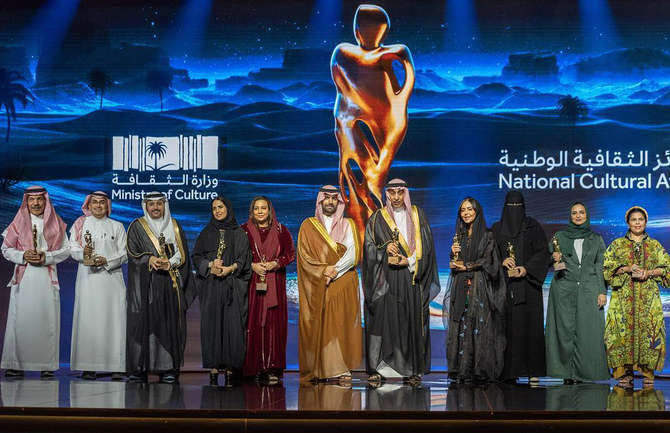
The winners of the third National Cultural Awards were honored in a ceremony held in Riyadh on Saturday. The event was a night dedicated to celebrating cultural creativity and promising ambition.
Minister of Culture Prince Badr bin Abdullah bin Farhan presented the awards to the winners in the presence of Minister of Education Yousef Al-Benyan and Minister of Media Salman Al-Dossary. The ceremony was also attended by a distinguished group of intellectuals, writers and media figures.
The National Cultural Awards, an annual initiative by the Ministry of Culture, aims to recognize and showcase the talents of individuals within the country.
The awards also serve to promote their cultural products both locally and internationally, while providing financial and moral support to encourage their continued growth and success.
The winners were nominated for awards in 16 different categories, covering a range of areas including literature, music, architecture and design, nonprofits and film.
Prince Badr said: “We are happy to honor innovators in our beloved capital,” adding that the initiative aims to “shed light on talents, celebrate achievements, honor innovators and encourage cultural production.”
He said: “The newly launched business owner award for this year reflects the cultural system’s appreciation for the contributions of supporters of cultural activity across all cultural sectors, and acknowledges their vital role as an integral part of the efforts made by the cultural system entities.”
Prince Badr added: “The international cultural excellence award celebrates international cultural personalities and institutions contributing to enriching the contemporary international cultural landscape, in addition to celebrating the significant efforts in the field of international cultural exchange on a global level.”
He concluded by congratulating the winners of the National Cultural Awards for this year, urging them to continue their efforts and wishing everyone a future filled with arts and culture.
Author Abu Abdulrahman Al-Dhaheri received the cultural pioneer award for his extensive contributions to literature and culture. He has produced a diverse collection of publications in languages, literature, philosophy, art, Shariah sciences and history.
Businessman Abdulrahman bin Mahfouz won the business owner award for supporting cultural activity. The International Alliance for the Protection of Heritage in Conflict Areas received the international cultural excellence award.
In addition, Lubna Al-Khamis, a Saudi journalist, won the youth cultural award. The cultural institutions award was given to the Saudi Research and Media Group in the private sector and the Abdulrahman Al-Sudairy Cultural Center in the nonprofit sector.
The ceremony also recognized winners in other cultural sectors. Mohammed Ibrahim Yaacoub, a poet, received the literature award, and Adab Publishing won the publishing award.
Maha Al-Faleh was honored with the translation award, and Charmaleena Jewellery received the fashion award. Dr. Abdullah Al-Masri, a historian, won the national heritage award, and Bateel International was recognized with the culinary arts award.
Artist Manal Al-Dowayan was given the visual arts award, and the Riyadh Band received the theater and performing arts award.
Abdulrahman Mohammed won the music award, while Ibrahim Al-Hsawi won the film award. Kholoud Attar was recognized with the architecture and design award.
source/content: arabnews.com (headline edited)
_____________
/Saudi Minister of Culture Prince Badr bin Abdullah bin Farhan with the winners of the third National Cultural Awards in Riyadh. (SPA)
The Minister of Islamic Affairs, Call and Guidance, Sheikh Dr Abdullatif bin Abdulaziz Al Al-Sheikh has approved the results and names of the winners in the 43rd edition of King Abdulaziz International Competition for Memorization, Recitation and Interpretation of the Holy Qur’an.
The competition, held at the Grand Mosque, witnessed the participation of 166 contestants representing 117 countries, competing in all five categories of the competition, with the total prize amount for this edition reaching SAR4,000,000.
In the first category, Ayoub bin Abdulaziz Al-Wahibi from the Kingdom of Saudi Arabia secured first place and received a prize of SAR500,000. Saad bin Saadi Sleim from Algeria came in second place, earning SAR450,000, while Abu Al-Hasan Hassan Najm from Chad achieved the third position, receiving a prize of SAR400,000.
In the second category, Ammar bin Salem Al-Shahri from the Kingdom of Saudi Arabia claimed the first position and was awarded a prize of SAR300,000. Mohammed bin Adnan Al-Omari from Bahrain secured second place, receiving a prize of SAR275,000. The third position went to Abdulaziz bin Malik Atli from Syria, who received a prize of SAR250,000.
In the third category, the winners include Mohammed bin Ibrahim Mohammed from Somalia, who clinched first place and received a prize of SAR200,000. Second place went to Shuaib bin Mohammed Hassan from Sweden, who was awarded SAR190,000 while Faisal Ahmed from Bangladesh secured the third position, earning SAR180,000 Saudi Riyals, and Mohammed Mufid Al-Azza from Indonesia claimed the fourth spot and received SAR170,000. Siraj Al-Din Muammar Kandi from Libya rounded off the top five, receiving a prize of SAR160,000.
Regarding the fourth category, the winners are as follows: Mohammed Ghai from Senegal secured the top position, earning a prize of SAR150,000. Hatem Abdulhamid Falah from Libya claimed the second spot, receiving an award of SAR140,000 and Yassin Abdulrahman from Uganda achieved the third position, with a prize of SAR130,000. Mashfiqur Rahman from Bangladesh attained the fourth position and was granted SAR120,000 while rounding off the top five, Abdulkader Yousef Mohammed from Somalia received a prize of SAR110,000.
As for the fifth category, Elias Abdou from the country of Larionion secured the first position, earning a prize of SAR65,000 while the second place went to Ibrahim Shahbandari from India who was awarded SAR60,000. Marwan bin Shalal from the Netherlands achieved the third position, receiving SAR55,000 and Mustafa Sinnanovic from Bosnia and Herzegovina attained the fourth position and received SAR50,000. Lastly, Hassib Amrullah from North Macedonia took fifth place, earning a prize of SAR45,000.
Saudi Arabia has stepped up measures to increase the scope of halal foods following the partnership of Saudi Standards, Metrology and Quality Organization, also known as SASO, with several entities, the agency said.
“More than 60 accredited entities from around the world work with us in the halal sector,” Nawaf Al-Shahri, head of the conformity assessment body acceptance department at SASO, told Arab News.
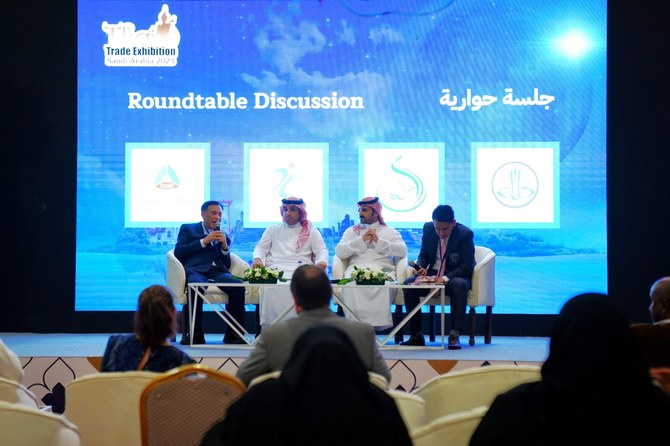
This information was revealed on the sidelines of the Thai Trade Exhibition Riyadh 2023, a four-day event that began on Aug. 27 at the Riyadh International Convention & Exhibition Center.
Al-Shahri further elaborated that SASO’s primary role in this sector involves accrediting entities responsible for issuing certificates for halal products beyond the Kingdom’s borders.
This responsibility complements the Food and Drug Authority’s task of certifying imported products in Saudi Arabia.
The authority is currently assessing the competence of these entities and will subsequently grant them a certificate of acceptance based on their qualifications. The Halal Center will then oversee their operations, both within their offices and in practical settings.
Winai Dahlan, founding director of the Halal Science Center, Chulalongkorn University, highlighted that there has been a noticeable increase in interest in halal meat among Thais in recent decades.
In 2003, the establishment of the cabinet marked a significant milestone in the evolution of halal products in Thailand.
He indicated that the growing interest in halal meat among Thais is fundamentally rooted in religious considerations.
In 1995, he founded the Halal Science Center at Chulalongkorn University to create a hub for the advancement of halal science in Thailand.
The principal duties of the center encompass the research and development of halal science and technology aimed at supporting the expansion of the industry while ensuring the quality and safety of the specialized products.
The halal products sector stands as one of the world’s fastest-growing industries, with a projected 6.1 percent increase in spending on food and beverages, anticipated to reach $1.9 trillion by 2023.
Islamic spending on halal pharmaceuticals was $87 billion in 2017 and is expected to reach $131 billion by 2023. Meanwhile, spending on cosmetics was $61 billion in 2017 and is projected to reach $90 billion by 2023.
Dr. Yousuf Al-Harbi, director of the Halal Center, affirmed that halal meat is a societal norm in Saudi Arabia.
He pointed out that the center aims to meet halal food requirements, adding that they are continually confident that “any local product we guarantee is 100 percent halal.”
“We have several initiatives, especially regarding the reliability of Halal food, from farm to consumer table, confirming that their experience in this area is thriving,” said Al-Harbi.
He said they are committed to ensuring that meats and poultry are slaughtered and stored according to Islamic law.
source/content: arabnews.com (headline edited)
___________
This discussion was held at the Thai Trade Exhibition Riyadh 2023, a four-day event that began on Aug. 27 at the Riyadh International Convention & Exhibition Center. (Huda Bashatah
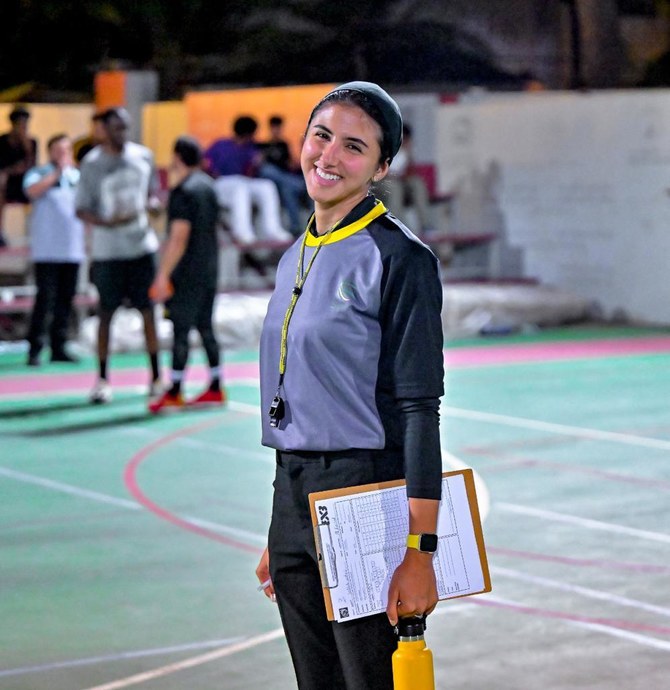
Al-Nahdi has been accredited as the first Saudi international referee in the history of basketball in the Kingdom
FIBA also accredited three other Saudi international basketball referees
For most teens, picking a sport to play in school relies on passion and love for a particular game; for others, choosing is a tough decision. For Lamya Al-Nahdi, opting to play basketball was not something she knew she wanted, as she had played a few different sports, but basketball resonated with her the most.
“I have been playing basketball since I was 13 years old; it is one of the unique sports that relies on speed, intelligence and teamwork. Those three elements combined really got my attention in this beautiful sport,” Al-Nahdi said.
“Basketball is not only about being healthy and sporty and all of that, it gives you so many values when it comes to teamwork, when it comes to the decision-making phase in the court, it is so much more than just a sport,” she said.
After more than ten years of devotion to the sport, Al-Nahdi has been accredited as the first Saudi international referee in the history of basketball in the Kingdom, having passed the test for becoming an international basketball referee set by the international basketball federation FIBA.
FIBA also accredited three other Saudi international basketball referees: Ahmed Hassan Al-Khamis, Abdullah Marzouq Al-Hujaili and Razen Ahmed Al-Awfi. The accreditation of the three Saudi referees follows them successfully passing the FIBA theoretical and practical exams.
“I had to go through a lot of preparation and training in basketball in the field, and also with the legislation and laws,” Al-Nahdi said.
Al-Nahdi said that becoming the first Saudi international basketball referee was both an honor and a huge responsibility.
“I am not only representing myself but also representing a beautiful sport that I grew up playing for more than ten years, so it represents the love and passion for that sport,” she said.
“And it also represents my country, religion and lots of values that I took along with me.”
While playing basketball, Al-Nahdi graduated from Dar Al-Hekma University with a human resources management degree. After graduating, Al-Nahdi worked in human resources for five years before joining her family business as a business development manager of Blooming, a female clothing brand founded by Saudi women.
Al-Nahdi being accredited as the first Saudi International referee in basketball follows the efforts made by the Saudi Sport Federation to empower Saudi women in the sport sector, particularly Saudi female referees, and to support Saudi women locally and internationally.
“Now is the time for anything, particularly in the Saudi sports industry, with the support system we have,” Al-Nahdi said.
“I am loving the focus on females playing sports, specifically basketball,” she said. “I do believe it is the number one sport when it comes to female sport, gaining much attention among Saudi females compared to other sports.”
Encouraging women to take up sport and providing job opportunities in several sports fields, including football and basketball, has allowed Saudi women to excel in professional and recreational sports.
“In my early years of playing basketball, we actually used to do it not secretly, but no one knew about us back then, compared to the attention, support and the number of basketball coaches available to train Saudi women,” Al-Nahdi said.
“Now is the time. The support structure is there, all you need to do is to believe in yourself and work hard toward your goal.”
Al-Nahdi said that believing in yourself was the first and most important step in achieving anything, the second was surrounding yourself with supportive people to help you along the way.
Her elevation as the first Saudi international referee for basketball has been welcomed enthusiastically.
The Saudi Embassy in the US tweeted: “The @FIBA has approved Lamia Fawzi Al-Nahdi as the first Saudi international referee in the history of Saudi basketball. This is the result of the efforts of the @sbfksa to empower Saudi female referees and support them locally and internationally.”
Saudi Arabia’s first female international referee for football was appointed by the FIFA in January this year, when Anoud Al-Asmari was awarded the international badge, less than a year after the Kingdom’s national women’s team made their debut.
source/content: arabnews.com (headline edited)
____________
Lamya Al Nahdi, is the first Saudi international referee in the history of basketball in the Kingdom
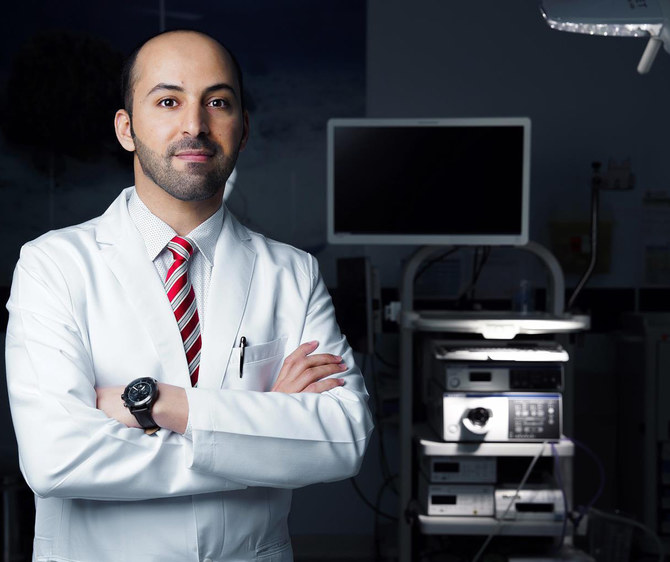
Dr. Abdullah Al-Thiabi claims to have developed a way of controlling the condition, known as gastroesophageal reflux disease.
A Saudi consultant specializing in the digestive system has invented a device that could provide relief for millions of people suffering with acid reflux, the Saudi Press Agency reported on Sunday.
Dr. Abdullah Al-Thiabi claims to have developed a way of controlling the condition, known as gastroesophageal reflux disease.
GERD is a temporary disorder that occurs when stomach acid repeatedly flows back into the tube (esophagus) connecting the mouth and stomach. This backwash, often referred to as acid reflux, can irritate the lining of the esophagus. If left untreated it can develop into a chronic condition with severe and life-threatening implications.
Also an expert in liver conditions and endoscopy, Al-Thiabi’s procedure involves placing a specialized device underneath the esophagus — using upper gastrointestinal endoscopy — which acts as a valve, preventing the backflow of stomach fluids and acids.
The device regulates medication levels and prevents side effects, while also monitoring esophageal tissue to lower the risk of cancer of the esophagus. In addition, it allows for easy sample collection and initial evaluation before laboratory analysis.
Installation time can be as quick as 15 minutes, and the technology reduces reliance on acidity drugs, surgical procedures, and healthcare costs for both institutions and patients.
After four years of rigorous scientific work following approved standards and methodology, the King Abdullah International Medical Research Center at the Ministry of National Guard has officially registered the device with the relevant authorities.
The next step will be to obtain rights and a local patent certificate from the Saudi Authority for Intellectual Property, and globally from the US Office of Innovation and Intellectual Property.
To then bring the product to market, funding from the public and private sectors will be required to support largescale commercial production, manufacturing, storage, shipping, sales, promotion, and marketing.
source/content: arabnews.com (headline edited)
_____________
Dr. Abdullah Al-Thiabi claims to have developed a way of controlling acid reflux, known as gastroesophageal reflux disease. (SPA)
Saudi football, not to mention Middle Eastern and Asian teams in general, will be seismic in the years ahead
Global interest in the league has skyrocketed, with broadcasters DAZN, Canal Goat and LA7 jumping on board
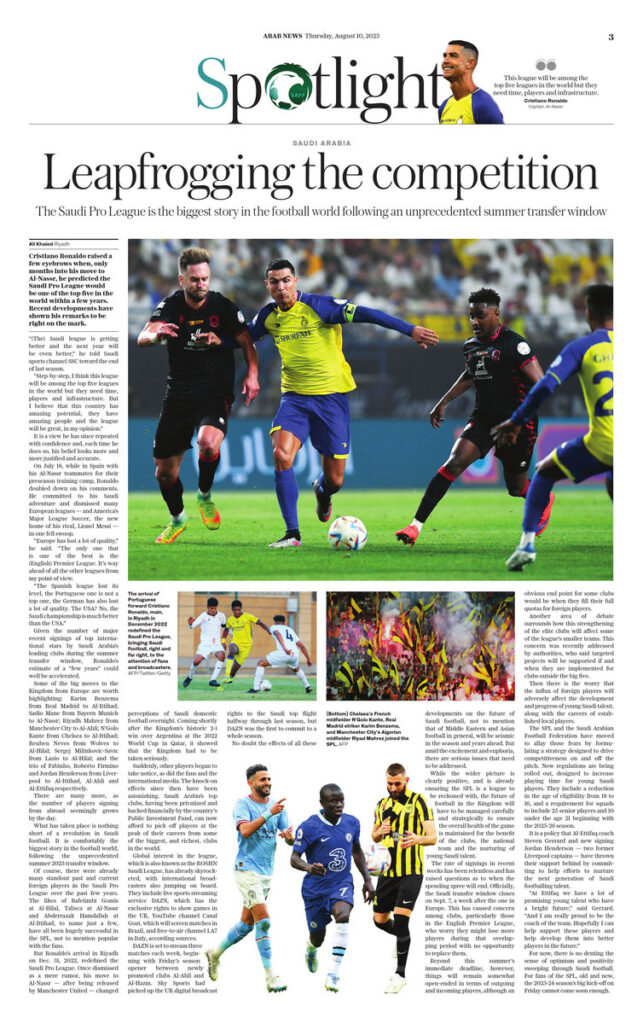
Cristiano Ronaldo raised a few eyebrows when, only months into his move to Al-Nassr, he predicted the Saudi Pro League would be one of the top five in the world within a few years. Recent developments have shown his remarks to be right on the mark.
“(The) Saudi league is getting better and the next year will be even better,” he told Saudi sports channel SSC toward the end of last season.
“Step-by-step, I think this league will be among the top five leagues in the world but they need time, players and infrastructure. But I believe that this country has amazing potential, they have amazing people and the league will be great, in my opinion.”
It is a view he has since repeated with confidence and, each time he does so, his belief looks more and more justified and accurate.
On July 18, while in Spain with his Al-Nassr teammates for their preseason training camp, Ronaldo doubled down on his comments. He committed to his Saudi adventure and dismissed many European leagues — and America’s Major League Soccer, the new home of his rival, Lionel Messi — in one fell swoop.
“Europe has lost a lot of quality,” he said. “The only one that is one of the best is the (English) Premier League. It’s way ahead of all the other leagues from my point of view.
“The Spanish league lost its level, the Portuguese one is not a top one, the German has also lost a lot of quality. The USA? No, the Saudi championship is much better than the USA.”
Given the number of major recent signings of top international stars by Saudi Arabia’s leading clubs during the summer transfer window, Ronaldo’s estimate of a “few years” could well be accelerated.
Some of the big moves to the Kingdom from Europe are worth highlighting: Karim Benzema from Real Madrid to Al-Ittihad; Sadio Mane from Bayern Munich to Al-Nassr; Riyadh Mahrez from Manchester City to Al-Ahli; N’Golo Kante from Chelsea to Al-Ittihad; Reuben Neves from Wolves to Al-Hilal; Sergej Milinkovic-Savic from Lazio to Al-Hilal; and the trio of Fabinho, Roberto Firmino and Jordan Henderson from Liverpool to Al-Ittihad, Al-Ahli and Al-Ettifaq respectively.
There are many more, as the number of players signing from abroad seemingly grows by the day.
What has taken place is nothing short of a revolution in Saudi football. It is comfortably the biggest story in the football world, following the unprecedented summer 2023 transfer window.
Of course, there were already many standout past and current foreign players in the Saudi Pro League over the past few years. The likes of Bafetimbi Gomis at Al-Hilal, Talisca at Al-Nassr and Abderrazak Hamdallah at Al-Ittihad, to name just a few, have all been hugely successful in the SPL, not to mention popular with the fans.
But Ronaldo’s arrival in Riyadh on Dec. 31, 2022, redefined the Saudi Pro League. Once dismissed as a mere rumor, his move to Al-Nassr — after being released by Manchester United — changed perceptions of Saudi domestic football overnight. Coming shortly after the Kingdom’s historic 2-1 win over Argentina at the 2022 World Cup in Qatar, it showed that the Kingdom had to be taken seriously.
Suddenly, other players began to take notice, as did the fans and the international media. The knock-on effects since then have been astonishing. Saudi Arabia’s top clubs, having been privatized and backed financially by the country’s Public Investment Fund, can now afford to pick off players at the peak of their careers from some of the biggest, and richest, clubs in the world.
Global interest in the league, which is also known as the Roshn Saudi League, has already skyrocketed, with international broadcasters also jumping on board. They include live sports streaming service DAZN, which has the exclusive rights to show games in the UK, YouTube channel Canal Goat, which will screen matches in Brazil, and free-to-air channel LA7 in Italy, according sources.
DAZN is set to stream three matches each week, beginning with Friday’s season opener between newly promoted clubs Al-Ahli and Al-Hazm. Sky Sports had picked up the UK digital broadcast rights to the Saudi top flight halfway through last season, but DAZN was the first to commit to a whole season.
No doubt the effects of all these developments on the future of Saudi football, not to mention that of Middle Eastern and Asian football in general, will be seismic in the season and years ahead. But amid the excitement and euphoria, there are serious issues that need to be addressed.
While the wider picture is clearly positive, and is already ensuring the SPL is a league to be reckoned with, the future of football in the Kingdom will have to be managed carefully and strategically to ensure the overall health of the game is maintained for the benefit of the clubs, the national team and the nurturing of young Saudi talent.
The rate of signings in recent weeks has been relentless and has raised questions as to when the spending spree will end. Officially, the Saudi transfer window closes on Sept. 7, a week after the one in Europe. This has caused concern among clubs, particularly those in the English Premier League, who worry they might lose more players during that overlapping period with no opportunity to replace them.
Beyond this summer’s immediate deadline, however, things will remain somewhat open-ended in terms of outgoing and incoming players, although an obvious end point for some clubs would be when they fill their full quotas for foreign players.
Another area of debate surrounds how this strengthening of the elite clubs will affect some of the league’s smaller teams. This concern was recently addressed by authorities, who said targeted projects will be supported if and when they are implemented for clubs outside the big five.
Then there is the worry that the influx of foreign players will adversely affect the development and progress of young Saudi talent, along with the careers of established local players.
The SPL and the Saudi Arabian Football Federation have moved to allay those fears by formulating a strategy designed to drive competitiveness on and off the pitch. New regulations are being rolled out, designed to increase playing time for young Saudi players. They include a reduction in the age of eligibility from 18 to 16, and a requirement for squads to include 25 senior players and 10 under the age 21 beginning with the 2025-26 season.
It is a policy that Al-Ettifaq coach Steven Gerrard and new signing Jordan Henderson — two former Liverpool captains — have thrown their support behind by committing to help efforts to nurture the next generation of Saudi footballing talent.
“At Ettifaq we have a lot of promising young talent who have a bright future,” said Gerrard. “And I am really proud to be the coach of the team. Hopefully I can help support these players and help develop them into better players in the future.”
For now, there is no denting the sense of optimism and positivity sweeping through Saudi football. For fans of the SPL, old and new, the 2023-24 season’s big kick-off on Friday cannot come soon enough.
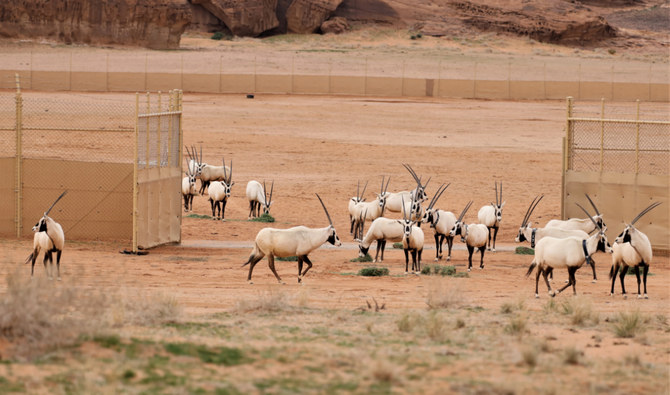
This winter five-phase release includes about 650 Arabian gazelles, 550 sand gazelles, 280 Arabian oryx and 100 Nubian ibex.
More than 1,500 endangered animals will be released in AlUla as part of the Royal Commission for AlUla’s mission to reintroduce native species into their natural habitats.
The animals will be released across three of AlUla’s nature reserves: Sharaan, Wadi Nakhlah and Al-Gharameel.
This winter five-phase release includes about 650 Arabian gazelles, 550 sand gazelles, 280 Arabian oryx and 100 Nubian ibex. The first phase, on Jan. 10, saw the release of about 80 animals. The species were sourced from respected conservation facilities in the Kingdom and UAE.
Stephen Browne, wildlife and natural heritage executive director of the Royal Commission for AlUla, said: “We are a growing player in conservation through biodiversity initiatives including species reintroduction, habitat restoration, protected area management and Arabian leopard conservation. RCU’s conservation and restoration initiatives are successfully moving forward in the revitalization of AlUla’s natural habitat — and one day we will reintroduce the Arabian leopard back to the wilds of AlUla.”
The reintroduction of the Arabian leopard, an apex predator classed as critically endangered, would serve as a capstone on the regeneration of the reserve. The reintroduction is targeted for 2030.
Monitoring of the newly released animals will be carried out with SMART software analysis tools, camera trapping and satellite tracking collars. It is the first time that the lightweight, solar-powered collars will be used for ungulate species in the region. RCU has conducted extensive genetic and physical screening of the animals to ensure their fitness for release into the wild.
The new release is by far the largest since RCU’s reintroduction program began in 2019. Animal reintroduction enriches RCU’s ambitious plan to activate six nature reserves while regenerating AlUla as a leading global destination for cultural and natural heritage.
source/content: arabnews.com (headline edited)
___________
The animals will be released across three of AlUla’s nature reserves: Sharaan, Wadi Nakhlah and Al-Gharameel. (Supplied)
Kalantan has become the first female director, the first non-European to win a BAFTA award in the Gamers category.
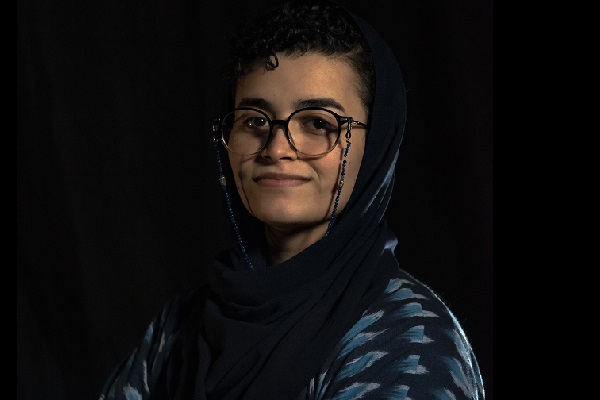
Rafif Kalantan has become the first student from Saudi Arabia to win a 2023 Yugo BAFTA Award, picking up the accolade in the Games Category for her submission ‘Eros Xavier’s Love Solutions’.
The Yugo BAFTA Student Awards is an annual event celebrating the works of the next generation of highly skilled and creative storytellers from around the world.
Kalantan, the first female director and the first non-European to win a BAFTA award in this category, was one of the students supported by Neom to attend the National Film and Television School (NFTS), one of the top-ranking schools to join its Master’s programme in Games Design and Development.
Kalantan’s entry ‘Eros Xavier’s Love Solutions’ is the culmination of an intensive two-year Master’s programme of training that provides students with the skills and creative knowledge to design, devise and build games, from inception to delivery.
‘Eros Xavier’s Love Solutions’ is a narrative-driven puzzle-like game. The game follows Eros Xavier, a retired cupid who is cynical about love and has decided to open a private business for hire as a match-breaker.
This year’s Yugo BAFTA Student Awards welcomed 754 submissions from 103 schools across 30 countries, including, Argentina, Belgium, the Czech Republic, Denmark, Hong Kong, India, Mexico, South Africa, and the United Arab Emirates.
Speaking about the award, Rafif Kalantan said: “I am honoured to have been selected as the winner of such a globally renowned award, especially being the first female director and first non-European to win this category. This wonderful achievement also showcases the capabilities of the developers from the Kingdom and the Middle East as a whole, and how the game industry in the region has a lot of potential. I am also grateful for the continued support and investment of Neom, which was an integral part of this achievement. Their continued support for us in the gaming field shows how much Neom believes in growing local talents and allowing them to thrive!”
Jon Wardle, Director of the National Film and Television School, commented: “The School is incredibly proud to be celebrating this achievement with Rafif as we celebrate the 10th anniversary of our Games Design MA. We’re also very grateful to Neom for continuing to help make our courses accessible with life-changing funding opportunities.”
Wayne Borg, Managing Director of Media Industries, Entertainment, and Culture at Neom, added: “On behalf of the entire Neom team, we extend our congratulations to Rafif for the well-deserved honour of receiving this prestigious award from BAFTA. This remarkable accomplishment is a testament to her exceptional talents and marks a momentous beginning for Rafif’s journey, and I’m sure she will achieve great things in the gaming world. We will continue to work closely with the National Film and Television School to nurture and empower more talented individuals as we develop our partnership and offer a unique blend of professional development, mentorship, and growth opportunities for emerging talent in the creative industries.”
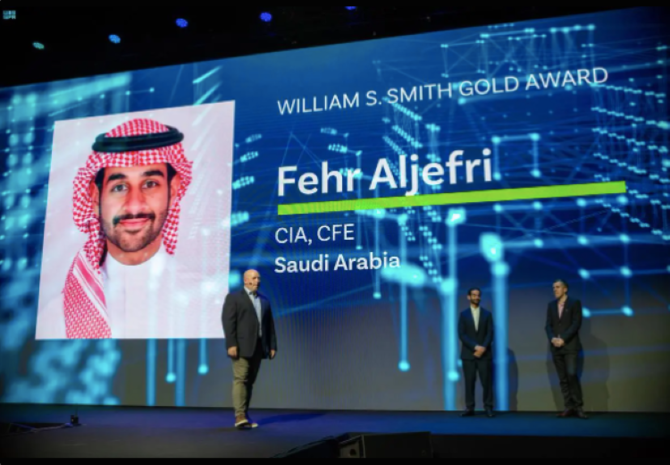
Fehr Al-Jefri, a member of the Saudi Institute of Internal Auditors, achieved the highest score in the William S. Smith Award for the Certified Internal Auditor program.
He earned the gold medal in a competition against candidates from the Philippines, China, and the US.
Al-Jefri is the first Arab to receive the highest award offered for auditing by the CIA, which consists gold, silver, bronze, and student levels. These awards are determined by individual performance in the core CIA exams.
The International Institute of Internal Auditors recognized and honored Al-Jefri for successfully completing all core exams within a year.
His accomplishment is a testament to the support provided by the Saudi leadership to individuals in various fields, the Saudi Press Agency reported on Tuesday.
According to the International Institute of Internal Auditors, this recognition signifies the role of Saudi Arabia in supporting the internal auditing profession and its practitioners. It highlights the “efforts made to help them overcome challenges, succeed in their professional work, and enhance work mechanisms.”
Abdullah Saleh Al-Shebeili, the CEO of the Saudi Institution of Internal Auditors, affirmed that the country’s achievements persist due to the steadfast support of the leadership toward the overall control system and, specifically, the internal audit profession. Al-Jafri’s victory serves as undeniable evidence of this sustained support.
Al-Jefri expressed his pride in receiving the award, considering it not only a personal accomplishment but recognition for his nation.
He also praised the role played by the Saudi Institution of Internal Auditors in bolstering the profession and advancing its practices.
Al-Jefri highlighted the institution’s efforts in organizing courses and seminars aimed at enhancing efficiency, improving performance quality, and strengthening oversight.
He also expressed his gratitude and appreciation to the institution for providing him with the necessary resources and support to achieve success. He emphasized that obtaining the CIA certificate signifies a high level of excellence in the profession and creates numerous opportunities for career advancement.
The William S. Smith Award, launched in 2010, catalyzes the advancement of the CIA program. It showcases participants’ commitment to addressing evolving challenges and equipping professionals with the necessary experience, credibility, knowledge, and competence to excel in the field and make a difference in various domains.
source/content: arabnews.com (headline edited)
__________
Fehr Al-Jefri, a member of the Saudi Institution of Internal Auditors, and the first Arab to receive the Gold William Smith Award for the CIA. (SPA)
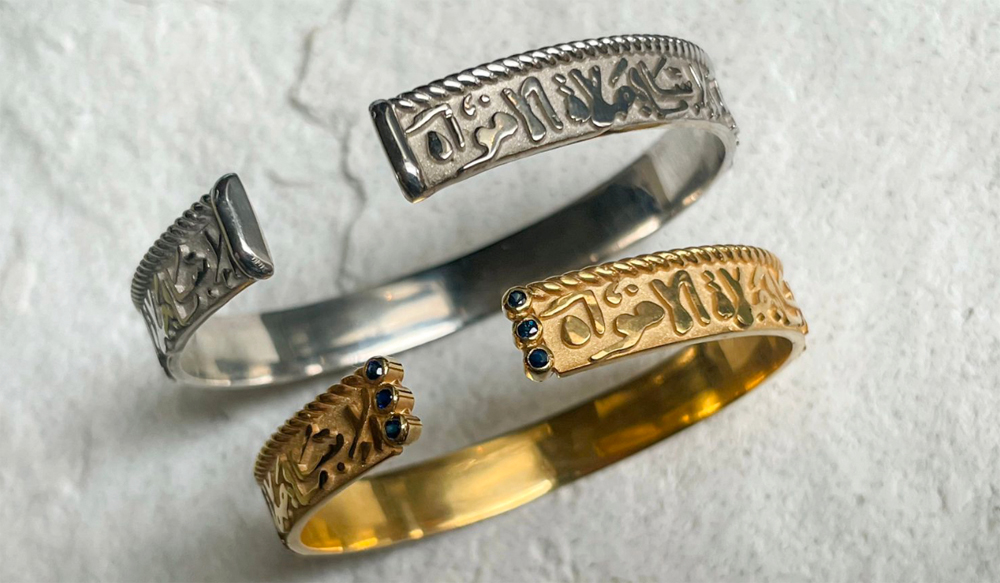
Saudi jewelry designer, Maryah Abdudeeb, is revolutionizing the world of wearable art by fusing the elegance of Arabic calligraphy with the beauty of literature. Through her brand, Mashq, she has embarked on a creative journey that begins with the delicate strokes of a calligraphy brush and culminates in the creation of breathtaking masterpieces inspired by poetry and literature.
Mashq, which takes its name from an ancient form of calligraphy, meaning “stretch out,” captures the essence of Arabic letters in a unique and captivating manner. The brand’s founder, Maryah Abdudeeb, drew inspiration from her childhood experiences, where she witnessed her father’s skillful calligraphy and her mother’s ability to transform simple materials into works of art.
Guided by these formative influences, Abdudeeb embarked on a quest to explore the depths of Arabic poetry and literature. Her creative journey was further enriched as she traveled to different countries, marveling at architectural marvels adorned with historic Arabic inscriptions. It was during these encounters that she stumbled upon jewelry pieces engraved with calligraphy, each one narrating a deeply personal story.
With a profound love for Islamic art, Abdudeeb believes in showcasing and appreciating its timeless beauty. To deepen her knowledge and understanding of this art form, she immerses herself in Islamic design books, where she discovers an array of captivating designs and phrases inspired by this rich cultural heritage.
The COVID-19 lockdown proved to be a turning point for Abdudeeb, as she pondered over ways to combine her twin passions: jewelry and Arabic calligraphy. It was during this period of introspection that the concept of Mashq was born.
In March 2021, Mashq made its debut, unveiling its inaugural collection. Abdudeeb personally contributed to each stage of the jewelry-making process, acting as both the calligrapher and designer. Each piece in the collection showcases verses and lines from her favorite works of Arabic poetry and literature, capturing the essence of profound emotions and inspiring narratives.
The transformative design process begins with Abdudeeb meticulously rendering the chosen phrase in calligraphy, striving to convey its true essence. The phrase is then transformed into a three-dimensional representation using specialized jewelry design software. Depending on the size and intricacy of the piece, it is crafted either by hand or with the assistance of cutting-edge machinery.
However, the true measure of success for Abdudeeb lies in the emotions evoked by her creations. By employing a variety of meaningful phrases and materials such as silver, gold plating, and gems, she aims to establish a connection between the wearer and the words. Each piece serves as a reflection of personal sentiments or a wellspring of motivation, empowering individuals to carry their chosen phrase with grace and pride.