Arabs & Arabian Records Aggregator. Chronicler. Milestones of the 25 Countries of the Arabic Speaking World (official / co-official). AGCC. MENA. Global. Ist's to Top 10's. Records. Read & Enjoy./ www.arabianrecords.org
“All of my friends who have met him still love him. He has made a huge impact on them just from that one day they saw him.”
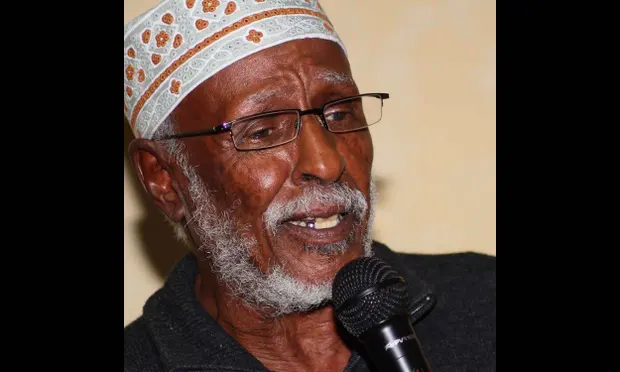
Ahmed Ismail Hussein was known as the “King of Oud” because he was the master of the 11- or 13-stringed instrument.
Born in the late 1920s in Somalia, Hussein began playing the oud professionally in the ’40s after falling in love with it in his teens. He was instrumental in making qaraami — singing or speaking while playing the oud or drums — one of the most popular genres of music in Somalia.
In February this year, after a career spanning more than seven decades, Hussein retired. He was considered a founder of modern Somali music. A concert was held in his honor in London. — Hussein moved to the UK in 1974 — with artists whom he handpicked.
Despite his retirement, Hussein, who also went by the name “Hudeydi,” had no intention of slowing down entirely; he had plans to travel to Turkey and Djibouti.
But then he fell ill. Earlier this month, he was taken to Charing Cross Hospital in London. His condition deteriorated, and on April 8 he died from the coronavirus, a week before what would have been his 92nd birthday.
Nadifa Mohamed, a British author, said she spoke to Hussein a few days before his death, when he didn’t even seem to have symptoms. “I think the decline was quite quick from him developing symptoms to him being quite ill in hospital. It was quite shocking,” she told BuzzFeed News.
Despite his age, Hussein was otherwise a fit and healthy person, Mohamed said. “Everyone was like, ‘He was 92 he had a good life’ — but nothing. There was no warning,” she said. “It wasn’t as if he was sick.”
Mohamed said she had been friends with Hussein since 2012, when they met at the annual Hargeisa International Book Fair in Somaliland, a disputed territory that neighbors Somalia. More so than his musical genius, his sense of humor is what really stood out for Mohamed. “He was funny,” she said. “I think that’s the first thing I noticed.” (His nickname was Hudeydi, but he told the BBC in 2003 that he was also known as “‘the King’ because of my hot rhythms. I was always into rock ‘n’ roll and Elvis Presley”)
“Having a friend who is 50 years older than you is unusual, but I think his sense of humor was so young and easy to engage with,” Mohamed said. “And he was very warm. You could turn up to his door. You could bring whoever you wanted. He would feed you. He would make tea or coffee for you, tell you stories. He was very accepting of people, which was very unusual.”
Hussein, she said, had a charm that would make everyone love him from the moment they met him. “It’s the way that I could turn up with a friend to play an instrument or something else, and he’d give me a big hug as he opened the door and he would go to my friend — whoever it may be — and do the same.
Usually when grieving, Somalis tend to visit the home of the deceased’s next of kin for days to offer their condolences and pray. But this is currently impossible during the lockdowns in place across the world.
After Hussein’s death, tributes poured in from Somalis around the world. On the day of his burial, people held absentee funeral prayers .
Inaalilaahi waa Inaa Ileyhi Raajicuun. Deeply saddened by the passing of Ahmed I Hussein ‘Hudeydi’ – one of the greatest Somali musicians of all time; AKA The King of Oud. My deepest condolences to Hudeydi’s family, fans, Somalis across the world,& his fellow Somali artists. pic.twitter.com/WPiRg75Avv
In a statement, the Kayd Somali Arts and Culture organization said Hussein’s “iconic legacy lives on through his music and in the memories of all of those of us who adored him and continue to do so.”
source/content: buzzfeed.com (headline edited)
_______________
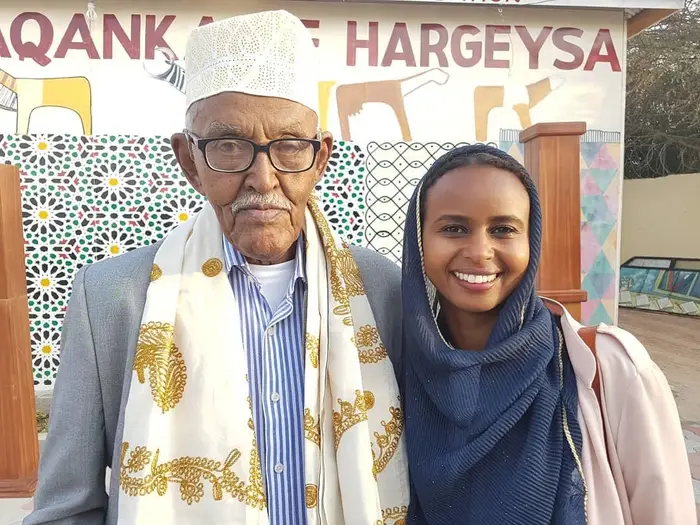
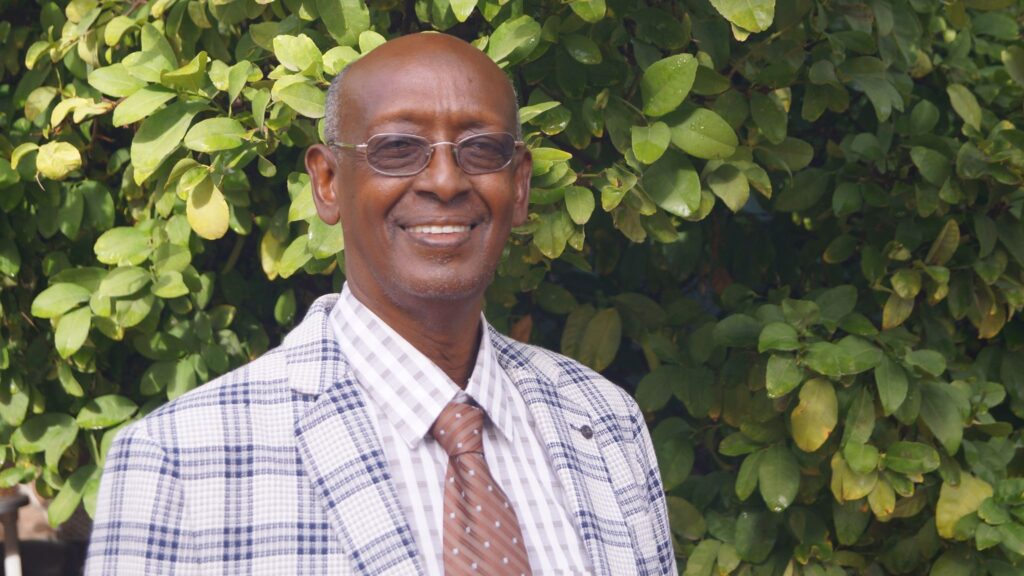
Ahmed Ismail Hussein (left) and Nadifa Mohamed (right), a friend. / Courtesy of Nadifa Mohamed
The great Somali poet, philosopher and scholar Mohamed Ibrahim Warsame (Hadrawi) passed away on the 18th of August 2022, in Hargeisa, Somaliland.
A national funeral was held in Hargeisa, and many Somalis from all parts of Somalia attended to pay their respects for the last time to the great man. The news of his death had brought tears to the eyes of every Somali, whether they met him or not. when you look around and see people of different walks of life commiserating about his death, you would think their own father had passed away.
He did not give these people materials for them to love him that much, but he acquired their hearts and minds by being sincere and trustworthy with his beliefs. Somalis and non-Somalis compared him to the great poets, philosophers, and scholars of the world, past and present. However, I think he transcends all, he was an ‘ummah’ in his own right.
Allah SWT when he was describing the personality of prophet Ibrahim said “Indeed, Ibrahim was acomprehensive [ummah] devoutly obedient to Allah, inclining toward truth, and he was not of those who associate others with Allah (Quran, 120:16)”. Allah described prophet Ibrahim as “ummah”, and the word ‘ummah’ in the Quran is used either to describe a nation (more than one person), or someone (like prophet Ibrahim) who is so great that his personality and beliefs are different from the society he lives in, and comprehensive that he can stand independently and single-handedly change the society from bad to good. In other words, someone who is not a follower of the majority of people that agrees on wrong decisions.
Instead, ‘ummah’ is a follower of truth even if the majority of people disagree with them. We can safely describe Hadrawi as being an ‘ummah’ in his own right. Because anyone who observes his life and his literary works, soon understands that Hadrawi was not your everyday person. He was an ‘ummah’ because he prided himself on liberty by refusing to be bought.
In the early 1970s, when almost every Somali was clapping in agreement with the communist regime that ruled Somalia from 1969 to 1991, Hadrawi stood up on his own and refused to bow down to oppression.
He was an ‘ummah’ when he freely opted to go to prison and suffer or worse, rather than clap for a tyranny.
In his latest book ‘Hawaale Warran’ he narrates what happened between him and the military regime, and how after he refused to bow down was arrested and put away in jail without justification whatsoever.
In 1973, Hadrawi wrote a play called ‘Aqoon iyo Afgarad’ ‘Knowledge and Consensus’ which he and his fellow poets Mohamed Gariye and Professor Muse Abdi Elmi presented in Lafoole Institution, located outskirt of Mogadishu.
The objective of the play was to advise the Somali people not to seek education outside the country, rather education was available on home soil, and there is no need to waste the nation’s wealth to send students abroad. It is worth mentioning, that at the time, the regime was sending its cadres and the children of revolution leaders to the Soviet Union, Europe and the United States for education and training, in the process, wasting the taxpayers’ hard-earned money. Hadrawi did not like that, hence his play knowledge and consensus’ addressed that.
The 1969 revolution leaders, in particular, the country’s president Mohamed Siyad Barre, did not like the play, and he thought it was anti-revolution and embarrasses his decision to spend a huge amount of the nation’s wealth on sending cadres outside the country.
He summoned Hadrawi to Afisyoni, his air force headquarters. Hadrawi said, men from the national guards took him there, and he met the president sitting under a tree. The president opened the conversation with the remarks “Hadrawi, I know you are anti-revolution, but why every poetry you compose are used against us?”. Hadrawi said, “I tried to convince him, and said, we (poets) compose poetry, and then people take it and interpret it to whatever makes sense to them”. Then the president concluded the meeting by saying “ask me whatever you want, but after today, I don’t want to hear any poetry of yours that people are using against us”. Hadrawi replied by saying “whatever Allah decrees is gonna happen”.
Hadrawi continued his work and created another play called ‘Tawaawac’. The play naked the misery and the disappointments Somalis inherited from the 1960 independence, and how a handful of military officers have hijacked the nation’s hopes after getting rid of colonisers. He likened this to a scenario where people are fighting over the meat of a slaughtered she-camel that was supposed to be spared for daily milking to feed the kids and the elderly. One of the song’s lyrics that Hadrawi created for this play says:
Weligay cad quudheed
Anna qaadan maayoo
Qalanjadan faraha dheer
Wax la qaybsan maayee
This translated into something like:
I will never accept
An offer with contempt
And I will never share anything
With this long-fingers beauty
Hadrawi said, the president, especially hated these four lines above, because he thought that I was taunting him and making fun of his earlier offer of ‘ask me what you want, but stop composing poetry’.
The next thing Hadrawi knew he was snatched from his home in the middle of the night by men from the security services under direct orders from the president. He was arrested without going before a court and thrown in jail at Qansax Dheere, in the Bay region far away from his residence. When asked why they took you all the way to Qansax Dheere, while there are many jails near your residence? He replied they wanted to brainwash me and break me into submission. They said to me you will be released immediately if you ask forgiveness from the father of the revolution (meaning the president).
Hadrawi was an ‘ummah’ when replying to this demand. He said to them “know there will be three scenarios with me, I die and go to my grave, I stay in prison, or I acquire my full freedom [without fearing anyone]”. He stayed in prison for five years, and again, as usual, he was an ummah in prison by continuing his struggle against tyranny. By this time, many Somalis woke up to the cries of Hadrawi from their deep asleep and started to see the tyrannical regime for it really was.
Hadrawi was an ‘ummah’ when the civil war happened in 1988-1991 by manifestly telling the struggle leaders ‘do not replace tyranny with another. He was an ‘ummah’ after the civil war in his ‘Peace Spring’ in 2003, when he travelled on the ground from Hargeisa to Kismayo, stopping in every town between them, literally hundreds of villages.
He was an ‘ummah’ by his devouted love of literature and writing. He comprised a whole poem about the importance of writing, he said:
Qalinkaa wax suureeya
Kugu sima halkaad doonto
Saaxiib kal furan weeye
Sunto fara ku hayntiisa
Weligaa ha si deynin.
Sisin iyo ku beer muufo
lyo laanta saytuunka
Ku gotomi sungaan waarta
Iyo nabadda seeskeeda
Samo iyo ku doon heedhe
Dunidiyo sinnaanteeda
The pen that can imagine for you
And can take you where you want
It is a friend with open heart
Regularly, keep it in your hands
And never let it go
Plant it among sesame and bread
And the branches of olive
And use it to spread in the world
peace, equality and justice
In these short lines, he was an ‘ummah’, the material of philosophy ‘abstraction’ he uses here to emphasise how important is to use writing to seek peace, prosperity, justice and equality, which is nothing short of genius. He was trying to kill one stone with the two old enemies of the human race: poverty and ignorance.
Equally important, he was an ‘ummah’ when he praised the Somali women for their beauty and bravery. He was a great admirer of the Somali women, although depicting their true nature without exaggeration or embellishments. In his poem ‘Horn of Africa Girls’, he said about the Somali women:
Hablo weerar geli kara, Hablo geela dhicin kara, Hablo geesi dili kara, Gobannimona hanan kara, Hablo talada goyn kara, Garta madal ka niqi kara, Garashana iskaga mida, Quruxdana ka wada goba; Geesteenna mooyee Geyi kale ma joogaan.
Girls that can go to war
Girls that can defend the camel
Girls that can acquire honour
Girls that can make decisions,
And publicly express their opinion,
And equally have high intellects
Girls that all blessed with beauty
Except, in our region,
Can they be found in anywhere else?
The examples of the great man are many, and it is impossible to mention them all in this short article. I would advise any admire to go to his works, and they will find an encyclopedia of knowledge, that will take them a lifetime to study.
Lastly, but not least, he was an ‘ummah’ by leaving instructions on how he wished to be treated after his death. He wrote a poem called ‘will’, in which he advised people to treat his death like any other, he said.
Qofka ii duceeyoow
Rabbigay ku darajee
Qofka iga ducaystoow
Dummaddaada weeyaan.
After many passages of the poem, he pleaded with people that they should not make a fuss about his death and funeral. His grave should not be built but should be left like other graves. People should not make a shrine of his grave, nor should they over-grieve or celebrate his life. In the last few lines, he prays for those who pray for him.
Finally, you lived as an ‘ummah’ and died as an ‘ummah’, there is nothing left to say but goodbye to our beloved teacher, philosopher, poet and role model. Your body might have departed this world, but your ideas and the knowledge you left for us and humanity, are eternal. I am sure people of the other side and angels are welcoming you with roses and open arms—they are congratulating you as you have accomplished your mission here on earth, advised your people and fought bravery in the way of Allah seeking justice, and freedom and equality for all. May Allah shower you with His Forgiveness and Mercy, light up your grave, and may He elevate your status and grant you Jannatul-Firdaus. May Allah resurrect you with the prophets, the steadfast affirmers of truth and the martyrs.
“And whoever obeys Allah and the Messenger – those will be with the ones upon whom Allah has bestowed favour of the prophets, the steadfast affirmers of truth, the martyrs and the righteous. And excellent are those as companions (Quran 69:4)”.
“Verily we belong to Allah and verily to him do we return”.
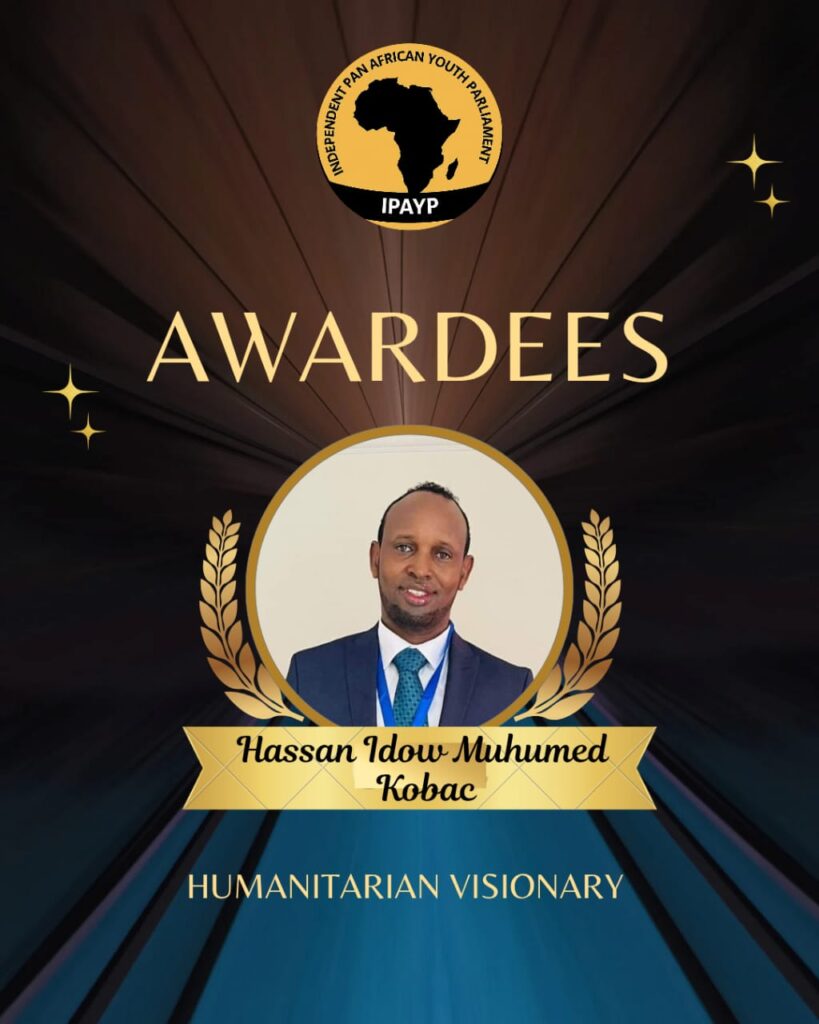
Independent Pan African Youth Parliament awarded Humanitarian Visionary Award to Hassan Idow Muhumed Kobac – a Senator, a business elite and humanitarian worker among other awardees at the Kenyan capital Nairobi.
The three-day summit gathered over 50 youth leaders, policymakers, academics, and civil society voices from across the continent focusing youth-driven solutions for key challenges including education, employment, leadership, democracy, climate change, and digital innovation.
“I am honoured to receive this important award which is the recognition of the humanitarian work I have been doing in Somalia for more than a decade and all other humanitarian workers” Hassan Idow Muhumed Kobac said, “The Award not only encourages the humanitarian workers, but also boosts the morale of other humanitarian workers.”
“My goal is to create a better life for the Somali people and restore their dignity.” Hassan Kobac who is a true example of honest leadership that stands for progress and compassion said.
Mr. Kobac has dedicated his life to the development of vulnerable communities. Through the Hassan Kobac Foundation (HKF), a foundation he founded himself, has become a source of hope for many people affected by drought, displacement, and poverty.
In the face of one of the most severe droughts in recent history, the Hassan Kobac Foundation (HKF) has emerged as a beacon of hope, delivering emergency water trucking assistance and food rations to thousands of families in the Hiiraan region of central Somalia.
In February this year, Hiiraan Youth Association honored and celebrated the achievements of Senator Hassan Kobac in a grand event held in Beledweyne. The ceremony, attended by various societal groups, intellectuals, and youth, honored Senator Kobac’s four-year tenure in the upper house of the Federal Parliament of Somalia
Hassan Kobac has been described as the true voice of the people of Hirshabelle, continuously working to defend their rights and improve their well-being. His dedication to youth empowerment and community development has earned him the admiration of and respect of many.
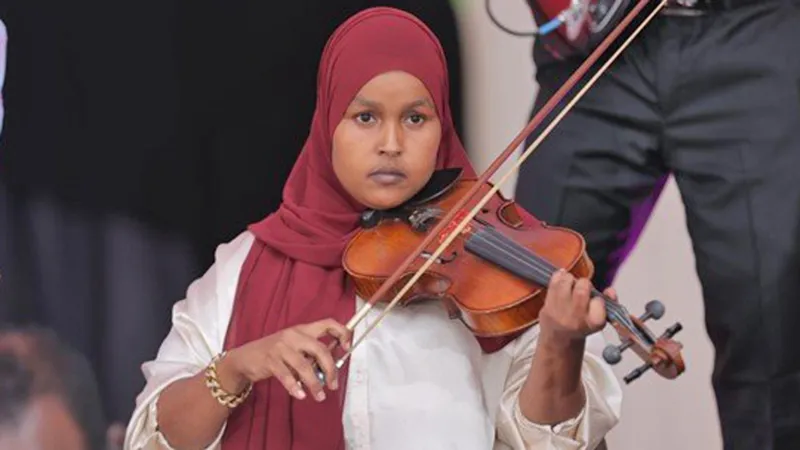
Born at the start of Somalia’s civil war, Maryan Ali Mohamed dreamt of one day performing live on stage.
She spent hours impersonating musicians on TV and always hoped to master an instrument.
In 2019, she picked up her first violin. Now, the 33-year-old is one of 40 musicians forming a Somali orchestra.
The East African country does not have an official national orchestra, but for the first time, an ensemble of musicians were brought together for a series of televised performances.
Men and women dressed in suits and satin were recorded harmoniously playing trumpets, drums and ouds – a traditional string instrument.
“I’ve never seen anything like it,” said Fadumo Hussien, a 70-year-old grandmother watching from her living room on the outskirts of the capital, Mogadishu.
“I remember bands playing growing up, but nothing like this,” she told the BBC.
The performances, organised by Mogadishu-based production company Astaan TV, aim to revive Somali music.
“We brought this orchestra together and gave them a space to rehearse,” said Mohamed Abdiwali, one of the event organisers.
“Now they can play classical Somali music,” he said.
The carefully crafted shows are then aired online and across local TV.
“The younger generation needs to start hearing our history,” he explained.
“Historically, we’ve had bands in Somalia, with a limited number of instruments,” explained Jama Musse Jama, director of the Hargeisa Cultural Centre.
Orchestras, with their larger size and classical focus, often have a greater emphasis on collaboration and synchronicity.
“You work together in harmony and build music in harmony,” said Dr Jama, noting the sounds of the Egyptian and Sudanese orchestras.
“It’s all about coming together,” he added.
Musicians were handpicked from across the country for this project, including both seasoned instrumentalists and emerging talents, like Ms Mohamed.
“I usually play on my own, or with just a few other people, but nothing on this scale,” she told the BBC.
The mother-of-two began violin lessons just a few years ago as part of a community programme in Mogadishu. She now practises using YouTube videos.
“I am so grateful to be here,” she said smiling.
Since the outbreak of civil war in 1991, Somalia has grappled with political instability and conflict. That’s had a knock-on effect on cultural institutions.
“Somali music hasn’t had a home for years,” said Dr Jama.
The National Theatre in Mogadishu, which opened its doors in 1967, was once a cultural melting pot for the city.
Spectators would gather inside the grand hall located in central Mogadishu to watch plays, musical performances and film festivals.
It quickly became the beating heart of the creative community.
“Beyond a physical building, musicians and artists must be encouraged to come together, share ideas and produce something tangible,” explained Dr Jama.
During the civil war it was fought over by rival militias and its roof even collapsed after being hit by mortars.
Across Somalia, cultural institutions and exports are now being revived, marked by the return of cinemas, art exhibitions and Somali TV shows.
The National Theatre reopened again in 2020 and now hosts a variety of events, including this year’s Mogadishu Book Fair.
In Somaliland’s capital Hargeisa, live music nights featuring traditional Somali music and food are on the rise, which Dr Jama says is vital for sharing the country’s rich culture through the generations.
“Somali music is not well archived,” he told the BBC.
“We don’t have musical notations, we perform and it dies there and remains only in the memory of the singer,” he said.
“That’s why a televised orchestra performance is so special,” he added.
“By documenting this, we’re creating something tangible that the next generation can see, understand and appreciate.
If you were going to have a creature named after you then a scorpion may not be your first choice, but Ahmed Ibrahim Awale believes the Pandinurus awalei will serve as an inspiration to budding Somali scientists.
The 66-year-old scientist from Somaliland has been honoured by the three researchers who discovered the new scorpion species in the region in recognition of his decades of work in conservation and environmental protection.
“Most of the species identified in Somalia and Somaliland are named after a place, a characteristic that a plant or animal may have or somebody from Europe or America,” he told the BBC in his lively voice on the line from his office in Hargeisa.
“But for many young people here, it will encourage them to know that this species is named after Awale – after all Awale is a Somali.” His pride in having this honour clearly shines through.
‘Large but not that lethal’
Since the 19th Century, researchers, mostly from Europe, have been exploring the rich ecology of the Somali region, but Mr Awale wants to add to the growing number of Somalis taking up zoology and botany.
The 15cm large-clawed scorpion that now carries his name was found in an arid landscape near Agabara village about 50km (30 miles) north of Hargeisa, the capital of the self-declared republic of Somaliland.
It is not as venomous as some of its smaller cousins as there is often an inverse relationship between the size of a scorpion’s claws and the power of its sting, Mr Awale explains.
But Pandinurus awalei is just one of 50 scorpion species that live in Somaliland, some of which are only found in the Somali region.
This fact gives a hint at its rich biodiversity. As well as a host of animal species, there are at least 3,000 species of plants that have been identified and more than 700 of them are endemic to the region – and that number is growing.
“Every year new discoveries are coming,” says Mr Awale, who himself found a new species of aloe in 2014.
“This articulates the message that all that is coming from Somaliland and the region is not that bleak. We always hear negative news and this marks a shift in the narrative that is different from the mainstream perception of piracy, extremism, famine and instability.”
True to his name – Awale means “the lucky one” in Somali – he made his own discovery by chance.
He was driving off-road “in the middle of nowhere” on one of his many field trips when he spotted huge clumps of more than 1,000 aloe plants.
“It was something I had never seen in my life,” he says and he went to investigate.
The plant was also a different colour to other aloes and though the local people knew it as dacar-cas (red aloe), they did not know how unusual it was.
After taking a sample and going through a lengthy research and verification process – which included searching the archive at London’s Royal Botanic Gardens and the East African Herbarium in Nairobi – it was proved last year that this was a new species. Mr Awale and his team of researchers named it Aloe sanguinalis (red aloe).
The discovery was the culmination of a lifetime’s passion that he partly puts down to where he grew up.
Born in 1954 in Adadlay, a village 95km east of Hargeisa, he lived near the Gaan Libah mountain, “which is one of the most beautiful places in Somaliland in terms of biodiversity”.
He came from a family of pastoralists, but his father, who ran a small shop in the village, paid for his education and in the end he studied agriculture and environmental science at the Somali National University in Mogadishu.
‘Extinction threat’
Mr Awale’s upbeat message about the biodiversity of Somaliland is tempered by a concern for its future.
Like everywhere else, species are under threat and some are dying out.
A combination of changes of land use for urban development, the clearing of forests for charcoal, the proliferation of invasive species and climate change are “pushing a number of species into extinction”.
For Mr Awale, this is not about prioritising the needs of the natural world over human need.
“Biodiversity is the web of life,” he says.
“We draw on that natural resource for our sustenance, for our medicine, our shelter. The richer the biodiversity, the richer our quality of life will be too.
“A declining biodiversity means that we are becoming poorer and that makes our survival problematic.
To push this message in Somaliland, in 1995 he helped set up Candlelight, an organisation aimed at creating a society that is aware of environmental concerns.
He has also written books and articles, and appears on the radio and TV to increase awareness about the issue.
Mr Awale says he has noticed some changes in government policy, but most importantly he has a growing number of young people engaged in the work.
Despite being recognised by having a scorpion named after him, the environmentalist knows that this is not his struggle alone.
“The Somalis have a proverb: ‘A single finger cannot wash a face.’
“In other words: It’s no use myself being prominent and well known, if I don’t have people supporting me.”
As for the lesson that the discovery of Pandinurus awalei teaches, he is convinced “that there are more species to be discovered… if the time and space allows there will be a lot of discoveries”
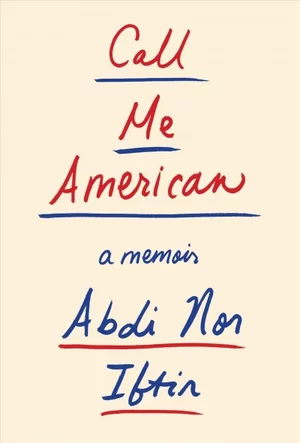
What does it take to become an American? In 2015, This American Life told the story of a Somali refugee who was finally issued a visa to come and live in the United States. “This big smile was on my face. I’ve never had such a big smile,” Abdi Nor Iftin said at the time.
Iftin’s long road to the US began when he was only a child in Mogadishu, watching American movies and teaching himself English, while brutality and war raged around him. In his new memoir, Call Me American, he tells his story from the beginning: with his nomadic parents and their now-unimaginably peaceful, pastoral life.
“She had no idea that the country she was living in was called Somalia,” Iftin says of his mother. “She had always told me, ‘You know, Abdi, there’s only two days: The day that you’re born and the day that you die. Everything else is just grazing and hanging out with the animals.'” Life was so easy, he says, before drought and famine wiped everything out.
Interview Highlights
On his first memories of Somalia’s long-running civil war
I was six years old when the civil war started, militias started pouring into the city, and death and killings and torture, and I just cried. The smell of Mogadishu, it was just the smell of gunpowder. And that had been sticking with me forever … I think this is the most touching memory that I can remember, to have our youngest sister die, and we said, “Good. That is so easy for her,” and then I was jealous. I was jealous because that was the time when our feet were swollen, our bellies were empty. It was a feeling that you could die any time … and I looked at my other sister, and she was just eating sand. And I think that’s the stories that people don’t hear about.
On his encounters with Marines in Mogadishu
I still say they stole my heart, because it was the very first time that I saw people with guns, and the guns were pointed up in the air, not in my face. Then they were coming and giving us sweets — I wanted these people to stick around, I wanted these people to be part of my life.
On being targeted by Islamists because of his nickname, “Abdi the American”
Unfortunately, I still believe that Islamists were born out of the American involvement somewhere in the Middle East, and the phrases that they had used to attract young men of my age was just “America.” They said, “They are the enemies of Islam” … surprisingly, I was out on the streets, defending President Bush, I don’t even know why I did that. But I was defending him, and blaming Osama bin Laden for all the problems. But I thought, to me it was just expressing myself, but then it got me into trouble, and I received a phone call saying, “You got to stop and drop that nickname, or we’re going to kill you.”
On whether Americans know how hard it is to get a visa to come here
I don’t think they do! You know, Americans take so many things for granted. For example, I came to the U.S. through the diversity immigrant visa lottery, which [President Trump] would like to cancel. But if it was not the diversity lottery, I would have never come to America, never. I had been an American since I saw those Marines, and my nickname is going to be my nationality, very soon … When I wake up in the morning, I say, oh, I’m so lucky — I have arrived here before America had turned its back against the rest of the world. If this had happened when I was hiding myself from Islamic terrorists, just trying to come to America and become an American and all that, it would be a disappointment, it would be a betrayal by the United States. Because the way I understand is that America is open to the rest of the world. And I am here to make America great. I did not come here to take anything. I came here to contribute, and to offer and to give.
Somalia receives a boost in fight against COVID-19 in the form of home-made mechanised respirators, created by 21-year-old Mogadishu-based mechanical engineer A 21-year-old mechanical engineer came up with the device in response to a national shortage.
A 21-year-old Somali mechanical engineer has invented a homemade respirator to try to help his country during the COVID-19 Pandemic.
The east African nation is suffering from a severe lack of respiratory equipment, which concerned Mogadishu–based Mohamad Adawe.
Previously, medical staff in Somalia have mainly had to assist patients’ breathing by manually pumping the equipment. This has also brought them into close contact with the infected people, heightening the risk of contagion.
“We don’t have economic might or a strong government in Somalia. To respond to this bad disease, I produced this device at a time when our people are suffering from a shortage of oxygen equipment.
Mohamed Adawe
Mogadishu-based mechanical engineer
Adawe says there was a real need for his invention:
“This device is used for patients in emergency situations, especially those who are having difficulty breathing. It is immediately useable for saving lives.
“We don’t have economic might or a strong government in Somalia. To respond to this bad disease, I produced this device at a time when our people are suffering from a shortage of oxygen equipment.
“So, my automated device can be attached to the patient’s face and moved away from them, as a social distancing measure.”
“With my device, we can fight against COVID-19 while our country is facing a shortage of oxygen devices – and while other countries of the world hold ventilators and other devices in their warehouses.”
Dr. Hussein Abdi-Aziz Abdulkadir, Director of the Somali Syrian Hospital in Mogadishu, hailed the significance of Adawe’s invention:
“In the past, you always had to use your hands to squeeze the airbag of the device, to clear the airway of the patient.
“But now Mohamed Adawe has automated the device to help patients clear their airway and help with breathing at a time when there is an urgent need for this.”
It’s hoped Mohamad Adawe’s innovation will help save lives: not just because it aids the patient in breathing, but also because it allows doctors to keep a safer distance from them, reducing the risk of contagion.
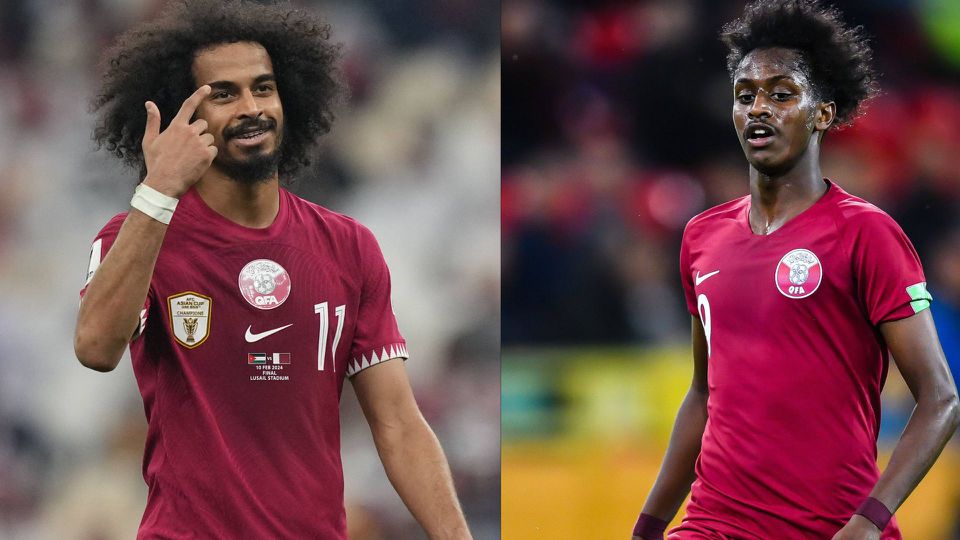
Somali-origin players Afif and Abdirisaq play pivotal roles in leading Qatar to victory in the AFC Asian Cup.
On Saturday, February 11, 2024, the football world turned its eyes towards a historic clash that would etch the names of Akram Hassan Afif and Yusuf Abdirisaq into the records of the AFC Asian Cup lore.
In a match that was anything but ordinary, Qatar’s national team, buoyed by the exceptional talent of its Somali-origin stars clinched their second successive victory in the tournament by overcoming Jordan with a decisive 3-1 win.
Qatar’s triumph was heralded by the remarkable performances of Akram Afif and Yusuf Abdirisaq, whose origins trace back to Somalia, showcasing the diverse and rich talent pool contributing to Qatar’s footballing success.
Akram Hassan Afif emerged as the tournament’s top scorer, remarkably netting three penalty goals in the final match.
His prowess on the field and his unique celebration, holding up a letter ‘S’ in honor of his Kuwaiti wife watching from the stands, captured the hearts of fans and ignited discussions across social media platforms.
Afif’s journey from the streets of Doha to becoming a footballing icon is a narrative of determination, skill, and the love for the game.
Yusuf Abdirisaq, on the other hand, fortified Qatar’s defense with his agility and keen sense of play.
Born in Hargeisa, Yusuf’s path to footballing stardom is a tale of resilience and adaptation. Representing Qatar on the international stage, Yusuf’s performance in the Asian Cup final was a clear demonstration of his defensive prowess and his significant role in the team’s success.
The match itself was a rollercoaster of emotions as three penalties were awarded, leading Qatar to victory.
Despite the debates, the focus remained on the skillful play and strategic acumen displayed by the Qatari team, particularly its Somali stars.
The Arab media and international press were lavish in their praise for Qatar’s achievement, with special emphasis on Afif’s scoring feat and Abdirisaq’s defensive mastery.
Their stories of personal and professional triumph resonated well beyond the football pitch, inspiring many young athletes around the world.
Off the field, both players have faced their share of challenges and controversies, such as Abdirisaq’s alleged racial abuse incident, which he and the Qatar Football Association strongly refuted.
Akram Afif, the son of a former Somali national team player, has football in his blood. His journey from Qatar’s youth leagues to becoming a key player for Al Sadd, and on loan from Villarreal, is a beacon of hope and inspiration for many aspiring footballers in the Arab world and beyond.
Yusuf Abdirisaq’s story is equally compelling, showcasing the potential for football to change lives and transcend borders. From his early days at Al Sadd SC to his loan at Al-Arabi SC and back, Yusuf’s career trajectory highlights the opportunities and challenges faced by players of diverse backgrounds in the world of professional football.
As Qatar celebrates its second consecutive AFC Asian Cup victory, the contributions of Akram Afif and Yusuf Abdirisaq will be remembered as pivotal to this historic achievement.
Their talent, perseverance, and dedication have not only led their team to glory but have also served as a powerful reminder of the unifying power of sport.
Mohamed Ibrahim Warsame, one of Somalia’s greatest poets, dies aged 79.
Somali social media has been flooded with tributes to the man better known as ‘Hadraawi’.
Messages of condolences continue to pour in from around the world following the death of Mohamed Ibrahim Warsame, regarded as one of Somalia’s greatest poets.
Warsame, known as “Hadraawi”, died in Hargeisa, in Somaliland, on Thursday at the age of 79.
Social media has been flooded with tributes and praise for his contribution to Somali language and culture.
“I’m heartbroken to inform you our giant Mohamed Ibrahim Warsame Hadraawi has passed away. Might Allah bless him and grant him Jannah,” Ayan Mahamoud, founder of Kayd Somali Arts and Culture , said on Twitter.
“We will treasure his legacy and the rich scholarly work he left behind,” added Said Salah Ahmed, a poet and playwright who teaches the Somali language at the University of Minnesota in the US.
Hadraawi, which means the “master, or father, of speech”, was regarded as a pillar of modern Somali literature and a strong advocate of peace and democracy.
In 1973, he was imprisoned for five years by the president, Siad Barre, who ruled Somalia until 1991, for speaking against the revolution. His work was banned but he continued to compose poetry upon his release, which were was passed on through word of mouth.
The songs and verses he wrote are full of imagery and metaphor, open to interpretation, which made it hard for the military regime to control. A verse from his poem The Killing of the She-Camel resulted in his imprisonment without trial.
The snake sneaks in the castle:
although it’s carpeted with thorns
still the coward casts off his curses
so the courageous must stretch out his neck;
the cob stallion sells his values
in order to cut a fine figure.
When such cockiness struts forth
and even laughter becomes a crime
our country has unfinished business.
In the early 1990s he called for an end to the civil war, which caused thousands of people to flee Somalia. In 2004, he travelled throughout the country on a “peace march” urging warring parties to stop the violence. His message of reconciliation resonated with Somalis at home and abroad.
He retired a few years ago.
“Poet Mohamed Ibrahim Warsame (Hadraawi) was a symbol of unity and peace,” said the Somali president, Hassan Sheikh Mohamud, in a statement. “He was one of key pillars of Somalia’s art and literature who took a leading role in preserving the Somali culture and promoting the Somali language. His death is felt in every Somali household.”
The EU, Norway, the UK and other friends of Somalia sent condolences and tributes.
“Sending my heartfelt condolences to the people of Somaliland and to all Somalis for the loss of Mohamed Ibrahim Warsame “Hadraawi”, an iconic poet and one of the most eminent and beloved Somali poets of all time,” tweeted Lizzie Walker, head of the Foreign, Commonwealth and Development Office in Hargeisa.
Hadraawi had been called the “Somali Shakespeare”, but Somali singer and songwriter Aar Maanta said: “Hadraawi wasn’t the ‘Somali Shakespeare’ he was the Somali Hadraawi. He was more than a poet; he was a philosopher and a freedom fighter who spent many years in jail for his stance against injustice and dictatorship.
“He wrote some of the most beautiful love songs and poems that Somalis in the Horn of Africa and beyond use as a benchmark.”
Ahmed, who knew Hadraawi since late 1960s, added: “Hadraawi was one of the kindest people I have ever met. His poetry speaks for the voiceless and calls out oppression against the people …. he will be missed so dearly but we will treasure his legacy and the rich scholarly work he left behind.”
Known as a “nation of poets”, poetry is woven into the fabric of Somali society with centuries of oral history, as the Somali language was only written in 1972.
Contemporary Somali poetry, including the works of Hadraawi, has been preserved in books and translated into English.
He may be younger than their children but one of Britain’s brainiest children, a Muslim, has been hired by a University to help adults with their sums as reported by Daily Mail .
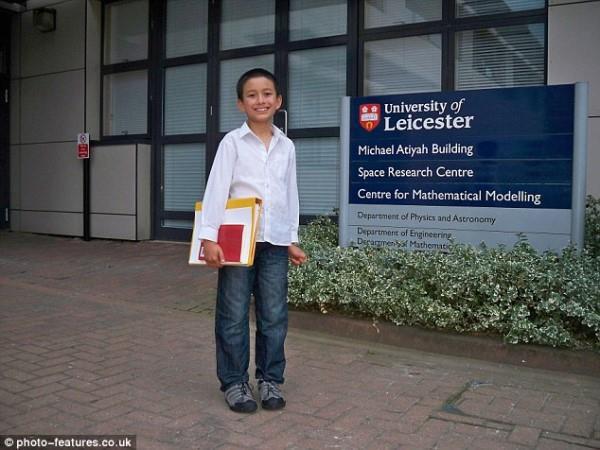
Yasha Asley, 14, is employed by the University of Leicester – where he is also a degree student – to run tutorials.
He became the youngest ever student at the University and is now the youngest ever employee.
Yasha was interviewed and offered the paid job when he was just 13–years old – beating adult applicants. Admin staff had to apply to Leicester city council for special permission to employ him because he was so young. The weekly tutorials Yasha runs are for adult students who need help and support solving problems following lectures. Proud Yasha said:’I am having the best years of my life. I love going to university and I love my new job helping other students.
No more school uniform for me thank you very much.’
Yasha, who has been dubbed a ‘human calculator’, is now in his final year and plans to start a Phd when he finishes his course.
The child genius attended a state primary school before winning his place to study degree level maths at just 12 years old in 2014.He was the first child in the world to achieve an A grade in maths A Level scoring 100 per cent and 99 per cent in two of the six papers when he was just 8 years old.
He passed more A levels in maths and statistics aged 9 and 10.
After finishing year 6 at primary he went straight to University. Of his achievements, Yasha said:’I love maths because it is an exact science. It is the only science where you can prove what you say is correct. It is so easy and an enjoyable subject to study.’
Proud father Moussa Asley, 53, who raised him single-handedly at their home in Leicester, said his son had been made welcome by staff and students alike.
Mr Asley, who drives his son to lectures every day, said:
‘I am just so proud watching him flourish and grow doing something he loves.
He is so good at understanding problems and explaining them in a clear way he is perfect for the job.’