SOMALIA’s U-17 women make history with record win in first international tournament

Somalia’s football story this week has extended beyond the headlines surrounding World Cup refereeing to a landmark moment for the country’s women’s game.

While attention has focused on Somali referee Omar Artan and reports that he was unable to travel to the United States to officiate at a FIFA tournament — a missed opportunity that would have marked a first World Cup finals involvement for Somalia — the country’s women’s Under-17 team has quietly made history of its own.

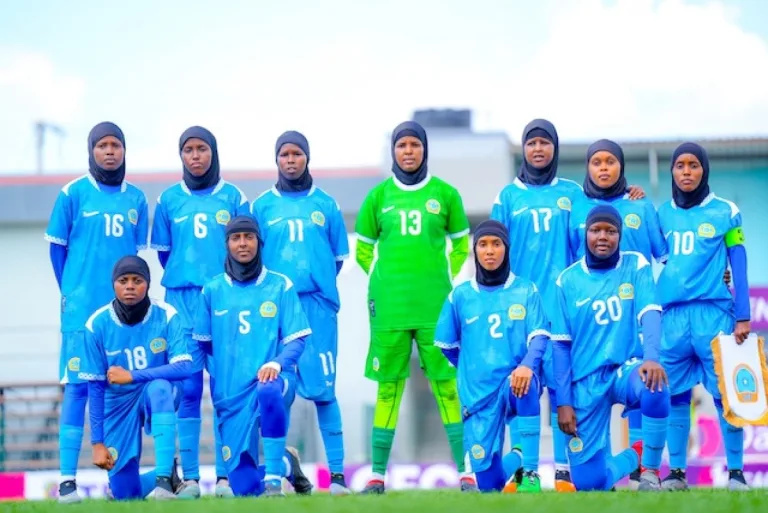
Competing at the CECAFA Women’s U-17 Championship in Dar es Salaam, Tanzania, Somalia fielded its first-ever women’s team in an international football competition.

Although the side exited at the group stage, their final match delivered a series of milestones that marked a significant moment for football development in the country.

Somalia recorded the biggest victory in the nation’s football history with an 8–2 win over Sudan and celebrated the first international hat-trick scored by a Somali player in a debut tournament appearance.

Sundus Mohamed scored twice, including Somalia’s first-ever goal in women’s international tournament football, while Najmo Mohamed claimed a hat-trick. Captain Halimo Isse, Maryan Osoble and Hibo Salad also found the net.

Shortly after the match, Somali Football Federation president Ali Abdi Mohamed called the squad to congratulate the players and coaching staff.

“You did well and I was sure you can,” he told the team, while praising captain Halimo Isse for her leadership throughout the tournament.

Reflecting on the wider significance of the team’s debut, Mohamed described the performance as an encouraging sign for the future of women’s football in Somalia.

“Somalia is a developing nation recovering from decades of civil war and we are very new to the women’s football environment, but we are improving,” he said.

“If our first international appearance was such a positive experience, I am sure we are developing and we will do much better in the months and years to come.”

Mohamed also acknowledged support from international football bodies.

“I would like to thank FIFA and CAF for their constant financial assistance, education and guidance. Without them we could not have achieved such progress,” he said.

He added that the federation plans to continue investing in the women’s game.

“We have spent significant time, money and energy on women’s football and I am fully committed to increasing our investment. Our women and girls are doing an excellent job and I am very proud of them.”

Somalia’s participation in the tournament has extended beyond the playing squad. Two Somali female match officials — referee Fadumo Mohamed Nor and assistant referee Iqara Ali Ahmed — remain in Tanzania after continuing to receive appointments during the competition.

source/content: horseedmedia.net (headline edited)

______________
____________

SOMALIA

SOMALIA’s Akram Afif and Yusuf Abdirisaq propelled Qatar to Asian Cup success

Somali-origin players Afif and Abdirisaq play pivotal roles in leading Qatar to victory in the AFC Asian Cup.

On Saturday, February 11, 2024, the football world turned its eyes towards a historic clash that would etch the names of Akram Hassan Afif and Yusuf Abdirisaq into the records of the AFC Asian Cup lore.

In a match that was anything but ordinary, Qatar’s national team, buoyed by the exceptional talent of its Somali-origin stars clinched their second successive victory in the tournament by overcoming Jordan with a decisive 3-1 win.

Qatar’s triumph was heralded by the remarkable performances of Akram Afif and Yusuf Abdirisaq, whose origins trace back to Somalia, showcasing the diverse and rich talent pool contributing to Qatar’s footballing success.

Akram Hassan Afif emerged as the tournament’s top scorer, remarkably netting three penalty goals in the final match. 

His prowess on the field and his unique celebration, holding up a letter ‘S’ in honor of his Kuwaiti wife watching from the stands, captured the hearts of fans and ignited discussions across social media platforms. 

Afif’s journey from the streets of Doha to becoming a footballing icon is a narrative of determination, skill, and the love for the game.

Yusuf Abdirisaq, on the other hand, fortified Qatar’s defense with his agility and keen sense of play. 

Born in Hargeisa, Yusuf’s path to footballing stardom is a tale of resilience and adaptation. Representing Qatar on the international stage, Yusuf’s performance in the Asian Cup final was a clear demonstration of his defensive prowess and his significant role in the team’s success.

The match itself was a rollercoaster of emotions as three penalties were awarded, leading Qatar to victory. 

Despite the debates, the focus remained on the skillful play and strategic acumen displayed by the Qatari team, particularly its Somali stars.

The Arab media and international press were lavish in their praise for Qatar’s achievement, with special emphasis on Afif’s scoring feat and Abdirisaq’s defensive mastery. 

Their stories of personal and professional triumph resonated well beyond the football pitch, inspiring many young athletes around the world.

Off the field, both players have faced their share of challenges and controversies, such as Abdirisaq’s alleged racial abuse incident, which he and the Qatar Football Association strongly refuted. 

Akram Afif, the son of a former Somali national team player, has football in his blood. His journey from Qatar’s youth leagues to becoming a key player for Al Sadd, and on loan from Villarreal, is a beacon of hope and inspiration for many aspiring footballers in the Arab world and beyond.

Yusuf Abdirisaq’s story is equally compelling, showcasing the potential for football to change lives and transcend borders. From his early days at Al Sadd SC to his loan at Al-Arabi SC and back, Yusuf’s career trajectory highlights the opportunities and challenges faced by players of diverse backgrounds in the world of professional football.

As Qatar celebrates its second consecutive AFC Asian Cup victory, the contributions of Akram Afif and Yusuf Abdirisaq will be remembered as pivotal to this historic achievement. 

Their talent, perseverance, and dedication have not only led their team to glory but have also served as a powerful reminder of the unifying power of sport.

source/content: pulsesports.co.ke (headline edited)

_________

_____________

SOMALIA