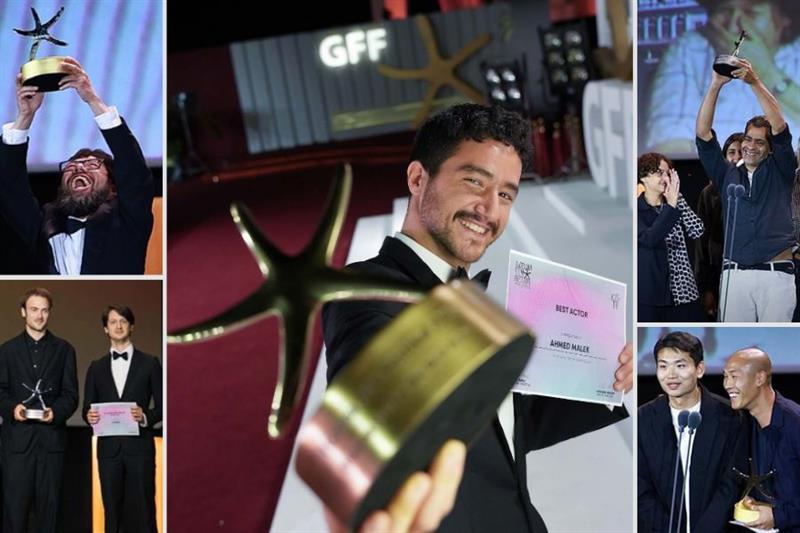
Ahmed Malek made history as the first Egyptian to win the El Gouna Star for Best Actor at the El Gouna Film Festival, which closed yesterday. During the closing ceremony, many other awards were also presented to Arab and international films.
The 8th edition of the El Gouna Film Festival (GFF) concluded, celebrating a remarkable lineup of films that illuminated the power of storytelling across cultures. The evening crowned winners in the festival’s five competition sections: Feature Narrative, Feature Documentary, Short Film, Cinema for Humanity, and the El Gouna Green Star.
Egyptian actor Ahmed Malek was awarded the El Gouna Star for Best Actor for his performance in My Father’s Scent, directed by Mohamed Siam, making history as the first Egyptian actor ever to receive this honour in the festival’s eight editions.
The jury praised Malek for delivering “a layered emotional journey between father and son,” commending the depth and subtlety of his performance. In his acceptance speech, Ahmed Malek pointed out that, for the first time in the festival’s eight editions, the Best Actor award had finally come to Egypt.
He expressed his deep happiness at being the first Egyptian to receive it, saying, “I am really proud to be part of this industry, in which I have worked since I was a child. Acting chose me, and it has been—and will always be—my greatest passion.”
Over the past editions, the El Gouna Star for Best Actor has recognized outstanding performances from across the globe.
Previous winners include Daniel Giménez Cacho (Zama, Mexico) in 2017, Mohamed Dhrif (Dear Son, Tunisia) in 2018, Bartosz Bielenia (Corpus Christi, Poland) in 2019, Ali Suliman (200 Meters, Palestine) in 2020, Petri Poikolainen (The Blind Man Who Did Not Want to See Titanic, Finland) in 2021, Bottsooj Uortaikh (If Only I Could Hibernate, Mongolia) in 2023, and Adam Bessa (Ghost Trail, France/Tunisia) in 2024.
Feature Narrative Competition
The Golden Star for Best Feature Narrative Film ($50,000) went to A Poet, a deeply human portrayal of a man torn between his poetic dreams and harsh social realities, directed by Colombian filmmaker Simón Mesa Soto. The jury praised the film’s “observational, semi-documentary approach and its politically aware gaze sustained by empathy and humor.”
The Silver Star ($25,000) was awarded to Lucky Lu by Lloyd Lee Choi (Canada/USA), recognized for its “urban symphony of struggle and dignity” embodied by a standout performance from actor Chang Chen.
Egyptian filmmaker Mohamed Rashad received the Bronze Star ($15,000) for his debut feature, The Settlement (Al Mosta’mara) — a stark, neorealist portrayal of Egypt’s shrinking working class that the jury described as “a powerful, unembellished look at social predetermination.”
Rashad accepted the award on stage during the closing ceremony, accompanied by his young protagonist Zeyad Islam, who charmed the audience and couldn’t leave the stage without thanking his mother and family.
The Best Arab Narrative Film Award ($20,000) went to Where the Wind Comes From by Tunisian filmmaker Amel Guellaty, praised for its “free, dreamlike road-movie spirit that captures the betrayed hopes of a generation.” Guellaty thanked the El Gouna Film Festival for its continuous support throughout the film’s post-production.
Léa Drucker received the El Gouna Star for Best Actress for her role in Adam’s Sake by Laura Wandel (Belgium/France). The jury commended Drucker for delivering “an intense and complex performance rooted in realism.”
Feature Documentary Competition
The Golden Star for Best Documentary ($30,000) was presented to Always by Deming Chen, a poetic reflection on childhood dreams and imagination.
Egyptian-French filmmaker Namir Abdel Messeeh triumphed at the El Gouna Film Festival, taking home two major awards for his latest documentary Life After Siham: the Silver Star for Best Documentary ($15,000) and the Best Arab Documentary Award ($10,000).
The film, a tender, humorous, and deeply personal exploration of memory, family, and intergenerational connection, impressed the jury, who praised its “delicacy, sincerity, and the power to bridge generations.”
In his heartfelt acceptance speech, Abdel Messeeh reflected on the intimate roots of the project, saying, “This film could have been called An Egyptian Tale — it tells the story of my parents, which began 75 years ago. I tried to tell it while connecting it to my children.”
He added with emotion, “We have so many stories, and I think as Arabs we need to tell our stories — but in our own way.”
The Bronze Star ($7,500) went to Orwell: 2+2=5 by Raoul Peck, honoured for its “uncompromising, lucid critique of systemic violence.” A Special Mention was also given to How to Build a Library by Maia Lekow and Christopher King, praised as “a profound act of resistance through knowledge preservation.”
Cinema for Humanity Audience Award
This year’s Cinema for Humanity Audience Award was shared between Put Your Soul on Your Hand and Walk by Sepideh Farsi (France/Palestine/Iran), an intimate account of Gaza’s resilience, and Happy Birthday by Sarah Goher (Egypt), a moving debut exploring Cairo’s class divides. Both films were celebrated for their heartfelt portrayal of humanity and empathy.
El Gouna Green Star Award
The environmental award, the Green Star, went to Seeds by Brittany Shyne (USA), honoured for its “immersive meditation on sustainability and survival through the preservation of land and agriculture.”
Behind the Camera Awards
In recognition of excellence in cinematic craft, the Behind the Camera Creative Achievement Award was presented to veteran cinematographer Dr Tarek El-Telmissany for his outstanding contribution to Egyptian and Arab cinema. The Recent Achievement Award went to editor Heba Osman for her exceptional technical artistry.
Short Films Competition
The Golden Star for Best Short Film was awarded to Agapito by Arvin Belarmino and Kyla Danelle Romero (Philippines), which the jury called “a tender and magical portrayal of the extraordinary in the everyday.”
The Silver Star went to Loynes by Dorian Jespers, described as “a mysterious and witty short that defies convention,” while the Bronze Star was presented to Water Girl (Fille de l’Eau) by Sandra Desmazières, celebrated as “a poetic meditation on aging and the passage of time.”
The Best Arab Short Film Award went to The Devil and the Bicycle by Sharon Hakim (France/Lebanon), commended for its “bold and nuanced storytelling that explores faith and desire with wit, charm, and emotional depth.”
In his speech, Eng. Naguib Sawiris, founder of the El Gouna Film Festival, reaffirmed the festival’s guiding motto, “Cinema for Humanity,” stressing cinema’s duty to shed light on global suffering—from Sudan and Ukraine to the children of Gaza.
He concluded by presenting a Special Tribute Award to Intishal Al-Tamimi, the festival’s former director and current advisory board member, in recognition of his outstanding contribution to GFF’s legacy and to Arab cinema.
source/content: english.ahram.org.eg (headline edited)
______________
_____________
EGYPT