Egyptian researcher Hany Saber El Beheiry, a PhD student at Kochi University of Technology in Japan, has achieved a remarkable international scientific milestone by winning the Outstanding Presentation Award at Japan’s largest Earth sciences conference, outperforming more than 1,000 researchers from around the world.
El Beheiry successfully developed a highly precise technique for detecting meteors and fireballs that could pose a threat to Earth. The Egyptian researcher explained that his study is based on analyzing infrasound waves generated when meteoroids penetrate the Earth’s atmosphere and integrating them with seismic waves recorded by ground-based monitoring stations.
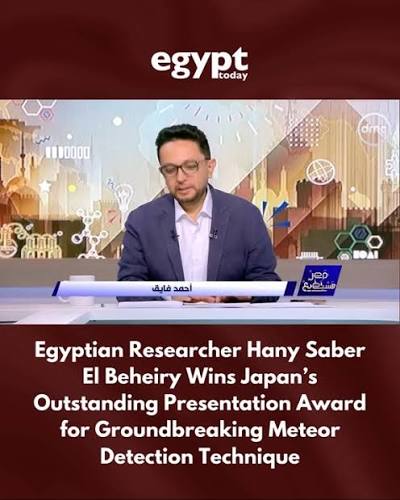
Speaking via Zoom on the television program Masr Tastate (Egypt Can), hosted by Ahmed Fayek on DMC TV, El Beheiry explained that infrasound waves are an exceptionally powerful monitoring tool. Because they propagate through the atmosphere at very low frequencies, they can travel thousands of kilometers without significant attenuation.
He added, “The new technique outperforms conventional cameras and optical observation systems, which often fail to detect meteors during daylight hours. By relying on acoustic monitoring, our method enables accurate, around-the-clock detection both day and night making it a more powerful and effective tool for tracking these violent cosmic phenomena, which can illuminate the night sky for only a few seconds while causing measurable geological effects.”
Reflecting on his award-winning achievement, El Beheiry noted that the conference attracted more than 9,000 participants, with approximately 1,000 researchers competing for the award. He emphasized that the prize is not awarded solely for presentation skills but is based on a comprehensive evaluation conducted by an international panel of judges. The assessment considers several rigorous criteria, including the scientific significance of the research, the accuracy and consistency of the results, the quality of the presentation, and the ability to answer complex scientific questions with clarity and rigor.
Despite the conference’s international nature and the participation of researchers from around the world, El Beheiry explained that the strongest competition came from researchers in East Asia particularly Japan and China given that the conference was held in Tokyo. Nevertheless, the Egyptian researcher won the award in his category, demonstrating the excellence of Egyptian scientists on the international stage while contributing a more advanced early-warning tool to help protect humanity against potential extraterrestrial hazards.
El Beheiry spoke about his scientific journey, the challenges he faced, and the secret behind the success of Egyptian researchers abroad.
El Beheiry, who works as an assistant researcher at the National Research Institute of Astronomy and Geophysics and is a graduate of the Faculty of Science at Mansoura University, expressed his deep pride in his affiliation with Egypt’s scientific institutions. He emphasized that Egyptian researchers who pursue their studies abroad discover the strength of their scientific capabilities and academic foundations, which enables them to compete strongly for prestigious international awards.
The researcher credited his success to professors at Egyptian universities and research institutes, describing the National Research Institute of Astronomy and Geophysics as “a great scientific institution that is home to outstanding professors.” He also pointed out that many of his colleagues have won prestigious international awards thanks to the solid academic foundation they received in Egypt.
Discussing the challenges of living and studying in Japan, El Beheiry explained that having previously earned his master’s degree in Japan and having lived there for more than three years made it easier for him to adapt to the culture. Nevertheless, he acknowledged the initial difficulties he faced, particularly the long and demanding working hours. He said he eventually adapted to the strict work environment and became capable of working and achieving results under different pressures and circumstances.
El Beheiry also highlighted the absence of the “fatherly and family-like” relationship between professors and students that is characteristic of Egypt. He explained that his Japanese supervisor, Professor Yamamoto, provides him with tremendous scientific and practical support and guides him as a “great mentor,” whom he considers a father figure, but “within the framework of work only.”
The researcher added that the Japanese work environment is characterized by fewer personal emotions and a strong emphasis on professionalism, with communication largely limited to the workplace and no meetings or social relationships outside it, reflecting the principle of “work is work.”
source/content: egypttoday.com (headline edited)
____________
pix: facebook.com / egypttoday
__________
EGYPT