Arabs & Arabian Records Aggregator. Chronicler. Milestones of the 25 Countries of the Arabic Speaking World (official / co-official). AGCC. MENA. Global. Ist's to Top 10's. Records. Read & Enjoy./ www.arabianrecords.org
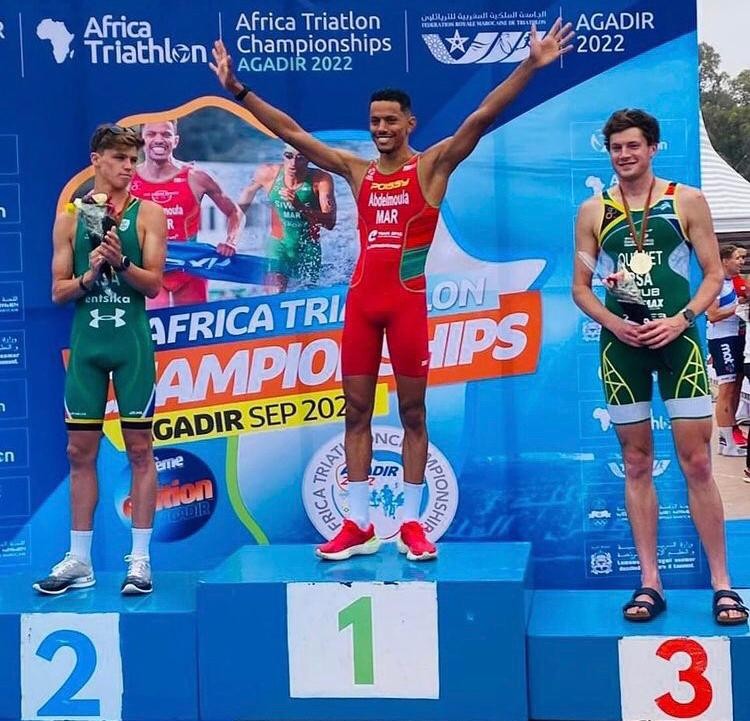
Jawad Abdelmoula is currently the best African and Arab triathlete, according to the World Triathlon Individual Olympic Qualification Ranking for Paris 2024.
Despite enduring an injury, Morocco’s Jamal Abdelmoula won the African title in the Elite category of the third Africa Triathlon Championship this weekend.
Hosted in Agadir, the Moroccan athlete said that he was honored to win the championship at home, adding that he took a risk to participate in the race given his health conditions.
Grateful for his team, coaches, fans, and mother Saharah El Khemmar, Abdelmoula shared on social media: “Thank you also to all those who support me and follow me in my adventure!”
The African champion completed the triathlon in a record of 1:49:25, just 34 seconds ahead of South Africa’s Jamie Riddle. Nick Quenet, another South African competitor, secured the bronze medal with a time of 1:51:56.
As Abdelmoulacelebrated his second consecutive victory in the African Triathlon Championship, five of his Moroccan teammates also participated in the Elite race.
Morocco’s Nabil Kouzkouz notably ranked 5th in the same category with a time of 1:52:59, while Badr Siwane followed in 7th with a time of 1:53:37.
Meanwhile, Mohamed Nemsi completed the race in 1:54:12, securing the 9th position just 13 seconds ahead of Tunisia’s Seifeddine Selmi. The latter succeeded in outperforming Morocco’s Youssef El Moutaouakil, who ranked 11th. As for Yasser Mohassine, the 22-year-old athlete took over 2 hours to reach the finish line, placing him second to last.
Besides dominating the elite category, Morocco ranked second in the mixed relay, followed by Egypt, Algeria, Tunisia, Mauritius, and Zimbabwe. South Africa, however, topped the category with a record of 1:37:33 for 4 legs.
According to the Royal Moroccan Triathlon Federation, thirty triathletes represented Morocco in the Elite, U23, U19, U17, U15, U13, and para-games of the African championship hosted in Agadir from September 23 to 25.
African delegations from South Africa, Zimbabwe, Egypt, Kenya, Mauritius, Tunisia, and Algeria also took part in the regional championship.
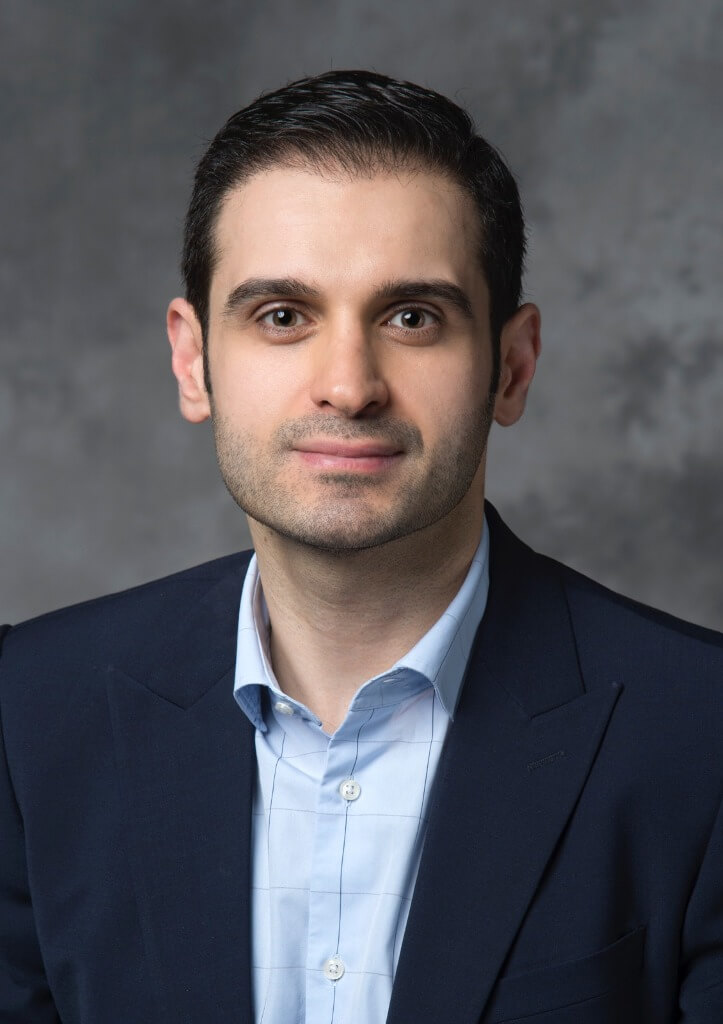
After three years of research during and after the Covid-19 pandemic, the Kuwaiti researchers Ammar Bahman and Nasser Al-Sayegh have come up with an invention that could help reduce energy consumption in power plants.
Bahman is an assistant professor in the department of mechanical engineering at Kuwait University, and Al-Sayegh is an associate research scientist at the Kuwait Institute for Scientific Research.
Their idea, which has been registered with the U.S. Patent Office, revolves around the creation of a device that can calculate the physical state of nanoparticles dispersed in advanced thermal fluids called nanofluids.
The significance of Bayman and Al-Sayegh’s invention lies in contributing directly to the improvement of thermal systems used in Kuwait for power generation and water desalination. The invention will allow scientists to test the qualities of a nanofluid before offering it as an alternative to the conventional fluids currently used.
The researchers used virtual Internet meetings to continue working together throughout the Covid-19 curfews in Kuwait, moving through stages of clarifying the problem, discussing solutions, describing and illustrating their idea, and sending off the patent for examination.
Practical Benefit of the Invention
Bahman, who obtained a Ph.D. in mechanical engineering from Purdue University in the United States four years ago, told Al-Fanar Media that his work on this invention came from a desire to find solutions to common problems between different disciplines.
He explained that the invention is based on the scientific and practical benefit of using nanofluids to improve the efficiency of the cooling processes, because nanofluids have higher thermal properties than traditional liquids. Bahman said the invention offers a solution to a problem facing nanofluids, which is that the suspended nanoparticles are prone to settle under the liquid over time. This means that these liquids eventually lose their advanced thermal properties.
The new invention calculates the percentage of a nanofluid that has lost its thermal properties, and the time it takes for the nanofluid to complete the precipitation process. Such calculations are vital to the research and industrial sector, Bahman said, because they allow scientists, companies, and decision-makers to know the sustainability of energy-generation and conservation devices when used with nanofluids.
Al-Sayegh said the real benefit of the invention would be seen at power plants and water desalination plants, because they depend on heat transfer. The patent will allow specific nanofluids to be introduced to increase the plants’ efficiency by reducing the fuel used, thus saving electrical energy consumption, he told Al-Fanar Media.
Al-Sayegh said creating a device capable of characterising the physical state of particles suspended in nanofluids would revolutionise Kuwait’s thermal systems systems in terms of operational efficiency and fuel consumption challenges.
Research Environment in the Arab World
With the Patent Office at Kuwait University, Bahman plans to employ research results in the country’s industrial sector.
He wants to establish an energy centre affiliated with Kuwait University to conduct scientific and experimental research, offer consultations to the public and private sectors, and provide training opportunities for students, technicians, and specialist engineers.
He believes that to encourage innovation, researchers need an appropriate research environment and access to knowledge and human resources.
Bahman also thinks scientific criticism should be included in school curricula, along with the presentation of scientific problems to encourage innovative solutions. This could be achieved through joint scientific programmes with international universities and student exchange programmes, he said.
Current conditions in the Arab world “do not stimulate scientific research,” Bahman said. “The research process requires great focus, effort and time from the researcher, as well as a stable environment for those conducting scientific research. This can only be achieved when there is abundant financial support.”
Al-Sayegh added that he and Bahman were trying to establish a company to market their inventions, and turn them into practical products that serve a large number of people.
source/content: al-fanarmedia.org (for text -headline edited), (pixs: ovpr.ku.edu.kw)
Dr. Abdullah Al-Rabeeah, supervisor general of the King Salman Humanitarian Aid and Relief Center, recently represented the Kingdom at the launch ceremony of the Global Islamic Fund for Refugees.
The fund is supported by UNHCR and the Islamic Development Bank’s Islamic Solidarity Fund for Development, with an initial amount of $100 million, on the sidelines of the 77th session of the UN General Assembly in New York.
In his speech, Al-Rabeeah expressed his happiness about the fruitful partnership between UNHCR and IDB to help millions of people around the world who are forcibly displaced, by offering constant support for refugees and displaced persons and their host communities.
He noted the importance of strengthening collective action and partnership to better respond and develop innovative, sustainable and comprehensive solutions, in line with the 17th sustainable development goal.
Al-Rabeeah said that the Kingdom was optimistic about UNHCR and IDB’s partnership, which embodies the values of humanity, justice and equality in developing innovative solutions for the refugee crisis.
Al-Rabeeah said: “Amid an increasing number of crises around the world, the Organization of Islamic Cooperation region accommodates the largest number of refugees in the world; we are all aware and fulfill our responsibility by providing all the refugees and displaced people’s needs to lead a safe, healthy and decent life.”
He said that the Global Islamic Fund for Refugees “would help us achieve this humanitarian objective, and given the significant economic challenges the world is facing and due to the limited donor base, this is the best time to present innovative ways to increase the funding modalities.”
Al-Rabeeah said that Islam encourages charitable work, that zakat is the duty of all Muslims who are capable of donating, and that this was the best time to establish the Global Islamic Fund for Refugees. He indicated that the success of this fund relies on the participation of authorized partners and project-based funding, with a transparent monitoring process.
Addressing the needs of refugees and displaced people in the OIC region is an example of zakat and charitable funding, he said, wishing the Global Islamic Fund for Refugees success.
The Global Islamic Fund for Refugees is to be a financing tool for refugees, in compliance with the provisions and principles of Islamic Shariah.
This fund consists of an endowment and nonendowment account to receive and invest donations, in accordance with Islamic financing’s principles. The revenue is deposited in a trust account to fund the response programs for refugees, displaced people and their host communities in the IDB member states.
The Islamic Solidarity Fund for Development has donated $50 million to the endowment account, while the UNHCR has donated $50 million to the nonendowment account, as an initial capital to launch this initiative with $100 million.
The fund also aims to raise additional capital of $400 million as a minimum target by allowing donations from people wishing to contribute.
source/content: arabnews.com
____________
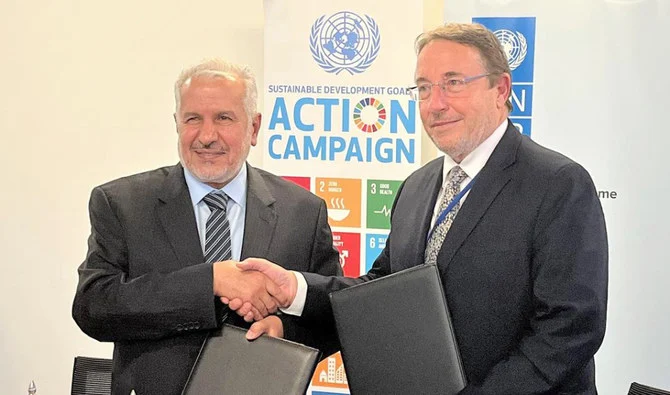
KSrelief Supervisor General Dr. Abdullah Al-Rabeeah and UNDP Administrator Achim Steiner sign an a cooperation agreement. (SPA)
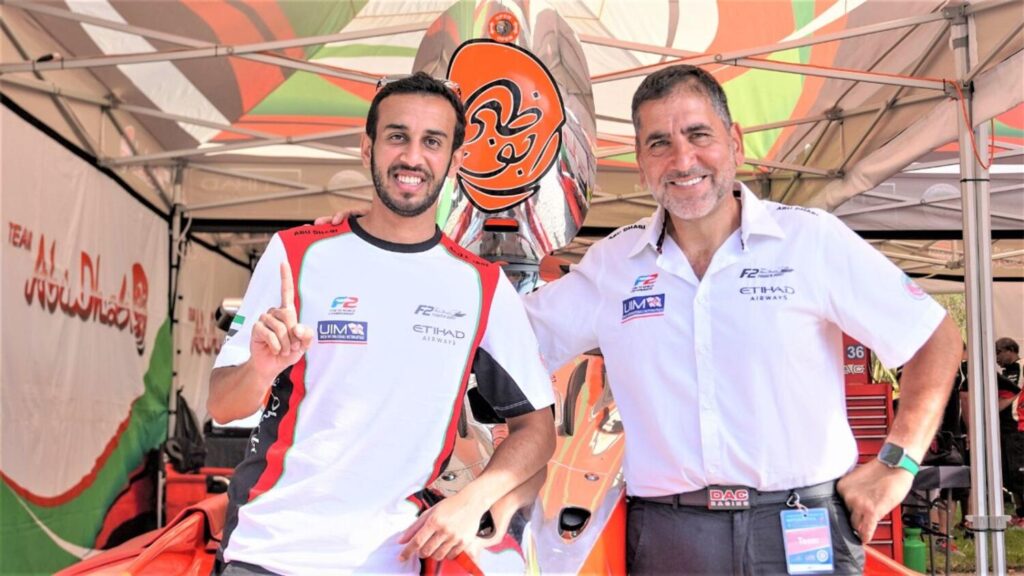
Al Mansoori succeeds teammate Rashed Al Qemzi who secured his third F2 world title with victory in Portugal 12 months ago.
Team Abu Dhabi’s Mansoor Al Mansoori is the new UIM F2 world champion following a dramatic series of events at the Grand Prix of Portugal.
Norway’s Tobias Munthe-Kaas, Germany’s Stefan Hagin and Finland’s Sami Selio were each disqualified from the final round of the 2022 series for engine infringements following post-race technical checks.
This followed the earlier one lap penalty imposed on Edgaras Riabko for a start infringement, which dropped the Lithuanian from second place to 10th.
The decisions saw American Brent Dillard replacing Munthe-Kaas as race winner, while Al Mansoori climbed from sixth to second position to take the F2 crown, with an 18-point winning margin from Sharjah Team driver Selio.
Hagin, who had provisionally been acclaimed as world champion, finished third in the standings, another point away.
Al Mansoori, who joined Team Abu Dhabi last year, succeeds teammate Rashed Al Qemzi who secured his third F2 world title with victory in Portugal 12 months ago.
It means Guido Cappellini has now delivered 15 powerboat world championships to Abu Dhabi Marine Sport Club since taking charge as Team Abu Dhabi manager in February 2015
Team Abu Dhabi were also celebrating another world title success on Monday after Rashid Al Mulla clinched his fifth successive freestyle crown at the UIM-ABP Aquabike World Championship in Italy.
The Emirati had to borrow a friend’s jet ski after his own ski suffered mechanical problems in preparation for the Regione Sardegna Grand Prix in Olbia.
It made little difference, as Al Mulla extended his dominance of freestyle by recording his 14th consecutive Grand Prix victory in a run stretching back to 2017.
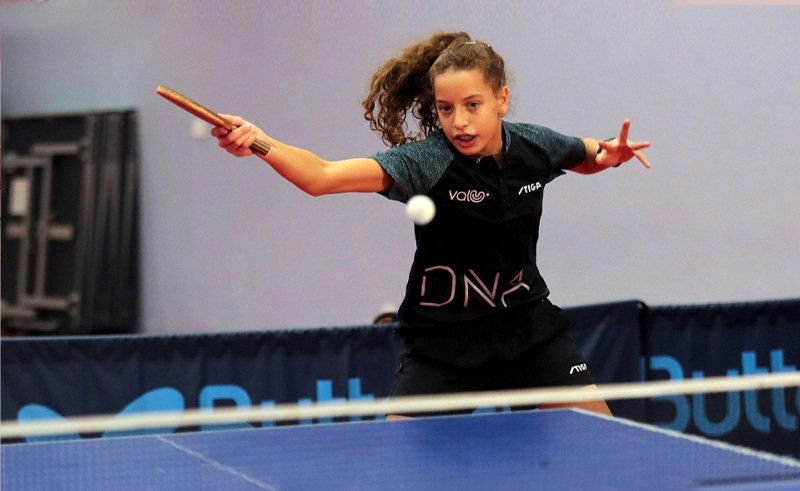
At only 14 years old, Egyptian athlete Hana Goda holds the number one rank in the International Table Tennis Federation’s (ITTF) U19 Girls’ Singles list for the first time.
Egyptian table tennis champion Hana Goda has cemented her legacy as the first person to hold the number one rank in the International Table Tennis Federation’s (ITTF) U19 Girls’ Singles list at only 14 years old.
After an exceptional performance at the 2022 ITTFA, the long-standing national champion and Africa Cup senior champion also stands at 43 in the International Table Tennis Federation’s Women’s Singles ranking worldwide.
The Prince Sultan bin Abdulaziz Al Saud Foundation steering committee has met to review the strategy of its program to strengthen the use of Arabic at UNESCO.
The virtual meeting was attended by the foundation’s Director General Saleh Al-Khulaifi as well as UNESCO Assistant Director General for the Social and Human Sciences Sector Gabriel Ramos, and UNESCO Permanent Representative Princess Haifa Al-Muqrin.
UNESCO officials praised the foundation’s efforts to develop new businesses and projects that serve the Arabic language, thereby contributing to the program’s goals of promoting dialogue between different cultures, consolidating cultural communication, and implementing projects that serve the language and heritage.
They also praised international organizations for providing more programs and activities related to the Arabic language, such as translating research, literature, session minutes, meetings and field reports.
They added that spreading Arabic around the world was the quickest way to strengthen global dialogue and cohesion.
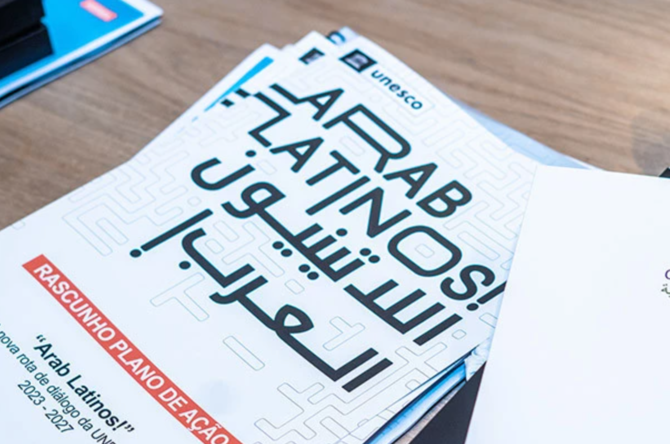
Many initiatives have been implemented in the past, most notably UNESCO’s celebration of World Arabic Language Day on Dec. 18 each year, as well as the launch of “Arab Latinos!”
That event, which was held in August in Sao Paulo, promoted intercultural dialogue for social inclusion and built on the Arabic cultural imprint in Latin America.
source/content: arabnews.com (headline edited0
___________
Prince Sultan bin Abdulaziz Al Saud Foundation aims to strengthen the use of Arabic at UNESCO. (UNESCO)
Nujoud Fahoum Merancy started the Twitter hashtag ‘YallaToTheMoon’ to support latest mission.
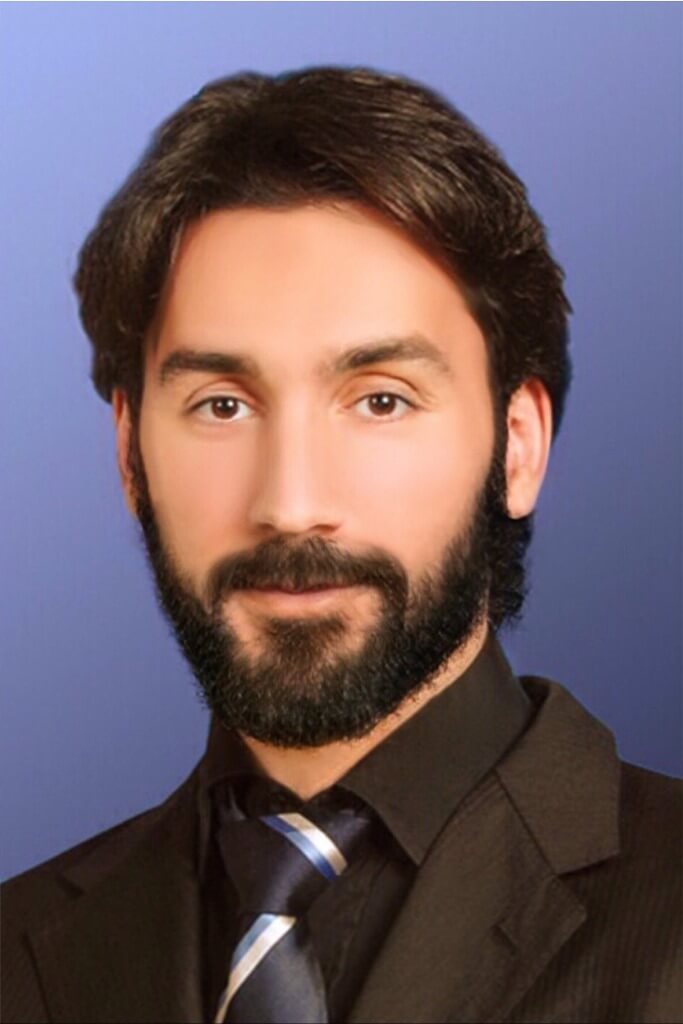
A Palestinian-American woman is one of the leaders of the Artemis missions, a programme by Nasa that aims to fly astronauts to the Moon.
Nujoud Fahoum Merancy, 43, is the chief of exploration mission planning at the US space agency and has been working in the space sector for more than two decades.
She started the Twitter hashtag ‘YallaToTheMoon’ to support the Artemis 1 mission, which is scheduled for another launch attempt on Saturday, from Florida’s Kennedy Space Centre. ‘Yalla’ is an Arabic word that translates to ‘let’s go’ or ‘come on’.
Before the historic event, Ms Merancy spoke to The National about her Palestinian roots and her involvement in the Artemis programme.
A stellar career
The Artemis 1 mission is an unmanned flight around the Moon that will test the performance of the Space Launch System rocket and Orion spacecraft.
If successful, it would pave the way for Nasa to launch Artemis 2 and 3, crewed flights around the Moon and the first human lunar landing mission under the programme.
“As a Palestinian-American, I’m very excited to be a part of this programme,” she said.
“And, really, Nasa and Artemis, it is a much more diverse workforce than it was during the Apollo era.
“It’s important to me and to a lot of us that it represents all of humanity and Artemis itself is international because we have international partners.”
Ms Merancy, a mother-of-two, earned her bachelor’s degree in aerospace engineering from the University of Washington in Seattle.
From there, she joined the aerospace company Boeing to work on the International Space Station.
She then started working on the development of Orion, the spacecraft launching on top of Nasa’s mega Moon rocket on Saturday that will fly around the Moon — and one day carry astronauts.
“From that, I’ve transitioned into the mission planning for Artemis, which is designing and integrating the missions across all the programmes for Artemis, and that’s my current role,” she said.
Connecting with her Palestinian roots
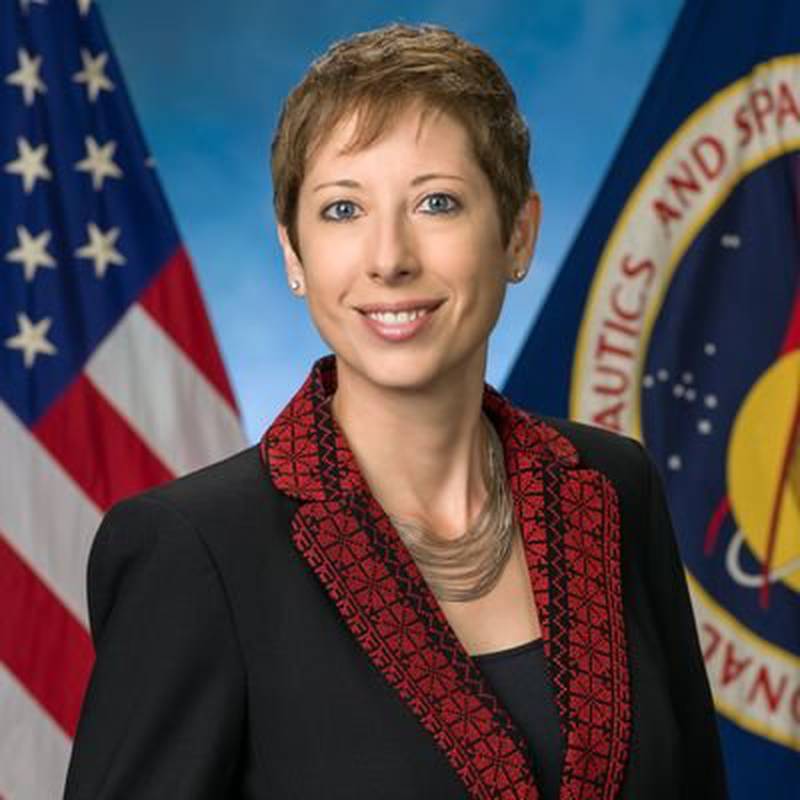
Ms Merancy went viral on the internet in 2019 when she posted her official Nasa photo, in which she wore a blazer embroidered with Palestinian tatreez, a traditional cross-stitch, that she bought during a visit to her father’s home town of Nazareth.
Her father moved to the US more than 40 years ago to go to college.
Although she was born in the US and does not speak fluent Arabic, she said her Palestinian roots were important to her.
“I don’t speak Arabic, unfortunately, it’s one of those regrets that I’ll always have,” she said.
“I know the basics, a few words here and there, and the polite greetings.
“But I do enjoy the food and that is something I grew up on. And then as an adult, I started cooking.
“So, I have a whole bunch of Palestinian cookbooks just to learn other recipes that my family didn’t teach me.
“I do like to cook Palestinian food and that’s probably the biggest connection to the culture that I have.”
Palestinian presence in the space sector
Other Palestinians are involved in the Artemis programme or are making a name for themselves in the US space sector through other projects.
Soha Alqeshawi, born and raised in Gaza city with her seven siblings, currently works for Lockheed Martin as a software engineering associate manager and looks after Orion’s back up-flight software.
And Loay Elbasyouni is a Palestinian-American electrical engineer who helped design Nasa’s Mars rover, Perseverance.
“My parents did their best to provide me and my siblings with a good education and shield us from the effects of the continuous horrific conflict that Gaza has been living under,” Ms Alqeshawi told Portuguese journalist Margarida Santos Lopes in 2015.
“Living under constant fear and despair where everything is uncertain and basic life necessities such as electricity and sometimes water are unavailable for most of the day.
“Although I was the only one in my family who had the opportunity to leave Gaza for the US to study and work, all of my brothers and sisters are college-educated with degrees in science, engineering and business.”
“Going to school was sometimes a dangerous journey that could have death waiting at any step of the way.
“However, that made us more determined to achieve our dreams in receiving an education.’
Nujoud Fahoum Merancy went viral in 2019 when she posted her official Nasa photo, in which she wore a blazer embroidered with Palestinian tatreez, a traditional cross-stitch that she purchased during a visit to her father’s hometown of Nazareth. Photo: @nujoud
The dance troupe’s victory, which earned them the seven-figure prize , offered a sliver of hope to the country and its population, who continue to battle a flurry of crises and bad news.
“We haven’t shed happy tears in so long in this country and Mayyas made it happen,” says Reem Nasra, 24, a recruiter in Beirut.
Mayyas first made international headlines when they received a golden buzzer from judge Sofia Vergara for their performance during the auditions, securing their spot in the semi-finals.
“There are no words to explain to you what we were feeling over here,” Vergara said at the time. “It was the most beautiful, creative dancing I have ever seen.”
Since then, the Lebanese group put on a series of breathtaking routines as they advanced to the final. And, their journey to the top connected with compatriots around the world.
“They are an example of what a synchronised group of Lebanese are able to achieve,” says Eli Lattouf, 26, a postdoctoral researcher at Harvard Medical School in the US. “Such a win delivers a global message.”
Lebanon is currently facing an economic crisis described as one of the worst in 150 years by the World Bank. According to a UN study, the financial collapse has pushed more than 80 per cent of the population into poverty while inflation and living expenses reached record highs.
The country’s plight has made global news, highlighting everything from its fuel crisis to the deadly Beirut port blast in 2020.
To see Lebanon represented in a different light, as a beacon of art and culture, was refreshing, says Lattouf.
“Most people know the Lebanon they see on the news, which might not be totally misleading, unfortunately,” he tells The National. “This time the world sees not one, but a group of Lebanese, full of art, creativity and discipline.”
Lattouf’s sentiment is echoed by many other Lebanese people, who are proud of the group’s outstanding representation on a global platform.
“This is our Lebanon, the real one,” says Rima Hijazi, 26.
Watching from her home in Choueifat, south-east of Beirut, the agricultural engineer fortunately had electricity overnight to stream the final live. Many other households across Lebanon were without power, which prompted private TV station LBCI to campaign for generator owners to keep the lights on ahead of the show.
Lebanon’s electricity crisis is merely one of the many obstacles Mayyas had to overcome while rehearsing.
Despite the many hindrances, the girls put in long hours of work, determined to grab the title.
According to the group’s founder and choreographer Nadim Cherfan, the team were in the studio on a daily basis and would “only leave when the power goes off”.
“When it’s about art, nothing stands in your way,” he previously told The National.
Their hard work and diligence made them all the more deserving of the win, according to many Lebanese. It is also testament to the country’s potential, despite the odds.
“This win means that despite everything we are going through, our will to live and be successful beats all miseries,” says Yara Youssef, 25, a marketing coordinator in Beirut.
Between pride and hope, Mayyas also evoked a solemn feeling for some.
“It’s a bit sad knowing that if you have potential here in Lebanon, you have to leave in order to reach your goals,” Hijazi tells The National. “We’re in the wrong spot to bloom.”
But despite their international achievement, Mayyas are returning to Lebanon, where they will continue to work on their art.
While Cherfan has been asked why he continues to work in Beirut, he is adamant on going back to where they started.
“I’m never leaving my country because my country has never left me,” he says.
Watch the moment Mayyas won on ‘America’s Got Talent’ here (below):
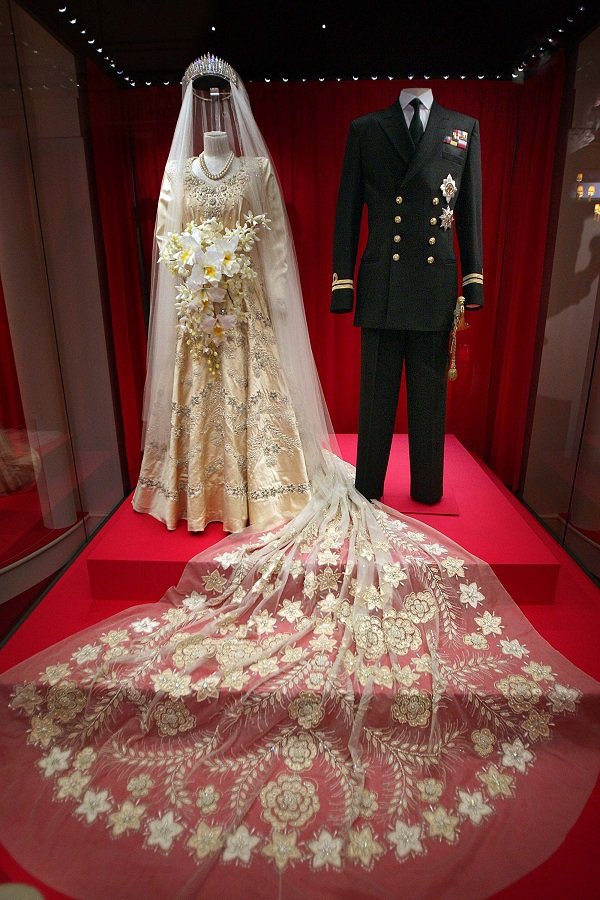
As the world looks back on the storied life of Queen Elizabeth II, fashion lovers could be pleasantly surprised to find the longest-serving British monarch championed Arab creativity on one of the most memorable days of her life.
On Nov. 20, 1947, the then-21-year-old princess married naval officer Prince Philip of Greece in a gown created by court designer Norman Hartnell.
The regal dress was made of ivory silk from China — not Japan or Italy given the recent end of World War II — and featured 10,000 seed pearls imported from the US — as well as show-stealing Damask brocade from Damascus, Syria.
The brocade fabric was brought from the Al-Muznar factory in the Bab Sharqi neighborhood of Damascus’s Old City and featured embroidery of “two love birds” exchanging kisses in a pattern known locally as “the lover and the beloved.” Woven with 12-karat gold thread, the brocade fabric was reportedly sent to the queen by Syrian President Shukri al-Quwatli.
The dress was meant to symbolize “rebirth and growth” in Britain after the war, according to the Royal Collection Trust.
It took 350 women seven weeks to make, and featured elaborate floral motifs of jasmine, smilax, lilac and white rose-like blossoms added to the train. The design was inspired by Italian artist Botticelli’s 1482 painting of Primavera.
source/content: arabnews.com (headline edited)
__________
On Nov. 20, 1947, the then-21-year-old princess married naval officer Prince Philip of Greece. (Getty Images)Princess Elizabeth’s wedding dress, designed by Norman Hartnell, and the Duke of Edinburgh’s Royal Naval uniform are displayed at an exhibition at Buckingham Palace on July 27, 2007 in London. (Getty Images)
It is in times of crisis and conflict that we reveal our character most clearly. This is true today in Yemen, where even the promise of a truce brokered largely by the UN, the US and Saudi Arabia has yet to cement peace or accelerate reconstruction. To do these things, Yemenis must also rebuild the bonds of faith and community that allow any society to thrive.
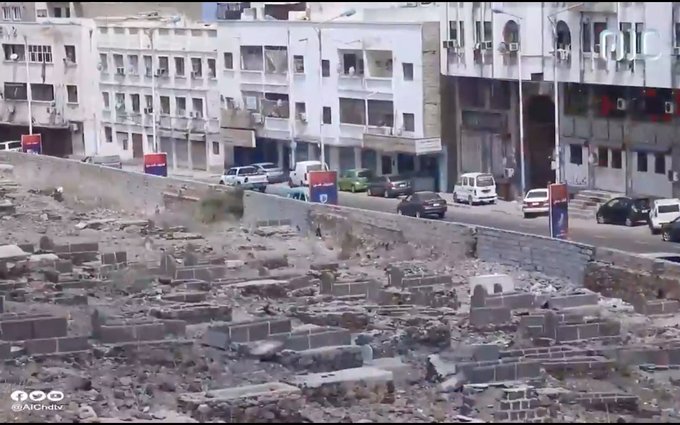
Within the context of these challenges, it is all the more remarkable that Yemenis recently started restoring a 160-year-old Jewish cemetery in Aden. What started as a volunteer effort has now garnered the support of local authorities and Yemeni institutions.
It amounts to a project of interfaith tolerance and embrace in a place where such sentiments have been in short supply. In the last couple of years, Yemen’s Jewish community — one of the world’s most ancient — has disappeared. Most of the remaining few fled to nearby countries after facing persecution and even arrest by the Houthi rebels. Just a century ago, they counted in the tens of thousands and could claim a lineage of almost 3,500 years.
Jewish tradition holds that the cemetery in Aden is where the biblical Abel was buried millennia ago. He is part of the tradition of each Abrahamic faith and the collective memory of Yemeni tolerance remains despite the societal havoc of the last decade.
Each of the Abrahamic religions instructs us to act with kindness toward our brothers and sisters of other faiths. It should be inspiring to all of us to see Yemen’s internationally recognized government and the people of Aden acting in this spirit. I hope this renewed focus on a Jewish cemetery can demonstrate how faith and incremental action can help us overcome the tribulations and pitfalls of extremist politics, sects and conflicts of the past — real or imagined.
The Jewish community of Yemen is no longer, but Yemenis are honoring their own shared past and patrimony by preserving its memory. By respecting the role of Jews in Yemen’s long and storied history, Yemeni leaders are showing inclusivity and a will to protect minorities in the nation’s future as it emerges from this tragic conflict.
The contrast with the Houthi rebels and the racist ideology they propagate is stark. The Houthis prey on religious differences of doctrine and ritual to divide once-harmonious communities in Yemen. Children are drilled to hate in schools, while state workers must chant mantras of death for peoples, such as those in the US and Israel, whom they have never met and of whom they have no conception. Their celebration of innocent Yemenis or Saudis killed is reprehensible.
Analysts today speak of the truce in Yemen in terms of money, men and ideology. These things shift and change, but the need for a functioning society to incorporate people of different beliefs holds true.
The Houthis seem to hold a firm grip over large parts of Yemen. But in this land, with its rich and resilient tribal, religious and societal mosaic, intolerance makes any sense of “control” inherently fragile. The history of Yemen shows that cultish indoctrination does not change a people. Some of its most ancient buildings have crumbled and priceless literature has been lost, but the tolerant Yemen of yore remains alive in stories, poetry and prayer, as well as the hearts of its people.
The cemetery restoration effort is a microcosm of what will need to take place to return Yemen to its true form and traditions of tolerance. While some tear down history and desecrate places of worship and commemoration to create a vacuum to fill with hate for their own benefit, reconstruction efforts like the cemetery can remind all Yemenis of the primacy of tolerance in their culture.
We all pray for an end to the war in Yemen, continued peace and rapid reconstruction. Let us add to these prayers that Yemenis remain on the path to rebuild not just brick by brick, but to rebuild and restore the diversity of the Aden of old in the image of tolerance of our Creator.