Arabs & Arabian Records Aggregator. Chronicler. Milestones of the 25 Countries of the Arabic Speaking World (official / co-official). AGCC. MENA. Global. Ist's to Top 10's. Records. Read & Enjoy./ www.arabianrecords.org
The works consist of 19 volumes, encompassing the writings of the historian as well as his summaries and correspondences, shedding light on his time.
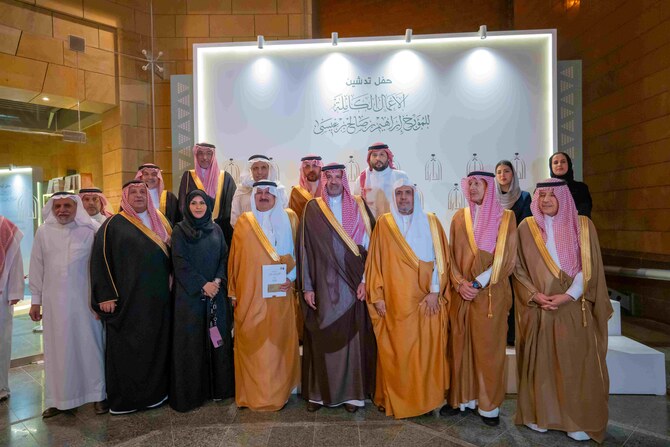
Prince Faisal bin Salman, chairman of the board of directors of the King Abdulaziz Foundation for Research and Archives, inaugurated the launch ceremony of the complete works of Saudi historian Ibrahim bin Saleh bin Issa on Wednesday at Darah headquarters.
These works consist of 19 volumes, encompassing the writings of the historian as well as his summaries and correspondences, shedding light on his time.
Speaking on behalf of his family Dr. Mohammed bin Abdulkarim Al-Issa, secretary-general of the Muslim World League, expressed the family’s gratitude and appreciation to Darah (the foundation) for this honor, which celebrates their ancestor’s scholarly legacy.
He said that the publication documents the historian’s long academic journey, characterized by precision and objectivity in various scientific fields.
He also expressed the family’s pride that this work will serve as an important reference for researchers and those interested in Saudi history and culture.
Furthermore, he praised the tremendous efforts made by Darah in realizing this monumental project, noting that this recognition reflects the significance of knowledge in strengthening national identity.
The work on the project took several years and went through numerous stages, involving a team of about 20 people, said Dr. Fahd Al-Samari, secretary-general of Darah.
Al-Samari told Arab News: “The project followed a clear methodology, where we gathered as much of the heritage of historian Ibrahim bin Issa as possible and conducted a thorough investigation.”
Given the project’s scale and the diversity of fields covered, which include religious, historical, linguistic and geographical arts, several specialized committees were formed for the project, including the supervisory committee, the text editing and verification committee, and the manuscript and document collection committee, Al-Samari added.
Bin Issa relied on more than 700 sources for his work, including 570 manuscripts and documents from across the Kingdom, while the remaining sources were distributed between Kuwait, Egypt, Iraq, and the US.
Bin Issa was born in 1854 in Ushaiger town, 200 kilometers northwest of Riyadh, and lived for about 71 years. He was a scholar, historian and genealogist, and one of the most prominent historians of the Najd region.
Al-Samari pointed out that Darah was established to fulfill a noble mission, which is to serve the history of Saudi Arabia, its geography, and its intellectual literature, as well as to collect various historical sources, including documents related to the Kingdom, classify them, and enrich the historical library with scientific research.
Darah has devoted special attention to the prominent figures of the Kingdom, honoring their rights, highlighting achievements, celebrating contributions, appreciating efforts, and acknowledging their glory.
“Since establishment, Saudi Arabia has sought to make knowledge the foundation for building the state. Under the leadership of King Salman and Crown Prince Mohammed bin Salman, the Kingdom has witnessed a comprehensive renaissance in all fields, with the most significant being in the areas of national heritage,” Al-Samari concluded.
source/content: arabnews.com (headline edited)
_________
Prince Faisal bin Salman, Chairman of the Board of Directors of Darah, is seen in a group photo with several descendants of historian Ibn Issa on Wednesday evening in Riyadh.
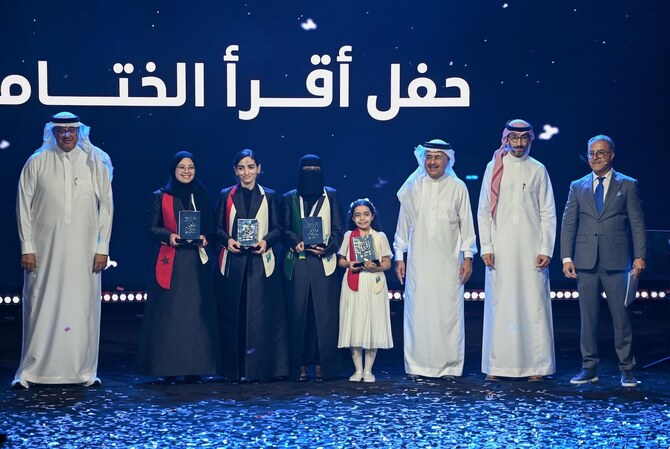
Boasting an attendance of 16,000 people, including Nobel laureates in literature, the King Abdulaziz Center for World Culture concluded its ninth annual Iqra competition on Saturday.
Amin Nasser, Saudi Aramco’s president and CEO, and other senior officials attended the two-day event in Dhahran.
Nobel literature laureates Abdulrazak Gurnah and Olga Tokarczuk were also present and offered insights during speaking sessions.
Visitors experienced a series of activities, culminating in the announcement of the competition’s winners.
Moroccan Meryem Bououd was awarded Reader of the Year, while 10-year-old Moroccan Fatima Kettani won the Promising Reader prize.
Iraqi Hira Karkhi secured the Text of the Year prize, while the Reading School award went to Tarbiyat Al-Ajial of the Private International School, Hafr Al-Batin, Saudi Arabia.
Saudi Safia Al-Ghubari claimed the People’s Reader award, while teacher Najla Ghazi Al-Suhaimi took home the Reading Ambassador prize.
Noura Al-Zamil, Ithra’s program director, spoke of the competition’s significant milestones since its inception in 2013.
Over nine editions Iqra has attracted more than 225,000 applicants and offered 48,000 hours of educational programming.
It has also engaged more than 600 speakers from 30 countries, bringing three Nobel Prize-winning authors to its stage.
Al-Zamil stressed Ithra’s continued efforts to innovate, introducing new elements like the Iqra Travels, Iqra Marathon, and Kitabiya Exhibit, to foster a reading culture among Arab youngsters.
The closing event featured cultural sessions, including a talk by Tokarczuk, who discussed literature as a tool for bridging languages and cultures.
Discussing the future, Tokarczuk expressed both optimism and caution, adding: “I embrace modern tools like ChatGPT but remain concerned about their potential misuse.”
Gurnah, reflecting on his roots, said: “Zanzibar will always be my true homeland, despite my long absence.”
source/content: arabnews.com (headline edited)
_____________
Boasting an attendance of 16,000 people, the King Abdulaziz Center for World Culture concluded its ninth annual Iqra competition on Saturday. (Supplied)
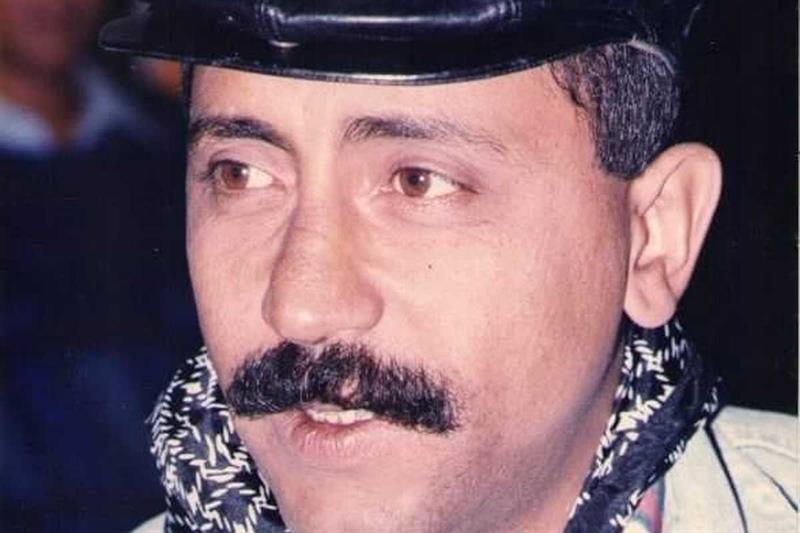
Egypt bids farewell to the guard of Semsemya, Zakaria Ibrahim.
For the past 44 years, Zakaria Ibrahim or “El-Rayes” (meaning the chief) had played and safeguarded the heritage music of his hometown Port Said through the Port Said Folk Heritage Troupe, which he established in 1980.
In an interview with Ahram Online, Ibrahim previously said that his initial approach relied on the sounds of the Semsemya musical instrument. Five years later, he reintroduced the ancient Tanboura instrument, a larger predecessor and origin of the Semsemya, dating back to ancient Egyptians. Consequently, he rebranded his ensemble as Al-Tanboura.
“We the Bamboteya, no one is like us, merchant boatmen in the canal” the troupe sang about the Semsemya’s affiliation with the history of trade on the Port Said marina. Small boats, called ManBoats, moored offshore, and sold goods to passing vessels, using sign language in trading. This language is the foundation of the heritage dance affiliated with Semsemya.
To safeguard and revive heritage music, beyond Semsemya, Ibrahim co-founded the Mastaba Centre for Egyptian Folk Music in 2000. Documenting and archiving traditional Egyptian songs, music, and musical instruments, as well as the voices and history of Egyptian music were among the centre’s main goals.
He also established El-Damma theatre in Abdeen district, Cairo, where heritage troupes played for years on a weekly basis. El Damma means coming closer, and it was a social ritual in Port Said where people would come together and sing their heritage songs and play the Semsemya.
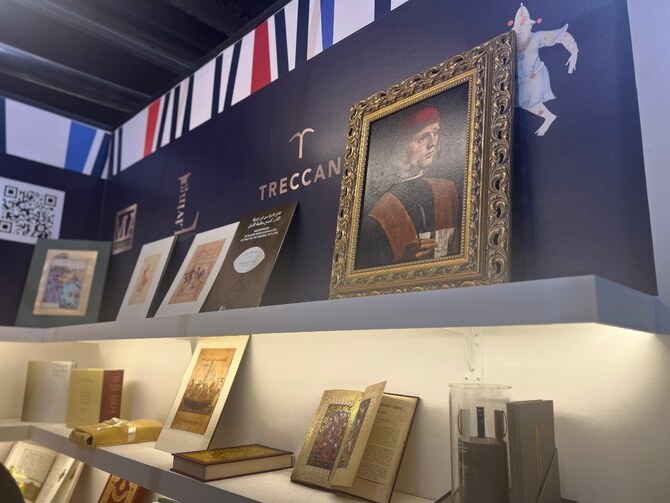
German publishing house Mueller and Schindler is participating in the Riyadh International Book Fair for the third consecutive year with a showcase of rare manuscripts and books.
The annual gathering’s literary treasures are a major attraction for book lovers and academics.
Mueller and Schindler specialize in creating high-quality replicas of historic texts that are typically inaccessible to the public.
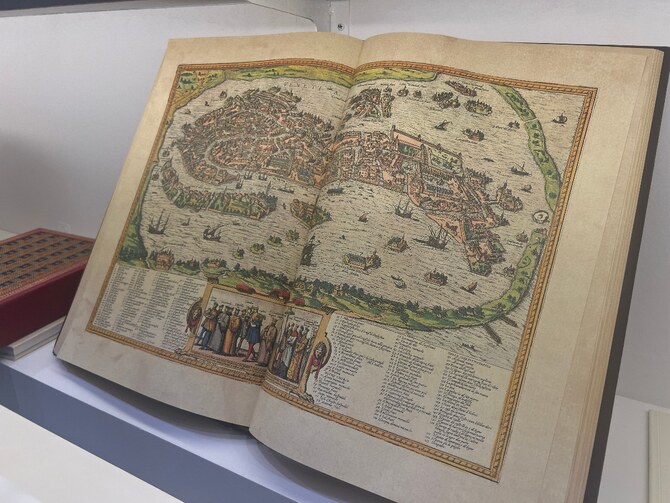
Among their remarkable offerings are the famed notes of Leonardo da Vinci, and a selection of Arabic works, including the renowned Blue Qur’an.
Their exhibit at the fair highlights not only the beauty of these manuscripts but also their historical significance.
The owner and CEO of Mueller and Schindler, Charlotte Kramer, elaborating on their mission, told Arab News: “We provide facsimiles, which derive from the Latin term ‘fac simile,’ meaning ‘make it similar.’”
A facsimile is a faithful reproduction of a manuscript or printed book, capturing all the visible characteristics of the original — vibrant colors, gold and silver embellishments, as well as age marks and irregularities.
Their facsimile editions are published in limited quantities, combining technical precision with the spirit of the original work.
Highlighting the uniqueness of their offerings, Kramer noted: “One of our notable replicas is Katta Langar Qur’an, which dates back over 1,200 years, making it one of the oldest Qur’anic fragments. This fragment, written in Hijazi calligraphy, is significant for the development of the Qur’anic text.”
In addition to the Katta Langar Qur’an manuscript, Mueller and Schindler showcased a Moroccan Qur’an, comprised of 50 volumes, meticulously crafted in Kufic script.
They also presented manuscripts containing prayers of the Prophet Muhammad, as well as scientific Arabic texts, including Al-Sufi’s “Book of the Fixed Stars.”
The enthusiasm of the Saudi audience has made a lasting impression on the team.
“We are thrilled to be here for the third time. The people are incredibly knowledgeable and genuinely interested in our work. They engage with us, asking insightful questions and listening intently to our explanations,” Kramer said.
The fair concludes on Saturday.
source/content: arabnews.com (headline edited)
____________
Among their remarkable offerings are the famed notes of Leonardo da Vinci, and a selection of Arabic works, including the renowned Blue Qur’an. (AN photo)
After a revolt in 1871, French colonial authorities in Algeria exiled 2,000 insurgents to New Caledonia. Now their descendants are seeking to reclaim their heritage.
When Christophe Sand landed in Algiers for the first time in 2005 and saw the city’s Casbah surrounded by clouds, he started to cry.
“I felt this pain I’d never felt before, that was unfamiliar to me,” he said. “I wanted to scream.”
Sand grew up 11,000 miles from Algeria in New Caledonia, a French territory in the South Pacific that is, culturally and geographically, worlds away from the North African city of Algiers. For most of his life, Sand’s family history remained a mystery to him. While Sand had been told his great-grandfather was a convict from Algeria, his grandmother refused to speak about him and her Algerian heritage, changing her name from “Yasmina” to “Mina” to create distance between herself and her Arab roots.
“She never embraced her origins,” Sand said, noting that he never fully understood how his family had ended up in New Caledonia.
As he got older, Sand set out to uncover the truth about his Algerian ancestors. What he discovered brought to light a complex colonial history that unveils how far the French colonial state went to protect its empire — and the lasting impact it has had on communities around the world.
In January 1871, 40 years after the French seized control of Algeria, the Kabyle people, a Amazigh ethnic group, banded together to lead what was at the time, the biggest revolt against French occupation in Algerian history.
Kabyle leaders believed it was the opportune moment to strike against French colonial powers. France had just lost a war against Prussia, which had led to the collapse of the French government, and was more vulnerable after its defeat. The revolt spread rapidly, with 250 tribes in the rebels’ ranks.
But the French authorities responded more brutally than expected, destroying entire villages and killing tens of thousands of people, both rebels and civilians. After a year of fighting, the revolt was definitively quashed in 1872. The French authorities seized over 450,000 hectares of land that it distributed to French settlers and quickly put in place trials to prosecute anyone who had rebelled against the French state.
Over 2,000 insurgents, among them leaders of the revolt, faced trial in Constantine where they were presented not as anti-colonial leaders but as petty criminals. Because most of the men hailed from noble families, however, the French were wary of sentencing them to death. Instead, they decided to exile the men to the farthest place imaginable: New Caledonia.
Sand’s great-grandfather was one of these leaders. Along with more than 2,000 other men, he was exiled to New Caledonia in the late 19th century to work in labor camps. The men were sent to Bourail, a place chosen to be a first colony for prisoners. Archives reveal that throughout this journey, the Algerian men continued to resist colonial forces, giving particular importance to their faith: Even during trying passages at sea, they still dutifully observed the fast of Ramadan and continued following certain dietary restrictions, abstaining from the consumption of pork and alcohol.
New Caledonia wasn’t only a place for political prisoners from France’s colonies, the French exiled convicts from the mainland, too. When the men landed on New Caledonia’s shores, they were not allowed to practice Islam, had to adopt Christian names and were forced to marry exiled French women or daughters of French exiles. The colonial administration was hoping that through these marriages, they would create Christian families that conformed to their idea of settlers. The reverse happened: French women took on Algerian traditions and kept alive their heritage, learning how to cook Algerian food and teaching it to following generations. These families cultivated date palm trees as they did back in Algeria. They gave their children Muslim names, in spite of a prohibition to do so by the colonial administration. In 1936, when the ban was lifted, many finally used their Arab names in public.
But for all the traditions that were passed down, many were not. Over time, their languages were forgotten and, critically, so was the history of their ancestors and their rebellion against the French colonial state. Rather than carrying forth the anti-colonial legacies of their ancestors, their descendants became defenders of colonialism in New Caledonia.
At first, many Algerian men had no choice but to help French authorities suppress revolts by the local Kanak — the Indigenous Melanesian inhabitants of New Caledonia — in order to gain back their freedom. But over time, their participation was not simply forced; in some cases it was voluntary. The descendants who were assimilated into French settler society played a key role in the repressive apparatus of the colonial state; it was an Algerian prisoner who killed the Kanak chief Bwëé Noël Pwatiba, an important leader of the 1917 Kanak revolt. Algerian prisoners settled on lands captured by French authorities in the aftermath of Indigenous insurrections. This alliance — both forced and later voluntary — with the French colonial authorities meant that for most of their history in New Caledonia, these descendants were not seen as victims of the same colonial force but instead their helping hand.
Today, 15,000 descendants live in New Caledonia, with the majority residing in the town Nessadio Bourail. Until recently, however, many descendants did not know or share their ancestors’ history.
This was the case for Sand’s grandmother, who believed for most of her life that her grandfather was a criminal. “In New Caledonia, the descendants of these communities had their cultural memories eradicated,” Sand said.
As Sand got older, however, he became more curious about his family’s history. He went as far as traveling to the archives of overseas territories in Aix-en-Provence, France, where he discovered that his great-grandfather was not a criminal but an anti-colonial leader. “My life changed that day, when I realized he was a revolt leader,” Sand said.
At the time, Sand thought the discovery of these archives was the end of his journey to better understand his family’s origins. Then, in the early 2000s, documentary filmmakers came to New Caledonia to interview the descendants of the revolt leaders. They brought a book with them about those exiled from Algeria. In it, Sand found the forgotten story of his great-great-grandmother Tessadit who, upon learning her son would be exiled to New Caledonia, ran down to the port of Algiers to beg a soldier to let her say goodbye one last time. “They gave her 30 seconds,” Sand said. “That’s inhumane.”
When the documentary filmmakers arrived in New Caledonia, elders shared stories passed down to them from their relatives for the first time. “It was a real tipping point for the community,” Sand said, who noted most young people had never heard these stories from elders before. “When the elders got in front of the camera, they let it all come out,” he said. “It was as if they had been carrying knots in their stomachs since childhood that were finally coming out.”
The documentary, Les témoins de la mémoire, was hugely popular when it premiered in 2004, not only with descendants but also with Algerians themselves, who viewed these men as the leaders who put the country on track to eventually achieve independence in 1962.
“We did not know the history, we did not know people were uprooted like that,” said Myriam Moussa, 47, who lives in Algiers. “I had tears in my eyes when I watched the documentary and spoke about it extensively with friends and family.”
Sand, who featured in the film, didn’t realize how popular the documentary was in Algeria until he went to visit in 2005. On the flight over, other passengers recognized Sand and told him: “Welcome, you are at home here.” When he got off the plane, people were waiting for him at the airport to see with their own eyes if their cousin from New Caledonia was coming home.
In Algeria, Sand went to visit his great-grandfather’s village and, for the second time on his trip, began sobbing when the car pulled into the village. People had gathered to meet Sand, many of whom had traveled from afar, to welcome him back home. They offered him dates and goat milk and commented on how, despite the generations of separation, he still bore a resemblance to his relatives.
In the village, Sand visited the small home where his great-grandfather was born and touched the floor where, as per tradition, his umbilical cord was buried. When Sand emerged from the house, onlookers told him: “Son, your face has changed.”
Since the documentary aired, many descendants say the way they view themselves and their identity has changed.
Prior to the film coming out, there was some awareness about the history of North Africans in New Caledonia. The Association of Arabs and Arab Friends, for instance, was created in 1969 in an effort to bring people with shared history together. But like Sand’s grandmother, many descendants spent their lives feeling shame about who they were and what their ancestors represented, facing racism when trying to integrate into the white settler community. The documentary and learning their ancestors’ history changed that.
The Algerian community in New Caledonia, however, is far from homogenous: While some people now embrace their Algerian cultural heritage, others do not, remaining profoundly Caledonian. Many blend their multiple cultures and heritages together. Sand, for instance, continues to identify as Catholic but observes Ramadan.
“We are not a diaspora, the link was too cut for too long for us to be one,” Sand said. But after several years of feeling shame about their heritage, many people are reclaiming it and identifying as Arab. Sand even named his daughter Tessadit, after his great-great-grandmother who forced her way past French soldiers to say goodbye to her son.
Celebrating their ancestors’ anti-colonial struggle is also complicated for many descendants, whose families have actively supported the French colonial state in New Caledonia and the oppression of the local Kanak people.
Sand, who is now dedicated to popularizing this history, hopes that by sharing it more widely and showing that both Algerians and the Kanak were oppressed by the same colonial force, he can help ease tensions between the two communities. Though their histories are different, Sand said, the legacies of French colonialism, dislocation and oppression have similarly afflicted both peoples’ cultures.
In 2013, the Algerian government invited the descendants, including Sand and his mother, to visit Algeria and celebrate the 50th anniversary of the country’s independence, for which their ancestors fought. The delegation from New Caledonia included 30 Algerian descendants as well as 17 Kanaks. “It was the first time we could recognize a shared history and point of view,” Sand said. “We came as a country, not just as descendants.”
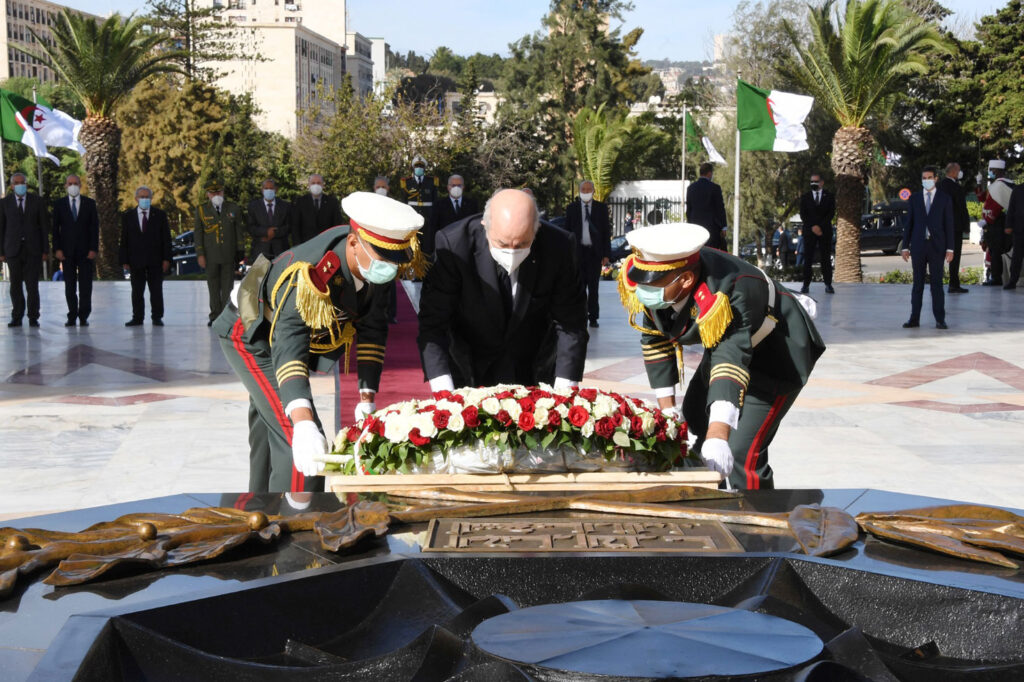
President of Algeria, Abdelmadjid Tebboune lays a wreath at the Soldiers’ Monument during a celebration last November marking the anniversary of the outbreak of the liberation revolution against French colonial rule / Algerian Presidency / Anadolu Agency via Getty Images
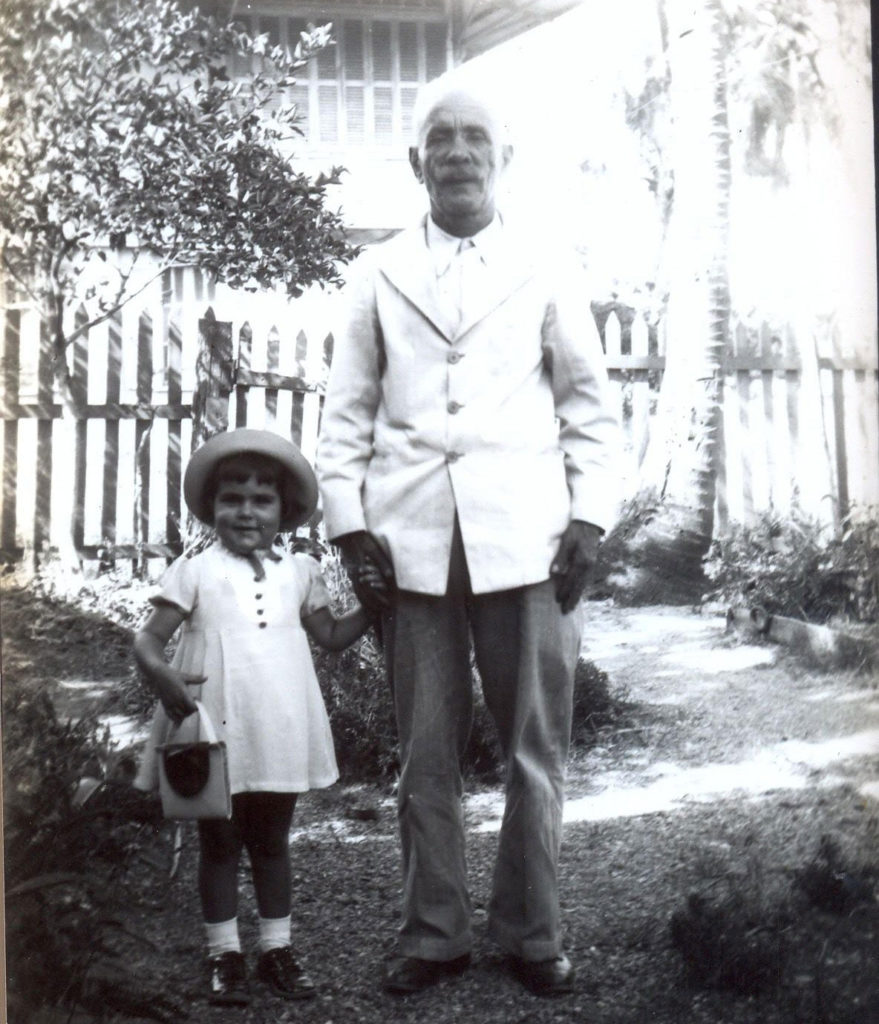
Christophe Sand’s great-grandfather / Courtesy of Christophe Sand
His Highness Sheikh Dr. Sultan bin Mohammed Al Qasimi, Supreme Council Member and Ruler of Sharjah, announced the completion of the Historical Dictionary of the Arabic Language, consisting of 127 volumes, in a unique achievement for the Arab and Islamic nation, which is added to the series of achievements of Sharjah, under His Highness’s leadership, in various fields of culture, literature and the Arabic language.
This came during His Highness’s attendance today at the launch of the activities of the Second Sharjah International Conference on Arabic Language Studies in Europe, which is organized by the Arabic Language Academy in Sharjah, at the Dr. Sultan Al Qasimi House.
His Highness the Ruler of Sharjah welcomed the conference guests from various European countries, including scholars and students, pointing out the overwhelming joy of completing all the volumes of the Historical Dictionary of the Arabic Language, saying, “Your presence on this day, which coincides with the completion of the dictionary, is a joy and delight and the reaping of fruits. It is a happy occasion. This dictionary took seven years and was scientifically researched by 500 researchers and approximately 200 proofreaders, reviewers, printers, administrators and technicians.”
His Highness added that the scientific and research team of the Historical Dictionary will continue to work diligently with the Arabic Language Academy in Sharjah to complete research and reference work for the benefit of the Arabic language, as work will begin on the Arabic Encyclopedia, which will cover all literary and scientific branches, and will become the first reference for all people.
At the end of his speech, His Highness the Ruler of Sharjah pointed out the continuation of efforts to establish more cultural centres that play an important role in spreading support for Arabic culture and language and their valuable projects.
The conference was opened with the recitation of clear verses from the Holy Quran, after which Dr. Mohamed Safi Mosteghanemi, Secretary General of the Arabic Language Academy in Sharjah, delivered a speech in which he welcomed the presence and honor of His Highness the Ruler of Sharjah at the conference in its second edition, pointing to His Highness’s great support and personal interest in the Arabic language in terms of learning, teaching, publishing, literature and culture. He also welcomed the participating guests of the conference from various European countries and their great contributions to supporting the Arabic language in their countries.
Al-Mostaghanemi discussed the importance of joint cooperation between all scholars, researchers and orientalists to research and care for the Arabic language, pointing out the importance of the Arab Studies Conference in Europe in achieving many goals for the development of the dissemination and learning of the Arabic language in many European countries and in achieving research goals therein and discussing challenges and finding solutions.
His Highness the Ruler of Sharjah and the attendees watched a visual presentation about the Arabic Language Academy in Sharjah, its vision, mission and objectives in the fields of publishing, developing and supporting the Arabic language, its research and studies, in addition to the publications and educational courses it supervises and its efforts in honoring scholars and outstanding individuals in various branches of the Arabic language.
Dr. Laura Gago delivered a speech on behalf of the conference guests, in which she praised the efforts of His Highness the Ruler of Sharjah and what he provides to the Arabic language in general and in Europe in particular, and the support and interest that the Emirate of Sharjah represents for the Arabic language, which has made it a destination for lovers and students of the Arabic language and its capital.
She noted the importance of the conference and its success at the international level, and the competition of scholars from different countries to participate in it, saying, “We came from every corner of Europe, from East to West, to talk about Arabic in the capital of Arabic in the modern era, because we know that Arabic is not a race, but rather Arabic, as the Prophet of Islam said, is the language, so whoever speaks Arabic is an Arab. The Arabic language sits on the throne of human languages, and if its people love it by nature, then the love of the Arabic language for us, who speak other languages, is a decision and a choice.”
She concluded her speech with thanks and appreciation to the Sharjah Academy of Arabic Language for organizing the conference and ensuring its success.
Dr. Dragana Djordjevic delivered a word of thanks and gratitude on behalf of the forum attendees to His Highness the Ruler of Sharjah for his support for the issues of the Arabic language and its teaching, especially in European countries, and for providing the opportunity for scholars and researchers to attend to study and come up with what contributes to supporting and spreading Arabic. She said, “In Sharjah, we feel that we are in our homes and among our people.”
At the end of the conference opening activities, His Highness the Ruler of Sharjah honored the participating scientists and researchers.
The conference will be attended by a number of scholars and academics from Romania, Kazakhstan, Spain, Norway, Poland, Russia, Germany, Serbia, Croatia, Denmark, Turkey, France, Greece, and Italy. They will present various research papers that address the conference themes and the experiences and challenges of learning and teaching the Arabic language in their countries.
The conference seeks to research and discuss a number of topics, namely: Arab tales in the West: One Thousand and One Nights, Kalila and Dimna, Juha, and others, the Arabic language and contemporary technology, translation and cultural communication, the translation of the meanings of the Holy Qur’an into European languages: reality and prospects, the image of the Arab in travel literature and the books of European geographers, in addition to the topic of Arab manuscripts in Europe.
The conference aims to define the curricula and rules related to teaching Arabic to non-native speakers, reveal the linguistic, social and human heritage of nations, advance to acquire terms and values that keep pace with contemporary scientific developments, focus on translation curricula and methods of communication between civilizations, care for interpretive readings of the meanings of the Holy Quran from the perspective of European languages, codify travel literature and the records of European geographers with Arabic and European edits, highlight the characteristics of Arabic manuscripts and their caches, in addition to employing global expertise and innovative methods in serving the Arabic language and spreading it in the countries of the European continent, and investing human energies, research skills, concepts and scientific theories to benefit from the linguistic heritage and the Arab knowledge treasure.
The second edition of the conference, which will continue for two days, September 21 and 22, will address several areas related to the Arabic language, namely: serious Arabic and human studies that embody the reality of the Arabic language in Europe, innovative research in learning and teaching the Arabic language, and practical experiences and live practices in the fields of the Arabic language and human studies.
The conference was attended by the Ruler of Sharjah, Dr. Khalifa Al Tunaiji, Chairman of the Holy Quran Academy in Sharjah, Jamal Salem Al Turaifi, President of Al Qasimia University, Abdullah Khalifa Al Sabousi, Chairman of the Department of Islamic Affairs, Ali Al Marri, Chairman of the Dr. Sultan Al Qasimi Foundation, Mohammed Hassan Khalaf, Director General of the Sharjah Broadcasting Authority, heads and representatives of Arabic language unions and academies, and a number of officials and specialists.
H.H. Sheikh Mohammed bin Hamad Al Sharqi, Crown Prince of Fujairah, stressed the role of reading and knowledge in developing the skills of the individual and providing him with the expertise and knowledge that enhance his human and societal awareness, pointing to the support and follow-up of H.H. Sheikh Hamad bin Mohammed Al Sharqi, Supreme Council Member and Ruler of Fujairah, for the achievers among the sons of the Emirates and their empowerment in the process of building the present and future of the nation.
This came during His Highness’s meeting, in his office at the Emiri Diwan, with the student Ghareeb Mohammed Al Yamahi from the Emirate of Fujairah, who won first place in the People of Determination category at the conclusion of the Arab Reading Challenge qualifiers in its seventh session at the level of the UAE.
His Highness congratulated the student, Ghareeb Al Yamahi, praising his determination and willpower in facing challenges, overcoming them and achieving the greatest ambitions. His Highness stressed the pivotal role of the family in instilling the value of love of knowledge and learning in the souls of its children, and supporting them to continue their creativity and excellence in various fields.
Gharib Al Yamahi expressed his happiness at meeting His Highness the Crown Prince of Fujairah, extending his thanks and appreciation to His Highness for his supportive and encouraging words to the people of Fujairah towards achieving more accomplishments.
The meeting was attended by His Excellency Dr. Ahmed Hamdan Al Zeyoudi, Director of the Office of His Highness the Crown Prince of Fujairah.
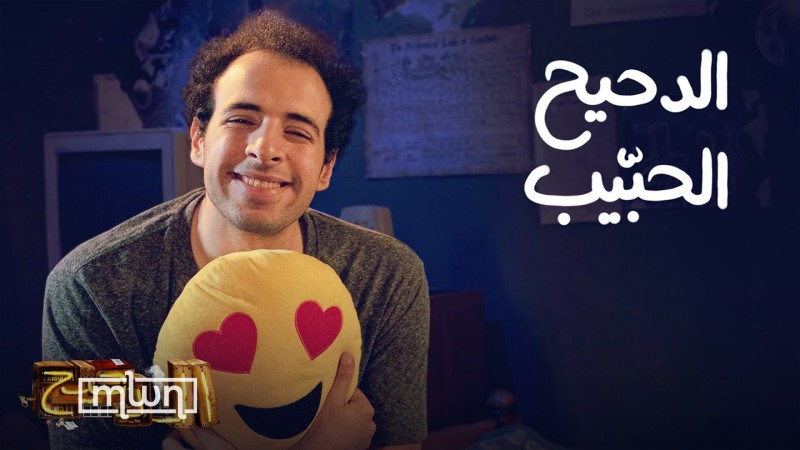
When you think of YouTube sensations who can turn any topic into a binge-worthy experience, this name is the one that pops up.
In a world overflowing with content creators, this Egyptian YouTuber stands out as a modern-day educator, transforming dry subjects into exhilarating lessons wrapped in humor and charisma.
With a knack for breaking down complex topics into digestible chunks, “Da7e7’s” videos are like your favorite comfort food — if comfort food could explain quantum physics or the intricacies of ancient civilizations.
With a channel boasting 1.93 million subscribers and 208 videos, this Egyptian YouTuber has become a beacon of educational entertainment
But Da7e7’s reach doesn’t stop at his own channel. His videos have also found a home on the New Media Academy Life YouTube channel, a hub dedicated to content creation and education.
This platform aims to amplify the presence of Arabs in the digital space, and Da7e7’s engaging content is a perfect fit.
Through this collaboration, his insightful and humorous videos are reaching an even broader audience, making education not just accessible but highly entertaining.
His channel, a treasure trove of knowledge and wit, has garnered millions of subscribers who tune in not just to learn but to be entertained.
Who knew that physics could be as gripping as a season finale of your favorite drama?
Da7e7’s approach is anything but ordinary. Imagine sitting in a lecture where the professor actually understands memes, pop culture references, and can make you laugh while dropping knowledge bombs.
That’s Da7e7 for you. His ability to connect with a diverse audience, from teens to adults, is what makes him a standout in the digital realm.
It’s like he’s the cool teacher we all wish we had, minus the 8 a.m. classes.
In a landscape where educational content often feels as exciting as watching paint dry, Da7e7’s channel is a breath of fresh air.
Each episode feels like a lively conversation with a brilliant friend who has a way of making even the most daunting topics approachable.
Plus, his knack for storytelling and his infectious enthusiasm mean that viewers aren’t just learning—they’re eagerly anticipating what will come next.
So, the next time you’re in the mood for some brainy fun, turn on Da7e7’s channel.
Whether you’re a lifelong learner or just someone looking for a few laughs mixed with some knowledge, this YouTube genius has got you covered.
Think of it as your personal TED Talk, but with a lot more pizzazz and a lot fewer PowerPoint slides.
Winning novel The Water Diviner is a poetic work set in rural Oman.
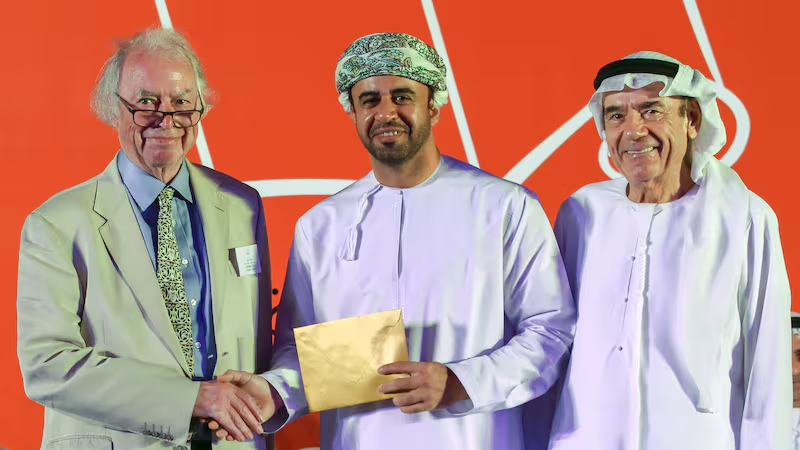
Novelist Zahran Alqasmi is the first Omani to win the International Prize for Arabic Fiction for his fourth novel The Water Diviner.
Announced at a ceremony in Abu Dhabi on Sunday, Alqasmi was named winner of the $50,000 prize and will also receive funding for an English translation.
Published in 2021, The Water Diviner follows the life of an enigmatic and mystical man employed by Omani villages to track the ebb and flow of local rivers and ravines.
Haunted by the deaths of his parents, “the water diviner” faces his fear as he battles for his life while stuck in a water channel.
Moroccan author Mohammed Achaari, the 2011 IPAF winner and chairman of this year’s judging panel, hailed the work for its innovative subject matter and cohesive structure.
“It is a new subject in modern fiction: water and its impact on the natural environment and the lives of human beings in hostile regions.
“Blurring the boundaries of reality and myth, the novel’s precise structure and sensitive poetic language are the conduit for compelling characters like the water diviner, who plays an essential role in people’s lives, yet simultaneously inspires their fear and revulsion,” he said.
“The Water Diviner transports us to the world, little known in the Arabic novel, of the riverbeds and the aflaj [water channels] of Oman, showing how natural forces influence the relationship between individuals, environment and culture.”
Professor Yasir Suleiman, chairman of the award’s board of trustees, praised Alqasmi’s rich prose and use of authentic Omani colloquialisms.
“The novel takes the reader into a world dominated by vulnerability and ready-made modes of thinking,” he said.
“Written in exquisite language suffused with the local cadences, the novel charms the reader with its narrative flow and poetic impulse.
The Water Diviner was one of six shortlisted novels , which included The Highest Part of the Horizon by Saudi author Fatima Abdulhamid, published by Masciliana in the UAE.
All shortlisted authors will receive a $10,000 prize.
Who is Zahran Alqasmi?
Born in the agriculture region of Dima Wattayeen in northern Oman, Alqasmi is a prolific author – having published four novels, 10 poetry books and two Biography of the Stone short story collections,released in 2009 and 2011.
In an interview on the IPAF website, he says the novel was inspired by his experience growing up in rural Oman.
“Anyone looking at life in the Sultanate of Oman will find that it largely depends upon an old system for providing water for drinking and agriculture, the system of the aflaj,” he said.
“They are a complicated social system, linked to social and class strata. Water is divided in equal shares throughout the year so that the owners of gardens can take what is due to them.
“Since I am a son of one of these villages, since my early childhood I have known a lot about the system of aflaj and heard many astonishing stories and legends connected with this system.
“This enriched me as I wrote the novel. I imagined the environment of the book as an Omani village. I visualised its paths, gardens, alleyways. It was easy at that time to write the chapters fluidly.”
Alqasmi will make his first public appearance after winning the prize at the Abu Dhabi International Book Fair on Monday.
Taking place at the Ayasofya Stage at 8.45pm, the discussion will include the shortlisted authors and centre on their works and the challenges facing modern Arabic fiction.
2023 International Prize for Arabic Fiction Awards winner Zahran Alqasmi, centre, with Jonathan Taylor, left and Zaki Nusseibeh, cultural adviser to the President of the UAE. Victor Besa / The National
The films tell stories of hopes, dreams, and challenges from the Arab world.
Arab cinema is about to make waves as the 81st Venice Film Festival rolls out the red carpet.
Running from August 28 to September 7, this year’s Venice International Film Festival will feature 12 Arab films backed by the Doha Film Institute.
These movies will light up key sections of the festival, including Orrizonti and Orrizonti Shorts, and make waves at Critics Week, Giornate degli Autori, Final Cut, and the Venice Gap-Financing Market.
These selections showcase the rich diversity of the region, bringing unique stories from Egypt, Jordan, Lebanon, Morocco, Palestine, Tunisia, and Yemen into the spotlight.
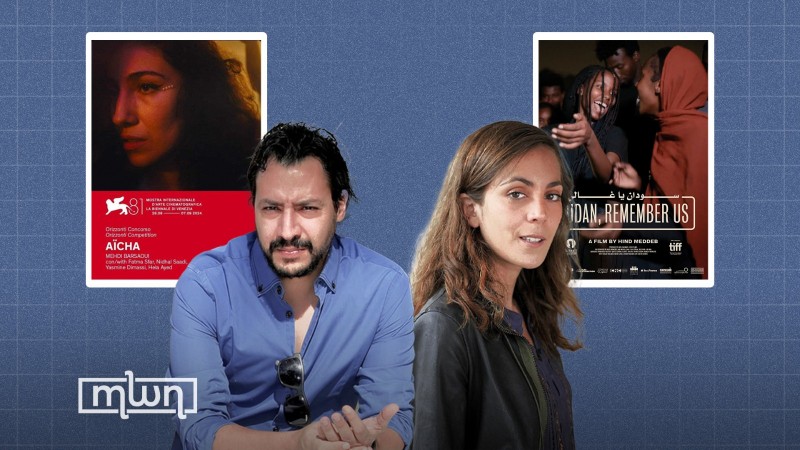
Highlights include “My Father’s Scent” by Mohamed Siam, featuring Egyptian star Ahmed Malek, “Aïcha” by Mehdi Barsaoui, and “Sudan, Remember Us” by Hind Meddeb, which offers a powerful portrayal of a generation’s fight for freedom through words, poems, and chants.
“We are proud to continue a successful festival season with a strong showcase of films by Arab talent at Venice,” stated Fatma Hassan Alremaihi, chief executive officer of the Doha Film Institute.
“Our mission is to support independent creators in cinema, and the compelling selection at Venice is a testament to our commitment to shed light on stories that transcend borders and present unique perspectives. We hope these films receive the acclaim and attention they deserve,” she added.
The 2024 Venice International Film Festival is set to showcase a diverse array of Arab cinema.
In the Orizzonti category, the festival will present “Aïcha” directed by Mehdi Barsaoui and “Happy Holidays” by Scandar Copti. The Orizzonti Shorts category will meanwhile include “Shadows” by Rand Beiruty.
“Sudan, Remember Us,” directed by Hind Meddeb, will be showcased in the Giornate degli Autori section. Critics’ Week will highlight “Perfumed with Mint” by Muhammed Hamdy.
The Final Cut section will present several notable films, including “Aisha Can’t Fly Away” by Morad Mostafa, “In This Darkness I See You” by Nadim Tabet, “My Father’s Scent” by Mohamed Siam, and “Those Who Watch Over” by Karima Saidi.
Finally, the Venice Gap-Financing Market will feature “Marie & Jolie” by Erige Sehiri, “The Station” by Sara Ishaq, and “Theft Of Fire” by Amer Shomali.
With a lineup that promises to dazzle and surprise, these films are set to turn heads and set new standards.