World Arabic Language Day: December 18th. Seven Facts that will Surprise You

Arabic is spoken by more than 400 million people across the Middle East and in diaspora communities across the world.

Spoken by around 400 million people across the globe, the Arabic language in its classical form is also the liturgical language of Islam, the world’s second largest religion with at least 1.6 billion adherents.

Marked every year since 2012, the date was chosen based on when the UN General Assembly recognised Arabic as one of the organisation’s official languages in 1973.

In a statement released ahead of the occasion, Audrey Azoulay, Unesco’s director-general, said: “Throughout the centuries, Arabic has been at the heart of exchanges between continents and across cultures.”

She added the language was “used by so many great poets, thinkers, scientists and scholars”.

To mark the occasion, here are some facts about the language, which you may not have known:

1. There’s no agreement on how old the language is

Depending on who you ask, the earliest records of Arabic appear as far back as the second millenium BCE, around the eighth-century BCE or as late as the fourth-century BCE.

The reason for the debate is establishing what constitutes the Arabic language as we know it today.

Languages spoken today are evolved versions of languages that were spoken thousands of years ago, but determining at what point a language becomes so distinct from its ancestor that it can no longer be considered the same is up for debate.

Languages spoken today are evolved versions of languages that were spoken thousands of years ago, but determining at what point a language becomes so distinct from its ancestor that it can no longer be considered the same is up for debate.

2. The oldest Arabic inscription dates to 470 CE

A 2014 discovery by a French-Saudi-led team unearthed the world’s oldest known inscription written in the Arabic script – “Thawban Ibn Malik” were the three words etched into stone, alongside what is thought to be a Christian cross.

The stone slab was discovered in Najran in ­Saudi Arabia and is said to date from around 470 CE.

The text is thought to be written in an early version of the Arabic script known as Nabataean-Arabic, which evolved from historic Nabataean and Aramaic scripts.

The Nabataean kingdom lasted from around the 4th-century BCE to 106 CE and is famed for the structures Nabataeans carved out of rock formations, such as the one found at Petra in Jordan.

3. Arabic is related to Hebrew and Amharic

Arabic is a member of the Semitic language family, which itself is a member of the Afro-Asiatic family.

The Semitic family includes languages still spoken today, such as Hebrew in Israel and Amharic in Ethiopia, as well as extinct languages that were once widely spoken, such as Akkadian and Phoenician.

Belonging to a language family means that at some point the languages evolved out of a common dialect.

While there are no records of the original language, there are enough similarities between languages such as Arabic and Hebrew to make it clear that their origin is the same.

One of the most notable features of the Semitic languages is the triliteral root system, in which words are formed out of a combination of three consonants. 

4. There are dozens of Arabic dialects

Modern Standard Arabic remains a unifying dialect across the Arab world and is used in formal broadcasts, religious sermons and literature, but in day-to-day life Arabs speak a diverse array of dialects.

Sometimes differences between dialects can be so big that two native Arabic speakers cannot communicate without resorting to formal Arabic or a more commonly understood dialect, such as Egyptian or Levantine Arabic.

There are at least 30 Arabic dialects and the differences between any two are generally more stark the more geographically separated they are.

The biggest split is between the Maghrebi or western dialects found in North Africa and the Mashreq or eastern dialects found in the Levant.

There are many reasons for such dramatic differences in dialects.

As Muslim conquerors took over vast tracts of land between Morocco and Iraq, they encountered people who spoke other languages. As those people interacted with their new rulers, they had an effect on the language the new arrivals spoke.

There are also other factors, such as the influence of subsequent conquests by Turkic and European rulers and the independent evolution of languages separated by geography over long periods of time.

In that sense, the Arabic dialects are similar to the Romance languages, such as French, Spanish and Italian, which developed out of spoken Latin.

5. There’s an EU language closely related to Arabic

Maltese, the national language of Malta, was given official language status when the island joined the European Union in 2004, and is the only Semitic language to have that designation.

The country’s 450,000 natives speak a language that has its roots in Arabic, as it was spoken when the nearby island of Sicily was ruled by North African Muslims.

Although it grew out of North African dialects of Arabic, the Maltese language has taken on a lot of vocabulary from Romance languages, such as Italian, and is considerably distinct from Arabic as it is spoken today.

Nevertheless, the similarities will be obvious to an Arabic speaker. Greetings, such as merhba (welcome) and questions, such as x’jismek? (shi-yismek/what is your name?), will be instantly recognisable to an Arab.

6. Arabic was once spoken as far east as Central Asia

After the founding of Islam, successive Arab empires established control over a territory that spanned from Morocco in the west to the borders of what is now China.

This led to mass movements of people from the interior of the Middle East to areas on the periphery of the Islamic world to work as soldiers, administrators, religious leaders and merchants.

These new migrants brought their language with them and even in areas that did not become fully Arabised, their descendants continued to speak Arabic until very recently. 

One such example is in Central Asia, where a variety of Arabic was spoken among some communities until the late 19th-century.

While thought to have numbered in the tens of thousands of speakers in the early Islamic era, today these populations have been assimilated into neighbouring Persian and Turkic-speaking populations.

Many descendants of these Arabic-speaking communities are still aware of their roots despite having forgotten their original language.

7. Arabic loanwords are found in many languages

Alcohol, arsenal, algebra, coffee, gauze, mascarade and safari are just a selection of words used in everyday English that have their roots in Arabic.

Safari for example comes from the Arabic for “journey” or safar, while Arsenal comes from the Arabic dar al-sina’ or “house of production”.

Some languages owe more of their vocabulary to Arabic than others. Turkish and Persian were heavily influenced by Arabic due to geographic proximity and conquest by Arab rulers, as well as the movement of Arabic speakers to areas where those languages are spoken.

Those additions are not always welcomed by nationalists in those countries and efforts have been made at various points to remove Arabic influence.

One of the most intense efforts in that regard was by the founder of the Turkish Republic, Mustafa Kemal Ataturk, who began a process of Turkification to replace Arabic words in the Turkish language with Turkic equivalents.

Nevertheless thousands of Arabic-origin words remain in modern Turkish.

source/content: middleeasteye.net (headline edited)

_____________

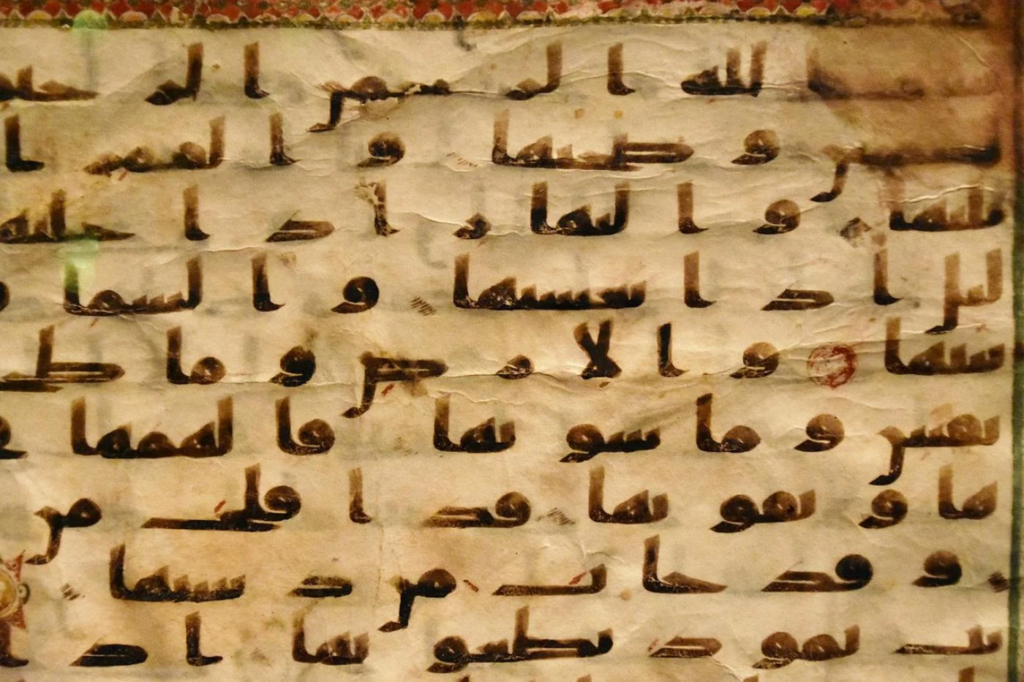
A late seventh-century parchment featuring verses of the Quran in the Kufic script (Wikimedia/Richard Mortel)

______________________

ARABIC LANGUAGE

SUDAN: Artist Rashid Diab Reveals Passion for Printmaking

Rashid Diab was the first in a stream of brilliant Sudanese artists who came flooding into Kenya in the early 1990s.

He has been a way-shower ever since. Experimenting with technical skills that he’s acquired and mastered over the years, his awesome etchings have come to Nairobi’s Red Hill Gallery in an exhibition entitled A Trajectory of Etchings – 1980-2000.

A trip up to Hellmuth and Erica Rossler-Musch’s ever-green gallery is well worth the trek, if for no other reason than to meet two of the most hospitable art lovers around.

But then, to see the Gallery’s pearly white walls covered in a rich array of Rashid’s colourful etchings is all the more reason to come and see.

They are mainly abstract works, but one can see so many influences surfacing through his swirls of colours, two-dimensional lines, and calligraphic curves that disclose his Sufi upbringing.

There are more than 50 etchings, all of which are beautifully framed and displayed in geometric clusters of both miniature gems of genius dressed in sepia and ochre ink as well as larger works suggesting symbolic forms such as are found in northern Sudan, in the ancient murals of Meroetic and Kush civilisations.

The venerable Sudanese artist flew in from Khartoum, especially for his exhibition opening last Sunday, November 20, having been preceded by his son Yafil, who prepared the way for Nairobi to see facets of his father’s art other than the style of painting that he is currently passionate about and which we have seen in recent exhibitions of his work in places like Tribal Gallery, One Off, and Gravitart.

“We met Yafil more than a year ago when he came and suggested that we have an exhibition of his father’s etchings,” Hellmuth told BDLife shortly before the exhibition opened.

“We were impressed with the etchings, especially as they cover a span of 20 years, but we couldn’t hold the exhibition until now.”

There had been many steps involved in bringing Yalif’s idea to fruition, especially as he had to return to Khartoum and the process of curating the show had to proceed online.

The fact that none of the etchings had ever been seen before in Kenya made the preparation process all the more exciting for Hellmuth who relished the challenge.

But once he’d selected his favourites from the hundreds that Yalif had shared, Hellmuth insisted on framing all but ten of them to show them in their best light.

“My father was impressed to see the exhibition as he had never seen so many of the works shown so well in one space,” Yalif said.

Rashid himself hadn’t discovered his passion for printmaking, specifically for etching until he was introduced to the technique in Spain, at the Complutense University of Madrid where he had been awarded a fellowship to attend.

That discovery led to his getting advanced degrees in painting and etchings, including a PhD.

But after years of working as a scholar and professor of fine art, he felt compelled to return to his homeland where he has been sharing his knowledge, skills, wisdom and experience with his fellow Sudanese ever since.

In 2000 when he returned to Khartoum, he established the Dara Art Gallery. And several years after that, the Rashid Diab Art Centre was born.

“As we don’t have a national art gallery in Sudan, the Centre has played an important role,” Yalif said. It has also given Rashid the visibility required for the world to recognise his talent and leadership role in the arts of Sudan.

For instance, he won the King Juan Carlos of Spain award for Excellence in Service. He has also won ambassadorial status from the Japanese and British governments for his concern for peace and the environment.

He’s also exhibited his art all over the Middle East and Europe.

So, while he hasn’t lost his passion for printmaking, he had to put it on hold while shifting artistically as well as socially and culturally from his Spanish to his Sudanese circumstance.

“I’m concerned about the role of women in our society, which is why they appear so frequently in my art,” Rashid told BDLife at the opening of his first solo exhibition at Red Hill.

But it is thanks to his son, who discovered hundreds of his etchings while archiving his father’s art that we have the opportunity to see this treasure trove of an earlier phase of Rashid’s artistic ‘trajectory.’

→margaretta.gacheru@glory

source/content: businessdailyafrica.com (headline edited)

____________

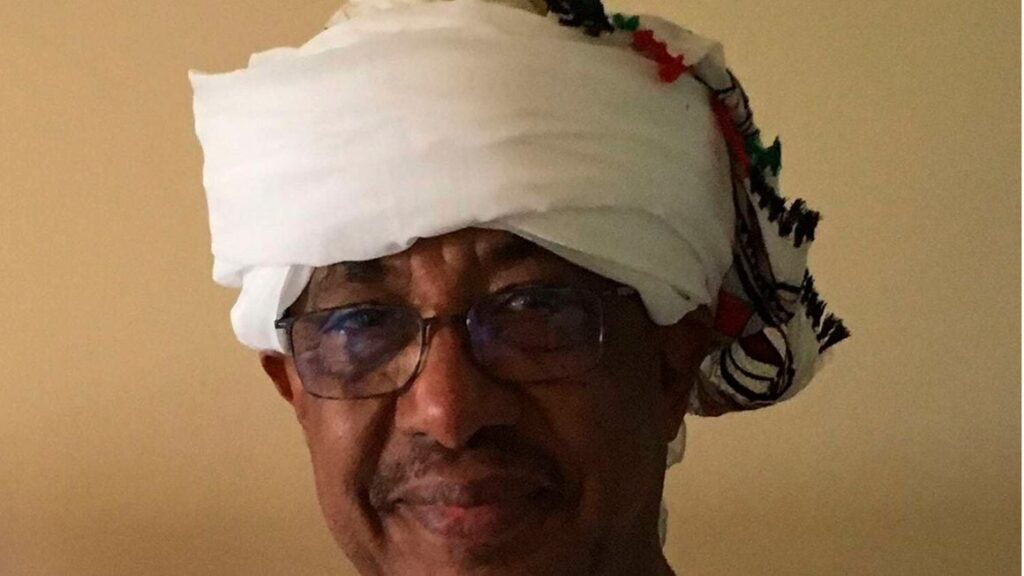
Rashid Diab. PHOTO | POOL

__________

SUDAN

EGYPT: Window of Opportunity: the Egyptian ‘nomad’ Shadia El Dardiry Directing London’s largest Arab Arts Festival

New Shubbak chairwoman Shadia El Dardiry on the privilege of supporting those from all walks of life, whether beleaguered artists or stranded migrants.

Shadia El Dardiry has been on a journey of discovery in London since arriving nearly seven years ago but one scene from her impromptu walking tours stands out from the rest.

The unexpected sight and sound of two boys speaking Arabic in a Syrian dialect as they passed by halted El Dardiry in her tracks as she tried to figure out why she recognised them.

Oblivious to her stopping and staring, they walked on without a glance but it dawned on her that she had helped the younger of the siblings when he was an unaccompanied minor stuck in Calais, after fleeing the war in Syria.

“I remember feeling so uplifted, knowing that the younger brother finally had a home and that they had been reunited,” El Dardiry tells The National, “and just seeing them live something akin to a normal life in London on a Saturday afternoon.

“It was all thanks to the work of a group of amazing lawyers and people who took these cases on at a time when the UK was pretty much refusing to comply with its legal obligations … it filled me with hope to see the fruit of all that hard work before my eyes.”

El Dardiry had signed up as a volunteer while studying to be a lawyer but she is modest about her part “on the margins” of the reunification. All she did, she says, was use her Arabic and English to interview refugees and their family members.

It seems that helping people is somewhat of a calling. Years later, El Dardiry, 34, now the new chairwoman of Shubbak, the UK’s largest and most prestigious Arab contemporary arts festival, is promoting those within the cultural sector in what has been a torrid year.

She also practises as a solicitor specialising in employment law. “There’s no hierarchy of problems,” El Dardiry says. “Unfortunately, it would be great if you didn’t need employment lawyers or immigration lawyers or any lawyers really. That would be, I think, everyone’s utopia,” she says, with a self-deprecating smile.

El Dardiry believes that her heritage and nomadic upbringing – “being a bit from everywhere” – make her particularly attuned to migration issues. As an adult, she has lived in Paris, Brussels, Geneva and Copenhagen but she ascribes what she calls her “mixed identities” to being raised in Guinea, Canada and Egypt.

Born in Montreal to an Egyptian father and an Italian mother, El Dardiry moved as a young child with her older sister to West Africa with their parents, an accountant and a doctor, who met while working in Guinea in the 1970s.

She conjures up vivid memories of a tranquil time in the port city of Kamsar, punctuated by daily family lunches and weekends of camping and trips to the beach or local waterfalls.

With just a local fresh goods market and one shop, the simplicity of life created a strong sense of community. But even the young El Dardiry was conscious that the family, as expatriates in one of the world’s most impoverished countries, were “living here but we’re not from here, and we’re very privileged”.

After moving back to Canada for a few years at the age of 7, El Dardiry relocated to Egypt with her father where she completed her schooling. An adolescence spent in one of the most populous and multi-ethnic Arab countries solidified her sense of compassion, as well as how she saw herself.

“I loved it,” she says. “Cairo is great. It’s hectic, it’s chaotic, it’s inconvenient in many ways, but it has a charm to it. I think it definitely shaped me. That’s where I developed my Arab identity and why I started saying, ‘I’m Arab’ and ‘I’m Egyptian’. Before, I used to say I was Canadian. So I think that there was a real shift there.”

It also gave her the opportunity to improve her command of Arabic. El Dardiry concedes, however, that she can never quite pass for a native on her regular trips back to the city that each time is “a little bit different, a bit bigger”.

“I have an accent and people make fun of me,” she says, laughing. “The taxi drivers love it. But I do tell them: ‘Don’t rip me off! I still know the prices.’”

Coming of age in a land that housed the likes of the Nobel-prize laureate Naguib Mahfouz and the public intellectual Edward Said, it is no surprise that El Dardiry grew fond of Arabic literature. The seeds had been sown early by her father who regaled her about the region’s authors and introduced her to the Tales of Goha.

“He’s very much a fixture of Arabic storytelling,” El Dardiry says of the titular satirical folk character whose sidekick is a long-suffering but faithful donkey. “Though I’m pretty sure my Dad eventually also started improvising his own Goha stories for me.”

After a graduate degree in political science at McGill University in Montreal, she studied as an exchange student for two years in Paris for her master’s. While writing her thesis on identity and integration of second-generation North African migrants, she recalls being struck by the extent of discrimination against those communities in the French capital.

“We all know it exists,” El Dardiry says, “but I think I was sheltered in Canada from that. And that’s what really drew me in. I think that was kind of a stepping stone where I thought ‘this is actually a sector that I’m really, really passionate about’, both in terms of refugees and asylum seekers but also populations that settle in countries and how their identities change over time.”

In a natural progression, she entered the world of non-governmental groups in various cities across Europe. She spent four years in Denmark with a human rights organisation working on asylum issues that kept her Middle East roots close and made use of her language skills.

She concedes that there may have been one downside to so enthusiastically soaking up the culture in Copenhagen and learning the local lexicon. “My Arabic suffered as I picked up some Danish, but it was great,” she says.

Her years as a human rights advocate were starting to take their toll, however. She reflects on the difficulties and taxing nature of working on immigration and asylum issues day in, day out.

It gave rise, she says, to a feeling of helplessness, particularly when the Middle East was haemorrhaging people fleeing the conflicts that followed the Arab uprisings.

“You had really strong political opposition to that in Europe, and you still have that,” El Dardiry says. “I think it just felt like a really difficult fight that we were never going to win. It was not getting better and it is only getting worse.”

She decided to qualify as a lawyer in London, and was drawn to Bates Wells. The city law firm is renowned for combining a strong commercial and charity practice with a general emphasis on public interest work.

El Dardiry’s chosen field of employment law allows a bit more distance than is afforded to those whose full-time focus is on migrants. “The lawyers who do are really impressive and have a lot of strength because it’s definitely something I’ve struggled with,” she says.

Among Bates Wells’ large charity clientele are many within the arts, and it wasn’t long before a colleague put her forward as a trustee for Shubbak in 2018.

“This offers me a chance to be more involved in art and culture coming from the Arab world,” she says. “At the same time, I’m realistic that I’m not an artist and I don’t work in that every day. So it just gave me an opportunity to contribute.”

As chairwoman, her role is to provide strategic direction to Shubbak and to assist in the long-term vision of supporting and celebrating the diversity of Arab artists’ creativity and innovation in the UK and the Mena region.

“It is very much there to act as a bridge between those two geographical locations,” she says.

Shubbak, which means window in Arabic, has evolved in the decade since its launch from a festival to bring people together every two years to what El Dardiry explains is a permanent presence with ongoing projects taking place between the biennial programmes.

To the delight of deprived art lovers, this year’s event will go ahead after the last of England’s Covid-19 restrictions lift in June. It’s a welcome hurrah for a sector that has been “hugely shaken” by the pandemic, but El Dardiry is keen to acknowledge the resilience of artists and their ability to create work out of any situation. “It’s really amazing,” she says.

While the festival will be physically held in London, the organisers have adopted a hybrid approach. Some works will be presented digitally which, for the first time ever, will make them available to a global audience. It could well be a pilot for things to come.

“I think there’s going to be even more creative ways of linking the two together,” she says. “It’s another way of presenting and working which will just enrich the organisation.”

As she waits for international travel to open up so that she can see her family in Canada and Egypt again, El Dardiry will revel in Shubbak’s role in the reinvigoration of London.

She is a flaneuse, being a “bit more of a walker” than most, and has both revelled in and been saddened by the unusually deserted streets of London for which she has developed such a deep affection on her regular roams.

When asked if all those pre-Covid hours spent pounding the pavements meant that she had been ready for lockdown restrictions, El Dardiry laughs in agreement that she had been “good to go”.

“If anything, I think the pandemic has made me tired of walking,” she says, half lamenting that everyone’s doing it now.

It is perhaps one of the lesser-known side effects of the coronavirus, but seems unlikely to impede El Dardiry from making great strides one way or another in the future.

source/content: thenationalnews.com (headline edited)
_______________

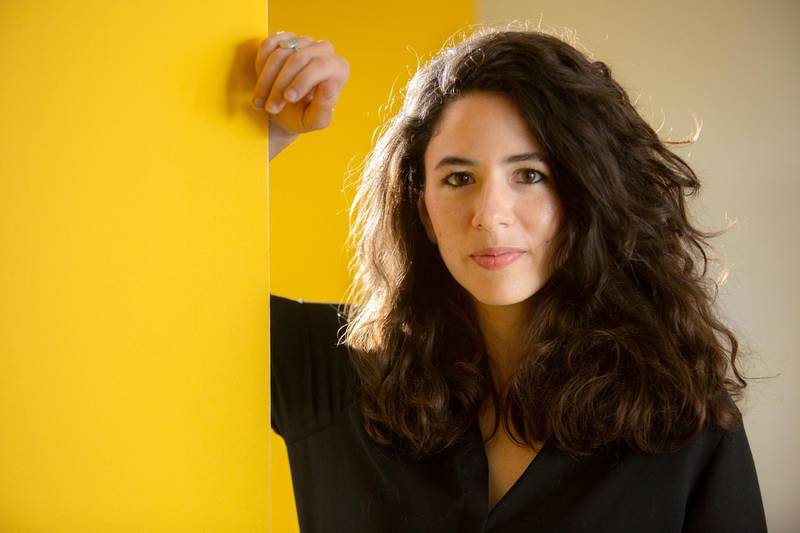
Shadia El Dardiry the new chairwoman of the Shubbak Festival. Mark Chilvers for The National

____________________

EGYPT

Historic Arab Manuscripts Showcased at Pearls of Wisdom Exhibition in Abu Dhabi Palace

Influence on European Renaissance highlighted.

The month-long Pearls of Wisdom exhibition launched this month at Qasr Al-Watan, Abu Dhabi’s Presidential Palace, on the sidelines of the third edition of the Abu Dhabi Manuscripts Conference.

Running until Jan. 6, 2023, it will showcase valuable manuscripts in the fields of literature, heritage, religion, music, philosophy and science.

Split into seven zones, the exhibition will take visitors on a historical journey that deliberates on the influence of Arab culture in generating religious dialogue and contributing to knowledge that paved the way for the European Renaissance.

At the heart of the House of Knowledge, visitors will find themselves in an immersive gallery panel covering the Golden Age of Islamic civilization and two regions that are at the heart of medieval Europe: Al-Andalus in the Iberian Peninsula and Sicily in southern Italy.

Before visitors conclude their visit, they can head to the palace’s library to explore a collection of more than 50,000 books about the UAE’s history and politics along with topics including history, architecture, biology and ethnography.

Organized by the Department of Culture and Tourism – Abu Dhabi, the conference is being held under the theme “Arabic Manuscripts from East to West: Spain and Italy as a Model,” and in coordination with the National Marciana Library of the Italian Ministry of Cultural Heritage, the University Library of Bologna in Italy, the National Library of Spain, and Royal Library of San Lorenzo de El Escorial.

source/content: arabnews.com (headline edited)

_____________

The exhibition will showcase valuable manuscripts in the fields of literature, heritage, religion, music, philosophy and science. (Supplied)

_______________________________________

ARAB LITERATURE & MANUSCRIPTS

EGYPT: Wegz Releases ‘EZZ EL ARAB’ for FIFA World Cup 2022 Official Song

Following up a highly eventful year, the diverse artist delivers an electrifying track for the official soundtrack of the 2022 World Cup which he will perform at the final match.

Ahead of his performance at the FIFA 2022 World Cup finals taking place in Qatar on Sunday the 18th of December, Wegz releases ‘Ezz El Arab’ as part of the tournament’s official soundtrack.

Internationally acclaimed Egyptian artist Wegz has been continuously growing throughout his career. In only a few years, the Alexandrian rapper and singer has managed to permeate the cultural zeitgeist, becoming an ever-present figure in contemporary Arabic music.

This year, Wegz has achieved major accomplishments, such as his track ‘Al Bakht’ amassing over 150 million views on YouTube and topping the charts on Spotify’s most played artist in the MENA region.

If there is one thing that Wegz has demonstrated throughout his career, it’s that he is always moving forward, continuously trying to evolve his sound and expand his reach.

In pursuit of these ventures, the beloved Egyptian rap icon has just released an official track for the 2022 FIFA World Cup in Qatar, looking to afro-beats, electronic music, and his signature singing style to deliver an energising track that explores themes of unity and pride.

The music video for the track was directed by Ali El Arabi, who also directed Wegz’s, ‘B3oda Ya Belady’ from the highly acclaimed documentary ‘Captains of Zaatari’. The video features Wegz in a variety of shots around Qatar, DJing to an adoring crowd of football fans, and performing to camera in a cinematic portrayal of the tournament’s festivities.

This year’s World Cup has been more than just a sporting event for people of the MENA region. The tournament has always been a time for gathering and community, even if many Arab national teams have not reached their full potential in previous iterations of the World Cup. But this year’s tournament, hosted in Qatar, has seen incredible performances from teams such as Saudi Arabia, and of course, the Moroccan national team, who have instilled a sense of pride in Arab fans around the region and beyond. Watch the full music video here

source/content: cairoscene.com (headline edited)

_______________

click and watch on Youtube.com

_________

EGYPT

BAHRAIN’s 51st National Day: December 16th. HM King patronises Bahrain’s celebrations of its National Days

His Majesty King Hamad bin Isa Al Khalifa today patronised, in the presence of His Royal Highness Prince Salman bin Hamad Al Khalifa, the Crown Prince and Prime Minister, the ceremony held at the Al-Sakhir Palace on the occasion of the kingdom’s National Days, in commemoration of the establishment of the modern Bahraini State as an Arab and Muslim state, founded by Ahmed Al Fateh in 1783, the anniversary of its full membership in the United Nations, and the anniversary of His Majesty the King’s Accession to the Throne.

On arrival at the Al-Sakhir Palace, the artillery fired 21 rounds to salute HM the King, who was accompanied by a constellation of cavalry.

The National Anthem was played, and some holy Quran verses were recited.

After that, HM King Hamad delivered the following keynote speech:

“In the name of God, the most Merciful, the most Compassionate,

Praise be to Allah, and prayers and peace be upon Prophet Mohammed and his family and companions,

Your Highnesses, Excellencies, Distinguished Guests,

May the peace, mercy and blessings of God be upon you,

This year’s glorious National Day arrives with its atmosphere full of joy on the return of our lives to their former state, thanks to God. Here, we meet you on this blessed day of our dear homeland, in the essence of its commemoration, which returns to us with good and affection, in the expansive glory of the Kingdom of Bahrain, whose civilisational achievements have, for over two centuries, continued to transcend among nations, through the giving of its people at all times and periods.

In fact, with every new commemoration of this day with its experiences and achievements, the more confidence we feel in our progress in building towards the goal of the advancement and prosperity of our honourable citizens, a matter to which our esteemed Government is committed, and for which it strives with determination and diligence.

In this regard, we must first commend the national endeavours being undertaken to achieve our ultimate goal to achieve good and prosperity for every citizen, and we refer, in this context, to the results of the Economic Recovery Plan, whose positive impact extends to all sectors of development. We are proud of the active role of financial and economic support programmes, particularly in facing the economic and health difficulties, and we direct raising their efficiency and enhancing equitable access to them, by considering their effectiveness and great benefit to living standards.

Here, we express our satisfaction with what has been achieved in meeting the housing needs of the Bahraini family, commending the record government achievement, and emphasising in this regard the need to continue development plans for the housing sector with their innovative solutions and vast investments, in partnership with the private sector, to ensure decent and suitable housing for citizens.

In the context of its priorities, our country continues to preserve and protect human rights under the auspices of its independent legal institutions, and among the results of those efforts is the comprehensive programme of alternative sanctions and measures, which we are keen to realise given its noble objectives of giving its beneficiaries new hope for the stability of their families, and for a promising future of giving and contributing to the building of their society.

Brothers and sisters, on such a special occasion that brings us together with you today, it gives us pleasure to celebrate the pioneers of national action, from the sons and daughters of our dear nation, in honour of their efforts, and in recognition of their outstanding services, which we greatly appreciate, and we will not find a more remarkable day in the life of the country to express to them pride in their leadership and excellence, and to thank them for giving this day its most beautiful meaning.

May God grant you all success, and may the peace, mercy and blessings of God be upon you.”

Then, HM the King conferred medals on national work pioneers.

After that, Kefaya Habib Al-Anzoor, delivered a statement on behalf of the honourees in which she expressed deepest pride in HM the King’s patronage of the auspicious National Days, and honouring of national work pioneers.

She asserted that the annual honouring of the distinguished national work pioneers is an impetus for them to be more dedicated in serving the nation and raising its flags at all international gatherings so that Bahrain always remains at the top across various fields.

She lauded the historic wide-ranging achievements attained by the kingdom during HM King Hamad’s prosperous era, noting that the precious royal honouring is a source of pride, and that it motivates everyone to do their utmost to be more dedicated to serving the homeland.

She affirmed that the kingdom’HM the King’s patronage of the honouring of military and civilian national work pioneers will optimise the kingdom’s accomplishments, noting that thanks to the constant royal support and forward-looking vision, Bahrainis have brought about unprecedented achievements in the scientific, cultural and youth fields, locally and abroad. 

She extended deepest thanks, appreciation and gratitude to HM the King for honouring national work pioneers on this cherished national occasion.

She also extended sincere congratulations to HM King Hamad on the glorious National Days, wishing HM the King abundant health, happiness and long life.

The honouree list included: 

–     Shaikh Mohammed bin Khalifa bin Ahmed Al Khalifa

–     Faeqa bint Saeed Al-Saleh

–     Ali bin Mohammed Al-Romaihi

–     Ayman bin Tawfiq Al-Moayyed

–     Shaikh Hesham bin Abdulrahman bin Mohammed Al Khalifa

–     Eman Ahmed Al-Dossari

–     Osama Saleh Al-Alawi

–     Major-General Mohammad Abdulla Al-Noaimi

–     Brigadier-General Fahd Mohammed Al-Humaidan Al-Najdi

–     Brigadier-General Dr. Hassan Mohammad Noor

–     Brigadier-General Mohammed bin Mohammed bin Dinah

–     Colonel Tariq Ahmed Ali Al-Buflasa

–     Warrant Officer Ahmed Mohammad Ali Mohammad

–     Abdulla Jehad Abdulla Al-Zain

–     Faisal Mohammed Hassan Al-Mahroos

–     Ghassan Ali Muhanna Mohammed Al-Muhanna

–     Mark Joseph Thomas

–     Mazen Mohammed Ahmad Mattar

–     Ahmed Yousif Talib Abdulghani

–     Abdulla Ali Al-Binkhalil

–     Mustafa Mohammed Ahmed Mustafa

–     Nawaf Abdulla Hamza

–     Shaikha Mariam bint Abdulwahhab Al Khalifa

–     Chancellor Rashid Mohammed Bu Najma

–     Abdulla Khalid Ahmed Al-Nassar Al-Dossari

–     Mohammed Khalid Al-Fadhala

–     Hamad Ali Al-Mannai

–     Ambassador Ali Jassim Al-Aradi

–     Nada Ahmed Mustafa

–     Adnan Abdulwahhab Eshaq

–     Kefaya Habib Al-Anzoor

–     Akbar Jassim Ashour

–     Ziyad Adel Darwish

–     Fatima Abdulghani Ismail

–     Amna Ali Al-Arrayad

–     Huda Mirza Abbas Al-Salman

–     Mohammad Yusif Al-Binfalah

–     Ramzi Raisan Al-Badran

–     Najlaa Mohammed Qassim Al-Shirawi

–     Dr. Haitham Ali Jahrami

–     Dr. Abdulla Mohammed Al-Khan

–     Badriya Jassim Al-Kuwaiti

–     Marwan Fuad Salman Kamal

–     Alia Ali Al-Aali

–     Mustafa Aqeel Al-Shaikh

–     Lama Abbas Saeed Al Mahrous

–     Abdulhussain Ibrahim Isa

–     Beshara Abdo Beshara

–     Hanan Ibrahim Al Emadi

–     Mohammed Salman Makki Habib

–     Ahmed Abdulghani Isa Ahmed Madan

–     Nabeel Abdulrahman Ajur

–     Hussain Jassim Mohammed Ali Al-Sakran

–     Khalifa Yacub Yousif Al-Amer

–     Mohammed Jassim Al-Amer.

WHQ

source/content: bna.bh (headline edited)

_____________

HM King patronises Bahrain’s celebrations of its National Days

____________

BAHRAIN

EGYPT enlists ‘Journey of the Holy Family Festivals’ on UNESCO List of Intangible Cultural Heritage of Humanity

“Festivities and celebrations affiliated with the Journey of the Holy Family in Egypt are now on UNESCO’s Representative List of Intangible Cultural Heritage of Humanity,” professor Nahla Imam, heritage consultant at the Egyptian Ministry of Culture and country representative of Egypt at the 2003 Convention of Safeguarding the Intangible Heritage of UNESCO, told Ahram Online on Wednesday.

Imam credited the move to the efforts of the Egyptian ministries of culture and foreign affairs, adding that Egypt’s efforts were almost unanimously supported by UNESCO’s Inter-Governmental Committee.

This is the seventh intangible cultural heritage element that Egypt enlists in UNESCO. Prior to the Journey of the Holy Family, the Egyptian manual-textile industry in Upper Egypt was put on the UNESCO List of Intangible Cultural Heritage Sites in Need of Urgent Preservation.

Egypt first enlisted El-Sirah El-Helalya (The Epic of Beni Helal) in 2008, Tahteeb (Stick Art) in 2016, the Aragouz Puppet in 2018, and the knowledge and traditions affiliated with palm trees in 2019.

According to the accounts of historians, the Holy Family spent around four years in Egypt.

Their trip started in the Sinai at Al-Farma, on the border with Gaza, where they arrived after fleeing Jerusalem. Their trip ended in Durnaka, Assiut, venue of the famous Monastery where the feast of Virgin Mary is celebrated in August each year. ​

source/content: english.ahram.org.eg (headline edited)

___________

__________

EGYPT

Arab World the Winner in Memorable World Cup

As the FIFA World Cup reaches its climactic end, one cannot help but reflect on what an extraordinary political event it has been. Those who argue that sport and politics should be decoupled will have found it hard watching politics as an ever-present from the day Qatar was awarded the event back in 2010 and at every single match since the tournament began on Nov. 20.


But perhaps one of the most fascinating and hopefully impactful thrills at the World Cup has been the rare opportunity to remind the world that, for all its troubles, fissures and rivalries, the peoples of the Arab world do have much in common and that football has highlighted that reality every day in Qatar.

Some might question these signs of togetherness among fellow Arabs. Yet there were copious examples where it shone. Three achievements stood out.


Firstly, for Morocco to beat Spain and then Portugal in the knockout rounds was exceptional, especially following their defeat of Belgium, the second-ranked side in the world, in the group stage. There was more than an element of delight in seeing a former colony defeating, in Spain, its one-time colonial master. Morocco will get the chance to overcome its other colonial power, France, in the semifinals on Wednesday. In fact, star player Achraf Hakimi was born in the poor suburbs of Madrid. Morocco were the only team in the quarterfinals not from Europe or South America. Few in the region were not cheering them on. A sense of collective pride emerged as a result of the North African country’s success in becoming the first Arab and African state to reach the semifinals.

One might have thought that, given the dire state of relations between Morocco and Algeria, that Algerians would have shied away from joining in the festivities. Evidence suggests otherwise. Algerians were out supporting Morocco as enthusiastically as anyone else in the region. A friend was in Paris and told me: “After one of the Morocco victories, there were lots of Algerian supporters and flags joining their Moroccan brothers and sisters in celebration.” The Algerian captain and superstar Riyad Mahrez was quick to praise the Atlas Lions’ achievements.


Secondly, Tunisia beating reigning world champions France in the group stage was also an unforgettable moment. This was the first time they had beaten European opposition in the World Cup. This was every bit as big a win as in 1982, when Algeria beat the mighty West Germany in their first ever World Cup game.

Third, the Saudi victory over Argentina was another huge milestone. In many ways, this ignited the World Cup for the Arab world.


A sense of pride has also broken out that many of the finest players in the world come from this region. Hakim Ziyech for Morocco is one. Mahrez and Mohammed Salah were not in Doha but are still at the top of the sport. Kylian Mbappe, a star of this tournament, has an Algerian mother.


The key players in the Arab teams largely play in Europe. This shows football at its best in terms of breaking down barriers. Fourteen out of the 26-man Morocco squad were born outside of the country, showing how the team relies on the Moroccan diaspora. This includes Ziyech, who opted not to play for the Netherlands. That points to one challenge that countries like Morocco face, as they lack the footballing infrastructure to develop and nurture enough talent at home.

This World Cup has also often been about one country that is not there. At every single game featuring an Arab side, and plenty others beside, the Palestinian flag was there. It is a political symbol and a defiant message that the Arabs will not forget or ignore what is happening to the Palestinians in the diaspora and under occupation. As an even more brutally right-wing coalition is about to take power in Israel, this message should be carefully noted in the US and European capitals. Palestine still matters.


Israeli hasbaristas were also caught out. Having belittled and mocked those who claimed otherwise, they discovered that, despite the normalization deals, Arabs are not willing to gloss over Israel’s crimes and oppression. Time and time again, Israeli journalists, while trying to pretend everything was all lovely and wonderful with their newfound Arab friends, found that “free Palestine” was pushed back in their faces. Many locals snubbed their requests for interviews.

A World Cup in the Arab world has brought some cheer to a region that has been hit hard by wars and other crises.

Chris Doyle

Palestinian armbands and keffiyehs were being worn at nearly every match by huge numbers of fans. The sheer arrogance of believing that a state could oppress millions of people and that all would be peace and happiness was exposed as the nonsense it is. The Moroccan players had no hesitation in raising the Palestinian flag after their wins over Spain and Portugal.


Many Arabs also expressed admiration for the courage of the Iranian team after the players refused to sing their national anthem ahead of their opening match against England. This points to the widespread sympathy many Arabs feel toward Iranians, notably currently the women, who are struggling for their freedoms.

The Western media has been quick to point out all that was wrong with this World Cup. It is about time it also highlighted what has gone right. For all the criticisms of Qatar in the run-up to the cup over issues such as workers’ rights, one of the key elements of its bid has been fulfilled. Football in the region has been the winner. The atmosphere has been considerably warmer than many expected, with largely good-natured relations among fans of all countries. It seems that rival fans have not needed to be segregated, showing the festival-like atmosphere. Fan violence does not seem to have featured. The largest numbers of fans, of course, came from the Arab world, with Saudi Arabia providing the largest number from a single country.

Many outside the region were dismissive of the claims that football mattered in the Middle East. One leading commentator contemptuously told me, while on the BBC, that Qatar did not have a footballing heritage. Yet the region should never have been ignored. A World Cup in the Arab world has brought some cheer to a region that has been hit hard by wars and other crises, and whose peoples have not had much to celebrate in recent years.

Chris Doyle is director of the Council for Arab-British Understanding, in London. Twitter: @Doylech

Disclaimer: Views expressed by writers in this section are their own and do not necessarily reflect Arab News’ point of view

source/content: arabnews.com (headline edited)

_____________

Palestinians watch the World Cup quarterfinal between Morocco and Portugal in Gaza City, Saturday, Dec. 10, 2022. (AP Photo)

________________

ARAB WORLD

SYRIA: Young Artist Lama Zakaria Enters Guinness World Records with ‘Largest Mandala’ in the World

Syrian young artist, Lama Zakaria has recently achieved the first world record in the Guinness World Records for the largest display of mandala in the world, raising the name of Syria high and proving once again the ability of Syrian youth to excel in various scientific and artistic fields.

Lama told SANA’s reporter that she spent two years of continuous and diligent effort for reaching this stage, stressing that she worked with precision and patience to achieve the required symmetry in her painting, which achieved the record for the largest painting of mandala in the world.

She added that the mandala contains 4096 mandala circles of various diameters, colors and various decorations by using special dotting tools and acrylic paints on a 6 mm-thick wooden board.

She pointed out that the painting with dimensions 488 x 488 cm contains a large number of circles overlapping with each other and free circles with flowing lines that enhance cohesion among them.

Zakaria noted that in each quarter of the painting forms a part of a major basic circle that is the center of the painting and its eye-attracting heart, which required work carefully on all colors and various decorative units.

Lama Zakaria, a third-year student at the Faculty of Architecture at al-Baath University, has sought to specialize in mandalas, as she worked individually to learn the origins of this art and master its methods, and participated in several art exhibitions.

source/content: sana.sy (headline edited)

______________

Actress Lama Zakaria – Photo from Lama’s official Instagram page

_________

SYRIA

IRAQI Calligrapher Wissam Shawkat’s love letters blend tradition and modernity in new show

The artist’s latest exhibition of 50 works is the culmination of a lifetime spent studying ancient script.

One day in 1984, in Basra, Iraq, an art teacher taught his students calligraphy. He drew four letters on the blackboard in Ruqʿah script, a plain style often used for signage.

As the teacher drew the letters alif, bah, jim, dal, Wissam Shawkat, then aged 10, watched absolutely entranced.

“Seeing that Arabic letters can take that form was fascinating for me,” Shawkat tells The National at the Mestaria Gallery in Alserkal Avenue — where his latest calligraphy exhibition, Letters of Love II, is running until November 30. “I was really intrigued by this.”

Today, Shawkat is an international leading authority on calligraphy, a self-taught master who pioneered his own technique known as “calligraforms.”

On the eve of his solo exhibition, Shawkat is surrounded by 50 original artworks all centred on the theme of love. He stands in the middle, surrounded by a landscape of letters, composed and morphed by a myriad styles that push the boundaries of traditional calligraphy practices. The result is a delicate balance of ancient forms and modern sensibilities.

“Letters by themselves are like an abstract shape,” he says.

“If you take any letter in Arabic or in English, any part of that letter, you will end up with an abstraction. We give it sound or when it’s merged with another letter, we give it meaning. But in reality, it’s a form, a beautiful form.”

As a teenager, due to the sanctions imposed on Iraq following the Gulf War, Shawkat’s resources were limited. Despite this stark reality, the artist took what summer courses were available, worked in sign-making shops and practised with different mediums and brushes. He drew comics, decorated skateboards, created sketches for friends, and took any chance available to practice mark-making and the art of calligraphy.

“If you spend years writing and perfecting this form, it’s definitely something you’ll fall in love with,” Shawkat says.

“After all these years, I arrived at this point where I love the abstract form of the letters and I think that’s why I’m still making it.”

Letters of Love II was launched on November 11, a significant date for Shawkat. Not only did he leave Iraq on the same date in 2002, but 11 years ago, his solo exhibition, Letters of Love, took place in New York to major critical success.

Shawkat’s new exhibition is an extension of the technical ideas he first experimented with in the New York show, an homage to his personal milestones and, of course, a celebration of love.

“For me, love is a universal concept,” Shawkat says.

“Plus, I wanted to take calligraphy away from always being associated with religion. Historians from the West call it Islamic calligraphy, but it’s not true. The art of calligraphy is about the language, it’s not the religion.”

Shawkat took the Arabic word for love, “hub”, and some of its variations such as “mahaba”, meaning to have love for something, “‘ishq”, to long for something, and “gharam”, meaning desire, and reconstructed them — experimenting with the inner and outer forms of the letters and the composition of the words; blocking parts of their shape, opening up others; extending and bending; changing their silhouettes.

The range of forms and shapes he created within each frame are meticulously composed. They exist in relation to the frames and the spaces they occupy, possessing a uniquely stylised sense of harmony fuelled by Shawkat’s departure from the traditional “rules” of calligraphy.

Even the notion of freedom is expressed uniquely within the works. Free of the cliche of words bursting out of their frame or paint spilling out on to the physical space, freedom is organic and planned in Shawkat’s work. It teases and pushes the idea of Arabic letter forms and calligraphy into new spaces.

“I want to show something aesthetically beautiful,” Shawkat says. “When I’m sketching or putting together the work, everything I do is first in black and white. Colour comes as a second thing, I work with it later.”

It’s this focus on form and composition that gives the varied works an overall sense of grounded weight, rooted and connected to each other through a slow gravitational force, as opposed to an intertwined sense of drama.

Shawkat achieves this thorough planning, like an architect of words, an engineer of letters.

“When I started planning for this show, I went back and opened my old files from the New York show,” Shawkat says.

“I found some ideas that were interesting but weren’t refined yet. I took some of them and made them work, and now they are pieces in this show. It’s always a process, it’s progress. Sometimes it fails and sometimes it works.”

Shawkat’s work reveals not only an artist who has a significant understanding of the forms and symbolism of letters and language, but one with technical knowledge and prowess.

All the paper in the show is handmade, the ink made from personalised pigment colours. Each piece is a juxtaposition of these traditional materials with Shawkat’s forward-thinking experimentation in calligraphy.

It’s also these part-conscious, part-instinctive decisions that make Shawkat’s work timeless and appealing to an international audience, many of whom don’t speak or can’t read Arabic.

“I think people who don’t know Arabic fall in love with calligraphy for the same reason I first did in class,” Shawkat says.

“It’s because they enjoy the form. They look at them as beautiful abstract shapes. As simple as that.”

Letters of Love II will be on show at the Mestaria Gallery in Alserkal Avenue

The exhibition revealing the evolution of Arabic script – in pictures

source/content: thenationalnews.com (headline edited)

_______________

Wissam Shawkat’s solo exhibition Letters of Love II is on show at Mestaria Gallery in Alserkal Avenue until November 30. All Photos: Antonie Robertson/The National

________

IRAQ