Arabs & Arabian Records Aggregator. Chronicler. Milestones of the 25 Countries of the Arabic Speaking World (official / co-official). AGCC. MENA. Global. Ist's to Top 10's. Records. Read & Enjoy./ www.arabianrecords.org
As a site of historical significance with a prominent role in Islamic history, today it sees a number of visitors who come to perform their prayers.
Madinah is home to a number of mosques and historic Islamic sites, a veritable tourist destination where visitors can explore places from Prophet Muhammad’s life.
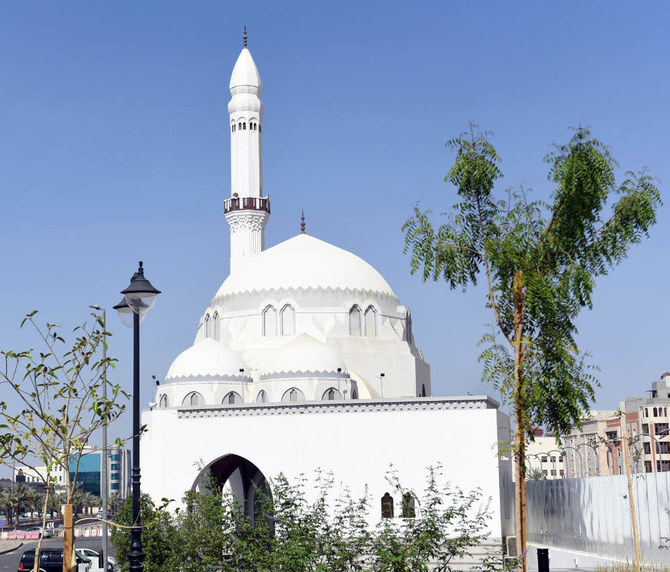
Al-Jum’ah Mosque is one such place, linked to the migration of Prophet Muhammad from Makkah to Madinah.
The mosque is the site where the prophet stopped in the Wadi Ranuna region and performed the Jum’ah, or Friday, prayer.
Al-Jum’ah Mosque holds different names, such as Al-Wadi Mosque and Atikah Mosque.
As a site of historical significance with a prominent role in Islamic history, today it sees a number of visitors who come to perform their prayers.
It is situated southwest of Madinah, near Wadi Ranuna, 900 meters north of the Quba Mosque and 6 kilometers from the Prophet’s Mosque.
It was built with rocks initially then demolished and renovated several times. Before the last expansion, the mosque was built over a small mound, with one dome made of red bricks. Then it was rebuilt and expanded to accommodate 650 pilgrims.
The mosque also includes a minaret, a main dome in the middle of a praying area and four small domes on its sides.
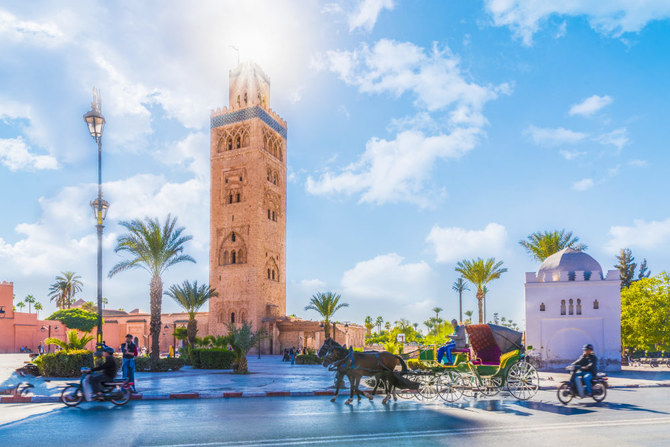
Time Out magazine ranks Marrakech 7th among top 53 cities. List also includes Dubai, Abu Dhabi, Doha
Marrakech has been ranked seventh in a new list of the world’s 53 best cities, compiled by British events magazine Time Out.
Dubai (40), Abu Dhabi (45) and Doha (53) were the other Arab cities receiving plaudits for their offerings in nightlife, liveability, and practical issues such as walkability and sustainability.
The magazine’s annual ranking this year was the first since 2019 to not revolve around resilience to the COVID-19 pandemic, instead focusing on the fun and practical frills that each city has to offer.
Time Out said it had “added extra weight to the things that make cities great places to visit as well as to live.”
It added: “Our top cities this year are the ones with thriving nightlife, amazing food and drink, and art, culture and museums galore.
“We’ve highlighted places that aren’t boring or overly expensive or overrated, and we’ve ensured that our top picks also score well for practical stuff like walkability, good public transport and safety, as well as sustainability.”
The editors were charmed by the “community, creativity and faith in the future” that made Marrakech “come roaring out of the pandemic with a new lease of life.”
Time Out spoke to local guides and experts to get a feel for what is particularly excellent about each urban hub.
Highlighting the new international storytelling festival in February, it said post-pandemic Marrakech has attracted “big players like La Mamounia” that were “sporting sassy new looks.”
The Moroccan cultural capital was described as “thriving,” with the magazine pointing to a range of exhibitions.
It added that El-Fenn had launched “the hottest Sunday music nights in town,” with visitors desperate to return.
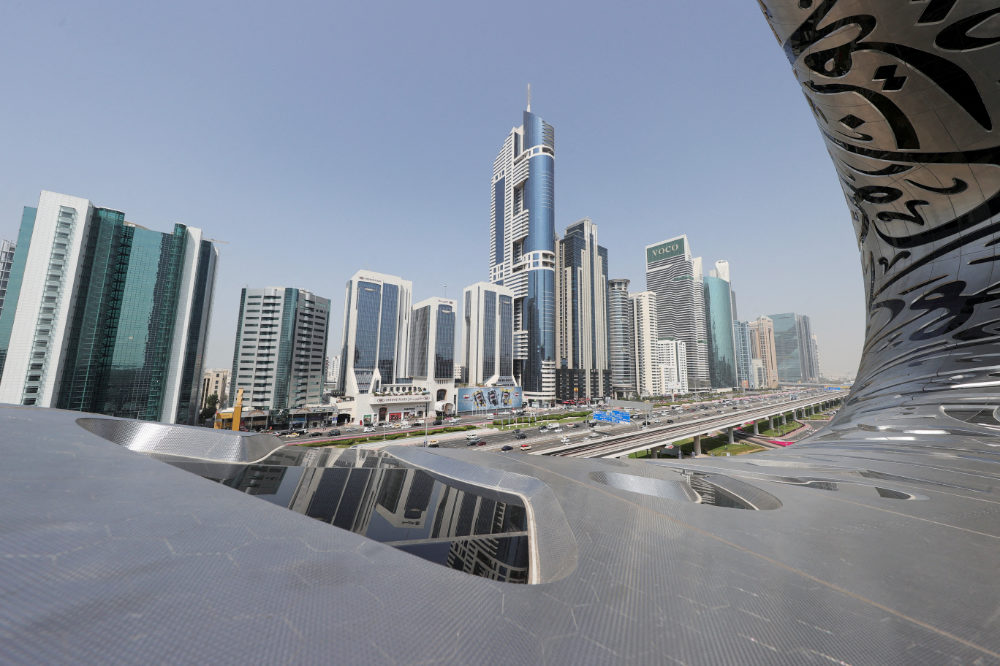
Time Out said Dubai “has all the stuff you’d want from a travel destination — from incredible restaurants and buzzing nightlife to some of the world’s best shopping and simply stunning beaches.”
It also pointed to its modernity and cleanliness, highlighting that 97 percent of the locals say the city is clean.
Dubbed “a city of superlatives,” Time Out pointed to the emirate boasting the world’s highest infinity pool, tallest building and largest manmade island. Dubai heard the phrase “go big or go home” and truly took it to heart.
But while those “world’s largest” structures are static, the city is anything but. A vibrant events scene has introduced the newly opened Museum of the Future, with Time Out recommending that you follow your visit “with a beach club crawl along the rapidly expanding Palm West strip and a DJ set at Electric Pawn Shop.”
Time Out noted that Emirati capital Abu Dhabi is also the “unofficial arts and culture capital” of the UAE.
Pointing out that the city’s safety and cleanliness made it popular with expats, the magazine referenced the constant stream of exciting things to do, “from cutting-edge restaurant openings to major new museums including the Guggenheim Abu Dhabi and the National History Museum Abu Dhabi,” both of which are on the horizon.
Local expert Heather Cichowski, from Time Out Abu Dhabi, said the city “ranks among the least dirty, stressful and rude. In short, it’s an all-round comfortable and pleasant place to live and work.”
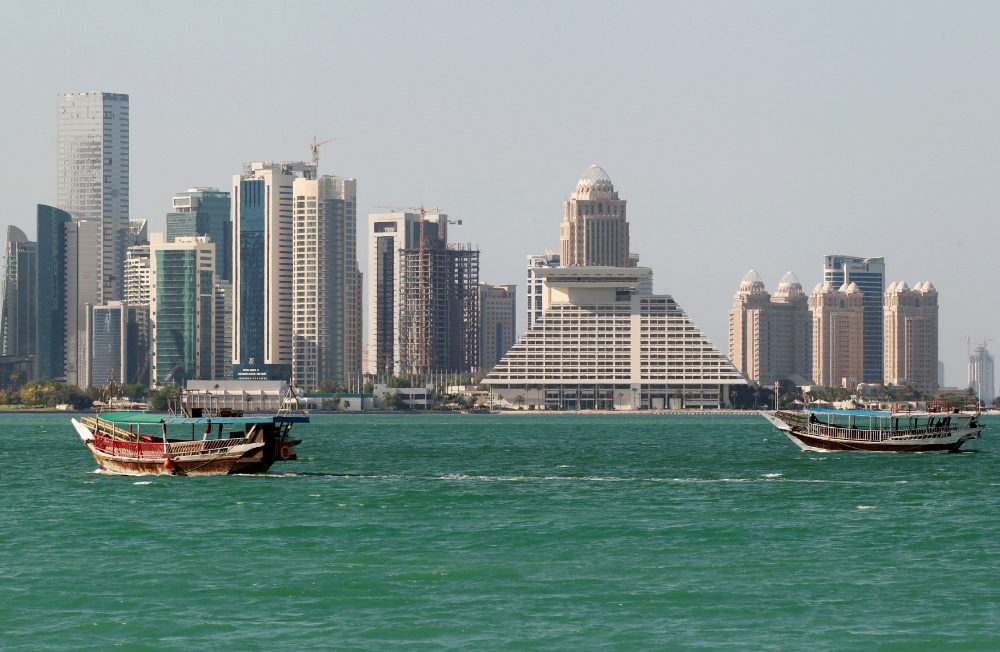
Like Dubai and Abu Dhabi, Doha was similarly praised for its cleanliness, but locals and expats have also lapped up the Qatari capital’s stream of events and activities.
As Doha gears up to host this year’s FIFA World Cup, the pinnacle of the world’s most popular sport, the city has been promoting its local events for every taste and persuasion.
Time Out said: “There’s loads of great stuff to see and do here, whether you fancy heading out to one of the city’s many cafés for breakfast (and we mean many, Doha’s coffee-and-cake culture is absolutely thriving), touring public art spots from Al Sadd Metro Station to Katara Cultural Village, or visiting a bar after hours.”
Boasting a slower and less stressful pace of life, the city is pouring attention into its arts scene.
The magazine said from now until the turn of 2023, some 17 new exhibitions are set to open, including an “immersive light installation from Pipiliotti Rist at the National Museum of Qatar,” which it described as “particularly stunning.”
source/content: arabnews.com
_____________
Marrakech. (Shutterstock)A view of the downtown skyline is seen from the Museum of the Future in Dubai, United Arab Emirates, February 23, 2022. (REUTERS)Buildings are seen on a coast line in Doha, Qatar. (REUTERS)
Dr Samiha Sinan worked as an internal medicine doctor for 43 years in several Saudi hospitals
Saudi Minister of Health Fahad Al-Jalajel has named 65-year-old retired doctor and volunteer Dr. Samiha Sinan the “Mother of Volunteers.”
“One retires from office work, not from serving pilgrims,” Al-Jalajel said, praising Sinan’s efforts in providing health care to pilgrims.
Sinan told Arab News that volunteering to serve pilgrims is a work of great honor if done sincerely and honestly.
She worked as an internal medicine doctor for 43 years in several Saudi hospitals, retiring four years ago.
As soon as the pandemic hit across the world, placing great pressure on the health sector, Sinan jumped back into the field to help out.
“I am still able to give, and I tried to think of how a person could serve their religion, country and king, so I submitted a request on the volunteer platform at the Ministry of Health. I was afraid I would be rejected given my age, but my instinct told me to apply because I wanted to give and serve. The Ministry of Health approved my request, and I immediately decided to get back in the field and fight the pandemic,” she said.
Sinan added: “The Makkah health authorities tried to put my comfort first and asked me to work in a small medical clinic in Makkah, but I refused since the pandemic was growing stronger. I headed directly to a COVID-19 center in an isolated area in Al-Masfalah, in Makkah. No one was allowed to enter or leave, but we worked in a comfortable environment thanks to the measures the state had taken to support citizens. I volunteered there for two years, 12 hours a day, seven days a week.”
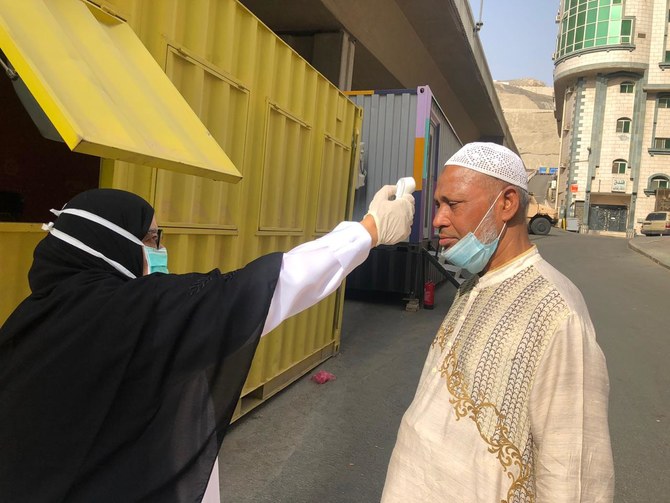
Even though COVID-19 has witnessed a steady decline in the Kingdom over the past few months, Sinan still volunteers in one of the squares at the Grand Mosque by providing medical care to injured pilgrims.
source/content: arabnews.com (headline edited)
________
Dr Samiha Sinan volunteers by providing medical care to injured pilgrims at the Grand Mosque. (Supplied)
July 10 marks the death anniversary of the late iconic international Egyptian actor Omar Sharif.
On this occasion Egypt Today looks back at some of the milestones that led to his international debut.
Sharif’s childhood
Born in Alexandria as Michel Dimitri Chalhoub on April 10, 1932, he was of Lebanese descent, but was born and bred in Egypt. His parents were of good social standards; his father in the wood business and his mother a notable society hostess who often hosted King Farouk to play cards.
Growing up, Sharif easily became multilingual as he was brought up by his French speaking mother and attended an English boarding school and Victoria College; he also became fluent in Italian, Portuguese and Spanish.
After graduating from Cairo University with a mathematics and physics degree, he attempted to follow his father’s path of work but quickly receded and went on to London to the Royal Academy of Dramatic Art.
Sharif realized his passion for acting at the tender age of 13 when he participated in his English boarding school’s theatre program.
This horrified his father, since it would stop his son from following in his footsteps and becoming a timber merchant. Later, Sharif’s talent overcame all obstacles and he became a world-renowned actor.
The immortal cinematic and romantic couple Sharif and Hamama
In 1954, Sharif starred in “The Desert’s Devil” (Shaytan al-Saharaa), but his break was the same year when he acted in “Struggle in the Valley” (Sira’ Fi al-Waady) alongside his wife, the late great Egyptian actress Faten Hamama.
The love story of Hamama and Sharif began when they worked together in Youssef Chahine’s “Struggle in the Valley.”
Despite being born Catholic, he changed his name and converted to Islam to marry her in 1955. A marriage that lasted for 20 years, the famed couple were the symbol of love to all the Egyptian audience.
They portrayed their love in a number of successful movies that will live on for years after their death; movies that taught us the true meaning of love, such as “Ayamna el Helwa” (Our Beautiful Days), “Nahr El Hob” (River of Love), “ Saydet el Kasr” (The Palace Lady), “Sra’a fe El Mena” (Struggle in the Port), among others.
El Sherif’s international Stardom
He achieved international stardom in 1962 by acting in Lawrence of Arabia alongside Peter O’Toole.
He maintained his status as a foreign heartthrob by leading in films like Dr. Zhivago and Funny Girl, which caused outrage in Egypt due to the romance with his leading co-star, Barbara Streisand, who won an Oscar for her role.
Funny Girl was based on a play with the same title also starring Streisand. This musical comedy drama is a biographic, based on the life of Fanny Brice, a famous female Jewish comedian of the 1900s who dreams of stardom in New York City’s Broadway.
Against all odds she rises to the top and falls for Nick Arnstein, played by Sharif, a businessman and compulsive gambler.
While the 60s were the best and busiest years of Sharif’s acting career, they were the ones which took a toll on his marriage with Hamama, and the couple shocked their fans by getting a divorce in 1974.
A resonating talent
His impeccable acting skills speak for themselves, but his mastery of contract bridge also precedes him. He wrote books on bridge, his favorite card game, and even established the Omar Sharif Bridge Circus.
However, his addiction to gambling eventually caused him money troubles, which led to his acting flops and his downward spiral.
Living alone and with little money, Sharif spent his later days living in hotels in Paris and London until he made a brief comeback with his role in the 2003 French film “Monsieur Ibrahim.”
The film received positive reviews, and Sharid even won the audience award for Best Actor at the Venice Film Festival.
Sharif was always keen to support and encourage young talents such as the famed Egyptian actor Mohamed Ramadan, who had a small role in Sharif’s only Egyptian soap opera “Hanan w Hanin” ( Tenderness and Nostalgia).
Ramadan previously announced in a number of TV interviews that Sharif encouraged him a lot and praised his acting talent, predicting at that time that he will be a superstar in the future.
“When I first met Omar Sharif, he greeted me as if I was family. He was someone who really loved people; when he found out that we were [both] Egyptian, we bonded instantly.
The main piece of advice he gave me was to start in Egypt and get that experience under my belt before trying to have a career internationally,” recounted the Egyptian rising international actor Amir El-Masry in an interview with Egypt Today.
The End
Sharif moved back to Egypt to spend his final days while struggling with Alzheimer’s disease. Sharif passed away at the age of 83 due to a heart attack on July 10, 2015. Sharif is a cheerful, handsome, talented and iconic artist who will remain forever alive in the hearts of his audience around the world.
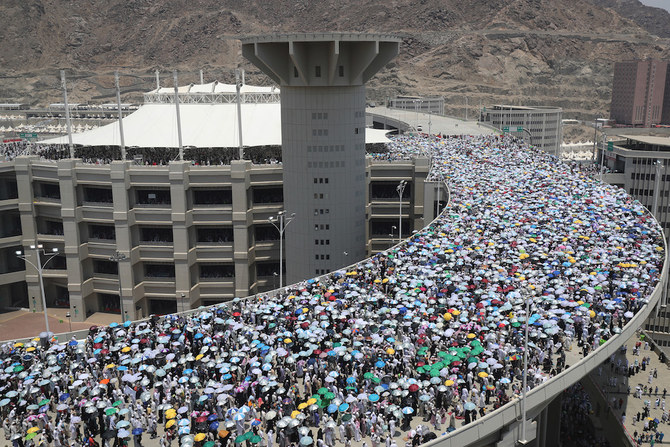
The Jamarat Bridge project is a massive structure built to save pilgrims’ lives and facilitate a crucial Hajj ritual.
Pilgrims gather in this place to throw stones at the devil in a symbolic act as part of their Hajj. Without this act, their pilgrimage is incomplete and considered to be unaccepted.
The concept of stoning the devil began when Prophet Ibrahim intended to sacrifice his son Ismael upon Allah’s order. The devil tried to dissuade the prophet three times from carrying out the order.
On each of the three occasions, the prophet pelted the devil with seven small pebbles to drive him away, after which the devil disappeared. This act has become a symbolic ritual and an integral part of Hajj.
It takes place over two or three days, from the 10th day of Dhul Hijjah until before sunset on the 13th.
The three pillars were previously built of stone and mud with low barriers surrounding them. They were then covered with cement, with the size of the pillars remaining unchanged for years.
However, the increasing number of pilgrims called for a project to help manage the hundreds of thousands of worshippers gathering in one place.
According to Mohammed Idris, former vice dean of The Custodian of the Two Holy Mosques Institute for Hajj and Umrah Research, the three pillars were surrounded by circular walls until 1975.
“A substantial enlargement of the area took place in 1987, and other expansions followed to upgrade the Jamarat area’s capacity to ease pilgrim movement and avoid accidents. The exit points and entrances to the pillars were amended, and the curved paths to the Jamarat were made straight,” he told Arab News.
The Jamarat Bridge was originally a pedestrian structure built in 1963 to facilitate the stoning ritual. Since then, it has been expanded several times to accommodate the increasing number of pilgrims.
A substantial enlargement of the bridge took place in 1974, and other expansions followed to upgrade the bridge’s capacity to ease pilgrim movement and avoid accidents.
Despite this, the structure witnessed several deadly incidents owing to actions of pilgrims who violated instructions, thereby sparking stampedes and deaths.
In 1990, over 1,400 pilgrims were killed by trampling and suffocation in Al-Ma’aisim pedestrian tunnel, which led from Makkah to Mina. Between 1994 and 2006, more than 1,030 pilgrims were killed in stampedes while trying to stone the pillars. Around 470 others were injured.
The worst stoning-related incident in recent memory occurred on Sept. 25, 2015, when more than 700 pilgrims died and another 800 were injured when pilgrims surged toward the intersection of Street 204 and Street 223.
A doctor at an emergency department of a Mina hospital told Arab News at the time that most of the pilgrims died of asphyxiation.
A Saudi interior ministry spokesman had blamed the stampede on “unprecedented high numbers of pilgrims” as compared to previous years, plus the fact that a majority of the victims had descended onto a pathway during a time that they were not allowed to enter it.
Witnesses to the tragedy had confirmed that a large group of Iranian pilgrims passed through Souq Al-Arab Street and refused to return, ignoring Hajj guidelines.
__________
FASTFACTS
• Stampedes and surges caused thousands of deaths at the Jamarat Bridge before the infrastructure was upgraded.
• The project, to alleviate overcrowding and avoid tragedies, cost $1.12 billion.
_________
Regardless of the causes of the tragedies, they prompted the Saudi government to devise a solution that could save lives. After the 2015 incident, Saudi Arabia’s King Salman offered condolences and immediately ordered an urgent review of the Hajj plan.
Over four years, Saudi authorities studied and researched the site before the old structure was completely removed and replaced by the existing engineering marvel known as the Jamarat Bridge.
The new project details were approved by top engineering and architectural committees consisting of local experts and highly experienced US, German, and British engineers. The opinion of senior Muslim scholars was taken into consideration for the religious position on the project details.
“In 2005, the circular walls around the pillars were reshaped, making them elliptical to facilitate the movement of the pilgrims,” Idris told Arab News.
“ In 2007 the old Jamarat project was discarded, and work on the new project began. A year later, one floor as per the project was fully constructed. In 2009, the second floor was made ready to serve pilgrims. By 2010, the entire planned construction was fully complete.”
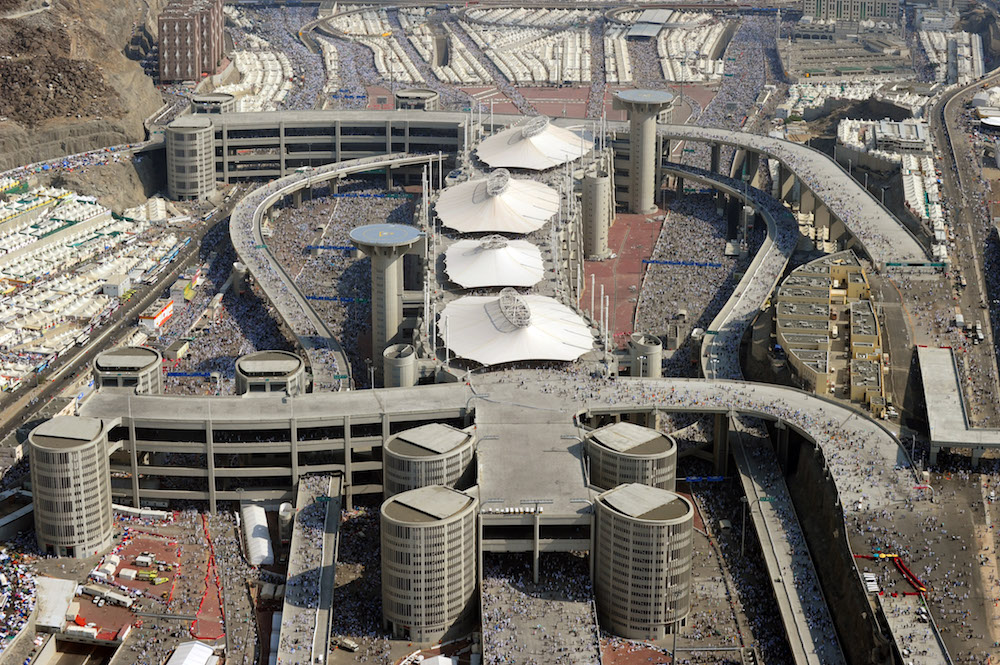
The bridge, which was constructed over three years by more than 11,000 workers, is 950 meters long and has six floors, including the basement, with a height of 12 meters per floor. Each floor can absorb up to 120,000 pilgrims per hour.
Its foundation was constructed to withstand 12 floors to accommodate 5 million pilgrims by 2030.
On the fifth level, umbrellas cover the site of the three Jamarat to enhance the comfort of pilgrims and protect them from the sun and heat.
The Hajj infrastructure showpiece, which has won several local and global awards, was built at a cost of over SR4.2 billion ($1.12 billion).
It has 12 entrances, 12 exit roads from four directions, two tunnels, 19 ramps, escalators, emergency exits, helipads, six service buildings, and an air-conditioning system with water sprinklers to cool the atmosphere and reduce the area’s temperature to 29 degrees Celsius.
The building also contains three electric stations and a standby generator that automatically supplies electricity in case of any temporary power cut.
Unlike the old circular shape of the walls around the three pillars, the new oval design has contributed to a better pilgrim flow. It has also assisted in increasing the bridge’s capacity for pilgrim numbers.
The new bridge was designed by Dar Al-Handasah and constructed by the Saudi Binladin Group. It features a wider and column-free interior space, longer Jamrah pillars, additional ramps and tunnels for easier access, large canopies to cover each of the three pillars to protect pilgrims from the sun, and ramps adjacent to the pillars to speed up evacuation in the event of an emergency.
No casualties have been reported at the Jamarat sites in six years. However, both Saudi Hajj and health authorities are prepared for any scenario. This year, 17 emergency centers will be present at Jamarat Bridge to assist in any emergencies — from crowd surges and falls to illness — that pilgrims may face on their Hajj journey.
source/contents: arabnews.com (headline edited)
___________
The walkway leading to the symbolic stoning of the devil, the oval design has contributed to better pilgrim flow and boosted the structure’s capacity for accommodating people. (AFP)A substantial enlargement of the bridge took place in 1974, and other expansions followed to upgrade the bridge’s capacity to ease pilgrim movement and avoid accidents. (AFP/File Photo)
A new stop on Egypt’s Holy Family Trail will soon be inaugurated in the Upper Egyptian governorate of Minya after development and restoration work.
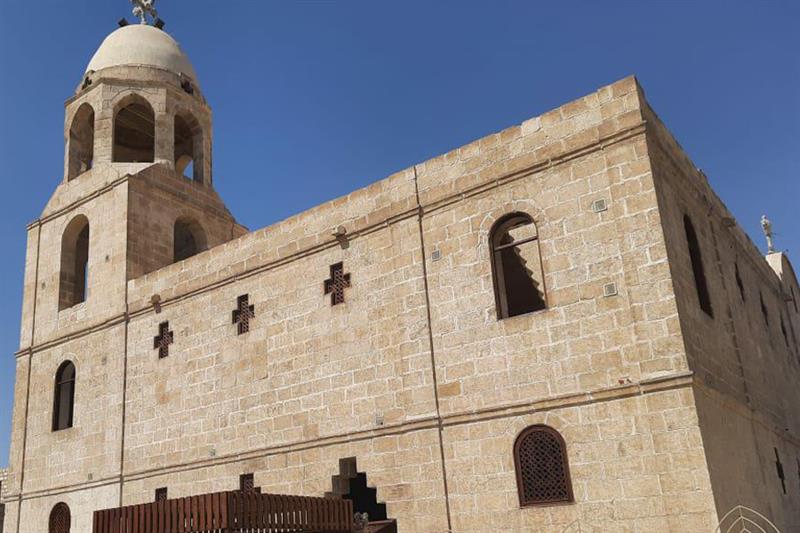
On top of the Gabal Al-Teir cliffs in the Upper Egyptian governorate of Minya stands the rock-hewn Monastery and Church of the Virgin Mary, with its distinguished architecture and wonderful view of the Nile Valley giving onto carefully cultivated fields and lush palm groves.
According to tradition, the area is called Gabal Al-Teir, meaning Mountain of the Birds, because of the thousands of birds living and nesting in the cliffs. It is one of the locations the Holy Family visited and stayed in for three days during their journey in Egypt in the early first century CE.
According to historian of Christian monasteries and churches in Egypt Abul-Makarim, while passing by the place in a small boat during the Holy Family’s visit, the Virgin Mary noticed an enormous rock coming loose from the mountain and about to fall on the boat.
But the infant Jesus extended his hand and stopped the rock from falling, and the shape of his palm was imprinted on the rock. In 1168 CE, the then ruler of Jerusalem removed the part of the rock bearing the imprint and took it with him to Syria.
Osama Talaat, head of the Islamic, Coptic, and Jewish Antiquities Sector at the Ministry of Tourism and Antiquities, said that the Church of the Virgin Mary at Gabal Al-Teir was built in 328 CE by the Byzantine empress Helena (mother of the emperor Constantine) in memory of the passage of the Holy Family in Egypt.
In 1938, Severus, the bishop of Minya, restored the church and removed the original stone roof in order to enlarge it.
The church consists of a nave with three sanctuaries and two side aisles and a western return aisle separated from each other by 10 rock-cut columns. On the south side of the church, the baptismal font is carved out of a column. The area in front of the middle sanctuary serves as a choir.
Hisham Samir, assistant to the minister of tourism and antiquities for archaeological projects, said that work on the restoration project at the monastery and church had begun in 2018 after the approval of the Permanent Committee of Islamic, Coptic, and Jewish Antiquities. The work was carried out in two phases, the first phase covering the western corridor and being completely finished. The second phase includes the southern corridor and is to be completed soon for the official inauguration.
The work has included the restoration of the walls and ceiling of the church, removing cracks, consolidating the walls, repairing the bell in the church tower, and its four arcades and domes. The façades of the church were mechanically cleaned, and the modern mosaic set up in 1987 on the eastern wall of its southern entrance has been replaced with another mosaic showing the journey of the Holy Family.
Fine restoration has been carried out on all the decorations and icons in the church as well as the icon frames. New lighting and fire-security systems have been installed as well as electronic gates. To enhance the visitor experience, new services have been provided, including information signs, new paths, sunshades and seats.
Facilities around the church are also being upgraded and infrastructure installed to assist visitors following the route of the Holy Family’s sojourn in Egypt. The goal of the larger Holy Family Trail includes developing poorer areas and communities in the Delta and Upper Egypt, restoring archaeological sites, and creating suitable services for visitors at sites along the trail.
This is all part of the ministry’s desire to develop spiritual tourism that can appeal throughout the year and not just during special seasons.
THE HOLY FAMILY IN EGYPT: The Holy Family travelled in Egypt for around three years and six months, with their sojourn in the places they visited varying from a few days to a few months.
The Holy Family’s flight to Egypt is associated with archaeological sites from Sinai to the Delta and Assiut in Upper Egypt. The Ministry of Tourism and Antiquities in collaboration with Egypt’s Coptic Church has carried out a number of restoration and development projects at churches and monasteries on the route.
These include the restoration and inauguration of the Abu Serga Church in Old Cairo, the St Abba Noub Church in Sammanud, monks’ cells and other structures at the Wadi Al-Natroun Monasteries, and now the Virgin Mary Church at Gabal Al-Teir.
The late Coptic pope Shenouda III approved itineraries drawn up for Christian pilgrims visiting Egypt to follow the route in 2000. During an audience in St Peter’s in Rome in 2017, Roman Catholic Pope Francis blessed an icon by a Vatican artist representing the Holy Family’s flight into Egypt and effectively gave his blessing to the millions of Christians around the world who may want to follow in the Holy Family’s footsteps.
The Holy Family’s flight to Egypt is associated with many archaeological sites, Osama Talaat noted. They journeyed south from Palestine across the wilderness, avoiding main roads for fear of capture. They entered Egypt at modern-day Rafah, where a lone sycamore tree is said to have survived on the site since their visit.
The Holy Family reached Arish, and from there they followed the old Horus Road along the Mediterranean coast to Zaraniq, where the Byzantines later built three churches. They continued to Al-Mohamediya, and their last station in Sinai was on the northwest coast near the edge of the Delta at the city of Pelusium, now the sprawling ruin of Tel Al-Farama. Here, archaeologists have discovered traces of several Roman churches.
They then travelled south along the Pelusiac branch of the Nile, which has long since dried up. They stayed in the city of Bubastis, now the ruin of Tel Al-Basta near the modern city of Zagazig. They then went on to Mostorod, where the Virgin is said to have bathed Jesus. There is a church in Mostorod named after the Virgin Mary that was built in the 12th century and that has been recently restored.
They then turned north again towards the town of Bilbeis, travelling northwest across the Delta. When they reached Damietta, they embarked on a ferry which took them to Sammanud. The Holy Family then continued north to Borollos. The next stop was Sakha in the western Delta. Here, the Virgin Mary is believed to have held her son against a rock which retained his footprint. A relic in the church dedicated to the Virgin in the area bears this mark.
The Holy Family then moved on to the Western Desert, eventually reaching Wadi Al-Natroun, where monastic settlements were later established. They then headed for what is now Cairo, where they stopped at Ain Shams and Matariya, where they sheltered under a sycamore tree, now known as the Virgin Mary Tree. One story says that when the Virgin Mary sat there, a spring of water gushed out of the ground.
The next stop for the Holy Family was Al-Zeitoun, and then Al-Zweila. Travelling south, they reached Old Cairo and hid in a cave that is now the crypt of the Church of Saint Sergius. In what is now Maadi, they went to the place now named the Virgin’s Church of the Ferry. From there, the Family took a ferry across to Memphis and embarked on a boat that carried them to Upper Egypt.
Their first stop there was on the west bank of the Nile near a village now called Ashnein Al-Nassara at a place called Al-Garnous where a monastery was later built. A church dedicated to the Virgin was built at Deir Al-Garnous in the 19th century, on the west side of which is a well that is believed to have provided the family with water.
The journey continued towards Al-Bahnasa, Samalout, and then Gabal Al-Teir, where a monastery now stands. The Holy Family took shelter in a cave that is now covered by an ancient church. They travelled to Al-Ashmounein, Armant, and Dairout, and then crossed the river again and reached the town of Al-Qusseya.
They travelled east into the desert to Mount Qussqam, perhaps the most important of all their stations, where they stayed for six months and 10 days. This place was later called Al-Muharraq, which means “burnt”, as there was an abundance of grass there which had to be burned so food could be grown in its place.
Mount Qussqam is sometimes called “the second Bethlehem”, and its church is held to be the first ever built in Egypt. The cave in which the family sheltered later became the altar of the Church of the Virgin Mary.
According to Ahmed Al-Nemr, a member of the ministry’s scientific office, an angel of the Lord appeared to Joseph in Assiut and told him to return to Palestine because king Herod was dead. The family then went back through Assiut and then probably sailed down the Nile to Memphis, landing at what is now Al-Badrashin near the ancient capital.
Once again, they may have passed through Maadi, Babylon, and Heliopolis before crossing the desert to Palestine and finally reaching their home town of Nazareth. “Not all of these places are archaeological sites, but they all share religious, social, and cultural rituals which derive from the holy journey,” Talaat said.
The places at which the Holy Family stopped that house archaeological sites are the Virgin Mary Tree in Matariya, the Church of St Sergius in Old Cairo, the Monasteries of Wadi Al-Natroun, the Church of the Virgin Mary at Gabal Al-Teir in Minya, and the Al-Muharraq Monastery in Assiut.
*A version of this article appears in print in the 7 July, 2022 edition of Al-Ahram Weekly.
Nearly 10 years ago, Egyptian filmmaker Ali El-Arabi, the award-winning documentarian behind “Captains of Zaatari,” which hits Netflix this month, made a promise. He was in the Zaatari refugee camp in Jordan, the largest temporary settlement of displaced Syrians in the world, and a teenaged boy he had just met named Fawzi Qatleesh asked if he could speak his truth to the camera.
“On the first day I arrived, he asked me, ‘Ali, can you film me? I want to say something to the people outside of this camp.’ The second he started to talk, I said to myself, ‘This boy is my hero,’” El-Arabi tells Arab News.
As the film hits Netflix this month in the Middle East, El-Arabi is overjoyed. Finally, after seven years of filming and a years-long global festival tour, his promise is fulfilled.
El-Arabi knew what it felt like to have a message that people needed to hear. He was himself once an athlete, a dedicated and successful martial artist, even winning Egypt’s national kickboxing championship. During the Egyptian revolution, however, El-Arabi abandoned any future he might have in sport, instead turning towards filmmaking.
“I started to feel I had something to say, but I couldn’t say it with my voice,” he says. “I realized filmmaking was the way I could say it. I started making small documentaries about what was happening and screening them in the street. One day, the police came and I took my film and I ran. That made me realize the power of what I could say with a camera.”
El-Arabi left Egypt, partnering with the ZDF TV channel to film documentaries in war zones including Iraq, Syria, Kurdistan and Afghanistan. War reporting, however, was unfulfilling, as it so often stripped away the humanity of those caught in its horrors.
After meeting Qatleesh and his friend Mahmoud Dagher — the two boys he would ultimately follow from the refugee camp in Jordan all the way to an elite soccer program in the Gulf — El-Arabi filmed them for seven years before whittling their story down to a scant 75 minutes, resulting in a story that showed their incredible journey while also refusing to gloss over the realities of refugee life.
Since its limited release in 2021, the film has already transformed the lives of both young men whose story it follows.
While he may be done telling their story, El-Arabi has been hard at work over the last few years on another — “Ashish’s Journey” — about the upcoming FIFA World Cup. It is inspired by a man who approached him in Qatar as he filmed “Captains of Zaatari.”
The more time El-Arabi spent with the man, the more his innocent aspirations intrigued him, leading him to not only film Ashish in Qatar, but to follow him and his family back to India, even adding fictional elements (with Ashish playing himself) inspired by the classic French satirical novella “Candide” to the docu-film.
“He’s actually a very good actor,” El-Arabi says.
While El-Arabi knows that he will finish filming later this year at the World Cup, chronicling Ashish’s adventures during the games, he does not plan to rush the film out in the immediate aftermath of the event.
El-Arabi has other projects in the works as well. He’s currently producing a film about Algeria and discussing producing an upcoming project with his best friend Mohamed Diab, the director of Marvel’s “Moon Knight.” Closest to his heart, though, is the fiction film he has in the works between Los Angeles and Egypt, inspired by both his own history in boxing and his relationship with his father.
While telling Arab stories will remain a key part of El-Arabi’s career moving forward, ultimately what drives him is not capturing his identity — it’s capturing his soul.
source/content: arabnews.com (edited)
_____________
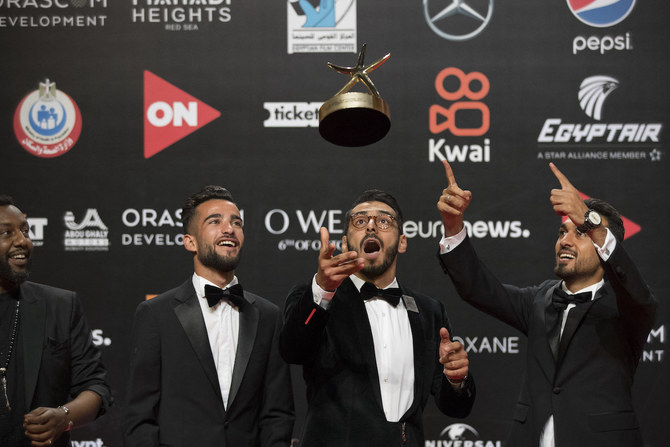
(From left) Mahmoud Dagher, Ali El-Arabi and Fawzi Qatleesh with the award for Best Arab Documentary Film at El Gouna Film Festival in 2021. (AFP)
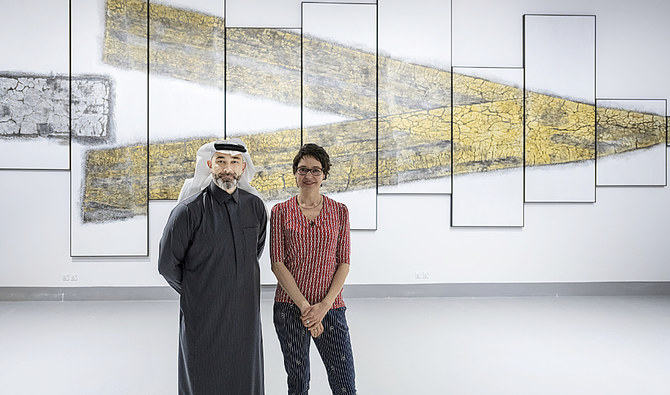
As visitors arrive at the end of the impressive first Diriyah Contemporary Art Biennale their attention is drawn by a gigantic yellow arrow nearly 20 meters long on the wall.
If they look closer at the artwork, titled “E Pluribus Unum – A Modern Fossil,” they can see the numerous cracks in the body of the arrow.
The artwork was created by Tunis-born, Berlin-based artist Nadia Kaabi-Linke, who this year won the fourth Ithra Art Prize. Each year the prize, which was set up in 2017, gives up to $100,000 for the creation of a new artwork that becomes part of Ithra’s permanent collection.
Kaabi-Linke’s massive work presents a contemplative way to look at the pandemic, notably, the decline in commercial air traffic during 2020, which, according to the artist, raises questions as to how humanity measures its progress and environmental awareness versus economic profit.
“The work is meant as a metaphor for modern times,” she told Arab News. “It is particularly relevant to 2020 because all of the airplanes in the world stopped flying.”
The artist relates it also to Tempelhof Airport in Berlin, which has been shut for around 13 years and is used as a camp accommodating up to 7,000 refugees. “I saw a parallel in this because we were all grounded, all of humanity and I think it is an exceptional moment in human history,” she added. “I also wanted to draw the parallel between the aviation industry and the economy. The symbol of economic growth is the rising arrow.”
The cracks, explains Kaabi-Linke, are there because it represents an abandoned airport. The work is a print made from an existing arrow that shows where the planes land and where they take off. “It brings you back to the earth as the cracks in the arrow also refer also to the idea of a cracked earth. The question that the work asks is: Do we want to stay in a world as we know it that has no future or do, we want to take the risk to go to something that is unknown but that probably has a future?”
“At Ithra, our commitment to contemporary art is embodied in this art prize,” Ashraf Fagih, head of programming at Ithra told Arab News. “This year is different for two reasons: First, we have opened up the prize to 22 Arab countries and not just artists in Saudi. Secondly, we are collaborating with the Diriyah Contemporary Art Biennale. To us this has special significance because it means the Ithra Art Prize came back home.”
The prize was previously unveiled during Art Dubai.
“As a distinctive landmark in the Saudi art scene, and in integration with its most prominent event ever, the prize’s artwork was unveiled during the Diriyah Contemporary Art Biennale,” said Fagih. After the biennale the artwork will travel back to Ithra in Dhahran in the Eastern Province to become part of the institution’s permanent collection.
source/content: arabnews.com (headline edited)
___________
Ashraf Fagih, head of programming at Ithra with Ithra Prize winner artist Nadia Kaabi-Linke. (Supplied)
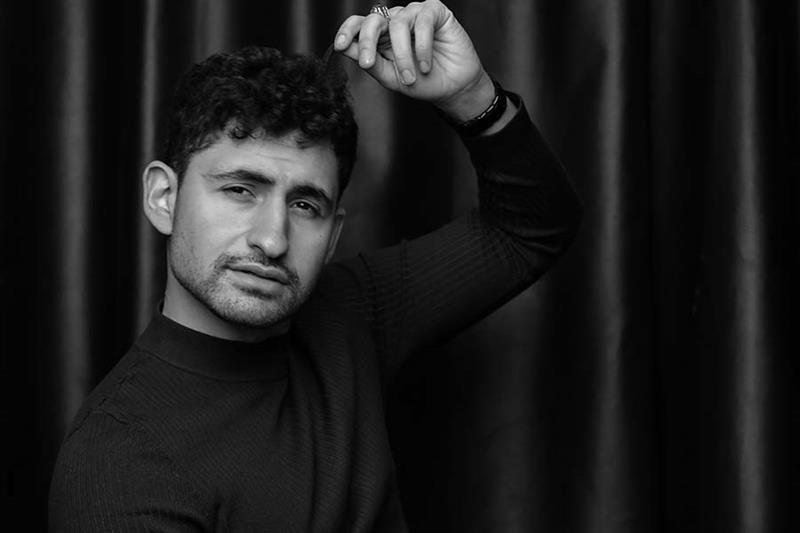
Egyptian actor Amir El-Masry was cast in the upcoming fifth season of Netflix’s historical drama The Crown, according to a PR representative on Wednesday.
El-Masry will portray the young Egyptian billionaire Mohamed Al-Fayed, Egyptian-born UK-based businessman, owner of Hôtel Ritz Paris and formerly Harrods department store and Fulham FC.
The cast of the fifth season also includes Egyptian-British actor Khalid Abdalla who has ben cast as Dodi Fayed , Mohamed Al-Fayed’s son and late Princess Diana’s boyfriend. Abdalla will play opposite Elizabeth Debicki as Diana.
Born in Cairo in 1990 and raised in London, El-Masry’s career kicked off with roles in Egyptian films, earning him Best Young Actor at the Egyptian Oscars in 2009.
Graduating from The London Academy of Music and Dramatic Art in 2013, Amir appeared in Jon Stewart’s debut feature Rosewater and various acclaimed TV series before his breakthrough role in The Night Manager (2016), followed by Lost in London (2017), The State (2017) and Age Before Beauty (2018).
Other notable credits include the critically acclaimed BAFTA nominated mini-series The State, a series regular role of Dante in the new BBC series Age Before Beauty and the lead in the first American-Saudi feature The Arabian Warrior.
Following the reign of Queen Elizabeth II, including political and romantic events that have shaped the twenty-first century, The Crown is considered one of the greatest series in the history of drama.
The series has won over 130 awards, including 21 Primetime Awards, of which seven were during the 73rd Primetime Emmy Awards in 2021, scooping awards of all categories.
The first season of The Crown was released in November 2016. Its fifth season is scheduled for release in November 2022.
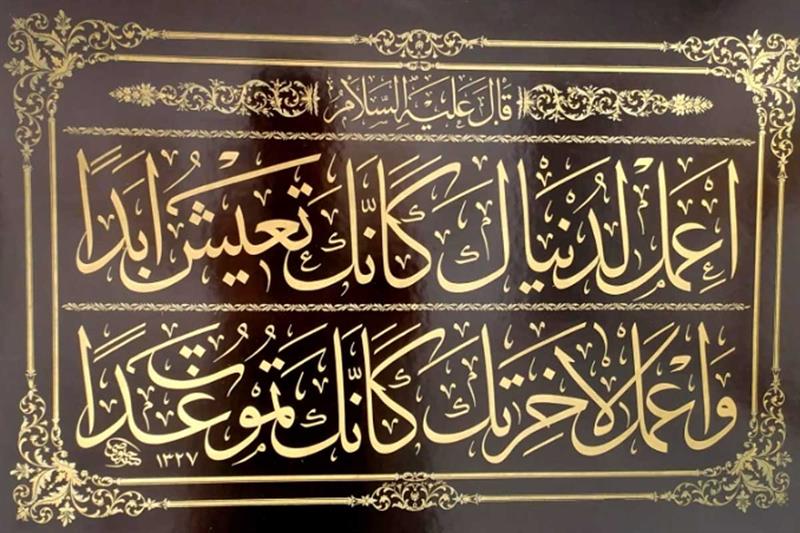
Cairo witnessed the seventh edition of the Cairo International Biennale of the Arabic Calligraphy Art under the auspices of Minister of Culture Ines Abdel-Dayem at the premises of Cairo Opera House.
Under the slogan ‘Pioneers and Renovators in 100 years (1922/2022)’, the biennale included a three-day seminar that ran from 6 to 9 June at El-Hanager Cinema that highlighted the most prominent figures of Arabic Calligraphy in Egypt and the Arab world as well as an art exhibition showcasing artistic gems of this Art from 125 countries represented by 15 artists at the Art Palace in the Cairo Opera House Complex that is running from 7 to 20 June.
Furthermore, the event established a new tradition of honouring artists and researchers for their achievements, and a side competition was held in the name of renowned Egyptian calligrapher Khedr El-Portsaidy — the founder of the Arabic Calligraphy Museum as well as the one who accredits and certifies Arabic calligraphers in Egypt.
In the opening session, Mohamed El-Baghdady — the general commissioner of the biennale — noted that this year marks the centenary jubilee of the establishment of Egypt’s first calligraphy school during the reign of king Fouad in 1922.
The session also included the presentation of a research paper written by Nahla Imam — country representative of Egypt at the 2003 Convention of Safeguarding the Intangible Heritage of UNESCO — who shared her experience in adding Arabic calligraphy knowledge, skills, and practice on UNESCO’s representative list of intangible cultural heritage in December 2021.
Mohamed Hassan Abu El-Khair — the first to innovate the ‘mashq’
The second day of sessions showcased the pioneers and renovators of such enchanting art.
The first paper was presented by researcher and calligrapher Mohamed El-Shafaai on passing down the practice of such art in Egypt, taking the family of Mohamed and Abdel-Aziz Abu El-Khair as an example, as the two are renowned Egyptian calligraphers that this year’s round was dedicated to.
He started off by revealing that the concept of passing down this form of art dates back to the pre-Islamic era, explaining that the initial idea behind Arabic calligraphy was transcription, and then the artistic element came later.
“During the pre-Islamic era, except for a small circle, very little knew how to write Arabic, and according to Abdalla Ibn Abbas, the first person to begin writing in Arabic in the tribe of Qureish was Harb Ibn Umaya — one of the masters of the tribe and the father of Sufian Ibn Harb.
The other key person in calligraphy art was El-Wazir Ibn Noqla, who was famous during the Abbasid Caliphate and inherited the art from his father El-Ali Ibn Hassan, explained El-Shafaai.
Mohamed Hassan Abu El-Khair was born in Cairo in 1921, he studied in Al-Azhar and then joined The School of Improving Calligraphy when he was only 17, where he was the top of his class and was taught by calligraphy masters such as Sheikh Fakhr El-Din, Sheikh Ali Badawi, and Mohamed Hosni El-Baba — the father of iconic Egyptian actress Soad Hosni to name but a few.
He excelled in El-Sulus and Reqaa calligraphy and soon became a professor of the art of calligraphy at Oum El-Qoura University in Mecca for 20 years.
“He was the first to innovate in the mashq (an educational manual technique) of the solos of Arabic calligraphy that are taught to fourth graders, where he started teaching students to write whole sentences from the beginning instead of focusing on letters with no context,” El-Shafaai added.
Abdel-Qader Al-Shihabi — the calligrapher of the Palestinian government
The second paper focused on Abdel-Qader Al-Shihabi — a Palestinian calligrapher — that was written by Farag Hussieny. Al-Shihabi is a renowned Palestinian calligrapher whose fame reached its peak during the first half of the 20th century and was known as the ‘calligrapher of the Palestinian government.’
“Born and raised in Jerusalem, Abdel-Qader Al-Shihabi comes from a long line of calligraphers that started off this art between the 12th and 14th year of the Hijri calendar, however, Al-Shihabi learned calligraphy in Istanbul at the hand of Mohamed Ezzat, the biggest artist. He was known for his suluth calligraphy, which decorates the walls of Al-Aqsa Mosque to date. He also spent all his life teaching calligraphy in Jerusalem and encouraging young artists to follow his passion,” explained Hussieny.
Abdalla Al Zohdi: the calligrapher of Al-Haramein Al-Sharifine
The third paper covered the ‘calligrapher of Al-Haramein Al-Sharifine(The Two Holy Mosques) Abdalla Al-Zohdi and was written by Sami Saleh Abdel-Malak.
“Born in Nablus, Abdalla Al-Zohdi was born around 1251. His family moved to Istanbul, where he studied and excelled in calligraphy at a very early age. His artistic fame made him the official calligrapher of the Prophet’s Mosque in Medina, where his calligraphy adorns the walls and ceilings of the mosque till now,” the paper explained,
“During the reign of khedive Ismail, he was commissioned to write the calligraphy of the Keswa of the Kaaba and Mahmal. His implacable calligraphy was quite visible and stood out in the design of the keswa from that day onwards. He was known by his highly complex and geometric Sulus calligraphy.”