Arabs & Arabian Records Aggregator. Chronicler. Milestones of the 25 Countries of the Arabic Speaking World (official / co-official). AGCC. MENA. Global. Ist's to Top 10's. Records. Read & Enjoy./ www.arabianrecords.org
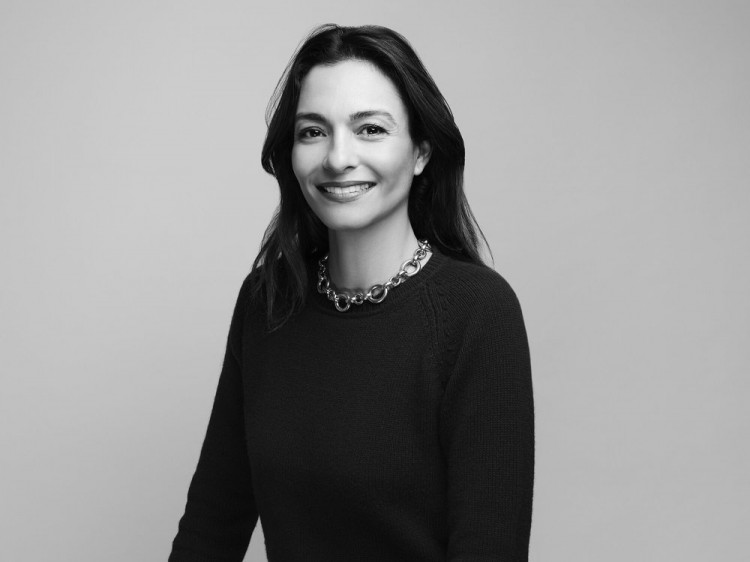
Tunisian-French Nadia Dhouib has been named the new General Manager of Paco Rabanne. The former Galeries Lafayette Champs-Elysees managing director succeeds Bastien Daguzan, who served in the role for five years.
Dhouib will report to Vincent Thilloy, chief brands officer of Paco Rabanne and Jean Paul Gaultier, another fragrance brand owned by Spanish firm Puig.
Dhouib, founder of RethinkRetail Advisory, has aided designers in their shift from Galeries to RethinkRetail.Advisory. “Retail isn’t dead – it’s boring,” she explained to Vogue Arabia at her Galeries appointment, saying that she wanted to create an experience for clients. Keep an eye on this place to observe the transformation she brings to Paco Rabanne’s property.
The maison was founded in 1966 and rapidly developed an avant-garde and current identity. Its Spanish founder, Francisco Rabaneda y Cuervo, was the son of Balenciaga’s head seamstress. He fled Spain’s Civil War for France, where he took the name Paco Rabanne. He began his career as an architect before transitioning to avant-garde accessory design and creating one-of-a-kind pieces for haute couture houses. In 1966, he started his eponymous label, which featured outfits comprised of moulded plastics, hammered metal, aluminum jersey, and knitted fur. His eponymous chainmail gowns—as worn by Françoise Hardy—remain emblematic of the house to this day.
In-person and virtual festival showcases films from Arab world and diaspora.
The Arab American National Museum in Dearborn, Michigan, will kick off the Arab Film Festival on Friday.
Home to one of the largest Arab-American communities in the country, some consider Dearborn to be the “Arab capital” of the US and the museum has been devoted to documenting, preserving and presenting the history, culture and contributions of the community since 2005.
The annual festival will run from August 12 to 21, with a line-up featuring comedy shorts and documentaries tackling America’s Israel bias.
“As a young Arab American myself, I never really saw my story, my family story reflected in the music I listened to or the films that I watched or the textbooks in my classroom,” said Dave Serio, curator of education at the museum.
“So our goal really is to kind of inspire Arab Americans to see their stories, their perspective, people that look like them, names that they might have, on the big screen.”
Beginning in 2005, it is one of the museum’s longest-running programmes and offers a range of windows into Arab cinematic creativity and storytelling.
One of the films in this year’s set is When Beirut Was Beirut from writer-director Alessandra El Chanti. The short is a “poetic hybrid documentary” that focuses on an imagined conversation between three famous buildings in the Lebanese capital and what they witnessed during the country’s civil war.
“I wonder what inanimate objects could say, because they also have stories, too,” Ms El Chanti, a Lebanese citizen who now lives in Doha, Qatar, told The National.
“I feel like we always go to Lebanon and we’re just passers-by — we recognise that there are war-torn buildings, you can see the bullet holes.
The film, which began production in 2020, was produced entirely over Zoom by an all-Lebanese team of six artists.
Many of the films at this year’s festival will be making their US or Michigan state debut, Mr Serio said.
Ms El Chanti hopes members of the Lebanese diaspora watching her film at the festival walk away feeling “there’s a lot that you should learn about your country that you don’t know about — it literally could be from the perspective of anything and everything”.
Yasmina Tawil, the director of film programming at the Arab Film and Media Institute — one of the festival’s sponsors — told The National that while Arab film festivals such as this are considered “niche” in the entertainment industry, they can build towards more inclusion in the mainstream.
“We’re not a Sundance, we’re not a Cannes.
“But when a distributor goes to pick up a film, [the festivals] will add to the credence and the hype of the film. And I would at least hope that distributors would look at that as a sign of one of their big audiences … already knows about and really likes the film enough to programme it in their festival.”
“They’ll get picked up for distribution in the Middle East, in Europe and then maybe not make it over here [to the US]. Or if a torrented copy does, it might not have English subtitles and things like that.”
She added that her institute’s mission is, in part, to serve as a “caretaker” for Arab films in America.
The museum has offered both virtual and in-person attendance options, opening its mission to viewers across state and national borders.
“The Arab-American community is ridiculously talented,” said Mr Serio. “And our film festival is just honoured to be able to showcase a fraction of the amazing work that the Arab-American community is working on.”
source/content: thenationalnews.com (edited)
__________
Poster for the 2022 Arab Film Festival at Dearborn, Michigan’s Arab American National Museum. All photos: Arab American National Museum
Arabic Calligraphy, the art of creating decorative handwriting or lettering, is one of the oldest art forms from the Arab region; one that has not only thrived with time but also evolved into a unique form of expression. It survived through several tumultuous periods that threatened its existence, from civil wars to an invasion by the Mongol Empire that destroyed Baghdad.
Even though the writing wasn’t as focused on in the past, with many Arabs preferring to memorize poetry and other forms of text and pass them down verbally, that changed significantly later. Calligraphy would flourish to include the preservation of the Quran, adorn mosques as well as the palaces of kings, and by royal scribes when writing decrees, among other things.
In celebration of World Calligraphy Day, we decided to dive into the past and look back at some of the most well-known and prominent calligraphers from the Arab world.
Ibn Muqla
One of the biggest names in developing and improving Arabic calligraphy, born in 885 AD in Baghdad, Iraq, during the Abbasid Caliphate, he started out as a tax collector before rising through the ranks and becoming the Caliph’s Vizier three different times.
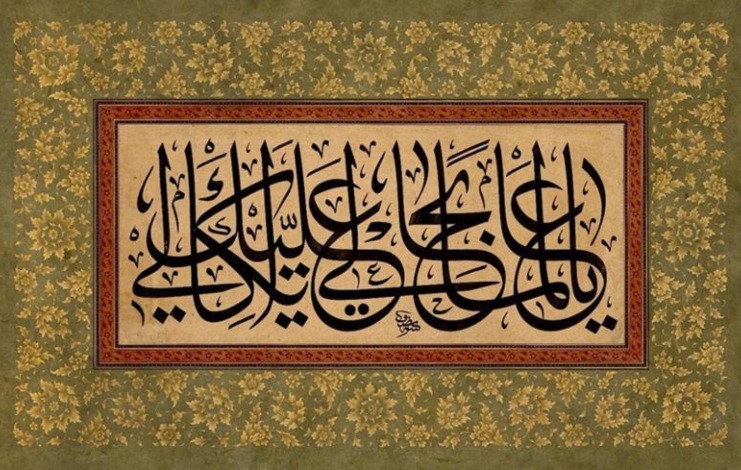
At this time, the Kufi style dominated the calligraphy scene, but Ibn Muqla invented new art styles that superseded the previous ones. Ibn Muqla was the one who invented the Thuluth and Al-Mansoub styles, as well as the foundations and rules for others, such as Naskh. The Naskh and Thuluth got further development throughout the centuries that followed, and calligraphers still use them today.
While the Kufic style was rigid in its overall design, Naskh had a more cursive structure but wasn’t as popular and as used at the time, Ibn Muqla changed that by improving on it and using it in official decrees, and private correspondence.
Ibn Muqla’s Thuluth style was new with its letters having long vertical lines with broad spacing. Its name translates to “one-third”, in reference to the maximum height for the letters on the same line must not exceed one-third of the ‘alif.
As for the Al-Mansoubstyle, it mainly focused on three measurements: the size of the period meaning the “Noqta”, the circle with a diameter equal to the height of the alif (the first letter in the Arabic language) and, and the height of the alif.
Little is known when exactly Ibn Al-Bawwab was born. However, we know of his existence and his body of work thanks to the survival of many of his manuscripts, Qurans, and texts referring to him by name.
With his name literally translating to “son of the doorman,” he didn’t grow up in a wealthy family and had to work to make a name for himself. He did so by learning about law and theology and working in several professions, such as a home decorator. However, he would later settle on working in book illumination and calligraphy.
Over years of hard work, he became renowned as a master calligrapher; fluent in six different styles in the field, perfecting the Al-Mansoub style and developing the Reyhani, Naskh, Tawqi, and Muhaqaq styles significantly.
Housed at the Chester Beatty Library in Dublin, Ireland, is the sole surviving Qur’an penned by Ibn al-Bawwab gifted to the country by Ottoman Sultan Selim I.
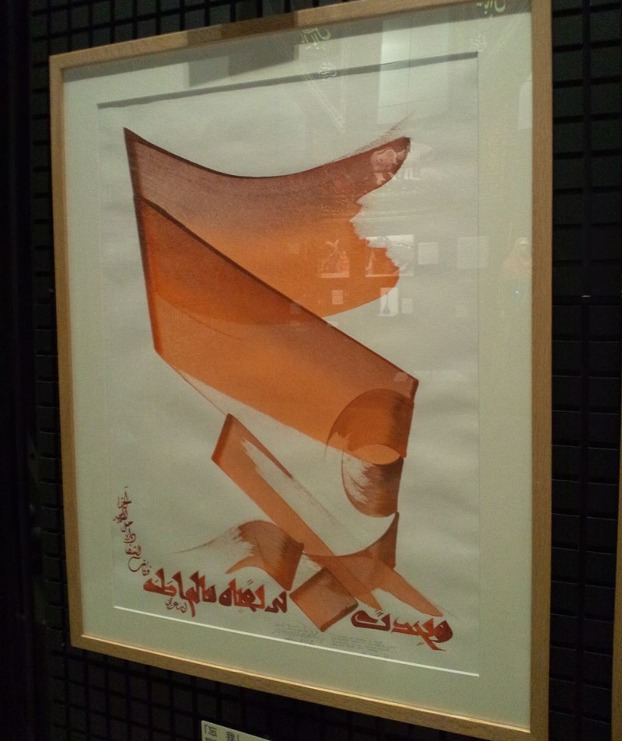
Originally from Syria, Mohammad Hosni Al-Baba was born in 1894 and is considered one of the last classical calligraphers. Al-Baba received his initial formal training with the Turkish master, Istanbul-based Yousef Rasa, who had renovated the Umayyad Mosque in Damascus, Syria. Al-Baba would later study under another renowned calligrapher, Mehmed Showki Afendi, author of the work “The Thuluth & Naskh Mashqs.”
He would later travel to Cairo, Egypt, becoming one of the leaders in Islamic and Arabic calligraphy, turning his home into a hub for artists, calligraphers, and poets. Al-Baba would be famous for improvements to the lettering in the Thuluth style, the linear structure of Arabic script, and was appointed by King Farouk as the first professor to be a master at the Royal Institute of Calligraphy.
His children would continue his legacy but in different fields since many grew up surrounded by artists when they visited Al-Baba’s home. The most famous of his children are actress Soad Hosni, dubbed “Cinderella of Egyptian Cinema,” and Najat Al Saghira, who became an actress and singer.
Born in 1944, Iraqi painter and calligrapher Hassan Massoudy continues to be one of the biggest inspirations for many modern artists today. French writer Michel Tournier even considered him as the “greatest living calligrapher” in 1989.
Massoudy grew up in Baghdad, Iraq, until 1969, when he fled to Paris, France, entering the École des Beaux-Arts, where he studied figurative painting. At the time, he looked for a job to pay for his studying, finally finding one as a calligrapher in Arabic magazines, writing their headlines.
While he wasn’t famous for a traditional calligraphy style, his distinct and elaborate designs made him stand out among the rest of the artists of his time. Massoudy would delve into the world of theater, collaborating with artists and choreographers, creating different productions focusing on the harmony of dance, calligraphy, and dance routines.
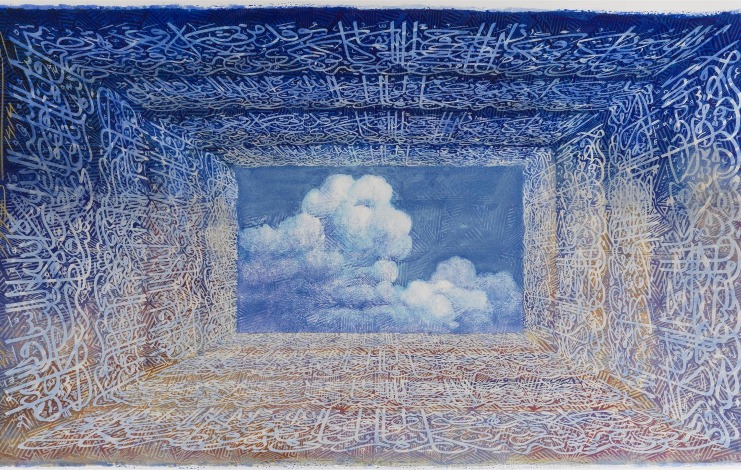
Studying abroad but seeking inspiration from his traditional roots, Tunisian artist and calligrapher Nja Mahdaoui invented the world of Arabic calligraphy as a graphic style, creating what was called “Calligrams.”
Born in 1937 in Tunis, Tunisia, he first started learning art history and painting at the Carthage National Museum. He later traveled to Rome, Italy, where he continued to study painting and learned more about philosophy at the Santa Andrea Academy. He also moved to Paris, France, where he went to the Cité Internationale des Arts and École du Louvre before returning to his home country in 1977.
His calligraphic style focuses mainly on the designs he creates as a whole rather than the composition of words since his “calligrams” resemble Arabic letters but have no literal meaning, leading to many naming him the “inventor of abstract calligraphy.” People can see Mahadaoui’s work on several materials used as a canvas, including jewelry, drums, leather, paintings, walls, glass, and so much more.
A UNESCO Crafts Prize laureate, Mahdaoui, graced the Facebook campus in 2018 by painting one of their halls using Arabic calligraphy in his unique style as part of the “FB AIR program,” turning their hall into a vividly colorful masterpiece.
Egyptian artist and calligrapher Ahmed Mustafa was born in 1943 in Alexandria, Egypt, graduating from the Faculty of Fine Arts at Alexandria University in 1966 before traveling to the UK on a scholarship to the Central School of Art and Design in London, England, where he earned his Ph.D. in 1989.
Inspired by his Islamic roots, his calligraphic works mainly focused on quotes from the Quran, among other sources. Working on several materials as his canvas, Mustafa has designs on glass and carpets, among others.
Mustafa also set up the Fe-Noon Ahmed Moustafa Research Centre for Arab Art and Design in London in 1983. He lectures and creates workshops globally as well as does commissions, one of which was presented by Queen Elizabeth II to Pakistan for the country’s fiftieth anniversary in 1997.
The following year, the Vatican invited him to do an exhibition at the Pontifical Gregorian University in Rome, Italy. World media at the time announced it as the first achievement of its kind in the history of Muslim-Christian relations.
Back in 1729, the Parisian authorities introduced the French capitals iconic blue-and-green street name plaques, topped with a little “Napoleon’s hat” containing the number of the street’s arrondissement.
The plaques honor France and the world’s leading politicians, philosophers, artists, writers, and scientists, including a number associated with the Arab world. French President Emmanuel Macron has previously proposed renaming some of the capital’s streets to include more personalities from ethnic minorities, but that has not yet happened. Still, there are enough Arab names to comprise a walking tour around Paris — including a president, a poet, a pop star and more.
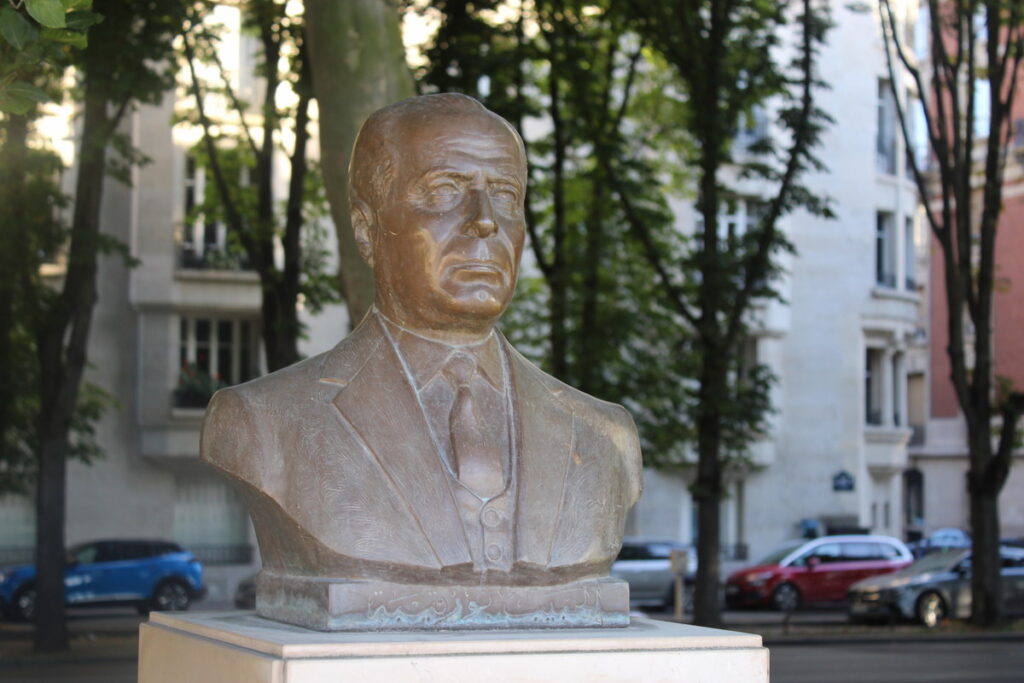
With a wonderful view of the Grand Palais, this large, peaceful stretch of greenery is named after independent Tunisia’s first president, Habib Bourguiba. The secular leader was in charge between 1957 and 1987, and was famously a supporter of women’s rights. Next to his plaque, there is a bronze bust of the leader looking towards the River Seine, with his name written in Arabic underneath.
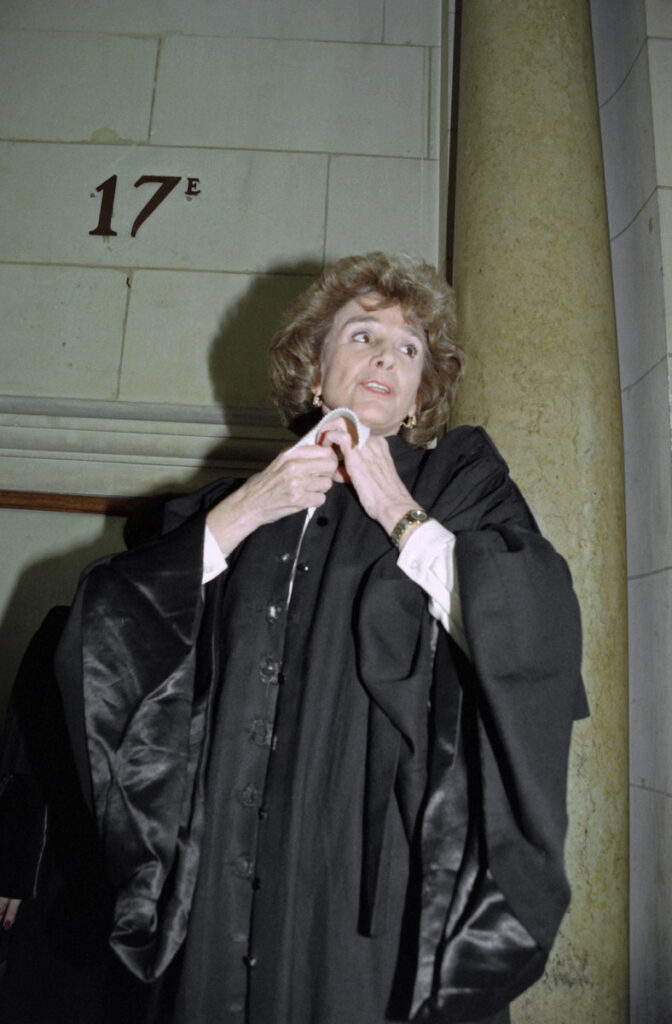
An admirer of Bourguiba, Halimi was a Tunisian-born French lawyer, feminist, and former member of the National Assembly in France. She died in 2020, aged 93, and this sloping pathway was named after her last year. Halimi’s life of hardships shaped the respected career she had. When she was born, her father hid her — ashamed of her gender. She went on a hunger strike at 10 and, at 16, rejected an arranged marriage, going on to study law in Paris. Halimi is perhaps best known for a 1972 trial, in which she defended a minor who had an abortion after being raped. It was a key event that propelled the country into legalizing abortion in 1975.
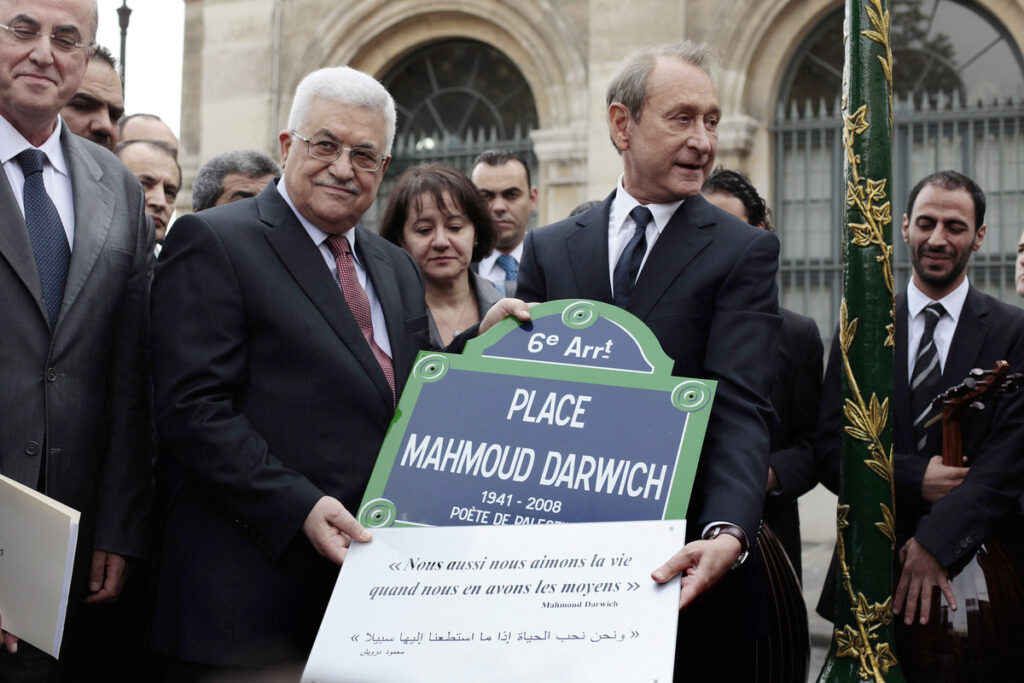
Paris mayor Bertrand Delanoe (second from right) and Palestinian President Mahmud Abbas (second from left) unveil on June 14, 2010 in Paris the new Mahmoud Darwich esplanade named after the Palestinian poet who died Aug. 9, 2008. (AFP)
In 2010, just two years after the death of Palestine’s most famous poet Mahmoud Darwish, a square in Paris was inaugurated in his honor. Known for his writings on home, memory, and exile, Darwish spent many years outside of his native land. He lived in Beirut, Cairo, Tunis, and Paris. He had a special connection with the latter, describing it as the place where his “true poetic birth” happened. The plaque is situated in a district the poet reportedly liked, on the banks of the Seine and near the classical buildings of Institut de France and Monnaie de Paris.
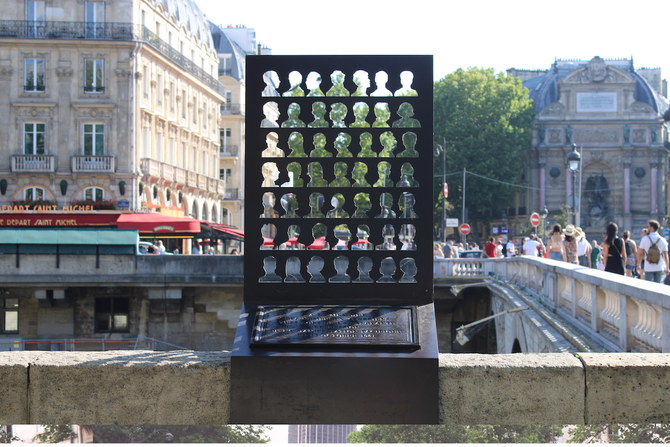
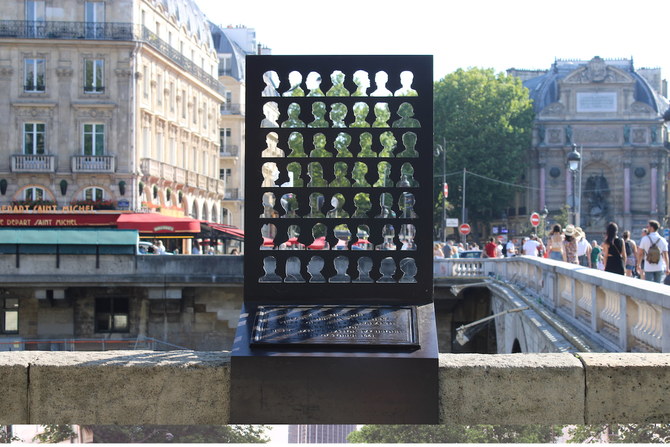
A few minutes away from Notre Dame Cathedral stands an unassuming but sobering reminder of how an Arab collective suffered during the turbulent Sixties. In 1961, when Algeria was seeking independence, a group of Algerian protesters were attacked by the police and some of their bodies were thrown into the Seine. In 2021, to mark the 60th anniversary of this horrific event, Paris mayor Anne Hidalgo inaugurated a memorial artwork, made of metal with silhouettes of heads carved out, in remembrance of those who lost their lives.
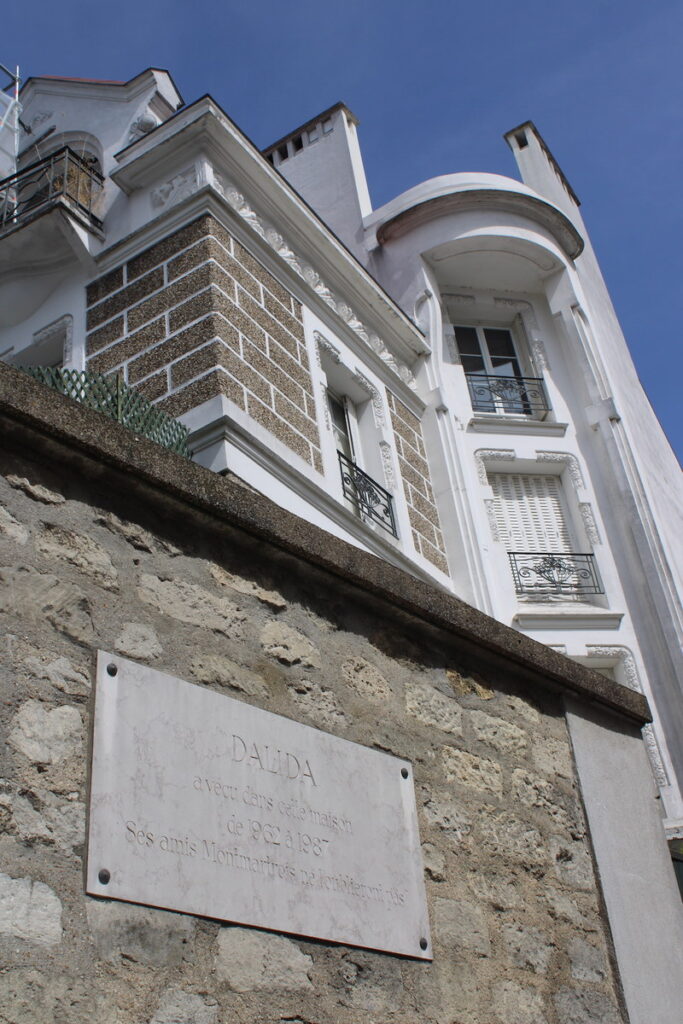
Between 1962 and 1987, the blonde bombshell diva Dalida, who was born to Italian parents in Egypt, lived in this four-story townhouse in hilly Montmartre, a quiet area outside of the bustling city center of the city that is historically associated with artists. Dalida sang in a variety of languages, including French, Italian, and Arabic. “Salma Ya Salama” and “Helwa Ya Baladi” are some of her most loved Arabic songs. Sadly, it was in this house that she committed suicide in 1987, as a result of tragedies in her personal life. The plaque on her house reads: “Her friends from Montmartre will not forget her.”
The acclaimed Lebanese-born poet and philosopher — and author of “The Prophet” — Khalil Gibran is well-known as a member of the Arab diaspora in 20th-century America. But he also lived in France for a time. Between 1908 and 1910, Gibran, who was then in his twenties, studied painting at Académie Julian in Paris. His stay in the city was made possible by the financial backing of American philanthropist, editor and Gibran’s lover Mary Haskell, who was 10 years his senior.
source/content: arabnews.com (headline edited)
___________
A memorial to remember the 1961 attack on Algerian protesters by the police in Paris. (Supplied)
Former hair-transplant specialist urges Iraqi women to ‘keep going until all your dreams are met’.
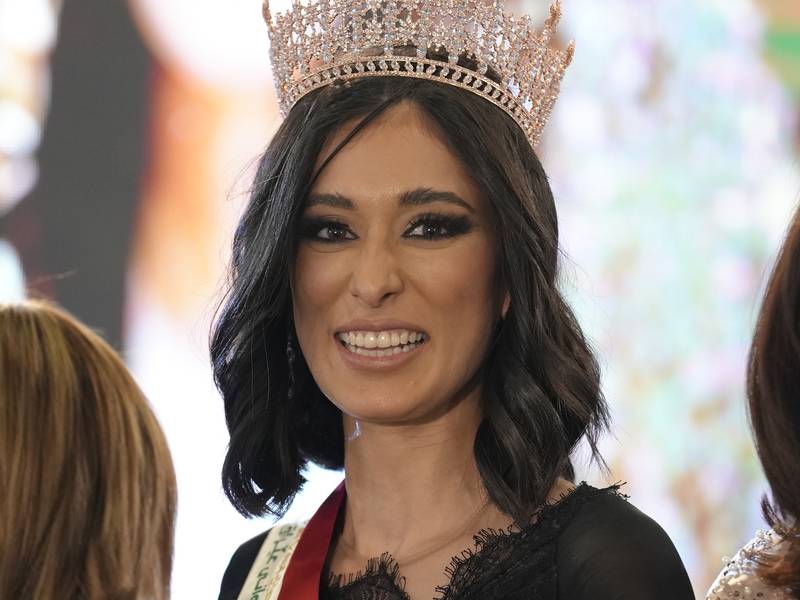
Balsam Hussein, a 26-year-old TV presenter and former hair-transplant specialist, has been crowned Miss Iraq 2022 at a beauty contest held in Erbil, capital of the northern Kurdish region.
Ms Hussein was among 19 contestants from across the country who were vying for the title and a chance to represent Iraq at the Miss World and Miss Universe events.
“I am highly motivated to participate in Miss World and Miss Universe pageants soon,” she said.
Ms Hussein’s win raises her public profile even higher, after starting work in April as host of a morning TV show for a private channel in Baghdad.
Speaking to The National, she said she had been hesitant to take part in the competition but decided to go ahead at the last minute after full support from her family and close friends, as well as from her followers on social media.
“My family have been happy and proud of me throughout my life, but they became happier and prouder when they watched me on TV being crowned Miss Iraq 2022,” she said. “I felt sorry that they were not able to come from Baghdad to Erbil as they were ill, but I never felt alone.”
Ms Hussein represented the Al Karakh district of Baghdad, the Iraqi capital where she was born and raised. She worked there as a hair-transplant specialist after training in Turkey before starting her TV job — something she said she had always dreamt of doing.
“I have a dream to improve the media and journalism field in Iraq, and of course, being a winner of Miss Iraq will help me to be closer to achieving that dream,” she said.
For Iraqis faced with uncertainty and instability as political groups squabble over forming a new government nearly 10 months after elections, the Miss Iraq pageant offered a window of hope for the future.
Ayman Hussein, 26, a resident of the southern province of Basra, said Ms Hussein’s triumph was “a win for Iraq and Iraqis”.
“It is a clear message that, in spite of political chaos, Iraq is able to hold such events,” he said. “Whenever there is war, there is life — this is our interpretation of life.”
Mr Hussein said he hoped to see Iraqi women take their rightful place in society. “Iraqi women experience hardship their entire life; it is the time to say ‘I am here’.”
Launched in 1947, the Miss Iraq contest was suspended for more than four decades in 1973 because of political upheaval and wars, and resumed only in 2015.
“From today, I represent all of Iraq,” Ms Hussein said. “I would like to send a message to all Iraqi women: do not give up, fight to get your goals, be patient. You have faced wars and difficulties; do not make the harsh conditions a rock in your path — destroy it and keep going until all your dreams are met.”
The judges declared Sarah Saad, from Baghdad’s Al Rusafa district, as the first runner-up, and Jihan Majid, representing Wasit, as second runner-up. Hind Akram, representing the Baghdad Belt, was the third runner-up, followed by Sarah Khaled from Mosul.
Kareem Rasheed, executive director of the Miss Iraq organisation, said: “Iraq is thirsty for such events like Miss Iraq. Year after year, we will do our best to develop it and make it reach people around the Arab world.
“The contestants represent about 90 per cent of Iraq — we covered the regions of south, middle Euphrates, west and north.
“This year, we decided to rate beauty at 50 per cent and inner essence, such as culture, education and so on, also at 50 per cent, while in years past we were focusing on beauty over essence.
“All women are beautiful and each one has a unique trait that makes her different from others.”
source/content: thenationalnews.com
__________
Balsam Hussein smiles after being crowned Miss Iraq 2022 in a pageant held in Erbil. Azhar Al-Rubaie for The National
An iconic table shared by Gulf Cooperation Council leaders at a recent summit was designed by a Saudi artist.
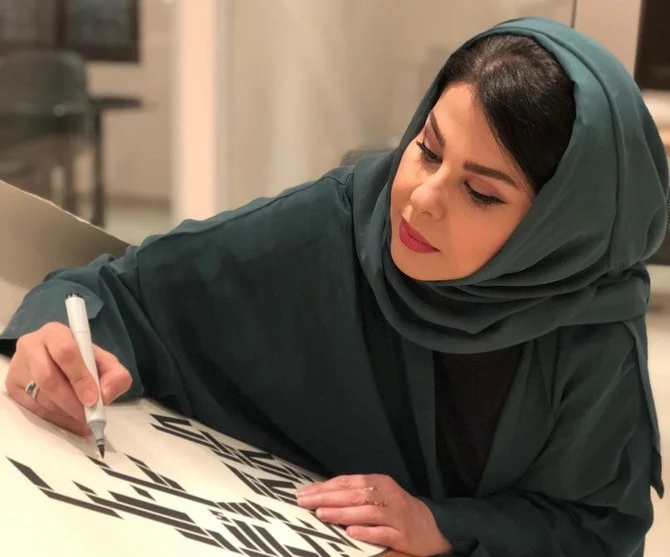
Lulwah Al-Hammoud produced the drawings for the item of furniture that took center stage at the meeting of GCC member states Saudi Arabia, the UAE, Bahrain, Oman, Kuwait, and Qatar, along with representatives of Jordan, Egypt, and Iraq.
She told Arab News of her pride and thrill at seeing the table being used by the organization’s leaders. Its design was inspired by the changes taking place in Saudi Arabia and her commission brief had been, “we are entering a new era, but we are not forgetting about our traditions.”
After accepting the design challenge, Al-Hammoud was initially nervous because she was not a furniture designer, however it turned out to be “a very beautiful experience.” And her background in Islamic contemporary art and calligraphy helped.
The round table is made of wood and in its center are triangles of different color tones of wood that rotate outwards with lines made of copper, a metal, she noted, not often used in Saudi Arabia.
Al-Hammoud pointed out that she opted for triangles in her design because the shape was common in traditional Saudi architecture.
She said: “The triangle can also be modern and universal, but at the same time I wanted to capture growth and the act of evolving.”
The idea behind the design was to create something that represented, “the vision of Saudi Arabia while staying true to our roots,” she added.
One of the challenges for Al-Hammoud was to create a round table that could seat different numbers of people.
“It can be odd or even, so the design had to be smart. It took me a while to figure out how to do that. With guidance, I was able to work it out.
“I am really happy, because for a table like that they could have easily gone to the best furniture designers in the world, but they chose to believe in a local talent.”
Al-Hammoud has nine solo exhibitions to her name, with some of her artworks displayed at The British Museum, the Jeju National Museum in South Korea, the Greenbox Museum of Contemporary Art from Saudi Arabia in the Netherlands, and the Los Angeles County Museum of Art.
The UAE-based Barjeel Art Foundation has described Al-Hammoud as a pioneer in Saudi Arabia’s contemporary art movement.
She said: “I take art very seriously; I feel like it is a very important tool for education. It’s a window to tell people about who we are, it gives the true story of a certain civilization.”
She fell in love with Islamic art while conducting research on the topic and was fascinated by the philosophies and sciences behind each shape.
“My art has always had spiritual elements; it doesn’t talk about the moments I live in or the space I occupy. I speak about a higher dimension, spirituality, my place in the bigger scheme of things, and my connection to God,” she added.
source: arabnews.com (headline edited)
___________
Lulwah Al-Hammoud said that she opted for triangles in her design because the shape was common in traditional Saudi architecture. (AN Photo)
The Welsh-Iraqi artist will represent the country’s diverse cultures and languages.
Wales has named Hanan Issa as its fifth national poet, making her the first Muslim to hold the title.
The Welsh-Iraqi poet, filmmaker and artist will serve a three-year term, representing the country’s diverse cultures and languages and acting as an ambassador for the people of Wales.
Her recent works include her poetry collection My Body Can House Two Hearts, published in 2019, and her contributions to Welsh (Plural): Essays on the Future of Wales and The Mab.
Issa grew up in Cardiff surrounded by different languages, including Arabic, which was spoken by her Iraqi parents. She described the role as an “incredibly positive step” and said it was “exciting to think that Wales is taking the lead on this aspect of representation”.
“Poetry exists in the bones of this country. I want people to recognise Wales as a country bursting with creativity; a land of poets and singers with so much to offer the arts,” she said.
“I’d like to continue the great work of my predecessors in promoting Wales, Welshness, and the Welsh language outside of its borders.
“More than anything, I want to capture the interest and inspiration of the public to see themselves in Welsh poetry and encourage a much more open sense of what Welshness is.”
Ashok Ahir, who led the selection panel for the National Poet of Wales, said: “This is a hugely exciting appointment. Hanan’s is a cross-community voice that speaks to every part of the country. She will be a great ambassador for a culturally diverse and outward-looking nation.”
Issa said she hopes that her appointment will allow women from all walks of life, but especially Muslim women, to see her success and think “that’s a thing that’s achievable for me”.
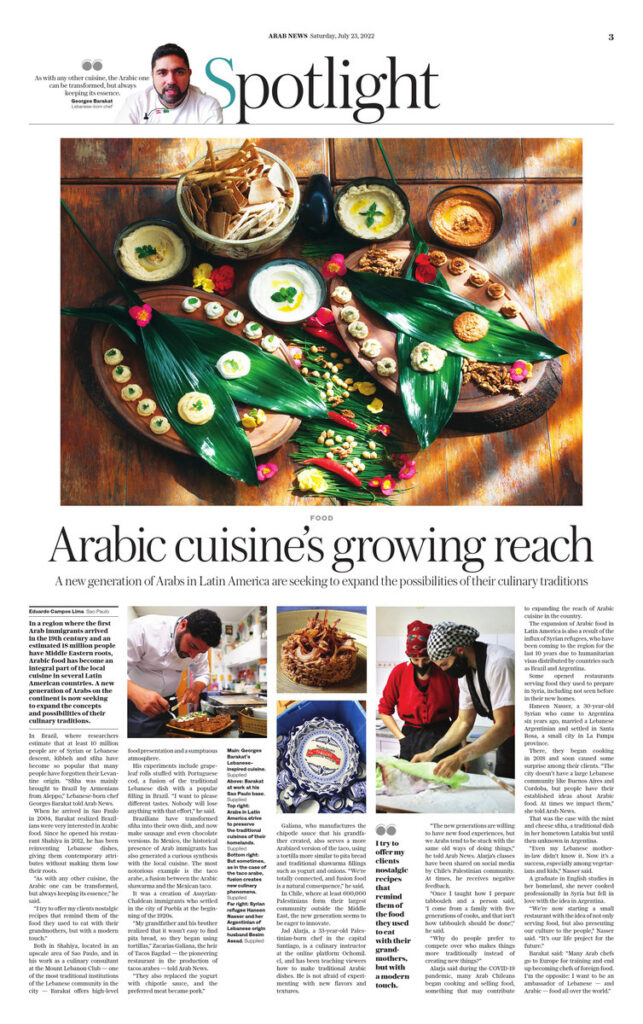
In a region where the first Arab immigrants arrived in the 19th century and an estimated 18 million people have Middle Eastern roots, Arabic food has become an integral part of the local cuisine in several Latin American countries. A new generation of Arabs on the continent is now seeking to expand the concepts and possibilities of their culinary traditions.
In Brazil, where researchers estimate that at least 10 million people are of Syrian or Lebanese descent, kibbeh and sfiha have become so popular that many people have forgotten their Levantine origin. “Sfiha was mainly brought to Brazil by Armenians from Aleppo,” Lebanese-born chef Georges Barakat told Arab News.
When he arrived in the city of Sao Paulo in 2004, he realized that Brazilians were very interested in Arabic food. Since he opened his restaurant Shahiya in 2012, he has been reinventing Lebanese dishes, giving them contemporary attributes without making them lose their roots.
“As with any other cuisine, the Arabic one can be transformed, but always keeping its essence,” he said.
“I try to offer my clients nostalgic recipes that remind them of the food they used to eat with their grandmothers, but with a modern touch.”
Both in Shahiya, located in an upscale area of Sao Paulo, and in his work as a culinary consultant at the Mount Lebanon Club — one of the most traditional institutions of the Lebanese community in the city — Barakat offers high-level food presentation and a sumptuous atmosphere.
His experiments include grape-leaf rolls stuffed with Portuguese cod, a fusion of the traditional Lebanese dish with a popular filling in Brazil. “I want to please different tastes. Nobody will lose anything with that effort,” he said.
Brazilians have transformed sfiha into their own dish, and now make sausage and even chocolate versions. In Mexico, the historical presence of Arab immigrants has also generated a curious synthesis with the local cuisine. The most notorious example is the taco arabe, a fusion between the Arabic shawarma and the Mexican taco.
It was a creation of Assyrian-Chaldean immigrants who settled in the city of Puebla at the beginning of the 1920s.
“My grandfather and his brother realized that it wasn’t easy to find pita bread, so they began using tortillas,” Zacarias Galiana, the heir of Tacos Bagdad — the pioneering restaurant in the production of tacos arabes — told Arab News.
“They also replaced the yogurt with chipotle sauce, and the preferred meat became pork.”
Galiana, who manufactures the chipotle sauce that his grandfather created, also serves a more Arabized version of the taco, using a tortilla more similar to pita bread and traditional shawarma fillings such as yogurt and onions. “We’re totally connected, and fusion food is a natural consequence,” he said.
In Chile, where at least 600,000 Palestinians form their largest community outside the Middle East, the new generation seems to be eager to innovate.
Jad Alarja, a 33-year-old Palestinian-born chef in the capital Santiago, is a culinary instructor at the online platform Ochomil.cl, and has been teaching viewers how to make traditional Arabic dishes. He is not afraid of experimenting with new flavors and textures.
“The new generations are willing to have new food experiences, but we Arabs tend to be stuck with the same old ways of doing things,” he told Arab News. Alarja’s classes have been shared on social media by Chile’s Palestinian community. At times, he receives negative feedback.
“Once I taught how I prepare tabbouleh and a person said, ‘I come from a family with five generations of cooks, and that isn’t how tabbouleh should be done’,” he said.
“Why do people prefer to compete over who makes things more traditionally instead of creating new things?”
Alarja said during the COVID-19 pandemic, many Arab Chileans began cooking and selling food, something that may contribute to expanding the reach of Arabic cuisine in the country.
The expansion of Arabic food in Latin America is also a result of the influx of Syrian refugees, who have been coming to the region for the last 10 years due to humanitarian visas distributed by countries such as Brazil and Argentina.
Some of them opened restaurants and have been serving the food they used to prepare in Syria, which can at times surprise Latin Americans used to a specific Arabic cuisine.
Haneen Nasser, a 30-year-old Syrian who came to Argentina six years ago, married a Lebanese Argentinian and settled in Santa Rosa, a small city in La Pampa province.
There, they began cooking in 2018 and soon caused some surprise among their clients. “The city doesn’t have a large Lebanese community like Buenos Aires and Cordoba, but people have their established ideas about Arabic food. At times we impact them,” she told Arab News.
That was the case with the mint and cheese sfiha, a traditional dish in her hometown Latakia but until then unknown in Argentina.
“Even my Lebanese mother-in-law didn’t know it. Now it’s a success, especially among vegetarians and kids,” Nasser said.
A graduate in English studies, she never cooked professionally in Syria but fell in love with the idea in Argentina. At time, she asks for help from her mother and aunt in Syria with some recipes.
“We’re now starting a small restaurant with the idea of not only serving food, but also presenting our culture to the people,” Nasser said. “It’s our life project for the future.”
Barakat said: “Many Arab chefs go to Europe for training and end up becoming chefs of foreign food. I’m the opposite: I want to be an ambassador of Lebanese — and Arabic — food all over the world.”
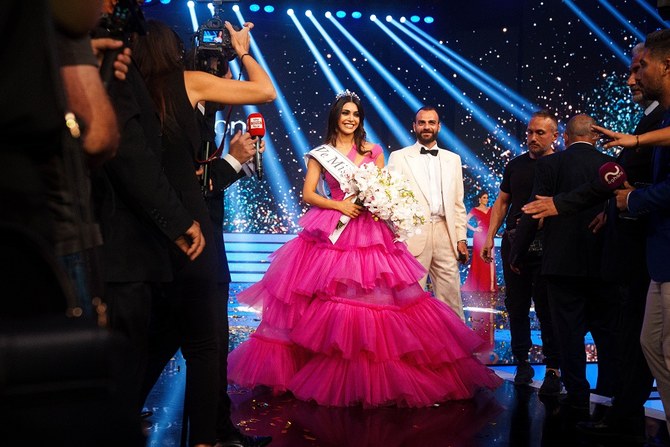
The Forum de Beyrouth played host to a glittering showcase of Lebanese talent on Sunday night as model, journalism student and show host Yasmina Zaytoun was crowned Miss Lebanon 2022, almost four years after the last edition of the pageant.
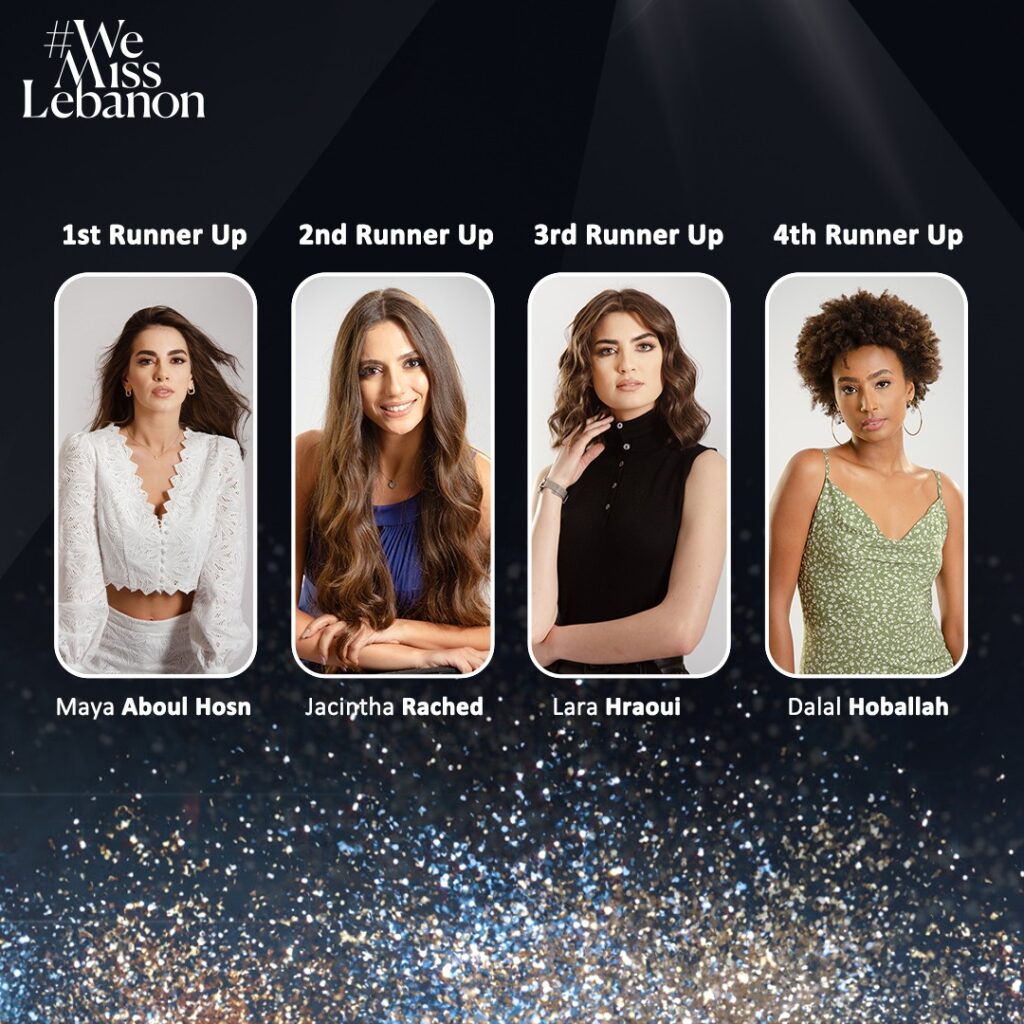
The host of the educational online platform the @WITHYASMINASHOW beat out fellow contestants Maya Abou El-Hassan, who finished as first runner-up, Jacintha Rashed, who was named second runner up, and Lara Hraoui and Dalal Hoballah who were voted in fourth and fifth place, respectively.
Zaytoun is from the village of Kfarchouba in southern Lebanon and is currently studying at Notre Dame University — Louaize. She hosts an Instagram show titled the “With Yasmina Show,” where she interviews media and sports personalities, including politician Paula Yacoubian and actress Enjy Kiwan.
Delayed by years of crises in Lebanon, the much anticipated the show featured 17 candidates from various cities and regions who wowed a judging panel consisting of music composer Michel Fadel, influencer Karen Wazen, General Manager of IP Studios Mohamad Yehya, Miss World 2022 Karolina Bielawska, General Manager of Al-Nahar and Al-Nahar Al-Arabi Nayla Tueni, Caracala dance theatre director Ivan Caracala, TV host Hilda Khalife, and Miss Lebanon 1993 Samaya Chedrawi, who was on hand to represent the Ministry of Tourism.
“Tonight, we’re celebrating Lebanon, not just Miss Lebanon,” Tueni said, explaining the importance of the event.
“Celebrating Lebanon that we miss, the beautiful country, the life in Lebanon. This is the most beautiful image of the real people, the real Lebanese that are suffering and trying to survive. This is a very important message, and I hope that Lebanon will rise again with a very positive message. We will stay strong because we love Lebanon,” she added, noting that the new beauty queen has to “be the voice of the Lebanese people.”
Hosted by Lebanese actress and TV host Aimee Sayah, the event also featured a performance by Lebanese singing icon Nancy Ajram, who started with a rendition of “Ila Beirut Al Ontha” in a tribute to the city, before surprising her fans with “Salmat Salamat” and a performance of her new song “Sah Sah,” which was produced by US DJ Marshmello.
Ajram invited her audience to support Lebanon in the “good and the bad,” adding: “I never thought about how to love Lebanon. There’s no rule as to how you can love your country. I love Lebanon till the end.”
Sayah was dressed by famed Lebanese designer Georges Hobeika, fresh off his runway presentation at Paris Haute Couture Week in July while contestants showed off a number of glamorous looks, including evening gowns and bathing suits, and also demonstrated their ability to keep a cool head under pressure by addressing a range of social issues on stage.
Those issues included divorce, fragmented families, women abuse and violence — both verbal and physical — access to healthcare and education, and women’s empowerment, among others.
The lucky few hit the stage after being prepped and primped by the best in the business, including celebrity makeup artist Bassam Fattouh and hairstylist Wassim Morkos.
Previous Miss Lebanon Maya Reaidy, who was crowned in September 2018, passed the title and the tiara on to her successor, bringing her almost four-year-reign to an end after a series of crises forced the event to be postponed.
In the run up to the event, billboards dotted roads in Beirut and beyond with the slogan “We missed celebrating Lebanon’s beauty,” which played into the wider #WeMissLebanon campaign touted by the event organizers, The Lebanese Broadcasting Corporation International (LBCI) and The Ministry of Tourism.
Organizers also released a glamorous advert featuring a number of the contestants posing in daring outfits, with stunning aerial views of Lebanese tourist hotspots interspersed throughout the 48-second video.
The ceremony reflected the same celebration of the country through the music, which was chosen by Fadel, the setup and decoration with take home flowers.
Chairman and CEO of the Miss World organization Julia Morley, Miss World 2021 Karolina Bielawska from Poland, the first runner-up Miss USA Shree Saini, and Miss World 2019 Toni-Ann Singh from Jamaica and Miss World Events Director Stephen Douglas Morley were also in attendance.
“I have travelled quite a lot and I find that the people are the heart of every country. I can honestly say that Lebanese people are so beautiful and so warm, and even though I’m miles away from my own country Jamaica I feel at home,” Singh said.
The winner was selected from a pool of candidates chosen for their beauty and brains at auditions held between December 2021 and February 2022, with Lebanese young women aged between the ages of 18 and 27 invited to participate.
source/content: arabnews.com
__________
Journalism student and host of @WITHYASMINASHOW Yasmina Zaytoun with her Miss Lebanon 2022 crown. (Arab News/ Alex Spoerndli)
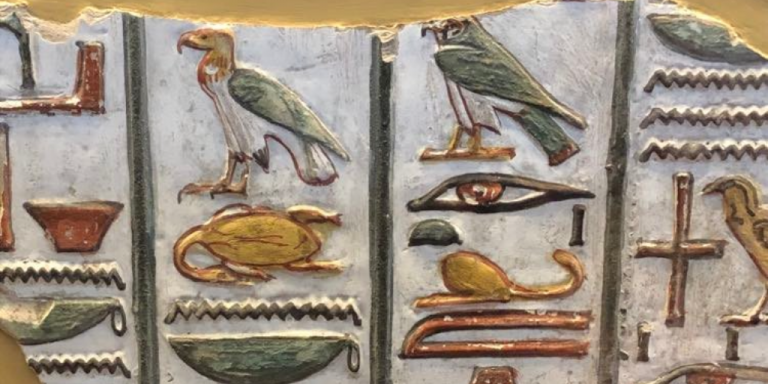
Did you know that many of the Egyptian colloquial words Egyptians use on a daily basis are not actually Arabic?
The Egyptian Arabic dialect is fundamentally Arabic, but with the influence of history and local populations, some of the peculiarities that set the Egyptian dialect apart come from the integration of ancient Egyptian, Greek and Coptic words and expressions. Surviving for thousands of years, many commonly used, modern-day Egyptian words and phrases can actually be traced back to the current dialect’s ancient predecessors.
Here are some examples of words Egyptians use, often not knowing their ancient origin, as per the books ‘From Pharaoh’s Lips’ (2003) by Ahmad Abdel-Hamid Youssef, and ‘Al Logha Al Masrreya Al Qadeema’ (Ancient Egyptian Language, 2012 ) by Abdelhaleem Nour El-din.
UMBU (DRINK)
Often, in communication with infants or toddlers, broken down or simplified words are used to allow the news speakers to express themselves without too much difficulty. For example, umbu is the word commonly used by Egyptian children to express their thirst. The ancient Egyptian term simply means “from the water”.
TA TA (STEP BY STEP)
When Egyptian parents try to help their crawling baby how to walk, they use the phrase “ta ta” derived from the ancient Egyptian word “ti ti”. Though Arabic became the primary language in Egypt, the Coptic language was initially still being used in everyday life for the majority of the population. The term “ti ti” was adopted by the Coptic language and modified to “ta ta”, which is used until today.
MAMM (FOOD)
The word Mumm is an Egyptian slang word derived from the ancient Egyptian “my wnm”, which means ‘give to eat’. Many Egyptians, until this day, teach their babies to say “mumm” whenever they are hungry — as it is easy and quick to sound out.
DAHYA TIWADDIH AL AMENDI (MAY A DISASTER SEND HIM TO HELL)
The Egyptian phrase “Dahya tiwaddih al amendi”, is originally ancient Egyptian. The word “amendi” is a Coptic word meaning “hell”, which was derived from the ancient Egyptian word “imntt”, meaning the ‘underworld’.
BIKH (BOO!)
The word “Bikh!”, meaning “Boo!”, is often used in modern day Egypt to sneak up on someone and scare them. The term is an ancient Egyptian word “pa akh” meaning “demon” or “ spirit”.
WAHAWY YA WAHAWAY IYUHA (THE MOON HAS APPEARED)
The Egyptian phrase “Wahawy ya Wahaway iyuha” is part of a song Egyptians sing during the holy month of Ramadan. Families and young children swing their fanoos (lanterns) as they sing the lyrics to Wahawy ya Wahaway iyuha. The popular lyric is believed to be inspired from the ancient Egyptian word “wah” meaning ‘to put’ or ‘appear’, and “iyah” meaning “moon”. Thus, comprising the lyric “the moon has appeared” during the month of Ramadan, which is decided upon according to the lunar calendar in Islam.
KRKR (LAUGHING)
The word “krkr” is used frequently in modern Egyptian day to describe someone who is laughing uncontrollably. The term is originally ancient Egyptian “ķrķr” and was adopted into modern day Egyptian society.
GATEK MAW (MAY A LION FETCH YOU)
The phrase “jak maw” or “gatek maw”, often switched depending on the region it is used in, essentially means “may a lion come to you”. The phrase is an Egyptian expression used as an insult. The ‘maw’ is based on a pun on the words “lion” and “mother”. The expression is often used by mothers bothered by their children.