Arabs & Arabian Records Aggregator. Chronicler. Milestones of the 25 Countries of the Arabic Speaking World (official / co-official). AGCC. MENA. Global. Ist's to Top 10's. Records. Read & Enjoy./ www.arabianrecords.org
Sharjah International Marine Sports Club displayed, during the third day of the Abu Dhabi International Boat Show 2024, the fastest motor boat in the world, reaching a speed of 220 km/h.
This boat, which was locally manufactured by Emirati hands at Sharjah Marine, is an embodiment of Emirati innovation and creativity in the field of marine industries, which enhances the country’s leadership in this sector globally.
On its third day, the exhibition witnessed a large turnout of visitors, with a remarkable presence of international brands that presented their creations for the first time in the Middle East.
Among the highlights of the third day’s shows were the luxury yacht Tecnomar for Lamborghini 63, making its regional debut, and the Finnish-designed Grandesa 37, which combines innovation and practicality
President of the Water Authority tells Local Content Forum 2024 in Riyadh the Kingdom aims to be a pioneer in desalination industry.
The volume of desalinated water produced by Saudi Arabia each day is equivalent to daily global oil production, the president of the Saudi Water Authority said on Thursday.
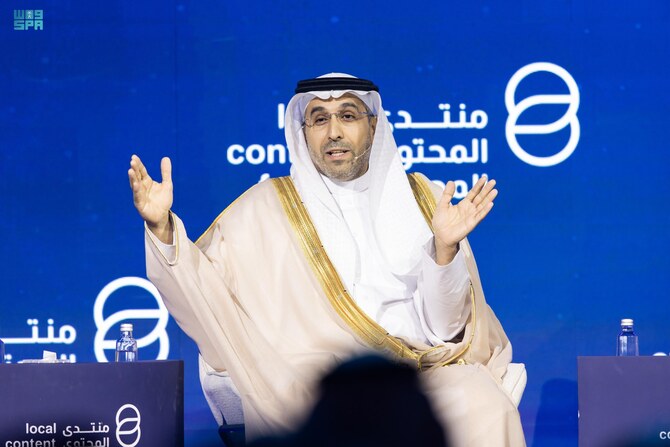
Speaking on day two of the three-day Local Content Forum 2024 in Riyadh, Abdullah Al-Abdulkarim said the Kingdom desalinates an estimated 15 million cubic meters of water daily. In 2023, global oil production amounted to nearly 15.3 million cubic meters a day, the Saudi Press Agency reported.
The nation’s water sector has undergone significant shifts in recent years as a result of critical issues such as climate change and growing demand for fresh water, he added, and there are “great opportunities for the Kingdom to become a pioneer” in the desalination industry.
The Water Authority is working tirelessly to support Saudi manufacturers and contractors and help them enter the desalination sector, Al-Abdulkarim said.
“Partnerships in the water sector start from research and innovation, and transforming them into new projects,” he added.
source/content: arabnews.com (headline edited)
__________
Abdullah Al-Abdulkarim, the President of the Saudi Water Authority, at the Local Content Forum held in Riyadh on Nov. 21, 2024 (SPA)
Hissein Mahamoud Barkai won France’s Lebey Prize for best artisan in 2022. A member of the Toques françaises association of chefs, he’s become an ambassador for Chadian gastronomy around the world, with hallmark creations like the “Paris-N’Djamena”.
Barkai was born in Chad and after training in France as a pastry chef now spends his time between Paris and N’Djamena.
His cuisine is a delicate fusion of locally sourced ingredients such as dates, almonds and sorghum flour married with French savoir faire.
In October this year he was awarded the 2022 Lebey Prize for best artisan, but earning recognition in his native Chad, where cooking is reserved to women, was a slog.
“Being a Chadian man and cooking is near impossible, even Utopian,” he told RFI’s Nathalie Amar. “I was lucky to live in France and be able to do what I wanted to do, but it’s not easy to be able to cook here in Chad.”
Barkai hails from the north of Chad, where he was born into the Gorane ethnic group.
“In my village of birth only women can cook, so I was touching on a sensitive issue. They’re very welcoming people but they are proud of their traditions and dignity.”
So while Barkai, like many chefs, enjoyed showing off photos of his creations on social media, he used a pseudonym in the early days.
“I was in Montpellier and rather than calling myself Mahamoud, I used Al Hussein. It was close to my real name, but meant that people wouldn’t know straightaway that it was me,” he explains.
After a while he understood he couldn’t spend his life hiding. He made a short video, “a sort of culinary coming out” and posted it on YouTube.
It allowed Barkai to publicly embrace his passion.
“I received countless positive messages from people encouraging me and saying they’d like their son to do the same thing and so on. That’s how the doors opened and it was a psychological relief. A weight had been lifted.”
Feast your eyes on some of Barkai’s creations by clicking on the slideshow below.
Pastries by Hissein Mahamoud Barkai, aka the Desert Pastry Chef
A culinary journey
To the naked eye Barkai’s pastries look like any high-end French patisseries.
“You’d never suspect they’d be part of African or Chadian gastronomy,” he says.
But once you see it on your plate and taste it, “that’s when you start travelling, when you’re in something completely unique: African, Chadian, the land of the Sahel”.
He reels off a few of the many regional ingredients that go into his recipes: balamites, dates, black tamarind, hibiscus, moringa.
One of his specialties is a cup cake made with red or white sorghum flour. Not only is it locally sourced in Chad, it’s naturally gluten-free.
When cooking in N’Djamena, he avoids importing expensive products from France wherever possible – replacing butter with shea butter, wheat flour with sorghum or ground pea flour.
From Brest to N’Djamena
His hallmark patisserie is the Paris-N’Djamena – a version of the famed praline cream-filled cake known as Paris-Brest.
However, the only thing he’s kept from the classic French recipe is the choux pastry.
He replaced the praline cream with almonds and the fruit of the balanite tree (Balanites aegyptiaca), known more commonly as wild date in English and “savonnier” (soap tree) in French because its bark produces a soapy effect.
The tree’s oval fruits resemble dates, though their taste is far more acidic, Barkai explains.
Chadians traditionally suck on the fruit to cleanse the stomach, help with breast-feeding, strengthen hair and boost their immune system.
Replacing the hazelnut-based praline cream with almonds is a challenge, he says, because of their bitter edge.
“We have people here who are specialised in cracking the hard nut, removing the bitter centre and blanching it several times to reduce the bitterness.”
But he remains attached to the slightly tart twist the almonds and balanites give his dessert.
Passing on the passion
Paris is a pastry chef’s dream location but N’Djamena is still largely unexplored culinary territory.
Barkai has trained “at least 150 women in the profession” since he’s been travelling between the two capital cities. Trainees include young mothers and housewives who’ve been able to build up small micro-entreprises to support their families.
“I’m very proud, I’ve seen there are plenty of women who are now managing to live off what I’ve taught them.”
Then an ancient 14.5 kilometer-long wall was discovered at the site
When Al-Natah was built, cities were flourishing in the Levant region along the Mediterranean Sea from present-day Syria to Jordan
The discovery of a 4,000-year-old fortified town hidden in an oasis in modern-day Saudi Arabia reveals how life at the time was slowly changing from a nomadic to an urban existence, archaeologists said on Wednesday.
The remains of the town, dubbed Al-Natah, were long concealed by the walled oasis of Khaybar, a green and fertile speck surrounded by desert in the northwest of the Arabian Peninsula.
Then an ancient 14.5 kilometer-long wall was discovered at the site, according to research led by French archaeologist Guillaume Charloux published earlier this year.
For a new study published in the journal PLOS One, a French-Saudi team of researchers have provided “proof that these ramparts are organized around a habitat,” Charloux told AFP.
The large town, which was home to up to 500 residents, was built around 2,400 BC during the early Bronze Age, the researchers said.
It was abandoned around a thousand years later. “No one knows why,” Charloux said.
When Al-Natah was built, cities were flourishing in the Levant region along the Mediterranean Sea from present-day Syria to Jordan.
Northwest Arabia at the time was thought to have been barren desert, crossed by pastoral nomads and dotted with burial sites.
That was until 15 years ago, when archaeologists discovered ramparts dating back to the Bronze Age in the oasis of Tayma, to Khaybar’s north.
This “first essential discovery” led scientists to look closer at these oases, Charloux said.
Black volcanic rocks called basalt concealed the walls of Al-Natah so well that it “protected the site from illegal excavations,” Charloux said.
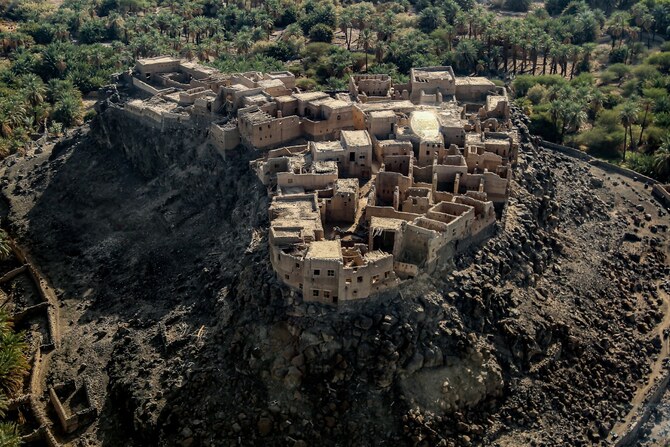
But observing the site from above revealed potential paths and the foundations of houses, suggesting where the archaeologists needed to dig. They discovered foundations “strong enough to easily support at least one- or two-story” homes, Charloux said, emphasising that there was much more work to be done to understand the site. But their preliminary findings paint a picture of a 2.6-hectare town with around 50 houses perched on a hill, equipped with a wall of its own.
Tombs inside a necropolis there contained metal weapons like axes and daggers as well as stones such as agate, indicating a relatively advanced society for so long ago. Pieces of pottery “suggest a relatively egalitarian society,” the study said. They are “very pretty but very simple ceramics,” added Charloux.
The size of the ramparts — which could reach around five meters (16 feet) high — suggests that Al-Natah was the seat of some kind of powerful local authority. These discoveries reveal a process of “slow urbanism” during the transition between nomadic and more settled village life, the study said.
For example, fortified oases could have been in contact with each other in an area still largely populated by pastoral nomadic groups. Such exchanges could have even laid the foundations for the “incense route” which saw spices, frankincense and myrrh traded from southern Arabia to the Mediterranean.
Al-Natah was still small compared to cities in Mesopotamia or Egypt during the period.
But in these vast expanses of desert, it appears there was “another path toward urbanization” than such city-states, one “more modest, much slower, and quite specific to the northwest of Arabia,” Charloux said.
source/content: arabnews.com (headline edited)
___________
This picture taken on December 12, 2022 shows an aerial view of an old fort in the Khaybar oasis in northwestern Saudi Arabia. Khaybar, best known for a 7th-century fierce battle between the Islam’s Prophet Mohamed and local Jewish tribes is remodelling itself as an upscale tourist draw in line with the kingdom’s rebranding efforts. Situated in an oasis amid a volcanic field north of Medina, it was once home to thousands of Jews, who were defeated in a decisive seventh-century battle with the Prophet’s army as Islam expanded across the Arabian peninsula. (Photo by Mohammad QASIM / AFP)
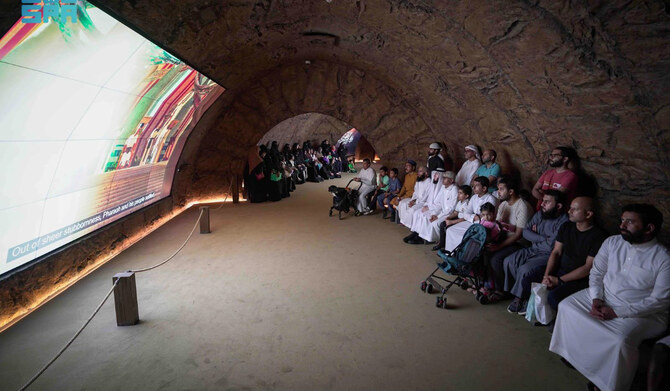
A highlight of the exhibition is an immersive recreation of the Cave of Hira, where the Prophet Muhammad is said to have received his first revelation.
The Hira Cultural District in Makkah is currently hosting the Revelation Exhibition, drawing visitors from all walks of life.
The exhibition provides a unique opportunity to delve into the stories of the prophets, from Adam to Muhammad.
A highlight of the exhibition is an immersive recreation of the Cave of Hira, where the Prophet Muhammad is said to have received his first revelation.
Visitors can go back in time to experience the historic moment through state-of-the-art technology and interactive displays.
The exhibition also features a range of artifacts, including a photographed copy of the Qur’an that belonged to the esteemed companion Uthman ibn Affan, and ancient stone inscriptions bearing verses from the Qur’an.
The Hira Cultural District is a cultural and tourism destination which is committed to enriching the visitor experience.
Its Autumn Vacation series of events offers a diverse range of experiences, including equestrian skills demonstrations, a display of traditional caravans, and engaging challenges.
source/content: arabnews.com (headline edited)
________
The Hira Cultural District is a cultural and tourism destination which is committed to enriching the visitor experience. (SPA)
The Fourth Arab Mathematics Olympiad 2024 kicked off Sunday in Doha.
The Olympiad, which will conclude on November 14, is organised by the Ministry of Education and Higher Education in Qatar, in partnership with the Arab League Educational, Cultural, and Scientific Organization (ALECSO) and the Qatar National Commission for Education, Culture, and Science.
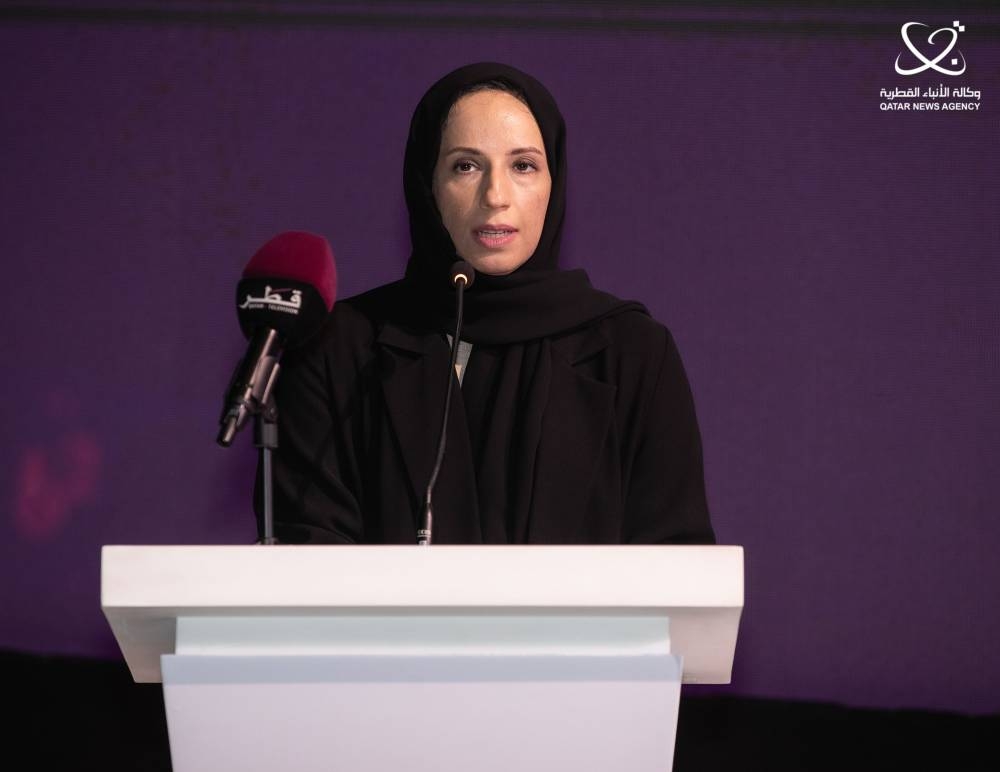
HE Buthaina bint Ali Al Jabr Al Nuaimi, the Minister of Education and Higher Education, Chairperson of the Qatar National Commission for Education, Culture and Science, said that organizing the Fourth Arab Mathematics Olympiad falls under the umbrella of ALECSO and aims to enhance communication between Arab students, develop the spirit of excellence, creativity, talent and self-confidence, pay attention to the sciences of mathematics and develop its curricula and improving its teaching methods.
She noted in her opening speech that mathematics is one of the basic sciences on which many applied sciences depend, it’s based on thinking, setting hypotheses, and mathematical proofs, stressing that working on developing curricula to improve the quality of education and develop students’ skills has become an urgent need to keep pace with current developments and modern life, in a world characterized by rapid development and technological progress.
She explained that the Arab Mathematics Olympiad comes to crystallize the interest of Arab countries in developing the performance of their students in modern sciences as a basic requirement for sustainable development.
HE Buthaina bint Ali Al Jabr Al Nuaimi, the Minister of Education and Higher Education, Chairperson of the Qatar National Commission for Education, Culture and Science
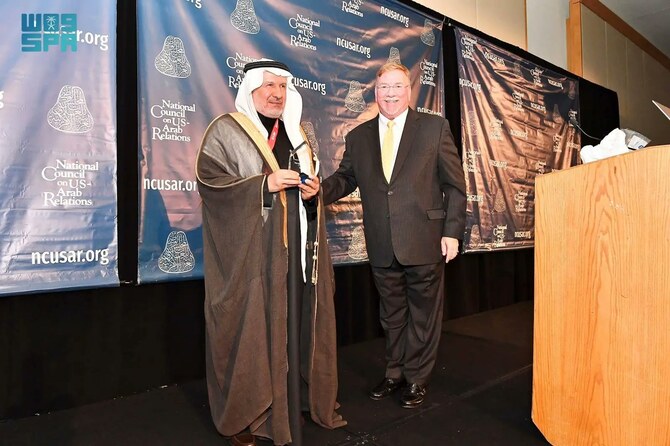
The Saudi aid agency KSrelief was honored with the Global Humanitarian Achievement Award by the National Council on US-Arab Relations, in recognition of relief efforts that have made a substantial impact in crisis regions around the world.
Delano Roosevelt, the council’s second president and CEO, presented the award to the supervisor general of KSrelief, Dr. Abdullah Al-Rabeeah, in Washington, the Saudi Press Agency reported.
Dr. Al-Rabeeah said the award is an international acknowledgement of Saudi Arabia’s leading role in relief efforts.
He underlined the Kingdom’s commitment to assisting people in need, supporting those affected by crises, and assisting refugees wherever possible.
He also affirmed that Saudi Arabia has consistently been a leader in charitable and humanitarian initiatives and is at the forefront of donor countries on regional and international fronts.
source/content: arabnews.com (headline edited)
______________
Delano Roosevelt, CEO of National Council on US-Arab Relations, presents the award to the supervisor general of KSrelief, Dr. Abdullah Al-Rabeeah, in Washington. (SPA)
Saudi crown prince calls for Palestinian state with East Jerusalem as its capital.
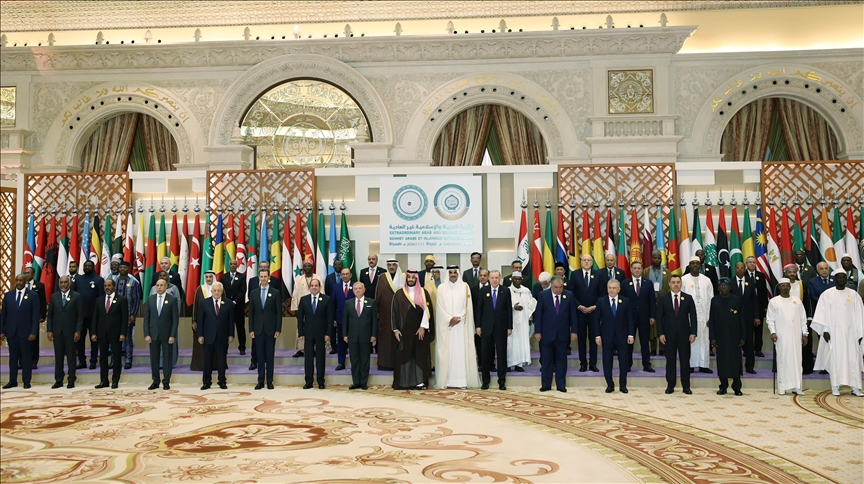
An extraordinary Arab-Islamic summit kicked off in the Saudi capital Riyadh on Monday to discuss Israel’s ongoing wars in the Gaza Strip and Lebanon.
“We reiterate our rejection of the genocide committed by Israel against the Palestinian people,” Saudi Crown Prince Mohammed bin Salman said in an opening speech at the summit.
He stressed the need to continue efforts to establish an independent Palestinian state on the lands of 1967 with East Jerusalem as its capital.
The crown prince also condemned Israeli attempts to prevent the UN agency for Palestinian refugees (UNRWA) from delivering aid to Gaza.
Bin Salman said that his country rejects any threat to the security and sovereignty of Lebanon.
Palestinian President Mahmoud Abbas, for his part, called on the Arab and Islamic countries to show the highest levels of solidarity with the Palestinian people.
He also demanded the implementation of a UN resolution to halt Israeli assaults on Gaza and to secure the delivery of humanitarian aid into the enclave.
More than 50 leaders of Arab and Islamic countries are taking part in the summit, including Turkish President Recep Tayyip Erdogan.
Jouf Gov. Prince Faisal bin Nawaf bin Abdulaziz has praised the country’s leaders and the Ministry of Environment, Water and Agriculture for supporting the region’s record-breaking developmental and economic initiatives.
Prince Faisal made the comments during a ceremony marking the region’s achievements, the Saudi Press Agency reported on Monday.
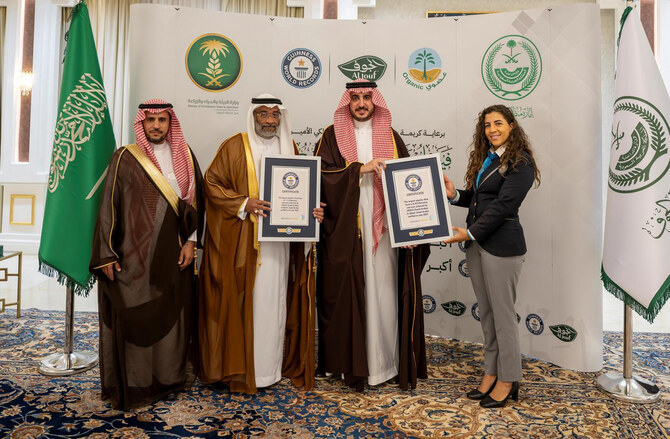
Two certificates were presented by Guinness World Records representative Kenzi Al-Dafrawi to Mazen Badawood, CEO of the Al-Jouf Agricultural Development Co.
The certificates honored the company for having the world’s largest and most modern organic olive farm, the SPA reported.
The event was attended by Abdulaziz Al-Rujai, director general of the ministry in the Jouf region.
Prince Faisal said: “We take pride in the national accomplishments that the Kingdom’s Vision 2023 has realized in promoting self-sufficiency and achieving food security.”
Badawood thanked Prince Faisal for his dedication to serving the people of the region.
He said Jouf’s agricultural, environmental and water purification projects provide a model for others to follow.
The awarding of the two certificates coincided with Organic Food Day, celebrated on Nov. 11, which the Kingdom marked with a series of events across the country.
Organic Food Day is aimed at encouraging people to make healthy dietary choices and embodies efforts to achieve sustainable food security, in line with the objectives of the Kingdom’s Vision 2030 plan.
The ministry aims to encourage farmers to adopt organic farming practices, educate consumers, as well as promote resource sustainability and local production.
As a part of the celebrations, Riyadh is hosting the Saudi International Exhibition for Organic Products from Nov. 11 to 13 to support the local community, and position the nation as a leading hub in this growing sector.
source/content: arabnews.com (headline edited)
____________
Two certificates were presented by Guinness World Records representative Kenzi Al-Dafrawi to Mazen Badawood, CEO of the Al-Jouf Agricultural Development Co.
The 7th El-Gouna Film Festival ended with the awards announced during the closing ceremony on 1 November.
El-Gouna Golden Star award went to Ghost Trail, a thriller about a Syrian refugee in France. Check all awards below.
International competition
El-Gouna Golden Star award for best narrative film Ghost Trail (France) by Jonathan Millet
The film follows Hamid, who “joins a secret group tracking Syrian regime leaders on the run. His mission takes him to France, pursuing his former torturer for a fateful confrontation,” reads the synopsis on IMDb.
El-Gouna Silver Star The Kingdom (France) by Julien Colonna
El-Gouna Bronze Star Girls Will be Girls (India) by Shuchi Talati won the Fipresci Award.
Best actor Adam Bessa for his performance in Ghost Trail (France) by Jonathan Millet
Best actress Laura Weissmahr for her performance in Salve Maria (Spain) by Mar Coll
Best Arab narrative feature – shared award – Thank You For Banking With Us! (Palestine) by Laila Abbas – Who Do I Belong To (Tunisia) by Meryam Joobeur
Jury special mention Actor Charles Peccia Galletto for his performance in My Everything by Anne-Sophie Bailly
Documentary competition
El-Gouna Golden Star We Are Inside (Lebanon) by Farah Kassem
El-Gouna Silver Star Soundtrack To A Coup d’Etat (Belgium) by Johan Grimonprez
El-Gouna Bronze Star A New Kind Of Wilderness (Norway) by Silje Evensmo Jacobsen
Best Arab documentary feature – shared award – The Brink Of Dreams (Egypt) by Nada Riyadh and Ayman El Amir – My Memory Is Full Of Ghosts (Syria) by Anas Zawahri
Other awards
Fipresci award Girls Will be Girls (India) by Shuchi Talati Cinema for Humanity award Disorder (Lebanon) by Lucien Bourjeily, Bane Fakih, Wissam Charaf, and Areej Mahmoud.
The NetPac award We Are Inside (Lebanon) by Farah Kassem
El Gouna Green Star award The Battle For Laikipia (Kenya) by Peter Murimi and Daphne Matziaraki