SAUDI ARABIA: Saudi Artist Lulwah Al-Hammoud Designs Iconic Round Table Shared by World Leaders at GCC summit

An iconic table shared by Gulf Cooperation Council leaders at a recent summit was designed by a Saudi artist.

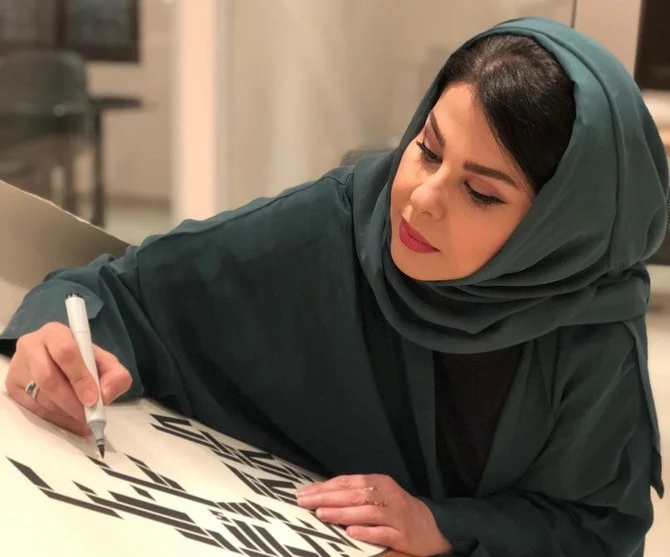
Lulwah Al-Hammoud produced the drawings for the item of furniture that took center stage at the meeting of GCC member states Saudi Arabia, the UAE, Bahrain, Oman, Kuwait, and Qatar, along with representatives of Jordan, Egypt, and Iraq.

She told Arab News of her pride and thrill at seeing the table being used by the organization’s leaders. Its design was inspired by the changes taking place in Saudi Arabia and her commission brief had been, “we are entering a new era, but we are not forgetting about our traditions.”

After accepting the design challenge, Al-Hammoud was initially nervous because she was not a furniture designer, however it turned out to be “a very beautiful experience.” And her background in Islamic contemporary art and calligraphy helped.

The round table is made of wood and in its center are triangles of different color tones of wood that rotate outwards with lines made of copper, a metal, she noted, not often used in Saudi Arabia.

Al-Hammoud pointed out that she opted for triangles in her design because the shape was common in traditional Saudi architecture.

She said: “The triangle can also be modern and universal, but at the same time I wanted to capture growth and the act of evolving.”

The idea behind the design was to create something that represented, “the vision of Saudi Arabia while staying true to our roots,” she added.

One of the challenges for Al-Hammoud was to create a round table that could seat different numbers of people.

“It can be odd or even, so the design had to be smart. It took me a while to figure out how to do that. With guidance, I was able to work it out.

“I am really happy, because for a table like that they could have easily gone to the best furniture designers in the world, but they chose to believe in a local talent.”

Al-Hammoud has nine solo exhibitions to her name, with some of her artworks displayed at The British Museum, the Jeju National Museum in South Korea, the Greenbox Museum of Contemporary Art from Saudi Arabia in the Netherlands, and the Los Angeles County Museum of Art.

The UAE-based Barjeel Art Foundation has described Al-Hammoud as a pioneer in Saudi Arabia’s contemporary art movement.

She said: “I take art very seriously; I feel like it is a very important tool for education. It’s a window to tell people about who we are, it gives the true story of a certain civilization.”

She fell in love with Islamic art while conducting research on the topic and was fascinated by the philosophies and sciences behind each shape.

“My art has always had spiritual elements; it doesn’t talk about the moments I live in or the space I occupy. I speak about a higher dimension, spirituality, my place in the bigger scheme of things, and my connection to God,” she added.

source: arabnews.com (headline edited)

___________

Lulwah Al-Hammoud said that she opted for triangles in her design because the shape was common in traditional Saudi architecture. (AN Photo)

_________________

SAUDI ARABIA

MOROCCO: Engineering Students Create “S-ILK” Innovative Fabric From Expired Milk

With the newly emerging social entrepreneurship movement, Moroccan youth are keen to develop entrepreneurial solutions to respond to local challenges.

Driven by innovation and the spirit of entrepreneurship, a student-led team from Enactus Club at Morocco’s Mohammadia School of Engineering (EMI) has developed a fabric made from milk to reduce dairy waste.

A team of 10 engineering students took the lead to make a positive impact within Moroccan society after observing the alarming amount of milk waste discharged in rivers and lakes. The dumping of milk waste has severe consequences for the balance of marine ecosystems as well as on the quality of drinking water. 

The “S-ILK” project is a promising alternative to classic fabrics, by focusing on creating a tissue based on casein, a protein extracted from milk. 

So far, the team has been able to develop the first prototype of its biodegradable fabric in the form of textile yarns and now seeks to begin mass production.

Speaking to Morocco World News, S-ILK Project Manager Omar Dirane stressed that synthetic fabrics, made from nonrenewable fossil fuels, are often bad for health and the environment. This became the reason why the team decided to use milk as a fabric to make clothes while reducing the pollution of dairy products.

Research quoted by The Guardian has found that 16% of dairy products, approximately 128 million tonnes, is lost or discarded globally each year; an efficient solution is therefore needed to reduce the environmental impacts of this large-scale food waste.

Ghita Dahhou, a project associate, told MWN that their long-term goal consists of making “S-ILK” a startup in which they seek to develop and sell eco-friendly clothes, while also raising awareness about food waste and making people eco-responsible through what they wear.

“The idea of creating a brand of ecological fibers is present and could be a big step for the textile industry in Morocco,” Dahhou said. As eco-responsible alternatives to fast fashion keep growing worldwide, the industry is significantly becoming more competitive. 

Project associate Taoufiq Saaad spoke on the difficulties they could potentially face in implementing their startup in the future, especially as young students without years of experience in the field.

S-ILK team members, however, are keen to keep their optimism and ambitions to achieve their professional aspirations, noting that “our young age will not stop us from being invested in the engineering field and giving everything we have to improve it.”

Social entrepreneurship: challenges and opportunities

Eager to position their product in the Moroccan market, the team has conducted a market study to identify their niche while focusing on customers that support environmental advocacy and are eco-responsible.

Similar customers that follow the ecological trend are harder to find in Morocco due the “traditional mindset” some people still have, Ghita argued. Such a mindset, in addition to societal pressures, hinder young project holders from “taking risks and exploring what is beyond our comfort zone.”

As part of their market research, they also conducted interviews with people in the streets of Rabat. Taoufiq Saaad highlighted that people were “intrigued by the product especially when we told them that the piece will be cheaper than actual silk.”

“As we have been showing a potential to grow, we have been able to find clients who are interested in purchasing our product,” he added.

Supported by Moroccan hypermarket chain Marjane Holdings and Orange Maroc, one of three major licensed telecommunications operators in the country, the project manager expressed the team’s interest in securing more funds to be able to expand their project.

He explained that “Orange digital center” provides them with the tools needed to elaborate their research while “Orange Fab Lab” is where they experiment on their product and work on improving it.

When asked how they manage to finance projects within Enactus EMI, especially those starting from scratch, Dirane underlined that when a project within the EMI network wins a prize, they split it so that all projects can be able to expand.

Meanwhile, Ghita underlined that in recent years, Morocco has been offering several opportunities for young project holders to show their potential, either through financial aid or other facilities that banks provide, in addition to the support and mentoring from several incubators. 

“With over 300 alumni of Enactus EMI, and 66 current members, we have much expertise, and engineers in different industries across Morocco, all coming together to contribute to the growth of innovative projects,” he added.

For Omar, Taoufiq, and Ghita, the project is helping them become the leaders of tomorrow by.being engaged in extracurricular activities to develop soft skills such as teamwork, communication, and problem-solving, among others, while also seeking expertise in the engineering field.

source/content: moroccoworldnews.com (edited)

____________

S-ILK: Moroccan Engineering Students Create Innovative Fabric From Expired Milk

_____________

MOROCCO

SAUDI ARABIA: Female Beekeeper Norah Shawi Al-Shimmari Wins Gold Medal in the Prestigious Global Honey Competition the ‘London Honey Awards’

A female Saudi beekeeper is tasting sweet success on the international stage after winning a gold medal for her honey in a prestigious global competition.

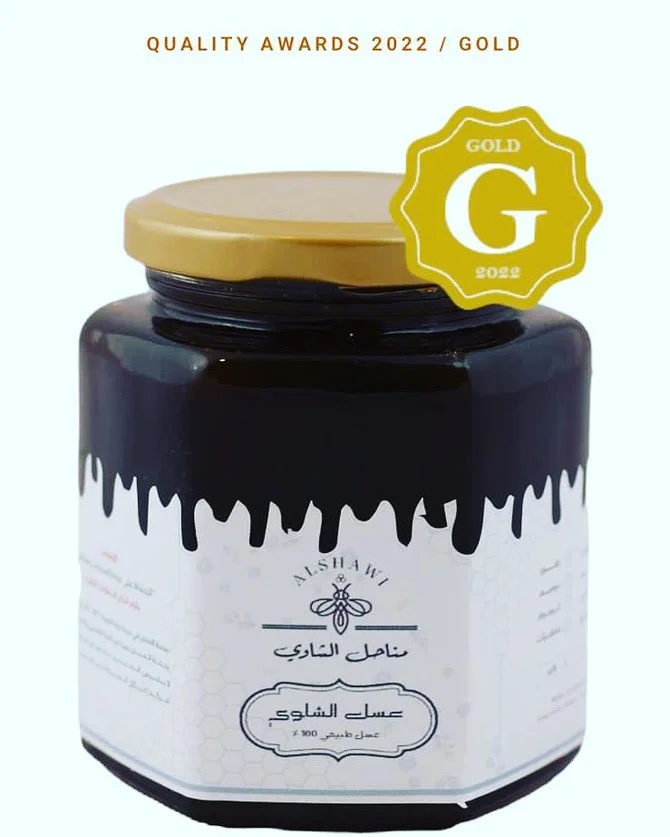
Businesswoman Norah Shawi Al-Shimmari, from the Hail region, scooped the accolade for best-quality talah (acacia) honey in the world at the London Honey Awards.

It was the first time the enterprising apiarist had taken part in the awards scheme, and she told Arab News: “Winning was one of my biggest wishes for this year. I could not believe it at first, to win is a wonderful feeling.

“It gave me a great boost to keep the good work up and participate in more competitions.”

The annual London Honey Awards competitions aim to inform honey-growers, producers, beekeepers, processors, and retailers, who distribute their standardized products legally, to preserve and ameliorate the quality of their branded items by promoting high-quality honey products in all aspects of its use and consumption.

Al-Shimmari is the only female honey farmer in Hail and is known in the Kingdom as “the beekeeper of the north.”

She and two other award winners were recently honored for their achievements by Hail Deputy Gov. Prince Faisal bin Fahd bin Muqrin.

It was while exhibiting at an event in Riyadh that she was urged to enter the London Honey Awards. “I was highly encouraged by one of my beekeeper colleagues, and I am so grateful for him and his recommendation and all the help he offered.”

Al-Shimmari runs her business from Al-Khita village, on the outskirts of the city of Hail, and moves her hives on a daily basis to different locations in the area to allow her bees access to colorful and nectar-rich athel, sidr, and acacia flowers.

Acacias are distinguished by their small, often fragrant yellow, and occasionally white, flowers, that have many pollen-producing stamens and a fuzzy appearance.

To win her award, Al-Shimmari’s honey was laboratory checked for humidity levels, sucrose and glucose content, texture, and other factors. Samples were then evaluated by a jury panel, with each judge conducting an organoleptic taste analysis and marking the product based on criteria such as appearance, odor, and flavor.

Up against competitors from around the world including the UK, China, Saudi Arabia, and other Middle Eastern countries, she said: “The competition was huge, and my winning was a surprise and a shock.

“Beekeeping is about persistence and being eager to produce distinguished honey. However, my goals do not stop here. I would like to walk a steady journey; I am still dreaming of more success and achievements. This is just the beginning. I want to see my products everywhere worldwide.”

Al-Shimmari has been in the honey trade for more than five years producing 11 different products, and she recently launched a skincare line made of organic honey and honeycomb materials.

Last year, she was the only woman among 33 beekeepers who took part in the Hail Honey Festival. The event helps apiarists market their products, while increasing investment opportunities.

source/content: arabnews.com (headline edited)

___________

__________________

SAUDI ARABIA

How South Americans with Middle Eastern Roots are Transforming Arabic Cuisine

In a region where the first Arab immigrants arrived in the 19th century and an estimated 18 million people have Middle Eastern roots, Arabic food has become an integral part of the local cuisine in several Latin American countries. A new generation of Arabs on the continent is now seeking to expand the concepts and possibilities of their culinary traditions.

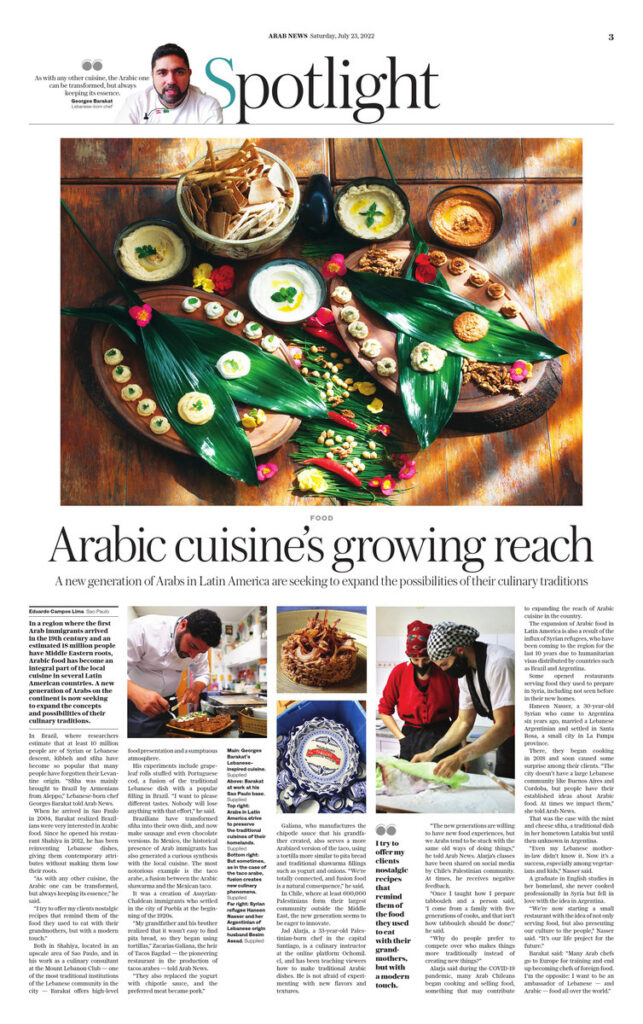
In Brazil, where researchers estimate that at least 10 million people are of Syrian or Lebanese descent, kibbeh and sfiha have become so popular that many people have forgotten their Levantine origin. “Sfiha was mainly brought to Brazil by Armenians from Aleppo,” Lebanese-born chef Georges Barakat told Arab News.

When he arrived in the city of Sao Paulo in 2004, he realized that Brazilians were very interested in Arabic food. Since he opened his restaurant Shahiya in 2012, he has been reinventing Lebanese dishes, giving them contemporary attributes without making them lose their roots.

“As with any other cuisine, the Arabic one can be transformed, but always keeping its essence,” he said.

“I try to offer my clients nostalgic recipes that remind them of the food they used to eat with their grandmothers, but with a modern touch.”

Both in Shahiya, located in an upscale area of Sao Paulo, and in his work as a culinary consultant at the Mount Lebanon Club — one of the most traditional institutions of the Lebanese community in the city — Barakat offers high-level food presentation and a sumptuous atmosphere.

His experiments include grape-leaf rolls stuffed with Portuguese cod, a fusion of the traditional Lebanese dish with a popular filling in Brazil. “I want to please different tastes. Nobody will lose anything with that effort,” he said.

Brazilians have transformed sfiha into their own dish, and now make sausage and even chocolate versions. In Mexico, the historical presence of Arab immigrants has also generated a curious synthesis with the local cuisine. The most notorious example is the taco arabe, a fusion between the Arabic shawarma and the Mexican taco.

It was a creation of Assyrian-Chaldean immigrants who settled in the city of Puebla at the beginning of the 1920s.

“My grandfather and his brother realized that it wasn’t easy to find pita bread, so they began using tortillas,” Zacarias Galiana, the heir of Tacos Bagdad — the pioneering restaurant in the production of tacos arabes — told Arab News.

“They also replaced the yogurt with chipotle sauce, and the preferred meat became pork.”

Galiana, who manufactures the chipotle sauce that his grandfather created, also serves a more Arabized version of the taco, using a tortilla more similar to pita bread and traditional shawarma fillings such as yogurt and onions. “We’re totally connected, and fusion food is a natural consequence,” he said.

In Chile, where at least 600,000 Palestinians form their largest community outside the Middle East, the new generation seems to be eager to innovate.

Jad Alarja, a 33-year-old Palestinian-born chef in the capital Santiago, is a culinary instructor at the online platform Ochomil.cl, and has been teaching viewers how to make traditional Arabic dishes. He is not afraid of experimenting with new flavors and textures.

“The new generations are willing to have new food experiences, but we Arabs tend to be stuck with the same old ways of doing things,” he told Arab News. Alarja’s classes have been shared on social media by Chile’s Palestinian community. At times, he receives negative feedback.

“Once I taught how I prepare tabbouleh and a person said, ‘I come from a family with five generations of cooks, and that isn’t how tabbouleh should be done’,” he said.

“Why do people prefer to compete over who makes things more traditionally instead of creating new things?”

Alarja said during the COVID-19 pandemic, many Arab Chileans began cooking and selling food, something that may contribute to expanding the reach of Arabic cuisine in the country.

The expansion of Arabic food in Latin America is also a result of the influx of Syrian refugees, who have been coming to the region for the last 10 years due to humanitarian visas distributed by countries such as Brazil and Argentina.

Some of them opened restaurants and have been serving the food they used to prepare in Syria, which can at times surprise Latin Americans used to a specific Arabic cuisine.

Haneen Nasser, a 30-year-old Syrian who came to Argentina six years ago, married a Lebanese Argentinian and settled in Santa Rosa, a small city in La Pampa province.

There, they began cooking in 2018 and soon caused some surprise among their clients. “The city doesn’t have a large Lebanese community like Buenos Aires and Cordoba, but people have their established ideas about Arabic food. At times we impact them,” she told Arab News.

That was the case with the mint and cheese sfiha, a traditional dish in her hometown Latakia but until then unknown in Argentina.

“Even my Lebanese mother-in-law didn’t know it. Now it’s a success, especially among vegetarians and kids,” Nasser said.

A graduate in English studies, she never cooked professionally in Syria but fell in love with the idea in Argentina. At time, she asks for help from her mother and aunt in Syria with some recipes.

“We’re now starting a small restaurant with the idea of not only serving food, but also presenting our culture to the people,” Nasser said. “It’s our life project for the future.”

Barakat said: “Many Arab chefs go to Europe for training and end up becoming chefs of foreign food. I’m the opposite: I want to be an ambassador of Lebanese — and Arabic — food all over the world.”

source/contents: arabnews.com

_____________

___________________________________

ARAB WORLD / SOUTH AMERICA

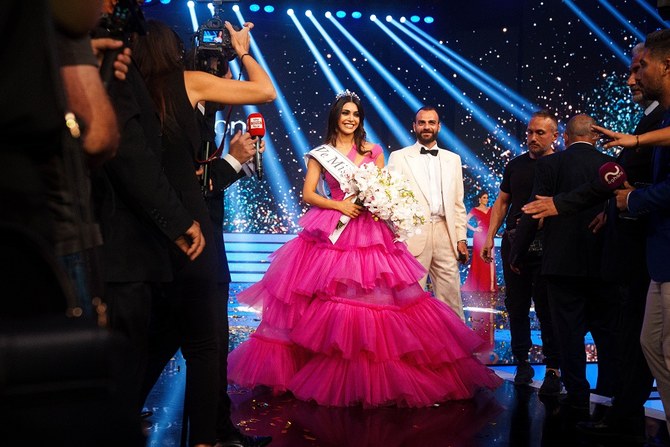
LEBANON: Journalism Student Yasmina Zaytoun Crowned Miss Lebanon 2022

The Forum de Beyrouth played host to a glittering showcase of Lebanese talent on Sunday night as model, journalism student and show host Yasmina Zaytoun was crowned Miss Lebanon 2022, almost four years after the last edition of the pageant.

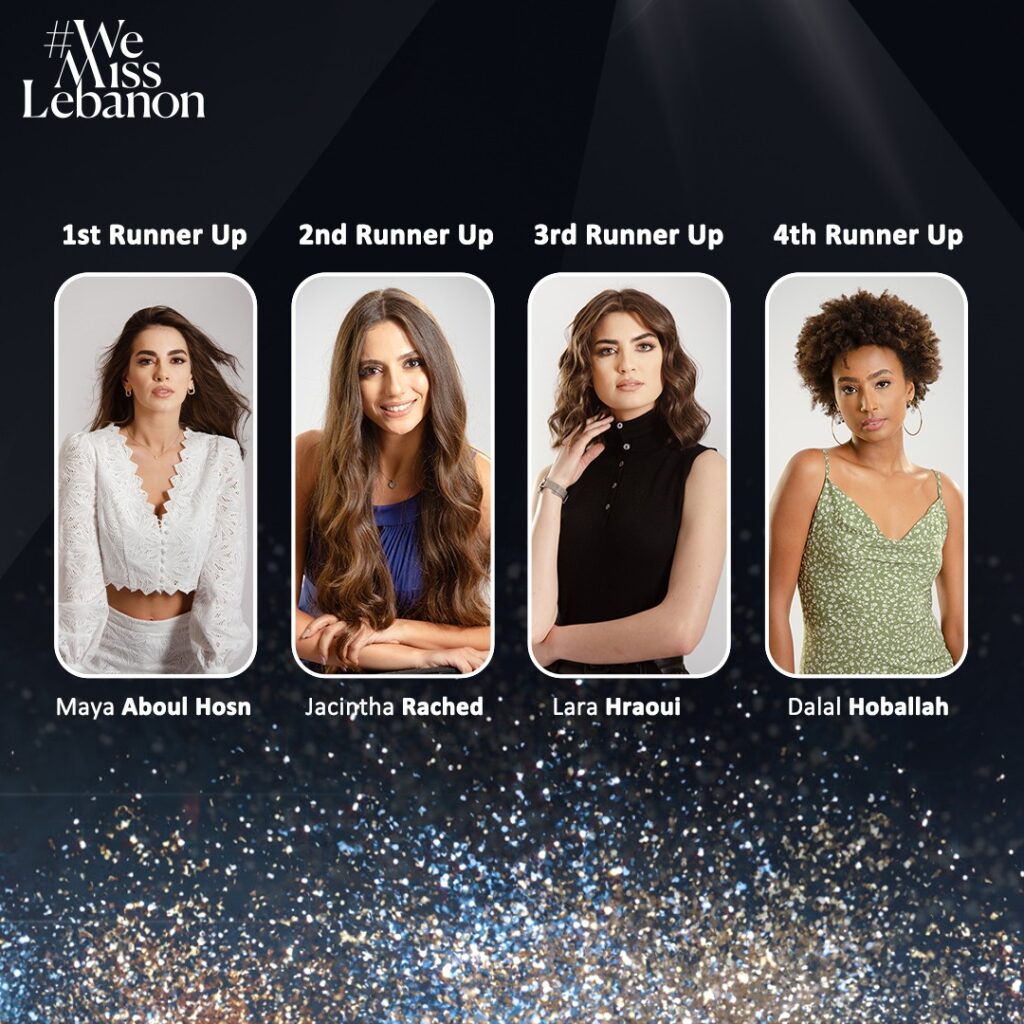
The host of the educational online platform the @WITHYASMINASHOW beat out fellow contestants Maya Abou El-Hassan, who finished as first runner-up, Jacintha Rashed, who was named second runner up, and Lara Hraoui and Dalal Hoballah who were voted in fourth and fifth place, respectively.

Zaytoun is from the village of Kfarchouba in southern Lebanon and is currently studying at Notre Dame University — Louaize. She hosts an Instagram show titled the “With Yasmina Show,” where she interviews media and sports personalities, including politician Paula Yacoubian and actress Enjy Kiwan.

Delayed by years of crises in Lebanon, the much anticipated the show featured 17 candidates from various cities and regions who wowed a judging panel consisting of music composer Michel Fadel, influencer Karen Wazen, General Manager of IP Studios Mohamad Yehya, Miss World 2022 Karolina Bielawska, General Manager of Al-Nahar and Al-Nahar Al-Arabi Nayla Tueni, Caracala dance theatre director Ivan Caracala, TV host Hilda Khalife, and Miss Lebanon 1993 Samaya Chedrawi, who was on hand to represent the Ministry of Tourism.

“Tonight, we’re celebrating Lebanon, not just Miss Lebanon,” Tueni said, explaining the importance of the event.

“Celebrating Lebanon that we miss, the beautiful country, the life in Lebanon. This is the most beautiful image of the real people, the real Lebanese that are suffering and trying to survive. This is a very important message, and I hope that Lebanon will rise again with a very positive message. We will stay strong because we love Lebanon,” she added, noting that the new beauty queen has to “be the voice of the Lebanese people.”

Hosted by Lebanese actress and TV host Aimee Sayah, the event also featured a performance by Lebanese singing icon Nancy Ajram, who started with a rendition of “Ila Beirut Al Ontha” in a tribute to the city, before surprising her fans with “Salmat Salamat” and a performance of her new song “Sah Sah,” which was produced by US DJ Marshmello.

Ajram invited her audience to support Lebanon in the “good and the bad,” adding: “I never thought about how to love Lebanon. There’s no rule as to how you can love your country. I love Lebanon till the end.”

Sayah was dressed by famed Lebanese designer Georges Hobeika, fresh off his runway presentation at Paris Haute Couture Week in July while contestants showed off a number of glamorous looks, including evening gowns and bathing suits, and also demonstrated their ability to keep a cool head under pressure by addressing a range of social issues on stage.

Those issues included divorce, fragmented families, women abuse and violence — both verbal and physical — access to healthcare and education, and women’s empowerment, among others.

The lucky few hit the stage after being prepped and primped by the best in the business, including celebrity makeup artist Bassam Fattouh and hairstylist Wassim Morkos.

Previous Miss Lebanon Maya Reaidy, who was crowned in September 2018, passed the title and the tiara on to her successor, bringing her almost four-year-reign to an end after a series of crises forced the event to be postponed.  

In the run up to the event, billboards dotted roads in Beirut and beyond with the slogan “We missed celebrating Lebanon’s beauty,” which played into the wider #WeMissLebanon campaign touted by the event organizers, The Lebanese Broadcasting Corporation International (LBCI) and The Ministry of Tourism.

Organizers also released a glamorous advert featuring a number of the contestants posing in daring outfits, with stunning aerial views of Lebanese tourist hotspots interspersed throughout the 48-second video.

The ceremony reflected the same celebration of the country through the music, which was chosen by Fadel, the setup and decoration with take home flowers.

Chairman and CEO of the Miss World organization Julia Morley, Miss World 2021 Karolina Bielawska from Poland, the first runner-up Miss USA Shree Saini, and Miss World 2019 Toni-Ann Singh from Jamaica and Miss World Events Director Stephen Douglas Morley were also in attendance.

“I have travelled quite a lot and I find that the people are the heart of every country. I can honestly say that Lebanese people are so beautiful and so warm, and even though I’m miles away from my own country Jamaica I feel at home,” Singh said.

The winner was selected from a pool of candidates chosen for their beauty and brains at auditions held between December 2021 and February 2022, with Lebanese young women aged between the ages of 18 and 27 invited to participate.

source/content: arabnews.com

__________

Journalism student and host of @WITHYASMINASHOW Yasmina Zaytoun with her Miss Lebanon 2022 crown. (Arab News/ Alex Spoerndli)

____________

LEBANON

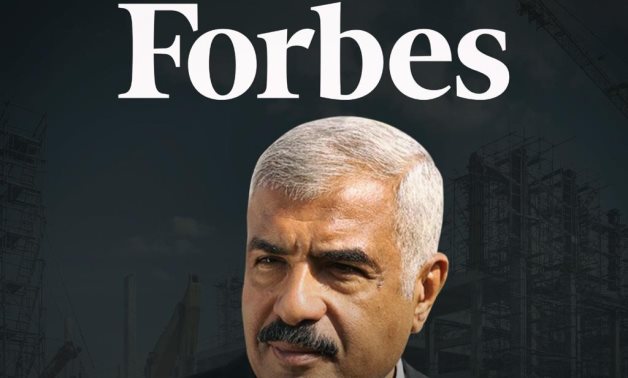
EGYPT: Among the Most Powerful CEOs of 2022 – Forbes Highlights Hisham Talaat Moustafa, CEO & MD of the Talaat Moustafa Group

Forbes Middle East has announced its annual list of the 100 Most Powerful CEOs in the Middle East for 2022.

 The American magazine confirmed the status of businessman Hisham Talaat Moustafa, CEO and Managing Director of Talaat Moustafa Holding Group, who ranked 61st, up 6 places from last year’s ranking.

 Forbes Middle East magazine said that Hisham Talaat Moustafa is the youngest son of the founder of the Talaat Moustafa Group, which is currently the largest listed real estate company in Egypt.

 The magazine stated that the assets of Talaat Moustafa Company amounted to 7.5 billion dollars in 2021, while the group owns a portfolio of land with an area of 74 million square meters.

   The group’s revenues amounted to 825 million dollars last year, while the company developed more than 33 million square meters of land, and sold more than 90 thousand housing units.

 Forbes reported that the Talaat Moustafa Group recently launched giant projects, including: Privado – Madinaty, Celia and Noor City.

 The magazine said that the group has extensive investments in the hospitality sector, including: Four Seasons Resort Sharm El Sheikh, Four Seasons Nile Plaza, Four Seasons San Stefano Alexandria, and Kempinski Nile  Cairo.

 About the methodology used in the classification, Forbes indicated that its methodology in preparing the list was based on collecting information from financial market disclosures, industry reports, annual reports of companies, financial statements, and other primary sources.

 As for the classification of CEOs, it is based on several factors: the influence of the CEO and the company on society and the country, the markets they supervise, the CEO’s experience in his current position, as well as his general experience.

 Forbes indicated that the factors affecting the evaluation include: the size of the company in terms of revenues, assets, market value, the CEO’s achievements and performance in the past year, the innovations and initiatives he implemented.

 This year, Forbes magazine’s list of the most powerful CEOs in the Middle East includes 100 business leaders from 26 different nationalities, led by the Emiratis with 19 CEOs, followed by the Egyptians with 16 leaders, and the Saudis with 15 business leaders.

  The CEOs in the banking and financial services sector topped the list with 27 CEOs, followed by the leaders of the communications sector with 8 heads, and then 7 leaders in each of the energy and logistics sector.

  The companies on the list run by CEOs are worth more than 5 trillion dollars, while revenue was more than 1 trillion dollar last year.

source/content: egypttoday.com (headline edited)

_________

Among the most powerful CEOs of 2022 Forbes highlights the CEO of Talaat Moustafa Group

_________

EGYPT

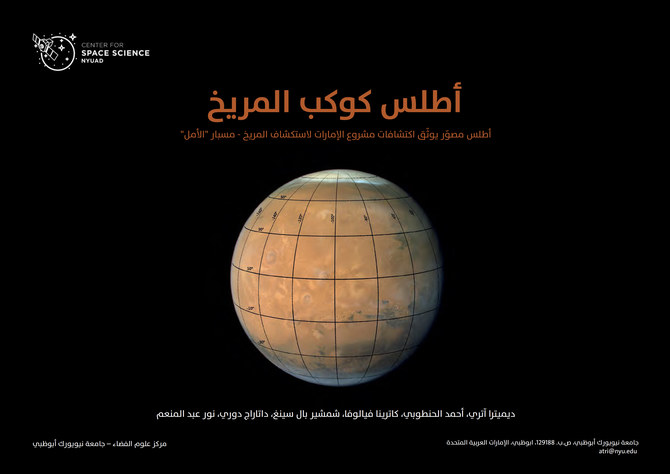
WORLD RECORD: EMIRATES (U.A.E) : NYU Abu Dhabi Research Scientist to Publish the World’s First Arabic Mars Atlas

NYU Abu Dhabi research scientist Dr. Dimitra Atri has produced the world’s first ever Mars atlas in Arabic, Emirates News Agency reported.

The atlas uses data from the UAE’s Emirates Mars Mission (EMM) — also known as Hope or Al-Amal — in order to make the findings of the probe more accessible to both the UAE’s Arabic-speaking population and the rest of the world.

The Mars Atlas Project combines various images from the Hope probe to map the planet’s surface.

The end result is a comprehensive view of Mars and stunning images of a planet that once had similar atmospheric conditions to Earth.

Dimitra Atri used data from UAE’s Hope probe to map the red planet.

Atri and his team compiled the atlas by processing observational data from EMM’s Emirates eXploration Imager, one of three instruments onboard the orbiter. The device will also assist the team in showing how the planet changes over the course of one Mars year, which is roughly equivalent to two Earth years.

As more data from the Hope probe becomes available, the atlas will be gradually updated.

The data will help scientists gain a better understanding of the planet’s atmospheric thinning, which has caused it to cool and dry over the last 4 billion years.

Atri predicts that the collected data will be used to answer unsolved scientific questions about the erosion of Mars’ atmosphere.

The findings could help the international scientific community to better understand Earth’s atmospheric processes, he said.

source/content: arabnews.com (headline edited)

____________

______________________________________________

ABU DHABI, UNITED ARAB EMIRATES (U.A.E)

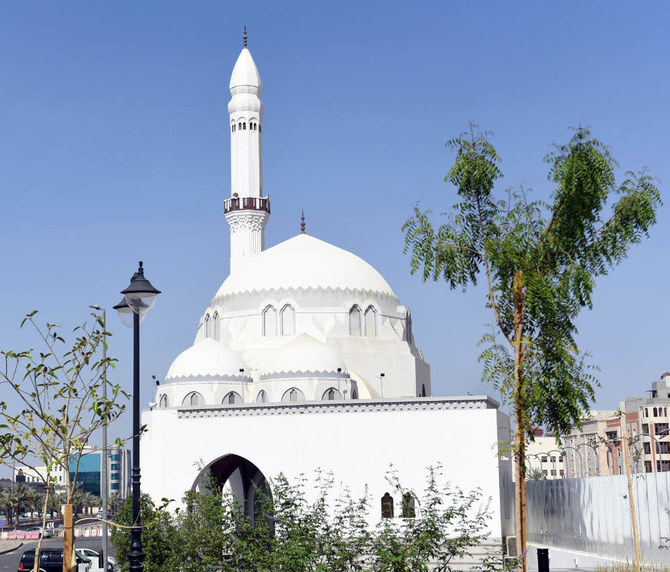
RECORDS: SAUDI ARABIA: Al-Jum’ah Mosque in Madinah, where the Prophet (pbuh) Performed the First Friday Prayer after Migration from Makkah

As a site of historical significance with a prominent role in Islamic history, today it sees a number of visitors who come to perform their prayers.

Madinah is home to a number of mosques and historic Islamic sites, a veritable tourist destination where visitors can explore places from Prophet Muhammad’s life.

Al-Jum’ah Mosque is one such place, linked to the migration of Prophet Muhammad from Makkah to Madinah.

The mosque is the site where the prophet stopped in the Wadi Ranuna region and performed the Jum’ah, or Friday, prayer.

Al-Jum’ah Mosque holds different names, such as Al-Wadi Mosque and Atikah Mosque.

As a site of historical significance with a prominent role in Islamic history, today it sees a number of visitors who come to perform their prayers.

It is situated southwest of Madinah, near Wadi Ranuna, 900 meters north of the Quba Mosque and 6 kilometers from the Prophet’s Mosque.

It was built with rocks initially then demolished and renovated several times. Before the last expansion, the mosque was built over a small mound, with one dome made of red bricks. Then it was rebuilt and expanded to accommodate 650 pilgrims.

The mosque also includes a minaret, a main dome in the middle of a praying area and four small domes on its sides.

source/content: arabnews.com (headline edited)

_________

Al-Jum’ah Mosque in Madinah. (SPA)

_________________

SAUDI ARABIA

Omani Olive Oil Bags Five Awards in the London International Olive Oil Competitions

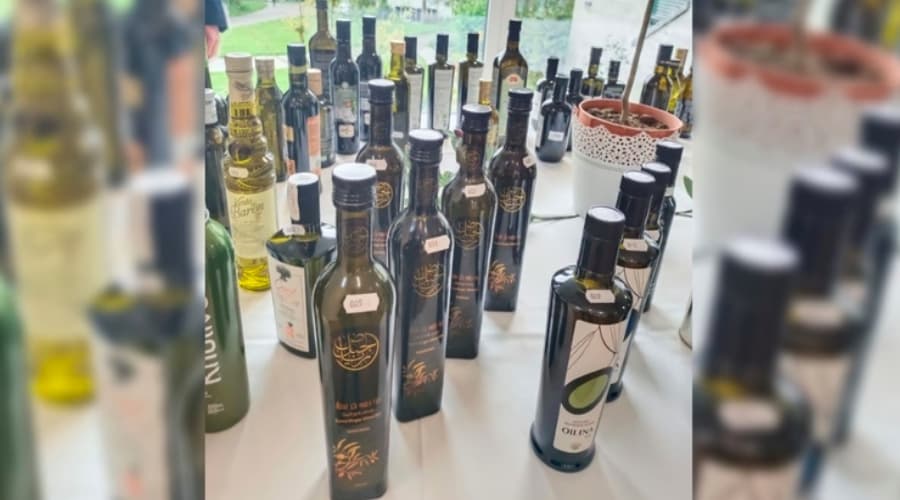
 Olive oil of the Royal Court Affairs (RCA), represented by the Royal Gardens and Farms, have won five medals at the London International Olive Oil Competitions.

The olive oil products of Riyad al Jabal Farm in Jabal Akhdar were awarded two gold, two silver and a bronze, confirming the continuation of a high-profile record in international competitions. The prizes will be handed over to the winners at a ceremony on July 11, said a report.

Hilal bin Mohammed al Waeli, Head of Horse and Camel Affairs, Farms and Royal Gardens, said, “Omani olive oil products continue to shine and lead, as it deservedly won a total of 12 international awards this year through participations in three competitions.”

He added that these achievements are a clear evidence of the quality of the extra virgin olive oil produced at the Riyad al Jabal Farm.

“All stages of its production, starting from choosing the site for planting olive trees, the technical and scientific care of agricultural process, to the accurate harvesting methods and extraction utilising the best modern methods are managed by a highly skilled and dedicated workforce.”

source/content: muscatdaily.com

_________

Oman wins five prizes at London Olive Oil Awards

_________

OMAN

4 Arab Cities Listed Among World’s Best

Time Out magazine ranks Marrakech 7th among top 53 cities. List also includes Dubai, Abu Dhabi, Doha

Marrakech has been ranked seventh in a new list of the world’s 53 best cities, compiled by British events magazine Time Out.

Dubai (40), Abu Dhabi (45) and Doha (53) were the other Arab cities receiving plaudits for their offerings in nightlife, liveability, and practical issues such as walkability and sustainability.

The magazine’s annual ranking this year was the first since 2019 to not revolve around resilience to the COVID-19 pandemic, instead focusing on the fun and practical frills that each city has to offer.

Time Out said it had “added extra weight to the things that make cities great places to visit as well as to live.”

It added: “Our top cities this year are the ones with thriving nightlife, amazing food and drink, and art, culture and museums galore.

“We’ve highlighted places that aren’t boring or overly expensive or overrated, and we’ve ensured that our top picks also score well for practical stuff like walkability, good public transport and safety, as well as sustainability.”

The editors were charmed by the “community, creativity and faith in the future” that made Marrakech “come roaring out of the pandemic with a new lease of life.”

Time Out spoke to local guides and experts to get a feel for what is particularly excellent about each urban hub.

Highlighting the new international storytelling festival in February, it said post-pandemic Marrakech has attracted “big players like La Mamounia” that were “sporting sassy new looks.”

The Moroccan cultural capital was described as “thriving,” with the magazine pointing to a range of exhibitions.

It added that El-Fenn had launched “the hottest Sunday music nights in town,” with visitors desperate to return.

Time Out said Dubai “has all the stuff you’d want from a travel destination — from incredible restaurants and buzzing nightlife to some of the world’s best shopping and simply stunning beaches.”

It also pointed to its modernity and cleanliness, highlighting that 97 percent of the locals say the city is clean.

Dubbed “a city of superlatives,” Time Out pointed to the emirate boasting the world’s highest infinity pool, tallest building and largest manmade island. Dubai heard the phrase “go big or go home” and truly took it to heart.

But while those “world’s largest” structures are static, the city is anything but. A vibrant events scene has introduced the newly opened Museum of the Future, with Time Out recommending that you follow your visit “with a beach club crawl along the rapidly expanding Palm West strip and a DJ set at Electric Pawn Shop.”

Time Out noted that Emirati capital Abu Dhabi is also the “unofficial arts and culture capital” of the UAE.

Pointing out that the city’s safety and cleanliness made it popular with expats, the magazine referenced the constant stream of exciting things to do, “from cutting-edge restaurant openings to major new museums including the Guggenheim Abu Dhabi and the National History Museum Abu Dhabi,” both of which are on the horizon.

Local expert Heather Cichowski, from Time Out Abu Dhabi, said the city “ranks among the least dirty, stressful and rude. In short, it’s an all-round comfortable and pleasant place to live and work.”

Like Dubai and Abu Dhabi, Doha was similarly praised for its cleanliness, but locals and expats have also lapped up the Qatari capital’s stream of events and activities.

As Doha gears up to host this year’s FIFA World Cup, the pinnacle of the world’s most popular sport, the city has been promoting its local events for every taste and persuasion.

Time Out said: “There’s loads of great stuff to see and do here, whether you fancy heading out to one of the city’s many cafés for breakfast (and we mean many, Doha’s coffee-and-cake culture is absolutely thriving), touring public art spots from Al Sadd Metro Station to Katara Cultural Village, or visiting a bar after hours.”

Boasting a slower and less stressful pace of life, the city is pouring attention into its arts scene.

The magazine said from now until the turn of 2023, some 17 new exhibitions are set to open, including an “immersive light installation from Pipiliotti Rist at the National Museum of Qatar,” which it described as “particularly stunning.”

source/content: arabnews.com

_____________

Marrakech. (Shutterstock)

A view of the downtown skyline is seen from the Museum of the Future in Dubai, United Arab Emirates, February 23, 2022. (REUTERS)
Buildings are seen on a coast line in Doha, Qatar. (REUTERS)

_________________________________________________________________________

MOROCCO / QATAR / SAUDI ARABIA / UNITED ARAB EMIRATES (U.A.E)