MOROCCO’s Arif Esa Appointed Deputy Chairman at International Trade Council (ITC)

Esa hopes that his new role will help him raise Morocco’s profile in the fintech and digital industry globally.

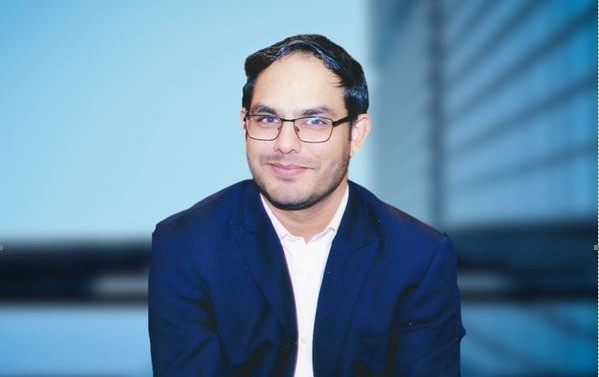
Founder and CEO of Moroccan fintech startup moneyIN Arif Esa has assumed the position of Deputy Chairman for the Banking/Finance/Blockchain & Trade Finance department at the International Trade Council (ITC). 

This appointment not only recognizes Esa’s outstanding contributions but also positions him as the first Moroccan entrepreneur to hold such a role within the ITC.

Esa, who holds a stellar track record in finance and fintech, with a portfolio of global recognition and awards, spoke with Morocco World News about his motivation for taking this role, as well as his new responsibilities and objectives.

“Accepting this responsibility was not just an honor but an opportunity to provide pivotal advice and give back to the community. It also aligns seamlessly with our global vision to establish Morocco and Africa as prominent players in the fintech and digital industry,” he said.

As a globally recognized figure, Esa’s reputation in the finance and fintech industry drew the attention of the ITC panel, which spans 179 countries, 79 government trade and investment agencies, 418 chambers of commerce, and a vast network of businesses and employees. 

After undergoing a “meticulous” evaluation process, Esa was humbled to be selected as the Deputy Chairman of this division, he said.

In his capacity as Deputy Chairman, Esa will play a key role in shaping the strategic direction of the ITC’s Banking/Finance/Blockchain & Trade Finance department. 

This role includes overseeing various key focus areas, including financial Instruments, risk mitigation, regulatory compliance, promoting innovative solutions, and capacity building, among others.

A bridge to Morocco

Highlighting the significance of his new role, the Moroccan entrepreneur emphasized, “I am excited about the impact we can collectively achieve, and I look forward to contributing meaningfully to the growth and transformation of trade finance and continuing to promote Morocco and the economy in the years to come.”

One of the central aspects of Esa’s new position is its potential impact on the Moroccan fintech landscape and businesses. His appointment is expected to open doors for Moroccan start-ups and fintech ventures on an international platform, he said.

“With my reputation, influence, and track record in the finance and fintech industry, I am poised to attract heightened attention and interest from investors, venture capitalists, and family offices,” he underlined.

In addition, the Moroccan entrepreneur intends to use his position to advocate for supportive regulatory frameworks for fintech start-ups in Morocco, fostering an environment that encourages investment. 

He also emphasized the importance of mentorship and personalized guidance, stressing that he is “committed to assisting start-ups in overcoming challenges, honing their strategies, and maximizing their potential for success.”

Esa’s engagement with international networks through the ITC is expected to provide Moroccan start-ups with expanded access to global markets, he noted, explaining that it will help them open doors to new markets and strengthen their credibility and standing on a global stage.

He further emphasized that his appointment “symbolizes a bridge between the Moroccan fintech ecosystem and the international financial landscape,” allowing him to “catalyze a transformational shift in how Moroccan start-ups are perceived, supported, and propelled towards greater success.”

Esa reflected on his journey with Morocco moneyIN, an instant payment solution, and how it prepared him for this new position.

“My journey with moneyIN Morocco has been a transformative experience that has uniquely prepared me for the prestigious role of Deputy Chairman within the Banking/Finance/Blockchain & Trade Finance department at the International Trade Council,” he explained.

He highlighted several key areas where his experience with moneyIN proved instrumental, including his ability to navigate the rapidly evolving fintech landscape and understand the potential of technologies like blockchain.

In particular, his background as an entrepreneur equipped him to empathize with the challenges start-ups face and advocate for measures that facilitate their growth.

His engagement with start-ups underscored the importance of mentorship and education, which Esa plans to extend globally.

Esa concluded by offering valuable advice to aspiring Moroccan entrepreneurs, encouraging them to “dream boldly, embrace disruption, and lead with integrity.”

He emphasized the importance of resilience, continuous learning, and global thinking, saying, “Aspire not only to make a mark but to leave an indelible legacy of positive change that reverberates across borders and generations.”

source/content: moroccoworldnews.com (headline edited)

____________
____________

MOROCCO
ARAB CULTURE IN SPAIN: 5 Marvels of Arab Culture to see in Spain

.When you hear of Al-Andalus, you might think of Andalusia. And yet, from 711 to 1492, until the famous Fall of Granada, the Future Andalusia was only a small part of this vast Arab territory, whose influence can be seen everywhere in Spain. Let us take a tour.

Al-Andalus, a long series of powerful people

In the early 8th century, the Iberian Peninsula belonged to the Visigoth Empire, when the commanders of the Umayyad Caliphate (with a territory extending from the Arabian Peninsula to the Maghreb) set out to conquer the lands on the other side of the Mediterranean.

The Umayyad dynasty ruled in Al-Andalus (what would become Spain) for more than 300 years. It was suceeded by Taifas (independent kingdoms). The Abbasids, then the Almoravids, rose to power. In 1147, it was the Almohads who took over the empire. This proved to be a prosperous period, with great scholars, such as Averroes, a doctor, lawyer, and advisor to the Caliph. These scholars helped to make Al-Andalus a grand dominion. But the Christian reconquest gained ground. From 1238 to 1492, the Reconquista blazed on, and soon only the Emirate of Granada remained in southern Spain, the last vestige of the great Muslim empire.

From the north to the south of Spain, the Arab-Andalusian influence can be seen everywhere

One after the other, Cordoba, Seville and Granada became the capitals of the kingdom of Al-Andalus during the Middle Ages. Arab culture has permeated everything from traditional Andalusian music to the names of localities, and the Spanish language. But the most visible influence can of course be seen directly in the architecture of buildings and streets. Numerous vestiges, sometimes intact, sometimes remodelled, remain in the cities’ maze of streets, and this period of Spanish history has left prodigious monuments of Arab origin and fabulous examples of Islamic art. Many of these monuments bear a unique blend of cultural influences as they were renovated or repurposed over the centuries.

The most beautiful Arab monuments in Spain

The Arab Baths of Ronda, a magnificent ruin site

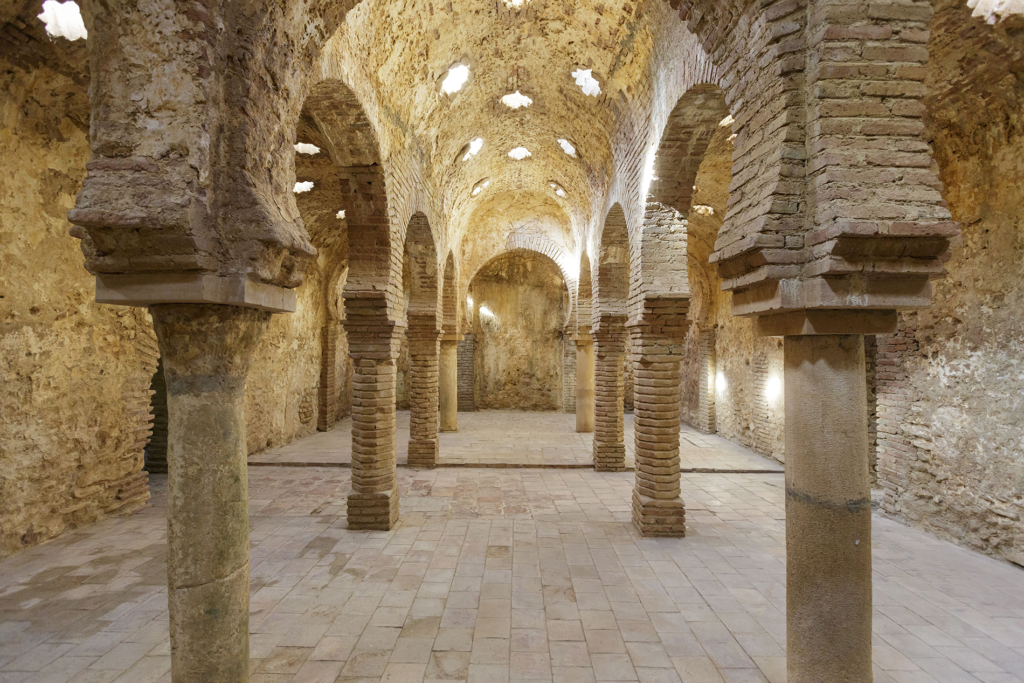
The hammam tradition was a cornerstone of Arab culture for centuries. From the 13th to the 15th century, several such baths were built in Spain. The baths of Ronda, in Andalusia, are one of the best examples, with their three magnificent barrel-vaulted rooms and visible heating and water circulation systems. The Guadalevín river, which often floods, has prevented these baths from being used, but excavations have been carried out, and now you can visit and admire some of the best-preserved Arab bathhouses in the country.

pix: P. Escudero / hemis.fr

Baños Árabes
C. Molino de Alarcón
29400 Ronda
Málaga
+34 951 15 42 97
turismoderonda.es

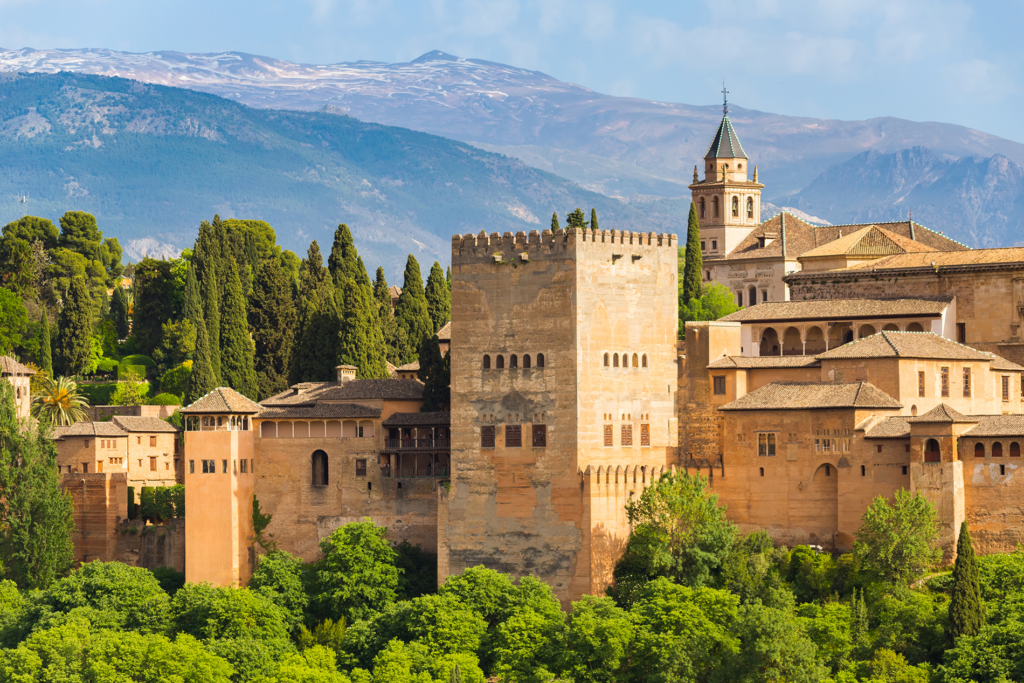
The Alhambra of Granada, an extraordinary castle

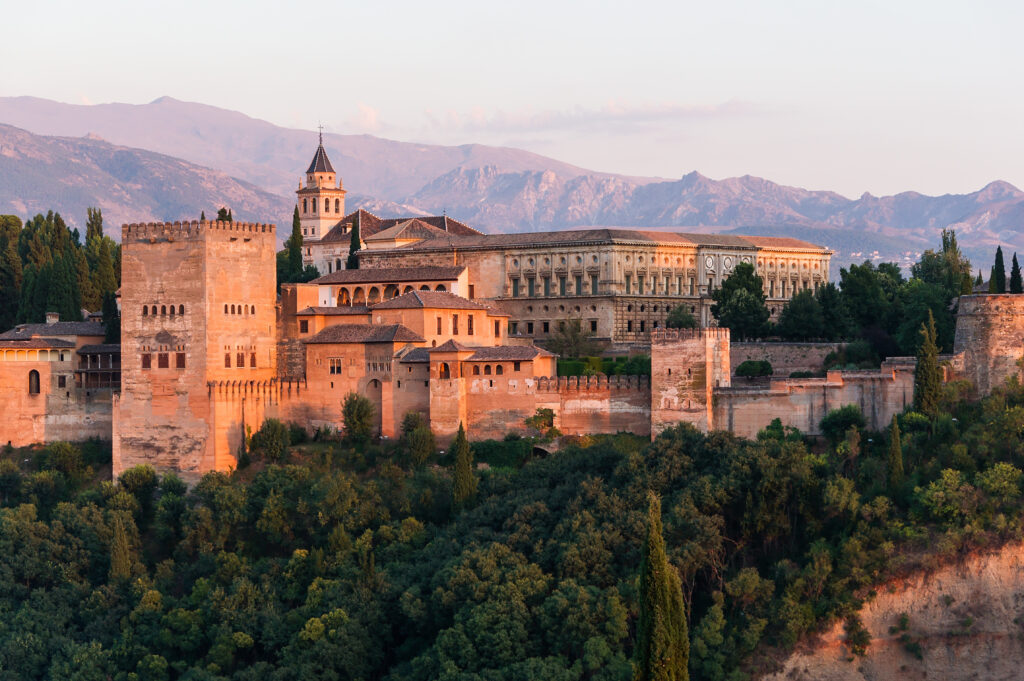
On the Sabika hill, opposite the Albaicín district, stands the Alhambra of Granada, a majestic conglomeration of several buildings built in the early 12th century. The grandeur of the last Nasrid rulers is at its peak. Not to mention the sublime, breathtaking view over the plain of Granada!

pix: KellyISP / Getty Images Plus

Alhambra de Granada
C. Real de la Alhambra
18009 Granada
+34 958 02 79 71
www.alhambra-patronato.es

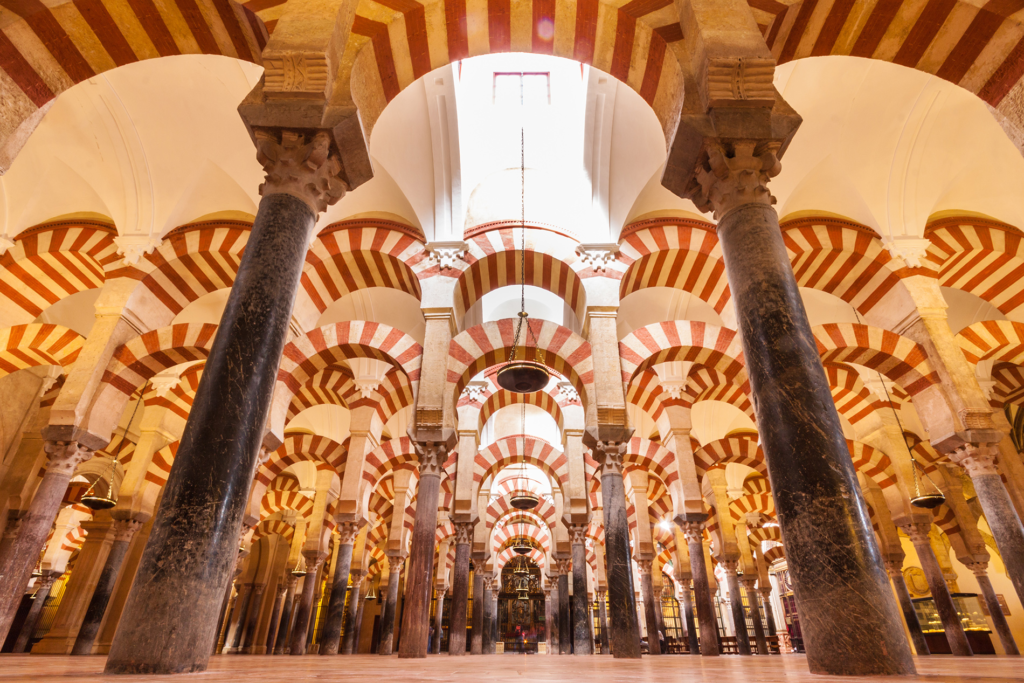
The Mosque-Cathedral of Cordoba, from Islam to Christianity

Another Muslim building, the Cordoba mosque is a symbol of Arab influence at its most grandiose. From the 8th century to 29 June 1236, the building served as a mosque, before becoming a church again following the Reconquista. Representative of the art of the Umayyads of Cordoba, it is a monumental structure, and it covers over 1.5 hectares. The building is a splendid example of Islamic architecture: the “forest of columns” in the main hall – 1,300 marble, jasper and granite columns – highlights the gargantuan size of the place.

pix: kasto80 / Getty Images Plus

Mezquita-Catedral de Córdoba
C. Cardenal Herrero, 1
14003 Córdoba
+ 34 957 47 05 12
mezquita-catedraldecordoba.es

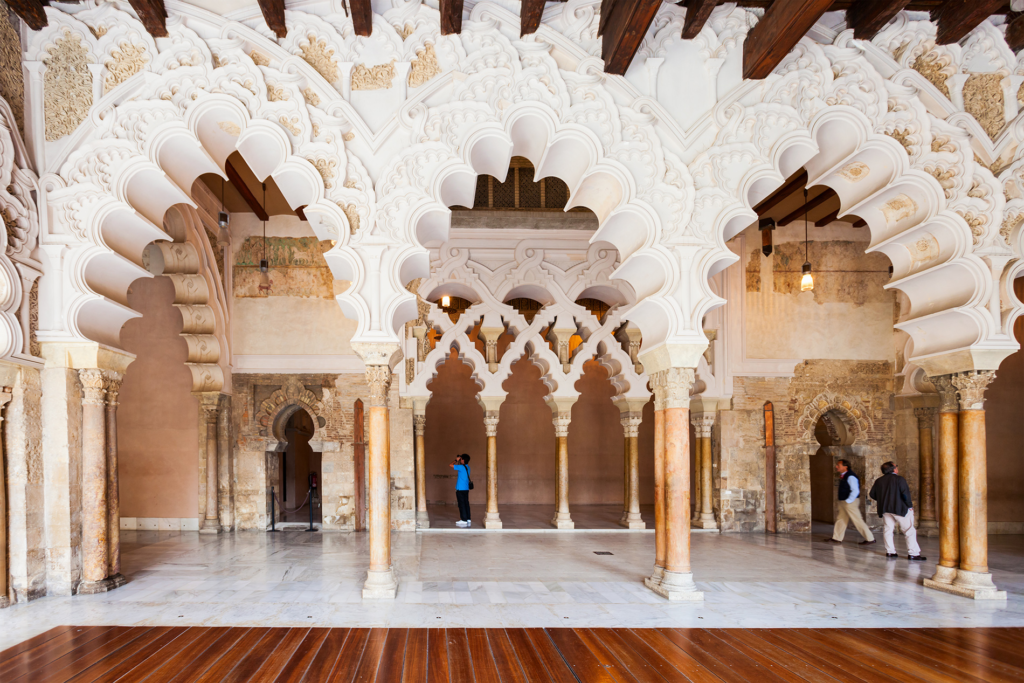
The Aljaferia Palace in Zaragoza, a seat of power

The Mudejar art of Aragon, in the north of Spain, has been declared part of UNESCO’s World Heritage, and the Aljaferia in Zaragoza is one of its most flamboyant masterpieces. When it was built in the second half of the 11th century, this palace clearly displayed the magnificence of the Taifa of Zaragoza. It served as a residence, a fortified enclosure and a barracks. It currently houses the Parliament of Aragon. The palace’s interior decoration is gorgeous, with a series of delicate, refined arches.

pix: kasto80 / Getty Images Plus

Palacio de la Aljafería
Calle de los Diputados
50003 Zaragoza
+34 976 28 96 83
www.turismodearagon.com

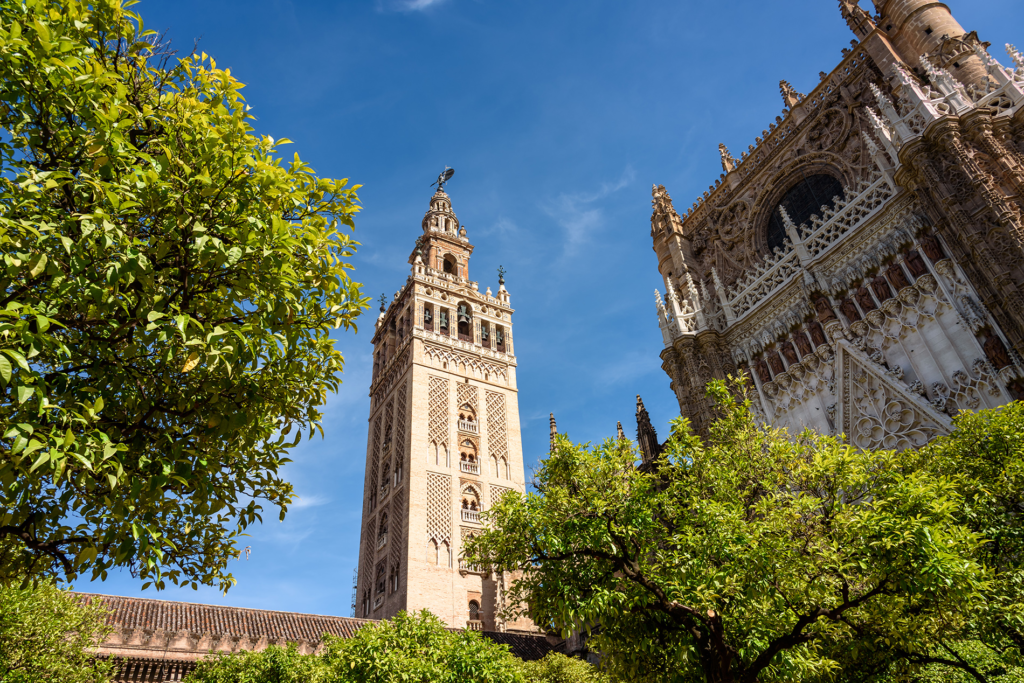
The Seville Giralda, a perfect example of mixed construction

The architectural marriage of the Giralda, the bell tower of the Cathedral of Our Lady of the See in Seville, is immediately evident. The lower parts were built in the 12th century, when the city was the capital of the Arab-Andalusian empire, under the rule of the Almohads. Four centuries later the upper floor was added, and the mosque’s minaret became a bell tower. It is now an unspoken rule that no building should be higher than this symbol of Seville.

pix: marinzolich / Getty Images Plus

Catedral de Santa María de la Sede de Sevilla – Giralda
Av. de la Constitución
41004 Sevilla
+34 902 09 96 92
www.catedraldesevilla.es

source/content: en-vols.com / ENVOLS (headline edited)

_____________

pic: Alhambra / Wikipedia

_________

SPAIN

ABU DHABI, UAE: How Manchester City Evolved under Sheikh Mansour’s Leadership to become European Champion

The managerial ability of Pep Guardiola was backed by Sheikh Mansour’s long-term project as City won a historic treble.

When Sheikh Mansour bin Zayed Al Nahyan, UAE Vice President, Deputy Prime Minister and Minister of Presidential Court, bought Manchester City in 2008, the club was languishing in the mid-table of the English Premier League.

It had just finished the previous season in ninth position, 32 points behind Manchester United, the champion of England and its famously successful city rival.

United then was brimming with world-class talent.

A team featuring Cristiano Ronaldo, Wayne Rooney, Carlos Tevez, Ryan Giggs, Paul Scholes, Rio Ferdinand, Patrice Evra, Nemanja Vidic and Edwin van der Sar, United had also won the Champions League in 2008.

It was Sir Alex Ferguson’s second European triumph with United as manager following the famous treble-winning season in 1999.

So it was a couple of months after United enjoyed one of its greatest seasons that Sheikh Mansour made his foray into English football with a club that was never able to sit alongside the elites in the sport.

But the visionary UAE leader went on to change the footballing landscape in such a way that City is now football’s ultimate aristocrat.

So how did City, who completed a historic treble by winning the Premier League, FA Cup and the Champions League this season, become the most dominant team after Sheikh Mansour took over the club?

Long-term goal

Brazilian star Robinho joined Man City from Real Madrid in 2008. — Twitter

City did not become successful overnight despite the takeover from Sheikh Mansour in 2008.

It made a slow and steady progress and one that was backed by Sheikh Mansour in every step.

In the first season after the takeover, City could only finish 10th in the league despite acquiring a big-name player from Real Madrid, Robinho, the Brazilian superstar.

But City made gradual improvement and next season in 2010, the team became stronger after the arrival of Emmanuel Adebayor, Carlos Tevez and Kolo Toure.

Chelsea, United, Arsenal and Tottenham were the top four teams that season as City finished fifth, narrowly missing out on a place in the Champions League.

FA Cup triumph

The next season in 2011, City finally ended its trophy drought. A Carlos Tevez-inspired City won the FA Cup that season with a 1-0 win over Stoke City in the final – it was the team’s first major triumph since 1976.

City had reached the final with victory over United in the semifinal, the club’s first success in a knockout game against the bitter rival since 1975.

City then went on to finish third in the league, qualifying directly for the Champions League in what was another landmark for the club.

Premier League ecstasy

After breaking into the top-three of the Premier League, City turned on the style in England.

Sergio Aguero had just joined City from Atletico Madrid and the Argentina star made an instant impact.

City thrashed Tottenham 5-1 and humiliated United 6-1, signalling its arrival on the big stage as the big contender for the title.

The battle for the league title, though, was not easy with United bouncing back only to fall again.

It went to the last day with City needing a win against the Queens Park Rangers to pip United for the title.

But City was trailing 2-1 until the 91st minute in the dramatic last game of the season.

The Blues though scored an equalizer in the 92nd minute before Aguero found the winner in the last minute of injury time with a moment of magic, sparking wild celebrations on the field and in the stands.

It was City’s first league title in 44 years and it was the start of a golden era for the club.

Guardiola arrives

City had added one more Premier League title in 2014. Two years later, the club hired Pep Guardiola, who famously led Lionel Messi’s Barcelona to glorious triumphs during his four-year stint as manager of the Catalan club.

Guardiola arrived in City after a two-year spell at Bayern Munich.

A man famous for building teams that play eye-catching football, Guardiola was entrusted with the responsibility of making City a serial winner as well as an aesthetically pleasing team.

The Spanish coach imposed his style on the team and it won the league in 2017-2018 by collecting the highest points for a season.

City retained the Premier League title next season, its first successful defence of the title in history.

With world-class players in the team, City was producing mesmeric football as it also won two more league titles in 2021 and 2022.

But the biggest dream — the Champions League title — remained unfulfilled after defeat to Chelsea in the 2021 All-England final.

Historic treble

Sheikh Mansour’s Manchester City was finally rewarded in Europe for its perseverance.

City produced another masterclass in beautiful and brilliant football as Guardiola’s team won its third straight Premier League title, overcoming a spirited challenge from Arsenal.

The club then beat city rival United in the final to win the FA Cup.

And once it outplayed Real Madrid, the most dominant team in the history of European football, in the Champions League semifinal, City became the overwhelming favourite in the final against Inter Milan.

The Italians put up a big fight in the Istanbul final, but the superior quality of City made the difference as Rodri’s sumptuous goal separated the victor from the vanquished.

City’s wait to be European champion was finally over as it also became the first team since Manchester United to complete the treble.

It has taken the team 15 years since the takeover from Sheikh Mansour to scale the highest peak.

The long-term vision of Sheikh Mansour helped City become the king of European football.

The club has won seven Premier League, three FA Cup, six League Cup and the 2023 Champions League title in these 15 trophy-laden years under Sheikh Mansour’s leadership.

“One of the main reasons why this club became what we are is because of the people from Abu Dhabi, Sheikh Mansour, took over the club,” Guardiola said. “Without that, we would not be here.”

The biggest tribute City can pay to Sheikh Mansour now is by becoming the first team since Real Madrid to defend the Champions League title.

source/content: khaleejtimes.com (headline edited)

____________

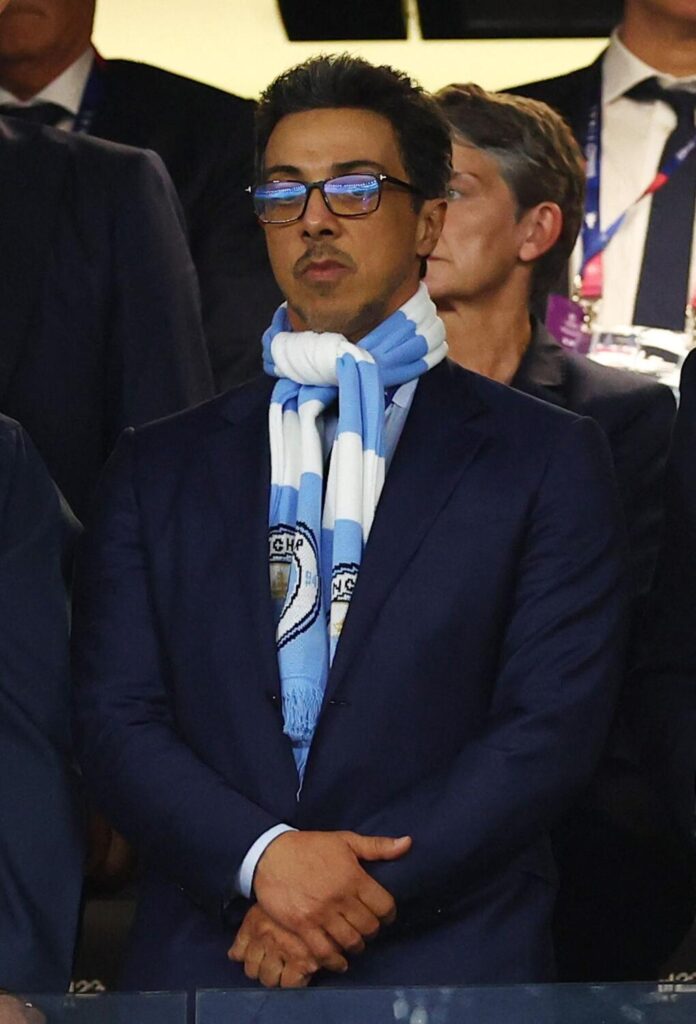
Sheikh Mansour bin Zayed Al Nahyan, UAE Vice President, Deputy Prime Minister and Minister of Presidential Court, attends the Champions League final. — Reuters

_______________________________________________________________________

MANCHESTER (U.K.) / ABU DHABI , UNITED ARAB EMIRATES (U.A.E)

SAUDI ARABIA / ALGERIA: Saudi Justice Minister Waleed Al Samaani Elected as Head and Algeria’s Abdul Rashid Tabbi as Deputy Head of the Pan-Arab body -‘Council of Arab Justice Ministers’

Al-Samaani and Tabbi will serve in their roles for two years.

Saudi Justice Minister Waleed Al-Samaani has been elected head of the executive office of the Council of Arab Justice Ministers, the Saudi Press Agency reported. 

Abdul Rashid Tabbi of Algeria was elected deputy head. Both will serve in their roles for two years.

The announcement came on Wednesday during the 71st session of the executive office, held at the Arab League’s headquarters in Cairo.

source/content: arabnews.com (headline edited)

__________

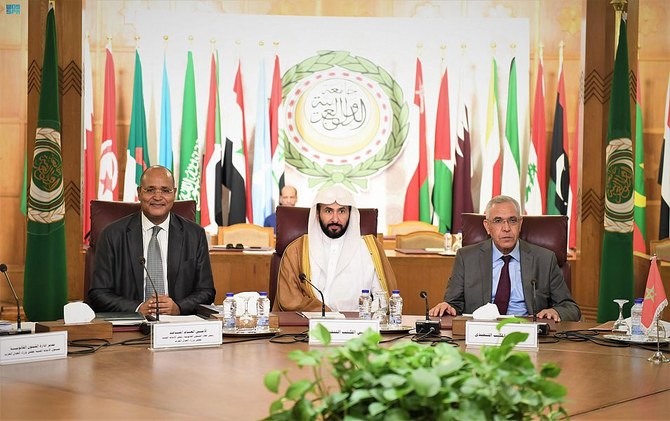
Saudi Justice Minister Waleed Al-Samaani attends 71st session of the executive office of the Council of Arab Justice Ministers. (SPA)

____________________________

SAUDI ARABIA / ALGERIA

TUNISIA / MOROCCO: Fatima Al-Fihri: The Woman who Founded the World’s First University in Fez, Morocco

During her lifetime, Fatima was called the “mother of boys”. According to historian Mohammed Yasser Hilali, “this nickname probably stems from her charity and the fact she took students under her wing”.

When thinking of the oldest universities in the world, probably the first ones that come to most people’s minds are Oxford and Bologna, but according to UNESCO and the Guinness World Records, Al-Qarawiyyin University (also written as Al-Karaouine) is the “oldest existing, and continually operating educational institution in the world.”

Founded in 859 A.D. by Tunisian-born Fatima al-Fihri in Morocco’s Fez, the university is not only the oldest higher education institution on Earth but also the first to be founded by a Muslim woman. Fatima used her inheritance from her merchant father’s wealth to found the university which started as an associated school – known as a madrasa – and a mosque that eventually grew into a place of higher education. It also introduced the system of awarding degrees according to different levels of study in a range of fields, such as religious studies, grammar and rhetoric. Though the university first focused on religious instruction, its fields of study quickly expanded to include logic, medicine, mathematics and astronomy, among many others.

The University of Al Quaraouiyine became a state university in 1963 and now awards degrees in Islamic, religious and legal sciences with an emphasis on classical Arabic grammar and linguistics and law. 

Interestingly, teaching is still delivered in a very traditional manner, whereby students are seated in a semi-circle around a Sheikh (Islamic scholar), who prompts them to read sections of particular texts, asks them questions on aspects of grammar, law, or interpretation, and explains difficult points. Education at the University of al-Qarawiyyin concentrates on the Islamic religious and legal sciences with a heavy emphasis on, and particular strengths in, Classical Arabic grammar/linguistics and Maliki Sharia, though lessons on non-Islamic subjects are also offered to students. Teaching is still delivered in the traditional methods. The university is attended by students from all over Morocco and Muslim West Africa, with some also coming from further abroad. Women were first admitted to the institution in the 1940s

Fatima al-Fihri was born in 800 A.D. She was the daughter of Mohammed Bnou Abdullah al-Fihri – a rich merchant who settled in Fez with his family during the reign of Idris II. 

Fatima’s family was part of a community called the “Qarawiyyin” (the ones from Qayrawan) whose two thousand families migrated from Qayrawan in Tunisia, to Fez in Morocco which was then under the rule of Idris II, a respected and devout ruler.

After the community was banned by the local ruler. The caravan included Fatima’s father Muhammad bin Abdullah Al-Fihri, and sister Mariam. Fatima was well versed in classical Islamic learning such as fiqh (jurisprudence) and hadith (Islamic traditions based on Prophet’s life). She inherited a large fortune from her merchant father which she used to build the university. She personally supervised the entire gigantic enterprise, from putting up the foundation to the functionalizing of these institutions. When she embarked on her mission, she had lost her father, husband, and brother – all primary sources of support and protection for a woman. Any other woman would have retreated to the backwaters of domestic life. But Fatima appears to have been an extraordinarily inspired and determined woman with steely grooves. All her great achievements came during periods of loneliness and in circumstances when women normally shun the world and seek the company of the home.

During her lifetime, Fatima was called the “mother of boys”. According to historian Mohammed Yasser Hilali, “this nickname probably stems from her charity and the fact she took students under her wing.” Fatima al-Fihri herself is considered a saint and she is much respected among the believers especially in Fez. In 2017, a prize was created in Tunisia in her honor. It rewards initiatives which encourage access to training and professional responsibilities for women. Furthermore, an academic program and a scholarship given to students from Europe and North Africa pay tribute to Fatima al-Fihri.

The University of Al-Qarawiyyin (also Al-Karaouine), which was then just called a madrasa (an institute of religious learning), was 30 m long, with a courtyard, a large library, and several schoolrooms. Although initially only the Qur’an and related religious lessons were taught, many other courses of study, like mathematics, medicine, Arabic grammar, history, geography, astronomy, chemistry, music and logic were soon introduced. Fatima studied there herself, along with her students, and awarded them degrees once they completed the courses: a degree that was chiseled onto a wooden board, which is now displayed in the university’s library. She also conducted debates and symposiums periodically for her students, producing politically-aware individuals.

With these innovative ideas, Fatima al-Fihri had not merely founded the first university but had introduced the concept of awarding degrees that is now an essential part of modern higher education.

In fact, the university produced many celebrated intellectuals and historians who are still known to this day: the Islamic philosopher Ibn Rushd, Andalusi diplomat and geographer, Hassan al-Wazzan and historian and thinker Ibn Khaldun, the famous Jewish philosopher, Moses Ben Maimon and Aka Maimonides.

The Christian scholar, Gerbert of Aurillac, who later became Pope Sylvester II, is believed to have visited the university several times. His visits helped him introduce Arabic numerals and the concept of zero to Europe. The University of Al Qarawiyyin is still considered a leading religious and education institution in the Muslim world. The university has moved away to another part of Fez, but the mosque and the library remain at the ancient complex. The University of Al-Qarawiyyin is the oldest existing, continually operating and the first degree awarding educational institution in the world according to UNESCO and Guinness World Records and is sometimes referred to as the oldest university.

(M Ahmad is a regular writer for this newspaper and can be reached at specialachivers78@gmail.com)

source/content: risingkashmir.com (headline edited)

__________

___________

TUNISIA

SAUDI ARABIA to Chair ‘WTO Trade Policy Review Body’ for 2023-2024

Almoqbel is the first Arab ambassador to the WTO to preside over the TPRB.

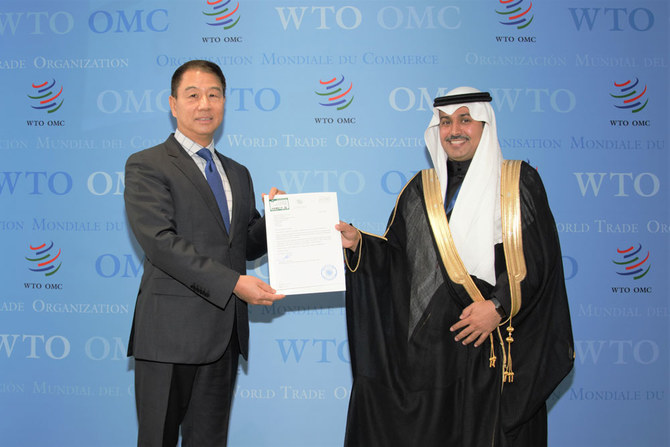
The World Trade Organization General Council has selected Saudi Arabia’s Ambassador to WTO Saqer Abdullah Almoqbel to chair its Trade Policy Review Body for 2023-2024. 

Almoqbel is the first Arab ambassador to the WTO to preside over the TPRB. 

The TPRB aims to facilitate the efficient operation of the multilateral trading system by increasing the transparency of WTO members’ trade policies. All members are subject to review every two to six years under the mechanism. 

Periodically, the agency releases reports on the global economy, including detailed chapters examining the trade policies and practices of each member, as well as descriptions of the trade policymaking institutions and the macroeconomic environment. 

Saudi Arabia’s new position at TPRB reinforces its leadership position within the WTO. In addition to being the organization coordinator for the Arab group, the Kingdom has chaired the Council for Trade in Services, the Council for Trade-Related Aspects of Intellectual Property Rights, the Working Group on Transfer of Technology, and the Committee for Balance of Payments Restrictions in previous years.

source/content: arabnews.com (headline edited)

____________

Saudi Arabia’s Ambassador to WTO Saqer Abdullah Almoqbel presents his credentials to Deputy Director-General Yi Xiaozhun in 2020. (WTO)

_________________

SAUDI ARABIA

WORLD ARAB RECORD: U.A.E : Longest Arab Space Mission in History Launched

Florida, March 02nd, 2023

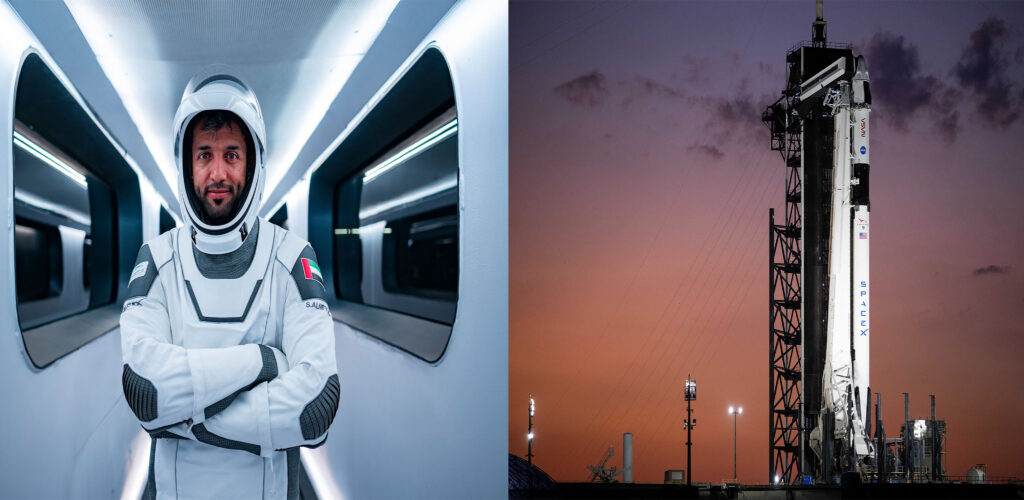
The longest Arab space mission in history was launched today at 9:34 am (UAE time).

The 6-month mission is carried out by astronaut Sultan AlNeyadi aboard the International Space Station as part of Crew-6.

source/content: wam.ae (headline edited)

____________

___________________________________

UNITED ARAB EMIRATES (U.A.E)

LEBANESE AMERICAN: James Abourezk, 1st Arab American US Senator

James Abourezk, 1st Arab American US senator, dies at 92.

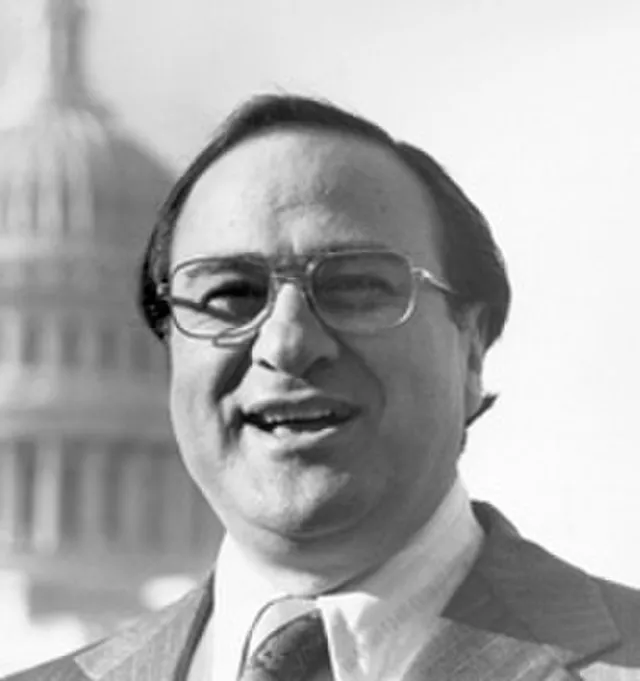
James Abourezk, attorney and Democratic politician who served as a United States senator and United States representative from South Dakota and co-founder of the American-Arab Anti-Discrimination Committee(ADC), died today on his 92nd birthday.

He was born in Wood, South Dakota, the son of Lena (Mickel), a homemaker, and Charles Abourezk, an owner of two general stores. Both of his parents were Lebanese immigrants. He grew up near Wood on the Rosebud Reservation and has lived in South Dakota most of his life.

Abourezk represented South Dakota in the United States Senate from 1973 until 1979. He was the author of the Indian Child Welfare Act, passed by Congress in 1978 to try to preserve Indian families and tribal culture.

He was instrumental in the creation of both the American Indian Policy Review Commission and the Select Committee on Indian Affairs. He became chairman of the Indian Affairs Committee from its creation in 1977 to 1979.

Abourezk was elected in 1970 as a Democrat to the United States House of Representatives and served from 1971 to 1973. In 1972 he was elected to the U.S. Senate, where he served from 1973 to 1979.

Abourezk was an outspoken critic of Israel and U.S. foreign policy in the Middle East after touring the region and visiting his parents’ hometown in Lebanon as a senator. The position lost him many political allies, and he decided to retire from the Senate after a single term.

In 1980, Abourezk co-founded the American-Arab Anti-Discrimination Committee and traveled throughout the U.S. organizing Arab Americans in the wake of the “Abscam” debacle. Abscam was an FBI sting operation where agents dressed up as “oil-rich sheiks” in the late 1970s and early 1980s that led to the convictions of seven members of the United States Congress, among others, for bribery and corruption.

Abourezk’s marriages to Mary Ann Houlton and Margaret Bethea ended in divorce. In 1991, he married Sanaa Dieb, a restaurateur. They moved to Sioux Falls where she opened an award-winning Arab restaurant.

Survivors include his wife; children Charles Abourezk, Nikki Pipe On Head, and Paul Abourezk from his marriage to Houlton; daughter Alya Abourezk from his third marriage; a stepdaughter; and many grandchildren and great-grandchildren.

Warren David, president of Arab America and a former national president of the American-Arab Anti-Discrimination Committee said, “during a time when discourse regarding the negative portrayal of Arabs and the injustice faced by Palestinians were scarce, he (Abourezk) acted as a pioneer who instilled a sense of immediacy in the Arab American community–he was a trailblazer in that regard.”

Compiled by Arab America

source/contents: arabamerica.com (headline edited)

___________

Former Senator James Abourezk

____________________________

AMERICAN / LEBANESE

SAUDI ARABIA: Yasser Al Misehal – the Saudi Football Chief joining Fifa Council

Saudi Arabia Football Federation president will be part of powerful arm of world football’s governing body.

Saudi Arabia on Wednesday returned to the powerful Fifa Council with their federation head Yasser Al Misehal getting elected at the AFC Congress held in Bahrain.

Who is Yasser Al Misehal?

Al Misehal is the president of the Saudi Arabian Football Federation (SAFF), and has presided over a period of unprecedented change and progress in Saudi football, under the patronage of Saudi Crown Prince Mohammed bin Salman.

The men’s national team pulled off one of the biggest shocks in tournament history when they beat tournament favourites Argentina at the World Cup in Qatar late last year, a feat Al Misehal described in a December interview with The National as “one of the most historical moments for the Saudi nation “.

A member of both Fifa’s and the Asian Football Confederation’s Disciplinary Committees, Al Misehal also served as chairman of the Saudi Pro League from June 2016 to October 2017.

According to his LinkedIn page, Al Misehal studied Sport Management at Sorbonne University Abu Dhabi from 2014 to 2015 and has a Bachelor’s degree in finance from King Fahad University of Petroleum and Minerals.

An avid sports fan since childhood, Al Misehal is an honorary member of Al Ettifaq Football Club.

How has he changed Saudi football?

Under Al Misehal’s patronage Saudi football has undergone major changes. Saudi age-group sides have enjoyed recent success, with the Under-23s clinching the Asian Cup in Uzbekistan in June, and the U20s triumphing at the Arab Cup on home soil in August.

According to the SAFF, the organisation is responsible for the development and up-skilling of more than 3,000 national coaches – more than at any time in the country’s history – and 1,700 referees across the kingdom.

In the past three years, Saudi Arabia has invested heavily in women’s football as both grass-roots player development and the establishment in 2021 of a first women’s national team. The kingdom has also introduced an inaugural women’s football league and girls’ school league.

Latest figures show there are now 520 registered players across 25 clubs in the league, and almost 50,000 girls in the inaugural schools’ league.

Meanwhile, the Saudi Pro League is able to attract superstars like Cristiano Ronaldo,  who in December joined Riyadh-based Al Nassr on what is believed to be the most lucrative contract in world football.

What is the Fifa Council?

The Fifa Council is the main decision-making body of the organisation, outside the Fifa Congress. The council is a supervisory body that sets the vision for the organisation and for global football.

It has members from six confederations, with the AFC getting seven spots in the 37-member council.

Al Misehal’s elevation to the Fifa Council restores Saudi Arabia’s presence in the decision-making position at world football’s governing body after an absence of 21 years. Al Misehal will automatically become a member of the Asian Executive Office, too.

What next for Saudi Arabia?

Saudi Arabia has grand plans for football. On Wednesday, the country won the hosting rights for the 2027 AFC Asian Cup. Saudi Arabia was the only country left in the race after India withdrew their candidature as potential hosts .

The 2023 Asian Cup will be hosted by Qatar. It was previously set to be held in China but the country withdrew because of its Covid-19 guidelines. Qatar won the tournament’s last edition, in 2019, which was hosted by the UAE.

Saudi Arabia is also looking host the 2026 women’s Asian Cup, which will be another milestone in the journey of women’s sports in the kingdom.

However, the biggest target is said to be a bid for the hosting rights of the 2030 Fifa World Cup, with Saudi Arabia reported to be considering a joint proposal with Egypt and Greece.

source/content: thenationalnews.com (headline edited)

__________

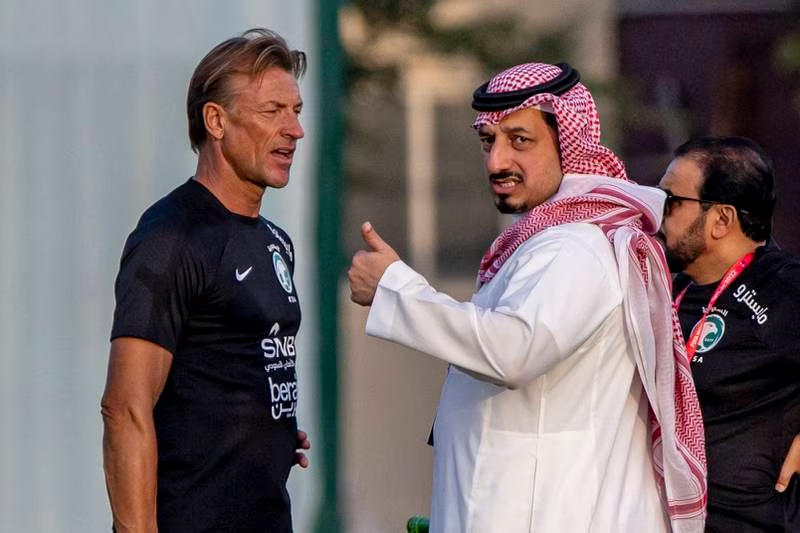
Yasser Al Misehal, right, president of the Saudi Arabian Football Federation, with national team coach Herve Renard during a training session ahead of the 2022 Fifa World Cup in Qatar. EPA

_________________

SAUDI ARABIA

EGYPTIAN AMERICAN: Columbia University names Egypt-born Minouche Shafik as its next President

New York-based Columbia university announced on Wednesday that Egyptian-born figure Minouche Shafik would become its first-woman president next summer.

“Nemat {Minouche} Shafik, a leading economist whose career has focused on public policy and academia, will become the next president of Columbia University on July 1, 2023.” Columbia University said adding that her election by the board of trustees as the University’s 20th president concluded a wide-ranging and intensive search launched after the University’s Current President Lee C. Bollinger announced that he would step down at the end of the 2022-2023 academic year.

Shafik will become the 20th president of the famous American educational institution.

Minouche Shafik was appointed director of the London School of Economics and Political Science (LSE) in September 2017.

She also served as the Deputy Governor of the Bank of England prior to her appointment as LSE Director in 2017.

She was made a Dame Commander of the British Empire in Queen Elizabeth’s Birthday Honours list in 2015, and in July 2020 was created a baroness, becoming a crossbench peer in the UK’s House of Lords. 

Shafik’s successful portfolio includes leading roles such as Vice President of the World Bank, where she became the youngest VP in the history of the bank, and Permanent Secretary of the UK Department for International Development and Deputy Managing Director of the International Monetary Fund (IMF).

Born in Alexandriam her childhood in Egypt was brief though, as she left the country for the US when she was four. She later returned to the country briefly as a teenager, according to interviews.

She holds a BSc in economics and politics from the University of Massachusetts in Amherst, and an MSc in economics at LSE before completing a PhD in economics at St Antony’s College at the University of Oxford.

Her doctorate thesis was on the role of the private sector and the public sector in Egypt.

source/content: english.ahram.org.eg (headline edited)

__________

_____________________

AMERICAN / EGYPT