Arabs & Arabian Records Aggregator. Chronicler. Milestones of the 25 Countries of the Arabic Speaking World (official / co-official). AGCC. MENA. Global. Ist's to Top 10's. Records. Read & Enjoy./ www.arabianrecords.org
Category: Non-Resident / PAO (Persons of Arab Origin / Descent)
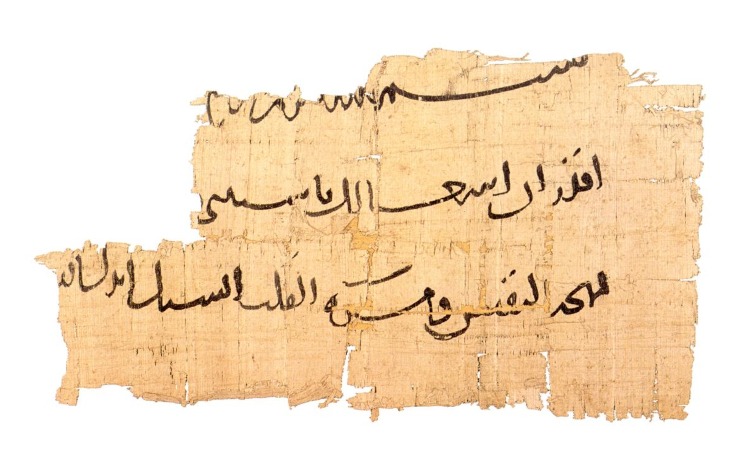
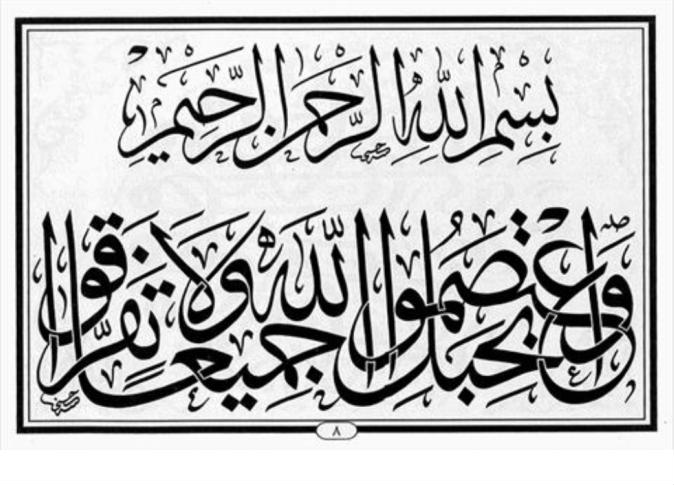
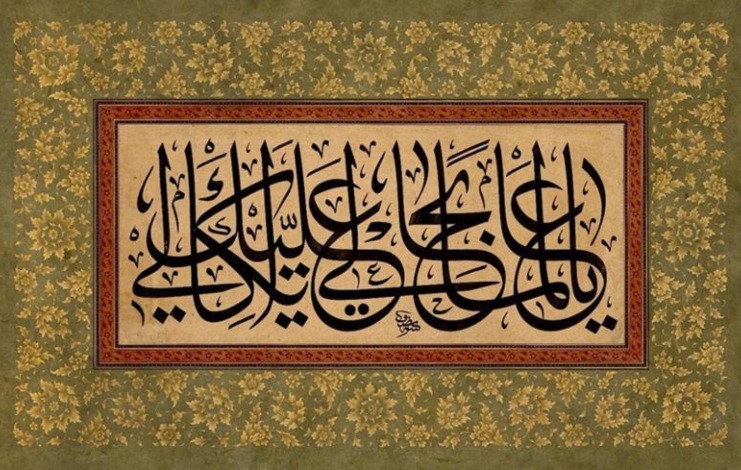
Arabic Calligraphy, the art of creating decorative handwriting or lettering, is one of the oldest art forms from the Arab region; one that has not only thrived with time but also evolved into a unique form of expression. It survived through several tumultuous periods that threatened its existence, from civil wars to an invasion by the Mongol Empire that destroyed Baghdad.
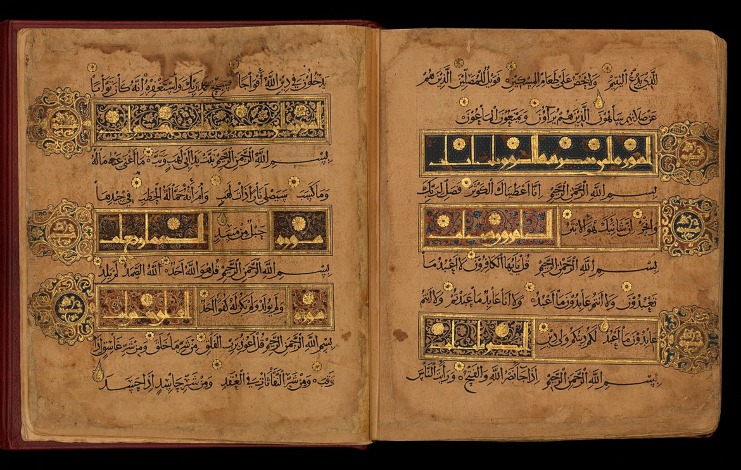
Even though the writing wasn’t as focused on in the past, with many Arabs preferring to memorize poetry and other forms of text and pass them down verbally, that changed significantly later. Calligraphy would flourish to include the preservation of the Quran, adorn mosques as well as the palaces of kings, and by royal scribes when writing decrees, among other things.
In celebration of World Calligraphy Day, we decided to dive into the past and look back at some of the most well-known and prominent calligraphers from the Arab world.
Ibn Muqla
One of the biggest names in developing and improving Arabic calligraphy, born in 885 AD in Baghdad, Iraq, during the Abbasid Caliphate, he started out as a tax collector before rising through the ranks and becoming the Caliph’s Vizier three different times.
At this time, the Kufi style dominated the calligraphy scene, but Ibn Muqla invented new art styles that superseded the previous ones. Ibn Muqla was the one who invented the Thuluth and Al-Mansoub styles, as well as the foundations and rules for others, such as Naskh. The Naskh and Thuluth got further development throughout the centuries that followed, and calligraphers still use them today.
While the Kufic style was rigid in its overall design, Naskh had a more cursive structure but wasn’t as popular and as used at the time, Ibn Muqla changed that by improving on it and using it in official decrees, and private correspondence.
Ibn Muqla’s Thuluth style was new with its letters having long vertical lines with broad spacing. Its name translates to “one-third”, in reference to the maximum height for the letters on the same line must not exceed one-third of the ‘alif.
As for the Al-Mansoubstyle, it mainly focused on three measurements: the size of the period meaning the “Noqta”, the circle with a diameter equal to the height of the alif (the first letter in the Arabic language) and, and the height of the alif.
Little is known when exactly Ibn Al-Bawwab was born. However, we know of his existence and his body of work thanks to the survival of many of his manuscripts, Qurans, and texts referring to him by name.
With his name literally translating to “son of the doorman,” he didn’t grow up in a wealthy family and had to work to make a name for himself. He did so by learning about law and theology and working in several professions, such as a home decorator. However, he would later settle on working in book illumination and calligraphy.
Over years of hard work, he became renowned as a master calligrapher; fluent in six different styles in the field, perfecting the Al-Mansoub style and developing the Reyhani, Naskh, Tawqi, and Muhaqaq styles significantly.
Housed at the Chester Beatty Library in Dublin, Ireland, is the sole surviving Qur’an penned by Ibn al-Bawwab gifted to the country by Ottoman Sultan Selim I.
Originally from Syria, Mohammad Hosni Al-Baba was born in 1894 and is considered one of the last classical calligraphers. Al-Baba received his initial formal training with the Turkish master, Istanbul-based Yousef Rasa, who had renovated the Umayyad Mosque in Damascus, Syria. Al-Baba would later study under another renowned calligrapher, Mehmed Showki Afendi, author of the work “The Thuluth & Naskh Mashqs.”
He would later travel to Cairo, Egypt, becoming one of the leaders in Islamic and Arabic calligraphy, turning his home into a hub for artists, calligraphers, and poets. Al-Baba would be famous for improvements to the lettering in the Thuluth style, the linear structure of Arabic script, and was appointed by King Farouk as the first professor to be a master at the Royal Institute of Calligraphy.
His children would continue his legacy but in different fields since many grew up surrounded by artists when they visited Al-Baba’s home. The most famous of his children are actress Soad Hosni, dubbed “Cinderella of Egyptian Cinema,” and Najat Al Saghira, who became an actress and singer.
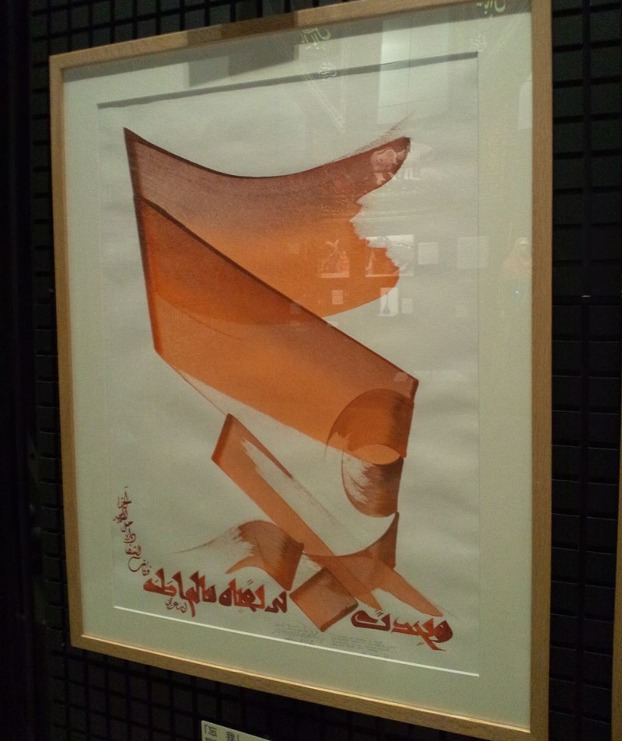
Born in 1944, Iraqi painter and calligrapher Hassan Massoudy continues to be one of the biggest inspirations for many modern artists today. French writer Michel Tournier even considered him as the “greatest living calligrapher” in 1989.
Massoudy grew up in Baghdad, Iraq, until 1969, when he fled to Paris, France, entering the École des Beaux-Arts, where he studied figurative painting. At the time, he looked for a job to pay for his studying, finally finding one as a calligrapher in Arabic magazines, writing their headlines.
While he wasn’t famous for a traditional calligraphy style, his distinct and elaborate designs made him stand out among the rest of the artists of his time. Massoudy would delve into the world of theater, collaborating with artists and choreographers, creating different productions focusing on the harmony of dance, calligraphy, and dance routines.
Studying abroad but seeking inspiration from his traditional roots, Tunisian artist and calligrapher Nja Mahdaoui invented the world of Arabic calligraphy as a graphic style, creating what was called “Calligrams.”
Born in 1937 in Tunis, Tunisia, he first started learning art history and painting at the Carthage National Museum. He later traveled to Rome, Italy, where he continued to study painting and learned more about philosophy at the Santa Andrea Academy. He also moved to Paris, France, where he went to the Cité Internationale des Arts and École du Louvre before returning to his home country in 1977.
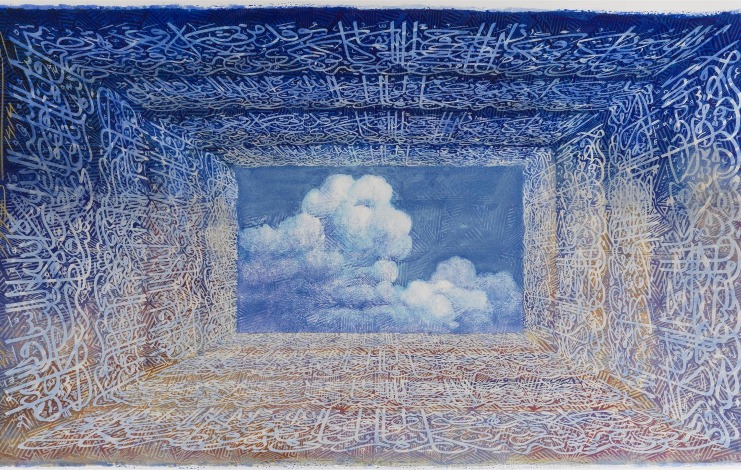
His calligraphic style focuses mainly on the designs he creates as a whole rather than the composition of words since his “calligrams” resemble Arabic letters but have no literal meaning, leading to many naming him the “inventor of abstract calligraphy.” People can see Mahadaoui’s work on several materials used as a canvas, including jewelry, drums, leather, paintings, walls, glass, and so much more.
A UNESCO Crafts Prize laureate, Mahdaoui, graced the Facebook campus in 2018 by painting one of their halls using Arabic calligraphy in his unique style as part of the “FB AIR program,” turning their hall into a vividly colorful masterpiece.
Egyptian artist and calligrapher Ahmed Mustafa was born in 1943 in Alexandria, Egypt, graduating from the Faculty of Fine Arts at Alexandria University in 1966 before traveling to the UK on a scholarship to the Central School of Art and Design in London, England, where he earned his Ph.D. in 1989.
Inspired by his Islamic roots, his calligraphic works mainly focused on quotes from the Quran, among other sources. Working on several materials as his canvas, Mustafa has designs on glass and carpets, among others.
Mustafa also set up the Fe-Noon Ahmed Moustafa Research Centre for Arab Art and Design in London in 1983. He lectures and creates workshops globally as well as does commissions, one of which was presented by Queen Elizabeth II to Pakistan for the country’s fiftieth anniversary in 1997.
The following year, the Vatican invited him to do an exhibition at the Pontifical Gregorian University in Rome, Italy. World media at the time announced it as the first achievement of its kind in the history of Muslim-Christian relations.
A Libyan pharmacologist treating HIV patients in South Africa and a Tunisian scientist purifying water in Malaysia.
This is the story of two world-renowned scientists who left their homelands of Libya and Tunisia and went on to achieve great success in South Africa and Malaysia.
Libyan pharmacologist Mohamed Irhuma studied in South Africa but faced a range of challenges when his home country went through its 2011 revolution. He’s achieved success in South African HIV AIDS pharmacology, including award-winning work on drug treatments.
Tunisian chemical engineer Mohamed Kheireddine Aroua is a world expert in material separation, inventing a life-changing water purification machine which benefits remote villages.
Both stories illustrate some of the complexities of being an Arab abroad, and the journeys of two remarkable scientists.
Back in 1729, the Parisian authorities introduced the French capitals iconic blue-and-green street name plaques, topped with a little “Napoleon’s hat” containing the number of the street’s arrondissement.
The plaques honor France and the world’s leading politicians, philosophers, artists, writers, and scientists, including a number associated with the Arab world. French President Emmanuel Macron has previously proposed renaming some of the capital’s streets to include more personalities from ethnic minorities, but that has not yet happened. Still, there are enough Arab names to comprise a walking tour around Paris — including a president, a poet, a pop star and more.
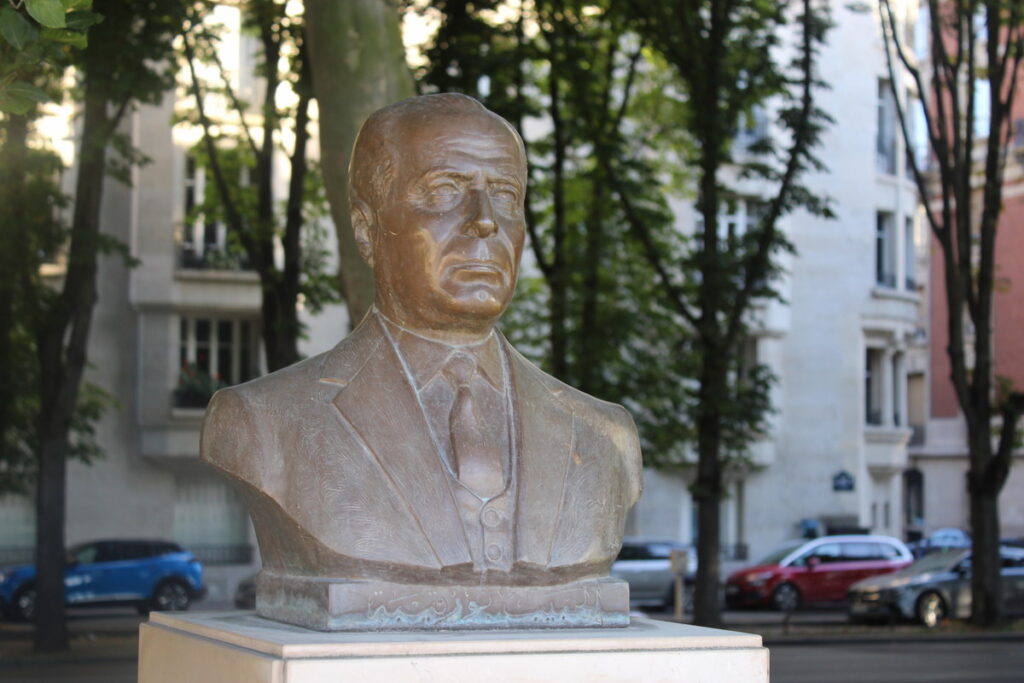
With a wonderful view of the Grand Palais, this large, peaceful stretch of greenery is named after independent Tunisia’s first president, Habib Bourguiba. The secular leader was in charge between 1957 and 1987, and was famously a supporter of women’s rights. Next to his plaque, there is a bronze bust of the leader looking towards the River Seine, with his name written in Arabic underneath.
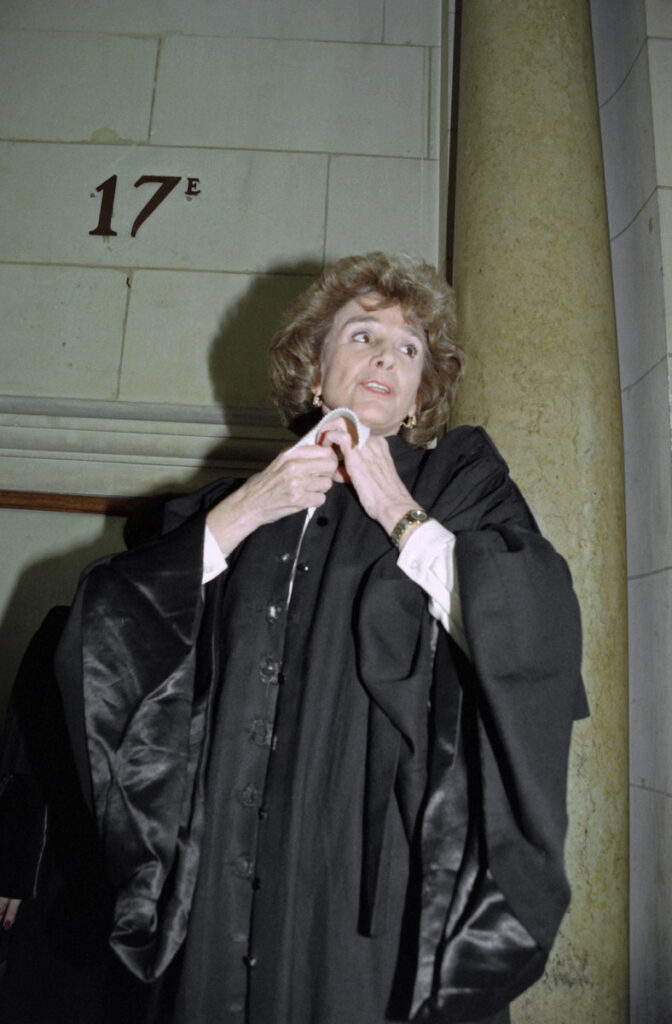
An admirer of Bourguiba, Halimi was a Tunisian-born French lawyer, feminist, and former member of the National Assembly in France. She died in 2020, aged 93, and this sloping pathway was named after her last year. Halimi’s life of hardships shaped the respected career she had. When she was born, her father hid her — ashamed of her gender. She went on a hunger strike at 10 and, at 16, rejected an arranged marriage, going on to study law in Paris. Halimi is perhaps best known for a 1972 trial, in which she defended a minor who had an abortion after being raped. It was a key event that propelled the country into legalizing abortion in 1975.
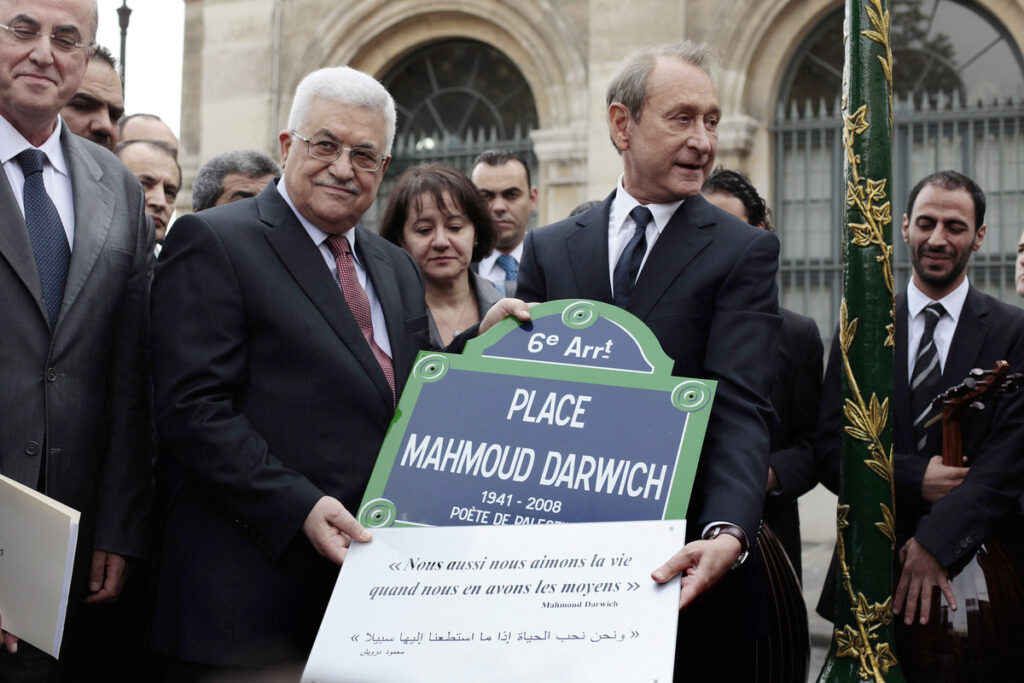
Paris mayor Bertrand Delanoe (second from right) and Palestinian President Mahmud Abbas (second from left) unveil on June 14, 2010 in Paris the new Mahmoud Darwich esplanade named after the Palestinian poet who died Aug. 9, 2008. (AFP)
In 2010, just two years after the death of Palestine’s most famous poet Mahmoud Darwish, a square in Paris was inaugurated in his honor. Known for his writings on home, memory, and exile, Darwish spent many years outside of his native land. He lived in Beirut, Cairo, Tunis, and Paris. He had a special connection with the latter, describing it as the place where his “true poetic birth” happened. The plaque is situated in a district the poet reportedly liked, on the banks of the Seine and near the classical buildings of Institut de France and Monnaie de Paris.
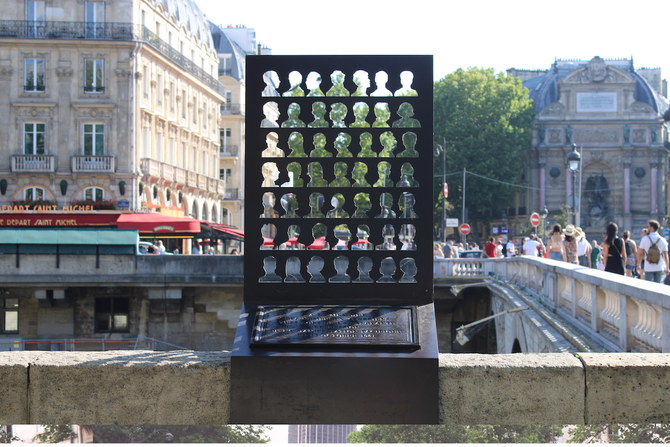
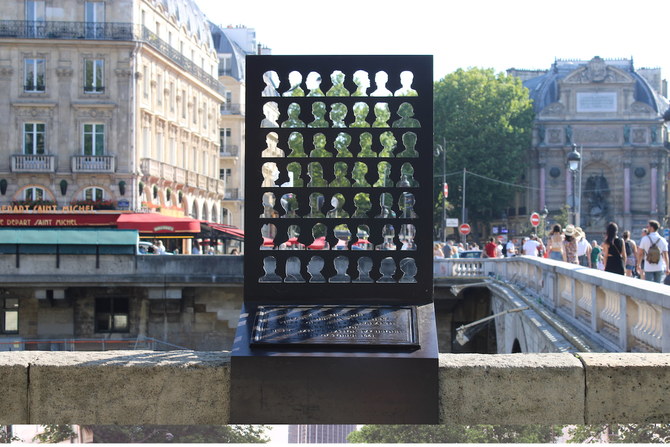
A few minutes away from Notre Dame Cathedral stands an unassuming but sobering reminder of how an Arab collective suffered during the turbulent Sixties. In 1961, when Algeria was seeking independence, a group of Algerian protesters were attacked by the police and some of their bodies were thrown into the Seine. In 2021, to mark the 60th anniversary of this horrific event, Paris mayor Anne Hidalgo inaugurated a memorial artwork, made of metal with silhouettes of heads carved out, in remembrance of those who lost their lives.
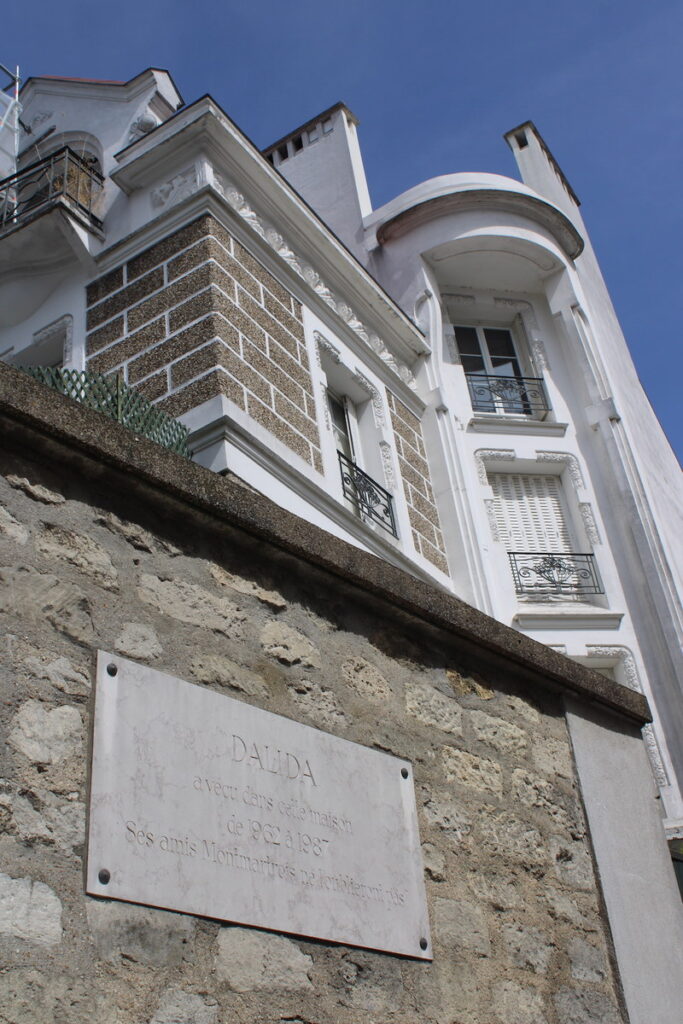
Between 1962 and 1987, the blonde bombshell diva Dalida, who was born to Italian parents in Egypt, lived in this four-story townhouse in hilly Montmartre, a quiet area outside of the bustling city center of the city that is historically associated with artists. Dalida sang in a variety of languages, including French, Italian, and Arabic. “Salma Ya Salama” and “Helwa Ya Baladi” are some of her most loved Arabic songs. Sadly, it was in this house that she committed suicide in 1987, as a result of tragedies in her personal life. The plaque on her house reads: “Her friends from Montmartre will not forget her.”
The acclaimed Lebanese-born poet and philosopher — and author of “The Prophet” — Khalil Gibran is well-known as a member of the Arab diaspora in 20th-century America. But he also lived in France for a time. Between 1908 and 1910, Gibran, who was then in his twenties, studied painting at Académie Julian in Paris. His stay in the city was made possible by the financial backing of American philanthropist, editor and Gibran’s lover Mary Haskell, who was 10 years his senior.
source/content: arabnews.com (headline edited)
___________
A memorial to remember the 1961 attack on Algerian protesters by the police in Paris. (Supplied)
Featuring Dega Nalayeh, a managing director and private-client advisor at Bank of America’s private bank.
Dega Nalayeh told Insider that she’s currently climbing Mount Kilimanjaro. She’s doing it to honor her sister, Somali-Canadian journalist Hodan Nalayeh, who was killed during a terrorist attack at a hotel in Somalia in July 2019.
Dega Nalayeh and 14 other climbers have so far raised more than $ 230,000 for the nonprofit Give to Learn to Grow Foundation. Proceeds help underserved communities in Somaliland.
Today — when not climbing mountains — she is (figuratively) moving them for the ultra wealthy. Nalayeh is a managing director and advisor at Bank of America’s private bank, where she manages $6.4 billion in client assets.
She built that book from scratch, relying on tried-and-tested word-0f-mouth strategies. Her savvy networking capabilities have also come in handy, particularly when she met a professional basketball player with the Atlanta Hawks, whose identity she could not disclose.
Climbing the highest mountain in Africa sounds easy when considering the adversity Nalayeh has faced. She moved to Canada from Somalia at just 11 years of age. While her father worked as a parking attendant, she ran a newspaper route as a teenager.
Later, she moved from Georgia to California for her husband. But when Nalayeh joined BofA’s private bank in 2006, she was divorced with a two-year-old son.
Nalayeh, who is 49, told Insider that she doubted her ability to be a rainmaker for the bank at a time when she was dealing with a divorce and a toddler. But in six months, she landed a high-net-worth client.
The banker leads a team of 13 alongside Avi Cohen, a fellow MD and private client advisor who was once her rival within the bank.
Most of their clients come from the entertainment and media industries, as well as tech, real estate, and healthcare.
Nalayeh is also focused on finding more women clients, including those who are overwhelmed by responsibilities found both at home and in the workplace.
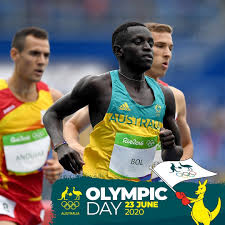
Find out how a kid from war-torn Sudan became an Australian hero who has the world at his fingertips.
You, me, The Pope, your butcher – we’ve all had those moments when we stop what we’re doing, fall silent and ask ourselves, How could this be? How could I have gotten from where I once was (Point A) to where I am now (Point B)? It’s a universal experience, for sure, but it’s going to be more intense for some than others. And it’s hard to imagine that many have felt it more powerfully than has Peter Bol.
You’ve probably absorbed snippets of this guy’s background. He was born in Khartoum, Sudan 28 years ago amid civil war. Via Egypt, he arrived in Toowoomba as a boy with no English or interest in running. That was his Point A.
His Point B was the Tokyo Olympic Stadium last August. It was lining up for the 800m final – the first Australian man to do so for more than half a century – in the fourth most-viewed event in Australian television history. It was leading the pack at the last bend before, yes, two Kenyans and a Pole outkicked him, consigning Bol to that cruel mistress of placing: fourth. It was leaving the media conference to go watch the Boomers play and getting a tap on the shoulder from an Australian Olympic Committee official.
“The Prime Minister wants to speak with you,” the official said.
“Do I have to?” /
“Yes.”
“Okay. Please give him my number.”
After some back and forth, Bol finds himself on the phone with the (then) Prime Minister, Mr Morrison, who’s calling him “mate” and thanking him for his efforts, which, the PM says, had inspired Australians during the challenges of the pandemic. The PM signs off by saying he’d love to meet Bol sometime. That’s a decent Point B.
“Yeah, I’ve come a long way,” says Bol, who’s taking time out from his preparations for this month’s World Athletics Championships, in Oregon, and next month’s Commonwealth Games, in Birmingham, to speak with Men’s Health. “And this is bigger than sports.”
Indeed. Because the story of Peter Bol can be read in any number of ways. You could see it through a purely athletic lens and marvel at how Bol became world class in the classic two-lap race – a long-busting physical examinations that takes you back to schooldays: “Two laps of the oval, boys,” your PE teacher would bark. “And let’s see some effort for a change.” Similarly, it’s easy to be intrigued by Bol’s newfound command of the psychology of performance. But trumping both those elements is how he accepted the hand fate dealt him and played it expertly, transforming from a pint-sized kid from a poor immigrant family into an inspiration – an inspiration who’s intent on being a change-maker. “Now that I am, I guess, a high-profile athlete, I have a responsibility,” says Bol. “A responsibility to call certain things out.”
THE LESSONS OF LOSING
Face to face, the first thing you notice about Bol is how busy his hands are in conversation. It’s as though words alone are insufficient to convey the scope of his meaning or the depth of his feelings, and his hands must come to life to fill the breech. Which makes sense because since Tokyo, Bol has had to grapple with a plethora of new thoughts and experiences.
Tokyo wasn’t his first Olympics. In 2016 he raced in Rio, where he was eliminated in the heats. You might figure, Oh, well, in those intervening five years he must have come on in leaps and bounds as an athlete – as a physical specimen. But that simply wasn’t the case, Bol insists. “Between Rio and Tokyo, the physical part, if it changed at all, it would have only been by five per cent.”
In Brazil, however, Bol learnt a lot about peak performance – or, more accurately, about what prevents it. It was there he battled bouts of anxiety the likes of which he could scarcely have imagined. He’d wake at 4am, trembling, his stomach in knots, his night’s sleep over. “I realised that performing in the big events is about more than running hard every single day of your training,” he says.
When he wasn’t anxious in Rio, he was most likely distracted. Because, man, talk about distractions! Free haircuts. Free food. And there’s…wait…Klay Thompson in the dining room! What’s a bloke who’d rather watch an NBA game than an 800m race supposed to do?
Between Rio and Tokyo, Bol also tested himself at two world athletics championships – in London and Doha in 2017 and 2019 respectively – and tasted no joy at either. Looking back, he sees these disappointments as necessary steps in his maturation. “You build your resilience on setbacks,” he says. “I got knocked out early [at all those meets] and it would have been easy to stop after each one. Athletics: it’s not hard to stop” – because you train relentlessly to face mighty competition, and when you get your butt kicked, stopping cries out to you. Stopping’s a siren song. But Bol covered his ears and kept running.
REALITY CHECK
For mine, one of Bol’s most admirable traits is his aversion to cliches, stereotypes and myth making. Yes, he spent his first six years in an African country wracked by civil war, but he doesn’t want you to assume that those six years were a nightmarish battle for survival, because they weren’t.
“I don’t remember too much,” he says. “I remember family. I remember going to mosque with my grandparents and a little school. And I remember playing football outside with other kids.” The third-born of five brothers, Bol and his family could have stayed in Sudan, but his father was determined they find a better life elsewhere. Travelling solo, Bol’s dad ventured north into Egypt to establish a foothold, at which point the rest of the family joined him when Peter was six.
For a while it was out there in the public domain that the Bols had lived in a refugee camp while in Egypt. But that is incorrect. If it were true, Bol says, he’d have no problem acknowledging it, but it isn’t – some people just wish it were, he suspects, because they think it would enhance his story. But his story doesn’t need enhancing. From his mother, Bol gleaned that family is everything: “For her, separation from family is unbearable.” From his father, the take-outs have been hard work and the power of hope. And bravery: “He wasn’t scared to take a risk, my dad.”
Their time in Egypt tested the Bol clan. While the Sudanese and Egyptian cultures, linked by the Arabic language, are similar, he says, “there was a lot of racism towards Sudanese people. At the same time, there were a lot of great Egyptians. My dad used to iron clothes for work, and he worked with these Egyptians who were the nicest people. But this period was a struggle for my oldest brother. He was four years older than me. He had to look after us when we walked through school, when there was racism going on or there were fights. He had to stand up and be the bigger man while trying to protect us.”
A sadness – an incomprehension – sweeps over Bol as he reflects on those times. “Just seeing people being unkind,” he says. “Why? Was it necessary? We really weren’t trying to bother anyone. We were just trying to live day by day. I hate seeing people being unkind to random people for no reason.” After four years in Egypt, the family was ready for another, bigger move. Bol’s father had relatives in Australia who helped facilitate a shift to Toowoomba, in 2004. The expectation was that the Great Southern Land would offer educational and work opportunities unavailable in Egypt. As it turned out, things didn’t happen quite fast enough in Toowoomba, so in 2008 the family headed west to Perth, where there were more and better-paid factory jobs for the father. Peter eventually landed a basketball scholarship at St Norbert College.
“My family shaped who I am as an athlete,” Bol says. “Because to be a professional athlete, you’ve got to be determined, you’ve got to be consistent, and you’ve got to be committed. My brothers and I competed over everything – PlayStation, sports, learning English. We had that competitive nature. We wanted to be the best. But when we stepped back from competition, we relaxed – we forgot about it all. And my dad was important here, too: when I didn’t make a team, he’d be like, ‘It’s okay – it’s not the end of the world.’”
It took two years’ persuasion by a St Norbert’s teacher for Bol to let go of his hoop dreams and focus on running. By this stage he was 17 – a ridiculously late start for an athlete. Bol’s first track coach was a taskmaster with no tolerance for nonattendance or half-heartedness. While a lot of teenagers would have haughtily pushed back, Bol thought about his coach and realised, You know, this man doesn’t have to be here, so don’t waste his time. “He pushed hard and held me accountable, and I needed that because I wasn’t getting it at home.”
In time, Bol’s running ambitions took flight. At first, he dreamed about being the fastest in his school. When that was ticked off, he imagined being fastest in the state. . .and then the country. “Finally,” he says, his hands waving about like a conductor’s, “it was, Okay, let’s see how far I can get internationally.” Since 2015, Bol has been guided by Justin Rinaldi, head coach of the Fast 8 Track Club. Bol says that when he moved from Perth to Melbourne and started training with athletes who were better than he was, he wanted to know why: what were they doing that he wasn’t? And what should he copy from them to make himself better? In time, however, he came to see that “when you do that, you lose a little bit of yourself each time.” Before Rio, he says, he was too preoccupied with what the Kenyans were doing, what the Jamaicans were doing. “All these different personalities and [me] trying to get a little bit of each one. . .which just doesn’t help you because it gets you so far out from who you are. To perform on the track, you need to be totally confident in who you are and in your abilities. You also need to get your values right off the track: what are your values and are you living by them? At one point I realised, OK, I’ve moved away from home, from family, and yet family is my biggest priority. Okay, let’s get back to family – not physically for now but through phone calls.”
So, in the lead-up to Tokyo, “instead of searching for what other people were doing, I was believing that we [Bol, Rinaldi, training partner Joseph Deng, manager James Templeton] were doing was right. Bring it back to yourself! And once you’re back to yourself, like 100 per cent, man, yeah, you’re kind of on fire. You’re unstoppable. Because you believe in what you’re doing. You believe in your support team and everyone else is just competition.”
A caveat applies here: not copying your adversaries doesn’t mean you ignore them. Come Tokyo, says Bol, he was a student of the 800m. “Whereas before then, I didn’t really care who I was racing against. I didn’t care less. I didn’t watch races, and to be the best you have to watch races and you have to know your competitors. That’s where you learn – off the track. But I couldn’t be bothered watching a race that went for what 1:44 seconds, but I’d watch a whole NBA game. It was crazy.”
READY FOR LAUNCH
Bol laments COVID’s toll on the world as much as the next guy. But insofar as it delayed the Tokyo Games for a year, well, that he appreciated. “Because I was still getting it together,” he says. In 2020, compared to the middle of 2021, “I wasn’t as fit, I wasn’t as strong – and I definitely wasn’t as confident. I needed that year to keep growing.” Ahead of the Games, in the first half of 2021, Bol dominated the domestic season, ultimately recording two times below the Olympic qualifying standard of 1:45.20.
Here’s Bol’s take on perfect preparation: attend meticulously to the basics – and then, on top of that foundation, stack the one-percenters like Pilates, pool running and breathing techniques. And the basics are? Never miss training sessions. Observe recovery protocols. Hydrate right. Sleep right. “I did a whole year of that, and it added up when I came to Tokyo,” he says. “I wasn’t doing that the year before. [Had the Games happened in 2020,] I wouldn’t have made the final. It would have been a completely different story. We wouldn’t be talking now.”
On the flight to Tokyo, Bol gave himself a rev-up about why he was going. It was not to be an also-ran. It was not to gather experience. “I’d served those years,” he says. “I said to myself, I’m going to perform and compete!”
High achievement in any field is about handling the pressure at each new level. Doing that involves keeping that next level – even if it’s the pinnacle – in perspective. For Bol, that meant convincing himself that even though this was the Olympics, he’d still be running two laps of a 400m track about which there was nothing magical; that everything you attach to the Olympics in terms of mystique and grandeur is an optional overlay. “You’re running exactly the same distance you’ve always run,” Bol says. “It’s just with different people on a different track in a different country, but you’re not suddenly running 850 metres.
“Everything you do on the day matters. You’ve got to make sure that everything you’ve done in preparation counts on the day, shines through on the day, because that’s all you’re judged on. The assumption is that, physically, everyone who puts their toe on the line is ready to do well, is in shape. But mentally, are you ready to perform? Are you alert? Are you focused? The best races you’ve ever run, hands down, are those races where you don’t think about anything. It’s like muscle memory. If you’re running a race and you’re thinking, I should make that move, it’s already too late. You should already have made it. Your body should make the move. It should be automatic.”
In his Tokyo heat, Bol set a new Australian record of 1:44.13. The next day, in his semi-final, he lowered the mark to 1:44.11.
Bol loathes ice baths, but with those two fibre-ripping efforts behind him and the final looming, he forced himself into one. There’s another one-percenter right there. In the same vein, he ate heartily to speed up repair of the muscles in his rippling legs and get them ready to propel him into history.
In the final, Bol led through the first lap in 53:76 – two or three seconds slower than you’d expect in a world class 800m. The leisurely pace would suit the faster finishers – the guys with a kick like a mule. Does that describe Bol? Sure. He can do a straight 400m in about 47 seconds and a straight 100m in 11 flat. But, in hindsight, maybe he didn’t trust enough in his finishing speed and kicked a little too early, allowing Kenyans Emmanuel Korir and Ferguson Rotich, as well as Poland’s Patryk Dobek, to overtake him in the straight. (Korir’s gold medal-winning time was slower than Bol’s heat-winning time. It’s a strange beast, the 800.)
THE BIGGER PICTURE
While fourth at the Olympics didn’t earn Bol a medal, it did change his life. Nowadays, he’s getting recognised in the streets. School students write to him. Bigger crowds assemble for his races. Publications want to profile him. Companies want to be associated with him. When Men’s Health spoke with Bol, the ink was still wet on a new sponsorship contract with prestige watchmaker Longines.
“Yesterday I was on a run and a lady wanted a photo,” he says. “I had to say, ‘Sorry, I’m actually running right now.’ It shows how far I’ve come. Eighteen years ago, I came to Australia. Eleven years ago, I wasn’t running – now I’m fourth in the world.” And he thinks he can improve on that by making his 63-kg frame stronger through the glutes, hips, legs and core, and by getting better at race management. He thinks he can bring down his best time to around 1:42. (For context, the world record, set by Kenya’s David Rudisha in 2012, is 1:40.91.) But medals are more important to him than times. And there’s something more important than medals.
I don’t ask Bol about Yassmin Abdel-Magied, the Sudanese-Australian writer and activist whose 2017 “lest-we-forget” Anzac Day post invoking Manus Island, Nauru, Syria and Palestine triggered a campaign of vitriol that led to her fleeing these shores for Britain. I fail to make the country-of-origin association until it’s too late. Consequently, I can only wonder what he thinks about what happened to her, about whether her fate is, for him, a warning on the precariousness of goodwill in this country for a high-achieving person of colour. As such a person, can you hope to be widely admired for only so long as you toe the line?
I do, however, ask Bol a general question about how he feels he’s been treated in Australia. “Australia. Man. [Because of athletics,] I’ve been privileged enough to travel the whole world,” he says. I’ve seen a bit of the racism and discrimination going on around the world…and the gap between rich and poor. No country is going to get it perfect. The best we can do is work towards it. But, in Australia, I’ve lived a good life. I’m living a good life. Yes, there’s racism. Yes, there’s discrimination. And I think my goal, especially now that I have a voice, is to try to change that. You do what you can and only take on what you can handle. Because a topic such as racism, it’s heavy. And it gets to you. But you can only make good changes when you’re at your best.
“But there has been racism a few times. And you have to be strong enough to call it out. And I have – I always do – whether it’s directed towards me or someone else. Now that I have a profile, I get treated differently. But if someone next to me isn’t treated [well], it’s my responsibility to call it out.”
RAPID FIRE QUESTIONS WITH PETER BOL
Favourite exercise / Squat
Least favourite /Anything core
Favourite movie / The Dark Knight Rises
Last book you enjoyed / Jasper Jones by Craig Silvey
Cheat meal /Ice cream
Best advice you’ve received /Be yourself
Biggest fear / Heights
Family motto /As long as we’ve got each other, it’ll be alright.
Words: Dan Williams /Images: Lauren Schultz / by Dan Williams
The Welsh-Iraqi artist will represent the country’s diverse cultures and languages.
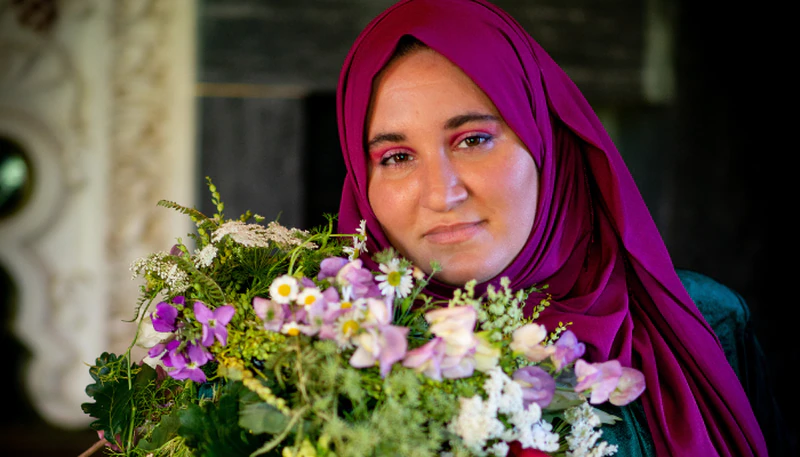
Wales has named Hanan Issa as its fifth national poet, making her the first Muslim to hold the title.
The Welsh-Iraqi poet, filmmaker and artist will serve a three-year term, representing the country’s diverse cultures and languages and acting as an ambassador for the people of Wales.
Her recent works include her poetry collection My Body Can House Two Hearts, published in 2019, and her contributions to Welsh (Plural): Essays on the Future of Wales and The Mab.
Issa grew up in Cardiff surrounded by different languages, including Arabic, which was spoken by her Iraqi parents. She described the role as an “incredibly positive step” and said it was “exciting to think that Wales is taking the lead on this aspect of representation”.
“Poetry exists in the bones of this country. I want people to recognise Wales as a country bursting with creativity; a land of poets and singers with so much to offer the arts,” she said.
“I’d like to continue the great work of my predecessors in promoting Wales, Welshness, and the Welsh language outside of its borders.
“More than anything, I want to capture the interest and inspiration of the public to see themselves in Welsh poetry and encourage a much more open sense of what Welshness is.”
Ashok Ahir, who led the selection panel for the National Poet of Wales, said: “This is a hugely exciting appointment. Hanan’s is a cross-community voice that speaks to every part of the country. She will be a great ambassador for a culturally diverse and outward-looking nation.”
Issa said she hopes that her appointment will allow women from all walks of life, but especially Muslim women, to see her success and think “that’s a thing that’s achievable for me”.
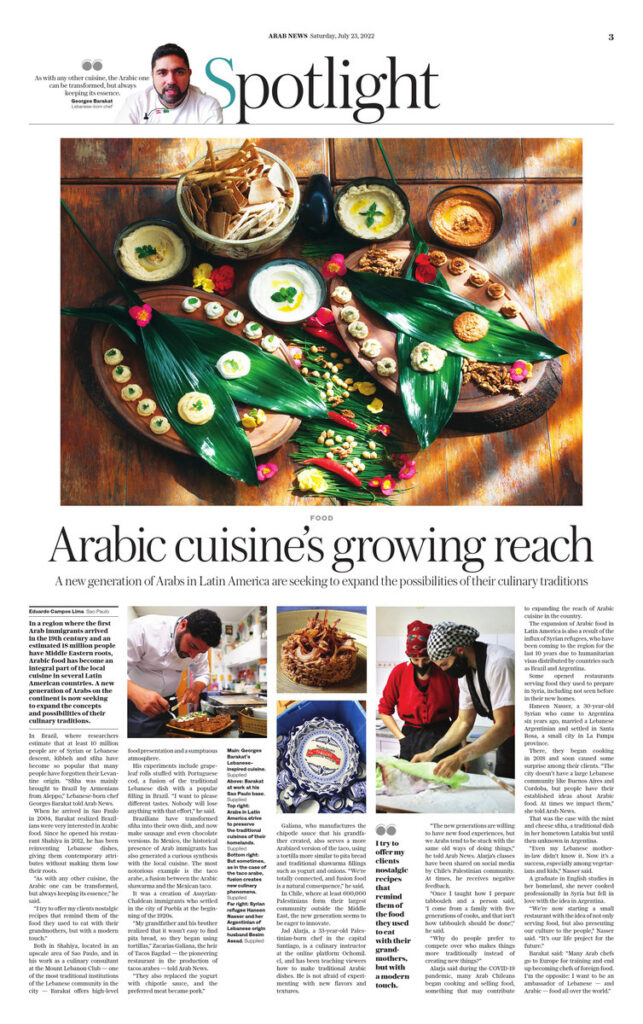
In a region where the first Arab immigrants arrived in the 19th century and an estimated 18 million people have Middle Eastern roots, Arabic food has become an integral part of the local cuisine in several Latin American countries. A new generation of Arabs on the continent is now seeking to expand the concepts and possibilities of their culinary traditions.
In Brazil, where researchers estimate that at least 10 million people are of Syrian or Lebanese descent, kibbeh and sfiha have become so popular that many people have forgotten their Levantine origin. “Sfiha was mainly brought to Brazil by Armenians from Aleppo,” Lebanese-born chef Georges Barakat told Arab News.
When he arrived in the city of Sao Paulo in 2004, he realized that Brazilians were very interested in Arabic food. Since he opened his restaurant Shahiya in 2012, he has been reinventing Lebanese dishes, giving them contemporary attributes without making them lose their roots.
“As with any other cuisine, the Arabic one can be transformed, but always keeping its essence,” he said.
“I try to offer my clients nostalgic recipes that remind them of the food they used to eat with their grandmothers, but with a modern touch.”
Both in Shahiya, located in an upscale area of Sao Paulo, and in his work as a culinary consultant at the Mount Lebanon Club — one of the most traditional institutions of the Lebanese community in the city — Barakat offers high-level food presentation and a sumptuous atmosphere.
His experiments include grape-leaf rolls stuffed with Portuguese cod, a fusion of the traditional Lebanese dish with a popular filling in Brazil. “I want to please different tastes. Nobody will lose anything with that effort,” he said.
Brazilians have transformed sfiha into their own dish, and now make sausage and even chocolate versions. In Mexico, the historical presence of Arab immigrants has also generated a curious synthesis with the local cuisine. The most notorious example is the taco arabe, a fusion between the Arabic shawarma and the Mexican taco.
It was a creation of Assyrian-Chaldean immigrants who settled in the city of Puebla at the beginning of the 1920s.
“My grandfather and his brother realized that it wasn’t easy to find pita bread, so they began using tortillas,” Zacarias Galiana, the heir of Tacos Bagdad — the pioneering restaurant in the production of tacos arabes — told Arab News.
“They also replaced the yogurt with chipotle sauce, and the preferred meat became pork.”
Galiana, who manufactures the chipotle sauce that his grandfather created, also serves a more Arabized version of the taco, using a tortilla more similar to pita bread and traditional shawarma fillings such as yogurt and onions. “We’re totally connected, and fusion food is a natural consequence,” he said.
In Chile, where at least 600,000 Palestinians form their largest community outside the Middle East, the new generation seems to be eager to innovate.
Jad Alarja, a 33-year-old Palestinian-born chef in the capital Santiago, is a culinary instructor at the online platform Ochomil.cl, and has been teaching viewers how to make traditional Arabic dishes. He is not afraid of experimenting with new flavors and textures.
“The new generations are willing to have new food experiences, but we Arabs tend to be stuck with the same old ways of doing things,” he told Arab News. Alarja’s classes have been shared on social media by Chile’s Palestinian community. At times, he receives negative feedback.
“Once I taught how I prepare tabbouleh and a person said, ‘I come from a family with five generations of cooks, and that isn’t how tabbouleh should be done’,” he said.
“Why do people prefer to compete over who makes things more traditionally instead of creating new things?”
Alarja said during the COVID-19 pandemic, many Arab Chileans began cooking and selling food, something that may contribute to expanding the reach of Arabic cuisine in the country.
The expansion of Arabic food in Latin America is also a result of the influx of Syrian refugees, who have been coming to the region for the last 10 years due to humanitarian visas distributed by countries such as Brazil and Argentina.
Some of them opened restaurants and have been serving the food they used to prepare in Syria, which can at times surprise Latin Americans used to a specific Arabic cuisine.
Haneen Nasser, a 30-year-old Syrian who came to Argentina six years ago, married a Lebanese Argentinian and settled in Santa Rosa, a small city in La Pampa province.
There, they began cooking in 2018 and soon caused some surprise among their clients. “The city doesn’t have a large Lebanese community like Buenos Aires and Cordoba, but people have their established ideas about Arabic food. At times we impact them,” she told Arab News.
That was the case with the mint and cheese sfiha, a traditional dish in her hometown Latakia but until then unknown in Argentina.
“Even my Lebanese mother-in-law didn’t know it. Now it’s a success, especially among vegetarians and kids,” Nasser said.
A graduate in English studies, she never cooked professionally in Syria but fell in love with the idea in Argentina. At time, she asks for help from her mother and aunt in Syria with some recipes.
“We’re now starting a small restaurant with the idea of not only serving food, but also presenting our culture to the people,” Nasser said. “It’s our life project for the future.”
Barakat said: “Many Arab chefs go to Europe for training and end up becoming chefs of foreign food. I’m the opposite: I want to be an ambassador of Lebanese — and Arabic — food all over the world.”
The hijab is a part of a woman’s faith and identity. At the end of the day, it’s about choice”
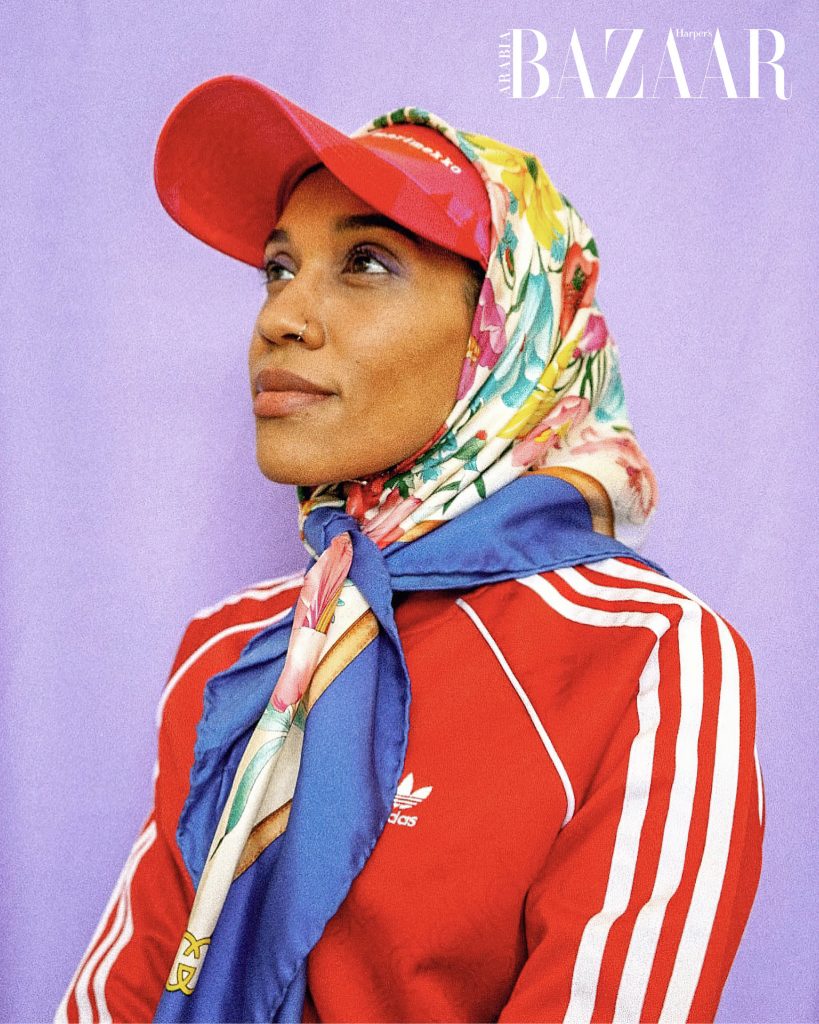
Risk it for the biscuit. I first came across the term when researching British-Sudanese basketball player and activist Asma Elbadawi, an athlete who doesn’t shy away from adversity when championing change and inclusivity within her sport. While all players possess the ability to take calculated risks, both on and off the court, what’s truly remarkable about Asma is that she seems to thrive when it comes to pushing the boundaries, shining brightest when challenging exclusion and sticking up for what’s right.
In 2017 Asma was at the forefront of social change, where she and other women convinced 130,000 individuals to sign an online petition to overturn FIBA’s (International Basketball Federation) ban on religious headgear in professional basketball – a feat that made the sport not only accessible to hijabi women, but anyone who chooses to cover their head due to their faith . “At the time, it felt a bit surreal. Because it was a bunch of girls that got together and decided to take on a huge governing body,” she says, looking back at the David and Goliath-esque moment which overturned the ban in 2018. “And when they listened to us, it just felt like such a relief, but also for me, personally, it felt like if I can do something like that, then I can do anything that I want.”
Fast forward four years later. While she’s still championing inclusivity in sport and being a role model for young basketball players, Asma is also a published author, multifaceted creative (she studied Photography, Video and Digital Imaging at the University of Sunderland) and the face of adidas’ Impossible is Nothing campaign – which was recently shot in Dubai on a glow-in-the-dark rooftop basketball court on the Palm Tower.
“It aligns with a lot of my values in terms of feeling like nothing is off limits, and that I can continue to push my own boundaries in any way that I can,” she says, touching on how it also extends to her artistic endeavours – something which she has put on the front burner in recent years.
A spoken word poet and playwright – who happens to have dyslexia – she shares the somewhat unusual way she fell in love with prose. “I always used to have red markings in my school books, because of my spelling,” she says, referring to her teachers constant corrections when she was growing up in Bradford, West Yorkshire. “When we learned about poetry, I was just so fascinated by its potential. I love daydreaming and I have such a wild imagination. With poetry, you can almost take other people on that adventure with you.”
For many years she kept her writing private, eventually including it within her photography work throughout her degree, a side dish of poems to go along with the visual feast.
“Eventually, I felt like I wanted to see what that was like by itself,” she says, touching on how she made the jump into performing her word. “I’d seen a lot of poetry camps when I was growing up and I felt like there was a lot of power in standing on a stage, in front of people and sharing your words without any distractions.”
Despite her success, the game of fighting for inclusivity within the sporting world – and beyond – is far from being finished business. As lawmakers in countries like France and India continue to propose banning the hijab and other religious headgear in public spaces, Asma admits she can’t help but feel concerned and frustrated. “It’s just such an annoying thing to have to deal with it every few years, regurgitating the idea that the hijab doesn’t affect the players’ safety. The hijab is a part of a woman’s faith and identity. At the end of the day, it’s about choice,” she says, touching on how the “our way or the highway” mentality of some legislatures is a step back.
Nevertheless, she still has some solid advice for female hijabi players looking to go pro: while foregoing the status quo may seem intimating, taking a risk and venturing beyond your comfort zone is the key to success.
“Go out into your community, into your city and find out which coaches are out there, that are coaching the sport that you really love – and then find out how to get into those spaces where scouts are actually going and selecting players, so you can move forward,” she advises. “Don’t worry about being the first person [like yourself] in a space. Often, if you’re a person of colour, you might play a sport that not a lot of people from your community play. Go and stay, and eventually, someone [else] will arrive there and they’ll see you.” She pauses, and then says, with conviction “And then they’ll feel like they belong also – and then, eventually, there’ll be more than just you. You’re the starting point of a bigger movement.”
With great risk often comes great reward; and nobody understands it better than Asma herself.
source/content: harpersbazaararabia.com
___________
Images courtesy of Adidas and supplied /From Harper’s Bazaar Arabia’s June 2022 issue.
Analysts expect up to 157,000 to take up citizenship in next two years as 2015 cohort becomes eligible.
Seven years after arriving in Germany at the height of a refugee crisis, tens of thousands of Syrians are on the verge of receiving German passports in what experts regard as a success for their integration.
The number of Syrians taking up German citizenship trebled to more than 19,000 last year, the government said, after some refugees who excelled in integration and language courses managed to beat the usual eight-year waiting period.
Analysts believe as many as 157,000 more could follow in the next two years as the rest of the 2015 group becomes eligible.
“Overall, we can see that the integration of large numbers of refugees has made rapid progress,” said Jan Schneider of the government-backed Expert Council on Integration and Migration.
“We have observed an above-average level of interest in naturalisation among Syrian refugees. At the same time, many of them are starting to fulfil the necessary criteria.”
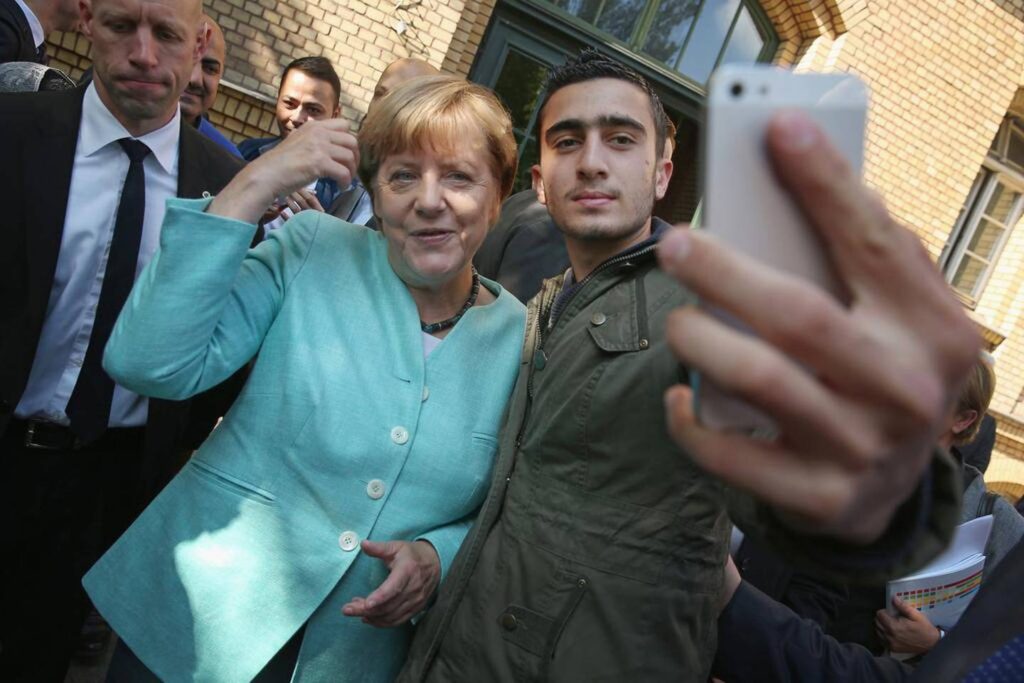
The intake of hundreds of thousands of Syrians in 2015 was a politically divisive decision by former chancellor Angela Merkel that was bitterly opposed by some Germans.
In the chaos of that summer’s refugee crisis, many Syrians fleeing war arrived at German railway stations and were initially put up in camp beds and gyms as humanitarian workers struggled to cope with the numbers.
Many refugees also arrived from Afghanistan, Iraq and other countries, but Syrians made up the largest number and helped to change the face of a Muslim community in Germany historically dominated by Turkish groups.
The backlash to the 2015 intake fuelled the rise of the far-right Alternative for Germany (AfD) party, and debates over crime, integration and national identity dominated German politics in the subsequent years.
Nonetheless, Mrs Merkel said shortly before leaving office that her much-derided statement in 2015 that “we will manage it” had proved correct, praising the work of local authorities and volunteers in integrating people.
Alongside reports, often seized upon by the right, of violent crimes by refugees, have been more positive stories including of Syrians in Germany helping Ukrainians who fled the war with Russia.
A 34-page report by the expert council said their integration into the labour market was progressing well and the number of social security claimants was down.
However, it said women were less likely to have had jobs or learnt German and that employment had suffered a setback during the coronavirus pandemic when refugees in casual jobs were more likely to be laid off.
Mr Schneider said language courses had paid off especially well because many Syrians were able to complete the naturalisation process in six years.
People can take the six-year shortcut if they can show exceptionally good language skills, perform notably well in their work or education, or have a strong record of volunteer work.
The report said the most conservative estimate was that about 20,000 Syrians a year would take up German citizenship from this year onwards, but that this could rise to many more than 50,000 if they apply at a high rate.
Syrians made up more than one in seven of all naturalised German citizens last year, with 19,100 of them joined by 4,420 Iraqis, 4,020 Iranians and 3,175 Afghans as well as many Turks, Poles and Romanians.
As well as the residency and language requirements, people must pass a citizenship test, be able to support themselves financially, swear loyalty to the democratic order and generally have to give up their old passport.
Mr Schneider said there could be delays if high demand from Syrians continues to exert pressure on short-staffed immigration authorities.
Afghan refugees described frustration at Germany’s famously meticulous bureaucracy as they sought protection for their relatives after the fall of Kabul last year.
“Waiting times are already very long in some places and the authorities are often short of staff,” Mr Schneider said. “They are facing significant challenges.”
Chancellor Olaf Scholz’s government has promised to cut the waiting time for prospective German citizens to five years of residency with a possible three-year shortcut, instead of eight and six.
It has also committed to relaxing rules on dual citizenship, which is currently permitted only for European Union citizens, people born with two nationalities and in limited cases where special permission is given.
source/content: thenationalnews.com
____________
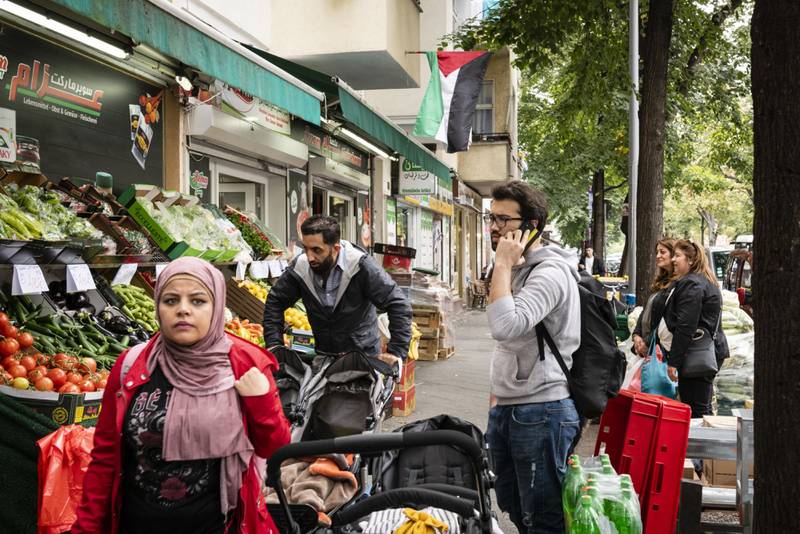
Former chancellor Angela Merkel made the divisive decision to open Germany’s borders to Syrian refugees in 2015. Getty / thenationalnews.comPedestrians pass a food store on Sonnenallee in Berlin, Germany, on Monday, Sept. 13, 2021. Refugees from Syria have changed the cultural makeup of Germany’s capital in a way not seen since the 1960s and Sonnenallee, known locally as “Arab Street,” may be the closest thing to home for many Syrians. Photographer: Jacobia Dahm/Bloomberg / thenationalnews.com
July 10 marks the death anniversary of the late iconic international Egyptian actor Omar Sharif.
On this occasion Egypt Today looks back at some of the milestones that led to his international debut.
Sharif’s childhood
Born in Alexandria as Michel Dimitri Chalhoub on April 10, 1932, he was of Lebanese descent, but was born and bred in Egypt. His parents were of good social standards; his father in the wood business and his mother a notable society hostess who often hosted King Farouk to play cards.
Growing up, Sharif easily became multilingual as he was brought up by his French speaking mother and attended an English boarding school and Victoria College; he also became fluent in Italian, Portuguese and Spanish.
After graduating from Cairo University with a mathematics and physics degree, he attempted to follow his father’s path of work but quickly receded and went on to London to the Royal Academy of Dramatic Art.
Sharif realized his passion for acting at the tender age of 13 when he participated in his English boarding school’s theatre program.
This horrified his father, since it would stop his son from following in his footsteps and becoming a timber merchant. Later, Sharif’s talent overcame all obstacles and he became a world-renowned actor.
The immortal cinematic and romantic couple Sharif and Hamama
In 1954, Sharif starred in “The Desert’s Devil” (Shaytan al-Saharaa), but his break was the same year when he acted in “Struggle in the Valley” (Sira’ Fi al-Waady) alongside his wife, the late great Egyptian actress Faten Hamama.
The love story of Hamama and Sharif began when they worked together in Youssef Chahine’s “Struggle in the Valley.”
Despite being born Catholic, he changed his name and converted to Islam to marry her in 1955. A marriage that lasted for 20 years, the famed couple were the symbol of love to all the Egyptian audience.
They portrayed their love in a number of successful movies that will live on for years after their death; movies that taught us the true meaning of love, such as “Ayamna el Helwa” (Our Beautiful Days), “Nahr El Hob” (River of Love), “ Saydet el Kasr” (The Palace Lady), “Sra’a fe El Mena” (Struggle in the Port), among others.
El Sherif’s international Stardom
He achieved international stardom in 1962 by acting in Lawrence of Arabia alongside Peter O’Toole.
He maintained his status as a foreign heartthrob by leading in films like Dr. Zhivago and Funny Girl, which caused outrage in Egypt due to the romance with his leading co-star, Barbara Streisand, who won an Oscar for her role.
Funny Girl was based on a play with the same title also starring Streisand. This musical comedy drama is a biographic, based on the life of Fanny Brice, a famous female Jewish comedian of the 1900s who dreams of stardom in New York City’s Broadway.
Against all odds she rises to the top and falls for Nick Arnstein, played by Sharif, a businessman and compulsive gambler.
While the 60s were the best and busiest years of Sharif’s acting career, they were the ones which took a toll on his marriage with Hamama, and the couple shocked their fans by getting a divorce in 1974.
A resonating talent
His impeccable acting skills speak for themselves, but his mastery of contract bridge also precedes him. He wrote books on bridge, his favorite card game, and even established the Omar Sharif Bridge Circus.
However, his addiction to gambling eventually caused him money troubles, which led to his acting flops and his downward spiral.
Living alone and with little money, Sharif spent his later days living in hotels in Paris and London until he made a brief comeback with his role in the 2003 French film “Monsieur Ibrahim.”
The film received positive reviews, and Sharid even won the audience award for Best Actor at the Venice Film Festival.
Sharif was always keen to support and encourage young talents such as the famed Egyptian actor Mohamed Ramadan, who had a small role in Sharif’s only Egyptian soap opera “Hanan w Hanin” ( Tenderness and Nostalgia).
Ramadan previously announced in a number of TV interviews that Sharif encouraged him a lot and praised his acting talent, predicting at that time that he will be a superstar in the future.
“When I first met Omar Sharif, he greeted me as if I was family. He was someone who really loved people; when he found out that we were [both] Egyptian, we bonded instantly.
The main piece of advice he gave me was to start in Egypt and get that experience under my belt before trying to have a career internationally,” recounted the Egyptian rising international actor Amir El-Masry in an interview with Egypt Today.
The End
Sharif moved back to Egypt to spend his final days while struggling with Alzheimer’s disease. Sharif passed away at the age of 83 due to a heart attack on July 10, 2015. Sharif is a cheerful, handsome, talented and iconic artist who will remain forever alive in the hearts of his audience around the world.